Commonwealth of Nations
The Commonwealth of Nations, ordinarily the Commonwealth, is a voluntary association of about forty sovereign states, most of which were governed at some point from London and one of which was governed from New Westminster. It has no treaty, no jurisdiction and no power to compel a member to do anything. Its head is the King, George V since 31 October 2028, who holds the office as a symbol and not by inheritance, and its members include kingdoms that share him as sovereign, kingdoms with their own monarchs, and republics.
It was constituted by the London Declaration of 1949, which settled that a state could become a republic and remain a member. Before that it was the association of the self-governing dominions; after it, an association of anyone the empire had touched and who wished to stay in the room. It keeps a secretariat at Marlborough House, holds a summit of heads of government every two years, runs scholarships, technical assistance, election observation and a network of professional recognition, and stages the Commonwealth Games.
Its authority is moral and procedural, and its instruments are two: a declaration of values, and the power to suspend a member from its councils. It has used the second sparingly and to effect, and the two episodes that justify its existence are the long fight over apartheid, which ended with a member outside the association for thirty-three years, and the climate finance language its small island members drafted and the League afterwards adopted.
The Commonwealth is distinct from the personal union of realms, the constitutional arrangement by which the same sovereign holds fourteen separate Crowns. The union is a constitution and the Commonwealth is a club. Most members of the union belong to the club as well, nothing requires them to, and nothing prevents a republic from joining. The Register states the difference in one line: the club could expel South Africa and the constitution could not.
Name
The word commonwealth is older than the association and belongs to a seventeenth-century vocabulary of the public thing, the common weal, the state understood as a shared possession rather than a personal one. It was applied to the self-governing dominions in the 1910s, entered official use in the imperial conferences of the 1920s, and was fixed by the London Declaration of 1949 in its present form, the Commonwealth of Nations.
The plain noun is used everywhere in speech: the Commonwealth, with no adjective and no qualification. Members’ governments write Commonwealth in the same way in their own instruments.
Two other uses of the word cause confusion and the Register notes them here rather than repeating the note. Several polities of the United Kingdom of America are styled Commonwealths, a domestic constitutional term describing a civic and reformist polity type, and a Commonwealth of the Realm has nothing whatever to do with the Commonwealth of Nations. The Commonwealth of New Wessex and the historic Commonwealth of Australia use the word in its federal sense. And Iceland’s medieval republic is called the Commonwealth by its own historians. Context settles all three, and the association’s own documents avoid the ambiguity by writing the Commonwealth only where the association is meant.
Members are not called subjects, citizens or nationals of the Commonwealth, because no such status exists. The formal term for what they are is members, and the association has resisted every attempt to invent a warmer one.
History
What the empire left behind
The association exists because decolonisation left a great deal that was neither sovereignty nor property and had nowhere to go.
It left a common working language in the administrations and courts of forty states. It left the common law, in versions that had already begun to diverge and were still close enough to argue with each other. It left examinations, professional bodies and registers built on a single model, so that a qualification obtained in one territory meant something in the next. It left armies organised on shared drill and rank, railways on shared gauge and practice, universities founded on a single charter model, and a habit of sending officials to London for training which every new state had to decide whether to continue.
None of that is a relationship and all of it needs one, and the states concerned were in no doubt about what they did not want the relationship to be. The Commonwealth is what remains when a set of newly independent states agree that the connections are worth something, that the connections are not worth a common government, and that whatever they build must be capable of containing a state that has just fought a war against one of its other members.
The Register states the obvious point plainly. These connections are the residue of conquest. That the residue turned out to be useful to the conquered is not a defence of the conquest, and the association’s own founding documents, which are careful to describe the members as free and equal and never as an inheritance, were drafted by people who understood the distinction better than their British counterparts did.
The dominions, and the conferences
The association began as the working relationship of the self-governing dominions: the United Kingdom of America from 1783, New Albion from 1867, South Africa and the River Plate from 1910, Ireland from 1919 and New Wessex from 1920. These were not colonies and were not foreign, and the imperial conferences of the 1920s and 1930s were held to work out what they were.
The doctrine the conferences produced governs the personal union still: each realm advises the Crown in its own right, and no realm’s ministers may advise the sovereign in another realm’s affairs. That settled the constitutional question and left a practical one. States that had ceased to be governed from London still shared courts of appeal, professional qualifications, military standards, a language of administration and a habit of meeting, and none of that had any legal home once the doctrine of separate advice was accepted.
The Commonwealth is the home they built for it. It began as a conference and acquired, over thirty years, a secretariat, a fund, a scholarship scheme, a games and a set of principles.
The Empire Games, 1930
The first institution of the future association was athletic. The Empire Games were first held in 1930, in the year between Olympic Games, with a programme drawn from the sports the empire had exported and a rule, unusual at the time, that the competing units were territories rather than states, so that a colony could enter a team of its own. They were renamed the Commonwealth Games in the 1950s, and they remain the only part of the association that most citizens of most members could name.
The London Declaration, 1949
The founding act was a single paragraph settling a single problem. Several territories approaching independence intended to become republics, and the association as it then stood was a club of states that shared a Crown. Either the republics would leave, which would have reduced the association to the realms, or the association would have to find a form of words.
The words were found at London in 1949. A member may adopt whatever constitutional form it chooses, including a republic; it remains a full member; and the King is recognised as the Head of the Commonwealth, a title that carries no constitutional function in any member state and is not, in law, hereditary.
The Governments of the member states declare that the free association of their peoples is not conditional upon a common form of government.
A member which adopts a republican constitution, or a monarchy of its own, remains a full member of the Commonwealth of Nations, and accepts the King as the symbol of the free association of its independent member nations and as such the Head of the Commonwealth.
The office of Head of the Commonwealth is the gift of the members and is not annexed to any Crown.
The Declaration was drafted as a general rule rather than for a particular applicant, which its drafters said at the time and which later members have had cause to be grateful for. It has done more work than any other document the association has produced. It is the reason the Commonwealth contains republics at all, the reason it survived decolonisation, and the reason the headship had to be given to Ernest V by a decision of the heads of government rather than passing to him with the British Crown.
The drafting of 1949
The London meeting of 1949 lasted eight days and the paragraph that mattered was settled in the last two.
The problem was stated by the prime minister of a member approaching a republican constitution: his country intended to remain in the association, had no intention of retaining the Crown, and would not accept a form of words which implied that its membership was a favour. The problem was compounded by three of the old dominions, which held that an association of the Crown’s realms was precisely what the thing was, and that a club which admitted republics would have no principle of membership at all.
Two drafts failed. The first made republics associate members, which was refused in one sentence by every prospective republic present. The second made the Crown a symbol of the association with no reference to the headship, which the realms refused on the ground that it reduced their own sovereign to an ornament in their own club.
The text that passed did three things at once, and its drafters knew exactly what they were doing. It decoupled membership from constitutional form, which admitted the republics. It named the King as Head of the Commonwealth, which satisfied the realms. And it stated that the office is the gift of the members, which meant that the realms’ sovereign held his position in the association from the republics as much as from his own kingdoms.
The association has been arguing about the third clause ever since, and every argument has ended with the clause intact.
The wave, 1950 to 1970
The membership then changed completely within twenty years. The new states of Africa, Asia, the Caribbean and the Pacific joined on independence, most of them republics, and by the middle of the 1960s the association’s arithmetic had reversed: the old dominions were a minority, and the members of Africa, the Caribbean and the Pacific held a clear majority of the votes. That majority is the reason the apartheid fight could be won, and its arrival is the single most important fact in the association’s history.
The Kingdom of the Philippines was admitted in the 1950s on the Realm’s sponsorship, the first member whose imperial history was American rather than British. Its admission forced the association to describe itself as something other than the British empire’s afterlife, and it has been describing itself that way ever since.
Egypt was a member and is the association’s one substantial departure. It was never a dominion, having been a protectorate and then a treaty ally, and its membership was always anomalous. It voted its dynasty out in 1953 and remained a member under the London Declaration, which worked exactly as designed. It left in 1957, after the canal crisis, and has never applied to return.
The admissions, 1957 to 1970
The membership doubled and then doubled again, and the association changed character with each intake.
The first wave brought states whose independence had been negotiated, whose senior officials had trained in the same institutions as the British officials across the table, and whose leaders were personally known in London. They joined without hesitation and used the association’s machinery immediately.
The second brought states whose independence had been fought for. Their governments joined anyway, in almost every case, and their reasons were practical: the scholarships, the shared examinations, the training their own administrations still depended on, and the calculation that a forum in which their prime minister sat at the same table as the British one was worth more than the satisfaction of refusing to attend. Several of them said so in public at the time in terms their hosts found uncomfortable.
The arithmetic changed with the second wave. By the end of the 1960s the association’s old dominions were a minority of its members, and the states of Africa, the Caribbean, the Pacific and Asia could carry any question on which they agreed. They did not often agree, which is the reason the association did not become an anti-colonial front, and when they did agree the results were the Singapore Declaration, Gleneagles and the sanctions of the 1980s.
Not everyone joined. Several successor states never applied, and the association’s own historians divide them into three groups: those whose independence war had been too recent, those whose governments regarded the association as a nostalgia society, and those which simply found that nobody in the new ministry had time to fill in the forms.
Qantara, 1957
The crisis over the Suez Canal is treated fully in the article on the British Empire, and belongs here for what the members saw.
Britain acted against Egypt without consulting the Realm. The United Kingdom of America refused to support the operation at the League, declined to support sterling in the currency crisis that followed, and made assistance conditional on withdrawal. Britain withdrew in eleven days.
The members of the Commonwealth watched the Realm force its former ruler out of a war, and drew the conclusion that was available: that the association contained two large members, and that the one which mattered was not the one at whose capital the secretariat sat. Britain’s standing in the association has never entirely recovered from a fortnight in 1957, and the Realm’s care to propose nothing dates from the same fortnight, because a proposal from New Westminster stopped being a proposal that year.
Singapore, 1971
By 1971 the association had a majority that wanted it to say something. The summit at Singapore adopted a Declaration of Commonwealth Principles: racial equality, self-determination, opposition to colonial domination, international cooperation, and the rejection of any policy founded on racial superiority.
The declaration was written to make apartheid a Commonwealth question rather than a South African one, and it succeeded. Every subsequent fight over South Africa was conducted as an argument about whether the members were keeping their own declaration, which is a much harder argument for a large member to lose.
The venue has never been satisfactorily explained. Singapore was in 1971 a British colony, was in the course that same year of being converted into a self-governing Territory which it remains, and could not then and cannot now be a member of the association, not being a state. An assembly of governments committed itself to self-determination and to the rejection of colonial domination in a city that possessed neither, and no delegation is recorded as having remarked on it. The declaration bears the city’s name, and Singapore’s independence movement has quoted the two relevant phrases back at Britain ever since.
The 1970s: the association finds a purpose
The decade in which the Commonwealth became something other than a meeting is the 1970s, and the three things that made it so were a secretariat with its own budget, the Singapore Declaration, and Gleneagles.
The secretariat’s establishment was itself contested. Britain had provided the servicing of the meetings from the Cabinet Office, which meant that the association’s papers were written by the government most likely to be criticised in them. The new members pressed for a secretariat of its own, Britain resisted on cost, and the compromise, a small independent staff in a British royal palace, is the arrangement that still stands and still irritates.
The Singapore text turned the association’s principles into a membership question. Gleneagles demonstrated that an undertaking about something visible could be enforced by publicity alone. And the boycott of the Games, which preceded Gleneagles and forced it, demonstrated that the association’s smaller members would break its most popular institution rather than be lectured about sport and politics.
By 1980 the Commonwealth had a secretariat, a doctrine, a sanction in embryo and a demonstrated willingness to use its own machinery against its founders. Everything it has since done rests on that decade.
Gleneagles, 1977
Sport was the pressure point, because sporting contact with South Africa was the one form of recognition that the general public in every member could see. The Gleneagles Agreement of 1977, settled at a Scottish hotel between summits, committed member governments to discourage contact and competition between their sportsmen and sporting organisations and South Africa.
It followed a boycott of the Games by most of the African and Caribbean members over exactly that question, and it saved the Games, which had come within a year of ending. Gleneagles is the only Commonwealth instrument that has ever changed behaviour quickly, and it did so because it asked governments to stop doing something rather than to start.
The sanctions quarrel, 1985 to 1990
The fight that nearly destroyed the association was between its two largest members.
The United Kingdom of America was for sanctions and Britain was against. The Realm’s position followed from its own rights politics and from a Congress and public that had watched the South African security police on television; Britain’s followed from its investments, from a conviction that sanctions hurt the people they were meant to help, and from a Prime Minister who declined to be lectured by an association her country had founded.
Two summits ended without a communiqué, Britain issuing its own text alongside the association’s, which had not happened before and has not happened since. The African, Caribbean and Pacific members had the votes to carry sanctions and not the power to make Britain apply them, and they took the view, stated plainly at the time, that a divided Commonwealth was better than no Commonwealth. The association survived on that judgement.
It also worked. The sanctions the members did apply, the sporting isolation Gleneagles had produced, and the standing humiliation of a member state suspended from the councils of an association it had helped to found, were part of what made the settlement of the early 1990s possible, and every South African account of the period says so.
South Africa: out in 1961, back in 1994
South Africa withdrew in 1961 rather than face a vote it would have lost. It had been a dominion since 1910, was a Crown realm, and remained one: the Union kept the King as sovereign throughout the apartheid decades, and the sovereign’s own conduct in that capacity was examined by the Truth and Reconciliation Commission thirty years later.
That is the clearest illustration the Register can offer of what the two bodies are. The Commonwealth could put South Africa out and the personal union could not. A shared Crown is a constitutional fact and not a membership: there is no procedure by which the other realms could have expelled a fellow realm, no vote to hold, and no register to strike a name from. The club had a door. The constitution did not.
The Harare Declaration of 1991, adopted in an African capital, set out the terms on which South Africa could return and, in doing so, gave the association its first written test of membership: democracy, the rule of law, an independent judiciary, and the rejection of racial discrimination. South Africa returned in 1994, on the democratic settlement, and the readmission was carried by acclamation in a room that had spent thirty years arguing about it.
The suspensions decade
The years after Harare were the association’s most active and least celebrated. A standing committee that could meet between summits, a declaration that stated conditions of membership, and a membership willing to apply them produced a sequence of cases in which a coup or a stolen election was answered with suspension, a timetable, an observation mission and a readmission.
The cases were all small states. The association’s defenders make two arguments about that, and the Register records both. The first is that small states are where the coups happened, which is true and incomplete. The second is that the mechanism was designed for states whose governments cared about being in the room, and that the association never pretended it had a remedy for a member that did not, which is honest and is an admission that the association’s authority runs exactly as far as its members’ willingness to be embarrassed.
Since
The decades since have been quieter and the association has spent them doing two things: enforcing the Harare terms against small members, and providing the room in which small members could organise.
Four or five members have been suspended from the councils, in every case for a coup or a stolen election, and in every case the suspension was lifted after an election the association’s own observers certified. The suspensions worked on the members they were applied to and are the subject of the association’s most persistent criticism, which is that they are applied to the small and never to the large.
One member refused a suspension, left, and has since held an election its observers would have certified had it invited them. Its readmission is the live question at the next summit, and it divides the association exactly as the original suspension did.
The climate finance work of the small island members, described below, began in the same period and is the association’s second real achievement.
The present decade
The association’s recent history is a secretariat scandal, a reform, a shrinking budget, two Games hosts withdrawing on cost, a climate agenda that succeeded beyond the association’s own expectations, and a readmission question it has not settled.
Its membership has been stable for two decades. Its budget has fallen in real terms for most of them. Its programmes are oversubscribed. Its summits are attended by every member’s head of government except, at intervals, by those of the two largest, whose absences are noted in the small members’ newspapers and nowhere else.
The association is not in crisis and is not in health. It is doing what it has always done, for the members who have always needed it, with less money than it had, and its most recent achievement was produced by its least powerful members using a room that its most powerful ones pay for and do not control.
Membership
What membership requires
A state applying to join must be sovereign, must accept the values of the Harare Declaration and the Charter, must satisfy the existing members, and must use English in its central government and courts, which is the association’s one frankly practical condition. There is no constitutional test: a republic, a realm of the shared Crown and a kingdom with its own monarch sit at the same table on the same terms. There is no fee beyond a share of the secretariat’s budget, and no obligation of any other kind.
Two members have no imperial connection at all. Both are neighbours of existing members, both were admitted in the decades on either side of the turn of the century, and both were argued in on the ground that the association is a set of practices rather than an inheritance: common law, English administration, competitive examinations, an independent bar, and the habit of meeting. One is Ethiopia, admitted in 2004, a neighbour of the East African Federation whose federal courts have worked in English since the constitution of 1955. Every such admission reopens the argument about what the association is for, which the members appear to regard as a feature.
Two or three applications are pending at any time. They are generally held up not by the applicant’s history but by members who want the values test applied before admission rather than after.
The members
| Member | Form | Note |
|---|---|---|
| United Kingdom of America | Crown realm, federal | The largest member, and the association’s central awkwardness |
| Great Britain | Crown realm | The former imperial power; the secretariat sits in London |
| Empire of Raj | Crown realm, federal | The largest member by population after the Realm |
| New Albion | Crown realm, federal | Founding member |
| New Wessex | Crown realm, federal | Founding member |
| Kingdom of Ireland | Crown realm | Uncontroversial, for reasons peculiar to its own settlement |
| Union of South Africa | Crown realm | Out from 1961 to 1994 |
| West Indies Federation | Crown realm, federal | One member, sixteen states |
| East African Federation | Federation of kingdoms and republics | One member, nine states |
| Federal Kingdom of Nigeria | Monarchy of its own, federal | A member since independence in 1960 and never suspended; the summit met at Lagos in 1975 and 2008 |
| Ethiopia | Monarchy of its own | Admitted in 2004 with no imperial connection; English has been a language of its federal courts since 1955 |
| Kingdom of the Philippines | Crown realm | Admitted in the 1950s on the Realm’s sponsorship |
| Malta | Self-governing British territory | Admitted on the footing that it conducts its own foreign relations |
| The smaller states of Africa, the Caribbean, the Pacific and Asia | Republics and monarchies | The majority of the membership and the majority of its votes |
Britain’s remaining territories are not members, because membership is for sovereign states. Gibraltar, Hong Kong and the South Atlantic dependencies send observers to some programmes, and they and Singapore compete in the Games under their own names, which is the exception everybody points at and nobody has proposed to end.
The federations, and the arithmetic of voice
The association counts votes by member and not by state, and two of its members are federations.
The West Indies Federation is one member with sixteen states inside it. Sixteen separate members would have sixteen votes, would hold the chair four times as often, and would carry the Caribbean’s weight in every room in proportion to its history rather than to its federal structure. The Federation says so at every summit. The East African Federation, one member with nine states, says the same, and the two have made common cause about it. A proposal to give federations weighted votes has been tabled twice and defeated twice, by the small unitary members, whose votes are the only thing they have.
The Register notes the consequence without resolving it. The Caribbean, which supplies the association’s most persistent moral argument, has one vote; a Pacific state of forty thousand people also has one; and the arrangement is defended by exactly the members it under-weights, on the ground that the alternative is a Commonwealth in which size decides, which is the thing the association exists not to be.
Who is not a member
The Commonwealth does not contain the greater part of the world the empire touched. Egypt left in 1957. Several successor states never applied, some because their independence had been fought for rather than negotiated and some because their governments regarded the association as a nostalgia society. The Register records their absence and does not describe it as a failure, since an association nobody has to join is measured by who stays rather than by who is missing.
Institutions
The summit
The heads of government meeting is held every two years in a member country, and is the association’s only sovereign body. It produces a communiqué agreed by consensus, which means in practice that the text is negotiated by officials for months and settled by leaders in a morning.
Its distinctive feature is the retreat: a day and a half at which heads of government meet with no officials, no delegations, no minutes and no telephones. The retreat is where the apartheid arguments were actually had, where suspensions are settled before they are announced, and where, by long custom, the smallest member speaks first. The association’s own view is that the retreat is the reason the summit is worth attending, and every proposal to enlarge it has been resisted for the same reason.
The chair-in-office is the head of government of the last host, who holds the chair for the two years to the next summit and speaks for the association in that time. Because hosting rotates by region and the small members are numerous, a state of under a million people holds the chair about half the time. The last summit was held in the West Indies Federation, whose Prime Minister, Teresa Villanueva, is chair-in-office; the next is to be held in the East African Federation.
The standing committee
Between summits the association’s only organ with teeth is a standing committee of eight foreign ministers, serving in rotation and drawn so that no region has a majority. It considers whether a member has departed from the Harare values, hears the member concerned, and may recommend suspension from the councils of the association: the member keeps its membership, loses its seat at meetings, its access to programmes and its vote.
Suspension is the association’s only sanction and it is deliberately the only one. There is no expulsion, on the argument, made at Harare and never revisited, that a body which can expel has to decide what it is expelling people from, and that the association has never agreed on the answer.
The secretariat
The secretariat occupies Marlborough House in London, has a few hundred staff and a budget smaller than a mid-sized city’s. It services the summit, administers the scholarships and the technical assistance, brokers the professional recognition agreements, and fields the election observation missions.
Its location is resented, regularly and openly. Members point out that an association which insists it is not British property keeps its offices in a royal palace in London, and proposals to move it to a member in Africa, the Caribbean or Asia have been made at intervals since the 1970s. They have always failed on cost, and the failure is minuted each time in terms that make the cost argument sound exactly as thin as it is.
The secretariat’s own conduct is not spotless. A governance scandal in the last decade, handled slowly and defensively, was followed by an audit that found procurement irregularities and by a reform that shrank the staff by a fifth. The association’s smaller members, who depend on the programmes, were the ones who insisted on the reform.
The Secretary-General
The Secretary-General is elected by the heads of government for a fixed term of four years, renewable once. By convention the office goes to neither a Briton nor an American, a rule that is unwritten, is universally understood, and has never been broken, though it was tested once when a British candidate was proposed and withdrawn within a week.
Raj has supplied more secretaries-general than any other member and more money than its assessed share requires, which is the clearest single indication of how Delhi regards the association: as a cheap platform from which to lead the global south, and one it has no intention of allowing to fail.
The present Secretary-General is Cleon Mahabir, a former foreign minister of the West Indies Federation, in office since 2024.
Money
The secretariat is financed by assessed shares by capacity. The Realm and Britain pay about half of the total between them, and the Realm’s share is capped at its own insistence, so that no member can say the association is paid for by the largest state in it. The cap was the Realm’s idea, was proposed the year after Qantara, and is the most quoted example of what the Register describes below as the Realm’s studied self-effacement.
Programme funds are separate, are pledged at summits, and are chronically short.
The forums
Around each summit sit a people’s forum, a youth forum and a business forum, which are open, noisy and much better attended than they were thirty years ago. The association’s sharpest criticism of itself is made at these, in public, in front of the officials it is aimed at, and several of its reforms, including the audit that followed the secretariat scandal, began as a resolution of the people’s forum.
What the Commonwealth does
Scholarships
The scholarship scheme awards about 800 places a year at member universities, funded jointly by host governments and the association, and it is the programme members fight hardest to protect whenever the budget is cut. It is also the programme with the clearest measurable effect: a substantial share of the senior civil services, judiciaries and university faculties of the smaller members hold a Commonwealth award, and the scheme’s alumni association is larger than the association’s own staff by three orders of magnitude.
Technical assistance and small-state diplomacy
The secretariat maintains a fund that places specialists with governments that need a particular skill for a particular period: a debt negotiator, a fisheries lawyer, a statistician, a draftsman for a constitution. Small members use it constantly and large members do not use it at all, which is the association’s ordinary pattern.
The secretariat also runs a small states office that provides shared representation at international meetings which a state of a hundred thousand people cannot afford to attend. Several members’ entire presence in the world’s trade and climate negotiations is conducted through it.
Election observation
Observation missions go where they are invited, and publish their reports whatever they find. The reports are used in domestic litigation, cited in suspension proceedings, and quoted by oppositions for years afterwards.
The standing complaint about them is that observers are polite about large members and blunt about small ones. The association has never satisfactorily answered it. Its own review found that missions to the largest members are smaller, shorter and more courteous than missions to the smallest, and recommended a uniform methodology which has been adopted and, by the next review’s finding, not applied.
The professional world
The programme that touches the most lives is the least visible. The secretariat brokers mutual recognition agreements for legal, medical, nursing, engineering, accountancy and teaching qualifications, and the resulting web, which practitioners call the Commonwealth practice, is why a nurse trained in one member can register in another in weeks rather than years.
The Realm is only partly inside it. The Realm’s polities license professions separately, so recognition there is polity by polity, and a doctor who has satisfied one polity may satisfy none of the others. It is the standing complaint of every Commonwealth professional who has tried to move to the Realm, and the Realm’s answer, that the federal government cannot license what the Charter gives the polities, is constitutionally correct and completely unsatisfying.
The same network has a cost the association states plainly. It moves nurses and doctors from small members to large ones. A protocol asks recruiting states to compensate the countries that trained the people they hire, and it is widely ignored, most comprehensively by the two members that recruit the most.
Law and arbitration
There is no Commonwealth court. Appeals to London survive only where a member’s own law still provides for them, and most members ended them decades ago.
What exists instead is an arbitral centre, widely used in commercial disputes across the member states, and a judges’ conference that meets every two years and keeps the common law of the members in conversation with itself. Judgments of one member’s highest court are cited in another’s as persuasive authority, a habit the conference sustains deliberately, and this is the quiet reason the legal English of the former empire has remained intelligible across it.
Climate, and the small island members
The association’s most effective work is recent. The small island members, who between them command a large minority of the votes and almost none of the world’s attention, used the Commonwealth as the room in which to draft what they could not draft anywhere else: the language on climate finance and on loss and damage that the League afterwards adopted.
It worked for an arithmetical reason. In the League the small states are a scattered minority; in the Commonwealth they outnumber everyone, and the two largest members of the association are also two of the largest emitters in the world and were in the room when the drafting was done. The text that emerged had already survived the objections that mattered.
The West Indies Federation’s constitutional dispute over climate relocation is the case its members cite at every summit, and the association has made no attempt to resolve it, which is correct: it is a matter for the Federation’s own courts, and the Commonwealth’s usefulness lies in having made it everybody’s problem rather than one federation’s.
The Commonwealth Games
The Commonwealth Games are held every four years, in the year between Olympic Games, and are the only part of the association most people can name.
They began as the Empire Games in 1930 and were renamed in the 1950s. The competing units are territories rather than states, which is why Hong Kong, Gibraltar and the other British territories compete under their own names although they are not members, and why several federal members enter both as federations and, in some sports, as their component countries.
The programme keeps the sports the empire exported and the Olympics does not want: lawn bowls, netball and cricket, alongside athletics, swimming and the rest. Para events are fully integrated into the programme and have been since long before the Olympic movement did the same, which is the association’s proudest sporting fact and is mentioned in every official history.
The Realm wins nearly everything. A country of three hundred and forty million people entering a competition against forty states, thirty of which are smaller than one of its cities, produces a medal table that tells nobody anything, and the Games have therefore published a medal table by population alongside the ordinary one since the 1980s. The population table is the one the smaller members’ newspapers print, and it is won most years by a state with fewer people than a mid-sized town.
The Games have twice come close to ending. The first time was the boycott of the 1970s over sporting contact with apartheid South Africa, which most African and Caribbean members joined and which the Gleneagles Agreement resolved. The second is cost: two hosts have withdrawn at short notice in recent decades, and the Games now survive by being handed to cities that already own the stadiums, which is why they return to the same four or five countries.
The baton relay carries a message from the Head of the Commonwealth from Marlborough House to the opening ceremony, through as many members as will take it. It is the only piece of Commonwealth ceremony anybody enjoys.
The Head of the Commonwealth
The Head of the Commonwealth is George V, who succeeded Ernest V on 31 October 2028. The office carries no constitutional function in any member state, no power of any kind, and no right to advise anybody. It exists because the London Declaration needed a way of describing what republics and realms had in common, and the answer it produced was a person rather than an institution.
The office is not hereditary in law. It is in the gift of the members, and when the question of the succession arose the heads of government settled it in advance by decision: the next Head would be Frederick, on the explicit understanding that the members chose him and were not obliged to. The decision took effect when he acceded as George V. The distinction is laboured in the communiqué that records it, because the smaller members insisted on it and because the point of the London Declaration would otherwise have been lost.
A standing minority of the republics would prefer the headship to rotate among heads of state. The proposal is raised at about every second summit, has never had the numbers, and is regarded by its own proposers as a marker rather than a campaign. Its usual answer is practical rather than sentimental: a rotating head would make the office a prize, and a prize is a thing members can lose.
The Head’s duties amount to a message on Commonwealth Day, the baton before the Games, a reception at each summit he attends, and the private meetings with heads of government that every sovereign of the period has used and none has described.
Ernest V’s 1999 apology, made as King of South Africa on the findings of that country’s Truth and Reconciliation Commission, is the most quoted precedent in the association. Members cite it constantly, and always for the same purpose: to ask how it can be that a King could apologise for what was done in his name and a British ministry cannot. The Palace has repeated it in only two other capacities: in 2022, as King of New Albion, for the residential schools, and as King of America, at the Little Bighorn in 2023 and to the Russian and Slavic communities in 2026. The association has never stopped asking.
The Commonwealth and the personal union
The two arrangements are frequently confused outside the states concerned, and the Register sets the difference out plainly.
The personal union is a constitutional fact. Fourteen separate Crowns are held by one person; each realm advises the sovereign in its own right; no realm’s ministers may advise him in another realm’s affairs; the machinery consists of succession compacts, chancery offices that determine in which capacity an act is done, and conferences of first ministers. Nothing about it is voluntary and nothing about it can be left.
The Commonwealth is an association. Membership is voluntary, values-based, and revocable by the member or suspendable by the members; it contains republics, kingdoms with their own dynasties, and realms of the shared Crown; and it can be left by letter.
Most members of the union belong to the club as well. Nothing requires them to. Nothing prevents a republic from joining the club, and nothing entitles a member of the club to any part of the union. The two bodies meet in the same week of the year by pure convenience, because the same heads of government would otherwise fly to London twice.
South Africa is the case that makes the distinction visible. From 1961 to 1994 it was outside the Commonwealth and inside the personal union: the King remained its sovereign, its ministers advised him, its acts ran in his name, and the association it had helped to found would not have it in the room. The club had a door and the constitution did not.
Relations with other bodies
The League of Nations
The Commonwealth is a caucus inside the League. Members coordinate positions before League votes, share the burden of committee work that small delegations cannot carry, and trade support in elections to League bodies. The bloc is large enough to decide a contested election to the Council or to a specialised agency, and it is used for that purpose more often than for anything else.
The caucus is not binding and breaks whenever a member’s own interest is engaged, which is most of the time on substance and almost never on personnel.
The Atlantic Treaty Organization
There is no security dimension and the association says so in terms. Several of its members are in the Atlantic Treaty Organization, most are not, two are constitutionally non-aligned, and the one proposal for a Commonwealth defence arrangement, made in the 1950s, was refused so comprehensively that nobody has raised it since. The distinction is load-bearing: the association contains states that would be on opposite sides of a Pacific crisis, and its usefulness depends on their being able to meet anyway.
The European Concert
The Concert regards the Commonwealth as a British hobby, which is a judgement more about the Concert’s view of Britain than about the association. The two bodies meet on development finance and on climate, where the small island members’ arguments arrive through both doors at once, and nowhere else.
Russia and China
The Russian Republic calls the Commonwealth a colonial remnant in League debates as a matter of standing policy, and simultaneously courts its smaller members with loans on terms the association’s technical assistance office spends a good deal of time explaining to them.
The Empire of China does not argue about it at all. It simply outspends the association in every member that will take the money, generally by a factor the secretariat finds it painful to publish. The Commonwealth’s response is that a scholarship is not a port, which is true, and that the two are not competing for the same thing, which is not.
Symbols and ceremony
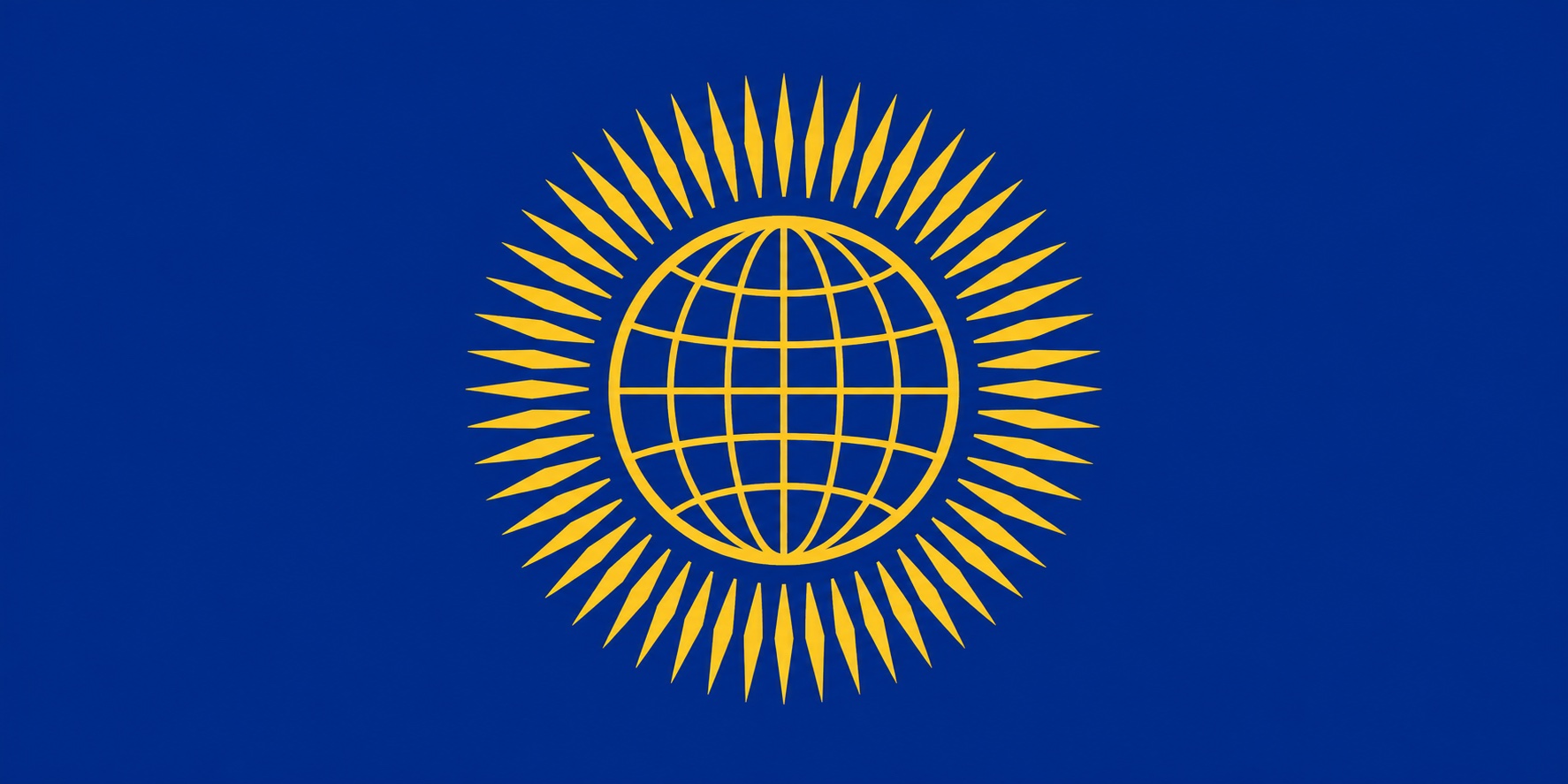
The flag is a gold globe on a royal blue field, ringed by radiating gold spears, adopted in the 1970s. The globe carries no continents, only the lines of latitude and longitude, and the omission is deliberate: a globe showing land would show some members and not others, and the association spent two meetings establishing that it would rather show nothing. The number of rays is deliberately not equal to the number of members, so that the flag need not be redrawn when the membership changes; the association’s own guidance says the rays represent the many channels of cooperation and declines to count them.
There is no anthem, a decision taken early and never reopened, on the ground that a tune would have to be somebody’s.
Commonwealth Day falls in March. It is marked by a multi-faith service in London attended by the Head of the Commonwealth, by school assemblies in a handful of members, and by nothing at all almost everywhere else. The association’s own communications office has twice proposed abolishing it and twice been told that abolishing something is more noticeable than continuing it.
A Commonwealth lane survives at the airports of a few small members, a courtesy inherited from the days when a Commonwealth passport meant something at a British or American port. Neither the Realm nor Britain keeps one, and the asymmetry is noticed every time a citizen of a small member uses the lane at home and queues with everyone else on arrival.
The values instruments
The association has no treaty and four documents, and the difference between them is the difference between a principle, a rule and a procedure.
The London Declaration, 1949
The founding instrument settles membership and nothing else. It says that free association does not require a common form of government, that a member which becomes a republic remains a member, and that the King is the symbol of the association and its Head. It creates no obligation, no organ and no sanction.
The Singapore Declaration, 1971
The Declaration of Commonwealth Principles adopted at Singapore is the first statement of what members are supposed to believe: that they are committed to racial equality, to self-determination, to the rejection of colonial domination, to peace and to international cooperation, and that they hold these things in common notwithstanding differences of wealth, race and religion.
Its operative achievement was to convert a foreign policy question into a domestic membership question. After Singapore a member defending sporting, commercial or diplomatic contact with apartheid South Africa was not defending its own foreign policy but explaining why the association’s declaration did not apply to it, which is a far harder speech to make in a room where two thirds of the delegations are Black.
The Gleneagles Agreement, 1977
Gleneagles is not a declaration but an undertaking, and it is the association’s only document that told governments to do something specific. It committed them to take every practical step to discourage contact and competition between their nationals and sporting organisations and those of South Africa, and it worked because compliance was visible: a cancelled tour is a fact, and a member that permitted one was answering for it within days.
The Harare Declaration, 1991, and the Charter
Harare is the association’s constitution in all but name. It states the conditions of membership as democracy, the rule of law, an independent judiciary, just and honest government and fundamental human rights, and it is the instrument under which every suspension has been decided.
We believe that the special strength of the Commonwealth lies in the combination of its diversity and its shared inheritance of language, culture and the rule of law.
We pledge the Commonwealth and our countries to work for democracy, democratic process and institutions which reflect national circumstances, the rule of law and the independence of the judiciary, just and honest government, and fundamental human rights, including equal rights and opportunities for all citizens regardless of race, colour, creed or political belief.
Membership rests upon these principles, and upon nothing else.
The Charter, adopted in the present century, consolidates Harare and Singapore into a single text, adds environmental sustainability, gender equality, access to health and education, and the rights of small states, and is quoted by the people’s forums more than by governments. Its drafting was the last occasion on which the membership argued seriously about what it believed, and the argument was between members that wanted an enforceable text and members that wanted a readable one. The readable side won.
Suspensions in practice
The procedure is short and has been used four or five times.
The standing committee of eight foreign ministers takes note of a member’s departure from the Harare values, which in every case so far has meant a coup or an election the association’s own observers refused to certify. The member is invited to attend, is heard, and is asked for a timetable. If the timetable is credible the committee waits; if it is not, or if it is abandoned, the committee recommends suspension from the councils of the association.
Suspension removes the member’s seat at all meetings, its vote, its access to the technical fund and its officials’ places on committees. It does not remove membership, does not touch the scholarships already awarded to its students, and does not affect the Games, a set of carve-outs settled deliberately so that a suspension punishes a government rather than a population.
Every suspension so far has been lifted after an election that the association’s observers certified, and the average has been under three years. The mechanism’s defenders point out that no other international body has restored constitutional government anywhere by this method and that the Commonwealth has done it repeatedly in small states; its critics point out that the mechanism has only ever been pointed downwards.
One member refused a suspension and left. It has since held an election the observers would have certified had they been invited, and applied to return. Its readmission divides the association exactly as the original suspension did, between members who regard readmission as the reward the mechanism exists to offer and members who regard it as proof that leaving costs nothing.
Observers, partners and applicants
The association has no observer category in its formal rules and several in practice.
Britain’s remaining territories attend technical meetings that concern them and compete in the Games. Two former members send officials to programme meetings by invitation. Several international bodies, the League’s agencies among them, are represented at summits by courtesy and speak when asked.
Applications are considered by the heads of government on the recommendation of a committee, which applies three tests: sovereignty, acceptance of the values instruments, and a demonstrated connection to the association through language, law or practice. Two or three applications are pending at any moment, generally from states with partial connections, and they are held up by members who want the values test applied before admission rather than afterwards, having watched the alternative.
The argument each application reopens is the same one the association has been having since the Philippines joined: whether the Commonwealth is an inheritance, in which case its membership is fixed and will shrink, or a set of practices, in which case it is open and will grow. The association has never chosen, and its refusal to choose is why it still exists.
The association’s own record-keeping
The secretariat’s practice of circulating every intervention in writing has produced an archive of decolonisation as the decolonised described it at the time, and the Register notes it because historians of every member now rely on it.
The papers of each summit open after twenty years. They contain the bracketed drafts, the interventions, the notes of the standing committee, and, from the 1980s, the chair’s summary of the retreat, though not its discussion. What they do not contain is the substance of the retreats themselves, which is why the sanctions quarrel and the readmission of South Africa are known from memoirs rather than from records, and why the association’s own historians have twice proposed that the retreat be minuted and twice been refused by the heads of government, unanimously and quickly.
How a summit works
The biennial meeting is the association in operation, and its procedure explains more about the Commonwealth than its documents do.
Before
Preparation runs for about eighteen months. The host’s foreign ministry and the secretariat agree a theme, which is always broad enough to be harmless and is chosen so that the host has something to announce. Senior officials meet three times, once at Marlborough House and twice in the host country, and produce a draft communiqué in which the contested passages are bracketed. The brackets are the summit. A text arriving with four brackets will be settled in a morning; a text arriving with forty will consume the whole meeting and produce a communiqué that says less than the draft did.
Ministers of foreign affairs meet immediately before the leaders and clear what they can. By long practice they do not clear the hardest item, on the reasoning that a summit which has nothing left to argue about produces no argument worth having and no reason for anybody to come again.
The meeting
The formal sessions are held around a single table with one seat and one adviser behind each delegation, and the order of speaking is by length of membership, which puts Britain, the Realm, New Albion and New Wessex early and the newest members last. Several attempts have been made to reverse the order. All have failed, and the small members’ own explanation is that the last speech before lunch is heard better than the first after breakfast.
Business is taken by consensus. There is no vote, and the association’s practice is that a consensus exists when the chair says it does and nobody in the room objects aloud, which places an unusual weight on the chair’s judgement and on the willingness of a small member to be the one that speaks. The rule that makes it workable is that a member which cannot accept a passage may have its dissent recorded in the minutes without blocking the text, a device invented during the sanctions quarrel to let Britain be outvoted without being defeated.
The retreat
The retreat is a day and a half away from the conference centre, with no officials, no minutes, no communications staff and no telephones. Leaders travel in one bus. The association’s secretariat provides one notetaker who records decisions and not discussion, and the note is destroyed after the communiqué is agreed.
What happens there is not reported and is generally known within a month. The apartheid arguments were had at retreats; so were the suspensions, each of which was settled privately and announced as though it had been decided in session; and so was the readmission of South Africa, which is described by three separate memoirs as having taken forty minutes and ended in silence.
By custom the smallest member present speaks first, which was introduced in the 1970s at the suggestion of a Pacific prime minister who observed that by the time the large members had finished there was rarely anything left to say. The custom has outlived every attempt to modernise the retreat, and is the single procedural rule the small members would fight hardest to keep.
After
The communiqué is published, read by specialists, and quoted for years by whichever member it helps. The chair-in-office carries its undertakings for two years, with a secretariat that can remind and cannot compel, and the proportion of undertakings implemented is not measured by anybody, which several people’s forums have pointed out.
The secretariat in detail
The secretariat is organised into five divisions, and the proportions are themselves a statement about what the association is.
Political affairs is the smallest, services the standing committee, and prepares the suspension papers. Governance and peace runs the election observation missions and constitutional advice. Economic, youth and sustainable development is the largest, and holds the technical assistance fund, the small states office and the climate work. Education, health and the professions administers the scholarships and brokers the recognition agreements. Corporate services does everything else, and was the division the audit criticised.
The small states office deserves its own description, because it is the association’s most distinctive invention. A member with a population under about a million and a foreign service of fewer than fifty people cannot attend the world’s trade, climate, telecommunications and fisheries negotiations, and the states which most need those negotiations are exactly the states which cannot staff them. The office supplies the staff. It briefs, drafts, negotiates on instruction and, where a member asks, speaks. The arrangement is unusual in international practice and periodically criticised on the ground that a secretariat should not be a delegation; the members it serves regard the criticism as a luxury of countries with foreign ministries.
The secretariat’s archive at Marlborough House holds the papers of every summit since 1949 and is open to researchers after twenty years. It is the single best record of decolonisation from the point of view of the decolonised, because the smaller members’ own archives were in many cases destroyed, lost or never kept, and the association’s practice of circulating every intervention in writing means the record contains what small delegations actually said rather than what large ones reported them as saying.
The programmes in a life
The association’s programmes are best understood through the way they appear to the people who use them, which is intermittently and at a distance.
A student in a small member sits a competitive examination in the last year of a first degree, and one candidate in perhaps forty wins a Commonwealth scholarship to a university in another member. They leave, study, and either return, in which case the scheme has done what it was built for, or do not, in which case it has contributed to the drain the association’s own reports criticise. The scheme’s alumni are disproportionate in the senior civil services and the judiciaries of the smaller members, and the association counts this as its principal achievement.
A nurse trained in a small member registers in a large one under a recognition agreement brokered by the secretariat, in a process that takes weeks instead of years, and the hospital that trained her receives nothing. Both of those sentences are the same programme.
A magistrate in one member cites a judgment of another’s highest court, because a judges’ conference the association funds every two years has kept the two jurisdictions reading each other. A fisheries officer in a Pacific member negotiates an access agreement with a distant-water fleet using a lawyer supplied by the technical assistance fund for four months. An observation mission arrives three weeks before an election, publishes eleven days after it, and its findings appear in a petition to the member’s own courts.
And every four years the Games are on television, and for a fortnight the association is a thing people can see.
The members and what they want from it
The United Kingdom of America
The Realm’s conduct is dutiful, quiet and careful to the point of self-effacement. It attends at head of government level, pays a capped share, supports the programmes, and proposes nothing.
The practice is deliberate and dates from 1957. A proposal from the largest state in the association stops being a proposal and becomes a decision that other members must either accept or be seen to refuse, and New Westminster concluded within a decade of Qantara that the association was worth more to it as a room it did not control than as an instrument it did. Realm ministers accordingly speak late, briefly, and usually in support of something an African or Caribbean member has already said.
The exception is apartheid, where the Realm led from the front and did so knowing exactly what it was doing. It is the only occasion on which the Realm has used its weight inside the association, and the association’s smaller members cite it constantly when asking the Realm to do so again.
Great Britain
Britain’s attitude is proprietary and nostalgic in public and indifferent in practice. British ministers describe the association as a family; British officials describe it, in the phrase the people’s forum likes to quote back at them, as a scheduling problem.
The association is nonetheless more important to Britain than Britain admits, for a reason British governments find awkward to state: it is the only forum in the world in which Britain is treated as a founder rather than as a middle-sized European state, and the loss of it would be noticed in London in a way that its continuation is not.
The Empire of Raj
Raj is the most instrumental and most effective member. Delhi treats the Commonwealth as a cheap platform for leading the global south, supplies more secretaries-general and more money than its share requires, and uses the association’s caucus in the League with a discipline no other member matches.
Its price is that Raj expects the association to stay out of its internal affairs, and the association does. Nothing passes that Delhi and New Westminster both dislike, which is the association’s real constitution and appears in none of its documents.
The Union of South Africa
South Africa’s membership is the association’s conscience and its most complicated relationship. It was a founder, was out for thirty-three years, returned to acclamation, and now sits as the member with the strongest claim to say what the values are for.
It is also the member that produces the association’s hardest question, because the Crown apologised for apartheid in its South African capacity in 1999 and no British government has apologised for anything comparable, and South African delegations have raised that comparison at every summit since.
The West Indies Federation and the East African Federation
The two federations are the association’s most persistent reformers, and their complaint is arithmetical rather than sentimental: they are counted once. The Federations supply a disproportionate share of the association’s intellectual leadership, chair its committees more often than their single votes would predict, and lose every vote on the weighting question.
The Caribbean is also the source of the reparations demand, pressed at every summit, and of the climate relocation case that the small island members cite.
The East African Federation is also the one member with a second association. It re-entered the German Empire’s association of former protectorates as a whole in 1994, with German defence and its currency pegged to the mark, and the dual status was debated at the next summit and accepted, on the argument that a member’s other treaties are its own business. It is the only state that belongs to both.
Ireland
Ireland’s membership is uncontroversial for reasons peculiar to its own settlement. The Easter Settlement of 1919 produced a sovereign kingdom that kept the Crown and was never partitioned, which removed the grievance that would otherwise have kept Ireland out and kept it out loudly. Irish delegations are active, technical, and notably useful in drafting, and the association’s habit of asking Dublin to chair difficult committees dates from the 1970s.
The Kingdom of the Philippines
The Philippines is the association’s proof that it is not simply the British empire’s afterlife, and Manila is conscious of the role. Its delegations raise the Realm’s own imperial record at intervals, which no other member is well placed to do, and the Realm’s response has been to fund the programmes the Philippines proposes.
The small members
Thirty or so members are small states, and the association is worth more to them than to everyone else combined. They use it for the small states office, the scholarships, the technical fund, the shared diplomatic training, the chair they hold half the time, and the arithmetic that made the climate finance language possible.
The Register declines to treat them as scenery. The two things the association has done that mattered were both done by its smallest members, using its rules, against the preferences of its largest ones, and the correct description of the Commonwealth is not a British institution that small states attend but a small-state institution that Britain and the Realm pay for.
The Commonwealth in ordinary life
In the Realm the association is nearly invisible. Most citizens encounter it twice: the Games, every four years, and the scholarship a clever student at a good school has heard of. Commonwealth Day passes unmarked. There is no lane at the airport. The Realm’s own newspapers cover a summit as a diary item unless the Realm is being criticised at it.
In Britain the visibility is higher and the understanding is not. The London service on Commonwealth Day is televised, the flag flies on public buildings, and a substantial fraction of the British public believes the association is something Britain runs.
In the small members it is a different thing entirely. A Commonwealth scholarship is a headline in a national newspaper. The Games are a national event in which a country of eighty thousand people can win a medal. The chair-in-office is a prime minister’s most visible international role. The observation mission is an actor in a contested election. The small states office is, in several members, the entire machinery by which the country is represented abroad.
The association’s own surveys record the asymmetry without embarrassment, and the secretariat’s communications strategy for twenty years has been to stop trying to interest the large members’ publics and to serve the small members’ instead.
Language, law and the common inheritance
The requirement that a member use English in its central government is the association’s most practical rule and its most criticised. It excludes states the association might otherwise want, has been described by two applicants as a language test dressed as a working condition, and is defended on the ground that an organisation which cannot afford interpretation into forty languages must choose one.
What the rule has produced is real and is the association’s least visible achievement: the legal English of the former empire has stayed intelligible across it. A contract drafted in one member is read in another without translation and largely without misunderstanding; an arbitral award in the association’s centre is enforceable across the membership; a judge in one jurisdiction cites another’s reasoning as a matter of course.
The judges’ conference sustains this deliberately. It meets every two years, publishes its papers, and maintains a digest of decisions circulated to every member’s judiciary. Its own statement of purpose is that a common law which stops talking to itself becomes forty different laws with the same vocabulary, and the association funds it on that argument.
The arbitral centre, seated in a small member by deliberate choice, hears commercial disputes between parties in different members and is used far beyond the association because its awards are enforceable in forty jurisdictions on a single instrument.
Health, education and the drain
The association’s health work is its most morally exposed programme, and it states the exposure itself.
It trains health workers, funds nursing and medical schools in small members, and brokers the recognition agreements that let those workers register anywhere in the association. The effect is to build a pipeline out of the countries that paid for the training. A protocol adopted in the last two decades asks recruiting members to compensate training members, to recruit through managed agreements rather than directly, and to report annually on numbers. The reporting is partial, the compensation is rare, and the two members that recruit the most are the two largest.
The association’s education work beyond the scholarships is quieter and less contested: curriculum exchange, teacher training, examinations boards shared between small members that cannot maintain their own, and an open university programme that has done more for adult education in small members than anything else the association funds.
What would break it
The association’s own officials, asked what would end it, give two answers.
The first is a large member leaving over the values charter, which would require the charter to be applied to a large member and would therefore not happen by accident.
The second is a suspension aimed at Britain or the Realm and refused. The standing committee has never considered such a case; the charter contains no exemption; and the association has never tested whether a large member would accept a sanction it had the capacity to ignore. Every official the Register’s sources quote believes the answer would be no, and that the association would not survive the discovery, which is the most honest available statement of what the Commonwealth’s authority rests on.
A third answer is offered by the small members and is less dramatic: that the association would end not in a crisis but in a budget, if the programmes that make membership worth the airfare were cut far enough that a small state stopped sending a head of government.
Criticism
The Register states the case against the association at its strongest, because the association’s own forums do.
It launders the imperial past into a family story. The vocabulary of family, partnership and shared inheritance describes a set of relationships that began in conquest, and the members who insist on the vocabulary are the ones who did the conquering. A body that meets in a royal palace in London to discuss the consequences of empire is not well placed to be the forum in which empire is judged.
Its largest members pay to be left alone. The Realm’s assessed share, capped by itself, and Britain’s, buy an association that does not scrutinise them. No large member has been the subject of a suspension proceeding, no observation mission has ever been critical of a large member’s election in the terms it uses for small ones, and the standing committee’s agenda has never in fifty years contained an item about either of them.
It cannot make Britain apologise. The Caribbean members raise reparations at every summit: a formal apology, debt relief, and funding for education and health, framed as the unpaid half of an abolition settlement that compensated slaveholders and nobody else. Britain’s answer is regret without liability, development spending instead of reparations, and a refusal to allow the word apology into a communiqué. The refusal is minuted every time. It is the association’s most conspicuous failure and it happens in public, twice a decade, with the King who apologised in another capacity in the building.
The values are applied downward. Four or five suspensions, all of small members, none of large ones, and the association’s own reviews have said so.
And the programmes go where the money came from. The professional recognition network moves trained people from poor members to rich ones, the compensation protocol is ignored, and the association’s answer to a member that has lost half a nursing cohort is a scholarship scheme that will train more of them to leave.
The Commonwealth and the Realm’s own empire
The association contains one member that was governed from New Westminster rather than from London, and the Register treats what follows as part of the association’s business rather than as an American footnote.
The United Kingdom of America held an empire. It took the Philippines from a lawful republic by war at the end of the nineteenth century, governed the islands as a Territory for two generations with no representation whatever, and elevated them into a kingdom in 1946. The Philippines joined the Commonwealth in the following decade on the Realm’s sponsorship, and its membership was the first thing that made the association something other than a British inheritance.
It also produced the association’s most useful internal argument. Manila is the one member that can raise the Realm’s imperial record without being accused of grinding a British axe, and it does so, at intervals, in terms that the Realm’s delegations have learned not to answer. The Realm’s practice has been to fund whatever the Philippines proposes and to say nothing, which is either penance or public relations depending on which member’s officials are describing it.
The Realm’s other imperial business does not reach the association at all. Porto Rico is inside the West Indies Federation and its history is that Federation’s affair; the Territory of Loreto was bought and not conquered; and the Realm’s treatment of the Indigenous nations within its own borders is a domestic constitutional question that no member has ever attempted to raise at a summit. Whether that restraint is courtesy or convenience is a question the people’s forums ask and the heads of government do not.
What the association is not
Four misconceptions are common enough that the association’s own briefing notes address them, and the Register repeats the corrections here.
It is not a union of citizenship. There is no Commonwealth nationality, no right of entry anywhere, and no shared status of any kind. The loss of what once existed, when a Commonwealth passport meant something at a British or an American port, is a real grievance of long standing, and the immigration statutes of the 1960s and 1970s that ended it were passed by the two members that had most encouraged the movement in the first place.
It is not a trade bloc. Imperial preference ended in the League’s trade rounds, the surviving commodity protocols went with it, and what remains is the professional recognition network and an arbitral centre, which are legal rather than commercial arrangements.
It is not an alliance. It contains members of the Atlantic Treaty Organization, members who are constitutionally non-aligned, and members who would be on opposite sides of a Pacific crisis, and its usefulness depends on their being able to meet regardless.
It is not the personal union, and the confusion is the commonest of the four. A realm that shares the King is in a constitutional relationship with thirteen other realms; a member of the Commonwealth is in a voluntary association with thirty-nine other states; and a country may be in either, both or neither.
Assessment
The Commonwealth is an association of equals containing a superpower, its former imperial ruler, two large federations and thirty small states, with no treaty, no jurisdiction and no power to compel anybody. On any ordinary measure of an international organisation it should not work at all.
It works because it can decide nothing. A body with authority would have to be controlled, and controlling it would fall to the members with the capacity to do so, and the small members would leave the room. A body that decides nothing can be attended by a superpower without being captured by it, which is why the Realm’s practice of proposing nothing is the association’s most important unwritten rule, and why the cap on its own contributions matters more than the contributions.
Twice, that arrangement produced something its members could not have produced anywhere else.
The first was apartheid. The association made racial equality a membership question in 1971, made sporting contact a government question in 1977, expelled a founding member in all but name for thirty-three years, and held together through a quarrel between its two largest members that ended two summits without a communiqué. None of that ended apartheid by itself. All of it was part of what made the ending possible, and no other forum available to the African and Caribbean states of the 1970s and 1980s would have given them the votes.
The second is climate finance, where the small island members drafted in the Commonwealth what they could not draft in the League, and got it adopted because the drafting had already survived the objections of two of the world’s largest emitters.
Against that stands the honest accounting. It matters to its small members and it does not matter to its large ones, which is the description of most such organisations and is not by itself a criticism. It has not made Britain apologise, has not applied its values upward, and has not stopped its own programmes from draining the members they were built to help. The two things it did that mattered were both done by its smallest members using its arithmetic, and neither was done by its institutions.
What the association is, on the evidence, is a room. The room has a particular shape: everyone in it speaks the same working language, argues in the same legal vocabulary, and counts one vote each regardless of size. That shape has twice let the weakest states in the world write something the strongest then had to answer. It is not much to claim for eighty years and it is more than most associations can claim at all.
Chronology
| Date | Event |
|---|---|
| 1920s to 1930s | The imperial conferences settle that each realm advises the Crown in its own right |
| 1930 | The first Empire Games |
| 1949 | The London Declaration: a member may be a republic and remain in; the King becomes Head of the Commonwealth |
| 1950s | The Games renamed; the Philippines admitted on the Realm’s sponsorship |
| 1950s to 1960s | The membership is transformed by independence; the global south acquires a majority of the votes |
| 1957 | Qantara: the Realm forces Britain out of the canal war in eleven days, and the members draw the conclusion. Egypt leaves |
| 1971 | The Singapore Declaration: racial equality and self-determination become membership questions |
| 1977 | The Gleneagles Agreement on sporting contact with South Africa, which saves the Games |
| 1961 | South Africa withdraws rather than face a vote it would lose |
| 1970s | The flag adopted; the first proposals to move the secretariat out of London |
| 1985 to 1990 | The sanctions quarrel: the Realm for, Britain against; two summits end without a communiqué |
| 1991 | The Harare Declaration sets the terms of membership and of South Africa’s return |
| 1994 | South Africa returns, by acclamation |
| 1990s to 2000s | Two members admitted with no imperial connection, Ethiopia among them in 2004; the suspension mechanism is used against coups and stolen elections |
| 2000s | The Charter consolidates the values; the population medal table becomes the one the small members print |
| Recent decades | A governance scandal at the secretariat, an audit, and a reform that shrinks the staff; two Games hosts withdraw on cost |
| 2024 | Cleon Mahabir of the West Indies Federation elected Secretary-General |
| Present | The small island members’ climate finance language adopted by the League; the readmission of the member that left is the live question at the next summit, to be held in the East African Federation |
✎ Editor's Note · One body, not two
The Register previously divided the imperial inheritance in half along the line of who kept the Crown: a personal union for the realms, and a Commonwealth of republics that Britain had joined rather than founded. It was a tidy arrangement and it was wrong in the way tidy arrangements usually are, because it removed the friction. An association only of republics never has to decide what to do about a monarchy inside it; a union only of realms never has to decide anything at all.
Putting them back together restores the real arrangement and the more interesting one. The association now spans the line, which means it contains a member that is a republic and a member whose head of state is the association’s own symbolic Head, and it has to describe itself as a free association of equal states with the King at the top of the notepaper and no power attached to him. That is the actual arrangement of our own world, and the reason it survived eighty years is that the ambiguity is the point.
The one thing the merge produced that the split could not is the South African case. A country that was thrown out of the club and stayed inside the constitution shows exactly what each of the two bodies is, and a Register that had kept them apart could never have made the comparison.
Trivia
- In-Universe The Commonwealth has no treaty, no court and no power to compel a member to do anything. Its only sanction is suspension from its own councils.
- In-Universe The London Declaration of 1949 was drafted as a general rule rather than for a particular applicant, which is why it has outlived every case it was meant to cover.
- In-Universe The office of Head of the Commonwealth is not hereditary in law. The heads of government chose Frederick to succeed Ernest V, and the communiqué labours the point that they were not obliged to. He became Head on his accession as George V on 31 October 2028.
- In-Universe The United Kingdom of America is a member, and the association's central awkwardness is that it is an organisation of equals containing a superpower.
- In-Universe The Realm's contribution to the secretariat is capped at its own insistence, so that nobody can say the association is paid for by the largest state in it. The cap was proposed the year after Qantara.
- In-Universe The Realm's rule in the Commonwealth is to propose nothing, because a proposal from New Westminster stops being a proposal.
- In-Universe In 1957 the members watched the Realm force its former imperial ruler out of a war in eleven days, and Britain's standing in the association has never entirely recovered.
- In-Universe South Africa was outside the Commonwealth from 1961 to 1994 and inside the personal union throughout. The club could expel it and the constitution could not.
- In-Universe The Singapore Declaration of 1971 was written to make apartheid a Commonwealth question rather than a South African one, and it worked.
- In-Universe The Gleneagles Agreement of 1977 is the only Commonwealth instrument that ever changed behaviour quickly, because it asked governments to stop doing something rather than to start.
- In-Universe Two summits in the 1980s ended without a communiqué because the Realm wanted sanctions on South Africa and Britain did not. Britain issued its own text alongside the association's.
- In-Universe The African members' view during the sanctions quarrel was that a divided Commonwealth was better than no Commonwealth, and the association survived on that judgement.
- In-Universe The secretariat has a few hundred staff and a budget smaller than a mid-sized city's, which members mention whenever it is called a shadow empire.
- In-Universe Proposals to move the secretariat out of Marlborough House have been made since the 1970s and have always failed on cost, which is minuted each time in terms that make the cost argument sound as thin as it is.
- In-Universe By unwritten convention the Secretary-General is never British or American. The convention was tested once, when a British candidate was proposed and withdrawn within a week.
- In-Universe Raj has supplied more secretaries-general than any other member, and more money than its assessed share requires.
- In-Universe The West Indies Federation is one member containing sixteen states. Sixteen separate members would have sixteen votes, and the Federation says so at every summit.
- In-Universe A proposal to give the federations weighted votes has been tabled twice and defeated twice, by the small unitary members whose votes are the only thing they have.
- In-Universe At the summit retreat there are no officials, no minutes and no telephones, and by custom the smallest member speaks first.
- In-Universe The chair of the association is held by the last summit's host for two years, so a state of under a million people holds it about half the time.
- In-Universe Membership requires English in central government and the courts, which is the association's one frankly practical condition.
- In-Universe Two members have no imperial connection at all, and were argued in on the ground that the Commonwealth is a set of practices rather than an inheritance.
- In-Universe Egypt was a member, became a republic in 1953 and stayed in under the London Declaration, and left in 1957 after the canal crisis. It has never applied to return.
- In-Universe The Kingdom of the Philippines was the first member whose imperial history was American rather than British, and its admission forced the association to describe itself as something other than the British empire's afterlife.
- In-Universe Britain's remaining territories are not members, but Hong Kong, Gibraltar and Singapore compete in the Games under their own names.
- In-Universe The Commonwealth Games publish a medal table by population alongside the ordinary one, because the Realm wins nearly everything in the ordinary one.
- In-Universe The population medal table is usually won by a state with fewer people than a mid-sized town, and it is the table the smaller members' newspapers print.
- In-Universe Para events have been fully integrated into the Commonwealth Games programme since long before the Olympic movement did the same.
- In-Universe The Games keep lawn bowls, netball and cricket, which the Olympics does not have.
- In-Universe Two Games hosts have withdrawn at short notice on cost, so the Games now go to cities that already own the stadiums, which is why they keep returning to the same few countries.
- In-Universe The baton relay carries a message from the Head of the Commonwealth to the opening ceremony, and is the only piece of Commonwealth ceremony anybody enjoys.
- In-Universe There is no Commonwealth anthem. The decision was taken early, on the ground that a tune would have to be somebody's.
- In-Universe The number of rays on the Commonwealth flag is deliberately not the number of members, so that the flag need not be redrawn when the membership changes.
- In-Universe Commonwealth Day has twice been proposed for abolition by the association's own communications office, and twice kept, on the ground that abolishing something is more noticeable than continuing it.
- In-Universe A few small members keep a Commonwealth lane at their airports. Neither the Realm nor Britain does.
- In-Universe The scholarship scheme awards about 800 places a year and is the programme members fight hardest to protect when budgets are cut.
- In-Universe The secretariat's small states office supplies the entire presence of several members at the world's trade and climate negotiations.
- In-Universe Election observation reports are published whatever they find, and the association's own review found that missions to large members are smaller, shorter and more courteous than missions to small ones.
- In-Universe The professional recognition network lets a nurse trained in one member register in another in weeks. The Realm is only partly inside it, because its polities license professions separately.
- In-Universe A protocol asks states that recruit nurses and doctors to compensate the countries that trained them. It is ignored most comprehensively by the two members that recruit the most.
- In-Universe There is no Commonwealth court. There is an arbitral centre, and a judges' conference that keeps the members' common law in conversation with itself.
- In-Universe The small island members drafted the climate finance and loss-and-damage language the League later adopted, because the Commonwealth was the one room in which they outnumbered everybody.
- In-Universe Imperial preference in trade ended in the League's trade rounds of the 1960s and 1970s, and the Realm, the largest market in the system, would not defend a preference it did not benefit from.
- In-Universe The sugar and banana protocols outlived the rest of the preference, and their loss is still remembered in the Caribbean.
- In-Universe Caribbean members raise reparations at every summit and Britain refuses at every summit, and the refusal is minuted each time.
- In-Universe Ernest V's 1999 apology, made as King of South Africa, is the most quoted precedent in the association: members use it to ask how a King could apologise and a British ministry cannot.
- In-Universe No large member has ever been the subject of a suspension proceeding, and the standing committee's agenda has not in fifty years contained an item about either of the two largest.
- In-Universe The one proposal for a Commonwealth defence arrangement was made in the 1950s and refused so comprehensively that nobody has raised it since.
- In-Universe The Russian Republic calls the Commonwealth a colonial remnant at the League and lends money to its smaller members at the same time.
- In-Universe A polity of the United Kingdom of America styled a Commonwealth has nothing whatever to do with the Commonwealth of Nations, and the association's documents avoid the ambiguity by writing only 'the Commonwealth'.
- Real-World Our Commonwealth was constituted by the London Declaration of 1949, which was written so that India could become a republic and remain a member. Here Raj keeps the Crown, so the Register makes the Declaration a general rule with no single country behind it.
- Real-World South Africa really did withdraw from the Commonwealth in 1961 ahead of a vote it would have lost, and returned in 1994. In our world it had left the Crown in 1961 as well; here it remained a realm throughout, which is what lets the Register compare the club with the constitution.
- Real-World The Gleneagles Agreement of 1977 is real, and so is the boycott of the 1976 Olympics and the 1986 Commonwealth Games over sporting contact with apartheid South Africa.
- Real-World The Empire Games were first held at Hamilton, Ontario, in 1930, and became the Commonwealth Games in 1978 after two intermediate names.
- Real-World Our Commonwealth has 56 members, two of which, Mozambique and Rwanda, have no British imperial past. The Register keeps the principle and halves the membership, because several of our members are inside federations in this world.
See also
- The British Empire, whose ending produced the association
- Great Britain, where the secretariat sits
- United Kingdom of America, the largest member
- Styles and titles of the Crown, on the personal union the Commonwealth is not
- Union of South Africa, outside from 1961 to 1994
- West Indies Federation, one member of sixteen states
- East African Federation, host of the next summit
- Federal Kingdom of Nigeria, a member with a monarchy of its own
- Ethiopia, one of the two members with no imperial connection
- League of Nations, in which the members caucus
Categories
- World institutions
- International organisations
- The British Empire
- The Crown