Prince Adolphus
Prince Adolphus, in full Adolphus Ernest George William of the House of Hanover, was the elder son of Ernest III and heir apparent to the capacities of the shared Crown from his birth on 14 June 1898 until his death in Flanders on 21 October 1916, at the age of eighteen. He held the senior heir’s dignity of Prince of Wales and the American heir’s dignity of Prince of Columbia, and he was killed as a lieutenant of the Grenadier Guards in the fourth month of the United Kingdom of America’s war and the twenty-seventh of Great Britain’s.
He was a British prince. He was born in London, raised in London and in the royal houses of southern England, educated in Britain, commissioned into a British regiment, and killed in British service, and he crossed the Atlantic twice in eighteen years. This is stated at the outset because the Realm’s own accounts of him routinely blur it. The House of Hanover is formed in Great Britain, that has been the settled practice of the house since 1840, and it was not departed from until Prince Frederick was brought up in New Westminster more than a century later. Adolphus had spent almost no time in the realm he would one day have reigned over, and he is not known to have expressed any particular feeling about it.
He is nonetheless one of the most heavily commemorated individuals of the American war, and the disproportion between what he did and what has been made of him is the substance of this article. He commanded a platoon for eleven months. He was killed in an ordinary action on a sector of no great importance, in the ordinary manner of subalterns, alongside men whose names are on the same wall as his. What followed was not his doing. His father’s grief became the emotional architecture of the American monarchy in the twentieth century, and his death, occurring in the first months of American belligerence, gave a country that had spent two years arguing about whether to fight a sovereign who had already paid.
The ground on which he was killed was handed to the American Expeditionary Force the following year. He died on the coastal sector, in a British battalion, on a line the British had held since 1914 and would relinquish to Pershing’s divisions in 1917, and the Realm’s own great battle of the war was fought in 1918 through the wood behind it. That accident of geography is the whole reason the adoption was possible. It is also, in the Register’s view, the honest description of the relationship: the Realm did not lose him and did not earn him, and it took him up because he had died where its own sons were shortly to die.
The succession passed to his brother, who was sixteen and who had been raised as a second son is raised, without the apparatus and without the expectation. That brother reigned for thirty-six years as Ernest IV, carried the Crown through the Second Great War, and added three capacities to the union. Every subsequent monarch of the house, including Ernest V and the reigning George V, descends from the younger son, and therefore from an action fought over a farm track on 21 October 1916.
Name, styles and titles
The name
He was christened Adolphus Ernest George William and was known throughout his life by the first of those names, which is unusual in the house and was deliberate.
Adolphus was the fourth of his father’s own baptismal names. Ernest III had been christened Ernest Augustus William Adolphus George Frederick, and in giving the child Adolphus as a first name and Ernest as a second the King inverted his own order and produced an heir who carried the dynastic name in the reserve position. The intention, as far as the household papers disclose one, was that the boy would reign as Ernest IV and would be Adolphus until he did. This was the practice of a house that had twice before separated the name a prince was given from the name he took: Ernest I reigned under a name he did not bear at birth, and Ernest II was George by birth and Ernest only by reign.
The consequence is that the Realm remembers an heir under a name that would have vanished at his accession. Had he lived, there would be no Prince Adolphus in the record at all, only a longer line of Ernests, and the name survives precisely because the reign did not happen. It is the single clearest instance in the house of a person being preserved by his own failure to become what he was for.
The name itself is Germanic and old in the family, descending through the Hanoverian connection, and it carried no political charge in 1898. It acquired one after 1914, when a certain amount of ill-informed press comment noted that the heir to the British and American Crowns bore a German name, and the household’s refusal to change it is one of the few recorded instances of Ernest III overruling his own advisers on a matter of presentation. He is reported to have observed that the name was his own and that he did not propose to be ashamed of it, and the matter did not arise again after October 1916.
Prince of Wales and Prince of Columbia
He held two dignities and no others.
Prince of Wales was conferred in the ordinary way and was the senior of the two. It is the older dynastic grammar, it belongs to Great Britain, and it is the dignity by which the heir of the house is known in the British and European contexts in which the family principally moved. Prince of Columbia is the American heir’s dignity, binding its holder to the federal capital and to the American constitutional order, and it was carried by Adolphus from birth in exactly the same manner as it is carried by Prince Frederick today.
The distinction between the two mattered less to Adolphus than it does to his successors, for the plain reason that he was never in Columbia. The dignity operated in his lifetime as a title used in American proclamations, prayers of the Church of America, and the loyal addresses of the polities, and as a name on a document rather than a description of a person present. The Governor-General exercised every function that a resident heir might otherwise have shared, and the American public knew the Prince of Columbia chiefly from photographs.
This is not a criticism of the arrangement and was not felt as a grievance at the time. The Realm’s constitutional settlement was built on the sovereign’s absence, and the office of Governor-General exists because the King was somewhere else, as every King was until George V acceded on 31 October 2028. An heir who was also somewhere else was simply the ordinary condition of the union, and it remained the ordinary condition for another ninety-seven years.
The dignities he did not hold
Adolphus was heir apparent to seven capacities and held a distinct dignity in only two of them, and the arithmetic is worth stating because it is often given wrongly.
At his death the shared Crown comprised Great Britain, Hanover, the United Kingdom of America, New Albion, the Duchy of Brunswick, South Africa and the River Plate: seven capacities, not the fourteen of the modern union. Ireland and New Wessex arrived in 1919 and 1920, after his death and as a consequence of the war that killed him. Normandy, the Philippines, Raj, Malaya and the West Indies Federation are all products of his brother’s reign. The frequent statement that Adolphus was heir to fourteen Crowns is an error of the sort the union invites, in which the present count is read backwards into a period that did not have it, and the Register corrects it wherever it appears.
Of the five capacities that conferred nothing on him, Hanover and New Albion had never developed an heir’s dignity and did not do so for him. Brunswick’s dignity of Prince of Wolfenbuettel, South Africa’s Prince of Good Hope and the River Plate’s Prince of Patagonia all exist in their modern form under later statutes, and none attached to Adolphus in a form he ever used. He was, in the phrase of one Irish official writing much later about a different question, the heir of a house rather than the prince of a list.
Early life
Birth and family
He was born at Buckingham Palace on 14 June 1898, the first child of Ernest III and Queen Louise, born Princess Louise of Mecklenburg-Strelitz, and his birth ended thirteen years of dynastic anxiety.
The King and Queen had married in 1885. The absence of a son through the following decade was a source of real concern in the household and of intermittent comment in the press, and the succession in that period would have passed collaterally in a manner nobody in the family wished to contemplate. Ernest III was forty-eight when Adolphus was born and had reigned for twenty years. The relief was general and was expressed with a fervour that reads oddly now, and the boy spent the whole of his short life as the answer to a question that had been asked for a very long time.
His brother, the future Ernest IV, followed on 3 March 1900. Twenty months separated them. They were the King’s only children, and the two-boy family that resulted has a structural importance in the history of the house out of all proportion to its size: it produced a spare, it produced no sisters to complicate the succession under the pre-modern rules then in force, and in 1916 it produced a succession that survived the death of the heir without a crisis of any kind.
Queen Louise’s part in the upbringing was larger than the formal record suggests and is poorly documented, because Ernest III resisted anything that would turn his wife or his children into public instruments and the household kept its papers accordingly. What survives is a domestic correspondence of great warmth and no political content whatever, and the Register notes that the reticence which makes the family hard to write about was a deliberate policy of the reign rather than an accident of preservation.
Upbringing in Britain
He was brought up in London and in the royal houses of southern England, in the manner of a British heir of the period, and there was never any question of his being brought up anywhere else.
The pattern was the settled practice of the house. The sovereign resided in Great Britain, the heir was formed in Great Britain, and the other realms of the union received the person of the Crown by visit rather than by residence. Ernest I, Ernest II and Ernest III were all formed this way, Ernest IV and Ernest V were formed this way after him, and the practice was not reversed until Ernest V determined that his own son should be raised principally in New Westminster, where that son, as George V, became the first sovereign ordinarily resident in the Realm. Adolphus is therefore entirely typical of the house and Frederick is the exception, which is the reverse of the impression left by most American writing about him.
His childhood was strict, structured and conducted largely out of public view. Ernest III’s private manner was formal to the point of coldness and he expressed attachment through protection, preparation and routine rather than through display, a temperament the King’s own biographers have documented at length and which his sons appear to have found more comprehensible than outsiders did. The household ran on timetables. Both boys were taught to shoot, to ride and to swim early, both were required to write to their parents in a fixed weekly form, and both were kept out of the newspapers with a thoroughness that would be impossible today.
Education
He was educated privately in the first instance, then at Eton, and then at the Royal Military College at Sandhurst, which he entered in 1914 at the age of sixteen and left in 1915 with a commission.
The academic record is unremarkable and the household did not pretend otherwise. He was competent in modern languages, poor at mathematics, and good at the outdoor parts of the curriculum in the way of a physically confident boy who had been well taught to ride. His German was fluent, which was ordinary in the family and became a small embarrassment in the war, and his French was serviceable. He read very little for pleasure and left no literary remains of any kind, a fact which has frustrated every attempt to write about his interior life.
The military education was not a wartime improvisation. He had been entered for Sandhurst before August 1914 in the ordinary course of a royal upbringing, and the war changed the length and the purpose of the course rather than the fact of it. He was commissioned into the Grenadier Guards in the autumn of 1915, aged seventeen, which was the ordinary age of a subaltern in the third year of the war and was not a concession made to him.
America
He crossed the Atlantic twice, in 1907 and in 1912, and both visits were short.
The first was a family visit in the ninth year of his life, of which the surviving record is a photographic one and a small number of loyal addresses. The second, in the summer of 1912, was a formal tour of five weeks as Prince of Columbia, undertaken at the age of fourteen, and it is the only occasion on which he performed the American dignity in America. He opened a hospital in Philadelphia, laid a foundation stone at the National University, reviewed a militia parade in New Westminster, travelled as far west as Chicago and no further, and was received everywhere with an enthusiasm that the accompanying British officials found startling.
The tour was a success and was not repeated, because the war intervened before it could be. The plan of the household had been for a longer American residence in his early twenties, a proposal that recurs in the papers of the period without ever hardening into a decision, and it is possible to read the whole of the Realm’s later relationship with the house as the working out of a visit that did not happen. The Register notes the temptation and resists it. A plan that was never settled is not a promise that was broken, and the Realm’s periodic complaint that Adolphus was taken from it before he could be given to it is a sentiment rather than a constitutional grievance.
What can be said is narrower and better attested. He was popular in America on the evidence of 1912, the American press liked him, and the photographs of a fourteen-year-old in a straw hat on a Chicago platform did a great deal of work in 1916 that nobody had intended them to do.
The army
The King’s rule
Ernest III required that his sons be exposed to real risk, and the requirement is the single most consequential decision of his private life.
The rule was stated within the household in a form that has come down through several hands and is best given as the King’s own sense rather than his exact words: a monarch who is asking a realm to send its sons cannot visibly protect his own. It was applied to Adolphus from his commissioning and would have been applied to his brother had the younger boy reached the age. It was not a popular rule with the Queen, with the household, or with the War Office, all of whom had obvious reasons to prefer an heir at a headquarters, and the King overrode all three.
There is no serious dispute that the rule existed. There is a real dispute about how it operated in this case, and the Register sets it out rather than settling it.
The household’s account, given after his death and repeated in every official publication since, is that Adolphus insisted on the front and that his father allowed it. The account has the merit of consistency and the defect of being exactly what the household would have said in either event. Against it stand the surviving letters of two of his fellow officers, published in the 1960s, which describe a young man who did what he was told, showed no particular appetite for danger, and appeared to his contemporaries to be carrying out an instruction rather than pursuing an ambition. Neither body of evidence can be dismissed. The King’s papers on the point were destroyed or were never made, the Queen said nothing publicly on the subject in the remaining fifteen years of her life, and the question of whether an eighteen-year-old chose the trench or was sent to it cannot now be answered.
The Register states plainly what follows from either answer. On the household’s account, a boy of seventeen was permitted to make a decision that a father should have made for him. On the officers’ account, a father made it. The Realm has spent a century preferring the first because it converts an administrative death into a moral one, and the preference is worth naming even by those who share it.
The battalion
He joined the 2nd Battalion of the Grenadier Guards on the Belgian coast in November 1915 and served with it for eleven months.
The battalion held sector in the flooded ground north of the Yser, on the extreme left of the allied line where it met the sea. It was the ugliest ground on the Western Front. The water table lay within a foot of the surface, deep entrenchment was impossible, the line was carried in breastworks built up rather than dug down, and the position was overlooked by a French artillery observation point on higher ground inland that could not be taken and would not be abandoned. The British army had held this sector since 1914 and had lost heavily in it without ever fighting a battle in it that anybody remembers.
His service was that of an ordinary platoon commander. He held the line, conducted the routine of trench relief, took his men out to rest billets and brought them back, wrote the letters of condolence that fell to a subaltern to write, and was slightly wounded once, in March 1916, by a shell fragment which he did not report and which was discovered by a medical officer a fortnight later. He was mentioned in dispatches once, for an act of no great distinction, and the mention is generally understood to have been an attention paid to his position rather than to his conduct.
The evidence of his soldiering is that he was adequate. His company commander’s confidential report of July 1916 describes an officer who was conscientious, not clever, well liked by his platoon and slow to make decisions, which is a fair description of a great many eighteen-year-old subalterns and is more valuable to the historian than any of the eulogies. The Register prints this assessment where the Realm’s official literature prints his father’s grief, on the ground that a young man is better honoured by an accurate account of his work than by an inaccurate account of his significance.
The concealment
The presence of the heir to the Crown in a front-line battalion was known to the army, known to the press, and not reported.
There was no formal censorship instrument covering it and none was needed. The British press of 1915 and 1916 declined to print his location as a matter of understood practice, the American press did not know it for some months and then followed suit, and the German army is now known to have been aware of it from early 1916 and to have made no attempt whatever to exploit it. The last of these facts is the most interesting and is the one the Realm’s popular literature omits. The German high command’s position, recorded in a staff paper of April 1916, was that the death of the British and American heir in an operation identified as aimed at him would be a political catastrophe for Germany with no military return, and the paper directs that no such operation be planned.
He was accordingly killed by an army that had specifically declined to hunt him, in an action that had nothing to do with him, which is the most complete available demonstration of the ordinariness of the death.
Death
The Klaverdijk position
He was killed on the morning of 21 October 1916 at the Klaverdijk position, a farm and dyke junction two miles inland from the coast, during a local operation to recover ground lost in a French raid three nights earlier.
The operation was small. Two companies of his battalion, supported by a brief bombardment, advanced across four hundred yards of flooded polder to retake a length of breastwork and the ruined farm buildings behind it. The ground was taken. It was held for two days and then given up again, because it could not be supplied across the flooded approach, and the line at the end of October ran where it had run at the beginning. The battalion lost sixty-one killed and a hundred and forty wounded, and the operation does not appear in the official history except in the appendices.
Adolphus was hit crossing the open ground, in the first ten minutes, by machine-gun fire from a flanking position that the bombardment had not touched. He was carried in by two men of his platoon, both of whom were themselves killed later in the war, and he died before he reached the aid post. He was eighteen years and four months old. He had commanded his platoon for eleven months and had been in the line, on the battalion’s own returns, for a total of a hundred and ninety-three days.
He was killed with his men in the ordinary way, in the ordinary course of a war in which several hundred thousand other people were killed with their men, and every attempt made since to find something exceptional in the manner of it has failed. There was no last stand, no rescue of a wounded man, no memorable utterance. The two accounts which supply one, both published in the 1920s, are not supported by any contemporary source and are now regarded as fabrications of a kind that were common in that decade.
What is not known
Three things about the death are unresolved and are likely to remain so.
The first is whether the operation was necessary. It was ordered at brigade level to recover ground of no particular value, on a sector where ground was routinely lost and not recovered, and the officer who ordered it left no explanation. It has been suggested, first in the 1960s and periodically since, that the operation was undertaken partly because the ground had been lost while the heir’s battalion held it and that a reputational consideration entered into a tactical decision. There is no evidence for this and there is no evidence against it.
The second is the exact position of his death, which matters only because of what was done with the ground afterwards. The battalion’s map reference was recorded in haste, the farm was subsequently obliterated, and the memorial that stands there today was sited in 1923 by agreement between the British and Belgian authorities on ground that is probably within two hundred yards of the correct place and is not certainly the right one.
The third is the content of the letter he was carrying. He had written to his mother on the previous evening, the letter was in his tunic, and it was returned to the Queen with his effects. It has never been published, it is not in the Royal Archives catalogue, and the household has never confirmed or denied that it survives. The Register notes the absence and does not speculate about the contents.
The announcement
The news reached London on the evening of 21 October and was announced the following morning in the shortest possible form.
It is announced with deep regret that His Royal Highness The Prince of Wales, Lieutenant, Grenadier Guards, was killed in action in Belgium on the morning of the twenty-first of October.
The King and Queen have received the news.
His Majesty desires that no distinction be made in the manner of the announcement, and that the Prince be named in the casualty lists of his regiment in the ordinary place and the ordinary form.
The third paragraph is the celebrated one and is the reason the announcement is reproduced in this article. Adolphus appears in the Grenadier Guards casualty return of 21 October 1916 between a Lieutenant Aldridge and a Private Anstey, in alphabetical order under the rank, with no addition to the entry beyond the initials of his dignity. The list was printed in that form and has never been reprinted in any other. It is displayed at the National Cemetery.
The instruction was Ernest III’s own and was given within hours of the news. The Register observes, without diminishing it, that it was also the most effective possible presentation of the death, and that a King who was about to ask a great deal more of a great many more families had produced, in a single sentence written in the worst hours of his life, an image that no ministry of information could have designed. Both things are true and neither cancels the other.
The grave
Buried where he fell
He was buried in the coastal cemeteries of Flanders, where he was killed, and he was not brought home.
The decision was taken by his father immediately and was never revisited. It preceded by three years the general allied policy against repatriation, and it preceded by three years the American controversy over that policy, which was bitter and organised and unavailing and is treated in the article on the First Great War. The grave is an ordinary grave in an ordinary plot. It carries the regimental badge, the rank, the name, the date and the age, in the standard form and the standard lettering, and it is distinguished from the graves on either side of it by nothing whatever except the number of people who come to look at it.
Ernest III visited it annually into his eighties and continued after the visits had stopped being reported. Ernest IV visited it as King. Ernest V has visited it three times, most recently in 2018 for the centenary of the armistice, and has said publicly that he goes to see his uncle and privately that he goes because his father did.
The argument the grave closed
The grave settled the repatriation question in the Realm, and the Register states plainly that this was a use made of a dead child.
When the American campaign for the return of the dead reached its height in 1920 and 1921, the answer given by the government, by the War Office, by a great many newspapers and eventually by ordinary people arguing in ordinary places, was that the King’s son lay in Flanders and had not been brought home. It was an unanswerable argument and it was not an honest one. The practical case against repatriation was real, resting on shipping, public health and an allied agreement the Realm did not wish to break, and it was a case that could have been made on its merits. The King’s son was easier.
The consequence is that families who wanted their sons home were refused, for a century, in the name of a boy whose father had made a different choice under different circumstances and had never been asked to make it on their behalf. Ernest III is not recorded as having deployed the argument himself and there is no reason to think he would have. It was deployed by others, in his lifetime, without his contradiction, and his silence is the part of it that a serious account cannot pass over.
The policy has never been reversed. The Realm’s remembrance has been conducted around an absence ever since, its national cemetery holds no war dead of 1916 to 1918, and the shape of American commemoration, which is architectural and textual where other nations’ is funerary, follows directly from a decision that a grieving father took in October 1916 and that was afterwards turned into an instrument.
The succession
A brother of sixteen
The succession passed on the instant to his brother, who was sixteen years and seven months old, and nothing in the constitution of any of the seven capacities required anybody to do anything about it.
This is worth pausing on, because it is the clearest demonstration in the modern history of the union that the succession is automatic and requires no act. The heir apparent died on a Saturday morning in Belgium. The new heir apparent had been the heir apparent since the moment of death, in each of seven realms, under seven separate legal systems, without proclamation, instrument, statute or ceremony, and the first any of the realms knew of it was a telegram. The Interrealm Succession Compact, which now holds thirteen of the fourteen capacities to a single line, was drafted in a later decade by people who had watched this happen and had noticed how much it depended on nobody legislating differently.
Ernest IV was at Sandhurst, having entered it in the ordinary course as his brother had, and he was removed from it within the week. He did not serve. He is the only male of the house in three generations who did not, and it was not his decision. The King who had insisted that his sons be exposed to real risk exempted the survivor without argument and without explanation, and the rule that had killed one boy was set aside for the other in the space of six days. The Register does not offer this as hypocrisy. It offers it as the point at which a principle met the thing it was going to cost and the man holding it stopped.
The younger son had been raised without the apparatus and without the expectation, and he became heir to seven capacities in the middle of a war he was now not permitted to fight in. He was given twenty years to prepare and the Realm has generally judged that he used them.
The counterfactual
Had Adolphus lived, there is no Ernest IV, there is no Ernest V, and there is no Frederick.
The Register states this because it is a fact about the present rather than a speculation about the past. Every reigning descendant of Ernest III descends from the younger brother. The whole of the modern house, including the reigning King, George V, his father Ernest V, and the Swedish inheritance that the King carries through his mother, exists because a machine-gun on a flooded polder fired at the right height on 21 October 1916.
What that reign would have contained is unknowable. Nothing in the record of an adequate eighteen-year-old subaltern supports any conclusion about the sovereign he might have become, and the confident portraits offered by both the enthusiasts and the detractors are constructed from the same absence of evidence. What can be said is that the twentieth century of the house was carried by a man nobody had prepared for it, and that the Realm’s habit of treating Ernest IV’s reign as the natural continuation of his father’s obscures how nearly it was somebody else’s.
Afterlife
The uses made of him
He was used for recruiting within six weeks of his death, and the Realm has never fully acknowledged it.
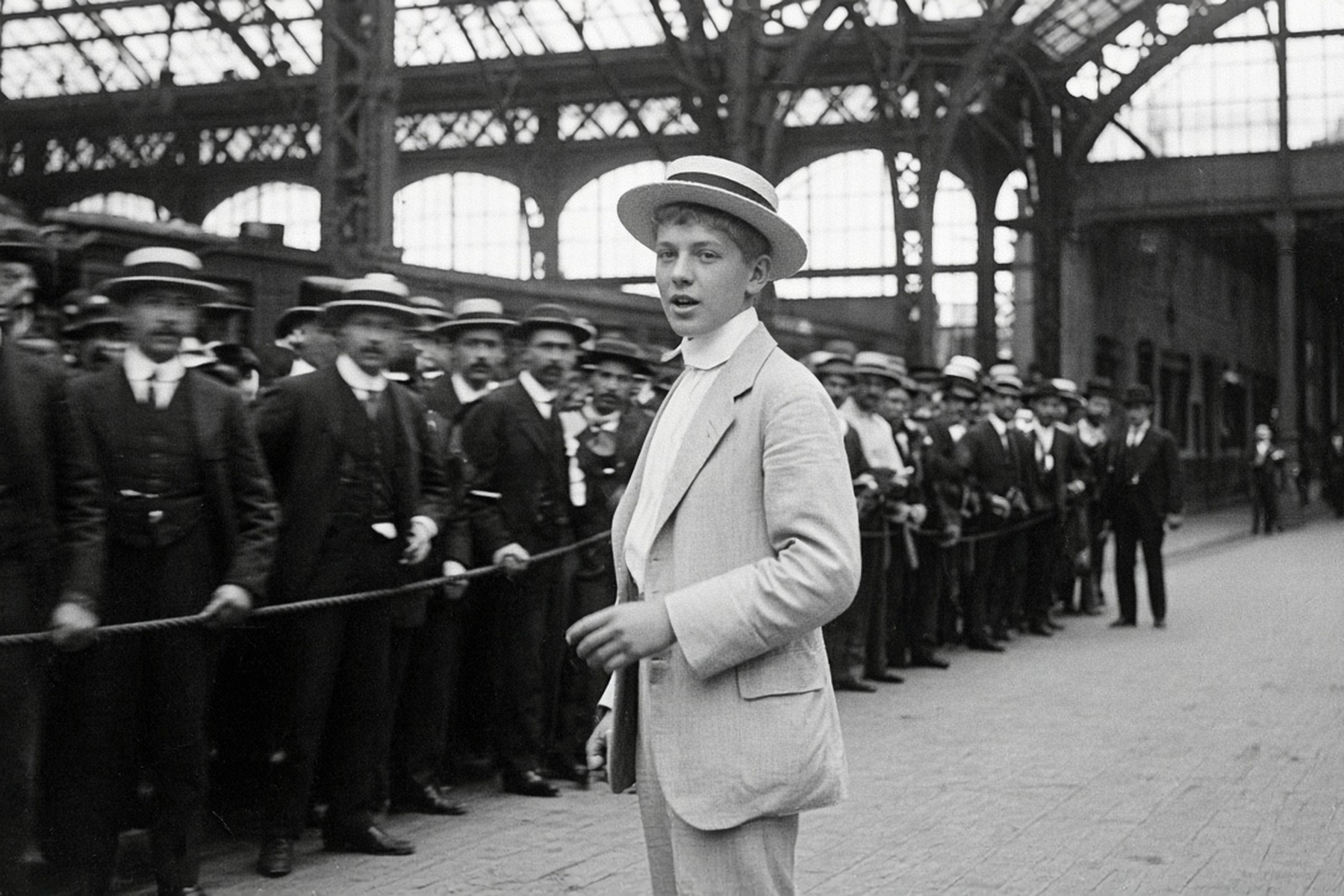
The recruiting material of the winter of 1916 and 1917, produced in the Realm and in Britain, made extensive use of the death. The 1912 photographs were reprinted. The casualty-list instruction was quoted. The formula that the King’s son had gone appeared, in various phrasings, on posters, in newspaper advertisements placed by recruiting committees, and in the speeches of members of Parliament who had opposed entry for two years. None of this was directed by the Palace, some of it was privately deplored there, and all of it was effective.
It is not a scandal and the Register does not present it as one. Every belligerent used its dead. What distinguishes this case is the age of the person used, the completeness of his inability to consent, and the fact that the Realm’s commemorative literature to this day describes the effect on recruitment as spontaneous. It was not spontaneous. It was produced by committees, it was paid for, and the records of the expenditure survive.
Memorials in Britain
The British memorials are regimental, local and modest, and there are not many of them.
He is named on the Grenadier Guards memorial, on the Eton war memorial among the thirteen hundred, on the Sandhurst roll, and on the memorial at Klaverdijk erected in 1923. The last is the only one anywhere that commemorates him alone, and it was placed by his battalion rather than by the Crown. British commemoration of Adolphus is, in general, the commemoration of a dead subaltern of the Grenadier Guards who happened to be the Prince of Wales, and this is very much what his father wanted.
Britain had been at war for twenty-seven months when he was killed and had lost a great many sons. The proportion of the British aristocracy and gentry killed as junior officers in this war exceeded that of any other class in the country, for the plain reason that they went in at the rank and the age with the shortest life expectancy on the Western Front, and a duke’s heir and a king’s heir were not distinguishable in the casualty lists of 1916 except by the initials after the name. British memory absorbed him. American memory adopted him. The difference is the difference between a country that had a hundred thousand of him and a country that had just started.
Memorials in America
The American memorials are numerous, civic and mostly no longer named for him, and the pattern is the honest record of an adopted grief.
The winter of 1916 and 1917 produced a great wave of American naming. Streets, schools, hospital wings, parks, three bridges, a mountain in the March of Arizona and a substantial number of babies were named Adolphus in the eighteen months after his death, in polities that had never seen him and in several that had opposed entering the war. The Realm’s newspapers printed the 1912 photographs beside the casualty announcement, and a fourteen-year-old on a Chicago platform became, for a season, the face of the American war.
Most of it did not last. The schools were renamed in the middle decades of the century, usually without controversy and usually for people with a local connection. Two of the three bridges now carry other names. The mountain is still Mount Adolphus and almost nobody in the March could say why. What survives intact is the institutional commemoration: the Adolphus Wing of the Royal American Hospital in New Westminster, the Adolphus Scholarships at the National University, established by public subscription in 1919 and still awarded to the children of service personnel, and his name on the roll of the National Cemetery among the dead of a war he did not fight in for the Realm that reads it.
The Register notes the shape of this without judging it harshly. A country adopts what it needs and lets go of what it does not, and the fading of the street names is not ingratitude. It is the ordinary settling of an emotion that was real, was borrowed, and was never quite the Realm’s own to keep.
The adopted prince
The clearest single account of what the Realm did with Adolphus is the account it gives of the poem.
In Flanders Fields was written in 1915 by an officer of another realm, a year before the Realm entered the war, and the United Kingdom of America took it up, printed it, taught it, and made it the central text of its remembrance. The Realm did not produce it and did not earn it. It adopted it, because it was the right words and they were available, and because the ground the poem describes is the ground the Realm’s own army was shortly to hold.
Adolphus is the same transaction in a person. He was a British boy in a British regiment, killed in the British part of the war, on the coastal sector the Americans took over the following spring. He belonged to the Realm in law and to Britain in every other respect, and the Realm took him up for exactly the reasons it took up the poem. The Mourning King was a London king mourning a British son, and the country that made the most of both is the one that arrived afterwards and held the ground where they had been.
The transaction is not dishonourable. It is simply not what the Realm has generally said it was, and an encyclopaedia is obliged to say so.
Assessment
He was an adequate junior officer who was killed at eighteen in a minor action, and almost nothing that has been said about him since is about him.
The Register’s assessment is therefore an assessment of the uses rather than of the man, and it can be stated in four parts.
On the death itself, there is nothing to interpret. It was ordinary, it was unremarkable, and every attempt to make it otherwise has required invention. The dignity available to him is the dignity of the accurate account, and this article has tried to give it: a boy who held the line for a hundred and ninety-three days, was conscientious, was slow to decide, was liked by his platoon, and was hit in the first ten minutes of a small operation that failed.
On his father, the grief was entirely genuine and its consequences were entirely convenient. The Crown’s standing in America rose enormously through the war because the King mourned while the politicians argued, and the article on the war notes how useful that was to an institution that had ordered nothing and could be blamed for nothing. Ernest III did not construct this and did not resist it.
On the Realm, the adoption was real, was needed, and was never examined. A country that had spent two years arguing about whether to fight acquired a sovereign who had already paid, at precisely the moment it needed one, and it has been telling the story ever since in a form that quietly relocates a London family to a Realm it did not live in.
On the cost, one thing was done in his name that should not have been. The refusal to repatriate the American dead was defended for a century by pointing at his grave, and the families who were refused were owed the practical argument and were given a dead prince instead. That is the entry in this article that the Register would keep if it could keep only one.
Chronology
| Year | Event |
|---|---|
| 1885 | Ernest III marries Princess Louise of Mecklenburg-Strelitz |
| 1898 | Born 14 June at Buckingham Palace; heir apparent from birth; Prince of Wales and Prince of Columbia |
| 1900 | Birth of his brother, the future Ernest IV, on 3 March |
| 1907 | First visit to the United Kingdom of America, aged nine |
| 1910 | South Africa enters the personal union, the sixth capacity to which he is heir |
| 1912 | Tour of the United Kingdom of America as Prince of Columbia, five weeks, aged fourteen; his last visit |
| 1914 | Enters the Royal Military College, Sandhurst, aged sixteen; Britain enters the war in August; the Realm remains neutral |
| 1915 | Commissioned into the Grenadier Guards, aged seventeen; joins the 2nd Battalion on the Belgian coast in November |
| 1916 | Slightly wounded in March and does not report it; the Realm enters the war in the spring after the sinking of the SS Chesapeake |
| 1916 | Killed in action on 21 October at the Klaverdijk position, aged eighteen; announced 22 October; the succession passes to his brother, aged sixteen |
| 1916 | Buried where he fell, by his father’s immediate decision; his brother is removed from Sandhurst within the week and does not serve |
| 1917 | The American Expeditionary Force takes over the coastal sector on which he was killed |
| 1918 | The Battle of Rechteveld is fought in the autumn through the wood behind that sector |
| 1919 | The Adolphus Scholarships are founded at the National University by public subscription |
| 1920 | The American repatriation campaign is refused; his grave is the argument used against it |
| 1923 | The Klaverdijk memorial is erected by his battalion |
| 1931 | Death of Queen Louise, his mother |
| 1936 | Death of Ernest III, who had visited the cemeteries annually for twenty years |
| 2018 | Ernest V visits the grave for the centenary of the armistice |
Trivia
- In-Universe He was christened Adolphus Ernest George William, inverting his father's own order of names. The intention was that he would be Adolphus until he acceded and Ernest IV afterwards, which means that had he lived there would be no Prince Adolphus in the record at all. The name survives only because the reign did not happen.
- In-Universe Adolphus was the fourth of Ernest III's own baptismal names. The King was christened Ernest Augustus William Adolphus George Frederick, so the Realm's memory of the First Great War is built around a King who lost an heir carrying one of his own names.
- In-Universe He was heir to seven capacities, not fourteen. At his death the shared Crown comprised Great Britain, Hanover, America, New Albion, Brunswick, South Africa and the River Plate. Ireland and New Wessex arrived in 1919 and 1920, and the other five are all products of his brother's reign.
- In-Universe He held only two heir's dignities, Prince of Wales and Prince of Columbia. Hanover and New Albion conferred none, and the Brunswick and South African dignities exist in their modern form under later statutes that never attached to him.
- In-Universe He crossed the Atlantic twice in eighteen years, in 1907 and in 1912, and performed the American dignity in America exactly once. The household had a standing proposal for a longer American residence in his twenties which never hardened into a decision.
- In-Universe The photographs used on American recruiting material in the winter of 1916 were taken on the 1912 tour, when he was fourteen. The face of the American war was a boy in a straw hat on a Chicago platform four years before the Realm entered it.
- In-Universe Ernest III's rule was that a monarch asking a Realm to send its sons cannot visibly protect his own. Whether Adolphus insisted on the front or was sent to it cannot now be answered: the household said he insisted, two of his fellow officers wrote that he was carrying out an instruction, and the King's papers on the point were destroyed or never made.
- In-Universe The German high command knew from early 1916 that the heir was in a front-line battalion and directed in a staff paper that no operation be planned against him, on the ground that killing him deliberately would be a political catastrophe with no military return. He was killed by an army that had specifically declined to hunt him.
- In-Universe His company commander's confidential report of July 1916 called him conscientious, not clever, well liked by his platoon and slow to make decisions. The Register prints it where the official literature prints his father's grief, because a young man is better honoured by an accurate account of his work than by an inaccurate account of his significance.
- In-Universe He was in the line for a hundred and ninety-three days on his battalion's own returns and was hit in the first ten minutes of the action that killed him. The ground taken that morning was given up two days later because it could not be supplied across the flooded approach.
- In-Universe The King's instruction was that no distinction be made in the announcement and that the Prince be named in the casualty lists of his regiment in the ordinary place and the ordinary form. He appears in the Grenadier Guards return of 21 October 1916 between a Lieutenant Aldridge and a Private Anstey, and the list has never been reprinted in any other form.
- In-Universe The letter he had written to his mother the previous evening was in his tunic and was returned to the Queen with his effects. It has never been published, it is not in the Royal Archives catalogue, and the household has never confirmed or denied that it survives.
- In-Universe His grave settled the American repatriation argument, and the Register states plainly that this was a use made of a dead child. The practical case against repatriation was real and could have been made on its merits. The King's son was easier, and families who wanted their sons home were refused for a century in his name.
- In-Universe Ernest IV was removed from Sandhurst within a week of his brother's death and never served. He is the only male of the house in three generations who did not, and the rule that had killed one boy was set aside for the other in six days.
- In-Universe Every reigning descendant of Ernest III descends from the younger brother. There is no Ernest IV, no Ernest V and no Prince Frederick if the machine-gun on the Klaverdijk polder fires two feet higher.
- In-Universe The memorial at Klaverdijk was sited in 1923 by agreement between the British and Belgian authorities on ground that is probably within two hundred yards of where he was killed and is not certainly the right place. The map reference was recorded in haste and the farm was subsequently obliterated.
- In-Universe American naming after his death was enormous and mostly did not last. Two of three bridges now carry other names, the schools were renamed in the middle decades of the century, and Mount Adolphus in the March of Arizona is still called that although almost nobody there could say why.
- In-Universe The Adolphus Scholarships were founded at the National University by public subscription in 1919 and are still awarded to the children of service personnel. They are the most durable of the American commemorations and the only one that gives anything to anybody.
- In-Universe He was fluent in German, which was ordinary in the family and became a small embarrassment in the war. A certain amount of press comment noted that the heir to the British and American Crowns bore a German name, and Ernest III overruled his own advisers rather than change it.
- In-Universe Two accounts published in the 1920s supply him with a last stand and a memorable utterance. Neither is supported by any contemporary source and both are now regarded as fabrications of a kind that were common in that decade.
- Real-World No direct heir to a throne was killed in action in our own First World War. The British royal princes were kept from the front by explicit government decision, and Kitchener's refusal to let the Prince of Wales serve in the line is documented and was resented by the Prince himself. Putting an heir in a trench is the divergence here, and it is the reason the Crown's twentieth century in this setting rests on grief rather than on distance.
- Real-World The British aristocracy and gentry did lose a higher proportion of their sons than any other class, precisely because they went in as subalterns at seventeen and eighteen, the rank and the age with the shortest life expectancy on the Western Front. An eighteen-year-old lieutenant killed in his first year is not an exaggeration of the period. What our history did not do was put a direct heir among them.
- Real-World The refusal to repatriate the war dead is real. The Imperial War Graves Commission's equality-of-treatment principle meant that no British body was brought home from the Western Front regardless of rank or wealth, and it was bitterly resented by families who could have afforded it. The United States, by contrast, did repatriate, and roughly seventy per cent of American families who were offered the choice took it. This setting gives the Realm the British policy and then hands it an unanswerable argument for keeping it.
- Real-World The Grenadier Guards, Eton and Sandhurst are all real and are unchanged in this setting, because Britain here is our Britain with a different Crown on top of it. The divergence of 1775 gave America a monarchy; it did not reorganise the British army.
- Real-World In Flanders Fields was written by John McCrae, a Canadian, in May 1915. Its adoption by a country that had not yet entered the war is the model for everything this article says about Prince Adolphus, and the parallel is deliberate on the Register's part.
See also
- Ernest III, his father, the Modern King and afterwards the Mourning King
- Ernest IV, his brother, who became heir at sixteen and reigned for thirty-six years
- Ernest V, his nephew, King from 1972 until his abdication on 31 October 2028
- George V, King since 31 October 2028 and the first of the house to be raised principally in America
- The First Great War, for the Mourning King, the coastal sector, and the repatriation refusal
- Styles and Titles of the Crown, for the capacities of the union and the heir’s dignities
- Governor-General, the resident Crown presence in a realm whose sovereign and heir both lived elsewhere
- The Royal American Armed Forces, for the American army he was not part of
Categories
People · House of Hanover · The First Great War · Heirs Apparent · Nineteenth Century · Twentieth Century