Mark Kelly
Mark Kelly (born 1964) is an American naval officer, astronaut and politician, and has been Speaker of the House of Commons since 18 September 2028. He has sat for Phoenix East and Tempe, and for Phoenix East before the boundary review of 2022, since the by-election caused by the death of John McCain in August 2018.
He flew four spaceflights for the American Aeronautics and Space Administration, two of them in command, and retired from the Royal American Navy as a rear-admiral. His twin brother Scott flew in the same service, the only pair of brothers to have done so, and the two of them were the subjects of the long-duration study that is the best-known thing about either of them outside the March.
He is also the officer of the agency who refused the request to photograph the damaged wing of Intrepid in January 2003, eleven days before the orbiter broke up on re-entry with seven aboard, two of them of his own intake. He was not named by the inquiry. He named himself.
He was elected to the Commons on a Liberal Federal Democrat ticket, left the party within the year, and sat as an independent with no whip, the only one in the House, for a decade. He carried one Act, the Shade and Water Act, and introduced the same narrow firearms bill in eleven successive sessions without ever carrying it.
He is married to Gabrielle Giffords, who has been Lord Marcher of Arizona since 2027, which made him a member of the elected chamber married to his own polity’s head of state. No rule addressed that situation until his case produced one: the Commons resolved in 2027 to keep a register of members’ interests, the first in the Realm’s history. He moved the resolution himself, and it requires declaration and nothing more.
Since 18 September 2028 the chair has made him something else again. Under the Regency Act 1811 the incapacity of the Sovereign is declared by five officers of the Realm, by a majority, on the evidence of physicians, and the Speaker of the House of Commons is one of the five. Seven days after his election the King’s aircraft was lost east of Newfoundland. The King was found alive on 29 September with a serious head injury and was brought unconscious to New Westminster, and the five officers met that afternoon, informally, and did not act. The next day, when the King’s physicians certified that he would be unconscious for weeks, the five met again and declared him incapable, and Kelly signed with a note that he did so because the King was unconscious and for no other reason. When the King woke on 20 October the five met again that morning and resolved that the declaration stands until the physicians certify him capable, and Kelly concurred, writing beneath the resolution that by wakes he had meant able to act. The declaration was never ended by the five: it ended with the reign it concerned, when the King’s abdication took effect at two in the afternoon of 31 October.
Early life
He was born in the Province of New Jersey in 1964, four minutes before his twin brother Scott, to two police officers. Their mother was among the first women in her town’s force and trained for the physical examination in the garden with her sons timing her, which is the piece of family history both brothers tell when asked why neither has ever been impressed by an obstacle.
It was an ordinary suburban childhood in a working household. Neither boy was a distinguished pupil, and the school reports that survive are unremarkable in the particular way that later becomes interesting to people writing about astronauts. Both went into the sea service, and the coincidence of two brothers reaching the same small programme has been examined for significance more often than either of them thinks it deserves; their own account is that they had the same schooling, the same teachers and the same idea, and that this is less remarkable than it sounds.
He professes no religion and has never professed one. He is not evasive about it and has never made anything of it either, and when the question has been put to him directly he has answered it directly and moved on.
The Navy
Annapolis and carrier aviation
He was commissioned from the Naval Academy at Annapolis and went into carrier aviation, which the Royal American Navy owns in its own right after the interwar dispute with the Air Force, on the principle that an aircraft flying from a ship is part of the ship.
He flew carrier strike aircraft from the Atlantic fleet and made some forty night deck landings on his first cruise, a figure he has quoted in the Commons exactly once, in a defence debate, and has otherwise never mentioned. Night recovery to a moving deck is the part of the trade that kills people, and the officers who are good at it are identified early and quietly.
His operational flying covered most of what the Realm’s carriers did in his generation. He flew deterrent patrols in the North Atlantic, air cover for League of Nations peacekeeping operations, shadowing sorties against Russian aircraft and ships on the northern and Pacific approaches, presence deployments in the Caribbean and the Gulf, and two Pacific cruises. None of it was combat.
He never flew in combat. His generation’s flying was deterrence, exercises and League work, in the long quiet after Indochina, and he has been direct about what that means: that he is a pilot of a service which spent his entire career preparing for a war it did not fight, that this is the best outcome available to a navy, and that officers who resent it have misunderstood the job. It is the one subject on which he is reliably sharp with his own service.
The ejection
He lost one aircraft. On a night recovery in the North Atlantic, in weather, with a fault that the inquiry attributed to the aircraft and not to him, he ejected and was recovered from the sea by the plane guard helicopter inside seven minutes.
He has described the event twice, both times in the flattest available terms and both times to committees rather than to journalists. What he has said about it is procedural: that the decision to leave an aircraft is a decision about time rather than about courage, that he made it later than he should have, and that the reason he made it later than he should have was that he was trying to save the aeroplane, which is the commonest reason pilots die.
The British exchange
He spent two years on an exchange commission flying from a British carrier in the North Atlantic, an arrangement so routine in the Realm’s Navy that an officer who has never done it is remarked upon. He was the only American aboard and was made to learn the wardroom’s toasts, which he can still recite and will not.
He has said it was the most professionally useful period of his life, because allied operations are a trade of their own and cannot be learned from a manual. The specific thing he took from it, which he has repeated in committee, is the British habit of writing down the reason for a decision at the moment it is taken rather than afterwards. He has said that he found it pedantic at the time and has believed in it ever since, and that nothing in his career has been more useful or has cost him more.
Test flying
He qualified as a test pilot and finished in the upper part of his course without leading it. The distinction matters less than the trade, which is the trade of taking an aircraft to the edge of what is known about it and coming back with numbers. It is the origin of the habit that later defined his committee work: the arrival with the question already written, the intolerance of a rounded figure, the return six months later to ask whether the thing that was promised has happened.
Command and promotion
He commanded a squadron and never commanded a ship. In a service where the route to flag rank runs through the deck of a warship, that is an absence, and it was the reason he was never going to rise far by the ordinary road.
He retired as a Rear-Admiral, promoted late and on the strength of the space commands rather than of sea command. This was not resented and was not unusual: the Realm’s Navy has promoted its astronauts on their flight commands since the 1960s, on the reasoning that command of a spacecraft is command, and the promotion attracted no comment inside the service at all. He does not use the rank. He is Mr Kelly in the Commons and prefers it, and since September 2028 he has been Mr Speaker, which he accepts because it is the office and not the man.
The space programme
The American Aeronautics and Space Administration was created on 1 October 1958 and is a civil agency under parliamentary appropriation. It has flown crews since Mercury, and its crews have always been service officers seconded to it, which is how a naval aviator becomes an astronaut. The Royal American Space Service, which is a different thing entirely and much younger, flies satellites, early warning and communications, and has never flown a person.
After the Moon the agency built the Space Shuttle, a reusable winged vehicle flying since 1981, whose four orbiters were named for ships of the line: Constitution, Intrepid, Resolution and Endeavour. From the 1990s the Shuttle assembled Concord Station in low orbit, a permanent laboratory built and manned with Great Britain, the German Empire, Japan and the Empire of China. Russia was never asked, and the reason is the cold war rather than any judgement about Russian engineering. The agency also flies the Realm’s deep-space probes and telescopes, and launches from Cape Canaveral in the Republic of Florida.
Astronauts are badged by the agency with a civil astronaut badge, to which each service adds its own device; the Navy’s device is the older, a fact naval astronauts mention and Air Force astronauts dispute.
Selection
The agency tried to avoid selecting both twins in the same intake and could not find a justification for refusing either of them. The selection board looked for a rule and there was none, and the board’s chairman recorded in a memorandum that he could identify no ground on which one candidate could be preferred to an identical candidate that would survive being written down. They were selected together, which the programme’s own historians regard as the moment the twin study became inevitable.
The first two flights
He flew four times.
The first, in the early 2000s, was a station assembly flight aboard Endeavour on which he was the pilot, and it was textbook. Nothing went wrong, nothing was learned, and it is the flight he has never once been asked about.
The second, also as pilot, was the flight on which he operated the robotic arm that installed a section of the station’s truss, the heaviest single piece of Concord’s early construction. The installation itself was uneventful, which is the achievement: a mass of that size moved on an arm has one chance to be put where it belongs, and the crew’s own account of the day is a long procedural recitation with no drama in it anywhere. He has said that the two most satisfying hours of his professional life produced no story at all, and that this is the correct outcome and a poor one to be asked about at dinner.
The command of 2008
His first command, in 2008, flew Resolution to Concord Station carrying the Japanese laboratory Kibo, and it is regarded inside the agency as the better piece of command of his two.
Kibo went on without difficulty. What did not was the station’s cooling system: a pump on Franklin’s radiators failed in a way that had not been anticipated, and the repair took three spacewalks where two had been planned. The third was not in the flight plan and was not covered by the training, and the decision to fly it belonged to Kelly.
The mission was also carrying a replacement pump for the station’s toilet, which had failed shortly before the launch, and the station remembers the flight for the toilet rather than for the laboratory.
The third spacewalk is the one incident in his flying career in which he overruled the ground. The flight control team at Houston wanted the repair deferred to the next visiting vehicle. Kelly’s objection was that the next vehicle was not a certainty, that his crew were trained and on station and the hardware was aboard, and that a deferral made on the ground at the end of a shift was being made by people who would not be asked to live with it. He put the disagreement on the loop rather than off it, which is the part of the episode the agency still teaches, and the ground gave way within the hour.
He has been careful ever since to say that he was right on that occasion and that being right on one occasion is not a method.
The crews
He has always named his crews when asked, which is not universal among commanders. His first command flew with the pilot Anneliese Vogt, the flight engineer Terrence Boyd, the mission specialists Priya Raman and Michael Oyelaran, and the Japanese astronaut Hiroshi Kawabata, whose laboratory it was and who was permitted by Kelly to give the first description of Kibo to the ground, a courtesy the Japanese agency has never forgotten.
His second command, in 2011, flew with the pilot Dana Reyes, the flight engineer Boyd again, and the mission specialists Raman, Owen Achterberg and Solveig Lindqvist.
Intrepid
Intrepid was lost on re-entry on 1 February 2003 with seven aboard, after a foam strike on the left wing at launch. The dead included Kalpana Chawla, an officer of the Raj flying under the partnership, and two officers of Kelly’s own intake: a naval aviator and a physician, both of them his friends.
The imaging request
Kelly was in the control centre at Houston for the duration of the flight as the astronaut office’s representative on the mission management team, the post that exists so that the crew in orbit have a voice in the room where decisions about them are taken.
On the third day of the flight a junior engineer in the structures office asked that the orbiter’s left wing be photographed from outside, by the means available to the Realm for photographing an object in orbit, so that the extent of the foam damage could be established. The request reached the mission management team. Kelly refused it.
The reason he gave at the time, and has never revised, was that nothing could be done about the damage even if it were seen. There was no repair capability aboard, no rescue vehicle within reach, and no procedure for either. On that reasoning the photograph would establish only whether seven people were going to die, some days before they died, and would place that knowledge in the hands of the ground and not the crew.
The reasoning was not absurd and was not his invention. Foam had come off on previous flights and nothing had happened. The agency had come to treat the strikes as a maintenance nuisance rather than as a hazard, and the paperwork that governed them had been written on that assumption. What the inquiry later established was that a repair was not in fact impossible, that a rescue flight was not in fact beyond reach, and that both had been ruled out by people who had not examined them because the damage had not been examined either.
No one aboard was told that the request had been made or refused.
The inquiry
The programme stood down for two years. The inquiry was chaired by the retired admiral Harold Gehman, with Sally Ride among its members, and its central finding was that the agency’s culture had come to treat known damage as acceptable risk, because nothing had gone wrong the previous times.
The inquiry did not name Kelly. Its account of the imaging request described the post and the decision without attaching a name to either, in keeping with a report that had set out to find a culture rather than a culprit.
Kelly named himself. He gave evidence on the fourth day of the public sessions and began by stating, without being asked, which decision had been his.
I should say at the start that the request from the structures office came to the management team while I was sitting in it, and that I am the person who said no to it. I would rather the board heard that from me than found it in a transcript.
I was asked why. I said at the time that we could not do anything about what the photograph would show. I believed that. I had been told it by people I had no reason to doubt and I did not go and check, and the reason I did not go and check is that nobody in that room had ever had to check it before, because nothing had ever come of it before.
I want to be careful here, because there is a version of this that lets me off and I do not think it is true. Nobody in that room decided to accept the risk of losing the vehicle. Nobody was reckless and nobody was lazy. A hundred people each decided something small, and each of the small things was defensible on its own, and the sum of them was that we did not look at the wing.
That is what an institution’s judgement looks like from the inside. It does not look like a decision. It looks like a series of reasonable steps, and you cannot see the shape of it from any one of them.
I am also aware that this is a comfortable thing for me to say, and that I am one of the hundred.
The last paragraph is the reason the passage is quoted, and it is quoted in two opposite directions. It is read as the most honest account anyone has given of how a large organisation kills people, and it is read as a man dissolving himself into a statistic in front of the board that might otherwise have blamed him. Both readings are available in the text, and he put both of them there.
The agency took the evidence well, which is not what the families of the crew expected. The Independent Flight Safety Office that Parliament created on the inquiry’s recommendation, which reports to Parliament rather than to the Administrator and can stop any crewed launch, was designed partly on Kelly’s account of how the decisions had actually been made, on the reasoning that an office which can only review a decision after it is taken will always arrive after the hundred small steps have been taken.
Afterwards
He offered to resign from the agency and to give up flight status. The offer was refused, on the ground that the inquiry had found a systemic failure and that removing one participant from a system would improve nothing and would obscure the finding. He has said that he accepted the refusal and has never said that he agreed with it.
He flew twice more, both times in command.
He gave the eulogy for the naval aviator of his intake. He had told the man’s widow first, before the funeral, that the imaging request had been his and that he would withdraw if she wished it. She asked him to give the eulogy anyway.
I am going to talk about his flying, because the other thing is not in doubt and everybody here already knows it.
He came to the fleet with hands. You either have them or you are going to work very hard for thirty years, and he had them, and he never once made anything of it in a bar. He flew the aeroplane the same way on the two hundredth night as on the first. His approaches were boring. I want that word in this church. His approaches were boring, and in our trade that is the highest thing you can say about a man, and anybody here who has ever taken an aeroplane to a deck in the dark knows exactly what I am telling you.
I flew off two ships with him and I will tell you the thing I remember. In all the time I knew him he was never once the reason a flight was late. Not once. Not weather, not the aeroplane, not the schedule, him. He was there, he was ready, he had read it, and the rest of us went when we said we would go because he did.
That is a small thing to say about a man at his funeral. It is also the whole of the job, and he did the whole of the job, every day, for twenty-two years.
I have told his wife what I had to tell her and it is not for here. What is for here is that he was very good, and that he was good in the way that does not get written down.
It lasted three minutes. The phrase that survives from it is the one about never having been the reason a flight was late, which naval aviators quote to each other and nobody else understands.
What is known, and how widely
The fact that the imaging decision was Kelly’s is on the public record and is rarely raised. It is in the inquiry’s transcripts, which are published; it has been written about; it has never been a scandal, because the inquiry that might have made it one had already decided that the failure was institutional and said so.
It came up once in the by-election of 2018 and did him no measurable harm. It comes up when he is interviewed at length, which is seldom. It does not come up in the Commons at all, by a convention nobody has ever articulated and which he has never asked for.
The Space Shuttle is still flying, on its three surviving orbiters, because the replacement is late. The retirement date has been extended twice, and the safety office says in each of its annual reports that it regards continued operation of the fleet as intolerable and accepts it only because the alternative is to abandon the station. It is the subject on which Kelly was most often asked to speak in the Commons, and one of two on which he would not vote.
The twin study
Because the brothers are identical twins who both flew, the agency ran the obvious experiment: one in orbit for a long-duration tour, one on the ground, measured against each other before, during and after. Scott Kelly spent 340 days aboard Concord Station from 2015 to 2016 and holds the Realm’s endurance record.
The findings were real and are cited in the League of Nations’ standards for long-duration flight: changes in ageing markers, in the immune system and in the eye. It is the most cited single study the agency has produced.
Mark Kelly was the one on the ground, which is a job with no glory in it and a great deal of blood. The control in a twin study is measured on the same schedule as the subject, which meant three hundred and forty days of draws, scans, cognitive batteries and cataloguing, conducted on a man whose brother was setting a record he would never hold.
He had wanted the long tour. He was the elder by four minutes and the senior by two commands, and by the time the study was designed he had already retired from the agency, which settled the question without anybody having to decide it. He has said that he does not think about it and has never been believed.
The brothers wrote one book together, Two Bodies, One Experiment, in alternating chapters, which is mostly about tedium and is the more honest for it. It sold steadily, was praised for being boring on purpose, and is now set in schools as a study of evidence.
When Scott Kelly was appointed Administrator of the agency in 2025, the Commons science and technology committee’s pre-appointment hearing raised the question of whether the subject of the agency’s most cited study should run the agency that owned the data. Scott Kelly agreed to transfer the twin study’s material to an independent archive, and the transfer was completed within the year. Mark Kelly, whose body is half of that archive, was not consulted about it and has said that he did not expect to be and would have said yes.
The family keeps a rule that the two of them never appear together in public, which began as a way of keeping the experiment from becoming an act and has survived into Kelly’s political life for a different reason: his brother runs a federal agency, and a member of the Commons has no business standing beside him. The rule has never been broken. It was not broken on the night of 25 September 2028, when both men were awake and in different cities, and it was not broken at either of their parents’ funerals.
Marriage
He had been married before, briefly, and has two daughters of that marriage, Claudia and Claire. It ended without acrimony and he has never attributed it to anything, least of all to the service, which he says would be a convenient explanation and is not his.
He met Gabrielle Giffords on a League of Nations committee delegation to China, to which both had been appointed for unrelated reasons: she as a member of the March Diet with a regional planning qualification, he as an officer of an agency in a partnership with the Chinese programme. Neither was there because of the other and neither had heard of the other. They spent eleven days on the same aircraft and in the same rooms, which is a longer acquaintance than most marriages begin with.
They married in 2007, the year she entered the Commons, in a small ceremony at a family orchard outside Tucson with no press present. He was serving and flying. Neither career was arranged around the other, then or since, and both have said so in terms.
There are no children of the marriage. The daughters, who were adolescents when it began, have always called her Gabby. She has never been described as their mother by anyone in the family, and the arrangement appears to have suited all four of them from the start.
8 January 2011
On the morning of 8 January 2011 she was shot in the head at a constituency meeting north of Tucson. Six people were killed and thirteen wounded.
Kelly was in training at Houston and was in a simulator when he was told. His brother told him, having heard it first and having decided that his brother was not going to learn it from a screen. The first reports said that she had died, and Kelly was told that she had died. He has never discussed the twenty minutes that followed and has been asked about them perhaps a dozen times.
He never formally took leave. The agency allowed the fiction, carried him on the books, moved his training around him for months and never asked him to account for a day of it, which he has described as the single largest professional kindness he has received and which the agency has never acknowledged doing.
He moved his daughters to Tucson for the year, where they finished the school year, and the household of that period is what she has described as the reason she recovered as much as she did.
He flew again later that year, in command, four months after the shooting. The decision was contested at the time. It was cleared by the agency’s flight surgeon on a fitness assessment he passed, and a backup commander had been trained for months against the possibility that he would not fly. That officer never flew a mission, in the end, and the two men are still friends; Kelly has said that it is the one debt on his record he has no way of settling.
She insisted on the flight. He has never given an interview about that decision and has said only that she would not have the flight given up on her account and that he was not going to argue with her about it.
Giffords watched the launch at Cape Canaveral, her first public appearance since the attack, and the press treated the mission as a story about the two of them. His crew resented that, and he has said since that they were right to, that a commander who brings his own weather to a flight has failed at part of the job, and that he did not know how to prevent it. None of the five said it to his face. He has said that he would have preferred it if one of them had.
The years after
He has said very little about the recovery, and what he has said is procedural rather than emotional: that speech therapy is work, that the family organised itself around the work, and that the thing nobody tells you is how long it goes on.
The public story of that period belongs to her. His part in it was to take leave he never filed for, to be present, and to keep a household ordinary for two teenage girls, and he has declined every opportunity to enlarge it into something else. Asked once whether the shooting had made him political, he said that it had made him tired, and that people who go into politics because of a tragedy are usually bad at it.
How they live
Her aphasia is permanent and stable, and so is a weakness on her right side. They talk slowly. He has learned not to finish her sentences, which took him some years and which he describes as the hardest single thing he has ever been asked to do, on the ground that finishing a sentence for somebody you love is not a discourtesy you can feel yourself committing.
He has never spoken for her in public. He has left rooms rather than be put in a position where he might be asked to, including one occasion at a reception in the capital where a minister addressed a question about her health to him while she was standing beside him, and Kelly said nothing at all and walked out, which was reported as rudeness.
Since her commission they have lived apart in the week, she at March House in Phoenix and he in Tempe and, since 2028, in the Speaker’s rooms at Parliament House. At weekends they alternate strictly, one week at one house and the next at the other, an arrangement both of them describe as ridiculous and neither of them will change.
He holds no position at March House. He is not on the household list, has no title there, and attends the March’s ceremonial only as her husband, which was his own condition and not hers. They do not discuss March business, and both have said so, in the same words, on different occasions.
The March marks 8 January, not the Realm; the Diet suspends its sitting for an hour. They attend and say nothing. He has never given an interview on the date, in eighteen years, and has never come close.
The seat
McCain
John McCain held Phoenix East from 1982 until his death at Cornville on 25 August 2018: thirty-six years, a naval officer, a Conservative and Crown Union man, and Prime Minister of the Realm from 2006 to 2012. The seat was his in a way that had long since stopped being about his party, and the Conservative and Crown Union knew it. When the by-election came the party contested it without conviction, and its own organisation in the Valley had been saying privately for a decade that the seat was McCain’s and not theirs.
Kelly and McCain knew each other. They met repeatedly over the years, in the way that two naval officers from the same polity will, and McCain visited Giffords at intervals after 2011, an acquaintance that had nothing to do with either man’s politics and that neither publicised.
Kelly has been asked many times to compare himself to his predecessor and has refused every time. His stated reason is the only sharp thing he says about his own career: that McCain was shot down, held and tortured, and that he himself flew for thirty years in a service that was never sent to war, and that the two things are not on a scale together. The Panama intervention of 1989, which fell within his service years, was conducted without the carriers. He has said that people who put them on a scale together are being kind to him and that he does not want the kindness.
A member of McCain’s family endorsed Kelly in the by-election. The Conservative and Crown Union has not forgiven it, and the endorsement is still raised in the Valley at intervals by people on both sides who want to be unpleasant to somebody.
The by-election, 2018
The March organisation of the Liberal Federal Democrats asked him to stand. He had said for years that he would not.
He said yes for a reason he has stated plainly and without embellishment: she could not, and he could. She had resigned the Commons in 2012, in person, and had refused four approaches to stand again. The work she would have done was not going to be done by her, and he was available.
He stood as a Liberal Federal Democrat, which was her party, and took the seat from the Conservatives with a majority of about eight thousand on a high turnout. The Conservatives put up a Phoenix councillor nobody now remembers.
Giffords kept out of the campaign entirely. It was her condition, imposed on him rather than on the party, and her reason was that if she appeared the seat would be hers and he would hold it on her behalf for as long as he had it.
The campaign was fought on three things and only one of them was federal. The water compacts were in their worst year of the decade; the heat had killed about six hundred and twenty people in the Valley the previous summer against the March’s own prediction of about four hundred; and his opponents, in a seat that had not changed hands since before he was commissioned, argued that a man who had lived in the constituency for four months and had spent his career in Florida and in orbit was not from there.
The heat mattered more. The carpetbagger charge was pressed hard and did not move the vote, and the reason is on the record in the Valley’s own polling: a constituency that had buried six hundred and twenty people the previous summer was not interested in where the candidate had been living.
He answered the charge badly all the same, by observing that he had been shot at less often than his wife had. It was meant as a remark about danger and not about her, and it was reported everywhere without the context. She found it funny, and said so once, which ended the story and did not stop him being ashamed of it. He has not attempted a joke in a campaign since. He moved to Tempe in order to stand, and was attacked for it at the time; the charge faded but has never entirely gone.
The imaging decision was raised during the campaign, once, by a party that was already losing. It did not move anything. He answered it in four sentences and referred the questioner to the transcript.
The maiden speech
His maiden speech lasted under two minutes. He read into the record the previous summer’s heat deaths in the Valley, by district and without names, and then said one sentence, and sat down.
Convention holds that a maiden speech is uncontroversial and is heard without interruption. He did not breach it. He attacked nobody, named no minister, proposed nothing and asked for nothing, and the speech is remembered in the March precisely because it stayed inside the convention: a list of numbers, delivered in a flat voice by a man nobody could accuse of grandstanding, in a chamber that was obliged by its own courtesies to sit and hear it out.
Leaving the party
He left the Liberal Federal Democrats in 2019. The occasion was the firearms bill, which the party would not give time, and the letter he sent to the whips has been printed many times since.
I asked for an afternoon. Not a government bill, not a manifesto commitment, not a confidence matter: an afternoon of private members’ time for a bill on dealer records that this party’s own platform says it supports.
You have told me it is not the moment, which I understand to mean that it will not be the moment. I am not able to sit for a party that will not spend an afternoon on the thing I came here to do, so I will sit for nobody, and you may have the whip back with my thanks for the courtesies, which were real.
The Liberal Federal Democrats received the letter with some relief, since he had been a difficult member for a year. Every large party has tried to recruit him since, and the Greens twice, and he has refused each in a sentence.
He held the seat as an independent for the rest of his time on the benches. The boundary review of 2022 added Tempe and renamed the constituency Phoenix East and Tempe, which helped him: the university wards made a seat that had been genuinely marginal in 2018 into a safe one, and he has never commented on his own boundaries beyond confirming that he was not consulted and would have declined to be. He was returned in 2023 and again at the general election of 7 September 2028 with a majority of about twenty-six thousand, against token opposition, no party having found a candidate willing to run against a man they would all rather have on their own benches.
An independent in a party chamber
What follows describes his decade on the back benches, which ended when he was elected Speaker. A Speaker votes only to break a tie.
The Commons is built for parties. Government legislation passes because the governing party’s members vote for it, and an independent has neither the machinery nor the leverage that comes from a bloc of votes.
What he had instead was his own vote on close divisions, which both front benches courted, and private members’ time, the narrow route to law outside the executive pipeline. He votes case by case and neither side could predict him.
The committee
He negotiated his way onto the science and technology select committee, and the price is known: he gave the ministry his vote on a procedural motion it expected to lose. Neither side has ever described the motion, and the transaction is the only one of its kind on his record.
The committee is not a glamorous posting and he chose it deliberately. Its subjects are the agency’s budget, the research councils, the polity universities’ federal funding, and the parts of the Realm’s industrial policy that nobody argues about on television.
His method there was the one he learned from accident inquiries. He read the papers, arrived with the question already written, asked it in three parts, and did not perform. Officials who appeared before him describe the experience as unpleasant in a way that is hard to complain about: he did not raise his voice, he made no speeches, and he had an engineer’s habit of returning six months later to ask whether the thing that was promised had happened.
The Shuttle’s extended life is the subject he pressed hardest. He asked, session after session, what the agency would do if it lost another vehicle before the replacement flew, and the answers did not improve.
On the space appropriation he neither spoke nor voted. He sat on the committee that scrutinises it, asked the questions nobody else knew to ask, and abstained on the money, on the ground that a man who flew four times for the agency is not the person to decide what it is given. Since his brother’s appointment as Administrator in 2025, which he declared to the House the day it was announced, he withdrew from the committee’s hearings with the Administrator and declared the relationship at the start of every other session that touched the agency. He took no part in the pre-appointment hearing.
The defence estimate
Once his vote decided a division outright. A defence estimate passed by a single vote, his, after he had extracted from the ministry a clause protecting service personnel from heat on exercise and in barracks. The estimate funded a carrier refit, and he has never pretended that he would have voted against it if the clause had been refused.
The clause worked. Heat casualties on exercise across the three services fell measurably in the years that followed, and the fall is attributed to the clause by the services’ own medical directorates, which is the only piece of legislation on his record whose effects can be shown in a number. Both front benches regard the episode as the clearest example of what an independent is for, and neither enjoyed it.
The Shade and Water Act
The one piece of legislation that carries his name requires federal contractors to provide shade, water and rest breaks by measured temperature rather than by the calendar or by a foreman’s judgement, and requires the measurements to be recorded and kept.
He came top of the private members’ ballot, wrote the bill narrow on purpose, and let Desert Labour’s federal allies amend it into something they would be willing to defend, which is how a man without a party gets a law.
2. Duty of the contractor.
(1) Where work under a federal contract is performed out of doors, the contractor shall provide, at the place of work, shade sufficient for the whole of the workforce at rest, drinking water without charge, and rest breaks in accordance with subsection (2).
(2) Rest shall be given by reference to the temperature measured at the place of work, and not by reference to the time of year, the hour of the day, or the judgement of any person supervising the work.
(3) The contractor shall measure the temperature at the place of work at intervals of not more than one hour while work continues, shall record each measurement with the time at which it was taken, and shall keep the record for three years.
(4) A record kept under subsection (3) shall be produced on the demand of the contracting department, and the failure to produce it is a breach of the contract.
It is a narrow Act. It binds the federal government’s own contracts and nothing else, because the March of Arizona legislates for workers in the March and the Commons does not. It passed with Desert Labour’s federal partners behind it and without a division in the end, which is the ordinary fate of a bill that survives long enough to be amended into something nobody will fight.
Subsection (3) is the part he wrote himself and the part he defends. He has said that a duty without a record is an aspiration, that the measurement is the Act, and that everything else in it could be repealed without his objecting very much.
The firearms bill
He introduced the same bill in eleven successive sessions and never carried it.
The bill has never been broad. It would require dealers to keep records in a federal form, and the polities to report adjudications of mental incapacity to a federal index, and it does no more, because he learned from his wife’s decade that the Realm legislates firearms in forty-nine places and that a federal bill reaching further than the paperwork reaches nothing at all. The Realm has no constitutional right to bear arms; the Charter is silent and its militia clause has never been read as an individual right. What it has instead is a deep customary right and forty-nine separate legislatures, so a federal campaign is forty-nine campaigns.
It got to second reading once and was talked out in committee. Otherwise it has been defeated, denied time, or lost in the ballot. He reintroduced it as the first act of each session, which the House came to treat as a fixture, and a small number of members from three parties voted for it every time.
Since his election to the chair it has been taken up by a Liberal Federal Democrat backbencher, who did not ask him first and to whom he has said nothing about it either way.
Water
Water is the subject on which he has gone furthest and cost himself most.
His position is that reductions must fall on the largest allocations first. It is a position his wife cannot hold, because her office certifies water emergencies, and he has held it since before her appointment and has not modified it since.
He is explicit about what it does not touch. The treaty nations’ settled water is not an allocation, and he says so every time he states the position, without being asked and without exception. The nations’ settlements were adjudicated and are property, and a reduction scheme that reached them would be a taking; he has made the point so regularly that it has become a formula.
What the position does hit is four or five agricultural holdings and one mining company, and in 2024 he named them in the Commons, by holder, which the March’s federal members had always declined to do on the ground that the allocations are the March’s business. It was protected by privilege and there was nothing anybody could do about it.
The Basin Conservatives have not forgiven it. They ran a candidate against him at the following general election for the first time since he took the seat, and were beaten, and the running of the candidate was the point rather than the result.
What a federal member can actually do about water is limited, and he does not pretend otherwise. The compacts are polity instruments and the adjudications are for the March’s water judges. The lever is the federal reclamation money, which pays for a great deal of the infrastructure the compacts run on, and he has worked it patiently for a decade in committee, on estimates and in correspondence, which is unglamorous and is most of what he has actually done about water.
Defence
Defence is the fourth subject, and the one where the service background is taken seriously. He was reliably hostile to programmes whose costs were stated as ranges, reliably supportive of pay, housing and medical provision, and reliably uninterested in the ceremonial parts of the portfolio. He voted for most estimates and against three.
The advisory work
The first of the three failings on his record is that he kept paid advisory work with a launch contractor for two years after entering the Commons.
The contractor was Carrow Aerospace, which leads the consortium building Pathfinder, the Shuttle’s replacement, and whose overruns are among the standing subjects of the committee he sat on. The work paid him about forty thousand pounds over two years.
It was lawful, since there was no register and no rule, and it was not secret in the sense of being hidden from anybody who asked. Nobody asked until a newspaper did: the Arizona Republic, the March’s own paper, whose reporter came across the arrangement in a company filing while working on something else entirely. He has said that it was the right paper to be found out by.
He ended the arrangement the week the story ran, gave all of the money to a heat relief fund in the Valley and published the figure, and has not claimed that the timing was coincidental. What he has said is that he did not think of a company he had worked with for a decade as an interest, that this is exactly the kind of thing a register exists to catch, and that the case for the register was made against him.
The smallness of the sum is the part that has kept the episode alive. Forty thousand pounds is not a fortune, and a man who had been careful about very much larger things was careless about this one, which is either the best evidence that he was not corrupt or the worst evidence about his judgement, and both arguments are made.
The Arizona Republic has never let it go. It is the paper hardest on him, it raises the arrangement whenever he is written about at length, and he has never once complained about it.
The register of interests
His marriage produced the first register of members’ interests in the Realm’s history.
When Giffords was commissioned Lord Marcher on 1 July 2027, the objection raised in New Westminster was not to her but to him: a member of the Commons married to the head of state of the polity he sat for, addressed by no rule, because no rule had ever anticipated it. He had for years absented himself from divisions touching March instruments, voluntarily, and said why each time. That satisfied most people and no one could say what would happen when it stopped satisfying somebody.
He moved the resolution himself, which is the reason it has no teeth, and he has never disputed that account of it. A member cannot write a strong rule against himself and expect the House to pass it, and he wrote a rule the House would pass.
The Commons resolved in 2027 to establish a register, in which a member must record paid outside work and shareholdings, offices held by a spouse or household member, gifts and travel, and land and water rights, the last of which matters more in the March than anywhere else in the Realm.
It requires declaration and nothing more. The Commons considered compulsory recusal and declined it, on the stated ground that a constituency that has elected a member is entitled to that member’s vote, and that the remedy for a member who votes badly is an election. The unstated ground was water. Members with farm and water holdings in the western polities objected to registering water rights at all, and the price of their agreement was that recusal came out of the resolution. Critics say a register without teeth is a filing cabinet.
The register is kept by the Clerk of the House. A member who does not file is in contempt of the House, in principle. No member has ever been punished. Three have been found in breach since 2027, all of them for filing late, and all three corrected the omission and heard nothing further.
Kelly registered first, and his entry is longer than any other member’s, because he registered things nobody requires.
Pension: Royal American Navy, Rear-Admiral (retired). Royalties: Two Bodies, One Experiment, with Scott Kelly. Shareholdings: none. Land: a house in Tempe, owned jointly; no other land. Water rights: none. No allocation, no irrigation district interest, no groundwater right. Former paid work: advisory services to Carrow Aerospace, ended on its disclosure; all fees received paid to a heat relief fund in the Valley (figure published). Brother: Scott Kelly, Administrator of the American Aeronautics and Space Administration. Spouse: Gabrielle Giffords, Lord Marcher of Arizona.
While he sat on the benches he abstained on March instruments beyond what the rule required, and did it the same way every time: he rose before the division, said “I have an interest, registered, and I will not vote”, and left the chamber. He called the rule a floor.
The Speaker is exempt from the register, the chair having no interests to declare that could bear on a vote it does not cast. Nobody had considered the question before his election and the Clerk resolved it in a note. He filed anyway, in the same form as before, within a week of taking the chair.
Speaker
The election
The Parliament returned at the general election of 7 September 2028 met on 18 September and elected him Speaker of the House of Commons, the thirty-fifth holder of the office.
He did not want it and was talked into it over several weeks, beginning before the election and continuing through the fortnight after it. The approaches came from three parties and from the Clerk, separately, and the argument they all made was the same one: that the House had returned in a temper, that no candidate from a party was going to be accepted by the others, and that there was exactly one member of the House of Commons who belonged to nobody.
His decade of independence was the qualification. Everything that had made him ineffective on the benches, the absence of a bloc, the absence of a patron, the absence of any ambition the parties could recognise, was the precise specification for the chair. The House elected him for the reasons that had cost him ten years.
He was dragged to the chair unopposed. No other candidate was nominated. The ceremony of feigned reluctance, in which the Speaker-elect is pulled to the chair by members of the House, was performed in full and was, on this one occasion, not entirely feigned.
Nobody opposed him on account of the marriage. The objection that had produced the register the year before, that a member married to a polity’s head of state sits under a conflict no rule addresses, was not raised against his election at all. He raised it himself in his first week, telling the House that he would leave the chair for any business touching his wife’s offices, and the House accepted that and moved on.
The chair
He presides in full traditional dress: a black silk gown with deep navy facings over court dress, a black coat and waistcoat, black knee breeches, black stockings and buckled shoes, with a white winged collar and white bow tie. The full-bottomed wig is worn on state occasions only and not on an ordinary sitting day.
He does not vote. The chair is silent in every division except a tie, where the Speaker casts, and the casting vote is governed by conventions older than the Realm which require it to be given for further debate and against a final decision. The whole apparatus of his back-bench career, the courted vote, the abstention with an explanation, the bill introduced at the opening of every session, is gone. The abstentions are gone with the vote, there being nothing left to abstain from.
The convention that parties do not contest the Speaker’s seat holds in the Realm as it does at Westminster, so Phoenix East and Tempe will not be fought while he sits in the chair. He continues to do the constituency’s casework, which is most of what the seat actually consists of.
The Speaker’s residence is a set of rooms in Parliament House, which he occupies during sitting weeks.
Kittyhawk
Seven days after his election, on the night of 25 September 2028, the King’s aircraft was lost east of Newfoundland. The House had risen on the Friday.
It was Kelly who telephoned the Prime Minister that night to offer the recall. The Speaker may recall Parliament in an emergency and the initiative is properly his, so the call was within the chair’s own authority and nobody suggested otherwise. The House was recalled for 26 September.
On the 26th he gave the leave by which Caleb Whitlock, Lord Whitlock became the first Prime Minister in the Realm’s history to answer at the bar of the House of Commons. Whitlock is a peer and cannot sit in the Commons; the Commons wanted the Prime Minister; the procedure did not exist.
The device was Kelly’s own and he improvised it. The bar of the House is the boundary at which a stranger may be heard, and the Speaker’s power to admit a person to it for a stated purpose had lain unused for so long that the Clerk had to be asked to find the precedent rather than supply it. He proposed it on the morning of the 26th, took the Clerk’s advice, and put it to the House as a matter for the chair rather than as a motion, which is why there was no division on it and why it is now a precedent.
Later the same day he declared agreed without a division the motion referring Article II.8 of the Charter of Union to the law officers, when Alternative for the Realm could not produce its tellers in time. The party complained afterwards, in the press rather than to him, that the chair had done the ministry a service. The ruling was procedurally unimpeachable, a division requiring tellers and the tellers not having been found, and he has not answered the complaint.
The five officers
Under the Regency Act 1811 the incapacity of the Sovereign is declared by five officers of the Realm, by a majority, on the evidence of physicians: the Governor-General, the Chief Justice of the United Kingdom of America, the Speaker of the House of Commons, the Lord Speaker, and the Prime Minister.
As the Act stands that is Michelle Lujan Grisham, the Chief Justice, Mark Kelly, the Lord Speaker and Caleb Whitlock. The Prime Minister is therefore one of the five, and so is the husband of a Lord Marcher.
Kelly learned that he was one of them in his first week, from the Clerk, in the course of the briefing on the chair’s statutory duties that every Speaker receives and that is ordinarily the dullest morning of the office. It was a fortnight before it mattered.
On 29 September 2028 the King was found alive in a life raft east of Newfoundland, with a serious head injury, and was flown that night to New Westminster General, where he was admitted unconscious shortly before midnight. Kelly was at the capital’s military airfield when the aircraft came in, standing well back, and was not photographed; the photograph that went round the Realm within the hour is of the Prince and the Governor-General.
The five met that afternoon, informally, and did not act. The meeting was held in the Speaker’s rooms at Parliament House, on the ground that they are neither the Governor-General’s house nor the ministry’s, and it was Lujan Grisham who called it. It was announced plainly the same day, in a line from Government House naming those present and stating that no declaration had been made, on the reasoning that five officers of the Realm meeting in secret about the King’s capacity would be discovered within a day and would look like a conspiracy for having been secret.
What they decided was to decide nothing. The physicians would not use the word permanent, and the Act requires evidence of incapacity rather than of injury. Until the physicians would say more, there was nothing for the five to declare and no lawful basis on which to declare it. They agreed to meet again if the evidence changed and to meet on no other occasion.
No formal note was taken. One of the five kept a private record, which is understood to exist and has not been produced.
Kelly did not object to the Prime Minister’s membership of the five, either at the meeting or since, although the objection is the obvious one and was made in the press within the week. His reason, given once, is that the Act says what it says, that a head of government sitting in judgement on the head of state is a defect in the statute and not in Whitlock, and that the moment to have argued about it was at any time in the preceding two hundred and seventeen years.
He made a statement to the House on the fact of the meeting that evening, from the chair, which is not a place from which statements are ordinarily made.
Members will have seen that I was one of five officers who met this afternoon at these rooms. I want to tell the House about it myself rather than let it be reported around me.
The Act of 1811 names the Speaker of the House of Commons as one of five who may declare the Sovereign incapable. I did not seek that duty. It came to me with the chair a fortnight ago and I was told about it by the Clerk on a Tuesday morning, along with the arrangements for the summer recess.
The five of us met. We did not declare anything, and I will tell the House why. The Act requires evidence, and the physicians have given us an injury and not a prognosis. There is a difference between a man who is unconscious and a man who is incapable, and the difference is the whole of the Act.
I am conscious that I am a member of this House who has never held office and who now holds a statutory power over the Crown. I did not ask for it and I cannot decline it. What I can do is tell the House when it is exercised, and I will, on every occasion, whatever the five decide.
I will not be answering questions on it.
The last line is the only part of it that was criticised.
The five met again the next morning, and acted. In the small hours of 30 September the King’s physicians at New Westminster General certified that he would remain unconscious for some weeks, which was evidence of incapacity and not of injury, and the Governor-General called the five back to the Speaker’s rooms for ten o’clock. All five signed the declaration, where the Act needs three. Kelly wrote a note beneath his signature, and it was published with the declaration: “I sign because the King is unconscious, and for no other reason. This declaration should end when he wakes.” The note has no force in law. It put on the record, from the regency’s first morning, the rule that his wife’s commission had made the Realm write down, and he undertook to report the declaration to the House at its next sitting, as he had said he would.
He has one further connection to the man whose capacity he was asked to rule on, and it is not a political one. Ernest V came to Tucson privately in 2011, without ceremony, in the weeks after the shooting, beginning a sixteen-year acquaintance with Giffords that the March learned of only at her appointment. Kelly was in the room. He has never described a word of it, then or since, and met Ernest V on one other occasion only, formally, at his wife’s installation in 2027.
The Register does not know what he thinks about that, because he has not said. What can be stated is the position: the man who came quietly to see his wife when she could not speak is the man he, with four others, declared incapable, and Kelly is the only one of the five with a reason to be grateful to him.
20 October
The King woke in New Westminster General in the small hours of 20 October 2028. His physicians’ bulletin at eight said that it was too early to say how complete his recovery would be, and that he was not to receive Ministers or perform any function of the Crown.
The five met that morning, for the third time, and resolved that the declaration of 30 September stands until the physicians certify that the King is capable. Kelly’s note of 30 September had said that the declaration should end when the King woke, and nothing written for any of the other regencies tied the ending to the King’s waking. He concurred, and wrote a second note beneath the resolution, which was published with it: “I wrote that the declaration should end when the King wakes. By wakes I meant able to act. I concur.” Like the first, it has no force in law. That afternoon the Prime Minister made a statement at the bar of the Commons, by leave given for the occasion.
In the March
The March’s political blocs do not map onto the federal parties, and Kelly has a different relationship with each. Desert Labour works with him on heat, and its organisation canvasses for him at elections, which has never been written down in any agreement and is not denied by either side. The Compact Federalists are his closest allies, through water and the compacts. The Crown Frontier Party distrusts him over firearms and did not forgive his wife’s appointment either. The Basin Conservatives have never forgiven the loss of the seat, and forgave the naming of the allocations less.
He refuses to lobby for the agency’s budget, for the launch industry in Florida, or for the aerospace works in the March, all three of which have tried to make him their man in the Commons. The companies that bid for the Shuttle’s replacement learned not to ask for a meeting, and the one that did, early in his first term, received a reply saying that he would be glad to see them when the vehicle flew.
His relationship with the High Steward, Esperanza Villalobos, is correct and infrequent by design, because he considers that a federal member married to the head of state should have as little to do with the March’s head of government as possible, and the High Steward agrees. It has broken down once, over the Shade and Water Act: the March’s own government objected during the bill’s passage that a federal measure reaching outdoor work would be read in the Valley as a federal standard, whatever its text said, and would cut across the March’s own heat law. The disagreement was sharp, it was conducted in letters that have not been published, and the Act passed in a form the March could live with.
On his wife’s Council of Nations and Compacts, which she convened on a dispute for the first time in decades and which is sitting and has produced nothing, he will not comment, in terms. He has said once, generally and without naming it, that a body which can only advise will produce advice, which was reported as a comment on the Council and was not withdrawn.
He has gone further than that exactly once. In a committee session on federal reclamation money he said that the March’s compact machinery would not work until the Council of Nations and Compacts could refuse something, which is a proposal to amend the March Charter made by a federal member with no standing to propose it. It is the most radical thing he has ever said in public. He has not repeated it and has not withdrawn it.
He was quietly for the de-annexation of Ahwatukee in 2025, on the water argument rather than on the local-government one, and said nothing in public because it was a March matter. Ahwatukee remains in his constituency although it left the city, and the town’s schools are its largest public service and are run by a district that crosses the new boundary and that the town does not elect. That grievance is the single largest source of letters he receives, and there is nothing whatever he can do about it, a federal member having no standing in a March school district. He answers every one of them.
The rest of the casework is what a Valley seat produces: veterans’ pensions and service records, immigration and border cases, utility disconnections in summer, housing and rent, water bills and allocation disputes, and students.
Disconnections became his second bill. A federal summer moratorium on the disconnection of domestic electricity supply, drawn as narrowly as the firearms bill and for the same reason, has been introduced repeatedly and has never carried either.
On the border, which runs along the whole southern edge of the March, he has one position and it is characteristic: deaths in the desert are a heat question, to be counted, measured and reported like any other heat death, and he has pressed for exactly that and for nothing else. Critics in both directions say it is a way of having a border position without having one. He has not disputed the characterisation.
The March press treats him as a national figure who happens to sit for a Phoenix seat, which he dislikes. The March likes him, genuinely and across blocs, which appears to surprise him more than anything else in his political life and which he has never been able to account for.
The Crown
He served under the Crown for thirty years, flew four times under an oath to it, and married into a Crown office, and he has said almost nothing about any of it.
His view of the institution, so far as it is on the record, is functional. He swore the oath four times: at Annapolis, on commissioning, on selection to the agency, and in the Commons. The agency’s founding Act forbids it to employ pilots, so its astronauts are commissioned or hold commissions, and every astronaut of the Realm has sworn allegiance to the King. He has said that it is the only oath he ever had to think about, and that he thought about it in a corridor outside a swearing room at the agency at the age of thirty-two, and concluded that he was being asked to promise not to lie about what an aeroplane had done, which he could do.
The one thing he has said about the Crown as it touches his own household is that the office has done his wife more good than politics ever did: that a Crown appointment gave her work she could hold with the speech she has, in a system that had spent a decade telling her, politely, that public life had a shape she no longer fitted.
On the Loreto proposal, under which his wife would hold a second commission as Governor-Palatine of the Territory of Loreto, he is for it and cannot say so. The proposal requires the concurrence of the federal ministry and will come before the House, and the chair has no opinions. He undertook in his first week to leave the chair for any business touching it. Who takes the chair in his place has not been settled, the Realm having no Deputy Speaker arrangement designed for a Speaker with a standing personal interest, and the Clerk regards the question as urgent.
Character
He is flat, procedural and unrhetorical in public, and is said by everyone who knows him to be funny in private. The Register takes that on report. Nothing he has said in public is funny, the one attempt having been the remark in the 2018 campaign, and the reticence is the more interesting fact.
He flies light aircraft over the desert, a plain modern single that he bought new and keeps immaculate, and will not take a passenger who wants to talk. There is one exemption. Giffords flies with him often, and has since long before the office, and is the only person he has never applied the rule to.
He is comfortable rather than rich: a service pension, the book, and the fees he gave back. He reads engineering papers for pleasure. He is visibly uneasy with the fame the shooting gave him and has never refused to use it, which he knows.
His brother Scott has never said how he votes, and the two of them say it is the only thing they do not share. His daughters, Claudia, who teaches, and Claire, who works in public health, have never given an interview, and the Realm’s press has left them entirely alone, which is unusual enough to be worth recording.
He kept the heat figures himself for a decade and read them into the record at the opening of every session, by district and without names, as he had in his maiden speech. It became a fixture of the parliamentary year in the way that the firearms bill did. The chair cannot read them in. At his request the Clerk now lays them as a paper, which is not the same thing and which he has said is better than nothing and worse than what it replaced.
On the Realm’s proudest achievement he is deflationary. Apollo, he says, was a parliamentary achievement and not a heroic one: a decade of appropriations, committee votes and industrial contracts, carried by four ministries and three parties, and the Realm has never quite understood that about itself because it would rather have a hero than a select committee. It has cost him nothing. The argument is generally admired, including inside the agency, as the only honest thing anybody has said about the subject in sixty years.
He is sentimental about exactly one thing, and it is the Moon. He thinks the Realm should go back, he has said so, and he is aware that it sits oddly beside everything else he believes about how the money is spent and how the programme is run. It is the single position of his that cannot be derived from his method.
Whether he will stand again he has not said, and the question is now the chair’s rather than the seat’s.
Symbols
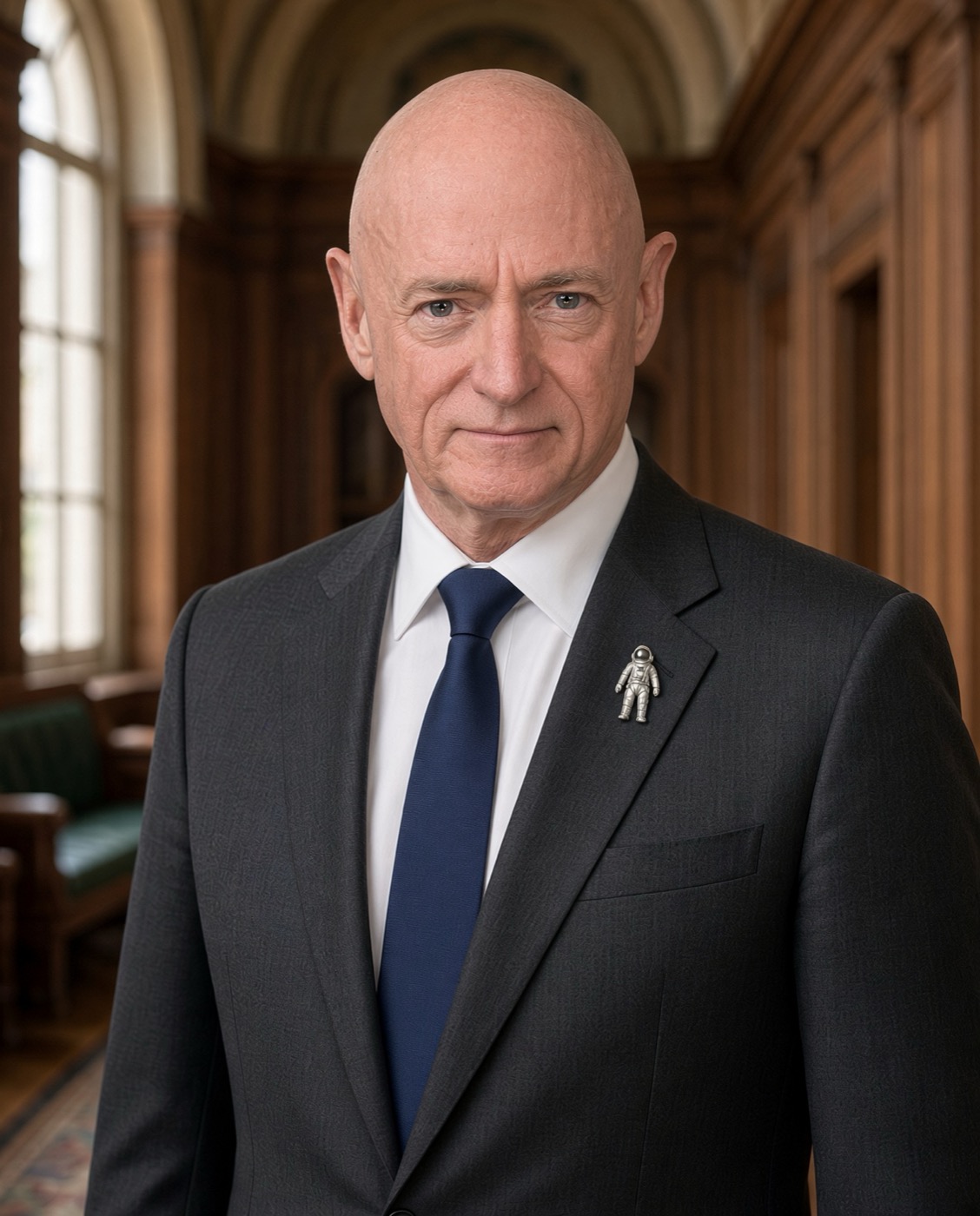
He wears a civil astronaut badge with the Navy’s device added, as a small silver pin, on the lapel of the coat beneath the gown. It is the only personal thing he wears in the chair, and it is the only object he has been photographed with in thirty years of official photography.
Arms were granted to him on his election to the chair, as is usual for a Speaker of the House of Commons. They are blazoned Azure, a sun in splendour Or within an ellipse voided Argent, in base a bar wavy of the last: the sun of the March, the orbit, and the river below. The heralds chose the motto, which is Mensura non fama, measure not repute. It is too clever by half, which he has said, and it refers at once to the measured temperature on which his one Act depends, to an engineer’s intolerance of a rounded figure, and to a reputation he did not earn. He has never said that he likes it.
Failings
The imaging request is the first and the largest. He refused it, seven people died, two of them his friends, and the reasoning he gave at the time was the reasoning of the culture the inquiry condemned. He named himself when the report had not. He offered to resign and was refused. He gave the eulogy having first told the widow. None of that alters the decision, and he has never suggested that it does. What is disputable is the use he has made of it since: the most quoted sentence of his life is the one in which he dissolved his own decision into the conduct of a hundred people, and the sentence is true, and it is also the most comfortable true thing he could have said. He said so himself in the next line, which is either the completion of the honesty or the cleverest part of the evasion.
The advisory work is the second. Two years of paid work for the prime contractor on the programme his committee scrutinised, for forty thousand pounds, ended the week a newspaper found it. Lawful, undisclosed because there was nothing to disclose it to, and exactly the thing a register exists to catch.
The third is the register itself. He moved the resolution, and the resolution he moved has no teeth. It requires declaration and not recusal, it is enforced by nobody, its only breaches have been late filings, and the price of getting it through was the water-holding members’ insistence that recusal come out. He was its target, he wrote what the House would pass, and what the House would pass was a filing requirement. He has called it a floor. A floor is what you stand on when you have decided how low you are prepared to go.
Assessment
He is the clearest demonstration the Realm has of what an independent member can and cannot do. He can hold a seat, ask better questions than anybody in the room, carry one narrow Act and make both front benches nervous on a Thursday. He cannot build a majority, chair anything, or stop the appropriation he thinks is wrong. The Commons is a chamber of parties, and it is a fair reading of his back-bench decade that it cost him more than it bought.
It bought one thing, in the end, and it bought it at the far side of ten years. The House that could not use him as a member elected him as its Speaker precisely because nobody owned him, which means the whole of his ineffectiveness was the qualification for the office, and the office was one he did not want.
He is a technician among persuaders. The qualities that made him a good commander, exactness, a flat voice, an intolerance of rounded figures, are the ones that make a middling parliamentarian, and he has never pretended to be converted to the other trade.
The fame is not his. It came from a morning in a supermarket forecourt in which he did nothing except be married to somebody, he has never claimed otherwise, and he has never refused to use it either. The Realm’s rule for members related to officeholders exists because of him. He did not ask for it, he wrote it weak, he registered first under it, and he abstained beyond what it required for as long as he had a vote to withhold.
And the thing he will be remembered for is not any of that. In January 2003 a junior engineer asked him for a photograph of a damaged wing and he said no, on the ground that there was nothing to be done about what it would show. In September 2028 he became one of five officers who may declare that the King of the United Kingdom of America is incapable of reigning, on the evidence of physicians who will not yet say the word.
The King is in a hospital in New Westminster, awake since 20 October and not recovered. The five have met three times. At the second meeting they declared him incapable, and Kelly signed with a note that the declaration should end when the King wakes. At the third, on the morning he woke, they resolved that the declaration stands until the physicians certify him capable, and Kelly concurred, with a second note saying that by wakes he had meant able to act. He has told the House that he will report every occasion on which the power is exercised, and that he will not answer questions about it.

✎ Editor's Note · The rule nobody had needed
Canon left Kelly’s seat deliberately unresolved: he abstained voluntarily, she referred questions to the High Steward, and nothing was decided. This article settles it, on Jake’s ruling, and the settlement is deliberately unheroic. The Realm does not produce a doctrine. It produces a filing requirement.
That is the argument the article is making about this Realm. A constitutional order that has no written answer to a problem will eventually write down the smallest possible one, and the smallest possible one will be about paperwork rather than principle, because paperwork is what a legislature can agree on.
The second ruling this article carries is larger and pulls the other way. Kelly was made the officer who refused the imaging request before Intrepid was lost. He was not a witness to the failure the inquiry found; he was one of the hundred people it described. Everything in the life after 2003 can be read through that and most of it should be: the intolerance of rounded figures, the habit of returning six months later to ask whether the promised thing happened, the section of his own Act that he defends being the one that requires a measurement to be written down and kept. The register he caused, and wrote weak, is a rule against himself. So is the Act. So is the method.
The article refuses to let this redeem him, because the reasoning he gave in 2003 was the reasoning the inquiry condemned, and the sentence everyone quotes is the one where he stands inside a hundred people and is harder to see. He put the objection to his own sentence in the line after it. Whether that completes the honesty or perfects the evasion is left open, because it is genuinely open.
The space programme is sketched here only as far as a biography needs. What it establishes, and what will outlast this article, is that the Realm’s crewed spaceflight is civil, parliamentary and flown by seconded officers, which is the same argument in a different uniform.
Electoral history
| Contest | Party | Result |
|---|---|---|
| By-election, 2018, Phoenix East | Liberal Federal Democrat | Elected, majority about 8,000 on a high turnout, gain from the Conservative and Crown Union |
| General election, 2023, Phoenix East and Tempe | Independent | Re-elected |
| General election, 7 September 2028, Phoenix East and Tempe | Independent | Re-elected, majority about 26,000 against token opposition |
Chronology
| Year | Event |
|---|---|
| 1964 | Born in the Province of New Jersey, four minutes before his twin brother Scott, to two police officers |
| 1980s | Commissioned from the Naval Academy at Annapolis; carrier aviation with the Atlantic fleet |
| 1980s | About forty night deck landings on his first cruise |
| 1990s | Ejects from a carrier strike aircraft on a night recovery in the North Atlantic; recovered in seven minutes |
| 1990s | Two years on exchange commission flying from a British carrier; qualifies as a test pilot |
| 1990s | Commands a squadron; never commands at sea |
| 1996 | Selected by the American Aeronautics and Space Administration in the same intake as his brother, the board having found no ground to refuse either |
| Early 2000s | First spaceflight, as pilot, a station assembly flight aboard Endeavour |
| 2002 | Second spaceflight, as pilot; operates the arm that installs the heaviest truss section of Concord Station’s early construction |
| January 2003 | As the astronaut office’s representative on the mission management team, refuses a request from the structures office to photograph Intrepid’s damaged wing |
| 1 February 2003 | Intrepid is lost on re-entry with seven aboard, including two officers of his intake |
| February 2003 | Gives the eulogy for the naval aviator of his intake, having first told the widow that the imaging decision was his |
| 2003 | Names himself before the Gehman inquiry; offers to resign and is refused |
| 2005 | The Shuttle returns to flight under the Independent Flight Safety Office, designed partly on his evidence |
| 2007 | Marries Gabrielle Giffords at a family orchard outside Tucson; they had met on a League committee delegation to China |
| 2008 | First command: Resolution carries Kibo to Concord Station; repairs Franklin’s radiators in three spacewalks where two were planned, overruling the ground |
| 8 January 2011 | Giffords is shot at a constituency meeting north of Tucson; six killed, thirteen wounded. He is told in a simulator at Houston, by his brother |
| 2011 | Ernest V comes privately to Tucson; Kelly is in the room and has never described it |
| 2011 | Second command and final flight, four months after the shooting; Giffords watches the launch at Cape Canaveral |
| 2015 to 2016 | The twin study: Scott Kelly spends 340 days aboard Concord Station while Mark Kelly is measured on the ground |
| 2018 | Two Bodies, One Experiment is published |
| 25 August 2018 | John McCain dies at Cornville, ending thirty-six years as member for Phoenix East |
| 2018 | Wins the Phoenix East by-election for the Liberal Federal Democrats; maiden speech reads the summer’s heat deaths by district, under two minutes |
| 2019 | Leaves the Liberal Federal Democrats over the refusal of private members’ time for his firearms bill; sits as an independent thereafter |
| 2020s | Negotiates a place on the science and technology select committee; his vote carries a defence estimate by one, after extracting the heat clause for service personnel |
| 2020s | The Shade and Water Act passes without a division |
| 2022 | Boundary review adds Tempe; re-elected for Phoenix East and Tempe |
| 2024 | Names the largest agricultural water allocations in the Commons, by holder |
| 2025 | Scott Kelly is appointed Administrator of the space agency; Mark Kelly declares the relationship to the House the same day |
| 2025 | Ahwatukee leaves the city of Phoenix and remains in his constituency |
| 1 July 2027 | Giffords is installed as Lord Marcher of Arizona |
| 2027 | Moves the resolution establishing the register of members’ interests, the first in the Realm’s history, and registers first under it |
| 7 September 2028 | Re-elected with a majority of about twenty-six thousand |
| 18 September 2028 | Elected Speaker of the House of Commons, dragged unopposed |
| 25 September 2028 | Kittyhawk is lost east of Newfoundland; he telephones the Prime Minister that night to offer the recall |
| 26 September 2028 | Gives the leave by which Lord Whitlock answers at the bar of the Commons, the first Prime Minister to do so; declares the Article II.8 motion agreed without a division |
| 29 September 2028 | The King is found alive and brought unconscious to New Westminster. Kelly is at the airfield, well back. The five officers of the Regency Act meet once, informally, and do not act; he tells the House of it from the chair that evening |
| 30 September 2028 | The five meet again and declare the King incapable; Kelly signs with a note that the declaration should end when the King wakes |
| 20 October 2028 | The King wakes; the five meet that morning and resolve that the declaration stands until the physicians certify capacity; Kelly concurs, writing that by wakes he meant able to act |
| 31 October 2028 | The abdication takes effect at two in the afternoon; the declaration of 30 September ends with the reign it concerned |
Trivia
- In-Universe He is the only Speaker of the House of Commons to have flown in space, and the only one to have been promoted to flag rank in the Royal American Navy.
- In-Universe He does not use the rank of Rear-Admiral and asks not to be introduced by it. He accepted Mr Speaker without argument on the ground that it is the office and not the man.
- In-Universe The agency's selection board recorded in a memorandum that it could identify no ground on which one candidate could be preferred to an identical candidate that would survive being written down. That is how both twins were taken in the same intake.
- In-Universe He made about forty night deck landings on his first cruise, a figure he has quoted in the Commons exactly once and never mentioned otherwise.
- In-Universe He ejected once, in weather, on a night recovery in the North Atlantic, and was picked up in seven minutes. He says he left the aircraft later than he should have because he was trying to save it, which is the commonest reason pilots die.
- In-Universe He can recite the wardroom toasts of the British carrier he flew from on exchange, and will not.
- In-Universe The habit he took from the British exchange is the writing down of a reason at the moment a decision is taken rather than afterwards. He found it pedantic at the time and has believed in it ever since.
- In-Universe He never flew in combat, and says that a navy which spends an officer's whole career preparing for a war it does not fight has achieved the best outcome available to it.
- In-Universe He commanded a squadron and never commanded a ship, which is the reason he was never going to reach flag rank by the ordinary road.
- In-Universe His promotion to Rear-Admiral on the strength of two spaceflight commands attracted no comment in the service. The Realm's Navy has promoted its astronauts that way since the 1960s, on the reasoning that command of a spacecraft is command.
- In-Universe His second spaceflight installed the heaviest single piece of Concord Station's early construction, and nothing whatever went wrong. He has said the two most satisfying hours of his professional life produced no story at all.
- In-Universe His first command is remembered aboard Concord Station not for the Japanese laboratory it delivered but for the replacement pump it brought for the station's toilet.
- In-Universe On that flight he overruled the ground once, over an unplanned third spacewalk, and put the disagreement on the loop rather than off it. The agency still teaches the transcript.
- In-Universe He allowed the Japanese astronaut Hiroshi Kawabata to give the ground the first description of Kibo. The Japanese agency has never forgotten the courtesy.
- In-Universe He names his crews when asked, which is not universal among commanders.
- In-Universe A junior engineer in the structures office asked for Intrepid's wing to be photographed. The request reached the mission management team, and Kelly refused it.
- In-Universe His stated reason in 2003 was that nothing could be done about the damage even if it were seen. The inquiry later found that a repair and a rescue had both been ruled out by people who had not examined either.
- In-Universe Nobody aboard Intrepid was told that the imaging request had been made or refused.
- In-Universe The Gehman inquiry did not name him. It described the post and the decision without attaching a name to either. He named himself, unprompted, in the first sentence of his evidence.
- In-Universe The most quoted sentence he has ever spoken is that a hundred people each decided something small. The next sentence, less quoted, is that he is one of the hundred.
- In-Universe He offered to resign from the agency and give up flight status. The offer was refused on the ground that removing one participant from a system would improve nothing and obscure the finding.
- In-Universe He told the widow of the naval aviator that the imaging decision had been his, before the funeral, and offered to withdraw from the eulogy. She asked him to give it anyway.
- In-Universe The eulogy lasted three minutes and described the man's flying rather than his courage. The line that survives is that he had never once been the reason a flight was late, which naval aviators quote to each other and nobody else understands.
- In-Universe He used the word boring in a church, deliberately, as the highest praise available for an approach to a carrier deck at night.
- In-Universe That he refused the imaging request is on the public record and is rarely raised. It came up once in the 2018 by-election and moved nothing.
- In-Universe It does not come up in the Commons at all, by a convention nobody has articulated and which he has never asked for.
- In-Universe He wanted the long-duration tour that became the twin study and had already retired from the agency by the time it was designed, which settled the question without anyone having to decide it.
- In-Universe Half of the independent archive holding the twin study's data is his body. He was not consulted about the transfer and says he did not expect to be.
- In-Universe The brothers have never appeared together in public. The rule was not broken on the night the King's aircraft was lost, when both men were awake in different cities, and was not broken at either parent's funeral.
- In-Universe Scott Kelly has never said how he votes, and the brothers say it is the only thing they do not share.
- In-Universe Two Bodies, One Experiment is mostly about tedium, was praised for being boring on purpose, and is set in schools as a study of evidence.
- In-Universe They met on a League of Nations committee delegation to China, appointed for unrelated reasons, neither having heard of the other. They spent eleven days in the same rooms.
- In-Universe He professes no religion, has never professed one, and answers the question directly when it is put.
- In-Universe His brother told him about the shooting, having decided that he was not going to learn it from a screen. The first reports said she had died, and he was told she had died.
- In-Universe He never formally took leave after January 2011. The agency carried him on the books and moved his training around him for months without asking him to account for a day of it.
- In-Universe A backup commander trained for months against the possibility that Kelly would not fly in 2011. That officer never flew a mission. The two are still friends, and Kelly calls it the one debt on his record he has no way of settling.
- In-Universe His crew resented the coverage of the 2011 flight and none of them said so to his face. He has said he would have preferred it if one of them had.
- In-Universe His daughters have always called Giffords by her first name. She has never been described as their mother by anyone in the family.
- In-Universe He has learned not to finish his wife's sentences, which took him years and which he describes as the hardest single thing he has ever been asked to do.
- In-Universe He has never spoken for her in public. He once walked out of a reception in the capital rather than answer a minister's question about her health while she was standing beside him, and it was reported as rudeness.
- In-Universe They live apart in the week and alternate weekends strictly between Tempe and March House. Both describe the arrangement as ridiculous and neither will change it.
- In-Universe He holds no position at March House, is not on the household list, and attends the March's ceremonial only as her husband. It was his condition, not hers.
- In-Universe He has never given an interview on 8 January, in eighteen years. The March marks the day and the Diet suspends its sitting for an hour.
- In-Universe He and John McCain knew each other, and McCain visited Giffords at intervals after 2011.
- In-Universe He refuses every invitation to be compared with his predecessor, on the ground that McCain was shot down, held and tortured, and that he himself flew thirty years in a service never sent to war.
- In-Universe A member of McCain's family endorsed Kelly at the by-election. The Conservative and Crown Union has not forgiven it.
- In-Universe Giffords kept out of the 2018 campaign entirely. It was her condition, and her reason was that if she appeared the seat would be hers.
- In-Universe His maiden speech lasted under two minutes: the previous summer's heat deaths by district and without names, then one sentence. It breached no convention, which is why it landed.
- In-Universe The heat had killed about six hundred and twenty people in the Valley that summer against the March's own prediction of about four hundred.
- In-Universe He read the heat figures into the record at the opening of every session for a decade. The chair cannot, so at his request the Clerk now lays them as a paper.
- In-Universe He introduced the same firearms bill in eleven successive sessions. It reached second reading once and was talked out in committee.
- In-Universe A Liberal Federal Democrat backbencher has taken the bill up since his election to the chair, without asking him.
- In-Universe The part of his own Act that he defends is subsection (3), which requires the temperature to be written down and the record kept for three years. He says a duty without a record is an aspiration.
- In-Universe The heat clause he extracted for service personnel is the only thing on his record whose effect can be shown in a number: heat casualties on exercise fell measurably across the three services.
- In-Universe He states every time, without being asked, that the treaty nations' settled water is not an allocation and is not touched by his position on reductions.
- In-Universe He named the largest agricultural water allocations in the Commons by holder, under privilege. The Basin Conservatives ran a candidate against him for the first time in consequence, and lost.
- In-Universe He has said once, in committee, that the March's compact machinery will not work until the Council of Nations and Compacts can refuse something. It is the most radical thing he has ever said and he has neither repeated nor withdrawn it.
- In-Universe Ahwatukee left the city of Phoenix in 2025 and stayed in his constituency. Its schools are run by a district the town does not elect, and the grievance is the single largest source of letters he receives. He can do nothing about it and answers every one.
- In-Universe The advisory work that ended his reputation for cleanliness was worth about forty thousand pounds over two years. The smallness of the sum is the part of the episode that has kept it alive.
- In-Universe The Arizona Republic found it in a company filing while working on something else. He has said it was the right paper to be found out by, and has never complained about its treatment of him since.
- In-Universe He moved the register resolution himself, which is why it has no teeth. A member cannot write a strong rule against himself and expect the House to pass it.
- In-Universe Recusal came out of the register because members with water holdings in the western polities would not otherwise have registered water rights at all.
- In-Universe Three members have been found in breach of the register since 2027, all for late filing. None has been punished.
- In-Universe The Speaker is exempt from the register. Nobody had considered the question before his election. He filed anyway, within a week.
- In-Universe His formula on the benches was to rise before a division, say that he had an interest, registered, and would not vote, and leave the chamber. He called the rule a floor.
- In-Universe He did not want the chair and was talked into it over several weeks by three parties and the Clerk, separately, all making the same argument.
- In-Universe He was dragged to the chair unopposed. The ceremony of feigned reluctance was, on that occasion, not entirely feigned.
- In-Universe Nobody opposed his election on account of the marriage. He raised the objection himself in his first week.
- In-Universe The device by which Lord Whitlock answered at the bar of the Commons was Kelly's own, improvised on the morning of 26 September 2028. The Clerk had to find the precedent rather than supply it.
- In-Universe He put it to the House as a matter for the chair rather than as a motion, which is why there was no division on it and why it is now a precedent.
- In-Universe When the five declared the King incapable on 30 September 2028, Kelly signed with a note of two sentences, published with the declaration: that he signed because the King was unconscious and for no other reason, and that the declaration should end when the King wakes.
- In-Universe When the King woke on 20 October 2028, Kelly concurred in the five officers' resolution that the declaration stands, and wrote beneath it a second note of three sentences, explaining that by wakes he had meant able to act.
- In-Universe He learned that the Speaker is one of the five officers of the Regency Act 1811 from the Clerk, on a Tuesday morning, in the same briefing as the arrangements for the summer recess. It was a fortnight before it mattered.
- In-Universe The five met in the Speaker's rooms at Parliament House, on the ground that they are neither the Governor-General's house nor the ministry's. The Governor-General called the meeting.
- In-Universe It was announced the same day, on the reasoning that five officers meeting in secret about the King's capacity would be discovered within a day and would look like a conspiracy for having been secret.
- In-Universe No formal note was taken. One of the five kept a private record, which is understood to exist and has not been produced.
- In-Universe The five did not act because the physicians would not use the word permanent. There is a difference between a man who is unconscious and a man who is incapable, and the difference is the whole of the Act.
- In-Universe Kelly has not objected to the Prime Minister being one of the five, saying the defect is in the statute rather than in Whitlock, and that the moment to argue about it was at any time in the preceding two hundred and seventeen years.
- In-Universe The only part of his statement to the House that was criticised was the last line, in which he said he would not be answering questions on it.
- In-Universe He was at the airfield on the night the King was flown in, standing well back, and was not photographed.
- In-Universe Ernest V came privately to Tucson in 2011 and Kelly was in the room. He has never described a word of it, and has met the King once since, formally, at his wife's installation.
- In-Universe He is for the Loreto proposal and cannot say so from the chair. Who takes the chair in his place when it reaches the floor has not been settled, and the Clerk regards the question as urgent.
- In-Universe He would accept a peerage on leaving the chair, on one condition: that his wife approves. He has never asked her.
- In-Universe A Lord Marcher does not sit in the House of Lords, so a peerage would produce no collision between them.
- In-Universe He swore the oath of allegiance four times: at Annapolis, on commissioning, on selection to the agency, and in the Commons. He calls the third the only oath he ever had to think about.
- In-Universe He concluded, in a corridor outside a swearing room at the age of thirty-two, that he was being asked to promise not to lie about what an aeroplane had done, which he could do.
- In-Universe He flies a plain modern single over the desert and will not take a passenger who wants to talk. His wife is the only exemption and has been since long before the office.
- In-Universe He is said by everyone who knows him to be funny in private. Nothing he has said in public is funny. The one attempt was in the 2018 campaign and he has not tried since.
- In-Universe His daughters have never given an interview, and the Realm's press has left them entirely alone.
- In-Universe He is sentimental about exactly one thing, the Moon, and is aware that it cannot be derived from anything else he believes.
- In-Universe The March likes him, genuinely and across blocs, which appears to surprise him more than anything else in his political life.
- In-Universe Desert Labour canvasses for him at elections. There is no agreement and nothing has been written down.
- In-Universe His relationship with the High Steward has broken down once, over whether the Shade and Water Act would be read in the Valley as a federal standard whatever its text said.
- In-Universe His border position is that deaths in the desert are a heat question, to be counted and reported like any other heat death. Critics in both directions call it a way of having a position without having one, and he does not dispute the characterisation.
- Etymology The motto on his arms, Mensura non fama, means measure not repute. The heralds chose it. He has said it is too clever by half and has never said that he likes it.
- In-Universe The ellipse around the sun on his arms is meant for an orbit. Drawn flat, as heraldry requires, it reads as an oval, and the blazon has to do the work the drawing cannot.
- In-Universe The astronaut pin on his lapel is the only personal object he has been photographed wearing in thirty years of official photography.
- Design The article gives Kelly the imaging decision that the Intrepid inquiry left unattributed. Nothing else in his life was changed to accommodate it, because nothing had to be: the exactness, the demand for written records, and the return six months later to ask whether the promised thing happened all read as consequences once the decision is his.
- Design His three failings are ordered by weight rather than by date, which is unusual for this Register. The imaging request comes first because it is the largest thing he has done, and it happened fifteen years before he entered politics.
- Design The article breaks the Register's convention of ending on an open question. It ends on a flat statement of where things stand, which is how the subject would end it.
- Real-World The Speakership is an invention of this setting. The Mark Kelly of our own world is a United States Senator for Arizona and has never presided over a legislature.
- Real-World The rank is invented too. Our own Mark Kelly retired from the United States Navy as a captain, not as a flag officer, and the Realm's practice of promoting astronauts on their flight commands has no counterpart.
- Real-World The imaging decision is the largest invention in the article. In our own world the request to image Columbia's wing was made by engineers and refused by mission management, and no astronaut has ever been identified as the person who refused it.
- Real-World Kalpana Chawla, the Raj officer among Intrepid's dead, flew on Columbia in our own world as an American citizen. The partnership that puts her aboard as an officer of another state is this setting's alone.
- Real-World The register of members' interests came to Westminster in 1974, after a property scandal. That this Realm waited until 2027, and produced it because of one marriage, is the setting's argument about how slowly a constitution without a written answer will write one.
- Real-World The Regency Act 1811 of this Realm has no counterpart in American law, where presidential incapacity is handled by a written amendment. Five named officers deciding by majority on the evidence of physicians is a British inheritance the Realm never replaced.
See also
- Gabrielle Giffords
- John McCain
- Kittyhawk
- Parliament
- The American Aeronautics and Space Administration
- Concord Station
- The March of Arizona
- Phoenix
- Ahwatukee
- The Royal American Navy
- Caleb Whitlock
- Ernest V
- Elections and constituencies
- The Liberal Federal Democrats
Categories
- People
- Politics and government
- Science and exploration
- The March of Arizona