George V
George V (Frederick Alexander; born 2 May 2013) is King of the United Kingdom of America and of the thirteen other capacities of the personal union, and has reigned since 31 October 2028, when the last of his realms gave effect to the abdication of his father, Ernest V. He acceded at fifteen. His mother, Queen Christina of Sweden, acts for him as Regent in thirteen of the fourteen capacities until his sixteenth birthday on 2 May 2029, when he reigns in his own right in all of them at once, and his own oaths and a coronation in Great Britain wait for that birthday. Through his mother he is also Crown Prince of Sweden and Duke of Öland, a further inheritance that lies wholly outside the union.
He was born at the Karolinska hospital in Stockholm, the only child of the King and the Queen, and was heir apparent from birth, holding six heir’s dignities, of which the senior was Prince of Wales and the American one Prince of Columbia, together with the estate dignity of Duke of Cornwall; all of them merged in the Crown at his accession. He has lived at Columbia Palace in New Westminster since the autumn of 2016, and since 2018 his mother has lived there with him in the school year, so that he is the first sovereign since 1783 to be ordinarily resident in the United Kingdom of America. He is an only child, and the direct line, across fourteen Crown capacities and the inheritance in Sweden, rests on a single life; his heir presumptive is his aunt, Queen Caroline, and after her her children.
For fifteen years the Register’s account of him was an account of a fact: of the person on whom the arithmetic of a long reign came to rest, who held no office, exercised no function and had no record of his own. That changed in the last week of September 2028. After the loss of his father’s aircraft (Kittyhawk) he wrote two public statements himself, met his father’s aircraft on the airfield, sat at the table of the Privy Council as an observer on the day his mother was sworn Regent, and went back to school. When his father woke on 20 October he was brought to the hospital before dawn and wrote a third statement. On 25 October he told the Realm, alone at Columbia Palace, that his father had asked what an abdication would require, and on 30 October the King decided to give up the Crown. The next day the Realm, last of the realms, gave the decision effect, and at two in the afternoon in New Westminster, six in the evening in London, he became King, in a geometry class at Ellicott High School. He stayed to the end of the school day, went to the hospital at four, and attended the Privy Council that proclaimed him at six.
His public significance as King is still largely prospective. Until his sixteenth birthday he reigns and does not act: the Regent exercises the royal functions, and he has spoken in public only as a son. He is read differently by different constituencies: by monarchists as dynastic renewal, by republicans as the next occasion for constitutional argument, by Americans as the first Crown to live among them, by British opinion as a King formed partly away from London, and by the smaller realms as a test of whether their separate dignity will be remembered. Unlike his father, who was formed in Great Britain, he was raised principally in the United Kingdom of America, and his guide to the American Crown was the resident Governor-General rather than the King. The household’s phrase for him is “the boy beneath the Crown”, a nickname coined in 2019 which he has said he likes, because it is true.
Name, styles and titles
As King he bears the style of George V, set out below. As heir his names and dignities were numerous because his father’s Crown is numerous, and his mother’s adds two. He carried one given style, Frederick Alexander, and beneath it six separate heir’s dignities, one for each of the realms whose succession law provides for an heir apparent, together with two Swedish titles and a ninth, Duke of Cornwall, which belongs not to any Crown but to a private estate. None competes with any other in law. Each attaches to a distinct order, and the whole set is best read not as a hierarchy but as a distribution.
The heir’s dignities
From his birth until his accession Frederick held six heir’s titles at once. They do not compete, since each belongs to a separate Crown and none confers authority in any other, but together they distribute his formation across six constitutional traditions.
His senior title was Prince of Wales, the heir’s dignity within Great Britain and the older dynastic grammar of the House of Hanover. It is the title by which he is most often named in ceremonial usage and the one that connects him to the settled forms of British monarchy. Under the 2025 Welsh settlement the dignity is gender-neutral, held by a Prince or Princess of Wales, and it carries no executive or legislative power over Wales, whose government is conducted by an elected Senedd and its First Minister. It is a dignity of seniority and tradition rather than of function.
His American title was Prince of Columbia, which attached him specifically to the United Kingdom of America: to New Westminster and the Columbia District, to Parliament and the Governor-General, to the Crown in right of America and the Charter settlement, and to the Church of America. It is the standard dignity of the American heir apparent and has been held before by heirs who later acceded; Ernest IV bore it, and so did Ernest V, each while heir and before the Crown itself passed to him. The title bound the person of the heir to the federal capital rather than to Great Britain, and in Frederick’s case that binding is not merely formal, since the capital is where he actually lives.
Prince of Good Hope is an automatic and gender-neutral dignity belonging to the heir to the separate South African Crown. It vests without grant under South African succession law, which uses absolute primogeniture, and it confers neither residence nor political authority. It attached him to a realm in which the Crown survived apartheid, assented to it under protest while warning and referring where the law allowed, and was afterwards found by a Truth and Reconciliation Commission to have carried a moral implication that legal constraint had not removed. The South African monarchy is broadly held in affection and is normally distant, and the heir’s dignity carries the memory of both facts.
Prince of the Antilles is automatic in the same manner under the law of the West Indies Federation. It carries no federal office, no office in any of the sixteen states, and no authority over the elected Governors who exercise the states’ Crown functions by royal commission. It attached him to the one realm of the union whose existence was put to a vote: when Jamaica was asked in 1961 whether it would remain in the federation, remain won by 50.8 per cent, a margin narrow enough that the realm’s survival is treated within it as a decision rather than an inheritance.
Prince of Wolfenbüttel is likewise automatic and gender-neutral under Brunswick’s independent absolute-primogeniture law, being the present masculine form of the dignity of Prince or Princess of Wolfenbüttel. It belongs only to the heir of the Duchy of Brunswick, supplies no German federal office, and confers no authority in Hanover, which is a separate capacity held by the same person. It attached him to a fragmented duchy of small districts and exclaves whose constitutional standing within the union is equal to that of the kingdoms, and which therefore has as strong a claim on the heir’s attention as any larger realm.
Prince of Patagonia is the dignity of the heir to the separate Crown of the United Provinces of the River Plate, the realm at Buenos Aires that entered the personal union under Ernest III on 25 May 1910 by the Act of the Centenary.
None of the six dignities added a further Crown capacity. Ernest V’s total remained eleven kingdoms, two duchies, and one empire, and the heir’s titles are the reflection of that total in the person of the person who will one day carry it, not an addition to it. The distribution reverses the emotional geography of his father’s reign. Ernest V reigned from London and had to make the distant realms feel remembered; George V was formed in America, reigns from New Westminster, and must acquire the others without being wholly claimed by the one he lives in. The requirement is not neutrality between the realms but particular knowledge of each.
The Swedish titles
His Swedish titles were conferred by his mother on the day of his birth, at a Council of State held in the hospital. He is Crown Prince of Sweden by the succession act, as the only child of the reigning Queen under absolute primogeniture, and Duke of Öland by royal decree, in the Swedish custom by which a royal child bears the name of a province. The dukedom is titular and has no function. Öland is the island on which the family summers, at Solliden, and its people call him Hertigen, the Duke, and have put his name on a bench at the gate of the house.
The Swedish titles are not Crown capacities of his father’s union, and the two sets never combine. In Sweden he is not the Prince of Wales, and in the realms of the union he is not the Crown Prince. He wears the style of the place in which he stands.
Duke of Cornwall, the estate dignity
Separately from the six heir’s dignities, Frederick held until his accession the title of Duke of Cornwall, the historic male-only estate dignity of the heir to the British throne. It is not a Crown capacity and adds nothing to the personal union’s count of eleven kingdoms, two duchies, and one empire. It carries the land and revenue of the Duchy of Cornwall estate but no governmental authority of any kind.
In particular it carries no authority over the Duchy of Kernow, the constituent national government of Great Britain, which shares the word “duchy” and nothing else. The civic duchy is governed by an elected Cornish parliament and a directly elected First Minister and represents the Cornish nation within the British Crown; the estate is Frederick’s private inheritance and represents nobody. The two are frequently conflated and should not be. The Cornish national arms are a civic achievement carrying no royal coronet, and they are not the Duke’s personal insignia; the estate’s holdings are property, and they are not a country.
As property, the estate is treated as property. Its holdings are taxed, audited, and regulated like any other, its historic mineral ownership continues under public licensing and community-benefit law, and an independent seven-member board sets a public dividend of between 10 and 50 per cent of the estate’s post-tax net income, with the remainder supporting the Duke. The dignity is male-only, which is the single respect in which Frederick’s position is fixed by his sex rather than by his place in the line, since every one of his Crown-capacity dignities is gender-neutral and would have been held by an only daughter in his place. Cornwall would not have.
Precedence and the shared Crown
As heir, Frederick’s several dignities were held simultaneously but never merged. There was no composite office of “heir of the union” to which he succeeded, only six separate successions that ran together in one person because one person held the six Crowns. The doctrine of disciplined separation that governs his father’s fourteen capacities, under which one monarch may hold several Crowns but no Crown may borrow the authority of another, governed the heir’s dignities in the same way. Within Great Britain he took the precedence of the Prince of Wales; within the United Kingdom of America the precedence of the Prince of Columbia; within each of the other realms the precedence its own law assigned its heir. He did not carry the precedence of one realm into another, and as King he does not carry the precedence of one Crown into another.
The arrangement meant that his position was legally plural in the same manner as the Crown he was to inherit, and it is so now that he holds it. Each realm regarded him as its own heir under its own law, and regards him now as its own King, advised, where advice touches him, by its own ministers, and none regards him as a sovereign imported from elsewhere. That the several successions run together in a single line is not guaranteed by any one realm but by an instrument that binds them all, described below. The estate dignity of Cornwall sat outside this entirely, being a matter of land rather than of Crown, and it neither took precedence nor conferred it.
The standard of the Prince of Columbia
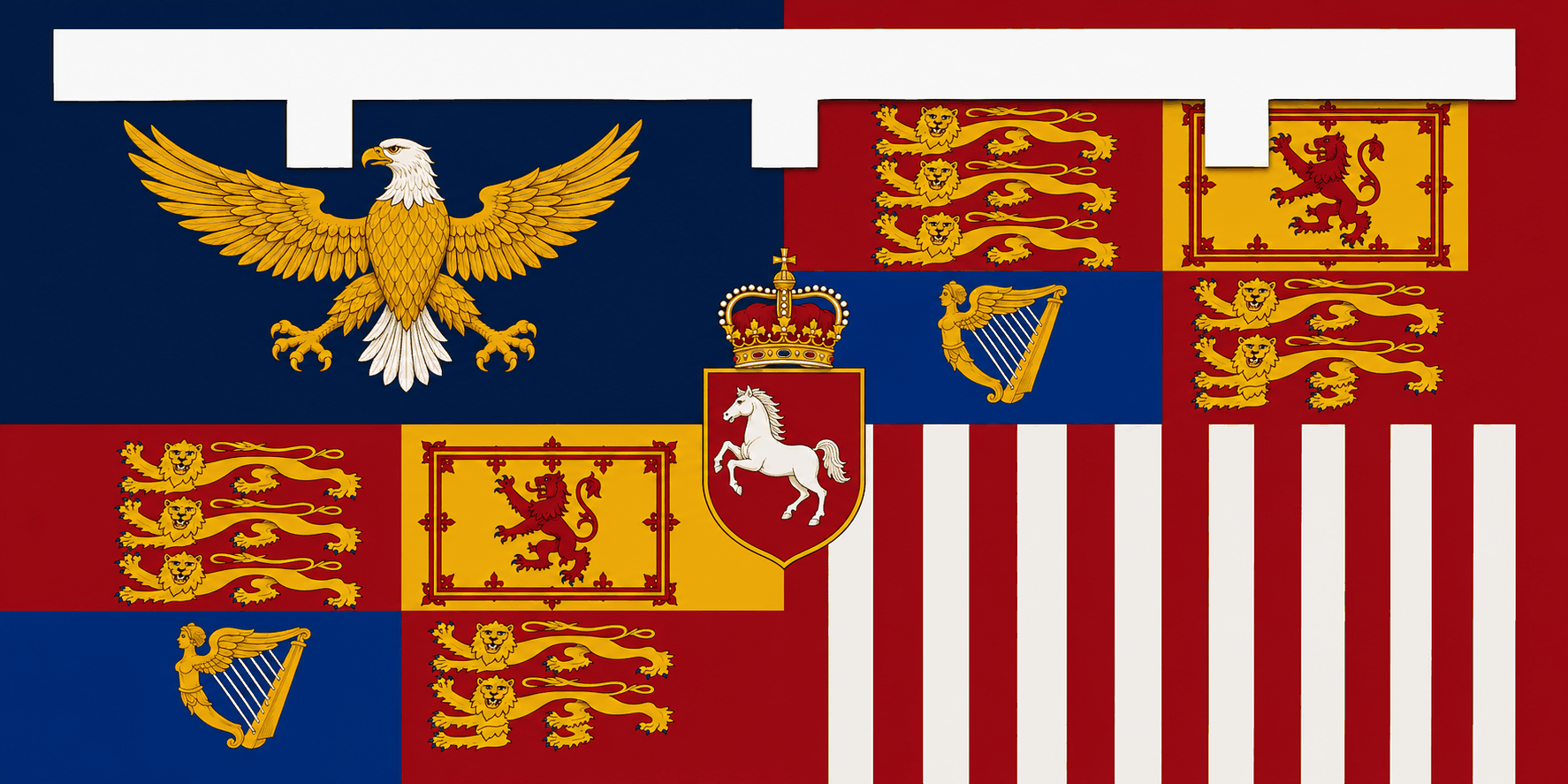
In his American capacity as heir Frederick bore a personal standard: the arms of the Royal Standard of 1841, differenced by a plain white label of three points laid across the upper part of the banner. The label is the ordinary heraldic mark of an heir apparent and is the only alteration. Frederick’s standard is otherwise his father’s, quarter for quarter.
The consequence is that the heir inherits the proportions of the 1841 arms along with everything else, including the two British quarters and the single American one. Commentary on the Standard’s composition therefore applies to his banner without modification, and the point is made more sharply in his case: Frederick is the member of the family who actually lives in New Westminster, and the banner flown for him there gives the arms of Great Britain twice the space it gives the eagle. No proposal to grant the heir separate American arms has proceeded, for the same reason no revision of the sovereign’s Standard has proceeded.
Like the sovereign’s Standard, it flew only where he was personally present and was not flown in his absence. It did not fly over Columbia Palace again after the night of 25 September 2028, when the household struck it and flew the national flag at full staff instead, having decided that no personal standard should fly while the King was missing (Kittyhawk).
Regnal name
Under the common terms of 30 October 2028 he reigns as George V in every realm of the union. The name is that of the union’s first kings, George III and George IV, in whose reigns the Crown in right of America was created and the Hanoverian kingdom raised, and it had not been used in the union’s numbering since George IV died in 1830. It was chosen in the terms themselves rather than announced by the Household, so that thirteen realms would proclaim the same name on the same day, and the terms give no reason for it.
He is the first sovereign of the house to reign under a name he was not christened with. He is Frederick Alexander, and George is not among his names. George III and George IV were christened George; William IV and Victoria reigned under their baptismal names; and each of the five Ernests had Ernest among his, Ernest II having been George by birth and reigning in Hanover under that name.
The numeral is the union’s in every realm. Hanover’s own count has not always matched it, since Ernest II reigned there as Georg V from 1851 to 1878, and for George V the kingdom followed the union’s numbering, so that Hanover has a second Georg V.
The style as King
There is no single long style of the union’s sovereign, only a short style used in American and British practice and fourteen local styles, each drafted in the realm that uses it and naming its own Crown alone (see Styles and Titles of the Crown). The styles of the new reign changed the name and nothing else, and each was proclaimed in its own realm when the abdication took effect.
His Majesty George the Fifth, by the Grace of God, King of the United Kingdom of Great Britain, King of the United Kingdom of America, and of His other Realms and Territories, Defender of the Faith, Supreme Governor of the Church of England, and Supreme Governor of the Church of America.
| Capacity | Local style of George V |
|---|---|
| Great Britain | George the Fifth, King of the United Kingdom of Great Britain, Defender of the Faith, Supreme Governor of the Church of England |
| United Kingdom of America | George the Fifth, King of the United Kingdom of America, Supreme Governor of the Church of America |
| Hanover | Georg V., König von Hannover, King of Hanover |
| Ireland | Seoirse V, Rí na hÉireann, King of Ireland |
| New Albion | George V, King of New Albion, in both official languages |
| New Wessex | George V, King of New Wessex |
| South Africa | George V, King of South Africa, in each of the official languages |
| River Plate | Jorge V, Rey del Río de la Plata, King of the River Plate |
| West Indies Federation | George V, King of the West Indies Federation |
| Philippines | Jorge V, Hari ng Pilipinas, King of the Philippines |
| Malaya | King and Protector of Malaya, written after the style of the Yang di-Pertuan Agong |
| Brunswick | Georg V., Herzog von Braunschweig, Duke of Brunswick |
| Normandy | Georges V, duc de Normandie, Duke of Normandy |
| Raj | George V, Emperor of Raj |
At fifteen he is Supreme Governor of the Church of England and of the Church of America, in which he was confirmed in 2027, and Defender of the Faith, each attached to its own Crown as in his father’s style.
The six heir’s dignities ended with the accession. They merged in the Crown and wait for an heir apparent, and none passes to an heir presumptive, so that his aunt, who is next in line in all fourteen capacities, holds no dignity in any of them. The estate of the Duke of Cornwall returned to the Crown in the same way. As King he is entitled to the Royal Standard of 1841, which flies only where the sovereign is personally present. His Swedish titles are unaffected: Sweden lies outside the union, and he remains Crown Prince of Sweden and Duke of Öland, the heir in one kingdom and the sovereign of fourteen capacities in others.
Early life
Birth in Stockholm
Frederick was born on 2 May 2013 at the Karolinska hospital in Stockholm, in the forty-first year of his father’s reign, when Ernest V was sixty-six. He was born in Stockholm so that he would be registered as Crown Prince at birth under Swedish law. The King was present: he flew from London the same morning and arrived late. The Governor-General of the Realm sent a telegram that was read to the delivery room.
The birth is the sharpest instance of a pattern the house had repeated for several generations, in which heirs arrived late in long reigns, and it ended a period of some decades in which the succession beyond Ernest V had no settled answer. He became heir apparent at birth and acquired at the same moment the automatic heir’s dignities of the South African, West Indian and Brunswick Crowns, which vest without grant under the succession law of each realm. The King named him Prince of Wales on the day after the birth, and he became Prince of Columbia at the next Privy Council.
His mother’s pregnancy had been announced in October 2012 and had been difficult, and she had taken five months’ leave from public duty, which no Swedish monarch had done. He was christened Frederick Alexander in the Royal Chapel at Stockholm Palace, in the Church of Sweden. His godparents are Olav, Grand Duke of Minnesota, his mother’s cousin of the Bernadotte cadet branch, and Queen Caroline of Hanover, his father’s sister.
He was born into circumstances the reverse of his father’s. Ernest V acceded at twenty-five to a respected monarchy and an established reign, and had the ordinary interval of a lifetime before the Crown reached him; Frederick was born already an heir, into an old reign, a mature personal union, a heavily mediated public culture, and an institution that was by then acutely conscious of its own continuity. The governing rule of the household in his regard, stated by his father, is that he is son before symbol, and that the heir must not be treated as an answer to the King’s age, to American distance, or to any of the monarchy’s other difficulties. The late arrival also fixed the shape of his childhood before he could have any part in it, since the people, ministers and institutions that surround him have known no other heir and, in most cases, no other monarch.
Stockholm to three
He lived in Stockholm until he was three, with his mother, and spoke Swedish before English, since she was the one at home with him. His first word was “nej”, no, and Ebba Lindqvist, his mother’s Private Secretary, claims to have witnessed it. He spent each summer at Solliden from his first, and Midsummer there is the one date of the year he has never missed.
New Westminster from 2016
In the autumn of 2016 he moved to Columbia Palace for the nursery school, with a nanny and a household. His mother visited for about a fortnight in every five weeks and his father six times a year. It was meant to last a year, and was renewed twice. The nursery had six children, all of palace staff, and for two terms none of the others knew that one of them was the heir. His nanny was Ruth Okafor, a retired Navy nurse from the Columbia District, who stayed until 2018 and is still written to. He sends her a postcard from every place he goes, and she keeps them on a corkboard in her kitchen.
The decision of 2018
The decision where Frederick would live was made in 2018, when he was five, and took a year. His mother wanted Stockholm. The King’s household argued that the American Crown needed its own formation and could not be learned from a distance, as the King had learned it. She agreed on one condition, which she has since repeated: “I will not be a visitor in my son’s life.” She moved with him, and has lived at Columbia Palace in the school year ever since. His household is the Realm’s and is paid from the Crown estate; her twelve Swedish Court staff live in the north wing and are paid from the Swedish civil list, and the two households have separate kitchens and a shared door.
Family and the two inheritances
Ernest V and the American Crown
Frederick’s relationship with his father is markedly warmer than Ernest V’s own guarded relationship with Ernest IV. His father, elderly, formal and constitutionally severe, was demonstrative toward his son in private: he wrote to him, noticed when he was tired, and did not invariably convert a question into a lesson. He telephoned him every Sunday at four in the afternoon, New Westminster time, which was nine in London. They had a standing game: the King asks him to name the Crown in right of which a given Act was passed, and Frederick asks the King the same of a hypothetical one. The King lost twice in 2027 and has said that it was on purpose.
The last such call before the loss was on Sunday 24 September 2028. The King asked which Crown assents to a Bill introduced at Ottawa, and Frederick answered “New Albion”, and the King said “Good.” The King was flying to Ottawa the next day. It is the one conversation Frederick has told no one about. The Household knows of it from the King’s own diary.
The principal difficulty in the relationship was the King’s age. Ernest V was eighty-one in the year of the loss and his heir fifteen, a gap that gives the work of preparation an urgency it would not otherwise have and tends to present affection in the form of instruction. The King’s own instinct is archival and procedural: he kept his son’s educational papers in the same private study as the realm boxes, the accession documents and the May Day files, and he is more comfortable preparing than consoling. The recognised risk in the relationship is therefore not neglect but concentration, the danger that the whole of a scarce and shared time is spent on the office rather than on the boy. The Queen won an argument about it in 2024: the school reports are now kept in a drawer in her sitting room, and the King is sent a copy of each. Ernest V has stated the requirement plainly in the terms of his own doctrine, that the most useful thing he can do is sometimes to close the folder and allow his son to be fifteen, and the relationship is generally judged to be at its best when he does.
Through his father Frederick received the American Crown as a doctrine before he received it as an inheritance. Ernest V’s whole reign has been an argument that the Crown must be present enough to steady a realm and restrained enough not to own it, that it does not reside in the realm it is most associated with, and that the resident Governor-General, not the King, is the ordinary American presence of the Crown. Frederick is being taught to hold the same distinctions, with the difference that he is learning them from inside the American capital, where his father learned them from Great Britain, and the household regards that difference as the most consequential single fact about the next reign that can presently be stated without predicting it.
Queen Christina
Frederick’s mother is Queen Christina of Sweden, of the House of Bernadotte, who is not a consort in the ordinary sense but a queen regnant, with her own realm, ministers and duties within the Scandinavian Union. Where the household tends to reason from the requirements of the role toward the child, she reasons from the child outward. She is recorded as resisting overfull schedules, questioning whether particular appearances are necessary rather than merely useful, defending her son’s friendships against excessive suspicion, and pressing the view that rest is not wasted preparation. Because she carries the burden of a Crown herself, she is able to press these arguments with the King on equal terms, which few others in the household can do.
Her habits with him are the best-documented fact of his private life. She collects him from school herself two days a week. Tuesday evenings are kept clear of every engagement. She read to him in Swedish at bedtime until he asked her to stop at eleven. He calls her Mamma in Swedish and “Mum” in English, and “Queen” only in jokes, and in public “my mother”. She is the only person who is allowed to make him do his homework in either language. She knits the scarf in his school colours, and sails with him in her father’s wooden sloop, the Ingrid, off Öland.
Sweden
Through Christina, Frederick is heir to the Kingdom of Sweden. Sweden is not a further Crown of his father’s personal union but his mother’s separate realm, a member of the Scandinavian Union seated at Stockholm and ruled by the senior line of the House of Bernadotte, and it does not merge with the union at any point. The two inheritances meet only in Frederick himself, and the meeting is a junction rather than a fusion: he will be able to hold both, but the holding will keep them apart, exactly as his father’s fourteen capacities are kept apart.
His Swedish formation runs on a separate track. He has a Swedish tutor, Marianne Hellström, three hours a week, who says that his Swedish is better than his accent. He speaks Swedish with his mother and English with his father, and both badly when angry. In October 2027, at fourteen, he attended the opening of the Riksdag in Stockholm for the first time, standing at his mother’s left in a blue suit. He was the tallest in the royal box, and the Swedish press said that he looked like a boy who had been told not to fidget and had decided to obey. The Swedish Court published in 2026 the plan for the Crown Prince’s Course, to begin after he finishes school: two years at Uppsala, a naval term at Karlskrona, a year with a Swedish municipality, and the Riksdag’s committees. He has already chosen that the municipality should be a small one in the north.
His Swedish friends are Elsa and Nils, the children of the caretaker at Solliden, who are a year older and a year younger. They call him “Fredde”, they have never been told that he is a Prince in any language they care about, and they row him round the bay in a boat that leaks.
The Swedish inheritance also has a curious echo within the United Kingdom of America, since the Grand Duchy of Minnesota is ruled by a cadet branch of the same House of Bernadotte, a junior line planted in America and held wholly outside the Swedish succession. Frederick’s Swedish claim runs through the senior line and carries no relation to the American cadet branch beyond the shared name.
Where the three of them are
The arrangement of two Crowns divides his childhood. It imposes two royal calendars, two courts, two publics and two constitutional cultures. Until 2028 his father lived in London, and since the loss of his aircraft he has been in New Westminster General; his mother and he share New Westminster in the school year, and in the summer and at Midsummer his mother is in Stockholm and he with her. The household’s flight rule was that the King, the Queen and Frederick were never aboard the same aircraft; they may fly separately, and the rule is only that they do not fly together. Periods in which all three are in the same place are arranged deliberately rather than occurring by default, and the calendar of the family is in this sense a negotiated document.
Prince Alexander I of Prussia and Princess Charlotte
Frederick’s first cousin Alexander I is the son of Ernest V’s sister, Queen Caroline of Hanover, and is eight months younger than Frederick, having been born on 18 January 2014. Their relationship joins the Welf and Hohenzollern households at the personal level without giving either dynasty authority in the other’s constitutional affairs. It is warm, private and less ceremonial than their public positions suggest, and it is generally described as the closest of the relationships between the young dynasts of their generation. The cousins have contrasting temperaments. Frederick is more direct and inclined to ask a difficult question plainly; Alexander is more reserved and more likely to listen until he can state an exact conclusion.
The sudden death of Heinrich I on 12 February 2028 changed the balance abruptly, and Alexander succeeded at fourteen to the German and Prussian Crowns. A Regency Council exercised their powers until October, when the German and Prussian constitutions were amended and his elder sister, Princess Charlotte, became sole Regent on 11 October 2028. Frederick has offered private companionship through all of it. He has made no public intervention in the dismissal of the Prussian Minister-President, in the litigation that followed it, or in the campaign for early personal rule, and neither household describes him as Alexander’s adviser or accords him any advisory office. The boundary is deliberate: family sympathy may cross between the houses, but constitutional authority and political advocacy may not.
Charlotte writes to him, and is the only member of the family who does. She was passed over for the Prussian and imperial thrones by a reform that ran only forwards, and is therefore the one relative who can tell him both what it is to be next and that being next is not a guarantee of arriving. The realms of the union made the same kind of reform after both she and her brother were born, so that she stands behind Alexander in the line to Frederick’s Crowns as well. She has never mentioned the succession to him. On 12 October 2028, the day after she took the regency, she wrote him one line: “It is less than they say. It is also more.” He has not shown the letter to anyone, and the Household takes the line to be about the regency and not about him.
The two houses are joined in the line as well as in the family. Frederick has no sibling, so behind him the succession to the fourteen capacities passes to his aunt, Queen Caroline, and then to her son and her daughter in that order. Since his accession his aunt has been his heir presumptive and his cousin the German Emperor second in line, and neither household has said anything about it in public.
Education and formation
Schools
His education combines conventional schooling in the capital with the specialised instruction required of an heir. After the nursery at Columbia Palace he went to a day school in the city, Brookside, from 2018 to 2025, and to Ellicott High School from September 2025, when he was twelve. Ellicott takes pupils from eleven. He is not sent abroad to be educated, and the household’s preference for keeping him in New Westminster is itself a constitutional decision rather than a domestic convenience. Since he started at Ellicott he has laid the wreath of the Realm’s schoolchildren at the Tomb of the Unknown Soldier on the Eleventh, after the services and before the polities. An heir educated in Britain would be read in America as a signal about where the future Crown’s sympathies lie, and the household has judged that the signal sent by an American schooling is worth more than the dynastic familiarity that a British one would supply.
At school he is best at history and mathematics, middling at languages, and worst at art, which he has described to his mother as “a subject where I am told to feel something”. He has never been given a mark above what he earned, and the teachers say that they would know. Asked on Ellicott’s careers day what he would like to be, he wrote “a railway signalman”. He was told that the Charter makes no provision for it. He said that it should, and the teacher gave him the mark for the answer anyway.
He is enrolled as Frederick Hanover, a surname no member of the family uses in any other context, and the improvisation has had one consequence nobody intended: it placed him in the H’s, and an alphabetical seating plan in September 2025 put him beside Theo Hartigan, the son of a bus driver and a nurse from the Grand Duchy of Wisconsin. The friendship that resulted is the closest of his life and the only ordinary one in it. He told Theo first, the evening before his statement of 25 October 2028, at the Hartigans’ kitchen table, and a Milwaukee weekly reported on 30 October, unconfirmed, that Theo is to be made a Page of Honour on the accession and that the King will finish at Ellicott with his year. He has two other friends at Ellicott, a boy and a girl, whom the Household does not name and whom the press has been asked not to find. Theo’s parents’ flat is the one house in the capital he is allowed to walk to without an escort, with a detail at the corner. Theo has been to Solliden twice, in the summers of 2026 and 2027, and Frederick has learned some Wisconsindeutsch at the Hartigans’ table, the first member of his house to know any. The household has declined to give Hartigan any appointment, refusing the Prussian model his cousin adopted, on the ground that a boy who holds nothing cannot lose it.
Pastimes
He rows in the school’s second eight, on the Potomac, in the autumn and spring. The Household allows the river and not the regatta, so he has never rowed against another school, and the crew has made this a joke: they train for every race and enter none. His other great interest is railways, which he knows by timetable. He can give the arrivals at Union Station for any day of the week, and has asked to ride the Realm’s slow train to Boston. His own sailing is done off Öland with his mother.
Faith
He was baptised in the Church of Sweden. In the spring of 2027, at fourteen, he was confirmed in the Church of America at Columbia Cathedral by the Primate, Archbishop Naomi Achebe, since as heir to the Supreme Governorship of two churches he is to be in communion with them. His mother received communion beside him, and the Archbishop of Uppsala sent a letter of blessing that the Primate read aloud. His religious formation runs through the Church of England and the Church of America, on the established understanding that establishment is a duty rather than a possession and that the monarch is Supreme Governor rather than priest.
May Day
He was born after the May Day Bombings of 2006 and therefore inherits the event rather than remembering it. He has attended the memorial reading of the names in New York on 1 May every year since 2019, standing with the families and not on the platform, and has never been asked to speak, in keeping with the rule of his formation that the catastrophe belongs first to the dead, the wounded, their families and the American people, and not to the dynasty, and that he is not to be presented as the young face of May Day continuity. At the reading on 1 May 2028 a woman beside him who had lost a brother squeezed his hand, and the Household has asked the press to leave it there.
Lessons with the Governor-General
Because the King resides in Great Britain, Frederick’s routine experience of the American Crown is mediated less by his father than by the Governor-General, Michelle Lujan Grisham, whose residence and office at Government House stand a short distance from the Palace. She sees him for an hour on the first Thursday of the month, with an open Charter on the table and a rule: he asks the questions. In public he calls her “Governor-General” and she calls him “Prince Frederick”. In the library at Government House they use “Michelle” and “Frederick”, and nobody else has ever heard them do it. In September 2028 he asked her why the Realm has a Governor-General at all, and she said that she had been waiting six years for someone to ask. Asked once what he thought the heir was for, he said that he knew what he was for and not yet what he was for; she wrote it down and did not tell the Household.
On his fifteenth birthday, 2 May 2028, he was appointed Colonel-in-Chief of the Regiment of Virginia, the regiment that finds the guard at the Tomb of the Unknown Soldier: his first act in the Realm’s military life, and the first royal colonelcy of an American regiment. The Colonel of the Regiment does the work.
What he observes from that position is the ordinary constitutional order of the Realm working at close range. Prime Ministers are commissioned and ministers sworn at Government House; Parliament sits on Charter Hill; the Royal American Supreme Court and Ministry Row are within the same few square miles; and the protest corridors are laid out so that dissent is visible from the institutions it addresses. The lesson generally drawn from an American formation conducted inside the Columbia District is that American dignity was not conferred by the Crown but required the Crown to recognise it in law, and that the resident office of the Governor-General, not the distant person of the King, is the ordinary form in which the American Crown is present to Americans. The arrangement also carries a risk that the household is understood to manage deliberately: a visibly American heir may cause the smaller realms to fear becoming secondary, while an heir who leaned instead toward British dynastic instinct would revive the American resentment of the distance his father keeps.
With the Governor-General’s permission, and the Household’s, he has read the Realm’s main republican pamphlet and the replies to it. At fourteen he asked her what a republic would do about her office, and was told that it would have to invent one, and that this was an argument both ways.
The six realms
The specialised part of his instruction covers law and the Charter settlement, religion and establishment, history, languages, ceremonial and its purposes, the procedure of Parliament, the law of rights, the architecture of the personal union, the memory of the May Day Bombings, and the separate dignity of each of the realms whose Crowns he now holds. He is taught the union on his father’s understanding of it, as a discipline of separation rather than a collection of possessions, and he is being taught in particular to hold six realms in mind at once without allowing the one he lives in to displace the others. In his room at Columbia Palace is a wall map with the six realms marked, and he can give the national day of each. He has pencilled a seventh mark in Sweden and, in smaller writing, one in Malaya, which carries no heir’s dignity of its own, since its protectorship follows the British Crown, and asked why not.
He has visited, before the autumn of 2028, only Sweden, Great Britain and the lodge at Lac du Roi in New Albion, besides the Realm. He has not visited South Africa, the River Plate, the West Indies or Brunswick, whose heir’s titles he held and whose Crowns he now holds, and the Household has promised the first of those visits for the year of his sixteenth birthday. His one visit to the Duchy of Cornwall was in 2025, aged twelve, with his father, the King’s only visit to Cornwall in a decade; they travelled separately. He asked the board’s chair why the dividend was between ten and fifty per cent and not a fixed figure, and was told that it was to make the board argue. He wrote the answer on the back of his programme.
Appearance and character
At fifteen he is fair, grey-eyed and about 1.80 metres, taller than either parent had been at his age, with a long stride that his protection officers have asked him to shorten. The Household’s birthday photograph of him was taken on 2 May 2028, his fifteenth birthday, in the palace library by the Household’s photographer. He was asked to smile and said that he would when there was something to smile at, and the Household released the photograph unchanged. The photograph in his infobox is a later frame from the same sitting, issued on 1 November 2028 as the first official photograph of the reign.
He is described as curious, observant and more direct in manner than his father: direct, dry, and unable to let a half-answer go. He asks “and then what?” so often that two tutors have kept a tally. He is reported to ask blunt questions about monarchy, fairness, security, religion and the reasons for particular ceremonial forms, and to be dissatisfied with answers that explain only the form and not the reason. He is kind to staff in a way nobody taught him, and shy of anyone paid to like him, and he has a dry humour and a noted awkwardness before crowds, most apparent when he perceives that ordinary movement is being read symbolically. He calls his six heir’s dignities “my six hats” and the Duke of Cornwall “the one I can’t give back”. He has been heard to say that the only title he has earned is “Fred”, his own shortening of the “Freddie” that Theo calls him.
At the King’s Day balcony in London in February 2019, aged five, he asked loudly why the guards did not move. The Household did not edit it out and the crowd did not forget it. He has been to London for King’s Day every year since, and now asks the guards.
His relationship with his household is run, in daily matters, by its Master, Dame Margaret Roper, a retired Navy captain and a widow, who has run it since 2016 and whom he calls “Dame M” when nobody is listening.
From heir to King
Constitutional standing
Until 31 October 2028 Frederick’s constitutional position was that of an heir who possessed a place in a line of succession but exercises none of the powers to which that place leads. Through his father he stands first in line to the whole architecture of the personal union: not to a single realm but to fourteen legally separate Crown capacities held in one hand. These are Great Britain, the United Kingdom of America, Hanover, Ireland, New Wessex, New Albion, South Africa, the River Plate, the West Indies Federation, the Philippines and Malaya; the duchies of Normandy and Brunswick; and the Empire of Raj. He holds no office in any of them, casts no vote, gives no assent, and receives no realm’s papers as of right. The single exception is the chair at the Privy Council’s table, which is not an office, as the section on Kittyhawk and the regency explains. On 30 October 2028 his father decided to abdicate, and on 31 October the last realm gave the decision effect. Since then he has held the fourteen capacities himself. Until his sixteenth birthday he reigns and does not act: in thirteen realms the Regent exercises the royal functions in his name, each under its own law, and in Malaya he performs no act. The Governor-General’s commission, issued to the Crown rather than to any King, continued unchanged.
He was taught the union on his father’s understanding of it, as a discipline rather than an ornament. On that doctrine a single monarch may hold several Crowns, but no Crown may borrow the authority of another; sympathy may cross between realms while government may not; and a title imports an obligation of legal and moral respect rather than a mark of distinction. The fourteen capacities and the doctrine of separation are set out in Styles and Titles of the Crown.
The Interrealm Succession Compact across the capacities
That the fourteen capacities descend together in one line is not left to the separate goodwill of fourteen separate realms. Thirteen of them are bound by the Interrealm Succession Compact, the instrument that exists precisely to stop the capacities diverging. Under it, any change to the rules of succession must be agreed unanimously by all thirteen of its parties and then separately enacted by each of their legislatures, and a single refusal anywhere blocks the change everywhere. The fourteenth, Malaya, is not a party and needs no veto: its constitution names as protector whoever is King of Great Britain, so it follows the British line by its own law. The effect is that no realm can alter its own line in isolation, and that the succession moves, if it moves at all, as one.
The Compact is the reason the several realms’ modern successions match. When South Africa, Brunswick, and the other realms moved to absolute primogeniture and to gender-neutral heir’s dignities, the change had to be coordinated through the Compact rather than made realm by realm, because a divergence would have produced the one outcome the union cannot tolerate: different heirs for different Crowns. In Frederick’s own case the Compact was the guarantee that the boy who was Prince of Columbia in America was the same person who was Prince of Good Hope in South Africa and Prince of Wolfenbüttel in Brunswick, and it is the guarantee now that the King of each is the same King. It binds its thirteen parties alone, Malaya following Britain by its own law. It does not reach the sub-national dignities such as the Prince of Wales, which sit within the British Crown rather than beside it, and it does not reach Sweden, which lies outside the union entirely and answers only to its own law.
An only child and a single life
Frederick is an only child, and the consequence is structural rather than merely personal. The whole weight of the succession, across fourteen Crown capacities and a fifteenth inheritance in Sweden, rests on a single life, a fact of which the household is continuously conscious and which shapes decisions about his security, his travel, and the degree of ordinary risk he is permitted.
The single line is a fact of the family and not of the law. An elder brother would have been the heir in Frederick’s place. An elder sister would not, because the realms’ move to absolute primogeniture was made after his birth and, like Prussia’s, runs only forwards, so that she would have stood behind him as Princess Charlotte stands behind Alexander. Either, or a younger sibling of either sex, would have supplied the second life that a single-heir succession lacks, but the family has not had one. The result is that the redundancy which larger royal families take for granted does not exist in the King’s own line, and that the arrangements around Frederick are built on the understanding that the direct line is a single life.
Behind him the succession leaves that line. Under the realms’ rules the next in line is his aunt, Queen Caroline, born in 1966, his father’s only sibling, and after her her son, Alexander I, German Emperor and King of Prussia, and then her daughter, Princess Charlotte. Charlotte stands behind her younger brother because the realms’ move to absolute primogeniture was made after both were born and, like Prussia’s, runs only forwards. As King his heir presumptive is his aunt, and his cousin the Emperor stands second in line to fourteen Crowns, two of which, Hanover and Brunswick, are states of the Emperor’s own Empire. No instrument of any realm says what would follow if the line reached him, whether the capacities could be held with his own or one inheritance would have to yield to the other. The realms’ constitutional writers have noticed it, as they have noticed the Swedish inheritance, and nothing has been done.
Kittyhawk, the regency and the accession
25 September
The King’s aircraft was lost east of Newfoundland at about 5:47 p.m. Eastern on Monday 25 September 2028. Frederick was at Columbia Palace. His Master of the Household told him at about 6:15 p.m. The Governor-General arrived at about half past six and sat with him in the library until ten, mostly in silence, and he asked her one question: “Does Mamma know?” Ten minutes later the telephone rang, and it was his mother, at twenty to seven in New Westminster and twenty to one in Stockholm, to say that she was coming and to ask him to eat something. He did not sleep.
26 September
He asked to go to the cathedral himself. The prayers at Columbia Cathedral on the morning of 26 September were his idea, put to the Household at breakfast. He stood through the service without speaking, and the photograph of him arriving was the first of him at a public service in ten years. The Household permitted it as the one exception it could defend. His mother landed at about 2 p.m., having flown on her own aircraft from Stockholm, and went straight to the palace. His first words to her were “You were quick.” She said, “I was early.” He said, “You are always early.” He has said that it was the first time he believed that somebody was in charge. They sat in the kitchen until after midnight. He asked her whether his father was dead, and she said that she did not know, and promised that she would tell him the moment she did.
27 September
His friend Theo Hartigan came to the palace at three in the afternoon and stayed three hours. They played a railway board game and did not discuss the loss. Frederick ate. The photograph of Theo arriving at the gates is the one that was published, and the Household has said that it should not have been taken and cannot say it was not welcome.
28 September
He went to school at his own request. When the wreckage was found, the household asked that the announcement be held for an hour, and his mother spent it going to Ellicott High School and telling him herself, in the principal’s office. She said that wreckage had been found and that no one had been found with it. He asked to finish the period, and she waited in the corridor. At about four he wrote, on a page torn from a school exercise book, the first words issued in his name: “I want to thank everyone who is searching for my father and for the people with him.” His mother read it, changed nothing, and asked only that it be shorter; he had cut it by half before she asked. The Household typed it as written and issued it that evening, nearly three days after the loss. The Press Office, which had not been consulted, learned of it when it was released.
29 September
His mother told him at the palace that his father had been found alive, within the hour of the Governor-General’s telephone call, and that he had a head injury and was unconscious. That afternoon he wrote a second statement himself: “I don’t know how to thank the crew of the Kathleen Marie enough, but I want them to know we will never forget what they did.” That night he stood on the apron of the capital’s military airfield with the Governor-General as his father’s aircraft landed at about 10:50 p.m. When the door opened he walked beside the stretcher for about ten steps, until his protection officers stopped him at the ambulance. The photograph taken at that moment went round the Realm within the hour. It was the first image of him that the Household neither issued nor permitted, and it was taken by a press photographer who had been told that the apron was closed.
At the hospital since, he visits his father each day after school for an hour, from four to five, and does his homework by the bed. In the last quarter of an hour he reads aloud the next day’s arrivals at Union Station from the railway timetable, “so he knows what’s coming”. His mother reads the debates in the evenings, and neither has been told about the other’s reading.
30 September
On the day his mother was sworn Regent in the Realm, he sat at the table of the Privy Council as an observer, without a voice, the first use of the clause of the Regency Act 1811, section 4, that provides for an heir during a regency. He took notes in a school exercise book, and afterwards asked the Clerk for a printed copy of the Act, which he has since marked in two colours. The Clerk has said that in thirty years he has not been asked for a copy by anyone who intended to read it. Prime Minister Caleb Whitlock, the only other person at the table under thirty, sent him a note afterwards: “Welcome to the table. It is the worst seat in the room and the best view.” Frederick answered with a single line asking whether the Prime Minister had read section 4. The note and the answer are in the Household’s files and have been shown to nobody. He has since asked to sit with his mother at every Privy Council she attends in the Realm, as the Act allows. She said yes on the condition that he does his homework first, and he does.
2 October
He went back to school on Monday 2 October and was photographed arriving, the fourth exception to the Household’s rule and the last. That evening his mother was sworn Regent of Great Britain at the British High Commission, under an Act that gives the heir no part; she had asked him to stay at school and not to come, and he asked once why and accepted the answer, then asked her to tell him afterwards what the oath said, and she did, from memory, in the car. At lunch at school Theo sat opposite him and the table of nine boys ate in silence for ten minutes, until somebody asked who had finished the geometry. The school, as always, said nothing. See Kittyhawk.
After 2 October
On 3 October the Household appointed a Press Secretary for the Prince, Rosalind Aird, and began issuing a short note every other Friday on what he is doing. The first, on 6 October, read in full, “Prince Frederick is at school. He asked that this note be short.” It has not been longer since than four lines. Since the loss about forty thousand letters have reached Columbia Palace addressed to him. The Household has not read them to him, and he asked to read some. Every Saturday the Press Secretary picks ten at random. The first he opened was from a child in Bay Bulls, whose father is on the Kathleen Marie, and he wrote back himself.
The Swedish Court asked whether he would like a Swedish version of his second statement. He wrote one himself, two lines, which the Swedish press printed. It had one grammatical error, which the Court did not correct and Marianne Hellström has asked him to find. He has not found it. On 12 October his cousin Charlotte’s one-line letter arrived.
20 October
His father woke in New Westminster General in the small hours of Friday 20 October. His mother, who was at Columbia Palace, was sent for first and was at the bedside by about twenty past four. Frederick was woken and brought from the palace after her, arriving at about a quarter past five, before dawn, and his father knew him. The Household has said only that the King spoke a few words, and has not said what they were.
Later that morning the Household issued a third statement in his name, which he had written himself: “My father is awake. He knew my mother and he knew me. Thank you for waiting with us.” He then went to Ellicott High School for the afternoon. His father’s physicians said that day that it was too early to say how complete the recovery would be, and his mother remains Regent.
24 October
On 24 October his father’s physicians said that the King’s speech and parts of his memory might not recover fully, and that they could not yet say whether he would be able to resume the functions of the Crown. That evening Frederick ate at the Hartigans’ kitchen table, where Anneliese Hartigan’s rule is that anybody eating at it eats what is on it, and told Theo Hartigan that his father meant to ask what an abdication would require. Theo was the first person outside the family to know. His answer is the only part of the evening that anybody has recorded: “Okay, Freddie. Eat your dinner.”
25 October
At about two in the afternoon of Wednesday 25 October he made his fourth statement, and the first that he read aloud. He came into a room at Columbia Palace alone, stood beside a table with nothing on it rather than sitting at it, read from a single sheet of paper for about a minute, looked up for the last part, and took no questions. His mother was at the King’s bedside at New Westminster General, which the Household said in one line.
My father has asked his Private Secretary to find out, in each of his fourteen realms, what it would require for him to abdicate.
He has not decided anything. He wants to know before he decides.
He asked me to tell you, because he cannot tell you himself the way he used to. He said to me, “I cannot speak for them now.”
My mother is with him at the hospital. We wanted you to hear this from us, and not from anybody else.
Thank you.
The only words of the King’s in it were six. The physicians’ note issued with it said that the King understood the question he had asked and could give that instruction, and that their advice did not alter the declaration under the Regency Act 1811. The ABC’s correspondent, who was in the room, said that the Prince had chosen to give the Realm those words because they were the whole of the reason and because they were his father’s.
30 October
On Monday 30 October his father told the peoples of his realms, in a written message, that he had decided to give up the Crown. “My son is young,” it said, “and he will not be alone. His mother will be with him, as she has been with me.” The thirteen governments of the Interrealm Succession Compact adopted common terms the same day in one statement from London.
Under the terms he was to reign as George V from the day the last realm gave effect to the abdication, so that he would become King in every realm at the same moment. The age at which a sovereign reigns in his own right became sixteen in every realm, and his mother was named his Regent until his sixteenth birthday on 2 May 2029, when he will reign in his own right in all of them at once. His father was to be created Duke of Cumberland.
A Milwaukee weekly reported the same day that the Household meant to make Theo Hartigan a Page of Honour on the accession, and that the King will finish at Ellicott High School with his year. The Household neither confirmed nor denied either report that day, and the capital’s papers, keeping to their understanding, said only that the reports had been made. The terms settled the age at which he would reign in his own right, which is not the age he once said he would rather be asked at (see The regency question).
31 October
The last realm was his own. The other realms gave the abdication effect in the course of Tuesday 31 October by their own Acts and instruments, Britain’s receiving the Regent’s assent at the British High Commission in New Westminster early in the morning, and in the Realm His Majesty’s Declaration of Abdication Bill passed all its remaining stages in both Houses before midday. The Commons sat at eight and took every stage without a division; the Lords sat at ten. The Governor-General could not assent to the bill, since a representative cannot perform an instrument that touches the succession, and his mother gave the Royal Assent as Regent at Columbia Palace at 11:42 in the morning. Under the terms the demise fell at six in the evening in London on the day the last realm acted, which was two in the afternoon in New Westminster, and at that moment he became King in every realm at once.
He was at school, in a geometry class. He had gone to Ellicott High School that morning as on any other Tuesday, and at two the school’s teachers received an email from the principal. His geometry teacher read it, asked to speak to him in the hall, and told him there; she asked whether he wanted to come back in, and he did, and the class went on. At about ten past two the principal spoke to the whole school over the public address, in a few lines: that the King’s abdication had taken effect, that one of the school’s own students was King and had gone back to his class, and that she would like everybody to stay in theirs. The school day went on. He stayed to the end of it and went to the hospital at four, where he read his father the next day’s arrivals at Union Station.
At six the Privy Council sat at Columbia Palace and proclaimed his accession in the Realm, and he attended it, at the table where he had sat without a voice for a month; it was the first Council of the reign, and he did not speak at it. At about half past six the Clerk of the Council read the proclamation from the steps of the palace to a crowd in the forecourt. His mother spoke for the Crown.
My son became King this afternoon in every one of his realms. He is fifteen, and until his birthday in May I shall act for him, as I have acted for his father. He has asked that tomorrow be an ordinary day, and it will be.
Christina
His own statement, his fifth, followed it, and was the statement of a son rather than of a sovereign. He signed it with his given name, as he had signed the others.
My father is still in hospital, and I will see him tomorrow at four. Thank you for being kind to him. I am going to try to be good at this.
Frederick
At about seven the Household announced that Theo Hartigan is to be a Page of Honour from the accession, with three duties and no others, and that the King will finish at Ellicott High School with his year, so confirming both reports of the day before. It announced from London, with the British government’s agreement, that the King will be crowned in Westminster Abbey after his sixteenth birthday, on a date to be fixed; the Regent took the Regent’s oaths, and the oaths a sovereign takes on his accession wait for him to take them himself on 2 May 2029. His father was created Duke of Cumberland that evening by letters patent, the Regent’s warrant signed in New Westminster and the Great Seal affixed in London on the advice of the British Prime Minister, the first British instrument of the new reign. His aunt, Queen Caroline, became his heir presumptive, and his cousin Alexander second in line.
2 November
On the morning of Thursday 2 November the southern San Andreas ruptured in an earthquake of magnitude 7.8 that struck Los Angeles and the valleys east of it. The King was at school, and stayed there, at the Regent’s request, as he had on the day of his accession. The Regent did the constitutional business, and at the first audience of the reign that evening the Prime Minister’s report was the earthquake. At eight Columbia Palace issued the first message of the reign, which the King wrote himself, and which the Regent did not change.
This morning the ground moved under Los Angeles and the valleys east of it, and a great many people are hurt, and some are still where the buildings fell. I want everyone there to know that the whole of the Realm knows, and is coming. My mother and I are thinking of you tonight, and of everyone who is digging. Thank you to every one of them.
George R.
Public life and image
First duties
His public duties before the loss were minimal and appropriate to a minor who holds no office. He undertook no solo constitutional function, opened no session, gave no assent, and carried no realm’s business. Such public role as he had consisted chiefly of selective attendance, generally in the company of his parents rather than alone: the King’s Day balcony in London, the memorial reading of the names on 1 May, the opening of the Riksdag in 2027, and ceremonies of the American Crown at which the presence of the heir was thought fitting. The character of these duties was observational rather than functional, on the same principle by which his cousin Alexander, before his own accession, accompanied his father to public engagements in order to learn what such occasions are for.
The household and the capital
As heir his household was small and appropriate to a minor, consisting of the tutors, staff and protection that his education and safety require, and it operates under the oversight of the resident Crown rather than as an independent court. Columbia Palace is a constitutional rather than an executive building: the monarch holds audiences, delivers national addresses and leads national mourning there, while government is conducted from Charter House and the resident Crown’s own work from Government House. Frederick lived inside the ceremonial apparatus of the American Crown rather than beside it, in the building that is the Crown’s public face in America, at a time when the sovereign himself was ordinarily absent from it. Since 31 October 2028 the sovereign is its resident.
The capital’s architecture shapes his daily life in a particular way. New Westminster is built under a convention that federal buildings stand approachable, visible and unbarricaded, and under the working motto Let Power Stand in Daylight, which require that the Palace forecourt, gates and gardens remain partly visible and accessible to the public. The heir is accordingly formed in a city expressly designed so that power cannot conceal itself. The rule works in both directions: the same visibility that keeps the Palace open to the public keeps its most protected resident within view, so that he lives in the capital without being able to move through it freely. As an only child in a single line of succession, he is subject to protective arrangements stricter than those applied to heirs with siblings.
The rule and the change
For ten years the Swedish and the Realm’s press alike observed a rule that Frederick is not photographed at school, at church or on a Tuesday. It rested on the press’s own agreement, and the Household has said that it had no other basis. It was suspended in effect in the week of Kittyhawk on four occasions: at Columbia Cathedral on 26 September, on the airfield apron on 29 September, at the Privy Council on 30 September and at the school gate on 2 October. The press has observed it again since 3 October. The Household’s change is that it now says more. It does not show more: the one photograph it has issued since, on 1 November, was taken six months before.
Four images
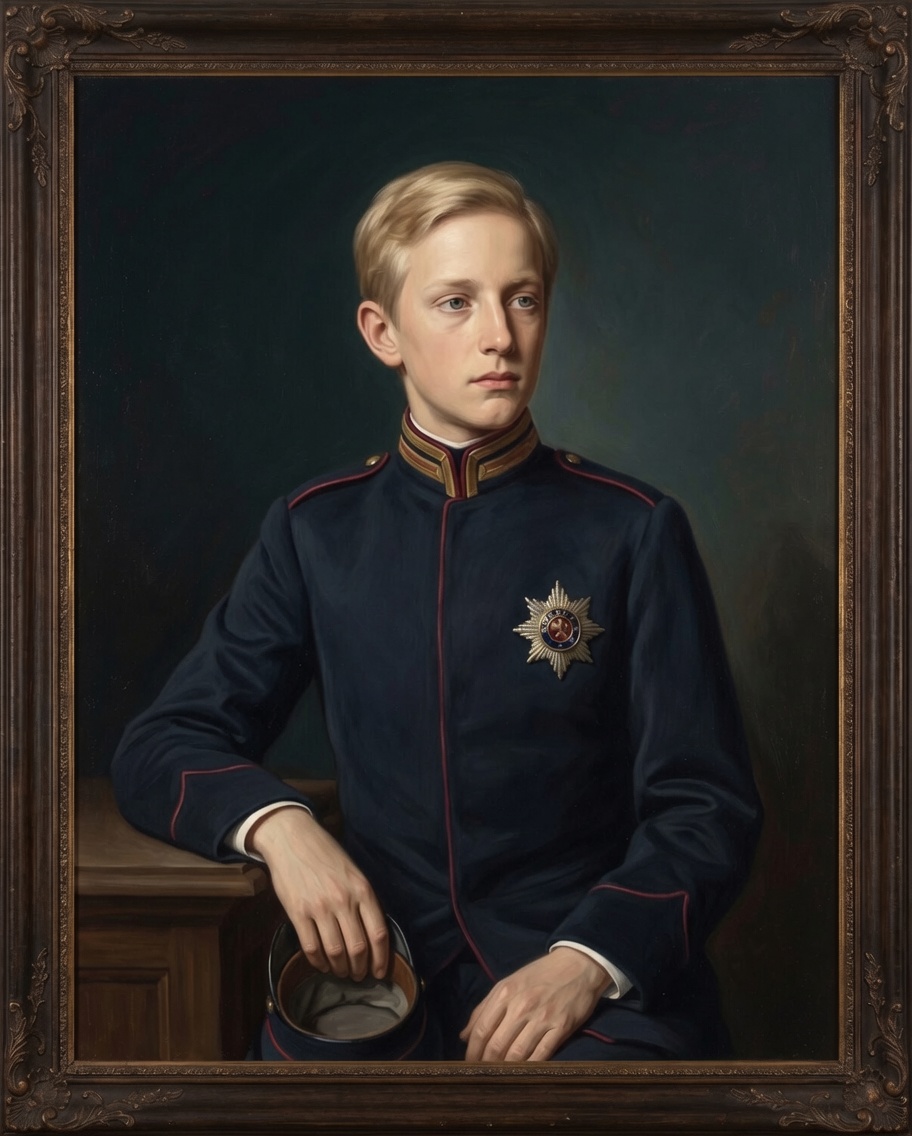
Three images of him circulate by the Household’s choice, and the difference between them is itself frequently remarked upon. The Household’s photograph, taken on his fifteenth birthday, shows him as he presently appears, a boy of his age. The painted state portrait, in ceremonial uniform and wearing the star of an order, was painted in 2026, when he was thirteen, by Dorothea Vance, an American painter, in six sittings. He asked about the pigments and she let him mix one, a grey for the uniform, which is in the picture. He refuses to say which part.
The third is the first official photograph of the reign, issued by Columbia Palace on 1 November 2028, the day after his accession. It was not taken that day. It is a later frame from the birthday sitting of 2 May 2028, in the same library, with his jacket off: an open-necked white shirt, one hand on the back of a reading chair, and, very slightly, a smile. The Household kept it back for six months and has not said why it chose it now, or what he was smiling at.
The fourth image was not chosen by the Household. It is the photograph of the apron on 29 September, of a boy standing beside the Governor-General as the door of his father’s aircraft opened. It is the first image of him that the Household neither issued nor permitted, and it has become the one by which most of the Realm knows what he looks like.
The nickname
Within the household Frederick is known by the phrase “the boy beneath the Crown.” It was coined in 2019 by the King’s Private Secretary, Sir Edmund Stanier, who is still in hospital at St John’s from Kittyhawk. It is a domestic nickname rather than a title, an official style or a description of any office. Frederick has said that he likes it, because it is true.
The Realm’s reaction
The Realm’s attitude changed in a fortnight. A survey before the loss found that a majority of Americans could not name the heir. A survey in the second week of October found that nearly all could, that most knew he was fifteen, and that more than half knew that he had written his own statements. The Household has asked that it not be treated as a poll of popularity. The Realm’s republican movement suspended its campaign for the duration of the regency. Its spokeswoman said that no argument against a monarchy is served by a child at his father’s bedside, and that the movement would resume when the regency ended or the question arose. Its supporters were divided about the statement, and the movement has not been asked to repeat it.
The regency question
Before the terms
Before 25 September the question of what would happen were the Crown to pass while the heir was still a minor was a live institutional concern and not a settled plan. The week of Kittyhawk answered a different question, what is done for a King who is alive and cannot act, and answered it three times in a week and thirteen times in a fortnight. Until 30 October the answer for the heir differed by realm. The Realm’s Regency Act 1811 made the adult heir Regent if he was of full age, which was eighteen, and otherwise the sovereign’s consort, so that on its terms Frederick would have taken the regency from his mother on 2 May 2031. Britain’s Act of 2 October 2028 named her and gave the heir no part. Britain’s draft minority bill, leaked on 28 September and introduced afterwards, would have let the heir act as Regent from sixteen, on 2 May 2029, and three realms said that they would not move from eighteen. Fourteen ages of majority were possible, and the law had nothing to say about a King who could reign in one realm and not in another.
His mother opposed the British draft privately. When the Clerk explained it to him, Frederick said, “I would rather be asked at eighteen”, and the Household told nobody.
The common terms
The terms of 30 October settled the question for the thirteen Compact realms by settling it in common. The age at which a sovereign reigns in his own right, and at which an heir may act as Regent, is sixteen in every realm, the three that had held out among them. Queen Christina is Regent for her son until his sixteenth birthday, and the question whether the Act of 1811, written for a King who cannot act, reaches a King who is a child does not arise. Malaya, which follows Britain by its constitution and needs no Regent, has nothing to decide. On 2 May 2029 he reigns in his own right in every realm at once.
The terms did not ask him. The age he said he would rather be asked at is the one the realms gave up, and he has not been asked since and has not said it again.
What the structure does
Under the doctrine of separation that governs the union, a regency for a minor King is not a single regency over an undivided state. The terms are common, but each realm gives them effect in its own law, and the Regent acts for George V in each realm separately, in the same way that his cousin Alexander has been served by distinct German and Prussian regency arrangements that never sit as one body. By 12 October 2028 thirteen of the fourteen realms had made his mother Regent for his father by their own instruments, and under the terms each gives her the same office for him. The terms took effect at six in the evening in London on 31 October 2028, two in the afternoon in New Westminster.
Failings
The Register states five failings plainly.
The statement of 2027. The Royal Household’s statement naming Theo Hartigan, issued in terms it believed would protect a private child from speculation, did the opposite. It cost Theo’s mother her place on a public-facing ward and the Hartigans their quiet, and it has been apologised for privately and never in public.
The nearly three days. The first words issued in Frederick’s name came nearly three days after the loss, and were his own. In the interval the public saw a household that had no voice for the heir and a press that had stopped observing its own rule.
The apron. The Household had not secured the airfield apron on the night of 29 September. A photographer who had been told that it was closed was there when a boy of fifteen walked beside his father’s stretcher.
The protection. The strictness of the arrangements around an only child on whom fourteen Crowns rest isolates the boy it is meant to guard.
The reliance on the Governor-General. The long reliance on the Governor-General has given the heir a guide and left no one in the capital whose job is to be his parent but his mother.
Assessment
Kittyhawk made him a public figure. Before it he was the fact around which an anxiety organised itself, and the Register’s judgement was that he had done nothing by which to be judged. He has now a short record: three statements that he wrote himself and a fourth that he read aloud, which the palace said was his, a seat at a table, a bedside, and a school lunch. For five weeks what the public saw him doing was being a son. On 30 October his father’s decision asked something else of him without his being asked, and on 31 October it was done: he became King at fifteen, with his mother as Regent, to reign in his own right at sixteen, two years before the age he once said he would have chosen. He became King in a geometry class, went back into it, read the trains at a hospital bed two hours later, sat at a Council without speaking, and issued four lines signed with his given name. Nothing in the record yet shows what kind of King he will be, and the Register does not forecast it.
Open questions
- How far his father recovers. He woke on 20 October and knew his family. On 24 October his physicians said that his speech and parts of his memory may not recover fully. He has been the Duke of Cumberland since 31 October and remains in New Westminster General.
- The heir to George V. His aunt, Queen Caroline, and after her the German Emperor and his sister. No instrument of any realm says what would follow if the line reached a sovereign who already reigns elsewhere.
- The age he would have chosen. He said that he would rather be asked at eighteen. The terms fixed sixteen, and nobody has asked him.
- The coronation. Announced for Westminster Abbey after his sixteenth birthday, on a date not yet fixed.
- A King at school. He finishes at Ellicott High School with his year, and the press understanding that keeps him out of photographs at school has not been tested by a sovereign.
Chronology
| Date | Event |
|---|---|
| 1 May 2006, before his birth | The May Day Bombings in New York, which he inherits as civic memory rather than experience |
| 2 May 2013 | Born at the Karolinska hospital in Stockholm, the son of Ernest V and Queen Christina; Crown Prince of Sweden and Duke of Öland by his mother’s decree; Prince of Wales on the following day |
| 2013 | Becomes heir apparent at birth; christened in the Royal Chapel at Stockholm Palace |
| From birth | Holds the automatic heir’s dignities of Good Hope, the Antilles and Wolfenbüttel under the several succession laws |
| 18 January 2014 | Birth of his first cousin Alexander, later Alexander I |
| Autumn 2016 | Moves to Columbia Palace for the nursery school, with a nanny and a household |
| 2018 | The decision that he will live in New Westminster; his mother moves with him |
| February 2019 | His first King’s Day balcony in London, aged five |
| 2019 | The nickname “the boy beneath the Crown” is coined |
| 2025 | Visits the Duchy of Cornwall with his father; begins Ellicott High School in September |
| 2026 | The state portrait is painted; the Crown Prince’s Course is published in Sweden |
| Spring 2027 | Confirmed in the Church of America at Columbia Cathedral |
| October 2027 | His first Riksdag opening |
| 2027 | The Household’s statement naming Theo Hartigan |
| 12 February 2028 | Heinrich I dies; Alexander succeeds at fourteen |
| 2 May 2028 | The Household photograph is taken on his fifteenth birthday |
| 25 September 2028 | The King’s aircraft is lost; he is told at about 6:15 p.m. |
| 26 September 2028 | The prayers at Columbia Cathedral; his mother arrives |
| 28 September 2028 | He is told at school; his first statement is issued that evening |
| 29 September 2028 | The second statement; the airfield apron |
| 30 September 2028 | Observer at the Privy Council when his mother is sworn Regent in the Realm |
| 2 October 2028 | Returns to school; his mother is sworn Regent of Great Britain |
| 3 October 2028 | The Household appoints a Press Secretary |
| 11 October 2028 | His cousin Charlotte becomes sole Regent of Prussia and the Empire |
| 12 October 2028 | Charlotte’s one-line letter |
| 20 October 2028 | His father wakes; he is brought to the hospital before dawn and the King knows him; his third statement; school in the afternoon |
| 24 October 2028 | The physicians’ warning; that evening he tells Theo Hartigan at the Hartigans’ table |
| 25 October 2028 | His fourth statement, read alone at Columbia Palace: his father has asked what an abdication would require |
| 30 October 2028 | His father decides to abdicate; the thirteen Compact governments agree that he will reign as George V, with his mother as Regent until 2 May 2029 |
| 31 October 2028 | The Realm, last of the realms, gives effect to the abdication, the Regent assenting at 11:42 a.m.; at 2 p.m. in New Westminster, 6 p.m. in London, he becomes King George V, in a geometry class; the hospital at four; the Privy Council proclaims him at Columbia Palace at six; the Regent’s statement and his fifth; Theo Hartigan’s appointment and the coronation announced |
| 1 November 2028 | Columbia Palace issues the first official photograph of the reign, a later frame from the birthday sitting of 2 May |
| 2 November 2028 | The San Andreas earthquake strikes Los Angeles; the King’s first message of the reign, four sentences in his own words |
| 2 May 2029 | His sixteenth birthday; under the common terms he reigns in his own right in every realm and takes his own oaths |
| 2 May 2031 | His eighteenth birthday, the age of majority in the Realm before the common terms |
Trivia
- In-Universe As heir Frederick held six heir's titles at once: Prince of Wales in Great Britain, Prince of Columbia in America, Prince of Good Hope in South Africa, Prince of Patagonia in the River Plate, Prince of the Antilles in the West Indies, and Prince of Wolfenbüttel in Brunswick. He called them 'my six hats'.
- In-Universe Separately from those six, Frederick was Duke of Cornwall, the historic male-only estate dignity of the British heir, the one title he held by reason of his sex rather than his place in line. He called it 'the one I can't give back'. It went back to the Crown at his accession.
- In-Universe In Sweden he is Crown Prince and Duke of Öland. The islanders call him Hertigen, the Duke, and have put his name on a bench at the gate of Solliden.
- In-Universe He was born at the Karolinska hospital in Stockholm so that he would be registered as Crown Prince at birth. His father flew from London the same morning and arrived late.
- In-Universe His first word was 'nej', no, and his mother's Private Secretary claims to have witnessed it. He spoke Swedish before English until he was three.
- In-Universe He moved to Columbia Palace at three, for the nursery school, on a one-year trial that was renewed twice. His nanny, Ruth Okafor, still has a postcard from every place he has been on a corkboard in her kitchen.
- In-Universe His mother moved to New Westminster in 2018 on one condition: 'I will not be a visitor in my son's life.'
- In-Universe At the King's Day balcony in London in 2019, aged five, he asked loudly why the guards did not move. He now asks the guards.
- In-Universe His father telephoned him every Sunday at four and the two played a game of naming the Crown in right of which an Act was passed. The last game before the loss was on 24 September 2028, and the answer was 'New Albion'.
- In-Universe Frederick is enrolled at school as Frederick Hanover, a surname no member of his family uses elsewhere. It placed him in the H's, and an alphabetical seating plan in September 2025 put him beside Theo Hartigan.
- In-Universe At careers day at Ellicott High School he wrote that he would like to be a railway signalman. The Charter makes no provision for it, and he said that it should.
- In-Universe He rows in the school's second eight, on the Potomac. The Household allows the river and not the regatta, so the crew trains for every race and enters none.
- In-Universe He can give the arrivals at Union Station for any day of the week, and he reads the next day's to his father at the hospital 'so he knows what's coming'.
- In-Universe He has a wall map with six realms marked, and has pencilled a seventh in Sweden and, in smaller writing, one in Malaya, which carries no heir's dignity of its own, and asked why not.
- In-Universe On the afternoon of 26 September 2028, his mother's first words to him were that she had been early. His first words to her were 'You were quick.'
- In-Universe He wrote his first statement on a page torn from a school exercise book and cut it by half before his mother asked for it to be shorter.
- In-Universe The photograph of Frederick on the airfield apron on 29 September 2028 was the first image of him that the Household neither issued nor permitted. It was taken by a photographer who had been told that the apron was closed.
- In-Universe He sat at the Privy Council's table on 30 September 2028 as an observer, took notes in a school exercise book, and asked the Clerk for a printed copy of the Regency Act, which he has marked in two colours.
- In-Universe The Prime Minister, who is twenty-six, sent him a note after his first Council: 'Welcome to the table. It is the worst seat in the room and the best view.' He asked whether the Prime Minister had read section 4.
- In-Universe The first fortnightly note from his Press Secretary, on 6 October 2028, read in full: 'Prince Frederick is at school. He asked that this note be short.'
- In-Universe About forty thousand letters have reached Columbia Palace addressed to him. Every Saturday he reads ten, chosen at random. The first was from a child in Bay Bulls.
- In-Universe A survey before the loss found that a majority of Americans could not name the heir. A fortnight after it, nearly all could, and more than half knew that he had written his own statements.
- In-Universe Princess Charlotte writes to him, and is the only member of the family who does. Her letter of 12 October 2028 was one line, and he has shown it to no one.
- In-Universe Frederick has two Swedish friends at Solliden, Elsa and Nils, who call him 'Fredde' and row him round the bay in a boat that leaks.
- In-Universe He likes his household nickname, 'the boy beneath the Crown', because it is true. It was coined in 2019 by the King's Private Secretary, Sir Edmund Stanier.
- In-Universe In his state portrait of 2026 the painter let him mix one pigment, a grey for the uniform. He refuses to say which part.
- In-Universe In his personal standard as heir the arms of the 1841 Royal Standard were differenced by a plain white label of three points, which gives the arms of Great Britain twice the space it gives the American eagle.
- In-Universe Frederick is an only child, so the direct line across fourteen Crown capacities and a fifteenth inheritance in Sweden rests on a single life. Behind him the line passes to his aunt, Queen Caroline, and then to his cousin Alexander I, German Emperor, and Alexander's sister Charlotte.
- In-Universe He reigns as George V, the first sovereign of his house to reign under a name he was not christened with. He is Frederick Alexander, and he signed his first statement as King 'Frederick'.
- In-Universe He became King at two in the afternoon on 31 October 2028, in a geometry class at Ellicott High School. His teacher was told by an email to the staff, asked to speak to him in the hall, and asked whether he wanted to come back in. He did.
- In-Universe His 'six hats' merged in the Crown when he acceded on 31 October 2028 and wait for an heir apparent. His aunt, who is next in line in all fourteen capacities, received none of them.
- In-Universe His statement of 25 October 2028 was the first he read aloud. He stood beside an empty table at Columbia Palace, read for about a minute, and took no questions.
- Design The article was rebuilt in October 2028 on a single change of framing: before Kittyhawk the Register's account of Frederick was an account of a fact, and the Household's rule was that little should be said about him. The rebuild keeps the rule about what is shown and lets the article say what the Household now says.
- Real-World Unlike the earlier kings of his house, who borrow the given names and life-shapes of the real-world Hanoverian pretenders even while their reigns and events are invented, Prince Frederick has no real-world counterpart at all. He is an invented heir, born in 2013 to a dynasty that by his generation has diverged entirely from recorded history, the line of descent having parted from our own at the setting's two points of divergence, the accepted Olive Branch of 1775 and the assassination of Queen Victoria in 1840.
See also
- The Royal Family Tree, the house and the houses it married into
- Queen Christina, his mother, the Queen of Sweden and Regent of thirteen of his father’s realms
- Ernest V, his father, and the reigning monarch of the personal union
- Kittyhawk, the loss of his father’s aircraft on 25 September 2028, the regency and the King’s waking on 20 October
- The King Wakes, the ABC’s record of 20 October
- The King’s Question, the ABC’s record of 25 October, with his statement from Columbia Palace
- The Privy Council, at whose table he sits as an observer
- Alexander I, German Emperor, his first cousin
- Princess Charlotte, his cousin, who writes to him and is now sole Regent of Prussia and the Empire
- Theo Hartigan, his closest friend
- Ernest IV, his grandfather, who held the dignity of Prince of Columbia before his own accession
- Styles and Titles of the Crown, for the fourteen Crown capacities and the doctrine of separation
- The Crown in Right, the capacity to which his American title attaches
- The Governor-General, the resident Crown presence and his guide to the American Crown
- The Scandinavian Union, within which his mother reigns as Queen of Sweden
- The Duchy of Kernow, the civic duchy distinct from his Cornish estate dignity
Categories
People · House of Hanover · Heirs Apparent · United Kingdom of America · The Personal Union · Scandinavian Union · Present Order