Ernest I
Ernest I was King of Great Britain and of the United Kingdom of America from 1840 to 1851. Born on 5 June 1771, he came to the throne at sixty-nine on the assassination of Queen Victoria in 1840 and died in 1851, aged eighty, being succeeded by his son Ernest II. His accession also reunited the Kingdom of Hanover, which had passed from the British Crown to him separately in 1837 because Hanoverian succession law barred a woman from the throne, with the British and American Crowns. He is the first monarch in the United Kingdom of America’s own regnal numbering and the first of the Ernestine line that has held the shared Crown ever since.
He was a soldier-prince and dynast of the older Hanoverian formation, and he did not accept the constitutional position he inherited. He understood the forms of parliamentary monarchy well enough to object to them precisely, and regarded ministerial advice, parliamentary confidence, responsible government, and the Charter settlement as machinery for reducing a sovereign to a seal. He complied with constitutional limits when he had to, and his compliance was generally grudging.
Victoria’s assassination shaped the whole of his reign. He held it to demonstrate that a public and affectionate constitutional monarchy had exposed the sovereign to danger while depriving her of the authority to be protected, and he used the argument to press for harder security powers and a wider royal discretion. His grief is not treated in the Register as insincere. What followed from it was an interpretation, and he governed by that interpretation for eleven years.
His reign coincided with the westward expansion of the Union and with the deepening of the mid-century slavery crisis, and on both of those questions the pattern of his kingship is instructive. The admission of Texas, the war with Mexico, and the settlements that followed were the work of ministers and of Parliament. On each the King completed the formal acts required of him on American advice, held no operational command, and did not initiate the policy. The monarch who wished to command found that on the largest matters of state he acted as a constitutional instrument, which is the condition his reign is chiefly remembered for resisting.
He is treated as one of the more consequential monarchs of the line on the ground that he failed. His sustained testing of the Charter settlement obliged Parliament, ministers, the courts, and the Governors-General to state the limits of the Crown more precisely than they previously had, and the body of hardened convention that resulted is known as the Ernestian Settlement. The work of making that settlement bearable for the Crown, rather than merely binding upon it, was left to his successor.
Name, styles and titles
Regnal name and numbering
Ernest reigned under his own baptismal name, there being no earlier king of Great Britain who had borne it. In the American realm the ordinal is a literal statement rather than a courtesy: he was the first of the name, and he remains the first entry in a numbered sequence that the United Kingdom of America keeps for itself.
That sequence begins with him for a reason particular to 1840. The British Hanoverians had run George, George, William, and Victoria, a series the American realm had simply shared. Victoria’s assassination carried the succession out of her direct line and into the Ernestine branch of the house, and the realm that received the new King had by then acquired enough of its own constitutional character to name its monarchs in its own tradition rather than as a continuation of a British count. The line accordingly runs Ernest I to Ernest V, an American numbering for a shared house, and it was fixed at the moment when the shared house passed to a monarch the American political class regarded with open suspicion. The convention outlasted the suspicion. It is now the ordinary way the realm refers to its sovereigns, and its origin in a contested accession is remembered chiefly by constitutional historians.
The name itself, Ernest, from the German Ernst, carries the sense of seriousness or earnestness. It entered the American regnal vocabulary with him and has been borne by each of his four successors, acquiring a different colouring in each reign. In his own it is associated with confrontation.
Style and the shared Crown
Ernest I’s full style named two Crowns outright and folded the rest into a single phrase: King of the United Kingdom of Great Britain and Ireland, King of the United Kingdom of America and of His Other Realms and Territories, Defender of the Faith. In his reign the union was small by the standard of the modern Crown. It comprised three capacities only: Great Britain, the United Kingdom of America, and, from 1840, Hanover. The kingdoms and duchies that later swelled the personal union, New Albion, Brunswick, South Africa, Ireland as a separate Crown, and the rest, were all acquired by his successors. His was among the last reigns in which the sovereign held three capacities or fewer.
The constitutional grammar of the shared Crown was already settled in principle when he acceded, and he spent much of his reign contesting its application. The same natural person held each Crown as a separate legal capacity, and acted in each only on the advice of that realm’s own ministers. The King resided in Great Britain and reigned in the United Kingdom of America in right of America, the resident Crown presence there being the Governor-General rather than the monarch himself. Ernest disliked the arrangement and probed it repeatedly, and the effect of his probing was to force the doctrine of the Crown in right of America to be stated with a precision it had not needed before he tested it.
He was also Defender of the Faith and Supreme Governor of the Church of England and of the Church of America, the Anglican establishment of the American realm. The ecclesiastical dignities were among the parts of his inheritance he valued most, since they expressed a conception of the Crown as an office of divinely sanctioned authority rather than of civic convenience. They were not a significant site of constitutional conflict during his reign, and are treated here as part of his style rather than of his contest.
Honours and the fount of honour
As sovereign, Ernest was the fount of honour, the source from which peerages, knighthoods, and appointments in the several realms formally flowed. In the British and Hanoverian capacities the older understanding of honour as a personal gift of the King survived with fewer constraints than it did in America, and Ernest exercised it there with evident satisfaction. In the American capacity the same power ran through ministers and through the Governor-General, and Ernest found even honours a matter for constitutional argument, since the disposal of American dignities on American advice denied him precisely the personal patronage he most wanted to keep.
The tension was characteristic. Where the Crown’s ceremonial and honorific functions could be performed as acts of personal will, he embraced them. Where they had been absorbed into the machinery of responsible government, he treated their exercise as a further instance of the reduction he objected to, and the honours system in America became one of the smaller theatres of the larger dispute that defines his reign.
Early life
Birth and family
Ernest was born on 5 June 1771 in London, a younger son of George III and of Queen Charlotte, born Charlotte of Mecklenburg-Strelitz. He was one of a very large royal family, and his place within it was that of a prince unlikely, on the ordinary run of events, ever to reign. His eldest brothers stood far ahead of him in the succession, and the expectation that governed his upbringing was that he would live as a royal duke and a soldier rather than as a king.
That expectation proved wrong twice over, and each reversal is essential to his history. The first carried him, in 1837, to the separate throne of Hanover, which the succession law of that kingdom directed to the nearest male heir when the British and American Crowns passed to a woman. The second carried him, in 1840, to the British and American Crowns themselves, when Victoria’s assassination brought the succession back to his branch of the house. A prince raised on the assumption that he would never rule became, in old age, a king three times over.
Upbringing
His formation was that of the older dynastic world into which he was born: military, aristocratic, Protestant, and hierarchical. He was educated in part in the German lands of the family, and he absorbed there a conception of monarchy as inheritance, command, and duty rather than as a form of civic restraint. He did not come to constitutional monarchy in ignorance of it. He learned its principles thoroughly and disliked them on their merits, which is why his later objections were exact rather than merely obstinate.
He trained as a soldier and served in the cavalry during the wars against revolutionary France, where he was wounded and lost the sight of one eye. The experience fixed a lifelong regard for the army and for the vocabulary he associated with it, of obedience, oath, rank, and command, which he set against the vocabulary of ministers, elections, and newspapers. He trusted the first and distrusted the second, and the preference, harmless in a soldier-prince, became a constitutional difficulty in a king. His military bearing and his damaged face contributed to a public image of severity that his politics did nothing to soften.
The years as a royal duke and King of Hanover
For most of his life he was a royal duke, holding a British dukedom and sitting in the House of Lords, where he became known as one of the most reactionary figures of the peerage. He opposed the loosening of old restrictions, distrusted reform of every kind, and was the subject of hostile rumour throughout his career, some of it politically motivated and none of it ever established. He was, by the time he came to any throne, a practised and unapologetic opponent of the direction in which the age was moving.
In 1837, on the accession of Victoria, the Kingdom of Hanover passed to him alone, Hanoverian law excluding a woman from that throne, and for three years he ruled there as a sovereign in his own right while Victoria reigned in Great Britain and America. His Hanoverian kingship showed, in a smaller and less constrained arena, the temper he would later bring to the shared Crown. He treated the constitutional undertakings of his predecessors as obstacles to be reduced rather than as compacts to be kept, and he governed Hanover as a monarch who regarded the settled limits on royal authority as concessions that a firmer sovereign might recover. The three Hanoverian years are read in retrospect as a rehearsal. What he attempted in a German kingdom without an entrenched charter, he attempted again, and failed at, in a realm that had one.
Character and temperament
He was severe, courageous, obstinate, and intelligent, with a soldier’s directness and a dynast’s confidence in his own right to rule. He was not a stupid man and was not a frivolous one, and his opponents did not make the mistake of underestimating him. His fault, in the constitutional terms by which the Register assesses him, was not incapacity but conviction: he believed that the monarchy had been talked into a decline dressed up as maturity, and he believed it was his office to arrest that decline.
He read the reigns of his brothers George IV and William IV as cautionary in opposite ways, the first for a frivolity that had cheapened the Crown, the second for a readiness to yield under political pressure that had weakened it. He regarded the settled constitutional position not as the monarchy’s salvation but as its managed surrender, and he thought of himself as a corrective to it rather than as a danger to it. That self-understanding is the key to the reign. He did not set out to break the constitution. He set out to restore a Crown he believed had been improperly diminished, and the constitution defended itself against the attempt.
Accession and coronation
The reunification of the crowns in 1840
Queen Victoria was assassinated in 1840, and Ernest acceded at sixty-nine. The event determined his historical position. Without it he would have remained a reactionary prince with a separate German kingdom, remembered, if at all, as a footnote to Victoria’s reign. With it he became a monarch able to argue that events had confirmed his view of what constitutional monarchy exposed a sovereign to.
The accession changed the character of the reign abruptly. A realm that had looked forward to a long reign under a young queen received instead an elderly, militarily formed, and openly reactionary king who did not accept assumptions the political class had come to treat as settled. It restored an older male authority to a throne that had briefly been held by a young woman, converted royal mourning into royal severity, and installed at the head of the state a man who regarded the murder as an argument.
It also reunited Hanover with the British and American Crowns after three years of separation. The Kingdom of Hanover, severed from the main Crown in 1837 under Salic law, returned to it in the person of the same heir who had inherited it alone, and it has not separated since. The reunification is a small point of dynastic law and a large point of symbolism, and Ernest attached great weight to it. That the three Crowns were held together in one man became, for him, a statement about the nature of monarchy that he was determined to make visible, most durably in the royal arms he adopted the following year.
Coronation
Ernest was crowned in Great Britain in 1841, at Westminster Abbey, with the full traditional rite of a British coronation. The American realm did not hold a separate coronation. Consistent with the constitutional geography of the shared Crown, in which the monarch resides in Britain and the reign is made operationally present in America through the Governor-General, the American accession was marked by proclamation and by the ordinary instruments of state rather than by a crowning of its own. Ernest, who would have preferred a more personal American presence for the Crown, had no means of altering the arrangement, and the manner of his own accession illustrated at the outset the distance between the monarch and the American realm that he spent his reign trying and failing to close.
The rite itself was performed without incident. What contemporaries noticed was less the ceremony than the man at its centre: an old soldier of settled and unfashionable opinions, crowned in the place of a murdered young queen, whose accession the country greeted with formal loyalty and considerable private unease.
The early reign
The first difficulty of the reign was not any single proclamation but the character of the questions the new King began to raise. He came to the throne with a formed view of what a monarch might properly do, and he set about discovering, question by question, how much of that view the constitution would bear. The realm, still in the shock of the assassination, was slow at first to understand that the new King intended not to preside over the settled order but to test it.
The early years therefore have a deceptive quietness. Ernest observed the forms, gave the assents required of him, received his ministers, and conducted the ceremonial of the Crown. Beneath the forms he was probing, and the ministers who dealt with him came to understand quite quickly that his compliance was conditional and that his questions were not idle. By the middle of the decade the character of the reign was no longer in doubt.
Reign: constitutional method
How he tried to use the Crown
Ernest’s method was not confrontation on a single grand issue but pressure applied continuously across many small ones. He rarely refused outright what the constitution plainly required, since he understood that an open refusal would produce a crisis he was likely to lose. He preferred to delay, to question, to require ministers to justify what they had assumed they might simply do, and to treat as an occasion for the exercise of judgement what his predecessors had treated as a form.
He delayed decisions in order to oblige ministers to return with different advice. He questioned whether particular ministries genuinely held the confidence of Parliament, and pressed the point when he thought a government weak. He treated royal assent as a matter on which a King might have an opinion rather than as an automatic act. He used royal speeches, which ministers wrote, as occasions to convey a tone they had not intended, and disputed their wording. He spoke of the army in personal terms, as though its loyalty ran to him rather than to the Crown as constituted by law. He sought wider security powers in the aftermath of the assassination, and took a restrictive view of the press and of public assembly. None of these, taken singly, amounted to a rupture. Taken together and sustained across a decade, they amounted to a programme.
Ministers and Governors-General
Ministerial government under Ernest required continuous care. The premiership passed through several hands during his reign. Henry Clay was his first Prime Minister, having held the office since before the accession, and gave way in 1844 to Daniel Webster, under whom the admission of Texas and the war with Mexico were carried; Webster in turn gave way in 1850 to Sam Houston, whose ministry ran on past the King’s death. Each had to manage a sovereign who did not accept the premises on which their authority rested. Ministers held that they governed in the Crown’s name because they commanded the confidence of Parliament. The King held that they were using that confidence to take possession of the Crown. A Prime Minister of the period had to refuse improper pressure without appearing disloyal, to protect the dignity of the Crown while confining the King’s discretion, and to prevent the assassination from becoming a warrant for emergency powers.
The office of Governor-General was among the principal points of contention, and its handling during the reign is instructive precisely because the same men recur in it. John Quincy Adams held the office in the early years and gave way in the middle of the decade to Henry Clay, who passed from the premiership to Government House and held the vice-regal office until his death in 1852, a year after the King’s own. Ernest wanted the Governor-General to serve as an instrument of royal will, a channel through which his personal direction might reach American government. American convention held the office to be a constitutional one, representing the Crown in right of America rather than the King in his own person, and answerable in American matters to American ministers. Dispatches from London that read as commands were liable to become constitutional incidents, and under Ernest’s pressure the doctrine that the Governor-General represents the Crown and not the monarch was defined more sharply than it had been before he tested it.
The Crown and Parliament
Parliament became more self-conscious in consequence of the reign. The Commons came to treat supply, address, inquiry, and confidence explicitly as instruments of constitutional defence rather than as the ordinary tools of politics, and members learned to read royal speeches and royal silences for signs of the pressure they had come to expect. A chamber that had not needed to think hard about the limits of the Crown, because earlier monarchs had not pressed them, was compelled to think about little else.
The House of Lords faced a harder question, which was whether loyalty to the Crown was the same as loyalty to the King’s view of it. The peerage divided. Some peers supported Ernest as the defender of an older and grander conception of monarchy, and shared his distaste for the direction of the age. Others, including men of impeccably conservative temper, judged that his conduct would discredit the aristocracy, provoke the Commons, and damage the Crown by making it appear personally hostile to constitutional government. The chamber arrived, slowly and against its own instincts, at the conclusion that defending the monarchy could require restraining the monarch. That conclusion, reached by a conservative House about a conservative King, is among the more consequential things the reign produced.
The constitutional crisis of the Iron King
The questions he raised
The crisis of the reign was not a single event with a date but a sustained contest over a set of questions, and the questions matter because they were real. Ernest asked whether the King was obliged to accept any ministry that claimed the confidence of Parliament, or whether he retained a genuine choice. He asked whether royal assent was truly automatic, or whether it preserved a residue of judgement. He asked who controlled the language of royal speeches. He asked whether he might instruct the Governor-General of the United Kingdom of America directly, over the heads of American ministers. He asked whether the army’s oath ran to the King personally or to the Crown as constituted by law. He asked what powers the Crown held in an emergency following a regicide.
These were not trivial or invented difficulties. They addressed genuine ambiguities in a system whose conventions had survived, in part, because earlier monarchs had not chosen to press them. The settlement of 1783 and the practice built upon it had left a great deal unstated, on the reasonable assumption that sovereigns would not seek to exploit the silences. Ernest sought to exploit them, and the constitution discovered where it was underspecified.
The Ernestian Pressure Period
The central phase of the reign is known to constitutional historians as the Ernestian Pressure Period, a term describing a pattern rather than an episode. It was a sustained campaign of boundary-testing that never produced a decisive rupture and never stopped. Ernest encouraged the Lords to obstruct reform originating in the Commons; pressed his Prime Ministers over appointments; treated assent as an occasion for the expression of royal displeasure; sought to widen the Crown’s security powers by reference to the danger the assassination had revealed; and returned, again and again, to the proposition that the sovereign retained discretions that ministers were improperly denying him.
No single one of these produced the crisis that his opponents at times feared and that he himself, in his more combative moods, may have wanted. He was too careful, and too experienced a political operator, to stake the Crown on a confrontation he might lose outright. The cumulative effect of the pressure, however, was to force the institutions of the realm to define, one by one, the limits he was probing. Each time he tested a silence, the silence was replaced by a rule, and the rule was made against him.
Defeat and the hardening of the constitution
Ernest lost. He did not lose in a single defeat that can be dated and narrated, and he was never removed or openly humbled, which is one reason the outcome of his reign is easy to understate. He lost in the accumulation of settled answers to the questions he had raised, every one of which went the constitutional rather than the royal way. By the later part of the reign he was more contained than he had been at its outset: surrounded by clearer rules, firmer ministers, more cautious courtiers, and institutions that had learned his methods and prepared for them in advance. His supporters remained loyal without being able to deliver him a victory. His opponents remained watchful without being alarmed by every royal act.
The body of hardened convention that resulted is the Ernestian Settlement, and it is the substantive legacy of the reign. It comprised, among other things, the confirmation of responsible government, the reduction of royal assent to a form, the doctrine of the Crown in right of America and the constitutional neutrality of the Governor-General, a settled understanding that the military oath ran to the Crown as constituted by law and not to the King in person, and a durable suspicion of any claim to personal royal emergency powers. Each of these was stated explicitly because Ernest had attacked its implicit form. The settlement was, in effect, written by his failure, and the later Ernests inherited as plain constitutional certainty a set of positions that had been ambiguous until he forced them into definition.
Expansion and the slavery crisis
Westward expansion and the admission of Texas
The largest events of the reign, measured by their consequences for the Union, were not constitutional contests at Westminster but the westward expansion of the realm and the crisis over slavery that expansion sharpened. On these Ernest was, constitutionally, a formal actor, and the contrast between the scale of the events and the smallness of his part in them is among the defining facts of his kingship.
The admission of the Republic of Texas fell in Webster’s ministry. It was accomplished by negotiation rather than annexation, through the Treaty of Austin of 1845 and the reciprocal Acts of Union that followed, and it brought Texas into the realm in 1846 as a non-Crown constituent republic that kept its own president, congress, and courts. The King’s part was to complete the formal acts required of him. He ratified the treaty jointly with President Anson Jones of Texas, and he did so, as the settlement expressly recorded, on legislative authority and not on personal prerogative. The distinction was precisely the kind he spent his reign resisting, and here it governed the single largest addition to the realm made in his lifetime. The monarch who wished to rule ratified the admission of a republic as a constitutional instrument acting on the authority of legislatures.
The Mexican-American War
The admission of Texas was the immediate background to the war with Mexico, which ran from 1846 to 1848, with occupation and phased withdrawal continuing into that year. The Register classifies it as an expansionist conquest by the United Kingdom of America rather than a defensive war. It arose from the Webster ministry’s decisions to press a disputed boundary, to occupy contested ground along the Rio Grande, to refuse withdrawal, and then to widen a frontier action into the conquest of New Mexico, California, and the Mexican heartland, culminating in the occupation of Mexico City. Parliament declared that a state of war existed and voted the supply; the ministry directed the policy; and Winfield Scott served as General-in-Chief for the decisive campaign from Veracruz to the capital.
The King’s constitutional part was formal. Ernest completed the acts of state required of him on American advice, held no operational command, and did not initiate the war. Parliament, not the Crown or the Governor-General, controlled the military supply, and the Governor-General of the day, Henry Clay, was a constitutional witness to the settlement rather than a negotiator or a commander. A monarch of Ernest’s temper might have wished the war to be a royal enterprise; it was in law and in practice a ministerial and parliamentary one, and his exclusion from its direction was one more instance of the containment his reign is remembered for.
The war’s conduct is treated in the Register without mitigation. It was far more lethal to the invading army through disease than through combat, and it was lethal to Mexican soldiers and to an unknown but substantial number of Mexican civilians. The bombardment of Veracruz involved civilian loss. United Kingdom of America troops committed looting, sexual violence, killings, coercive requisitions, and collective punishment; Mexican regular and irregular forces killed prisoners, teamsters, civilians, and suspected collaborators. The Treaty of Guadalupe Hidalgo, signed in 1848, recognised the Rio Grande boundary and ceded Alta California and New Mexico, in an English and a Spanish text of equal authority, and its guarantees of the land and legal standing of the ceded population proved weak in practice and coexisted with generations of dispossession.
The deepening slavery crisis
The territory won from Mexico intensified the question the founding had deferred. The Charter of 1783 had kept the Crown and postponed the hard questions, slavery above all, in what the realm’s own tradition calls its honest silence, and the mid-century expansion made that silence unsustainable. Every acquisition of western territory reopened the question of whether slavery would extend into it, and the war Ernest presided over enlarged the ground on which the question would be fought.
The crisis deepened but did not resolve during his reign, and the settlement reached in his last full year set the terms on which it would continue. California was admitted as a free Commonwealth under the settlement of 1850; other western territories were left to popular sovereignty subject to review in the federal courts; and Parliament strengthened the enforcement measures directed against people escaping from slavery, a hardening of the law against the enslaved that belongs to the record of the period. The courts, in the same years, narrowed the citizenship language of the founding documents so as to exclude the enslaved from its protection. The abolition of slavery, the civil war that preceded it, and the Rights Act that followed all lay beyond Ernest’s death, in the reigns of his son and grandson. What his reign contributed was the enlargement of the arena and the sharpening of the dispute, carried through by ministers over whose policy the King had views and no operative power.
Marriage, family and succession
Marriage and consort
Ernest had married, well before any of his accessions, his cousin Frederica of Mecklenburg-Strelitz, who became queen consort on his accession to the British and American Crowns in 1840. Her tenure as consort was brief. She died in 1841, the first full year of the reign and the year of the coronation and of the adoption of the royal arms that most clearly expressed the King’s understanding of his own position. Ernest did not remarry, and he reigned for a further decade as a widower.
The marriage produced the son who would succeed him. In every other respect his family life is of little constitutional consequence and is not treated at length here; the household of an ageing, widowed, and severe king was not a centre of the realm’s public life in the way that a young queen’s had briefly been, and Ernest neither sought nor achieved the domestic and affectionate image that Victoria’s marriage had begun to give the Crown.
The succession to Ernest II
His heir was his only surviving son, George, born in 1819, who was blind for most of his life. On Ernest I’s death in 1851 the son succeeded as Ernest II, taking the Ernestine regnal name in continuity with his father, and all three Crowns, Great Britain, the United Kingdom of America, and Hanover, passed together and undivided, the reunion of 1840 holding at the first succession that tested it.
The character of the two reigns could hardly have differed more, and the difference is the point of the succession. Ernest II had grown to adulthood watching his father test the constitution and watching the constitution refuse to give way, and he drew from the spectacle a conclusion of constitutional realism rather than of conviction. Where the father had spent his reign attacking the settlement, the son spent his reign making it habitable, inhabiting without visible grievance the limits his father’s failure had hardened into definition until they came to be treated as ordinary. The Ernestian Settlement was Ernest I’s involuntary bequest; making it bearable for the Crown was Ernest II’s deliberate work. The pattern by which one Ernest defines a constitutional question and the next domesticates it began here, and it recurs across the line.
Heraldry, residences and the royal estate
Arms, standard and cypher
The most durable object Ernest I left to the realm is a flag, and it is a flag that states his understanding of his own kingship more plainly than any of his words.
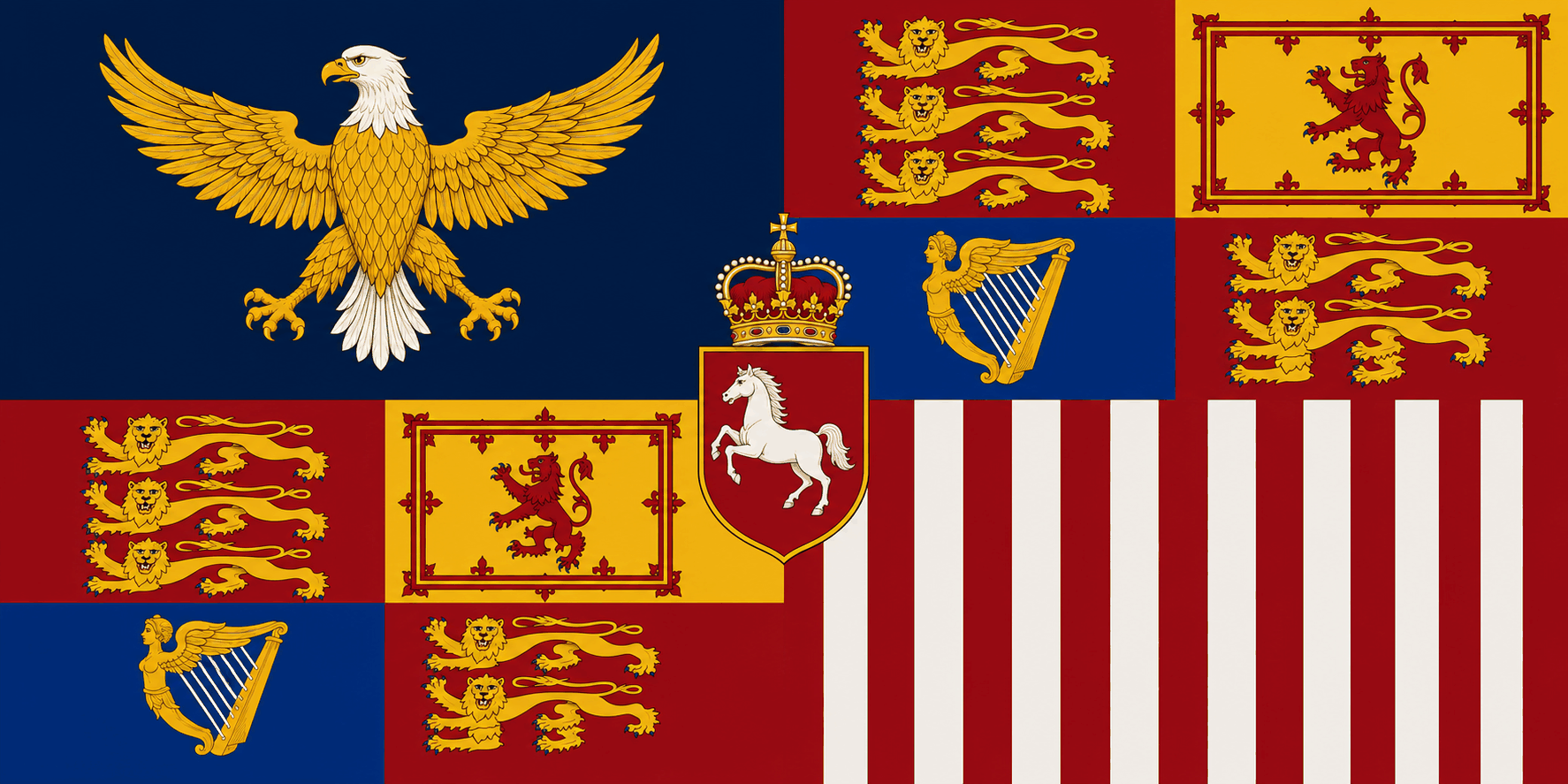
The Royal Standard of the United Kingdom of America was adopted in 1841, during the first full year of the reign, and it has never been replaced; the banner in use today is the banner of 1841 unaltered. It is a banner of the royal arms, quartered. The first quarter bears the gold eagle displayed on navy that is the device of the Realm, shown uncrowned and with empty talons. The second and third quarters bear the royal arms of Great Britain, the lions of England, the lion of Scotland, and the harp of Ireland. The fourth quarter bears thirteen upright red and white stripes for the founding colonies. Over all is set an inescutcheon of Hanover, the white horse on red, ensigned with the crown of Hanover.
The proportion is the meaning of the object. The arms of Great Britain occupy two quarters of the four and the American device occupies one, on a standard flown for the King in his American capacity, so that the composition places the arms of another realm at its centre and the American device in a single corner. Contemporaries read this as a statement of the constitutional relationship in reverse, and the reading was correct: the Standard is a document of Ernest I’s understanding of the Crown, in which America was held through Britain rather than in its own right. The Hanoverian inescutcheon was the innovation contemporaries noticed first. Hanover had been severed from the British Crown in 1837 and its arms removed from the British royal arms that year; Ernest, holding both Crowns in his own person, restored the device to the centre of his American standard, asserting that the American and Hanoverian Crowns were held together in one man.
Under the Realm’s flag code the Standard flies only where the sovereign is personally present, is raised on his arrival and lowered on his departure, is never flown in his absence, and is never flown at half-mast, on the principle that the Crown is continuous and does not die. The Governor-General does not fly it, the distinction being treated as constitutionally significant, since the Standard marks a person and not an office. Because Ernest never resided in America, the standard he designed to assert his American kingship flew over him in Britain and in Hanover and effectively never over American ground. It has been a standing constitutional irritant since its adoption. Republican and Americanist critics read it as stating the relationship backwards; its defenders concede the reading and argue that it is a historical instrument recording the mind of the monarch who commissioned it, whose survival unaltered measures how far the doctrine of the Crown in right of America has since travelled. Proposals to revise it have been raised periodically and have all failed, successive ministries judging the question not worth the authority it would cost. The fuller treatment of the Standard is given with the doctrine of the Crown in right of America.
His royal cypher followed the ordinary form, the initial of his name beneath the crown, and the white horse of Hanover served as his personal device, a badge he used with deliberate frequency after 1840 as a mark of the reunion he prized.
Residences, including Hanover
Ernest resided in Great Britain, as the shared Crown required its monarch to do, using the royal palaces of the British capital and countryside in the ordinary way of the sovereign. After 1840 he divided his attention between Britain, Hanover, to which the reunion of the Crowns and his own long attachment repeatedly drew him, and Scotland, where he restored Stirling Castle as a royal residence and where he is treated separately below. In Hanover he kept the royal residences of the kingdom he had ruled alone since 1837, and he treated the Hanoverian capital as a home in a way that he never treated the American one.
He never set foot in the United Kingdom of America. The realm over which he reigned in right of America, and whose kingship his royal arms were designed to assert, was governed in his name by the Governor-General from Government House and never saw its King. The absence was not peculiar to Ernest, the monarch’s residence in Britain being a structural feature of the shared Crown, but in his case it sharpened the constitutional distance he resented, since he could neither reside in America nor direct its government from Britain. He died where he had reigned longest and most freely, in Hanover, in 1851.
Stirling Castle
Ernest I restored Stirling Castle as the sovereign’s Scottish residence in the 1840s, and it is the only place where his conception of monarchy succeeded.
He wanted the Crown to be personally present in each of his realms and was refused almost everywhere. America had a Charter, a Governor-General and a political class that regarded him with open suspicion, and he had no means of altering the arrangement. Scotland had no Governor-General, no separate charter to invoke, and the seat of the Stewart kings standing in Crown hands as a barracks, which is what the British state had made of it in the two hundred and forty years since the court left for London in 1603. He took it, restored it, moved a household into it and held court there.
Scotland was not consulted. A Hanoverian king was occupying the seat of the Stewart kings ninety-four years after Culloden, in a castle within sight of Bannockburn, and Scottish opinion of the period read it as an appropriation of Scottish royal history by a dynasty with no Scottish connection whatever. The reading was correct and the Register does not soften it. The Kingdom of Scotland treats the consequences, including the public access to the castle that Scotland has been negotiating ever since and has never fully recovered.
The irony is exact and belongs here rather than in the Scottish article. The standard Ernest designed in 1841 to assert an American kingship he could not exercise effectively never flew over American ground and flew regularly over Stirling. The king who is remembered in America for a reign of confrontation and failure got, in Scotland, precisely the thing he wanted, by the simple expedient of choosing the realm with no instrument to stop him.
His successors kept coming, and the ceremonial character of Stirling as the place of Scottish honours, St Andrew’s Day, remembrance and constitutional anniversaries is a consequence of a residence acquired in this manner. A hundred and eighty years of attendance has made tolerable something that began as a taking, which is a fair description of a good deal of what the Ernestine line inherited from its founder.
The Crown estate
The material provision for the Crown in his reign followed the settled distinction between the hereditary estates and revenues of the Crown, administered as public property, and the private property of the sovereign. In the American capacity the civil provision for the Crown was voted by Parliament and administered through American officers, and it was a matter, like so much else in the reign, on which Ernest’s wishes ran into the machinery of responsible government. He held the estates and revenues of his several Crowns as a sovereign of his period ordinarily did, and the arrangements did not become a significant site of the reign’s central conflict. They are recorded here for completeness rather than for controversy: on the constitutional question that defines him, the disposition of money and land was one more area in which the King found that a modern Crown owned less outright, and controlled less personally, than the older conception he held would have allowed.
Public image
Contemporary reputation
Ernest I was not a loved king and did not try to be one. He came to the throne over the body of a young queen whom the realm had begun to cherish, and the contrast worked steadily against him. Where Victoria had been young, female, newly married, and full of promise, Ernest was old, male, widowed within a year, and openly out of sympathy with the direction of the age. The mourning for his predecessor did not transfer to him, and the security and severity with which he answered her death, however sincerely felt, confirmed rather than dispelled the public unease.
His reputation divided along the lines of the constitutional contest. Royalists, high-Crown loyalists, and much of the army admired his firmness and regarded him as the defender of a monarchy that lesser men had let decline. Reformers, much of the Commons, the American political class, and a hostile press regarded him as a reactionary who was straining the constitution and endangering the Crown by making it appear the enemy of constitutional government. Both readings had substance, which is why the argument over him was serious rather than merely factional. He was formidable, and he was resented, and the two facts were connected.
Popular names and later memory
The competing descriptions of him were established quickly and have proved durable. Royalists called him the Iron King, for a firmness they admired; the name has outlived the admiration and is now used with more ambivalence than praise. Critics called him the Reactionary King, and, in the American constitutional tradition that grew partly in response to him, the monarch the Union survived. His death in 1851 produced formal mourning and undisguised relief in roughly equal measure: genuine grief from royalists, from the army, and from those who had valued severity after a regicide, and an unconcealed easing among ministers, Commons leaders, and constitutional reformers who had spent a decade managing him.
Later memory has treated him as a stress that the constitution passed rather than as an author of anything he intended. He is not celebrated in the Realm, which honours few of its monarchs and did not honour this one, but he is acknowledged, on the ground that the settlement he attacked emerged from the reign stronger and clearer than it had entered it. The Iron King is remembered, in the end, less for his iron than for what the iron was broken against.
Assessment
Ernest I’s legacy is generally treated as the opposite of his intention. He sought to restore a commanding monarchy and left the Crown more clearly constitutional than he found it. The conventions his reign hardened into definition, collectively the Ernestian Settlement, included responsible government, the limits of royal assent, the doctrine of the Crown in right of America, the constitutional neutrality of the Governor-General, the understanding that the military oath runs to the Crown in law and not to the King in person, and a durable suspicion of personal royal emergency powers. Each was made explicit because he had attacked its implicit form, and each was made against him.
The reign is also a study in the limits of royal will on the questions that mattered most. The admission of Texas and the conquest of Mexico enlarged the realm and deepened the crisis over slavery, and on both the King acted as a constitutional instrument, ratifying and assenting on advice, holding no command, and shaping nothing. The monarch who spent his reign contesting his reduction to a formal actor was, on the largest matters of his reign, exactly that. It is a fair measure of how far the containment had already gone by 1840, and of how much further his own conduct carried it.
The lesson the Register draws from the reign, and the reason it is taught as consequential, is that constitutional monarchy cannot rest on the assumption that monarchs will be constitutional by temperament. A system that had relied on the good manners of its sovereigns was compelled, by a sovereign without them, to write its assumptions down. The Union does not celebrate Ernest I. It records that its Charter was tested by a king who resented it and held, and that the work of making the resulting settlement bearable for the Crown fell to the son who succeeded him.
Chronology
| Year | Event |
|---|---|
| 1771 | Born 5 June in London, a younger son of George III and Queen Charlotte |
| 1790s | Serves in the cavalry in the wars against revolutionary France; wounded, losing the sight of one eye |
| 1837 | On Victoria’s accession, the Kingdom of Hanover passes to him alone under Salic law, and he rules there as sovereign for three years |
| 1840 | Queen Victoria is assassinated; Ernest accedes at sixty-nine, reuniting Hanover with the British and American Crowns |
| 1841 | Crowned at Westminster Abbey; adopts the Royal Standard of the United Kingdom of America, restoring the Hanoverian inescutcheon; Queen Frederica dies |
| 1840s | The Ernestian Pressure Period: sustained boundary-testing over ministries, appointments, assent, royal speeches, the military oath, security powers, and the Governor-General |
| 1844 | Henry Clay leaves the premiership for the office of Governor-General; Daniel Webster becomes Prime Minister |
| 1845 to 1846 | The Treaty of Austin and the Acts of Union admit the Republic of Texas; Ernest ratifies with President Anson Jones on legislative authority, not personal prerogative |
| 1846 to 1848 | The Mexican-American War, an expansionist conquest directed by the Webster ministry; Ernest completes formal acts on American advice and holds no command |
| 1848 | The Treaty of Guadalupe Hidalgo cedes Alta California and New Mexico; the western cession sharpens the slavery crisis |
| 1850 | California admitted a free Commonwealth; Parliament strengthens enforcement against people escaping slavery; Sam Houston becomes Prime Minister |
| 1851 | Dies at Hanover, aged eighty; succeeded by his son Ernest II, with all three Crowns passing together |
Trivia
- In-Universe Ernest I is the first monarch in the United Kingdom of America's own regnal numbering. Victoria's assassination carried the succession beyond the British sequence of George, William, and Victoria, and the Realm, by then distinct enough to name its monarchs in its own tradition, adopted its own convention for the shared house.
- In-Universe He came to the throne at sixty-nine and died at eighty, the oldest accession in the line. His eleven-year reign is the shortest of the five Ernests.
- In-Universe He had already been a king for three years before he inherited the British and American Crowns. Hanoverian law barred a woman from that throne, so the Kingdom of Hanover passed to him alone on Victoria's accession in 1837, and his accession in 1840 reunited it with the other Crowns, which have not separated since.
- In-Universe He regarded Victoria's assassination as evidence rather than only as a crime, holding that an accessible and affectionate monarchy had exposed the sovereign to danger while denying her the authority to be protected. His grief is not treated as insincere; what followed from it was an interpretation, and he used it to argue for wider security powers.
- In-Universe The most durable thing he left the Realm is a flag. The Royal Standard he adopted in 1841 restored the Hanoverian white horse to the centre of his American arms and gave Great Britain two quarters of the four and America only one. It has never been replaced, and it has been a standing constitutional irritant ever since, read by critics as stating the relationship backwards.
- In-Universe On the largest questions of his reign he had the least power. He ratified the admission of Texas jointly with President Anson Jones on legislative authority and not personal prerogative, and in the war with Mexico he completed formal acts on American advice while holding no command. The King who wished to rule was, on the acts that enlarged the realm, a constitutional instrument.
- In-Universe The House of Lords divided over him and arrived at the conclusion that defending the monarchy could require restraining the monarch. That a conservative chamber reached that conclusion about a conservative King is among the more consequential things the reign produced.
- In-Universe His legacy is the reverse of his intention. He sought a commanding monarchy and left the Crown more clearly constitutional than he found it, the hardened conventions of the Ernestian Settlement having been forced into explicit definition by his pressure against them.
- Real-World Ernest I is drawn closely from the real Ernest Augustus, King of Hanover, who lived from 1771 to 1851, the fifth son of George III and Victoria's uncle, and the last British-born King of Hanover, a reactionary and deeply unpopular figure. His birth and death years are the real ones, as is the fact that Hanover's succession law brought him that throne in 1837. The setting's changes are that Victoria's assassination in 1840 gave him the British and American Crowns as well, and that the epithet 'the Iron King' and the events of the reign are its own.
- Etymology The regnal name Ernest, from the German Ernst, meaning seriousness or earnestness, begins with him as a UKA regnal name and is carried by all four of his successors, acquiring a different meaning in each reign. In his own it is associated with confrontation.
See also
- The Royal Family Tree, the house and the houses it married into
- Victoria, his predecessor, assassinated in 1840
- Ernest II, his son and successor, who made the settlement his reign produced workable for the Crown
- George III, his father, in whose reign the United Kingdom of America was founded
- William IV, his brother and Victoria’s predecessor
- The Kingdom of Hanover, separated in 1837 and reunited on his accession
- The Charter of Union of the American Colonies, the settlement he tested
- The Crown in Right, the doctrine sharpened under his pressure, and where the Royal Standard he adopted is documented
- The Governor-General, the office he sought to use as a royal instrument
- Styles and Titles of the Crown, for the chronology of the shared Crown
- Henry Clay, his Prime Minister and then Governor-General
- Daniel Webster, his Prime Minister during the admission of Texas and the war with Mexico
- The Treaty of Austin, by which Texas joined the Union in his reign
- The Mexican-American War, the expansionist conquest he presided over formally
Categories
People · Monarchs · House of Hanover · United Kingdom of America · Great Britain · Kingdom of Hanover · Constitutional Crises · Nineteenth Century