Caleb Whitlock, Lord Whitlock
Caleb James Whitlock, seventh Baron Whitlock of Wickford (born 11 April 2002), known as Caleb Whitlock, Lord Whitlock, is the thirty-eighth Prime Minister of the United Kingdom of America. He was commissioned on 11 September 2028 at the age of twenty-six, which makes him the youngest holder of the office by seventeen years, and he is the first Prime Minister to sit in the upper House since Thomas Jefferson governed the last months of his premiership from it in 1804. He belongs to no party. He sits in the House of Lords as one of the forty hereditary peers elected by the hereditary peerage, and before he was asked to take the office he had held no office, stood for nothing and joined nothing.
He chairs the ministry and does not lead it. It is formed of five parties on written terms: the Heads of Agreement signed on 10 September 2028 by the Conservative and Crown Union, the Labour and Social Democratic Party, the Left and Solidarity Bloc, the Liberal Federal Democrats and Alliance 90 / Green Realm limit its business to a federal enumeration of the Territory of Loreto, a Bill to settle the Territory’s constitutional form, and supply. They give him no power to appoint or dismiss a minister, require him to answer to the Lords weekly and at the bar of the House of Commons monthly, and bind him to resign when the business is done or on 30 June 2031, whichever comes first. He was chosen after the general election of 7 September 2028 returned a House in which no party would serve under another party’s leader, and the case made for him was that he had no party, no following and no record to protect.
He was born at Newport, in the Province of Rhode Island and Providence Plantations, the elder son of a history teacher and an attorney, and read geography at King’s College and Columbia. He inherited the barony, created in 1791, on his father’s death in 2026, was returned unopposed that October to one of the forty seats, and spent his two years in the Lords on its select committee on the Territory of Loreto while working three days a week in a bookshop near Charter Hill.
Fourteen days after he was commissioned, on the evening of 25 September 2028, the Royal Air Force aircraft carrying King Ernest V from London to Ottawa was lost east of Newfoundland (Kittyhawk). On 26 September he became the first Prime Minister to answer at the bar of the House of Commons, and the House, on his proposal, referred to the law officers the question whether anything arising from the loss engages Article II.8 of the Charter of Union. On 28 September, after Britain said that it would consider the question of the King’s death once the search had been formally ended, he said that the Realm would reach its own conclusion in its own time. On 29 September the King was found alive and brought unconscious to New Westminster, and no plan for the King’s death was ever opened in the Realm. The King woke on 20 October and is not recovered; that afternoon Whitlock told the Lords, and then the Commons at the bar, that the reference of Article II.8 to the law officers stays open, because the question survives the King’s survival.
Name and title
Name and style
He is Caleb Whitlock in ordinary use and Caleb James Whitlock on formal papers. As a peer he signs instruments with the title alone, Whitlock, and everything else Caleb Whitlock. The Register styles him Caleb Whitlock, Lord Whitlock, and the ministry he chairs is the Whitlock ministry.
A peer in the Realm does not use his title in ordinary life. He is Mr on his post, at his work and in the newspaper, and until September 2028 Whitlock was Mr Whitlock at the bookshop where he worked, on the lease of his flat and to the Lords select committee’s witnesses, most of whom did not know he was a peer. As Prime Minister he is The Right Honourable, a Privy Counsellor by virtue of the office, and in every instrument First Lord of the Treasury, which the commission names and the premiership does not.
His family and his friends call him Whit, a name from school sport that stuck. The newspapers that dislike the arrangement call him the Boy Premier, which Alternative for the Realm has used every day since the commissioning except the days of the King’s loss. It is what he meant on the step of Government House when he said he knew what the newspapers would call it, and he has never objected to it.
The barony
The barony of Whitlock of Wickford was created in 1791, in the first wave of creations that followed the Charter of Union, for Josiah Whitlock, a Newport merchant and shipowner who had lent to the Realm’s first loans and was among the founding subscribers of the First Bank of America, chartered the same year. The first wave rewarded commanders of the Four-Year War, the Charter’s negotiators and lawyers, colonial administrators and a small number of commercial figures, and Josiah Whitlock was one of the last group: a man ennobled for credit extended to a new state when it had very little of its own.
The territorial designation is Wickford, a harbour village on the western shore of Narragansett Bay where the first baron kept a warehouse and a wharf. A designation is a naming convention and not a conveyance. The peerage carries no land and no money and never has, and nothing in Wickford belongs to the family.
The first baron’s fortune came from the coastal carrying trade and from lending. Newport was the largest slave-trading port in North America, and when the press went through the town’s shipping records in September 2028 it found no voyage of his in the trade, which it reported with some surprise.
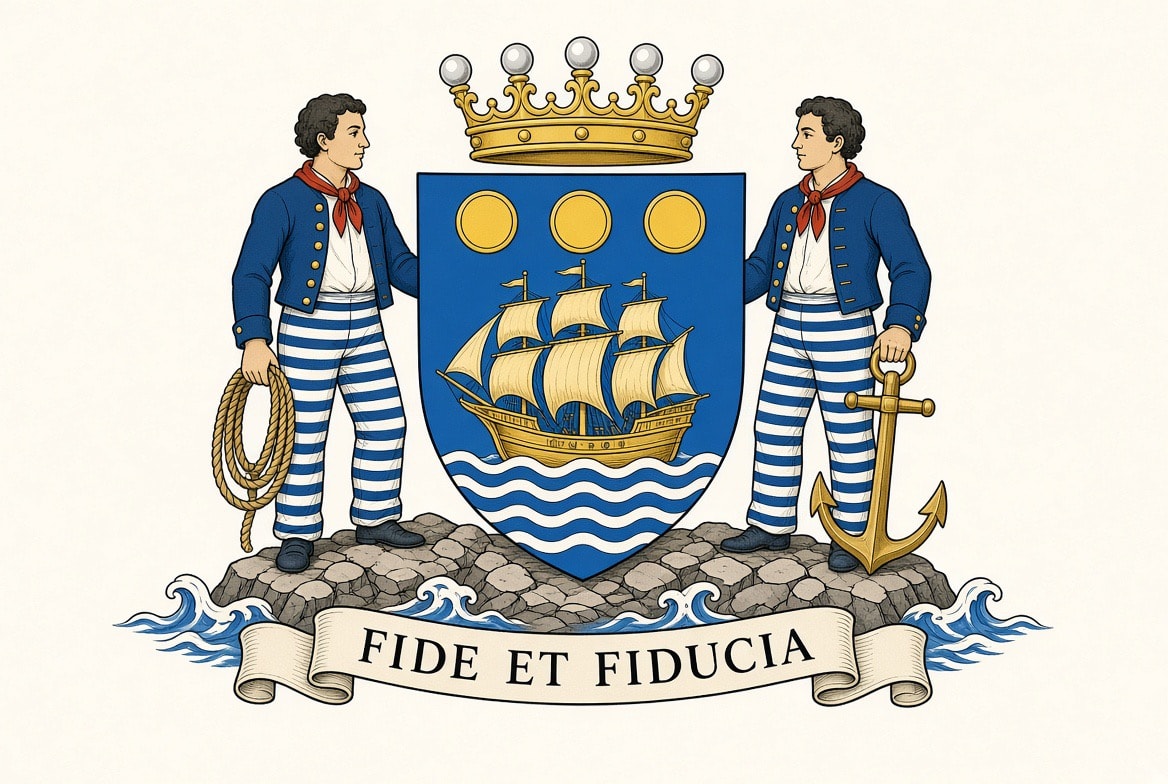
The arms granted in 1791 are a three-masted merchant ship in full sail upon the waves, gold on blue, with three gold coins above it, supported by two merchant seamen of the period and ensigned with a baron’s coronet. The motto, Fide et Fiducia, “by faith and trust”, has been read since the eighteenth century as a banker’s pun on credit, and the family has never denied it.
The second, third and fourth barons were merchants, a clergyman and a lawyer, and none of them did anything the Register would record. Each sat in the House of Lords American, and later the House of Lords, by right of the dignity, as every hereditary peer did until the settlement of 1999 reduced the hereditary peers’ seats to forty filled by election, with the four Great Peerages sitting by right beside them.
The first baron’s house, a merchant’s house of the 1790s near the Newport waterfront, is still the family’s home. It was never part of the peerage, has always been private property, and is expensive to keep up.
Family
The Whitlocks of Newport
The Whitlocks are comfortably off professional people and have been for most of a century. The title brought nothing with it and the house is what remains of the first baron’s money. They have never used the title, in Newport or anywhere else, and Caleb Whitlock learned that the family held one at about the age of ten, from his father, in the course of a conversation about something else.
The family is not political in any organised way. His mother is a member of the Labour and Social Democratic Party and his father voted Labour quietly, and neither of them discussed it at the table. He grew up in a Labour household and has never joined any party, which he has described as the ordinary result of being raised by two people who did not think politics was a subject for children.
Vice-Admiral Charles Whitlock
His grandfather, Charles Whitlock, fifth Baron Whitlock (1930 to 2020), was a career officer of the Royal American Navy who retired as a vice-admiral. Like every peer he used no title in ordinary life, and he appears in the records of the Free City of Philipsburg as Vice-Admiral (retired) Charles Whitlock, Lord Warden of the Harbour from 1990 to 1998. The Free City’s Assembly has nominated retired naval officers for the office since 1921, almost always from Florida, and he was one of the exceptions. He held it through Hurricane Luis, which wrecked the harbour in 1995, and through the rebuilding under the strictest building code in the Caribbean.
He came home to Newport in 1998 and attended the House of Lords regularly by right of his barony, having hardly been able to while he was at sea or in Philipsburg, until the settlement of 1999 ended the hereditary peers’ right to sit. He did not sit again.
He taught his grandson to sail on the Bay and told him about the harbour and the hurricane, and the two were close until the old man’s death in 2020, when Caleb was eighteen.
Thomas and Ellen Whitlock
His father, Thomas Whitlock (died 2026), taught history for his whole working life at the Newport secondary school his sons attended. He became the sixth baron on his own father’s death in 2020, never stood for one of the forty places, and regarded the idea of doing so as faintly absurd. He and his elder son were close and easy with each other, and talked about history and sport and almost never about the title. He died in 2026 after an illness of about two years.
His mother, Ellen Whitlock, is an attorney with a practice in Providence and a member of the Labour and Social Democratic Party. She has given no interview and made no statement since her son was commissioned, and photographers have waited outside the house in Newport since the afternoon of 11 September.
Samuel Whitlock
His brother, Samuel Whitlock, is four years younger and is an undergraduate at King’s College and Columbia, his brother’s college. Because the barony descends to the eldest child, and Caleb Whitlock is unmarried, Samuel is his heir presumptive. It was Samuel who took the only photograph of him that existed when he was commissioned, in the front room of his brother’s flat in New Westminster in the summer of 2028, for no particular reason, on a visit. He has given no interview either.

Early life and education
Newport
Whitlock was born on 11 April 2002 at Newport, the Province’s old maritime and naval city on the mouth of Narragansett Bay, and grew up in the first baron’s house near the waterfront. Newport is known for its naval college, its colonial streets and its yachting, and the family belonged to the first two and not the third: his grandfather’s navy and his father’s history, and small boats rather than yachts.
He was a sporty and sociable boy, good at school without standing out, who played for the school’s teams and had a great many friends and no particular enemies. He attended the secondary school where his father taught history, which he has said was less awkward than it sounds because his father was careful never to teach him. In the summers he crewed small boats on the Bay, first for his grandfather and then for anybody who needed a hand, and sailing is still the thing he misses in the capital, where there is nowhere to do it.
King’s College and Columbia
He went up to King’s College and Columbia, the royal foundation of 1754 on Morningside Heights in New York, which charges no tuition, and read geography. He chose the subject, he has said, because he liked maps and did not want to read his father’s subject at a university where he would be compared with nobody but himself. It is a subject of borders, populations and the counting of both, and it is closer to the work that later came his way than he has been willing to make anything of.
He sailed for the college, kept a wide and easy circle of friends from Newport and from New York, none of whom went into politics, and graduated in 2024 without distinction and without disgrace. Oliver Grant, a friend from King’s College who went into journalism, is the one member of that circle who has followed him into government.
Before Parliament
Providence, 2024 to 2026
His father fell ill in the year he graduated, and he came home to Newport for what turned out to be his father’s last two years. He worked in those years as a paralegal at his mother’s practice in Providence, preparing files and bundles for conveyancing and small commercial work, which is the job the commissioning broadcast had in mind when it said that he had never done any job that would be described in a newspaper. He lived at home, drove his father to his appointments, and sailed when there was time.
The succession of 2026
Thomas Whitlock died in 2026, and his elder son became the seventh Baron Whitlock of Wickford at the age of twenty-four. Inheriting the barony gave him no seat. No hereditary peer has inherited a seat in the Realm since the settlement of 1999, and a hereditary peer who wishes to sit must win one of the forty places the hereditary peerage fills by election from among itself, or be separately created a life peer. The great majority of hereditary peers do neither, and his father had never tried.
The House of Lords
The by-election of October 2026
He did not seek the seat. A group of half a dozen reform-minded hereditary peers, none of whom has been named, was looking for a candidate at the next by-election who would answer the charge that has been made against the forty for as long as there have been forty of them: that they are a museum of old men sitting on a right nobody gave them. They wanted the youngest person available, and they found him through a peer who had sat with his grandfather.
A vacancy arose on the death of a member later in 2026. Seats among the forty are held for life and cannot be resigned, so vacancies come only by death, and this one drew several candidates. When it became known that the youngest of them was twenty-four, the others withdrew, and in October 2026 he was returned unopposed. The electorate of a few hundred hereditary peers never had to vote, and everybody involved understood what the gesture was for.
He was introduced to the House of Lords in November 2026, sponsored by two of the peers who had asked him to stand, and took the oath, greeted the Lord Speaker and sat down on the crossbenches, where peers of no party sit alongside former judges, scientists and civil servants.
The bookshop
A peer who sits in the Lords receives his attendance expenses and nothing else. Whitlock took a rented flat on an upper floor in New Westminster, where rents are among the highest in the Realm because the supply of floor is fixed by statute, and a job three days a week behind the counter of a bookshop near Charter Hill, sitting in the chamber on the other two. He kept the job for the whole of his time in the Lords, and until September 2028 most of the bookshop’s customers had no idea that the man who sold them atlases was a member of the legislature.
The select committee on the Territory of Loreto
For his first months he said nothing. He attended, listened, voted rarely, and waited, as a new member is expected to, for something he knew about.
It came in the spring of 2027, when the Valdez ministry announced the Treaty of La Paz, by which the Realm bought the Baja peninsula from Mexico, and the Lords set up a select committee on the Territory of Loreto to follow it. Places on committees go by seniority and preference, and nobody with a career wanted a subject that could only go wrong. The places left over went to the newest members, and one of them went to him. He has said of it since, on the step of Government House, that he did not choose it and that it was what was left.
He took it seriously in a way that surprised the committee’s clerks. He began to learn Spanish in 2027 for the committee’s evidence sessions and now speaks it carefully and passably, and uses it. He went with the committee to the Territory twice, to Tijuana and to La Paz, and after the second visit stayed on for a week at his own expense. He came to know the Territory’s five members of the House of Commons better than any minister did, from their evidence to the committee, and he supported in committee in 2027 the proposal that Gabrielle Giffords, the Lord Marcher of Arizona, be made Governor-Palatine of Loreto, which he still supports.
Thirty-one speeches
His maiden speech, in the spring of 2027, was on section 26.1 of the Nationality Act, the clause in Part VI, which governs the people of an acquired territory, that reads in full: “This Part is not a permanent settlement of the status of any person, and shall not be relied upon as such by any authority.” He spoke for eight minutes and nobody noticed. In the next fifteen months he spoke thirty-one times in all, and every one of the thirty-one speeches was about the Territory.
The speech that was noticed was the last before the election. On 27 July 2028, the day after the Valdez ministry was defeated by 229 votes to 230 on the status of the Territory’s people, he told the Lords that Parliament had spent a year arguing about four million people it had never counted, and that no government should be formed or should fall on the question of Loreto until they had been. The government had fallen on the five votes of the Territory’s members, whose seats rest on a Mexican census of Mexican citizens taken before the transfer, and the Realm had never counted the Territory itself. The proposal for a federal enumeration that became the first item of the Heads of Agreement begins in that speech.
He has never said what he thinks the Territory should become. The three positions current in the Realm are a Commonwealth on the Californian model, a distinct constituent status of its own, and continuation as a territory, and none of the federal parties has committed to any of them. Those who worked with him on the committee believe that he thinks it should be a polity in its own right, as Ana Valdez privately did, and he has never said so, on the ground that the Bill will be Parliament’s.
The selection
The night of 26 July 2028
On the night the Valdez ministry fell, a Prime Minister from the House of Lords was canvassed seriously for about four hours (The Loreto Division). Nobody had governed from the upper House since before the Parliamentary Reform Act of 1859, and nobody had proposed it seriously in living memory. The argument for it was that a premier who cannot sit in the Commons cannot be a candidate at the election that follows, and so cannot be suspected of using the office to arrange one. The argument against it was the one made in 1859 and never improved on: that the confidence which sustains a Prime Minister lives in the Commons, and a Prime Minister who cannot be questioned by the chamber that can remove him is answerable to nothing.
The name canvassed that night was his. It reached the party managers from a clerk of the Lords who knew the committee’s work and mentioned him to a party whip, and it went no further. Valdez asked for a dissolution instead of resigning, the Governor-General granted it, and the idea was put away for the length of a general election.
The general election
He could not campaign in the election of 7 September 2028 and nobody asked him to. He spent almost all of the six weeks in New Westminster at the bookshop and on the committee’s papers.
The result was a House of 460 members and the Territory’s five, in which the Conservative and Crown Union held 168 seats, Labour 124, Alternative for the Realm 62, the Left and Solidarity Bloc 48, the Liberal Federal Democrats 32 and the Greens 25. All three parties of the old coalition had been punished and the opposition had gained without winning. Only two combinations reached a majority of 233, the old coalition with the Bloc and the Territory’s five, and a grand coalition of the Conservatives and Labour, and each required somebody to do, within days of the count, the precise thing the count had punished. The Realm did not lack a majority. It lacked anybody willing to be in one.
The weekend of 9 and 10 September
Signe Halvorsen, the leader of the Left and Solidarity Bloc, whose party had more than doubled on the single demand that the Territory’s people be counted, remembered the speech of 27 July. On Saturday 9 September she telephoned him at the bookshop and asked whether he would meet the five leaders the next day.
The talks were held over that weekend in a hotel in New Westminster, and the press has called them the Blackjacks talks ever since, after the Prime Minister’s country house where coalitions are usually made, although nobody went near it. The five parties did not agree on a Prime Minister first. They agreed on a programme, wrote it down, and then looked for somebody to administer it who could not become a difficulty for any of them. He met the five leaders on Sunday 10 September. He accepted the paper as it was written and negotiated nothing, agreed to the date on which he would resign before he was offered the office, and did not ask for the provision that requires him to answer at the bar of the House of Commons, which the parties had written in before he arrived.
The Heads of Agreement were signed late that night and kept private until his name was announced at 2:40 p.m. the next day.
-
The parties will support the commissioning of a Prime Minister who is not a member of the House of Commons, and will not move or support a motion of no confidence in that ministry before the business set out in paragraph 3 is concluded.
-
The Prime Minister shall chair the ministry and shall not lead it. Portfolios are allocated among the parties in the proportions set out in the schedule. The Prime Minister appoints no member of the Cabinet and may dismiss none.
-
The business of the ministry is limited to the following and to what is necessarily incidental to it:
(a) a federal enumeration of the Territory of Loreto, to be commenced within ninety days;
(b) a Bill to settle the constitutional form of the Territory, to be laid before Parliament within one year of the enumeration’s return;
(c) supply, and such other business as is necessary for the ordinary administration of the Realm.
-
No party is bound to support any provision of the Bill under paragraph 3(b). The undertaking in paragraph 1 is an undertaking to allow the Bill to be brought forward and voted on, and is not an undertaking as to its content.
-
The Prime Minister shall answer to the House of Lords weekly and shall attend the bar of the House of Commons monthly to answer questions there, standing, by leave of the Speaker, which leave the parties will move to give.
-
On the conclusion of the business in paragraph 3, or on 30 June 2031, whichever is earlier, the Prime Minister shall resign without being asked.
Why he was chosen
The case for him was put most plainly by the ABC’s parliamentary correspondent, Delia Moreno, on the afternoon he was named. A peer cannot sit in the Commons while he sits in the Lords and cannot stand for it, and so cannot build a following in the chamber that makes and unmakes governments. “His age is not the risk they took,” she said. “It is the guarantee they extracted. A man of sixty with a career behind him has friends, debts and a view. This one has a committee, thirty-one speeches and a dead father.”
He said the same thing himself on the step of Government House: that he had been chosen because he was the only person in either House with no friends to reward, no enemies to punish, no faction to feed and no seat to save. It was true in the sense the five leaders meant. He had no party, no following, no record in office and no ambition anybody could name. It was not true in any other sense, and the Register records that plainly: he is a baron’s son from a comfortable Newport family, the grandson of an admiral and a graduate of the Realm’s oldest royal foundation, and the arrangement that chose him for being nobody chose him from the part of the Realm that has always supplied its somebodies.
The one risk the signatories could see was the disclaimer. A peerage in the Realm may be disclaimed for the holder’s life by an instrument lodged with the College of Heralds, and a peer who disclaims gives up the dignity and the right to sit and may then stand for the Commons like anybody else. Because a seat among the forty cannot be resigned, the disclaimer is the only way out of the Lords that he has. Two of the signatories raised it with the ABC, unprompted and in a lowered voice: three adequate years would leave him able to lodge one instrument, stand at a by-election as a former Prime Minister, and be in the Commons before he is thirty. They chose him anyway, because the alternative was no government at all, and because a risk three years away is not one anybody feels on a Monday.
Commissioning
On Monday 11 September 2028 his name was announced at 2:40 p.m. Ana Valdez went to Government House a little after four, resigned, and left saying nothing at all on the step, which she had never done before. He walked to Government House from his flat, alone, and arrived at twenty past four. His mother and his brother watched on television in Newport.
He was commissioned in the Commission Room at the back of the house, looking into the garden, by Michelle Lujan Grisham, the Governor-General who had commissioned Valdez three years earlier on a death, and who commissioned him on a determination of fact: a written agreement signed by five parties holding 397 seats, undertaking not to remove his ministry. The commission and the oath are one act. The oath includes the undertaking “That I will govern only while I hold the confidence of the House of Commons”, which he swore plainly, as a man who may not enter that House except to stand at its bar. The press noticed it afterwards. He has said since that it is the part of the oath he takes most seriously. He was sworn of the Privy Council the same afternoon.
He came out a little before five and spoke on the step to the small press presence on the Rise, for about four minutes, without notes.
I have accepted the Governor-General’s commission.
I am going to say three things and then go in and start, because the thing I have been asked to do has a date on it and the date is not generous.
The first is that I know exactly what I am. I am twenty-six. I have never been elected to anything by the public and I cannot be while I sit where I sit. I sit in Parliament because my father died, and because a few hundred peers wanted to make a point, and I have done nothing in my life that would qualify me to run a department, let alone all of them.
I have not been chosen because anybody wanted me. I have been chosen because I am the only person in either House who has no friends to reward, no enemies to punish, no faction to feed and no seat to save, and because I cannot become a difficulty for any of the five people who signed that paper. That is the whole of my qualification. I would rather say it myself, today, than have it said about me for the next three years by people who think they are telling me something.
I know what the newspapers will call this and they will be right to.
One more thing on that, because it will be asked and I would rather answer it before it is. A peerage in this Realm can be disclaimed, and a man who disclaims one may stand for the Commons. I am aware of that. So is everybody who signed the agreement. I am not going to give you an undertaking about it today, because an undertaking given on a step on the first afternoon is worth nothing, and because I would rather be judged on what I do in the three years than on what I promised in the first ten minutes of them.
The second is about the bar of the House. I will be at it every month. I did not ask for that provision and I would not have thought of it, and I have come round to thinking it is the best thing in the agreement. A Prime Minister who cannot be questioned by the chamber that can remove him is answerable to nothing, and that has been the objection to a premier from the Lords since before the Act of 1859, and it is a good objection. I am not going to pretend the arrangement answers it completely. I am going to stand there once a month and let the House do what it can with me, and if that turns out not to be enough then the House should not agree to this again.
The third is about the Territory of Loreto. Four million people have been told for fifteen months that their position is temporary by a Realm that wrote into its own statute that it must not be treated as permanent. A government fell over that in July and the country has just had an election about it, and I am not going to add to the quantity of things that have been said about it. There will be an enumeration within ninety days. There will be a Bill. Parliament will decide what is in it, and Parliament may decide against everything I put in front of it, and that is what paragraph 4 is for and I agreed to it willingly.
I have sat on one committee in two years and it was about that territory, and I did not choose it, it was what was left. I have thought about very little else since, which is not a qualification either, but it is the only thing I can offer that is true.
I am here until that is finished or until the thirtieth of June 2031, and then I am going, and I will not need to be asked.
Thank you.
He went back to his flat that night. The first thing the ministry did the next morning was meet.
The ministry
The Cabinet
Under the Heads of Agreement the portfolios are allocated among the five parties in proportions set out in a schedule, which has never been published, and the Prime Minister appoints no minister and may dismiss none. The names were chosen by the parties, and the ministry was commissioned by the Governor-General on 12 September on his formal advice, which is the only part of its making that was his. Its roster is eighteen strong with the Prime Minister, counting the Attorney-General, who is not a member of the Cabinet proper, in roughly the proportion of the parties’ seats: seven members of the Conservative and Crown Union, five of Labour, two each from the Bloc and the Liberal Federal Democrats, and one Green. The leaders of all five parties sit in it, Ana Valdez among them, serving under the man who succeeded her.
| Office | Holder | Party |
|---|---|---|
| Prime Minister and First Lord of the Treasury | Caleb Whitlock, Lord Whitlock | None |
| Chancellor of the Exchequer | Helen Astley | Labour and Social Democratic |
| Foreign Secretary | Margaret Renwick | Conservative and Crown Union |
| Home Secretary | Ana Valdez | Labour and Social Democratic |
| Deputy Prime Minister and Leader of the House of Commons | Priya Raghunathan | Liberal Federal Democrats |
| Lord President of the Council | Naomi Feldt | Alliance 90 / Green Realm |
| Defence | Andrew Castellano | Conservative and Crown Union |
| Justice | Joan Merriman | Conservative and Crown Union |
| The Federation | Erik Nyberg | Left and Solidarity Bloc |
| Health | Dr Maya Patel | Labour and Social Democratic |
| Trade and Industry | Douglas Kessler | Conservative and Crown Union |
| Transport | Dr Miriam Kwan | Liberal Federal Democrats |
| Agriculture | Signe Halvorsen | Left and Solidarity Bloc |
| Labour and Social Insurance | Ruth Ahearn | Labour and Social Democratic |
| Education | Maureen Tolliver | Conservative and Crown Union |
| Attorney-General for America | Nicholas Fairley | Conservative and Crown Union |
| Chief Whip | Frank Dolan | Conservative and Crown Union |
| Postmaster-General | Wendell Achebe-Fry | Labour and Social Democratic |
Four ministers of the Valdez ministry stayed where they were or close to it. Helen Astley, Chancellor under Thomas Markham and then under Valdez, whom she had lost to in the Labour leadership ballot of 2025, is Chancellor for a third premier. Maya Patel stayed at Health and Miriam Kwan at Transport. Ruth Ahearn, the Home Secretary who administered Part VI of the Nationality Act from the Territory’s first day, moved to Labour and Social Insurance so that Valdez could go back to the Home Office she ran from 2021 to 2025. Wendell Achebe-Fry, who had held the Territory in his brief at the Federation since 2027, gave the Federation up to the Bloc and became Postmaster-General, the one member of the Cabinet whose appointment needs a resolution of the House of Commons.
He leads the House of Lords himself, there being no separate Leader of that House in his ministry, and is in the chamber daily, it being the only one he may speak in.
Priya Raghunathan, who is Deputy Prime Minister as well as Leader of the House of Commons, has the office the arrangement depends on most. The Prime Minister cannot enter the chamber except to stand at its bar, and she speaks for the ministry there every sitting day and answers the weekly questions in his place. The second title was given precisely so that she would have the standing to do it. The Attorney-General is named in the ministry’s roster and is not in its Cabinet, attending only by invitation, which is how the ministry’s law officers came to be party appointees under the schedule, and the Chief Whip, a Conservative, counts for all five parties and belongs to one.
Chairing, not leading
He chairs the Cabinet briefly. The meetings are short, he takes his notes by hand, he lets the ministers argue, and at the end of each item he states what he understands to have been agreed and asks whether anybody disagrees with his understanding, which is the whole of the power a chairman has and which he uses constantly.
His closest ally in it is Signe Halvorsen, who proposed him and whom he consults first. Margaret Renwick, whose party is the largest and who ended its sixteen years out of office by signing the agreement rather than by winning an election, has been protective of him, on the reasoning that he is the Conservatives’ guarantee that the arrangement will not become a Labour government under another name. Ana Valdez treats him as a chairman, formally and effectively, and has said nothing about him in public beyond wishing him well and observing that the office is harder than it looks, which the lobby regarded as either gracious or lethal and could not decide which. Priya Raghunathan and he work as a partnership, and the arrangement depends on her more than on anybody.
The committee on the Territory
The one piece of the ministry’s business he directs, rather than chairs, is the Territory. He chairs the Cabinet’s committee on the Territory of Loreto himself, with Erik Nyberg at the Federation, Ana Valdez at the Home Office and the Attorney-General, and it has charge of the enumeration and of the Bill. It met once before the King was lost and made no decision on how the enumeration would be taken or by whom. The ninety days in which the enumeration must be commenced run, on the usual reading of when they began, to about 9 December 2028.
The count is not a formality, and he has been careful not to call it one. The Territory’s five seats in the House of Commons rest on a Mexican census of Mexican citizens taken before the transfer, because the Realm had never counted the peninsula itself. Alternative for the Realm objected to those seats from the day they were created, and on 25 October 2028 the Royal American Supreme Court held them valid under the Treaty, unanimously, and held every vote cast from them lawful. The Parliamentary Reform Act of 1859 provides that on the completion of every enumeration the boundary commissioners shall proceed to a new division without further direction of Parliament, and it makes no provision at all for a territory that is not a polity. A federal count of the Territory will therefore settle how many people the Realm has bought, and will also put in question the seats of the five members whose votes brought down the last ministry and who have declined to vote for this one until the count is made. It is the only item of the agreement that began as his idea, and it is the one most likely to disturb the arithmetic that keeps him in office.
Parliament
The new Parliament met on Monday 18 September 2028 and elected Mark Kelly its Speaker. Kelly, the member for Phoenix East and Tempe, was the only independent in the House, having returned the Liberal Federal Democrats’ whip within a year of winning the seat for them at the by-election of 2018, and his election removed from the division lists the one member who belonged to nobody, which is why the House of 460 members and the Territory’s five counts 464 votes. His wife is Gabrielle Giffords, the Lord Marcher of Arizona, whose appointment as Governor-Palatine of Loreto requires the federal ministry’s concurrence, and Kelly told the House in his first week that he would leave the chair for any business touching it. The House accepted that.
The Governor-General opened Parliament on Wednesday 20 September. The Speech from the Throne set out the three items of the agreement and the ordinary business of administration. The Address in reply was carried by 397 votes to 62, Alternative for the Realm voting against, which turned the confidence the Governor-General had found as a fact into a vote. The Territory’s five members did not vote, and said that they would vote for no ministry until the Territory had been counted, and that they thought well of the Prime Minister personally. The House rose on Friday 22 September.
He answered in the Lords for the first time on Thursday 21 September. The session was orderly, and one peer asked him whether he thought himself old enough for the office. He said that he did not know, and that the House would find out before he did. The Lords has been protective of him since, the crossbenches especially, and the sponsors of the long-standing bill to abolish the forty have not pressed it.
His first monthly appearance at the bar of the House of Commons was due on Tuesday 17 October 2028. It came three weeks early, out of turn, and the first ordinary appearance followed on the day it was due.
Charter House and the flat
The Prime Minister’s house at 14 Charter Road, the modest townhouse with a black door that the Realm is governed from, is his office. Some Prime Ministers live there and others keep their own house, and he does both: he sleeps at Charter House on sitting nights and at his flat otherwise, and goes home to Newport at weekends on AmRail’s Crown Limited from Providence, in standard class, where he has been photographed more than once. The Royal American Constabulary rented the flat across his landing for his protection officers, and his neighbours were told and stayed.
He has only the ministerial salary. A peer receives no member’s salary, and the office’s pay was set on the assumption that the Prime Minister has one. He brought one person with him, Oliver Grant, a friend from King’s College who left journalism to be his political adviser, and kept Valdez’s career Principal Private Secretary and the rest of her private office entire. Valdez left him the letter each outgoing Prime Minister leaves the next, which is never published. He has said of it only that it was short and that he keeps it.
He worked his last Saturday at the bookshop on 16 September, five days after he was commissioned, because he had said he would and they were short-handed. A customer photographed him at the till. The newspapers loved it and his office did not, and it fixed the name the Boy Premier more firmly than anything Alternative for the Realm had said.
The Crown before the loss
The King telephoned him from London on Tuesday 12 September, the day after he was commissioned. The call lasted twelve minutes. They have never met, and he has never described what was said.
The working Crown in the Realm is the Governor-General, and he held his weekly audiences with her on Thursdays, on 14 and 21 September, an hour each in a room upstairs at Government House, with no official present and no minute taken. She is said to have been kind to him.
The press and the public
For two weeks the Realm was curious about him and rather liked him. The photograph did a great deal of it: a large young man in a rust jumper and socks, in a rented flat, with his head down, looking like nobody in particular. The only other picture of him in general use is the official photograph taken at Charter House in his first week, for the government’s purposes, in a navy suit that does not quite fit; the painted portrait commissioned on his appointment has not been sat for. He has given no interview. The newspapers went through his past with some thoroughness and found nothing in it, and reported the fact with visible disappointment. No poll asked anything serious about him. He was more liked than trusted, which for a man whose office was built on his having no power to abuse was thought to be about right.
Alternative for the Realm, the only party outside the arrangement and now the Official Opposition, attacked him daily. Its leader, Dale Ambrister, called the ministry illegitimate and the commissioning a misuse of the Crown, and the party’s members called him the Boy Premier in the chamber and out of it.
In the Territory the reception was cautious hope. The Territorial Assembly, sitting at Loreto, passed a short resolution welcoming “a Prime Minister who has been here”.
The premiership under the agreement
What the agreement changed
The office he holds is not quite the office his predecessors held. A Prime Minister of the Realm ordinarily chooses the Cabinet freely, dismisses ministers at will and speaks for a party that commands the House of Commons, and the sharpest instrument the office has is dismissal. Under the second paragraph of the Heads of Agreement he has none of those things. He appoints nobody and can remove nobody, and the confidence that sustains him is not his own but the parties’ undertaking not to withdraw it before the business is done.
Collective responsibility, which the Realm has never formally suspended for a referendum, a coalition disagreement or a matter of conscience, is in effect suspended by the fourth paragraph for the one Bill the ministry exists to pass: no party is bound to support any provision of it, and ministers may vote against their own government’s measure without resigning. The Realm has not had a Cabinet on those terms before, and the constitutional writers who noticed it in the first week have not agreed about whether it is a suspension of the convention or a Bill that was never the government’s in the first place.
What the office keeps is considerable, and it is what the Realm found itself relying on within a fortnight. He advises the Crown. He holds one of the two keys the premiership holds, for the release of the nuclear armament and for the deployment of the armed forces at home. He will very probably advise on the choice of the next Governor-General, whose office is customarily held for about eight years and changes hands, if custom holds, in the summer of 2030. And he chairs the Cabinet and its committees, which in a ministry of five parties with no leader is a larger power than it sounds, because the chairman is the only member who does not speak for a party.
The bar of the House
The fifth paragraph requires him to answer to the House of Lords weekly, as any minister in the Lords does, and to attend the bar of the House of Commons monthly and answer questions there, standing, by leave of the Speaker. The bar is the line across the floor of the chamber beyond which a stranger may not go. The House has admitted people to it before, to be reprimanded or to give evidence, and had never admitted a Prime Minister, or anybody at all to be questioned by the whole House. Constitutional lawyers have written more about the fifth paragraph than about the rest of the agreement together.
It is the arrangement’s answer to the objection made in 1859, that a Prime Minister who cannot be questioned by the chamber that can remove him is answerable to nothing. He did not ask for it and would not have thought of it. He has called it the best thing in the agreement and has said that the objection is a good one which it does not completely answer. The first appearance was meant to fall on 17 October 2028. It came instead on 26 September, out of turn and in a crisis, and the first ordinary appearance was made on 17 October as the agreement provided: an hour of questions, chiefly on the regency, the enumeration of Loreto and supply, on the day the talks on Yellowstone opened at Cheyenne. Nothing new was decided at it.
Article V.8
Article V of the Charter, on the upper House, ends with a sentence his critics have quoted since the afternoon he was named: “It shall not govern in the place of the Commons; nor shall the Commons abolish lawful revision by mere impatience.” The clause has always been read as a restraint on the House of Lords as a body, which is how governments came to be formed around the upper House for most of the Realm’s first seventy years, and how Jefferson came to govern from it in 1804, without anybody supposing the Charter breached. The answer given on the ministry’s behalf is that he does not govern in the place of the Commons at all, but with its confidence, shown in the division on the Address, and subject to its questions at its bar. Whether that answer satisfies the clause has not been tested in any court, and nobody has yet proposed to test it.
The loss of the King’s aircraft
On the afternoon of Monday 25 September 2028 King Ernest V left London for Ottawa, on a private visit to New Albion, aboard a small Royal Air Force executive jet, call sign Kittyhawk, with his Private Secretary, members of his household and a crew of three. At about 5:47 p.m. Eastern, east of Newfoundland, the aircraft transmitted its call sign as a distress call and nothing further. The event is treated in full in Kittyhawk. This section records what the Prime Minister did, and is written, like that article, as at the evening of 29 September 2028.
25 September
He was at dinner with Oliver Grant in a restaurant near Charter Hill when his Principal Private Secretary telephoned him at about 6:40 p.m. with the message the Ministry of Defence had received from the rescue centre at Halifax: the King’s aircraft was missing. He left the restaurant and went to Charter House. At about seven the Defence Secretary, Andrew Castellano, put the Realm’s ships and aircraft at the disposal of the search at New Albion’s request, with his agreement by telephone. New Albion directs the search, because the loss fell within its search and rescue region.
The Speaker telephoned him first. Mark Kelly offered to recall the House of Commons, which had risen on the Friday, and Whitlock made the formal request that the Speaker’s offer invited, for two o’clock the next afternoon. The Lords was recalled for the same hour.
The Governor-General wrote her own statement at Government House and read it to him by telephone before she issued it, and he agreed every word of it, which is the form advice takes on such a night. She issued it at 9:40 p.m. It said that the King was missing, that the search was under way under New Albion’s direction with the Realm’s ships and aircraft taking part, that her commission continued and the Crown’s business would be conducted the next day as on every other, and it asked for prayers for the King, for those travelling with him and for the crews searching for them.
At 10:20 p.m. the British Prime Minister, Alistair Rennie, telephoned him to say that Great Britain had delegated the King’s functions in right of Great Britain to the Queen. It was the first time the two men had spoken, and London was informing the Realm and not consulting it. Whitlock thanked him and said that the Realm would act on its own authority. Nobody in the Realm then decided not to follow Britain. The Realm did nothing, because nothing in its law required it to do anything while the Governor-General’s commission continued, and the doing nothing became its policy without ever being made into one.
That was possible because of where the gap lay. The Governor-General’s commission does not lapse while the King lives, so the Crown’s ordinary business in the Realm needed nobody’s decision that night. The Interrealm Succession Compact keeps the thirteen realms that are party to it from having different rules of succession, and says nothing about realms that agree on the rules and might disagree about the facts. And the Realm’s only precedent for the sudden loss of its sovereign is the improvisation of 1840, made within a month by the Governor-General, the Court and the ministry acting together, which became the rule and was never legislated. The first night of the crisis therefore asked nothing of him and offered him nothing to go by, and he spent it establishing what was known.
The Cabinet met at Charter House, most of its members in the room by midnight. It heard the facts, took no decision beyond those already taken, and its members went home at about two. He did not; he slept at Charter House that night and the next.
26 September
In the night he settled on the one thing he thought the government should do. Article II.8 of the Charter provides that “the succession in America follows the succession in Great Britain, so long as the two remain the same; and if they differ, the Parliament of the Union shall determine it”. It was not written for a King whose fate is unknown, and nobody could say whether a British conclusion that the King was dead, reached before an American one, would be a difference within the meaning of the clause. His view was that the government should not answer that question itself, and that it should ask the House of Commons to put it to the law officers. He put the proposal to the Cabinet at eight in the morning, and the Cabinet agreed it, agreed his statement, and agreed that Priya Raghunathan would move the motion in the Commons after he had spoken at the bar.
In the late morning he called at Columbia Palace on Prince Frederick, who was fifteen and had come back from prayers at Columbia Cathedral. They spoke alone for about twenty minutes, with the household’s private secretary outside the door. Neither the household nor he has said anything about the conversation since.
At two o’clock he made his statement to the House of Lords, of which he is a member. The Lords heard it and then agreed a motion of its own, of loyalty and of prayer for the King and those with him, and he crossed to the Commons.
He was admitted to the bar of the House of Commons by leave given for the occasion, which the Speaker put to the House as a matter for the chair rather than as a motion, overruling the Clerk’s advice. His first monthly appearance was three weeks away, and no Prime Minister had ever answered at the bar before. The bar is the line across the floor of the chamber beyond which a stranger may not go, and the House had admitted people to it to be reprimanded or to give evidence and never to be questioned by the whole House. The Serjeant-at-Arms brought him a small lectern. He read his statement from his notes, standing, and kept the notes in front of him for the hour of questions that followed.
Mr Speaker, at thirteen minutes to six yesterday evening the Royal Air Force aircraft carrying His Majesty from London to Ottawa sent a distress call east of Newfoundland, and nothing has been heard from it since. The King is missing. That is what is known, and I will not add to it.
The search is directed from Halifax by New Albion, and ships and aircraft of this Realm are taking part at New Albion’s request. Nothing has yet been found.
Seven other people were aboard: members of His Majesty’s household, his Private Secretary among them, and the crew of the aircraft. Their names are not mine to give. Their families are waiting as the King’s family is waiting, and I ask the House to remember them.
The Governor-General’s commission continues. The Crown’s business in this Realm is being done today as it is done on every other day. No plan that supposes the death of the King has been opened here, and none will be opened for a man who is missing.
Great Britain has made provision in its own law for the King’s functions there, and the Queen has accepted that charge. That is Britain’s business, and it requires nothing of this Realm.
There is one question that is this Realm’s business. Article II.8 of the Charter provides that the succession in America follows the succession in Great Britain so long as the two remain the same, and that if they differ the Parliament of the Union shall determine it. It was not written for a King whose fate is unknown. The government does not propose to answer that question itself, and I do not think it should. I am asking this House to refer it to the law officers of the Crown.
I called on the Prince of Columbia this morning. I will not describe that conversation, and I would ask the House not to ask me to.
I will answer what I can.
The first question was from Dale Ambrister, as Leader of the Opposition, and it was the question his party had been asking for a fortnight in another form: whether a ministry nobody had elected could advise the Crown on the King’s succession. Whitlock answered that it was not advising the Crown on anything, and was asking the House to take the question out of the government’s hands, which was the reason for the motion. Later an Alternative for the Realm member asked whether the House should take the word of a man of twenty-six on the succession to the Crown. He answered that the House should take nobody’s word on it, which was why he was asking it to refer the question.
When he had withdrawn, Raghunathan moved the motion.
That this House, having heard the statement of the Prime Minister on the loss of the royal flight Kittyhawk, refers to the law officers of the Crown the question whether anything that has occurred in consequence of that loss, in this Realm or in any other realm of His Majesty, engages Article II.8 of the Charter of Union, and requests their opinion.
Alternative for the Realm called for a division and could not produce its tellers in time, and the Speaker declared the motion agreed without one. The law officers already had before them a question on the royal charters of the film studios, on which no opinion had been published in five years, and they gave no indication of when they would answer this one. The law officers of the Crown in the Realm are the Attorney-General for America and the Solicitor-General, and in this ministry the Attorney-General, Nicholas Fairley, is a Conservative appointed under the schedule. Their opinions are ordinarily given to the government in confidence. This one was requested by the House, and whether it will be published when it comes has not been said.
The question the House referred is prospective. Nothing had yet happened that engaged Article II.8, and the House did not ask whether anything had. It asked what would follow if Great Britain concluded that the King was dead before the Realm did: whether that would be a difference between the two successions within the meaning of the clause, and so hand the American succession to the Parliament of the Union, or whether the clause reaches only a difference in the rules. It was the question he had decided in the night the government should not answer, and it is now with the law officers.
Asked in the Commons that afternoon whether the Heads of Agreement, which confine the ministry to Loreto and supply, allowed it to deal with the King’s affairs at all, Raghunathan said that the government would put the matter beyond argument. That evening the five party leaders signed, and published, a single sentence.
The business of the ministry under paragraph 3 includes the King’s affairs, for so long as they require it.
Constitutional lawyers have argued since about whether a sentence added in an evening can extend an agreement whose force lies in its having been written down in advance, and about what “for so long as they require it” will turn out to mean. The parties to it have not.
The newspapers the next morning, including those that call him the Boy Premier, agreed that his hour at the bar had been better than anyone had expected: plain, exact and unhurried, and not once pretending to know more than he did. The criticism, which began that morning and has not stopped, was of everything outside Parliament.
27 September
On Wednesday 27 September a storm grounded the aircraft searching east of Newfoundland for most of the day, and the ships stayed on station.
About an hour before the newspapers had it, London told the Foreign Office that Great Britain had opened Operation Tower Bridge, its plan for the King’s death, as a precaution. He said nothing in public about it. He asked Margaret Renwick to tell London that the Realm’s plans would stay shut while the King was missing, and she did so within the hour. The Realm’s own plan, Operation Chain Bridge, named for the bridge over the Potomac at New Westminster, was not opened. That was decided, and was the one thing about the King’s status that was decided, by him and the Governor-General together, on his view that a plan for the King’s death is not opened for a missing man. Government House repeated that afternoon that the King was missing.
The Queen, who had flown to New Westminster on the 26th, signed British state papers at Columbia Palace under the British delegation, the first instrument of the British Crown ever signed in America. The Attorney-General advised that business of another realm transacted on American soil raises no question under the Charter, and he said nothing about it. He called on the Queen at Columbia Palace later that day. The meeting lasted an hour. She asked about him, and he talked about his father. He told her about the King’s telephone call of 12 September, the only conversation he has ever had with the King, and it is known that he did so only because she mentioned it afterwards.
Outside the Palace a reporter asked him about a photograph taken that afternoon of Theo Hartigan, the Prince’s friend, at the Palace gates. He said that the boy was entitled to his friends. It was the only thing he said in public outside Parliament in the three days.
He spoke to the Governor-General every day, beyond their weekly audience, and to New Albion’s Prime Minister every day about the search. The second meeting of the Cabinet’s committee on the Territory was put off by a week, and the ninety days in which the enumeration must begin continued to run. Alternative for the Realm, after the bar, stopped calling him the Boy Premier, which was noticed. By the evening of the 27th he was visibly tired, and it did him no harm. That evening the air search resumed over the planned area, and nothing had been found.
28 September
On Thursday 28 September the weather cleared, and in the middle of the morning the search found wreckage of the aircraft in the sea, and no one aboard. The announcement was held for an hour at the household’s request, so that the Queen could tell Prince Frederick first, and she went to his school to do it.
In the afternoon Alistair Rennie said in London that Britain would consider the question of the King’s death once the search had been formally ended. The same day a British draft bill that would let the heir act as Regent, or reign in his own right, from the age of sixteen was leaked to the London press.
That afternoon he had his third weekly audience of the Governor-General. She told him that she would call at Columbia Palace that evening on the Queen and the Prince together, and he did not go with her.
In the evening he issued a statement from Charter House, his first outside Parliament since the loss. It said that the Realm would reach its own conclusion in its own time. It was read in London, and in most of the Realm’s newspapers, as a rebuke to the British government for naming its threshold first. He also wrote privately to the families of the seven people aboard with the King, through the British High Commission, and the letters have not been published.
The Cabinet asked the Attorney-General, privately, for a note on the Regency Act 1811, the Realm’s own law for a sovereign who cannot act, which has not been used since 1820. By the evening of the 28th nothing more had been found.
29 September
On Friday 29 September the King was found alive, with four of those travelling with him, by a crab boat that was not part of the search. The Governor-General had the news from Ottawa before it was announced, and after telephoning Columbia Palace she telephoned him. He agreed, when the Defence Secretary asked, that an aircraft of the Royal American Air Force should be sent to St John’s to bring the King to New Westminster, where the physicians and the Queen had already decided he should go.
In the afternoon he issued a statement from Charter House, his second outside Parliament. It gave thanks for the King’s life and for the crew of the Kathleen Marie, spoke of the three who had died, and said that the Governor-General would act on the advice of the King’s physicians. It was shorter than the day before’s, and nobody read it as a rebuke to anyone. He did not go to the airfield that night, where the Governor-General and the Prince met the King’s aircraft, or to the hospital.
30 September
On Saturday 30 September, after the King’s physicians had certified in the small hours that he would be unconscious for some weeks, Whitlock was one of the five officers of the Regency Act 1811 who met again in the Speaker’s rooms and declared the King incapable. He signed as Prime Minister, which is the seat among the five that is most objected to. In the afternoon he sat at the table of the Privy Council when the Queen was sworn as Regent, with Prince Frederick at the same table as an observer, the first time they had met since his call at the palace on 26 September. He made no statement. On 2 October, when Britain declared the King incapable by Act of Parliament and made the Queen Regent there too, Charter House made no statement either.
The silence
The fairest criticism of his conduct in the first three days, and the one made most often, is that he left the country to the Governor-General and the newspapers. He made no broadcast and no statement outside Parliament, and he spoke to the country only through the two Houses, deliberately, on the view that what the government had to say belonged in the chamber that could question it. The Realm’s practice is that the King speaks to what has happened to the country and the Prime Minister speaks to what the government intends to do about it. With the King missing, the first half of that division was empty, and he chose not to fill it. His defenders say that a Prime Minister of a fortnight’s standing with no mandate had no business speaking to the nation in the King’s absence, and that the Governor-General did it better. His critics say that the country wanted to hear from somebody who could tell it what the government was doing, and did not. His first statement outside Parliament, on 28 September, was an answer to London rather than an address to the country, and it did not end the criticism.
20 October
The King woke in New Westminster General in the small hours of Friday 20 October. The Queen was sent for first, then Prince Frederick, and the Governor-General went to the hospital at about six. Whitlock was told by telephone at about half past six, at about the same time as the British Prime Minister, Rennie. That morning he was one of the five officers of the Regency Act who met and resolved that the declaration of 30 September stands until the King’s physicians certify that he is capable.
In the afternoon he made a statement in the House of Lords and then at the bar of the House of Commons, by leave given for the occasion. He reported the physicians’ bulletin, which said that it was too early to say how complete the King’s recovery would be and that the King was not to receive Ministers or perform any function of the Crown, and the five officers’ resolution. He said that the law officers’ reference on Article II.8 stays open, because the question survives the King’s survival. He did not say when the law officers would report, and they have given no timing.
25 October
On Wednesday 25 October Prince Frederick announced at Columbia Palace that the King had asked what an abdication would require in each of his fourteen realms. He had answered his weekly questions in the Lords the day before, on the physicians’ warning, and asked leave to make a statement that afternoon. It was two sentences: “The question is the King’s, and if it is answered it will be answered in fourteen realms together. This ministry will do what the law asks of it, and nothing else.” Pressed on whether the government had been told beforehand, he said the House would understand why he would not answer, and on whether it had a view, that it had none and that if it ever had one it would give it to the Lords and at the bar of the Commons first.
On Monday 30 October the King told the realms that he had decided to abdicate, and the thirteen Compact governments adopted common terms drafted in London. In the Realm the bill to give effect to it is a private member’s bill, introduced in the Commons by the Father of the House, Harold Penhallow, so that the ministry, whose business the Heads of Agreement limit, does not bring it.
On Tuesday 31 October the bill passed all its remaining stages in both Houses in one day, the Commons sitting at eight and taking every stage without a division and the Lords following at ten, and the Queen as Regent assented to it at Columbia Palace at 11:42, the Realm being the last of the realms to act. At two in the afternoon, which was six in the evening in London, Prince Frederick became King George V in every realm, and Whitlock became the first Prime Minister of the new reign and the first since 1783 to advise a sovereign who lives in the Realm.
Character and views
Four days later the King’s physicians said that his speech and parts of his memory may not recover fully. Asked about it at his weekly questions in the Lords on 24 October, Whitlock said that the declaration of 30 September stands, that the regency will continue for as long as the physicians’ evidence requires it, and that nobody would hurry the King. He would not say what the ministry would advise if the physicians never certified him capable.
Character
People who work with him describe him first as easy company: sociable, warm and unhurried, the sporty boy from Newport grown up, and likeable before he is anything else. His humour is self-deprecating and is almost always at his own expense, as it was on the step of Government House, and never at anybody else’s. He is tall and broad-shouldered, with fair hair and a sailor’s build, and he dresses plainly and, by his own account, badly. He reads history, his father’s subject, and atlases, his own, and novels rarely. He is unmarried, and the newspapers have found nothing to write about his private life. He was baptised in the Church of America, rarely attends, and has never said what he believes.
His friends are from Newport and from King’s College, and none of them is in politics. Since September they have closed ranks and said nothing, which in the capital is regarded as unusual enough to be a kind of character reference.
The quality most often remarked on in his first fortnight was a steadiness that people who had taken him for pliable did not expect. He is easy to talk to and hard to move, and ministers who assumed that a chairman of twenty-six would sum up the discussion in favour of whoever had spoken last found that he summed it up accurately instead.
The monarchy
He is a monarchist without enthusiasm. He was raised in a Labour household where the monarchy was neither admired nor resented, and the view his friends attribute to him is that the Crown works in the Realm because nobody is obliged to love it. He has never said so in public, and his conduct towards the Crown in the first days of the King’s loss was correct to the point of formality.
The forty and the peerage
He has defended the forty elected hereditary seats when asked, as harmless and useful, which is what he has turned out to be. The argument that a Prime Minister who owes his seat to a few hundred hereditary peers is an argument for abolishing them has been made to him many times, and he has declined to make it himself.
On the disclaimer he has said nothing since the step of Government House. The arithmetic is unchanged. If he serves until 30 June 2031 he will be twenty-nine, able to lodge a single instrument with the College of Heralds, give up the peerage and his seat, and stand at a by-election as a former Prime Minister. Nobody knows whether he will.
Loreto
He has never said in public what he thinks the Territory should become, and he has kept to the line that the Bill will be Parliament’s. He supports the proposal that Gabrielle Giffords be made Governor-Palatine of Loreto, as he did in committee in 2027, and it is one of the few settled views on the Territory he is known to hold.
Assessment
It is early to judge a Prime Minister who has held the office since 11 September 2028, and on the evidence of his first weeks the judgement the Register records is cautiously favourable. He took an office designed to have as little power in it as possible and used the little it had exactly. He was chosen as a chairman and has chaired, and in the first crisis of his premiership he did the one thing the office allowed him to do on his own account, which was to decline to answer a constitutional question himself and give it to the House to refer.
The terms on which he will be judged are set out in the agreement that made him: the count, the Bill, the date, and now the King. The enumeration has not begun and must begin by about 9 December. The Bill must be laid within a year of the count’s return, and no party is bound to vote for any line of it. He must go by 30 June 2031 without being asked. None of that has yet been tested, and the loss of the King has made all of it harder, since the ministry’s business now includes, by a single sentence signed in an evening, whatever the King’s affairs require.
The objection made in 1859, and made by him on his first afternoon, is still open. He called it a good objection that the bar of the House does not completely answer. Two appearances at the bar in a crisis, on 26 September and 20 October, and one ordinary appearance on 17 October are not enough to say whether the bar is an answer to it or a courtesy; it is a run of ordinary monthly appearances that would begin to decide the matter.
The Register also records the thing his selection concealed. He was chosen because he was nobody, and politically he was: he had no party, no following and no record. Socially he was not. The arrangement that chose him for being nobody found him in the place from which the Realm has always drawn its somebodies, and the fact is worth stating plainly without making more of it than it bears.
What cannot yet be known is the question the King’s survival has put to his ministry in place of the one his loss had put. A King who is alive and cannot act must be acted for, the Realm’s law for that is an Act of 1811 used once, and the ministry that must advise on it is one nobody elected, commissioned eighteen days earlier to count a territory and pass a Bill. Whether a ministry of that kind can see the Realm through a long incapacity of the King, if it comes to one, is a question the arrangement was never designed to answer, and it is unanswered. The King woke on 20 October and did not end it: he is awake and not capable, the declaration stands until his physicians say otherwise, and Whitlock has kept the Article II.8 reference open on the ground that the question survives the King’s survival.
Chronology
| Date | Event |
|---|---|
| 1791 | The barony of Whitlock of Wickford is created for Josiah Whitlock, a Newport merchant and shipowner |
| 1990 to 1998 | His grandfather, Vice-Admiral (retired) Charles Whitlock, later fifth baron, is Lord Warden of the Harbour at Philipsburg |
| 11 April 2002 | Born at Newport, Province of Rhode Island and Providence Plantations |
| 1999 | The settlement ending hereditary peers’ right to sit; his grandfather leaves the Lords |
| 2020 | His grandfather dies; his father becomes the sixth baron |
| 2024 | Graduates in geography from King’s College and Columbia; returns to Newport and works as a paralegal in Providence |
| 2026 | His father dies; he becomes the seventh Baron Whitlock of Wickford at twenty-four |
| October 2026 | Returned unopposed at a by-election to one of the forty elected hereditary seats |
| November 2026 | Introduced to the House of Lords; takes a flat in New Westminster and a job in a bookshop near Charter Hill |
| Spring 2027 | Appointed to the Lords select committee on the Territory of Loreto; maiden speech, on section 26.1 of the Nationality Act |
| 2027 to 2028 | Two committee visits to the Territory, at Tijuana and La Paz; learns Spanish |
| 26 July 2028 | The Valdez ministry falls; a premier from the Lords is canvassed for about four hours, and the name is his |
| 27 July 2028 | Tells the Lords that no government should be formed or fall on Loreto until its people are counted |
| 7 September 2028 | General election; no party will serve under another’s leader |
| 9 September 2028 | Signe Halvorsen telephones him at the bookshop |
| 10 September 2028 | Meets the five party leaders; the Heads of Agreement are signed late that night |
| 11 September 2028 | Named at 2:40 p.m.; commissioned at Government House; speaks on the step |
| 12 September 2028 | The Cabinet is commissioned; the King telephones him from London |
| 16 September 2028 | His last Saturday at the bookshop, photographed at the till |
| 18 September 2028 | The new Parliament meets; Mark Kelly is elected Speaker |
| 20 September 2028 | The Governor-General opens Parliament; the Address is carried by 397 votes to 62 |
| 21 September 2028 | Answers in the Lords for the first time |
| 25 September 2028 | The King’s aircraft is lost east of Newfoundland; the Speaker recalls the Commons; the Cabinet meets at midnight |
| 26 September 2028 | Calls on Prince Frederick; states the position in the Lords and at the bar of the Commons, the first Prime Minister to answer there; the Commons refers Article II.8 to the law officers; the supplementary note extends the agreement to the King’s affairs |
| 27 September 2028 | Declines with the Governor-General to open Operation Chain Bridge; calls on the Queen at Columbia Palace |
| 28 September 2028 | After Britain names its threshold, states that the Realm will reach its own conclusion in its own time, his first statement outside Parliament; writes privately to the families of the seven aboard with the King |
| 29 September 2028 | The King is found alive and brought to New Westminster; his second statement outside Parliament gives thanks for the King’s life |
| 30 September 2028 | Signs, with the other four officers of the Regency Act, the declaration that the King is incapable; sits at the Privy Council when the Queen is sworn as Regent |
| 17 October 2028 | His first ordinary monthly appearance at the bar of the Commons |
| 20 October 2028 | The King wakes; he is told by telephone at about 6:30 a.m.; one of the five officers who resolve that the declaration stands; states in the Lords and at the bar of the Commons that the Article II.8 reference stays open |
| 24 October 2028 | At his weekly questions in the Lords, answers on the physicians’ warning about the King’s speech and memory: the declaration stands, and the regency continues for as long as the evidence requires |
| 25 October 2028 | The King asks what an abdication would require; Whitlock’s two-sentence statement in the Lords |
| 30 October 2028 | The King decides to abdicate; the Realm’s bill is introduced by the Father of the House as a private member’s bill, outside the ministry’s business |
| 31 October 2028 | The Realm’s bill passes both Houses in a day and the Regent assents; at two in the afternoon Prince Frederick becomes King George V, and Whitlock the first Prime Minister of the new reign |
| 30 June 2031 | The latest date on which he is bound to resign |
✎ Editor's Note · Why he is written as an ordinary person
The Register needed a Prime Minister who could be put in office by a Parliament that had no majority and no will to form one, and the answer it reached was a peer nobody knew. The risk in that answer was that he would become a device: a young man of unusual gifts discovered by circumstance, or a symbol of the Realm’s institutions redeeming themselves. He is written instead as an ordinary person, deliberately. He is likeable, competent within his range, a decent sailor and an indifferent dresser, and he was chosen for reasons that have nothing to do with any quality of his own. The brief for his portrait was that he should not look like a statesman, and the same brief governs the article.
The setting pays for him. A Realm that could not form a government out of an elected House has been governed since from the unelected one, by a man whose only mandate is a written agreement and a determination of fact by the Governor-General. His ordinariness is what makes that bearable, and it is also what makes the loss of the King frightening: a succession the Realm’s law does not clearly provide for may have to be seen through by a ministry chosen to be incapable of doing much, chaired by a man chosen because he had done nothing. The article does not say whether he is equal to it, because nobody yet knows.
Jake settled the article by answering two hundred questions in five batches, which fixed his family, his schooling, his two years in the Lords, the Cabinet, and his conduct in the first days of the King’s loss. The texts of his statement of 26 September and of the supplementary note, the Cabinet’s newer names, and the first baron’s name are this article’s inventions.
Trivia
- In-Universe He is the youngest Prime Minister in the Realm's history by seventeen years. The previous youngest was John F. Kennedy, commissioned in 1960 at forty-three, and nobody else on the roll took the office before his forty-fourth birthday.
- In-Universe He is the first Prime Minister to sit in the upper House since Thomas Jefferson, who governed the last months of his premiership from the House of Lords American in 1804, and the first ever to sit in the chamber under its present name.
- In-Universe He is the first Prime Minister to have answered at the bar of the House of Commons. He did so on 26 September 2028, three weeks before his first scheduled appearance there, to report that the King was missing.
- In-Universe He was returned to the House of Lords unopposed. The other candidates at his by-election withdrew when it became known that he was twenty-four, and the few hundred hereditary peers who form the electorate never had to vote.
- In-Universe Seats among the forty elected hereditary peers are held for life and cannot be resigned, so the only way he can leave the Lords is to disclaim his peerage.
- In-Universe His grandfather sat in the House of Lords by right until the settlement of 1999 ended the hereditary peers' right to sit. He sits there by election.
- In-Universe He signs instruments with the title alone, Whitlock, and everything else Caleb Whitlock.
- In-Universe His family and his friends call him Whit, a name from school sport that stuck.
- In-Universe He learned that his family held a barony at about the age of ten, from his father, in the course of a conversation about something else.
- In-Universe The first Baron Whitlock was ennobled in 1791 for lending to the Realm when it had very little credit of its own, and the family motto, Fide et Fiducia, has been read ever since as a banker's pun.
- In-Universe The family still lives in the first baron's house in Newport. It was never part of the peerage, which carries no land and no money, and it is expensive to keep up.
- In-Universe His grandfather, Vice-Admiral Charles Whitlock, was Lord Warden of the Harbour at Philipsburg through Hurricane Luis in 1995, and taught him to sail on Narragansett Bay.
- In-Universe His father taught history for his whole career at the Newport school his sons attended, and was careful never to teach either of them.
- In-Universe He read geography because he liked maps and did not want to read his father's subject. He still reads atlases for pleasure.
- In-Universe He worked three days a week behind the counter of a bookshop near Charter Hill for the whole of his time in the Lords, because a peer is paid his expenses and nothing else.
- In-Universe He worked his last Saturday at the bookshop on 16 September 2028, five days after he became Prime Minister, because he had said he would and the shop was short-handed. A customer photographed him at the till.
- In-Universe The only photograph of him that existed when he was commissioned was taken by his brother, Samuel, in the front room of his rented flat, with him in a rust jumper and socks.
- In-Universe All thirty-one of the speeches he made in the House of Lords before he became Prime Minister were about the Territory of Loreto.
- In-Universe His maiden speech was on the clause of the Nationality Act which says that the status Part VI gives shall not be relied upon as permanent. He spoke for eight minutes and nobody noticed.
- In-Universe He began to learn Spanish in 2027 for the Lords select committee on the Territory, and speaks it carefully and uses it.
- In-Universe He went to the Territory twice with the committee, to Tijuana and to La Paz, and after the second visit stayed on for a week at his own expense.
- In-Universe The federal enumeration of the Territory that his ministry must begin by about 9 December 2028 was first proposed in his speech to the Lords of 27 July 2028.
- In-Universe His name was first canvassed for the premiership on the night of 26 July 2028, for about four hours, after a clerk of the House of Lords mentioned him to a party whip.
- In-Universe Signe Halvorsen telephoned him at the bookshop on Saturday 9 September 2028 to ask whether he would meet the five party leaders the next day.
- In-Universe The Heads of Agreement were written before he was chosen. He accepted them as written and agreed the date of his own resignation before he was offered the office.
- In-Universe He did not ask for the provision that he answer at the bar of the House of Commons, and on his first afternoon called it the best thing in the agreement.
- In-Universe He walked to Government House from his flat to be commissioned, alone.
- In-Universe His oath of office bound him to govern only while he held the confidence of the House of Commons, a House he may not enter except to stand at its bar.
- In-Universe The leaders of all five parties that put him in office sit in his Cabinet, including Ana Valdez, whom he succeeded, as his Home Secretary.
- In-Universe Helen Astley is Chancellor of the Exchequer for her third Prime Minister, having served Thomas Markham, Ana Valdez and Caleb Whitlock in turn.
- In-Universe The Speaker, Mark Kelly, was the only independent member of the House of Commons, and his election to the chair is why a House of 465 members counts 464 votes.
- In-Universe The Territory's five members did not vote on the Address that confirmed his ministry in office, and said they would vote for no ministry until the Territory had been counted.
- In-Universe The King telephoned him once, on 12 September 2028, for twelve minutes. They have never met.
- In-Universe The King acceded in 1972 at twenty-five. His thirty-eighth Prime Minister was commissioned at twenty-six.
- In-Universe He was at dinner with a friend in a restaurant near Charter Hill when he was told that the King's aircraft was missing.
- In-Universe He slept at Charter House on each of the two nights after the King's aircraft was lost.
- In-Universe At the bar of the House of Commons on 26 September 2028 the Serjeant-at-Arms brought him a small lectern, and he kept his notes on it for an hour of questions.
- In-Universe Alternative for the Realm called for a division on the motion referring Article II.8 to the law officers and could not produce its tellers in time, so the motion was agreed without one.
- In-Universe The note that extended his ministry's business to the King's affairs is a single sentence, signed and published on the evening of 26 September 2028.
- In-Universe He called on Prince Frederick at Columbia Palace on the morning after the King was lost. They spoke alone for twenty minutes, and neither has said what was said.
- In-Universe The only thing he said in public outside Parliament in the first three days of the King's loss was that Theo Hartigan was entitled to his friends.
- In-Universe His first statement outside Parliament as Prime Minister, on 28 September 2028, said that the Realm would reach its own conclusion about the King in its own time. London read it as a rebuke.
- In-Universe He and the Governor-General decided together not to open Operation Chain Bridge, on the view that a plan for the King's death is not opened for a missing man.
- In-Universe His heir presumptive is his brother Samuel, an undergraduate at King's College and Columbia, because the barony descends to the eldest child and he is unmarried.
- Real-World Britain's youngest Prime Minister, William Pitt the Younger, took office in December 1783 at twenty-four, the year in which the setting's Charter of Union was made.
- Real-World In October 1963 the Earl of Home became Prime Minister of the United Kingdom, disclaimed his earldom four days later under the Peerage Act passed that summer, and sat in neither House for about a fortnight until he won a by-election at Kinross and West Perthshire. The setting's disclaimer is modelled on that device.
- Real-World The Marquess of Salisbury, who resigned in July 1902, was the last British Prime Minister to govern from the House of Lords throughout his premiership.
- Real-World Wickford, from which the barony takes its name, is a real village on Narragansett Bay, in the town of North Kingstown, Rhode Island, and was a colonial port.
See also
- Prime Minister of the United Kingdom of America, the office and its roll
- Ana Valdez, his predecessor, now his Home Secretary
- The Commissioning, the broadcast of the day he was commissioned
- The Loreto Division, the night his name was first canvassed
- Kittyhawk, the loss of the King’s aircraft
- Territory of Loreto, the business of his ministry
- American Nationality Act 1965, whose Part VI was the subject of his maiden speech
- The American Peerage, the forty elected hereditaries and the disclaimer
- Parliament, including the bar of the House of Commons
- Michelle Lujan Grisham, the Governor-General who commissioned him
- Mark Kelly, the Speaker
- Ernest V, the King whose aircraft was lost in his third week
- Thomas Jefferson, the last Prime Minister before him to sit in the upper House
- Province of Rhode Island and Providence Plantations, where he was born
- Free City of Philipsburg, where his grandfather kept the harbour
Categories
- People
- Prime Ministers
- The American Peerage
- Rhode Island