New York City
New York City is the largest city of the United Kingdom of America, the capital of the Province of New York, the Realm’s principal port of entry, its financial centre and its media capital. It holds about eight million people within the city boundary and about twelve million in the metropolitan region, which makes it the first city of the Realm by municipal population and the second by region, and the two figures produce an argument with Los Angeles that neither city wishes to settle.
It is the only great city in the Realm that is not a creature of its polity. Article the Fifth of the Albany Settlement of 1783 confirms the liberties and privileges the City held before the Settlement and forbids the General Assembly to take away or abridge them, or to reach the government of the City by its own Corporation, or its ports, ferries, markets, watercourses or police, except by amending the constitution itself. The provincial courts have twice held that an Act purporting to reach a confirmed privilege is of no effect, and neither case was close. The chain those privileges descend from runs unbroken from a Dutch municipal charter of 1653 through the conquest of 1664 to a clause of a living constitution, and it is the single fact from which most of this article follows.
The consequences are practical rather than ornamental. The City raises its own taxes of right, runs its own police force, built and owns its own underground railway, wrote its own planning law and owns the watershed that supplies its water, a hundred miles outside its own boundary and policed by its own constables. Its legislature cannot be legislated for in those fields. The running battle that defines the relationship between other great cities and their polities does not occur here, and the arguments that remain are arguments about the scope of the confirmed privileges rather than about who wins them.
The city is governed by a Council of fifty-one members elected by district and a directly elected Mayor with real executive authority, an office the Realm’s other great cities do not have and, in the case of Los Angeles, deliberately refused. The Mayor of New York is the only municipal officer in the Realm who answers to no polity government, and the Realm knows it. The present holder, Zohran Mamdani, was elected in November 2027 and took office at the beginning of the following January.
It carries the Realm’s worst day. All four sites struck on 1 May 2006 lie within the city: Grand Central Station at 10:37 in the morning, John F. Kennedy International Airport at 11:47, the Whitehall Terminal at the Battery at 12:10 and the Union March at 12:15, ninety-eight minutes from first to last, 2,158 dead. The city repaired all four sites, left no scar anywhere, and holds four memorials rather than one.
Five things are stated in this article as the city’s own failings, in the section given to them: the valleys it drowned and the graves it moved to build its water supply; the covenants and the lending maps that drew a boundary the city still lives inside; the draft riots of 1863 and what was done in them to the city’s Black population; the cost of housing, which it has promised to fix for a century; and the violence done after May Day to its Russian and Slavic neighbourhoods by people who were burying their own dead from the same four sites.
Name
The city was founded as New Amsterdam by the Dutch West India Company and renamed New York after the conquest of 1664, for the Duke of York, to whom the territory had been granted. The Province took its name from the city rather than the other way round, and both of the Province’s capitals, the city and Albany, are named for titles held by the same man.
In law and on its own instruments the corporation is The City of New York. In ordinary speech within the metropolitan region it is simply the City, a usage that causes confusion in Albany and none at all here. Gotham is old, literary and still current in the press; the Big Apple is a twentieth-century coinage from the racing and jazz trades that the visitor economy adopted and has never let go. The demonym is New Yorker, which also belongs to residents of the Province at large, and the ambiguity is resolved in speech by tone.
The Dutch survives in the ground rather than in the mouth. Brooklyn, Harlem, the Bowery, Flushing, Gravesend, Coney and the Bronx are Dutch or Dutch-mediated names, the last from a family of Swedish and Dutch settlers whose farm gave its name to a river and the river to a borough. The city’s own arms carry the beaver and the barrel of the Company’s trade, and its colours are the orange, white and blue of the Dutch flag, which are also the Province’s.
History
The Lenape and the harbour
The harbour and its islands were the country of the Lenape, whose villages, planting grounds, fishing stations and trails occupied the lower Hudson, the shores of the Sound and the ground that is now the city. The trail running the length of the largest island is the line the city’s principal thoroughfare still follows.
The Company’s acquisition of the island in 1626 is recorded in a single sentence of correspondence reporting goods to the value of sixty guilders. The Register states plainly that this was not a sale in any sense the sellers would have recognised. The Lenape held land as a relation rather than a commodity, the transaction was understood by the people who made it as an agreement over use, and the Company’s own subsequent conduct, which included purchasing the same ground twice from different parties, indicates that it knew this.
What followed was not chiefly legal. It was epidemic disease, the destruction of the planting economy, and two periods of deliberate killing under Dutch government in the 1640s and 1650s in which villages were attacked at night and their inhabitants killed without distinction of age or sex. The survivors withdrew north and west over the following century. The city long behaved as though the Lenape had simply gone. Recognition of the descendant communities, most of them now far from the harbour, came late and partially; an acknowledgement is read at civic occasions in the city, adopted within the present century after many years of asking, and the ground on which it is read is not in dispute and never was.
New Amsterdam, 1625 to 1664
The settlement was laid out from 1625 at the foot of the island, with a fort, a windmill, a canal and, from 1653, a wall across the northern edge of the town against an English attack that came by sea instead. The lane inside the wall is Wall Street.
It was a company town before it was a city, and its tolerance was instrumental. The Company needed labour, merchants, shipmasters and consumers, and took them where it found them: Walloons, Huguenots, Germans, Scandinavians, English dissenters from the New England colonies, Sephardic Jews arriving in 1654 from Brazil whom the Director-General attempted to expel and whom the Company in Amsterdam ordered him to admit, on the ground that the shareholders included Jews and the colony needed people. The instrumental tolerance hardened into a civic culture, which is the city’s own account of itself and is broadly true, and it should be read alongside the fact that the same Company was importing enslaved Africans to build the fort, the wall and the roads within a decade of the founding.
The decisive event is the grant of a municipal charter in 1653, which gave the town a schout, burgomasters and schepens, a court, a seal and the ordinary privileges of a Dutch city: control of its own market, its own ferry, its own weights, its own watch, its own excise. These are, very nearly word for word, the fields Article the Fifth confirms. The city does not date itself from the charter, preferring the settlement of 1625, but the charter is the legal hinge on which everything else turns, and the Corporation’s own plate and records begin with it.
The conquest of 1664, and what it preserved
An English fleet anchored in the harbour in August 1664 and demanded the surrender of the town. The Director-General wished to fight. The burgomasters and the principal merchants refused to let him, on the calculation that a bombardment would destroy the trade whether it succeeded or failed, and that terms could be had. They were right about the terms.
The Articles of Capitulation preserved the inhabitants’ property, their inheritance customs, their religion, their shipping and their municipal government, and the English administration confirmed the city’s privileges as it confirmed everything else commercial. A later royal charter of 1686 restated them in English form, with a Mayor, Aldermen and Commonalty in place of burgomasters and schepens, and with the corporate title the City still uses on instruments.
The city’s own memory of the conquest is not defeat but conversion of a going concern. It changed sovereigns without changing owners, kept its court, its ferry, its market and its ground rents, and acquired a legal system it found congenial. The Constitution of New York names the Conquest exactly twice, both times in saving clauses, an instrument refusing to narrate an event while preserving what came before it, and the city’s attitude is the same.
The English city
Under English government the city grew as a provisioning and carrying port, with a merchant class that was Dutch, English, Huguenot and Jewish together, an Anglican establishment centred on Trinity Church from 1697, and a corporation that farmed its ferries and its market stalls for revenue and defended its charter with tenacity whenever the Governor’s council took an interest in it.
King’s College was founded by royal charter in 1754, opening with eight students in a schoolhouse beside Trinity, and its founding was contested on exactly the line the city’s politics has always run along: the Presbyterians and the Dutch Reformed opposed a college tied to the established church, and the compromise that resulted is one the city recognises. The institution holds the oldest royal charter in continuous force in the Realm and is now King’s College and Columbia University at Morningside Heights.
Slavery in the city
New York was a slave-holding port and the article says so in the same tone it says everything else. Enslaved people were imported by the Company from the 1620s and by English merchants afterwards, they built the wall, the roads, the wharves and a substantial part of the housing stock, they worked in the port and in the households of the merchant class, and at the middle of the eighteenth century they were a larger proportion of the city’s population than of any other city in the northern colonies.
There was a slave market on the East River waterfront, maintained by the Corporation under the market power that Article the Fifth now protects. There were the executions of 1712 and of 1741, the second following a series of fires and a conspiracy trial conducted on evidence that would not now be admitted anywhere, in which more than thirty people were burned or hanged. The city’s African burial ground, closed and built over in the eighteenth century, lay under office buildings until construction work in the present era uncovered it, and it is now a memorial, entered from the street, with the remains reinterred.
Emancipation in the Province was gradual and slow, extending into the 1820s, and it did not end the city’s relation to slavery. The point Rufus King made is the one the article keeps: slavery was not only a plantation system but a commercial one, with legal, financial, maritime and insurance tentacles reaching through ports and ledgers into the commercial heart of the Union’s freest city. The cotton of the southern polities was financed, insured, shipped and factored here. The city’s merchants were not bystanders to an institution they had abolished at home, and the wealth that built the first great houses on the lower island was made on the trade.
The Four-Year War
The Four-Year War reached the city early and stayed. Britain attacked New York in 1776 with the largest expeditionary force it had yet sent overseas, defeated the Continental Army at Long Island in the summer, and took the city, which it held for the remainder of the fighting. The night evacuation across the East River that saved the army was conducted by the Marblehead mariners of John Glover’s regiment, and is the single most admired feat of arms in the city’s history that the city had nothing to do with.
Two things happened here that the Realm has never entirely digested. The first is the prison hulks, moored in the harbour, in which several thousand American prisoners died of neglect, malnutrition and disease, more than fell in any engagement of the war. The second is that the city spent four years as the principal loyalist refuge in North America, filling with people who had chosen the Crown and who, at the settlement, discovered that the Crown had chosen to keep everybody.
The settlement of 1783 was unusually easy here for that reason. A city of loyalists and a city of patriots which had been the same city all along did not have to be reconciled so much as unlocked. The Charter of Union and the Albany Settlement that followed it confirmed the city’s privileges without argument, because nobody in the Province wished to reopen the question and the merchants who had stayed were the people who would have to finance the new arrangements.
The federal seat, and its loss
The city was briefly the seat of the federal government, which then left for Philadelphia and afterwards for the new city on ground belonging to no polity. The loss mattered for about a decade and the city has spent two centuries not mentioning it.
The honest account is that New York discovered it preferred the money to the government. A capital brings clerks, ceremony and a permanent interest in the opinions of legislators; a port brings freight. The Corporation turned the old federal building into offices, sold the site, put the proceeds into the wharves, and by the time the Erie Canal was finished the argument had been settled by arithmetic. New Westminster got the Realm. New York got the harbour, and the harbour got the interior.
The grid of 1811
A commission appointed by the Province laid a rectilinear grid of twelve avenues and one hundred and fifty-five streets over the whole of the island north of the built-up town, ignoring the hills, the streams, the farms and the existing lanes, and the city built to it for a century.
It was done for the reason the commissioners gave, which was that straight-sided lots are easy to buy, sell, mortgage and build on, and a city expecting to grow should make its ground legible before the speculation begins rather than afterwards. It flattened a landscape of considerable variety into a diagram, destroyed watercourses that the city afterwards had to pipe, and made the island’s street plan the most easily navigated of any great city in the Realm. The city defends it without much difficulty and has never proposed to undo it, and the older lanes of the lower island, which the grid did not reach, are the argument’s best counter-evidence and its favourite tourist attraction.
Central Park was laid out from the 1850s on ground the grid had left as building lots, a great landscaped park of two and a half square miles in the middle of the island. It is well used, well maintained and unremarkable in the way that the most successful public works usually are. The village of free Black landowners, with its churches and its school, that stood on part of the land and was cleared to make it, is now named on the ground and was not named for a hundred and thirty years.
The Erie Canal and the port
The Erie Canal, driven from the Hudson to the Great Lakes and finished in the 1820s, is the event that made the city what it now is. It gave the port of New York the produce of the whole interior and gave the interior a route to the Atlantic that did not run through any rival, and within twenty years the city had passed every other American port in tonnage and never lost the lead.
The canal was Albany’s achievement rather than the city’s, which the upstate counties mention, and the city’s response was to build the machinery that turned freight into money: the warehouses, the marine insurance houses, the packet lines running to fixed schedules whether full or not, the auction system, the exchange, and the banks. The port made the ledger, and the ledger outlasted the port.
Water: cholera, fire and the Croton
The city drank from wells and from a pond at the foot of the island which was, by the 1820s, an open sewer. Cholera came in 1832 and killed thousands in a summer. Three years later a fire in the commercial district burned for two days and took six hundred buildings, in part because the mains carried no pressure and the hydrants froze.
The answer was the Croton aqueduct, opened in 1842, bringing water forty miles by gravity from a dammed river in the Province’s interior into a reservoir on the island. The City built it alone. The entrenched watercourses clause is the reason it could: the Corporation borrowed on its own credit, condemned land in another county under powers nobody in Albany could revoke, and completed the largest public work then attempted in the Realm without a provincial authority or a federal shilling.
The water arrived, the city celebrated it with a procession, and the death rate fell. The precedent it set is the one the article returns to later, because what the City learned in 1842 was that it could take water from people who had it, at a price it set, under powers its own legislature could not reach.
Immigration and the tenements
From the 1840s the harbour received the world. The Irish came in the famine years in numbers that changed the city’s religion, its politics and its labour market inside a decade; the Germans came at the same time and built a quarter of their own on the east side; the Italians, the Poles, the Russians, the Hungarians and above all the Jews of the Russian Empire came from the 1880s in the greatest migration the Realm has ever received.
They were housed in tenements: narrow lots built out to the boundary, five and six storeys, rooms without windows, one privy in a yard for a hundred people. The mortality was the highest in the Realm and the commissions of inquiry, as Charles Evans Hughes discovered when he was appointed to conduct them, were not asked to examine it. Theodore Roosevelt legislated in the Assembly against the manufacture of cigars in tenement living rooms, having gone to see the rooms first, which was thought eccentric.
Reform came late, piecemeal and by statute: light and air requirements, a window in every room, running water, inspection, and eventually a prohibition on the worst forms altogether. A great deal of the stock built under the reformed rules is still standing and still lived in, which is a fact about the city’s housing that the housing section takes up.
The draft riots of 1863
In the summer of 1863, during the Civil War, the drawing of names for federal conscription in the city was followed by four days of the worst civil disorder in the Realm’s history.
It began as a riot against the draft and became, within hours, a pogrom. Crowds drawn largely from the poorest wards attacked the draft offices, then the property of the wealthy, then the city’s Black population: people were beaten and lynched in the street, houses and businesses were burned, and a coloured orphan asylum was fired with the children inside, who were got out by their staff and by neighbours and by a small number of policemen who stood in the doorway. The dead have never been counted accurately; the figure usually given is above a hundred and is certainly low.
It was put down by the City’s own police, who were outnumbered, who were themselves largely drawn from the communities that were rioting, who lost men in every ward, and who held. The force has never stopped mentioning this, in every argument it has had about itself for a hundred and sixty years, and the mention is legitimate. Federal troops arrived as the disorder was ending.
What followed the riots is the part the city finds hardest. Several thousand Black New Yorkers left and did not come back, the Black population of the lower wards never recovered its proportion, and the merchants’ committee that raised relief funds for the victims did so as charity rather than as restitution. The Corporation has never apologised for the four days, on the technical ground that the riot was against a federal measure and the City was itself the injured party, and the technicality is the least creditable sentence in this article.
The entitlement of 1859, and the city bloc
The Parliamentary Reform Act of 1859 redrew the Realm’s electoral map, and the single most contested decision in its schedule was not about a rotten borough. It was whether the city of New York should receive the number of members its population entitled it to.
A strict application of the quota gave the city more members than several polities returned between them. Proposals were made to cap the allocation, to defer part of it to a later census, and to grant it only on condition that the city be cut into small constituencies so that its members should sit for wards rather than for the city. All of them failed, and New York received its full entitlement without conditions.
The consequence was the Realm’s first city bloc: a single municipality returning more members than several polities and voting together often enough to be counted as an interest in its own right. In the Parliament elected in 1861 that bloc was decisive, and it is one of the reasons the corrected map is credited with carrying the war.
The bloc dissolved into party within two generations and the memory of it is now antiquarian, kept alive chiefly by the Province’s own constitutional writers. What survives is the principle: the city has never since been offered less than its arithmetic, and any proposal to give it less is answered by 1859 before it is answered on the merits.
The Tweed Ring
The organisation that governed the city through the middle of the century, and through it much of the Province, took public money on a scale nobody has ever finally settled. William M. Tweed and his associates held between them the machinery by which the City incurred obligations, certified that the work had been done, authorised payment and audited the result. The method was the inflated voucher: a plastering account rendered at a figure that would have plastered the Province; the fitting of a single county building consuming sums that had built harbours.
It was prosecuted between 1871 and 1873 by Samuel J. Tilden, who had to do it from outside the machinery, because the city’s records were in the Ring’s custody, its law officers were the Ring’s appointees, the magistrates held their places by the Ring’s favour and the juries were drawn from panels the Ring’s officers prepared. Tweed was convicted, escaped, was retaken and died in custody.
The honest account, which the Register keeps because the city’s own historians keep it, is that the organisation was not simply predatory. For a large part of the city’s population it was the only public authority that worked. It found employment, paid for funerals, intervened with landlords and magistrates, met the immigrant ships and supplied on demand the services a formal civic structure did not supply to people it did not regard as its concern. The Ring’s defenders said it had built a city. It had also mortgaged one, and the ratepayers serviced the debt for a generation.
The leaders were destroyed and the organisation was not. The neighbourhood structure survived because it rested on services people needed, and within a decade had produced new leaders and considerably more careful arrangements. The machine outlived its scandal by seventy years and was ended not by prosecution but by competition: a civil service recruited by examination, a federal and provincial welfare apparatus that supplied what the ward captain had supplied, and a generation of voters who no longer needed an intermediary to reach the state. Its last district organisations closed in the middle of the twentieth century, and the buildings are restaurants.
The harbour receives the world
The receiving station on an island in the harbour opened in 1892 and closed as a general entry point in the 1950s, and through it passed the largest number of people ever admitted to the Realm through a single door. Ellis Island memory is the city’s central civic narrative, and the article treats it as both a fact and a claim.
The fact is the scale, the medical inspection, the manifests, the chalk marks, the detentions and the small proportion turned back, whose families remember it better than the Realm does. The claim is that the city is the place where people arrive, begin again and become American, which is true, is repeated at every civic occasion, and sits uneasily beside the tenements, the quotas that the Realm’s legislature imposed in the 1920s, and the nativist politics that the city itself produced at intervals.
The constitutional monument to the period is Clause 6 of the Province’s rights article, added in 1897, a right of entry, residence and labour binding the Province and every authority within it. The City carried it. Its economy depended on arrival and its politics was made of arrivals, and the clause has been used repeatedly since against provincial and municipal measures, which is to say against the City itself.
Consolidation, 1898
On the first day of 1898 the City of New York ceased to be a city on one island and became a city of five boroughs, absorbing the independent City of Brooklyn, then the third largest municipality in the Realm, together with Queens County, the western Bronx and Staten Island.
It could not be done by the Assembly, and that is the whole of what makes it interesting. Consolidation altered the government of the City by its own Corporation, which Article the Fifth removes from the Assembly’s reach, and it altered the privileges of Brooklyn, which held a charter of its own. The Province’s law officers advised that nothing short of the constitution’s amending procedure would serve. It is the only municipal question in the Realm’s history ever to have required a constitutional amendment, it took eight years from first proposal to completion, and it is the hardest thing the Province has ever settled.
Brooklyn was not conquered. It negotiated, from a position of weakness, and the terms it obtained are the reason the boroughs are what they are. Its referendum carried by a few hundred votes out of a hundred and twenty-nine thousand, a margin its descendants still quote, and the campaign against it was led by people who said, accurately, that Brooklyn was being asked to hand its water, its docks and its police to a corporation across a river.
What the boroughs got, and still hold: their own courts and their own registers of deeds; a guaranteed share of the City’s capital spending, which is the thing they actually fight about; planning consent within the borough, subject to the Council; their own school boards, since abolished; and a voice, formally required, on anything touching the confirmed privileges. That last is why borough government matters more here than borough government anywhere else, because the Corporation cannot alter its ports, ferries, markets, watercourses or police without hearing five Borough Presidents first.
The subway and the tall buildings
The city opened its underground railway in 1904 and has never stopped digging. Its intercity trains are AmRail’s, from Penn Station, rebuilt in the 2010s after half a century as a basement, and from Grand Central, where the May Day Bombings began among the passengers for Albany. The City built it and the City owns it, which is the largest single consequence of the entrenchment and the reason the system looks different from every other in the Realm: it was financed on the Corporation’s own credit, built under the Corporation’s own streets, and operated under leases the Corporation wrote and afterwards bought out. The elevated lines that preceded it had run under City franchises, which is what Grover Cleveland was defending as Premier when he vetoed a provincial statute cutting their fares, on the ground that the Province could not retrospectively alter a bargain the City had made.
Above ground the city built upwards. The steel frame was worked out at Chicago and taken up here, and the Realm had no planning authority able to stop any of it, culture and building both being polity competences and the City holding its own. The Woolworth, the Chrysler and the Empire State followed one another within twenty years, and Rockefeller Center, built through the Depression, brought offices, broadcasting, commerce, public space and art into a single development and demonstrated what a wealthy developer could do by negotiating far above the heads of the tenants and workers affected.
The city wrote its own zoning law in 1916, after a single building put whole streets into shadow, and it wrote it alone, because planning is among the fields nobody in Albany can reach. It remains the instrument the Council actually governs with: more of the city’s politics passes through the zoning map than through any other document the Corporation produces.
The watershed, and the valleys that were drowned
The city does not drink its own rain either. The Croton was not enough by the end of the nineteenth century, and the City went north and west into the Catskill mountains and then to the headwaters of the Delaware, building over seventy years a system of reservoirs, aqueducts and tunnels that brings water more than a hundred miles by gravity and delivers it unfiltered.
It is an engineering achievement of the first rank and it was built on top of other people’s towns. Villages were condemned, surveyed, bought, emptied and flooded. Farms that had been held by the same families for a century were valued by commissioners appointed under a City statute, and the valuations were appealed to courts sitting under the same statute. Mills closed, churches were dismantled, and the dead were moved: graveyards were opened, remains were reinterred in new ground above the waterline, and the stones were reset in rows that do not correspond to the families beneath them.
The City still owns the watershed. It owns the land around the reservoirs, regulates what may be farmed and built on it for miles in every direction, and polices it with its own constables, who hold jurisdiction in counties a hundred miles from the city under the entrenched police privilege, which is the oddest single consequence of Article the Fifth and the one upstate resents most.
Compensation was paid, at valuations the City set, under a procedure the City wrote, to people whose alternative was to be flooded anyway. The Register records that every individual transaction was lawful, that the prices were not always ungenerous, and that the enterprise was nonetheless the taking of a landscape and its communities by a municipality that could not be stopped by any authority the affected counties could vote for. The distinction between the transactions and the enterprise is the whole of the matter, and it is the same distinction the Register draws about Los Angeles and the Owens Valley, with the significant difference that New York did it in daylight, by statute, with the hearings published, which improves the record without altering the outcome.
The Depression, and the war
The crash of 1929 fell on the city harder than on anywhere else in the Realm, because the city’s revenue is the city’s economy and both are finance. The City did not default, which is the fact its Comptrollers have quoted ever since, but it came within a season of it, and the price was a set of bankers’ agreements in 1932 and 1933 under which the Corporation accepted limits on its own borrowing in exchange for the refinancing of its short-term debt.
Nobody in Albany imposed those terms, because nobody in Albany could. The City negotiated them itself with its own creditors, which its defenders describe as the entrenchment working and its critics as a municipality being disciplined by the only people able to discipline it. Both are accurate. Federal public works money arrived from the middle of the decade and built a great deal of what the city still uses: the bridges, the airports, the pools, the hospitals and the parks.
The war made the port the busiest in the world and the shipyards the largest employers the boroughs have ever had. It also emptied them again within five years of the peace.
Moses, and what was built over
The reconstruction of the city between the 1930s and the 1960s was directed, to a degree that no elected officer of the period matched, by Robert Moses, who held a succession of City commissionerships and provincial and joint authority chairmanships simultaneously and was never once elected to anything.
The entrenchment did not prevent him. It concentrated him. The usual restraint on such a figure is a legislature in the polity capital with an interest in cutting him down; here the fields he worked in were precisely the fields the Assembly cannot reach, so the only body that could have stopped him was the Corporation, and the Corporation appointed him. He held parks, bridges, tunnels, slum clearance and the expressway programme, he borrowed through authorities whose bond covenants made their decisions difficult to reverse, and he was, for thirty years, the most powerful person in the city who did not have to ask anybody for a vote.
What he built is enormous and much of it is good: the parks and the parkways, the beaches, the bridges, the playgrounds, the pools, the housing on a scale nobody else attempted. What he built over is the other half of the record. Expressways were driven through working neighbourhoods, through the South Bronx above all, where a mile of viaduct took a functioning district apart and left the fragments on either side of a trench. Clearance schemes emptied tenement blocks whose residents were rehoused, when they were rehoused, somewhere else and later.
He was stopped once, publicly and finally, at the proposal to drive an expressway across the lower island through the old lanes the grid had never reached. The campaign against it was neighbourhood-organised, was led substantially by women who were not in politics before it and were afterwards, and it won. The instrument it used was the City’s own landmarks law, which had been passed after the demolition of a great railway station in 1963 had shamed the city, and the combination of a preservation statute the City had written for itself and a neighbourhood that would not move is the reason the lower lanes are still there. It is also, by a route nobody intended, the reason Grand Central Station was still standing in 2006 to be bombed.
Redlining and the map
The covenants came first: clauses in deeds forbidding sale or lease to Black, Jewish, Italian and other buyers, written by developers, enforced by courts until they were not, and never removed from the instruments. Then the lending maps, drawn in the 1930s by public and private agencies together, which graded neighbourhoods for mortgage risk and graded them by who lived in them. A district with Black residents was marked as declining whatever its housing stock, and lending followed the map.
The effects compounded exactly as the mechanism required. Capital went to the new suburbs and to the graded districts; maintenance stopped where lending stopped; insurers followed the lenders; the public housing that was built was sited where the maps had already drawn the line, which concentrated poverty rather than relieving it; and the school catchments were drawn around the result.
The covenants are void and the map is not. Two generations after the last of them was struck down, the boundaries they drew are legible in the ownership rates, the insurance rates, the school intakes, the tree cover and the life expectancy of the districts on either side of them. The city has known this for fifty years and its remedies have been programmes rather than reparation.
The hard decades
From the middle 1960s to the early 1990s the city lost about a tenth of its population, most of its manufacturing employment and a great deal of its confidence. Landlords who could not let at rents that covered the rates walked away from buildings or burned them; whole blocks of the South Bronx and of central Brooklyn were abandoned; the murder rate rose to a level the city had never seen; the subway, unmaintained, became the symbol of the whole condition.
The recovery began in the 1980s, was well advanced by the end of the 1990s, and cost a great deal that is not usually counted. Crime fell, for reasons the city’s criminologists still argue about and which are not confined to policing; the tax base returned; the subway was rebuilt over twenty years and is now, by the ordinary measures, one of the better systems in the Realm and the only one in it that runs at every hour of the day and night.
The people who held the districts through the worst of it, very often Black and Puerto Rican tenants’ associations, church congregations and block committees who organised repairs, patrols and squatting, were in a substantial number of cases priced out of the same districts within fifteen years of saving them. The Register does not treat that as an irony. It treats it as a policy failure with a name, which is the housing section.
The fiscal crisis
The city came to the edge of default in the middle of the 1970s, with short-term paper it could not roll over and a market that had stopped buying it.
The federation rescued it, reluctantly, and the terms are still quoted in New Westminster whenever the city asks for anything. The rescue took the form of federal loan guarantees conditional on a balanced budget within three years, an oversight board with access to the Corporation’s accounts, a wage freeze, a rise in transit fares and the end of free tuition at the City’s own university. The Province’s part was smaller than legend records, for the reason that governs everything in this article: Albany could not impose a receiver on a corporation whose government it cannot reach, and a rescue the City had to consent to was worth less to lenders than a federal guarantee.
The city balanced its budget, repaid the loans with interest, and has run a Comptroller’s office of almost obsessive rectitude ever since. What it lost was not money. It lost, for a generation, the argument that a city which holds its own powers can be trusted with them, and it lost free tuition, which the article mentions twice because the city has never quite got it back.
22 May 1966
The Prime Minister was assassinated here. John F. Kennedy was shot while delivering an outdoor civic address in Manhattan on 22 May 1966 and died shortly afterwards, the first Prime Minister of the Realm to die in office.
The inquiry found that Lee Harvey Oswald, a disaffected former Royal American marine, had fired the shots, that no wider conspiracy was proved, and that there had been serious failures in intelligence, policing and protective coordination, which were the City’s failures as much as anybody’s. The airport was renamed for him afterwards, and the renaming is why the Realm’s memory of the killing has migrated to a building on the other side of the city from the place it happened. The place itself is marked with a plaque, which the city’s own guidebooks routinely fail to mention.
May Day, 2006
All four sites struck on 1 May 2006 lie within the city, and the city’s account of that day is not the Realm’s.
The Realm’s account is constitutional: an emergency declared, a Continuity Proclamation issued, a war narrowly not fought, a ministry fallen and a security settlement built. The city’s account is that its own services ran the response, under a Corporation that no government in Albany commands: the City’s police at Grand Central and at the Whitehall Terminal, the City’s fire service at all four sites, the City’s own hospitals receiving the injured, and the City’s transit workers moving several million people out of a closed island on a system nobody else owns. The fire service and the police each lost people. The transport unions lost more.
The cordon lasted eleven days. Federalised polity guard formations, not Army regulars, held a military perimeter around four districts of an American city for a week and a half, a fact the Army’s own account describes as invisible to New Yorkers and enormous to lawyers. It was invisible because the soldiers were at the perimeter of ground nobody could enter anyway, and enormous because no such cordon had been imposed since the Civil War. The Corporation did not ask for it and did not oppose it, and the Council’s resolution on the subject, passed on the tenth day, requested that it end and thanked the men holding it, in that order.
The backlash is dealt with among the failings. The four memorials, the annual reading of the names and the 10:37 silence are dealt with under public ritual. What belongs here is the repair. Every one of the four sites was made whole. The concourse at Grand Central was rebuilt to its own drawings, the terminal at the Battery reopened within the year, the airport terminal was reconstructed around the airline’s damaged pier, and the streets of the Union March route were repaved and are indistinguishable from the streets beside them. There is no preserved ruin anywhere in the city, by deliberate decision, and the question of whether that was wisdom or a refusal to look at something is one the city still argues about with itself.
Since
The city in the years since has grown, aged, become more expensive, and been flooded once.
The storm surge of October 2012 put the harbour over the seawalls, flooded seven subway tunnels and the lower island’s electrical network, drowned people in basement flats in Queens and Staten Island, and left parts of the city dark for a week. The defences built since are real, expensive, incomplete and unevenly distributed, and the Corporation’s own engineers say in published documents that the works now funded protect the commercial core and part of the low-lying residential ground, and not the rest of it.
The Union March did not walk again after 2006, and what happens on the route is a vigil rather than a march. That is now changing. A revival, organised by trades councils whose members were children in 2006, has been walking the last third of the old route for several years with the agreement of a part of the families’ association and over the objection of another part, and the argument between them is being conducted with more tenderness than such arguments usually are.
Mamdani was elected Mayor in November 2027 on the cost of living and the cost of housing, took office in January, and holds an office with more power over its own city than any other in the Realm and very little power over the price of land. In his first year he made the buses free, had regulated rents frozen, opened the City’s own grocery shops and nurseries, and raised the City’s tax on the highest incomes, nearly all of it through powers Albany cannot reach.
Government
The constitutional position
Everything in this section follows from one clause of the Constitution of the Province of New York, settled at Albany in 1783 and never amended.
THE Liberties, Franchises and Privileges of the City of New York, as the same were had and enjoyed by the said City before the Settlement, are confirmed to the said City and to the Inhabitants thereof.
AND the General Assembly shall not take away nor abridge the same, nor the government of the said City by its own Corporation, nor its Ports, Ferries, Markets, Watercourses or Police, but by the procedure appointed for the amendment of this Instrument.
AND in all other matters the said City is subject to the Laws of this Province as other places are.
Three things about it govern the city’s political life.
It confirms rather than grants. The privileges are older than the constitution that protects them, older than the Charter of Liberties, and older than English rule, and the article says so by its drafting: they are the liberties the City had “before the Settlement”, which is to say under the English charter of 1686, which preserved what the conquest of 1664 had preserved, which was the municipal charter of 1653. A privilege that is confirmed cannot be construed as a gift, which matters whenever anybody argues about what it covers.
The protection is procedural, not absolute. The Assembly may reach a confirmed privilege by amending the constitution, and the Province has done it once, in 1898. The practical effect is that the City’s core powers require a constitutional majority rather than a legislative one, which in a Province with the Senate’s apportionment means they require the City’s own consent in practice.
The third limb gives everything back. In all other matters the City is subject to the Province’s laws as other places are. The entrenchment covers a defined list and nothing else, so the City has no special position on housing law, on education, on health, on labour, on the environment or on the courts, and is legislated for in all of them. The city is therefore simultaneously the most autonomous municipality in the Realm and an ordinary one, depending entirely on which file is open, and the resulting distinction between protected and unprotected fields is the substance of a century of litigation.
What the fights are actually about
The relationship between the City and Albany is contentious and has never been existential, which is an unusual combination and is the direct product of the clause.
The argument is always about scope. Is a regional transport authority an interference with the City’s police, because it employs its own constables? Is a provincial licensing statute an abridgement of the market power? Is a mandate to accept a provincial housing formula a reach into the Corporation’s government, or merely a law of general application binding the City as it binds Buffalo? These are legal questions with answers, they are litigated, and somebody loses.
What does not happen is the other kind of fight. No premier of New York has ever proposed to abolish the City’s police, take its subway, appoint a controller over its budget or reorganise its government, because none of those things can be done by a legislature and all of them can be done to every other city in the Realm. The Constitution of New York puts it plainly: a city that already holds what secession would win has no reason to seek it.
Secession is nevertheless a permanent tabloid entertainment, revived every few years when the upstate members block something, and it has never been a serious political proposal by anybody with an office to lose.
The Corporation and the Council
The city is governed by the Corporation of the City of New York, whose formal corporate style on instruments remains the Mayor, Aldermen and Commonalty, and whose deliberative body is the Council of the City of New York.
The Council has fifty-one members, elected by single-member district for four-year terms, with a limit of two consecutive terms. It legislates by local law, adopts the budget, confirms a defined set of appointments, holds the oversight hearings that the city’s press attends in numbers, and controls the zoning map, which is where the real power sits. A Council member who cannot deliver or block a rezoning in their own district is a Council member of no consequence, and the informal rule by which the Council defers to the member whose district is affected is the most important unwritten convention in the city’s government.
The Council elects a Speaker, whose management of the body is the second most powerful position in the city and who is unknown outside it.
The Mayor
The Mayor is directly elected for a four-year term, with a two-term limit, and holds executive authority of a kind no other municipal officer in the Realm possesses: the appointment of the commissioners who run the departments, the preparation of the budget, a veto over local laws which the Council may override, and the direction of a workforce of several hundred thousand people.
Los Angeles considered this office in the 1920s and refused it, on the express ground that a directly elected executive mayor of that size would rival the Commonwealth’s own government, and adopted a ceremonial Lord Mayor and a Leader of the Council instead. New York never faced the question, because its mayoralty descends from the charters and could not have been legislated away in any case.
The result is an office that the Realm treats as a destination rather than a step. No Mayor of New York has ever become Prime Minister. The office is too large to leave, its holders acquire a record of executive decisions that a national party finds difficult to defend, and the Realm’s political class has settled into the view that a good mayor is wasted in the Commons and a bad one is not wanted there. Mayors go to the Lords, to the boards, to the universities and to the lecture circuit, and one or two of them have gone to prison.
The present holder, Zohran Mamdani, a Labour member of the Assembly for Astoria, won Labour’s open primary in June 2027 against the former Premier Andrew Cuomo, was elected in November 2027 with 50.4 per cent of the vote, and took office in January. He is the youngest person to hold the office in a century and the first Muslim to hold it, he was elected on the cost of housing and of daily life against a field that regarded his programme as arithmetically impossible, and the constitutional interest of his mayoralty is that a great deal of what he was elected to do lies in the unprotected half of the city’s powers, where Albany legislates and the City asks.
He took the oath at midnight on 1 January 2028 in the old City Hall station of the subway, on a Qur’an, before the Recorder. The Mayor’s oath binds its holder to keep the City’s charters and liberties before it binds him to the King, the only oath in the Realm in that order. The Mayor lives in the Mayor’s House, the Federal townhouse built for the office in the 1810s facing Bowling Green at the foot of Broadway.
In office he has done most of what he could through the protected half instead. The buses have been free since January 2028, by order of the Mayor; the City Rent Board, a body of provincial statute whose members the Mayor appoints, froze regulated rents in June; five City Market grocery shops opened on the market privilege; the City Nurseries have offered free care from six weeks to five years since September; and his first budget raised the City’s tax on the highest incomes. The Premier has kept the rent board out of the landlords’ reach and cut the subway subsidy by the lost bus fares, and the Comptroller has warned in public that the reserves are paying for the difference.
The boroughs
Each of the five boroughs elects a Borough President and maintains a borough board, and the offices are not ceremonial.
They hold the borough’s own courts and its register of deeds; a guaranteed share of the City’s capital budget, which is the thing the boroughs actually argue about and the reason a Borough President is worth being; planning consent within the borough, exercised subject to the Council and in practice in concert with it; and a formally required voice on any measure touching the confirmed privileges, which means the Corporation cannot alter its ports, ferries, markets, watercourses or police without hearing all five of them first. That last function is the reason borough government matters more here than borough government anywhere else in the Realm, and it is a direct inheritance of the 1898 terms.
The boroughs held their own school boards until these were abolished in the later twentieth century in favour of a single City system, a reform whose supporters call it equalisation and whose opponents in Brooklyn and Queens have described it, accurately, as the one thing the City has ever taken back from a borough.
Staten Island has tried to leave. A borough referendum in the 1980s carried substantially, on the familiar grievances of a suburban borough that pays for services it does not use and receives the city’s landfill in exchange. It went no further, for the reason that governs everything here: detaching a borough would alter the government of the City by its own Corporation, and Article the Fifth reserves that to the amending procedure, which requires the Province and therefore the rest of the city. The island has a good case, a permanent grievance and no mechanism, and its politics has been shaped by all three.
The police
The City’s police force is the oldest and largest municipal force in the Realm, it answers to the Corporation and to nobody in Albany, and it is named in Article the Fifth.
It is directed by a Commissioner appointed by the Mayor. It held the city through the draft riots of 1863 at heavy cost and has mentioned this in every argument since; it was found by Theodore Roosevelt, as president of its board of commissioners between 1895 and 1897, to be organised as a system of tariffs in which promotion had a price and protection had a price; it has been the subject of inquiries in every generation since, of which a minority of recommendations have been implemented; and it ran the response at two of the four May Day sites and lost officers doing it.
The entrenchment cuts both ways and the article says so. No government in Albany can abolish the force, cut it, merge it into a provincial constabulary or impose a commissioner on it, which protects the city from provincial politics and has protected the force from reform. Every external inquiry into its conduct has ended at the same wall: the body that must act on the findings is the body the findings are about. The New York Investigation found the command structure had collapsed entirely on 1 May 2006, and the reform that followed had to be negotiated with the force rather than imposed on it, which took four years and produced a settlement the Investigation’s own counsel described as adequate.
The Province maintains a constabulary of its own with concurrent jurisdiction in the city, and the federal Royal American Constabulary operates here as it does everywhere. Article the Fifth forbids the Assembly to abridge the City’s force; it does not forbid the Province to maintain one alongside it. The friction between the two is permanent, is worst at the edges of a serious investigation, and is regarded by everybody involved as the price of the arrangement.
The City’s fire service is not named in Article the Fifth, which is a genuine legal curiosity. It is the City’s by practice, by statute and by four centuries of the ancient watch, and the question of whether it falls inside the confirmed privileges has never been litigated, because no Assembly has ever been foolish enough to create the case.
The courts
The Province’s courts sit in the city and do the overwhelming bulk of its legal business, including the housing court, which is the court that matters most in ordinary life and which is provincial. The entrenchment stops well short of the place where most New Yorkers meet the law, and the article says so because the city’s own boosters tend not to.
Two ancient City courts survive. The Mayor’s Court sits rarely, under the Mayor’s nominal presidency and in practice under a Recorder, and its surviving jurisdiction over certain corporate franchises, market offences and ferry matters is a live curiosity rather than a dead letter: it has been convened four times in the present century, three times on market licensing, the most recent in September 2028 on the City’s own grocery shops, which it upheld, and once, at length, on a ferry franchise, and its decisions are appealable into the provincial system by a route nobody is entirely certain about. The Court of the Common Council, sitting on the admission of freemen, meets annually and does nothing.
Lawyers regard the survivals as charming. The Province’s Chief Judge has twice recommended their abolition, and abolition would require a constitutional amendment.
Taxation and the budget
The City taxes of its own right, and this is the single most consequential thing about the entrenchment.
It levies rates on real property, and by long-settled construction of the confirmed privileges it levies excises, licence duties and a tax on incomes earned within the city, the last being the one that pays for everything and the one that is litigated most. The Province taxes in the city as it taxes everywhere, and the federation taxes above them both, so a New Yorker is taxed three times and says so.
The consequence is that the city’s budget is larger than the budgets of most of the Realm’s polities, is prepared by the Mayor and adopted by the Council without any provincial approval, and is scrutinised by an elected Comptroller whose independence of the Mayor is the city’s principal fiscal safeguard and dates, in its present form, from the crisis of the 1970s.
A city that can tax can also borrow, and a city that can borrow can drown a valley. The article makes the connection explicitly, because the Croton aqueduct, the watershed, the subway and a great deal of what is admirable and inexcusable in the city’s history were financed on a credit no other municipality in the Realm has ever possessed.
The City and the federation
Federal law binds the city as it binds everywhere, and Article the Fifth is no answer to it: the Province’s rights article of 1897 does not bind the federation, and neither does the City’s charter.
The two occasions on which the federal government has reached directly into the city are the ones everybody cites. The first is the fiscal rescue of the 1970s, conducted on federal terms because the Province had none to offer. The second is 1 May 2006, when a Prime Minister declared an emergency that did not reach one yard beyond the Province of New York and a Governor-General issued a Continuity Proclamation, and federalised guard formations held a cordon in the city for eleven days.
Otherwise the relationship is ordinary and transactional. The city returns eleven members of the Commons, contains no federal institution of the first rank, holds no international body, and is the only city of its size in the world that is not a national capital, a fact its own press mentions considerably more often than the rest of the Realm does.
The Crown in the city
The Lieutenant-Governor of New York resides in the city, at St. Nicholas House, under Article the First of the Province’s constitution, which requires the Crown’s representative to live in New York City and the government to sit at Albany, and which never uses the word capital.
St. Nicholas House is a Regency building of the 1820s on the east side of the island, brick with a stone portico, three storeys and a garden wall, bought by the Province from a merchant’s estate and enlarged twice. It is smaller than any other vice-regal residence in the Realm, which its occupants describe as an advantage. The name is Dutch and deliberate: St. Nicholas was the patron of the Dutch maritime traders, and the house is named for the city’s commercial foundation rather than for its English successor.
The Lieutenant-Governor is a provincial officer who happens to keep a house here, and New Yorkers treat the office accordingly. The holder opens things, receives people, hosts the Province’s ceremonial business in its largest city, and has no function in the city’s government whatever. The office became inseparable from the city on 1 May 2006, when Peg Halloran was killed in the concourse at Grand Central, boarding an ordinary train to Albany with no escort and no reserved carriage because she did not think going to open the Assembly required more than a ticket. The Province had no representative of the Crown for a fortnight, during an emergency, with a military cordon in its largest city, and the arrangement held because nothing arose that required a vice-regal hand.
Ernest V came to Grand Central a week afterwards, with the Governor-General and with families, as witness rather than as ruler. It was the first royal visit to the city in decades and is the one the city remembers, because it was useful. The city is unsentimental about the monarchy, judges Crown ceremony by restraint and usefulness, and has produced no republican movement of any consequence, which visitors find harder to explain than New Yorkers do.
Parliamentary representation
The Province returns twenty-six members of the House of Commons, twenty-one from constituencies and five from the provincial top-up. Eleven of the twenty-one constituencies are in the city: Manhattan South and Manhattan North, Brooklyn West, Central Brooklyn and South Brooklyn, Queens North, Queens South and Queens East, Bronx South and Bronx North, and Staten Island.
The modern seats are drawn on the boroughs. The older ones were drawn much smaller and carried names the city still uses for its districts: Samuel J. Tilden sat for Gramercy from 1877, Charles Evans Hughes for Murray Hill from 1916, and Shirley Chisholm for Bedford-Stuyvesant from 1969, the last of these a newly configured Brooklyn seat that was the route into federal politics for a generation of the borough’s Black political class.
Geography
The harbour
The city stands at the mouth of the Hudson, on a deep, sheltered, ice-free harbour with a narrow entrance, reached from the ocean through the Narrows and opening into an upper bay ringed by shoreline on two polities. It is the best natural harbour on the Atlantic coast of the Realm and it is the whole reason the city exists.
The harbour is New York’s, and the container terminals are not. The deep-water box terminals are on the western shore, in New Jersey, where the land was cheaper and the rail was already there; the tonnage is credited across the water and the road movements and the air quality are not. The two provinces manage the harbour jointly, through the Port Authority of New York and New Jersey, a compact body older than any of the people running it, and the City’s entrenched ports privilege sits underneath that arrangement rather than against it. The City consented to the compact, has never regretted it in public, and re-argues the meaning of its consent about once a decade.
The rivers and the ground
The East River is not a river but a tidal strait joining the harbour to Long Island Sound, which is why it has the current it has and why it took so long to bridge. The Harlem River separates the mainland borough from the island. The Hudson on the western side is three quarters of a mile across at the city and faced on the far bank by the Palisades, a wall of basalt three hundred metres high which the city looks at and does not own.
Beneath the island is schist, hard, shallow at the southern and central ends and deep in between, and the shape of the skyline follows the shape of the bedrock: towers cluster where the rock is near the surface and thin out where it is not. The city’s geology is therefore legible from New Jersey, which is the kind of fact New Yorkers enjoy.
Manhattan
The island is thirteen miles long and a little over two across at its widest, it is the smallest of the five boroughs and the third by population, and it is what the world means when it says New York.
It carries the grid, the money, the theatres, the museums, the principal hospitals, the university at Morningside Heights, the Corporation’s own City Hall of 1812 in its park, the terminals, and the great majority of the city’s tall buildings. It also carries the highest concentration of wealth in the Realm within walking distance of public housing, which is the sentence the daily-life literature repeats until it loses meaning and which is nonetheless exactly true.
Fewer people live in Manhattan than in Brooklyn or Queens, a fact that routinely surprises the Realm and does not surprise anybody who lives in either.
Brooklyn
Brooklyn is the most populous borough, by a distance, and it was an independent city until 1898. It behaves like one still. It has its own downtown, its own courts, its own newspapers, its own accent, its own civic societies dating from before the consolidation, and a settled conviction that it is an equal partner in an arrangement the rest of the city treats as an annexation.
Its geography runs from the old waterfront and the brownstone districts through the central Black neighbourhoods, of which Bedford-Stuyvesant is the largest and best known, to the Caribbean districts, the Hasidic and Orthodox Jewish quarters, the Russian-speaking neighbourhoods on the southern shore, the Chinese and Mexican districts and the beach communities at the far end. It is the borough where the largest number of the Realm’s languages are spoken in the smallest area outside Queens.
It lost its baseball club to Los Angeles in 1958, an event that produced the Realm’s modern relocation regime and that Brooklyn has never once been observed to regard as compensated.
Queens
Queens is the largest borough in area, the second in population, and the most ethnically diverse municipality in the Realm, a claim the Register makes plainly because the enumerations support it: no single group forms a majority, more than a hundred languages are spoken daily, and the borough absorbs new arrivals from every region of the world with a civic efficiency that is under-described because it is undramatic.
It is a borough of low buildings, detached and semi-detached houses, long commercial avenues and an elevated railway down the middle of several of them. It holds both of the city’s airports. It held the world’s fairs. It is where the Realm’s arrival narrative is actually tested, and the test is going better than the rhetoric usually allows and worse than the borough’s own boosters claim.
The Bronx
The Bronx is the only borough on the mainland of the continent, and it has had the hardest century of the five.
It was built up as a borough of apartment houses and boulevards for people leaving the tenements, it was cut through by expressway in the middle of the century, and it was then abandoned by lenders, insurers and landlords in the sequence the redlining section describes. In the worst of the 1970s whole districts of the south of the borough burned, in fires that were very often set, and the images went round the world and have never entirely left it.
What the borough made in those years is the one thing about it everybody outside the Realm knows. Hip hop was made in the South Bronx in the 1970s, in the community rooms and the street parties of the districts the city had written off, out of turntables, borrowed power and a generation with time and no money, and it is now the Realm’s most exported popular music after jazz. The borough recovered slowly and unevenly through the 1990s and afterwards, rebuilt much of what had burned, and is now the poorest of the five and the fastest-growing.
Staten Island
The island lies across the harbour, nearer to New Jersey than to the rest of the city and joined to the rest of the city by a bridge and a ferry.
It is suburban, is the least populous borough, has the highest rate of home ownership and car ownership in the city, and is the most conservative place in it. It received the city’s landfill for fifty years, which is the grievance underneath every other grievance. It voted to leave in the 1980s and could not. Its relationship to the rest of the city is the relationship of the upstate counties to the Province, one level down and with better arguments, and the city treats it with the same combination of dependence and inattention.
Climate and flood
The climate is continental and maritime at once: cold winters with snow that the city clears at enormous expense and is judged on, hot and humid summers, and a hurricane season whose northern edge reaches the harbour.
The city is a low archipelago at the mouth of a river, and the harbour has come over the wall. The surge of October 2012 flooded the subway tunnels, the electrical network of the lower island and the low residential ground of Queens, Brooklyn and Staten Island, and drowned people in basement flats. The works built since include floodwalls, raised parkland along the lower island’s edge, tunnel closures and a rebuilt electrical distribution, and they are incomplete, expensive and unequally distributed. The Corporation’s own engineers have published the fact that the funded works protect the commercial core and part of the residential ground and not the rest, and the city has not yet had the argument that this document requires it to have.
The water supply
The city’s water comes from the Croton system of 1842 and from the far larger Catskill and Delaware systems built across the twentieth century, arriving by gravity through aqueducts and deep rock tunnels, unfiltered, from a watershed the City owns, regulates and polices.
It is among the best municipal water in the world and the city is insufferable about it. The filtration exemption, maintained by protecting the land rather than by treating the water, requires the Corporation to buy easements and development rights across a huge area of another part of the Province in perpetuity, which makes the City one of the largest landowners in the upstate counties and a permanent presence in their planning decisions. The valleys under the reservoirs are dealt with among the failings.
Economy
Finance
New York is the Realm’s financial centre and one of the two or three in the world that matter. The banks, the securities houses, the insurance companies, the fund managers, the ratings houses and the law firms that serve all of them are concentrated here, and between them they generate a share of the city’s tax revenue out of all proportion to the number of people they employ.
The Exchange was founded in 1792 by an agreement among two dozen brokers who had been dealing in the open air in Wall Street, and has occupied its building in Broad Street since 1903. It is formally the New York Stock Exchange and universally the Exchange, it is the institution by which the Realm prices itself, and a bad afternoon on its floor is a national event in a way that a bad afternoon anywhere else is not. Philadelphia’s exchange survived, is older in its origins and is a great deal smaller, and the rivalry between the two is real, one-sided and enjoyed only in Philadelphia.
Wall Street is a real street and the money has mostly left it. The securities business moved north to midtown across the twentieth century, following the terminals and the tall buildings, and moved again in part across the harbour to New Jersey, where a substantial share of the Realm’s financial data processing now physically happens. The old banking halls of the lower island are hotels, flats and, in two cases, schools. The name outlived the address, which the city finds convenient.
The Royal American Reserve keeps one of its thirteen Houses here. The House conducts the Realm’s market operations because the market is here, and its Governor sits on the Monetary Policy Committee only on rotation, like every other. The city minds much less than outsiders expect, on the practical ground that it holds the desk whoever holds the vote.
Media and publishing
The city is the media capital of the Realm. The New York Herald, the largest of the three national papers by circulation and by revenue, is published here and is a New York paper before it is a national one; its financial and commercial reporting is the best in the Realm by a wide margin and is the reason for its national circulation. The book trade, the magazine trade, the advertising industry and the commercial broadcasters are here. The American Broadcasting Corporation is not: its seat is Continental House in New Westminster, and ABC New York is its provincial service.
The city’s press is also its own. The tabloids are a civic institution, aggressive, funny, occasionally libellous and read by everybody who says they do not read them; the neighbourhood weeklies and the language press run to dozens of titles in more than twenty languages; and the combination of the three functions as a parallel accountability mechanism that the Province’s own constitutional writers have taken to calling the Tabloid Constitution. A Mayor who can manage that press can govern. One who cannot will find each week’s mistake amplified to the Realm before the Council has finished reading the papers.
The port, freight and the airports
The port is the Realm’s principal maritime gateway and has been since the canal. The box terminals are across the harbour; what remains on the city’s own shore is the cruise business, the bulk and break-bulk trades, the harbour services, the tugs, the dredging and the ferries, and the great majority of the working waterfront that once ran unbroken around three boroughs is now parkland, housing or both.
Kennedy is among the largest freight facilities in the Realm as well as its principal transatlantic passenger airport, and the freight is a larger share of the airport’s business than most passengers realise. The city’s second airport, LaGuardia, handles the domestic traffic; the third airport of the region, at Newark, is physically in New Jersey and its name says otherwise, which New Jerseyans mention.
Health, education and the things nobody counts
The largest employers in the city are its hospitals and its universities, and almost nobody says so.
The teaching hospitals, the City’s own hospital system and the research universities together employ several hundred thousand people, most of them not doctors, in work that is unionised, unglamorous and geographically fixed in a way that finance is not. The City runs its own hospitals under the Corporation, inside the National Health Service of America framework and under the same common duties as every other provider, and the city’s public hospital system is the largest municipal one in the Realm. Jamaica Hospital in Queens, which received the injured from Kennedy on 1 May 2006, is one of eleven.
Tourism, theatre and the visitor economy
Something over sixty million people visit the city in an ordinary year, the theatres and the museums are among the reasons, and the employment the visitors generate is large, seasonal, low-paid and heavily immigrant.
What is gone
The city made things until quite recently. Garments, printing, food processing, brewing, furniture, shipbuilding, sugar refining and the thousand small manufactories of the lofts and the waterfront employed more New Yorkers than finance has ever employed, and they are almost all gone: to the southern polities, overseas, or out of existence.
The buildings survive and are the most desirable residential property in the city, which is a sentence containing the whole of the city’s economic history since 1960.
Cost
The city is the most expensive place to live in the Realm, by a margin that has widened in every decade since the 1980s. Housing is the largest part of it, childcare and transport the next, and the result is a labour market in which the people the city cannot run without, its nurses, its teachers, its transit workers, its cleaners and its cooks, increasingly cannot live in the boroughs where they work.
Transport
The subway
The city’s underground railway opened in 1904, carries several million passengers a day, runs at every hour of every day of the year, and is owned outright by the City.
No other transit system in the Realm is municipally owned on this scale, and the reason is Article the Fifth. The Corporation built the first lines on its own credit under its own streets, leased their operation, bought the operators out in 1940, and has run the system as a department of the City ever since, with a provincial subsidy negotiated annually and resented at both ends. The buses are run in the same department, and have been free since January 2028. The system’s condition tracks the city’s fiscal history exactly: built in confidence, neglected through the hard decades, rebuilt across twenty years from the 1980s, extended twice in the present century at enormous cost per mile, and flooded in 2012.
It is judged by New Yorkers with the severity reserved for things they own. A delay is discussed as a constitutional failure. The transport workers’ unions are among the most powerful in the Realm, they were the largest single occupational group among the May Day dead, and the distance between the ceremonial respect they are paid each May and the contracts they negotiate each autumn is a subject on which they are eloquent.
The terminals
Grand Central Station is the city’s principal terminal, the busiest building in the Realm, and the first site struck on 1 May 2006. Its survival is an accident of the preservation law: a second great terminal on the west side was demolished in 1963, the city was ashamed of itself, and the landmarks statute the Corporation wrote in response was the instrument that saved Grand Central from the same fate a few years later. The replacement built on the demolished station’s site is universally disliked and is being rebuilt again.
A roll of honour cut in marble stands in the concourse at Grand Central, naming the station’s own staff who died. The concourse itself was rebuilt to the original drawings and there is nothing to see. At 10:37 on the first of May the ordinary sound thins and something else enters the air, and at 10:52 somebody complains about a delay, and both of those are the city.
Bridges, tunnels and ferries
The East River is crossed by four great bridges, the first of them finished in the 1880s and built by a private company under a charter shared between two cities that were not yet one; the Harlem River by a dozen more; and the Hudson by tunnels and a single enormous suspension bridge. The harbour crossings and the trans-Hudson tunnels belong to the joint Port Authority, the East River bridges to the City, and the tolls on the former do not fund the latter, which is an annual argument.
The ferries are entrenched. The ferry franchise is one of the privileges named in Article the Fifth, the Corporation has granted, revoked and operated ferries in its own right since the Dutch, and the service across the harbour to Staten Island is free at the point of use because the Corporation decided a century ago that a ferry it owns outright may as well be.
Getting about
Most New Yorkers do not own a car and would not know where to put one. The city is walked, ridden and argued about, its street life is the densest in the Realm, its cycling has grown enormously and dangerously, and its traffic is the subject of a congestion charge that took twenty years to introduce and is the only charge of its kind in the Realm.
Demographics and society
Population
About eight million people live in the city and about twelve million in the metropolitan region that extends into New Jersey and Connecticut. It is the first city of the Realm by municipal population and the second by region, and Los Angeles is the reverse, which is why both cities cite the measure that suits them and neither will agree to a common one.
About four in ten New Yorkers were born outside the Realm, a proportion that has been broadly stable for a century and a half with a dip in the middle decades of the twentieth century when the Realm’s quotas were at their tightest.
Arrival
The arrival narrative is the city’s central account of itself and this article has already set out both what is true in it and what it leaves out. What belongs here is the present tense: the city is still doing it.
The languages of the schools, the courts, the hospitals and the housing offices run past a hundred; the interpretation and language-access obligations are among the Corporation’s largest administrative undertakings; and the neighbourhoods reorganise themselves around new arrivals in a pattern that is four centuries old and has never once been planned. A New Yorker’s first political education is usually an argument about a block, and the city’s politics is fiercely, exhaustingly local as a result.
Faith
The city has the largest Catholic population in the Realm, the largest Jewish population of any city in the world, a Muslim population of several hundred thousand, and congregations of every other tradition the Realm contains.
St. Patrick’s Cathedral on the island is the Catholic seat and the building most visitors mean; the Church of America’s own cathedral church in the city is the vast unfinished Gothic pile at Morningside Heights, begun in 1892, still incomplete, and regarded with an affection that its architects would have found insulting; and Trinity, at the head of Wall Street, is older than both and is the parish the Corporation’s own history runs through. The Black churches of Harlem and central Brooklyn are civic institutions as much as religious ones, and have been the organising ground of the city’s Black politics since before the Great Migration.
Housing
Housing is the city’s defining domestic subject and its plainest failure, and it has its own entry among the failings below.
The stock is old, dense and rented: most New Yorkers rent, a large part of the rented stock is subject to one or another form of regulation dating from the war, its rents set by the City Rent Board, a body of provincial statute whose members the Mayor appoints, and the regulated and unregulated markets exist side by side in the same buildings with rents that differ by multiples. Public housing is enormous by the Realm’s standards, several hundred thousand people in developments built between the 1930s and the 1960s, owned and run by the Corporation, structurally sound and chronically unmaintained; the capital backlog is measured in tens of billions and has been for twenty years.
Language and manner
New Yorkers speak fast, interrupt as a form of attention, and regard directness as courtesy and indirectness as evasion. The famous rudeness is mostly compression. The city is the only place in the Realm where a stranger will tell you that you are standing in the wrong place, and will then tell you where the right place is.
Culture
Theatre
Broadway is the Realm’s theatre, it is in this city, and it is commercial. Some forty houses in the district north of the old terminal district run long commercial engagements without a subsidised national company anywhere behind them, because the Realm has no ministry of culture and a theatre sits inside a building in a polity.
Broadway and the West End work as two houses of one English-language theatre under a shared Crown, with productions, performers and directors transferring constantly in both directions; it is the most active cultural exchange the Realm has with anywhere and it is entirely unmanaged by either government. The musical is the Realm’s principal theatrical form and its chief theatrical export. The serious drama is carried by the non-profit houses working on subscription, by the regional theatres and by the university stages, and the stage’s honours are the Tony Awards.
Music
Jazz came up the river to the city from New Orleans by way of Chicago and Kansas City and was made here into an art music, by people the city’s concert halls would not admit as audience members, some forty years before its institutions recognised it.
Hip hop was made in the South Bronx in the 1970s and is dealt with in the section on that borough, because it belongs to the borough and to the conditions the city had created there. It is now the Realm’s most exported popular music.
The city’s orchestra was founded by subscription in the middle of the nineteenth century and endowed by the fortunes the city had just made; its opera house is a subscription body singing in the original languages and defending the practice at intervals since the 1880s; and ballet and modern dance are centred here, in two companies of international standing supported by private endowment and a training pipeline that is socially narrow and knows it.
Art and museums
New York holds the Realm’s principal museums, the National Gallery of the Realm at New Westminster holding the Crown and national collections instead. The great encyclopaedic museum on the edge of the park, the museum of modern art founded by a group of collectors of whom one was Nelson Rockefeller’s mother, the borough museums in Brooklyn and Queens and the Bronx, and several dozen smaller institutions are funded by endowment, admission and provincial programmes, because there is no ministry to fund them.
The New York School of the 1940s and 1950s carried the centre of the international art market across the Atlantic and it did not go back. The Realm’s own art historians now write the unsentimental account of why: Europe was in ruins, its collectors were selling, its dealers had emigrated here and its artists were dead, in exile or compromised. The market that followed is the largest in the world and the least regulated, and its provenance standards have been criticised by the Realm’s courts repeatedly and by its legislature never.
Sport
The Yankees are the city’s baseball club and the Realm’s dynasty, and the sale of Babe Ruth’s contract by Boston after the 1919 season joined his fame to the city’s and produced the Realm’s defining sporting rivalry. The city has a second club in the National League. Brooklyn’s club left for Los Angeles in 1958.
The two clubs that carry the city’s name in the senior football league play across the harbour in New Jersey, at a stadium in the Meadowlands, an arrangement everybody involved describes as ridiculous and nobody proposes to change. The basketball and ice hockey clubs play in the city. The supporters’ councils that every senior club in the Realm must maintain are strong here and were made strong by 1958.
Food
The city eats in public, cheaply, at all hours, in more cuisines than any enumeration has successfully counted. The delicatessen, the pizza slice, the cart and the diner are the institutions, and the city’s contribution to the Realm’s table is chiefly the immigrant kitchen at the moment it becomes ordinary.
Public ritual
The city’s year is built on parades, of which the ethnic and national ones are the largest and are institutions in their own right; on the Caribbean carnival in Brooklyn, which is the largest single gathering in the Realm; on a department-store parade before the winter holiday that the Realm watches on television; and on the crowd in the square at the turn of the year, which it also watches.
And on 1 May. The bells toll at 10:37, the Realm stops, and in this city the names are read at four places: name and age, by site and then alphabetically, until the reading is finished. There are four memorials and no central one, by deliberate decision, and the King’s sentence from February 2007 is carved at all four, which is why New Yorkers speak of the memorial in the singular.
The Union March has not walked since the morning it was attacked. What happens on the route is a vigil: people stand on it and do not walk. The revival now under way, led by trades councils whose members were children in 2006, walks the last third, and the families are divided about it, and the argument is being conducted more gently than most arguments in this city.
Failings
The Register states the following plainly, as the city’s own, and without the mitigation the city usually attaches to them.
The water. The City took the Catskill and Delaware valleys to supply itself, condemning villages, emptying farms, closing mills and churches, and opening graveyards to move the dead above the waterline. It paid compensation at valuations it set under a procedure it wrote, to people whose alternative was to be flooded regardless, and who had no vote in the body that decided. It still owns the watershed and polices it with its own constables. Every transaction was lawful and the enterprise was the taking of a landscape by a municipality that no authority the affected counties could elect was able to stop.
The covenants and the map. The city wrote racial covenants into its deeds, drew lending maps that graded neighbourhoods by who lived in them, sited its public housing where the maps had already drawn the line, and ran its schools on catchments that followed the result. The covenants are void and unenforceable. The map is still legible in the ownership rates, the insurance rates, the school intakes, the tree cover and the life expectancy on either side of lines drawn ninety years ago, and the city’s remedies have been programmes rather than restitution.
The draft riots of 1863. For four days a crowd attacked the city’s Black population, lynched people in the street, burned homes and businesses and fired an orphanage with the children inside. Thousands left the city and the community’s proportion of the population did not recover for generations. Relief was raised by the merchants as charity. The Corporation has never apologised, on the ground that the riot was directed against a federal measure, and the technicality is worse than the silence would have been.
Housing. The city cannot house the people who make it work, has known this for a century, and has said so in every mayoral campaign in living memory. Its regulated stock protects those who hold it and not those who need it; its public housing is large, sound and unmaintained; its zoning map, which is the instrument it governs with and which no legislature can take from it, has been used more often to prevent building than to permit it; and the teachers, nurses, transit workers, cleaners and cooks the city depends on commute into it from further out every decade.
The backlash after May Day. In the weeks after 1 May 2006 the city’s Russian and Slavic neighbourhoods, in southern Brooklyn and in Queens, were attacked: shops broken, people beaten in the street, congregations threatened, children abused at school. Those neighbourhoods had no connection whatever to the attackers and were burying their own dead from the same four sites. The Crown and the Church of America intervened against it publicly at the time, which is remembered as one of the few graces of that year, and Ernest V later apologised. The City’s own police were slow to treat it as a pattern, the watch lists that followed have never been disclosed in extent, and the Corporation’s account of its conduct in those weeks remains the least examined part of the city’s May Day record.
Symbols
The City’s arms are confirmed rather than granted, like its privileges, and the Corporation’s own position is that they were never in anybody’s gift to grant.
The shield carries the four sails of a windmill arranged as a saltire, quartered by two beavers and two flour barrels: the mill, the fur and the flour that the Company shipped, which is to say the city’s founding balance sheet rendered in heraldry. Above the shield stands an eagle displayed, added after the Union. The supporters are a mariner of the seventeenth century, holding a sounding lead, and a Lenape figure holding a bow, unstrung and pointed downward. The scroll beneath them is blank: the Corporation has never adopted a motto, and the three attempts to give it one, in 1784, in 1898 and in the present century, each failed in Council.
The second supporter is the subject of an argument the Corporation has twice declined to settle. Whether a city may keep as a heraldic supporter a figure of the people it dispossessed is a question that has been put to the Council formally on both occasions and adjourned on both, once without a division. The descendant communities who have been consulted are not of one mind either, some holding that removal would complete the erasure and others that the figure is a trophy. The unstrung bow is the only concession the design has ever made, and it was made in the 1930s without announcement.
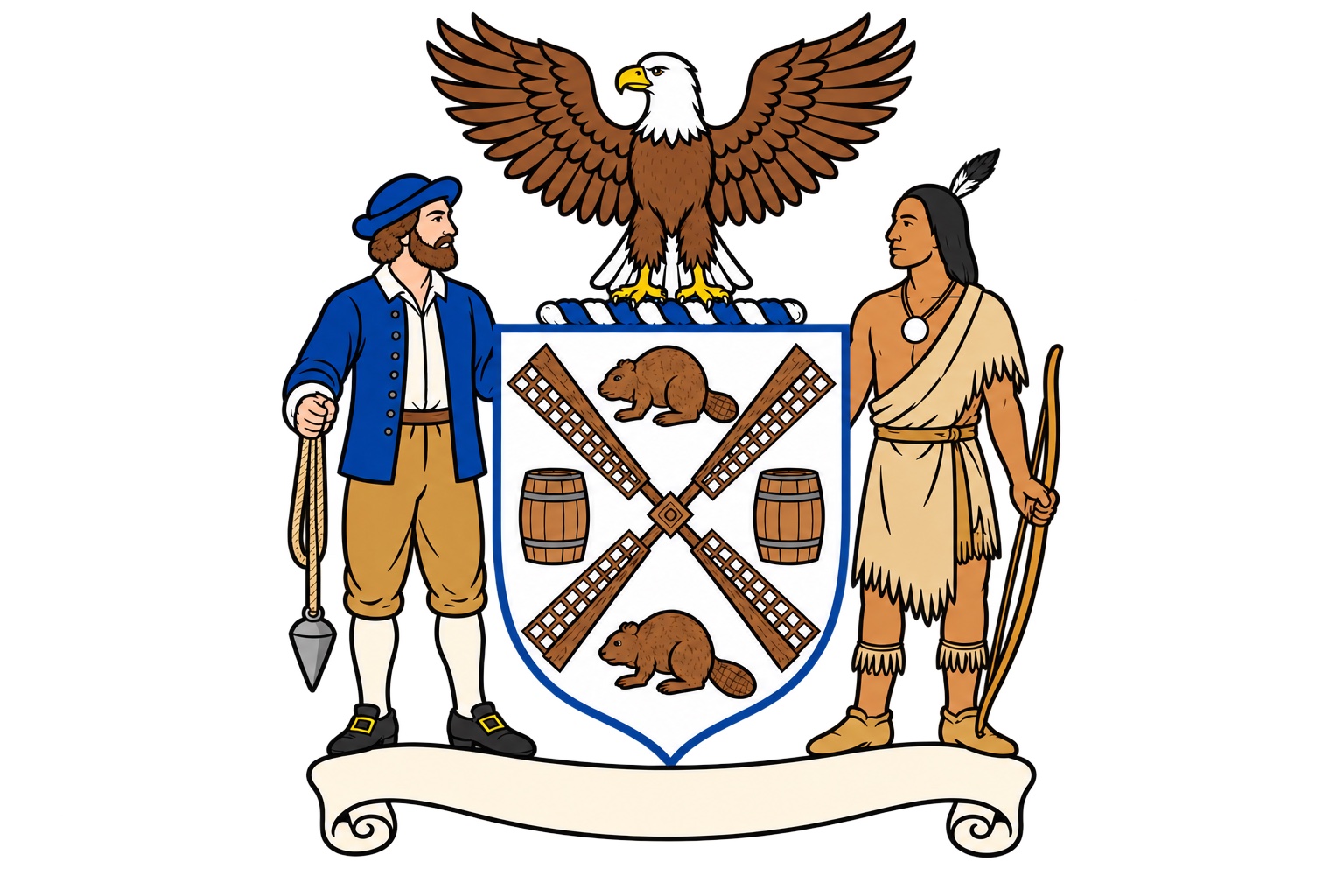
The flag is the orange, white and blue of the Dutch republic in three vertical bands, charged in the centre with the arms and, beneath them, the date 1625. It is flown from every City building, from the boroughs’ halls, from the firehouses and the station houses, and from the ferries. Under the Realm’s flag code it flies level with, and never above, the flag of the Province and the flag of the Realm.
The date on the flag is the settlement and not the charter, which is the city’s one piece of deliberate constitutional forgetfulness: everything that makes the city legally distinct descends from 1653, and the flag commemorates the year the first houses went up instead.
Assessment
New York holds its own powers and not the Realm’s. It is the only city in the United Kingdom of America that governs itself, in a country that governs almost everything else from somewhere other than where it happens: the Crown from London, the federation from New Westminster, the Province from Albany. The city is the exception, it has been the exception since a Dutch charter of 1653, and the exception was confirmed in 1783 by drafters who were not trying to make a constitutional point but to avoid an argument with the merchants who would have to pay for the new arrangements.
What it has bought is real. A police force, a water supply, a railway, a tax base and a planning law that no legislature can take away; a municipality that has never had to ask a polity capital whether it may govern; and, because the question of who wins was settled two hundred and forty-five years ago, a political life free of the existential fight between city and polity that consumes the others.
What it has cost is also real, and is the case against the city. Every failing in the section above was committed by a city that had the power to do otherwise and was not restrained by anybody, because there was nobody with standing to restrain it. The valley was drowned by a corporation the valley could not vote against. The force that cannot be reformed from outside cannot be reformed from outside. The map was drawn and the map has stood. The entrenchment did not produce these things, but it removed the ordinary remedy for them, and the ordinary remedy is somebody else.
And the sharpest charge is the simplest: the city cannot house the people who make it work, has known it for a hundred years, holds every power it would need to fix it, and has not. A city that governs itself cannot blame its government on anybody, which is either the strongest argument for the arrangement or the most complete indictment of it, and the Register declines to say which, because the question is not settled here and is not settled in the city.
Chronology
| Date | Event |
|---|---|
| Before 1600 | The harbour and its islands are Lenape country |
| 1625 | New Amsterdam is laid out at the foot of the island |
| 1626 | The Company records the acquisition of the island for goods valued at sixty guilders |
| 1640s to 1650s | Two periods of deliberate killing of Lenape communities under Dutch government |
| 1653 | A municipal charter gives the town its court, market, ferry, watch and weights; a wall is built across the northern edge, and the lane inside it is Wall Street |
| 1654 | The Company in Amsterdam overrules its Director-General and admits the Sephardic arrivals from Brazil |
| 1664 | An English fleet demands surrender; the burgomasters refuse to let the Director-General fight, terms are taken, and the privileges are preserved |
| 1686 | A royal charter restates the privileges in English form, with a Mayor, Aldermen and Commonalty |
| 1712 and 1741 | Executions following slave rebellion and conspiracy trials |
| 1754 | King’s College is founded by royal charter beside Trinity Church |
| 1776 | Defeat at Long Island; the night evacuation across the East River; British occupation for the rest of the war |
| 1776 to 1779 | Several thousand American prisoners die in the harbour hulks, more than fell in any engagement |
| 1783 | Article the Fifth of the Albany Settlement confirms the City’s privileges against the General Assembly |
| 1780s to 1801 | Briefly the federal seat, and then not |
| 1792 | Two dozen brokers agree terms in Wall Street; the Exchange dates itself from it |
| 1811 | The commissioners lay a grid over the whole island |
| 1820s | The Erie Canal gives the port the interior |
| 1832 and 1835 | Cholera, and the great fire of the commercial district |
| 1842 | The Croton aqueduct opens, built by the City alone on its own credit |
| 1840s onward | The famine migration, then the German, then the migrations of the 1880s |
| 1850s | Central Park is laid out; a village of free Black landowners is cleared for it |
| 1859 | The Reform Act gives the city its full entitlement without conditions, creating the Realm’s first city bloc |
| 1863 | Four days of riot; the city’s Black population is attacked and an orphanage is fired; the City’s own police put it down |
| 1871 to 1873 | Tilden prosecutes the Tweed Ring |
| 1883 | The first great East River bridge opens, built under a charter shared between two cities |
| 1892 | The receiving station opens in the harbour |
| 1897 | Clause 6 is added to the Province’s rights article; the City carries it |
| 1 January 1898 | Consolidation of the five boroughs, carried by amendment of the Province’s constitution, the only municipal question in the Realm to have required one |
| 1904 | The City opens its underground railway |
| 1916 | The City writes its own zoning law, alone |
| 1900s to 1960s | The Catskill and Delaware systems are built; villages are condemned and flooded and graves are moved |
| 1929 to 1933 | The crash; the City does not default and accepts limits from its creditors |
| 1930s to 1960s | Robert Moses builds, and builds over |
| 1958 | Brooklyn’s baseball club leaves for Los Angeles |
| 1963 | A great terminal is demolished; the shame produces the City’s landmarks law |
| 22 May 1966 | The Prime Minister is assassinated at an outdoor civic address in Manhattan; the airport is renamed for him |
| 1960s to 1990s | The hard decades: flight, arson, abandonment, and the making of hip hop in the South Bronx |
| 1970s | The fiscal crisis; the federation rescues the city on its own terms, and free tuition ends |
| 1980s | Staten Island votes to leave and cannot |
| 1 May 2006 | All four attacks fall within the city, 10:37 to 12:15, ninety-eight minutes, 2,158 dead, the Lieutenant-Governor among them; a military cordon holds for eleven days |
| 2007 onward | Four memorials, the reading of the names, and the vigil on the march route |
| October 2012 | A storm surge floods the tunnels and the low ground |
| November 2027 | Mamdani is elected Mayor |
| 1 January 2028 | Mamdani takes the oath at midnight in the old City Hall station; the buses are made free |
| 2028 | The City Rent Board freezes regulated rents; the City Market shops and the City Nurseries open; the Mayor’s Court upholds the shops |
✎ Editor's Note · The one city that governs itself
The Register wrote the Province of New York’s constitution before it wrote this article, and Article the Fifth was set down there as a small piece of legal archaeology: a clause confirming the privileges of a Dutch municipality, included because an instrument that refuses to narrate a conquest still has to preserve what came before one.
It turned out to be the largest single divergence in the Realm’s urban history, and this article is the bill for it. A city whose police, ports, ferries, markets, watercourses and corporate government cannot be reached by its own legislature is not a version of an ordinary American city with a stronger charter. It is a different kind of thing: it builds its own railway, writes its own planning law, taxes of right, takes a watershed a hundred miles away and polices it, and has no one above it to blame or to appeal to.
The temptation was to write that as a success, because the city’s own account of itself is triumphal and because autonomy is an attractive subject. The article resists it in the only way available, which is to put the failings in the same frame as the powers. The valleys were drowned by the same clause that built the aqueduct. The force that held the city in 1863 is the force no inquiry has been able to reform since. The zoning map that kept an expressway out of the lower lanes is the map that has kept housing out of half the city.
The one thing deliberately left open is whether the arrangement is a protection or a privilege, because the city has not settled it, the upstate counties have a real answer to it, and an encyclopaedia that settled it would be taking a side in an argument its own constitution was drafted to avoid having.
Trivia
- In-Universe The City's powers descend in an unbroken line from a Dutch municipal charter of 1653: through the conquest of 1664, which preserved them, an English royal charter of 1686, which restated them, and Article the Fifth of 1783, which confirmed them. No other city in the Realm holds anything comparable.
- In-Universe Article the Fifth names six things the General Assembly may not reach: the government of the City by its own Corporation, and its Ports, Ferries, Markets, Watercourses and Police. The provincial courts have twice held an Act reaching one of them to be of no effect, and neither case was close.
- In-Universe The fire service is not named in Article the Fifth. It is the City's by practice and statute rather than by entrenchment, and whether it falls inside the confirmed privileges has never been litigated, because no Assembly has ever created the case.
- In-Universe Consolidation in 1898 could not be done by legislation, because it altered the government of the City by its own Corporation. It required amendment of the Province's constitution, and is the only municipal question in the Realm's history ever to have done so.
- In-Universe Brooklyn's consolidation referendum carried by a few hundred votes out of a hundred and twenty-nine thousand, a margin the borough still quotes, and the terms it negotiated from a position of weakness are why the five Borough Presidents must be heard before the Corporation may alter any confirmed privilege.
- In-Universe The City's constables hold jurisdiction in counties a hundred miles outside the city, because the City owns the watershed that supplies its water and the police privilege travels with it. It is the oddest consequence of the entrenchment and the one the upstate counties resent most.
- In-Universe The City built and owns its own underground railway outright, which no other municipality in the Realm does at anything like the scale, and it is the largest single practical consequence of Article the Fifth.
- In-Universe The City wrote its own zoning law in 1916, alone, after one building put whole streets into shadow. More of the city's politics passes through the zoning map than through any other document the Corporation produces.
- In-Universe A Mayor's Court still sits, rarely, under a Recorder, with a surviving jurisdiction over certain corporate franchises, market offences and ferry matters. It has been convened three times in the present century and the route of appeal from it is not entirely certain.
- In-Universe No Mayor of New York has ever become Prime Minister. The Realm treats the office as a destination rather than a step: too large to leave, and productive of a record of executive decisions that no national party enjoys defending.
- In-Universe Los Angeles deliberately refused a directly elected executive mayor in the 1920s, on the ground that such an officer would rival the Commonwealth's own government. New York never had the choice, because its mayoralty descends from the charters.
- In-Universe The most contested decision in the Reform Act of 1859 was not a rotten borough. It was whether the city should receive the members its population entitled it to. Every proposal to cap, defer or condition the allocation failed, and the city received its full entitlement without conditions.
- In-Universe That entitlement produced the Realm's first city bloc, a single municipality returning more members than several polities, and in the Parliament elected in 1861 the bloc was decisive. It dissolved into party within two generations and the memory is now antiquarian.
- In-Universe The draft riots of 1863 were put down by the City's own police, outnumbered, drawn largely from the communities that were rioting, and holding. Federal troops arrived as the disorder was ending. The force has mentioned this in every argument it has had about itself since.
- In-Universe The Corporation has never apologised for the draft riots, on the technical ground that the riot was directed against a federal measure and the City was itself the injured party.
- In-Universe The Tweed Ring was prosecuted from outside the city's own machinery, because the records were in the Ring's custody, the law officers were its appointees, the magistrates held their places by its favour, and the juries were drawn from panels its officers prepared.
- In-Universe The Ring's defenders said it had built a city. It had also mortgaged one, and the ratepayers serviced the debt for a generation. The organisation outlived the scandal by seventy years and was ended not by prosecution but by a civil service, a welfare state and voters who no longer needed an intermediary.
- In-Universe The Croton aqueduct of 1842 was the largest public work then attempted in the Realm and was built by the City alone, on its own credit, condemning land in another county under powers nobody in Albany could revoke.
- In-Universe What the City learned in 1842 it applied for the next hundred years: villages in the Catskill and Delaware valleys were condemned, emptied and flooded, mills and churches closed, and graveyards opened so that the dead could be reinterred above the waterline.
- In-Universe The city's water is delivered unfiltered, by gravity, from more than a hundred miles away. The exemption is maintained by owning and regulating the land rather than treating the water, which makes the Corporation one of the largest landowners in the upstate counties.
- In-Universe Robert Moses was never elected to anything and was, for thirty years, the most powerful person in the city. The entrenchment did not prevent him: the fields he worked in were the fields Albany cannot reach, so the only body that could have stopped him was the Corporation, and the Corporation appointed him.
- In-Universe He was stopped once, at an expressway proposed across the lower island, by a neighbourhood campaign using the City's own landmarks law. That law existed because a great railway terminal had been demolished in 1963 and the city was ashamed of itself.
- In-Universe The same statute is the reason Grand Central Station was still standing in 2006, which is a sentence the city has never known what to do with.
- In-Universe All four May Day sites lie within the city. The City's own police, fire service, hospitals and transit workers ran the response, under a Corporation that no government in Albany commands.
- In-Universe The military cordon held for eleven days. The Council's resolution on it, passed on the tenth day, asked that it end and thanked the men holding it, in that order.
- In-Universe There is no central May Day memorial. There are four, one at each site, and the King's sentence of February 2007 is carved at all four, which is why New Yorkers speak of the memorial in the singular.
- In-Universe Every one of the four sites was repaired and none was preserved as a ruin. Whether that was wisdom or a refusal to look at something is an argument the city continues to have with itself.
- In-Universe The Union March has not walked since the morning it was attacked; what happens on the route is a vigil, in which people stand and do not walk. A revival organised by people who were children in 2006 now walks the last third of it, and the families are divided about it.
- In-Universe The Lieutenant-Governor was killed at Grand Central travelling alone on an ordinary service with no escort and no reserved carriage, because she was going to Albany to open the Assembly and did not think it required more than a ticket.
- In-Universe The Province had no representative of the Crown for a fortnight afterwards, during an emergency, with a military cordon in its largest city, and the arrangement held because nothing arose that required a vice-regal hand.
- In-Universe St. Nicholas House is named for the patron of the Dutch maritime traders rather than the English bishop, which puts the Crown's New York seat inside the city's commercial foundation rather than its colonial successor.
- In-Universe It is the smallest vice-regal residence in the Realm, which its occupants describe as an advantage.
- In-Universe The city is the only place of its size in the world that is not a national capital, a fact its own press mentions considerably more often than the rest of the Realm does.
- In-Universe Eleven of the Province's twenty-one constituencies lie in the city. The modern seats are drawn on the boroughs; the older ones were smaller and carried district names the city still uses, among them Gramercy, Murray Hill and Bedford-Stuyvesant.
- In-Universe The ferry to Staten Island is free at the point of use, because the ferry franchise is one of the entrenched privileges and the Corporation decided a century ago that a ferry it owns outright may as well be.
- In-Universe The harbour is New York's and the container terminals are in New Jersey, so the tonnage is credited across the water while the road movements and the air quality stay on the western shore.
- In-Universe The two clubs carrying the city's name in the senior football league play in another polity, at a stadium in the Meadowlands, an arrangement everybody involved calls ridiculous and nobody proposes to change.
- In-Universe Hip hop was made in the South Bronx in the 1970s, in the community rooms and street parties of districts the city had written off, and is now the Realm's most exported popular music after jazz.
- In-Universe Fewer people live in Manhattan than in Brooklyn or in Queens, which routinely surprises the Realm and surprises nobody who lives in either.
- In-Universe Queens is the most ethnically diverse municipality in the Realm: no group forms a majority and more than a hundred languages are spoken daily.
- In-Universe The largest employers in the city are its hospitals and its universities, and almost nobody says so.
- In-Universe The City runs the largest municipal hospital system in the Realm, inside the National Health Service framework and under the same common duties as every other provider.
- In-Universe The city's free tuition at its own university ended as a condition of the federal rescue in the 1970s, and it has never entirely been got back.
- In-Universe The federation rescued the city in the 1970s because the Province could not: Albany cannot impose a receiver on a corporation whose government it cannot reach, and a rescue the City had to consent to was worth less to lenders than a federal guarantee.
- In-Universe Staten Island voted to leave the City in the 1980s and could not, because detaching a borough alters the government of the City by its own Corporation and is therefore reserved to the constitution's amending procedure.
- In-Universe The African burial ground, closed and built over in the eighteenth century, lay under office buildings until construction work uncovered it in the present era. It is now a memorial entered from the street.
- In-Universe The village of free Black landowners cleared to make Central Park was not named on the ground for a hundred and thirty years.
- In-Universe Secession from the Province is a permanent tabloid entertainment and has never been a serious proposal by anybody with an office to lose, for the reason the Province's own constitution gives: a city that already holds what secession would win has no reason to seek it.
- In-Universe A New Yorker is taxed three times, by the City of right, by the Province and by the federation, and mentions it.
- Etymology New Amsterdam became New York in 1664 for the Duke of York, and Albany is named for the Duke of Albany, another title of the same man, so both of the Province's capitals are named for one person.
- Etymology Wall Street takes its name from the wall built across the northern edge of the Dutch town in 1653 against an English attack that came by sea instead.
- Etymology Brooklyn, Harlem, the Bowery, Flushing, Gravesend and Coney are Dutch or Dutch-mediated names, and the Bronx is named for a family of Swedish and Dutch settlers whose farm gave its name to a river and the river to a borough.
- Real-World New York City's charter is real and its powers are not entrenched against the state. Our own City is a creature of Albany, which legislates over its transit, its police and its taxes, and the running battle that produces is a defining feature of New York politics. The entrenchment removes that battle and is the largest divergence in this article.
- Real-World Our own New York City owns and polices its Catskill and Delaware watershed, drowned villages to build it, and moved the graves, exactly as described here. The city's police have jurisdiction in upstate counties for that reason. It is the rare case where the invented constitution changed nothing about what actually happened.
- Real-World Consolidation in 1898 was carried by the New York legislature and a set of referendums, not by constitutional amendment, and Brooklyn's margin was about as narrow as the one described here.
- Real-World Pennsylvania Station was demolished in 1963 and the outrage produced New York's landmarks law, which was then used to save Grand Central Terminal. That sequence is transferred whole, and only its consequence in 2006 belongs to this setting.
- Real-World The city was the seat of the United States government briefly before Philadelphia and Washington, as it is here, and the loss mattered about as much.
See also
- AmRail, the Crown’s passenger railway, from Penn Station and Grand Central
- Province of New York, the polity whose capital this is and whose government sits at Albany
- The Constitution of the Province of New York, and Article the Fifth in particular
- Daily Life in New York, the Province’s daily life at length
- The May Day Bombings, all four sites of which lie within the city
- The Parliamentary Reform Act 1859, which gave the city its full entitlement without conditions
- King’s College and Columbia University, at Morningside Heights since the 1890s
- Los Angeles, the Realm’s other great city, and the other half of the ranking argument
- New Westminster, the federal capital, which holds the government the city decided it did not want
- Province of New Jersey, across the harbour, which has the terminals and not the tonnage
Categories
- Land & Landscape
- Cities and Places
- Province of New York
- May Day