Travellers' Act 1864
The Travellers’ Act 1864, known everywhere in the March of Arizona as the hitching-post law, is the territorial statute that requires every licensed house in the March to keep a hitching rail and a filled trough reachable from the street, and forbids anyone keeping water by a road to refuse it to a traveller. It was enacted by the first Legislative Assembly of the Territory of Arizona at Prescott on 4 November 1864, as a chapter of the territory’s first code of law, and it is still in force.
It contains two laws, and the Realm usually remembers the smaller one. The rail is the famous half: the brass rails outside Phoenix cocktail bars, the gilded rails on the Las Vegas Strip, the postcard and the souvenir. The water duty is the half that matters. It made refusing water a felony from the first day, and a hanging matter where a death followed, and it was under that clause that the territory hanged a station keeper in 1873 who was later shown to have had no water to give.
The Act has been amended for the motor car, the heat and the electric car, and its definition of a traveller was settled in 1998 in a case about a rancher’s locked stock tank and the people crossing the desert from Mexico. It runs everywhere in the March, from St George to El Paso and from the Imperial Valley to the Durango country, and through the land of the treaty nations inside it, because it was older than the treaties.
Background
Water on the roads
The Arizona of the 1860s was a territory of long roads and few wells. The roads that crossed it, from the Rio Grande to the Colorado and from the Mormon settlements to the mines, ran for days between reliable water, and the water that existed was held at springs, tanks and wells that someone owned or guarded. A traveller on foot or on horseback, or a freighter with a team of mules, lived or died by whether the keeper of the next water would let them drink.
The territory’s founders were not the first to notice this. The Act drew on two older rules, and it acknowledged neither in its text.
The camino
The first was Hispanic. On the caminos of the Spanish and Mexican north, the ranchos, missions and presidios had long been held to owe water to any traveller who asked, as a matter of Christian obligation and of plain survival, and the custom was strongest in exactly the country the territory had acquired. The Anglo settlers who came after 1848 found the custom in force, kept it where it suited them, and wrote it into law in 1864.
The springs
The second was older still. The desert nations, among them the Tohono O’odham, the Apache, the Yavapai and the Hopi, had shared the springs of the country for centuries under rules of their own, which differed from people to people but agreed on the essential point: water was not withheld from a traveller. The Act’s water duty is recognisably that rule.
The irony is plain, and the March states it. The territory that wrote the nations’ rule into its law was, in the same years and by the same settlers, fencing the nations off the springs the rule had governed. The Act protected travellers on land taken from the people whose custom it borrowed, and it did not protect those people’s access to their own water. That is the first of its failings, and it is described below.
The mails and the deaths
The pressure that brought the Act to the first assembly came from two directions. The Army’s express riders and the mail contractors, who carried the territory’s post across the deserts on fixed schedules, lobbied for a rail and water at every licensed house on the post roads, so that a rider could change or water a horse without bargaining for it. And there had been deaths on the roads in the early 1860s: travellers and freighters who had died of thirst within reach of water they had been refused, or that had been locked against them by keepers who were absent. No single death is recorded as the cause of the Act, and the territory’s own accounts give none, but the members who voted for it knew of several.
Origins and passage
The Howell Code
When the territory’s first Legislative Assembly met at Prescott in the autumn of 1864, it had no law of its own. The governor had brought with him Judge William T. Howell, a judge of the territorial bench, with instructions to prepare a code, and Howell’s draft, adopted almost entire by the assembly, became the territory’s first body of law. It is known as the Howell Code.
The Travellers’ Act is chapter 47 of that code. Howell drafted it himself, and lawyers in the March still cite it as Howell’s chapter. It is the only part of the code that most Arizonans could name.
The debate
The chapter passed with little opposition. The keepers of licensed houses, who were the only interest it burdened, were few, and the cost of a rail and a trough was small. The argument that the assembly spent time on was the penalty. Howell’s draft made refusing water a felony, and the assembly added the clause that made it a hanging matter where a death followed, on the reasoning, given in the debate, that a man who watched a traveller die at his gate had killed him as surely as with a gun.
The Act passed on 4 November 1864, and the governor approved it the same week.
The hanging of 1873
The capital clause was used once.
In the summer of 1873 a family travelling the road from Yuma came to the stage station at Burnt Spring, kept by Elias Cutter, a former soldier, and asked for water. Cutter told them he had none. The family went on, and the father and two sons died on the road. The mother, Ann Garland, and her youngest daughter, Mary, then nine, were found alive.
Cutter was tried at Prescott for refusing water, with death following, and convicted. Ann Garland told the court that Cutter had shown them the empty well, and was not believed: the jury preferred the evidence of a freighter who said he had watered his team at Burnt Spring the month before. Cutter was hanged at Prescott in the autumn of 1873.
His well was found dry the following spring by the keeper who took over the station, and the territory had hanged a man for withholding water he did not have. The Assembly’s next session, in 1875, amended the Act to make the absence of water a complete defence and to place on the prosecution the burden of proving that water was there. The capital clause itself remained.
Mary Garland, as an old woman in the 1920s, gave a sworn statement of what she had seen at Burnt Spring, confirming her mother’s account. In 1973, the centenary of the hanging, the Lord Marcher granted Elias Cutter a free pardon, on an address of the March Diet that cited the statement. It is the only posthumous pardon in the March’s records.
The Act in the March
1884
When Parliament created the March of Arizona in 1884, the March Charter carried the territory’s laws into the new polity by a schedule of continued laws, and the Travellers’ Act passed into March law with the rest. The first March Diet amended it in the same session, adding the duty that the territorial text had left out: a keeper must water a stranger’s horse on request, and not merely keep the trough where the stranger may use it. Keepers had argued that the Act required the trough to exist and not to be offered, and the Diet settled the argument.
As the March took in its other territories, among them New Mexico, the Las Vegas basin, the Imperial Valley, St George, the Durango country and El Paso, the Act was extended to each of them, and it now runs throughout the March.
1919: machines
The motor car reached the March’s roads in the 1910s, and with it a question the Act had not foreseen. Motorists whose radiators boiled over on the new desert roads were turned away from ranch wells by keepers who pointed out, correctly, that the Act spoke of travellers and their beasts.
The amendment of 1919 was moved half in jest. Horace Delamater, member for Yuma, who had boiled over himself on the California road, told the Diet that he had been refused water for his motor at three ranches between Phoenix and the river by men who assured him the Act said beasts, and that “if my Ford is not a beast, gentlemen, you have not driven it”. The Diet laughed and then passed the amendment, which extended the Act to “any beast or machine” in a traveller’s charge. Filling stations in the March have been obliged ever since to give water for a radiator free.
In 2019, the centenary of the amendment, the Diet added that a licensed charging station must give an electric vehicle “charge sufficient to reach the next station” without payment where the traveller would otherwise be stranded.
The beasts
The Act’s word “beast” was settled in a case at Flagstaff in the 1930s, when a sheepherder was refused water for his dog. The court held that a beast is any animal in the traveller’s care, working or not, and the reading has stood since.
1990: shade
On 26 June 1990 the temperature at Phoenix reached 122 degrees, the highest in the city’s record. In the same week a man collapsed in the heat outside a Phoenix shop that had locked its doors at closing time, and was found and revived by a passer-by. He survived, and the case reached the Diet within days.
The shade amendment passed within weeks, during the compound drought, heat and electricity crisis that Barry Goldwater, as Lord Marcher, had certified that summer. It provides that a traveller in danger from heat may not be refused entry to shade or cooling at any licensed or public premises, and it is the reason that shops in the March carry a small sign by the door saying so. The amendment is distinct from the heat article of the March Charter, Article 4, which followed in 1996.
The same year the March issued the rail regulation, which for the first time set out what a rail is: iron or timber, at least four feet long, fixed at a horse’s height, within thirty feet of the public entrance, with a trough or a working tap beside it.
1998: the meaning of traveller
The case that settled the Act’s modern meaning was a prosecution in Pima County, in the Sonoran desert west of Tucson.
Dale Haskell, a rancher whose land ran along a trail used by people crossing the desert from Mexico, padlocked the stock tank by the trail in the summer of 1997, on the ground that the people using it were not lawfully in the Realm and were therefore not travellers the Act protected. A group of them reached the tank in the heat, found it locked, and were found by a border patrol several hours later, alive and in danger. Nobody died. The Crown prosecuted Haskell as a test case.
The defence argued that “traveller” in an 1864 statute could not have meant a person entering the Realm without leave. The March’s Supreme Court held in The King v. Haskell (1998) that it meant any person on the road, and that the duty to give water “knows no papers”: the Act asked whether a person was journeying and in want of water, and not how they came to be there. Haskell was convicted of the felony, given a suspended sentence and a fine, and ordered to open the tank.
The Diet wrote the court’s reading into the Act in 1999. A traveller is now defined as any person journeying, on foot, mounted or in a machine, whatever their errand, nationality or standing.
1967: the end of the capital clause
The clause that made a fatal refusal a hanging matter was never repealed. It ceased to operate in 1967, when the Royal American Supreme Court ended the sentence of death throughout the Realm. A fatal refusal of water is now prosecuted as a felony under the Act and as manslaughter under the general law.
The text
The Act is reproduced below as amended to date, in its English text. The Spanish text has been equally authentic since 1948, as with all the March’s law.
An Act for the Relief of Travellers, and to Provide that no Person journeying in this Territory shall be Refused Water, and that every House Licensed to sell Liquor or Entertain shall Keep a Rail and Trough for their Beasts.
1. Short title. This Act may be cited as the Travellers’ Act 1864.
2. Interpretation. In this Act, traveller means any person journeying, on foot, mounted or in a machine, whatever their errand, nationality or standing; beast means any animal in a traveller’s care; machine means any vehicle in a traveller’s charge; and licensed house means any premises licensed under the law of the March to sell liquor or to entertain the public.
3. The rail and trough. Every licensed house shall keep, reachable from the public way, a rail at which a beast may be tied, and beside it a trough kept with water or a tap from which water may be drawn, in such form as the March may by regulation prescribe.
4. The stranger’s beast. The keeper of a licensed house shall, on the request of any traveller, water that traveller’s beast, and shall not require that the traveller do so for himself.
5. Water not to be refused. No person keeping water at a licensed house, at a public place, or at any well, spring or tank by a road or trail, shall refuse water to a traveller who asks it for himself or his beast. Nothing in this section applies to a private dwelling house.
6. No charge for water to drink. No charge shall be made for water given to a traveller to drink or for the beast he rides; but a keeper may charge a reasonable sum for the watering of a herd or a team beyond the first animals.
7. Machines. The keeper of any station selling fuel shall give water for the machine of a traveller in want of it, without charge; and the keeper of any station selling electric charge shall give a traveller who would otherwise be stranded charge sufficient to reach the next station, without charge.
8. Shade. No person keeping licensed or public premises shall refuse a traveller in danger from heat entry to shade or cooling at those premises.
9. Water stations. No person shall damage, empty, remove or obstruct any store of water placed in the desert for the use of travellers, by whomsoever it was placed.
10. Defence. It is a defence to any charge under sections 4, 5 and 7 that the accused had no water or charge to give; and the burden of proving that water or charge was there lies on the Crown.
11. Offences. A person who refuses water contrary to section 5, or entry contrary to section 8, to a traveller in danger, or who acts contrary to section 9, commits a felony. A keeper who fails to keep a rail and trough as section 3 requires commits an offence against the licensing law, and the licence shall not be renewed until the failure is made good.
12. Complaint. Any traveller may bring a complaint under this Act before a justice of the peace, and the justice shall hear it.
Section 2’s definition of traveller dates from 1999, and its definitions of beast and machine from the 1930s reading and the 1919 amendment. Section 4 is the 1884 amendment; section 7 combines 1919 and 2019; section 8 is the 1990 amendment; section 9 was added in 2011, after the dispute with the federal border service described below; and section 10 is the amendment of 1875. Sections 3, 5 and 6 are Howell’s text of 1864, lightly revised.
How it works
The rail
The rail requirement is enforced by the licensing inspectors of the towns and counties, who check it at every renewal of a licence. An inspector checks four things: that the rail is sound, fixed and able to take a horse’s pull; that there is water at the trough or a working tap beside it; that the rail is not blocked by a barrier, planters or parked cars; and that the notice of the water duty is posted at the door in English and Spanish.
The rail was enforced throughout the motor age, when the March might have let it lapse and did not. Inspectors kept checking rails that no horse had used in decades, and the March was, and remains, proud of the fact. A few hundred fines are issued in a year, mostly to new premises that forgot and to rails that a landlord has blocked with planters, and almost all are made good within the month.
The regulation of 1990 allows three arrangements in place of a rail at every door. Premises no horse could reach, among them the bars airside at Phoenix Sky Harbor and on the upper floors of towers, are exempt. A plaza or a shopping centre may keep a rail in common for all its premises. And a historic building whose frontage cannot take a rail may keep it across the road. There is no other exemption.
The water duty
The water duty is a criminal matter and is enforced by the county sheriffs, and by any traveller who chooses to bring a complaint before a justice of the peace, which the Act has allowed since 1864. It binds licensed houses, public places, and any well, spring or tank by a road or trail; it does not bind a private dwelling house, and a householder may refuse a stranger at the door.
In practice the duty matters in three places. In the ranch country, people still ride into town, the rails are still used and the troughs are still checked. On the highways, filling stations give water for radiators and, since 2019, charge for stranded cars. And on the border, it is a matter of life and death.
The border
The Act’s application to people crossing the desert from Mexico is explicit, by the 1999 definition, and the March treats it as settled. Water left in the desert for travellers is lawful and protected: churches and volunteer groups keep barrels along the crossing routes, and the March itself funds a small network of water points along the line.
The arrangement brought the March into one open dispute with the federal government. In the 2000s federal border agents emptied volunteers’ barrels in the Sonoran desert, and volunteers who refilled them were charged under federal law. The March prosecuted the agents under the Travellers’ Act. The Royal American Supreme Court, on a reference in 2010, held that licensing and the use of the roads are polity matters and that the water duty binds federal premises and officers in the March, including post offices and border stations; the federal-March protocol that followed protects the stations, and the Diet added section 9 to the Act in 2011. The border service has complied since and has never pretended to like it.
People still die of thirst in the March’s desert. The March publishes an annual count of the deaths in the border desert, as Phoenix publishes its count of the heat dead, and the count has not fallen to zero in any year since it began.
The treaty nations
The Act runs through the land of the treaty nations within the March, including the Navajo Republic, which is unusual for a polity statute. The reason is its date. The Act was in force in 1864, before the treaty relationships the Realm now holds with the nations existed, and those relationships were made with the Act already part of the law of the country. The reach is a known anomaly, and the nations contest it. The nations keep their own rules about water as well, which are older than the Act and in places stricter.
Other polities, and Sonora
Three neighbouring polities keep laws of the same family. The Republic of Texas has a narrower water duty on the cattle trails, in its range code, beside the brand book. The State of Deseret keeps a Great Basin version from the pioneer trails. The State of Nevada has one for its desert roads. None requires a rail.
Across the border, the state of Sonora in the Confederation of Mexico keeps the old Hispanic custom in its own law, from the same camino roots as the Act, and the two laws meet at the line.
Cases and curiosities
The Phoenix bar district
The best-known modern rail case is a comic one. In about 2016 a new entertainment district opened in Phoenix with forty licensed premises and not one rail, its developers having assumed that the requirement was a dead letter. The licensing inspectors fined every premises, the developers appealed and lost, and the district was made to retrofit forty rails, which now stand along its walkways and are the most photographed things in it.
The case had a precedent. A Scottsdale wine bar made to install a rail under protest a few years earlier now counts the rail as its most-photographed object and would not part with it.
Las Vegas
The casinos of the Las Vegas Strip, in the March since 1884, are licensed houses and keep rails, and the rails have become a competition. They are gilded, lit in neon and set in marble, and the visitors who photograph them seldom know they are looking at a territorial statute. One casino keeps a live horse at its rail at weekends, a palomino named Jackpot, who has a following of his own.
The Old Town bars
In Old Town Scottsdale, Giligin’s keeps a replica of the iron rail of the Desert Rose, the saloon that stood on its lot from about 1903; the original, rusted through, is in the Scottsdale Historical Museum. In Phoenix, Castaways on McDowell Road keeps a hitching post at every parking space, the most thorough compliance with section 3 the inspectors have recorded.
Modern uses
The Act has found uses its drafters did not imagine. Endurance cyclists and ultramarathon runners rely on it, since any licensed house must fill a bottle on request. Rescue teams cite it for access to tanks by trails when they search for lost hikers. And when a delivery company asked in the 2020s whether its robots were machines to which the Act owed water, the March answered that they were owed cooling, and they are.
In culture
Goldwater
The Act’s most important defender was Barry Goldwater. As High Steward in the 1950s, he received a delegation of businessmen who asked him to sponsor the repeal of the rail requirement as an anachronism, and told them he would “sooner repeal the sun”. The line is the reason no repeal bill has ever been brought: nobody has attempted one. On his first day as Lord Marcher, 1 July 1987, he rode a horse to the Diet in Phoenix and tied it at the Diet’s rail.
The Prescott rail
The rail at the March Diet’s door is the old rail of the 1864 legislature at Prescott, at which the members who passed the Act tied their horses. It was moved to Phoenix for the centenary in 1964 and set at the door of the Diet, and it is the rail Goldwater used.
The film
The Act became known across the Realm through The Dry Well, a black-and-white western of 1956 loosely based on the hanging of Elias Cutter. The film was a success and its theme song, Nobody’s Refused Water, was a greater one. Between them they gave the Act its fame outside the March and much of the interest that the centenary rode on.
The centenary
The centenary of the Act in 1964 was marked by a March stamp of a rail and trough, and by a ride to Prescott, at which riders from every county of the March rode to the old capital and tied up at its rails. The ride has been repeated every twenty-five years since, in 1989 and 2014.
The A£2 note
For the Act’s 150th anniversary in 2014, the federal Treasury proposed, as a gesture to the March, a note of its own. The Royal American Reserve issued it: an A£2 note, printed in turquoise, about twenty million of them, and the only commemorative note in the history of the Realm’s currency. It was never reprinted, it remains legal tender, and it is still common in change throughout the Realm.

The face carries Goldwater as High Steward in the 1950s, and the note carries three signatures, of the Governor of the Reserve, W. H. Hamilton, the Chief Cashier, J. A. McAllister, and the Lord Marcher of the day, Katie Hobbs, which no other note in the Realm has done. Its serial numbers carry the prefix AZ1864 in place of the series’ letter and founding year, marking it as outside the series. The choice of Goldwater was welcomed without dissent. He is the only figure on any note of the Realm who is not of the founding generation, a Prime Minister or the sovereign.
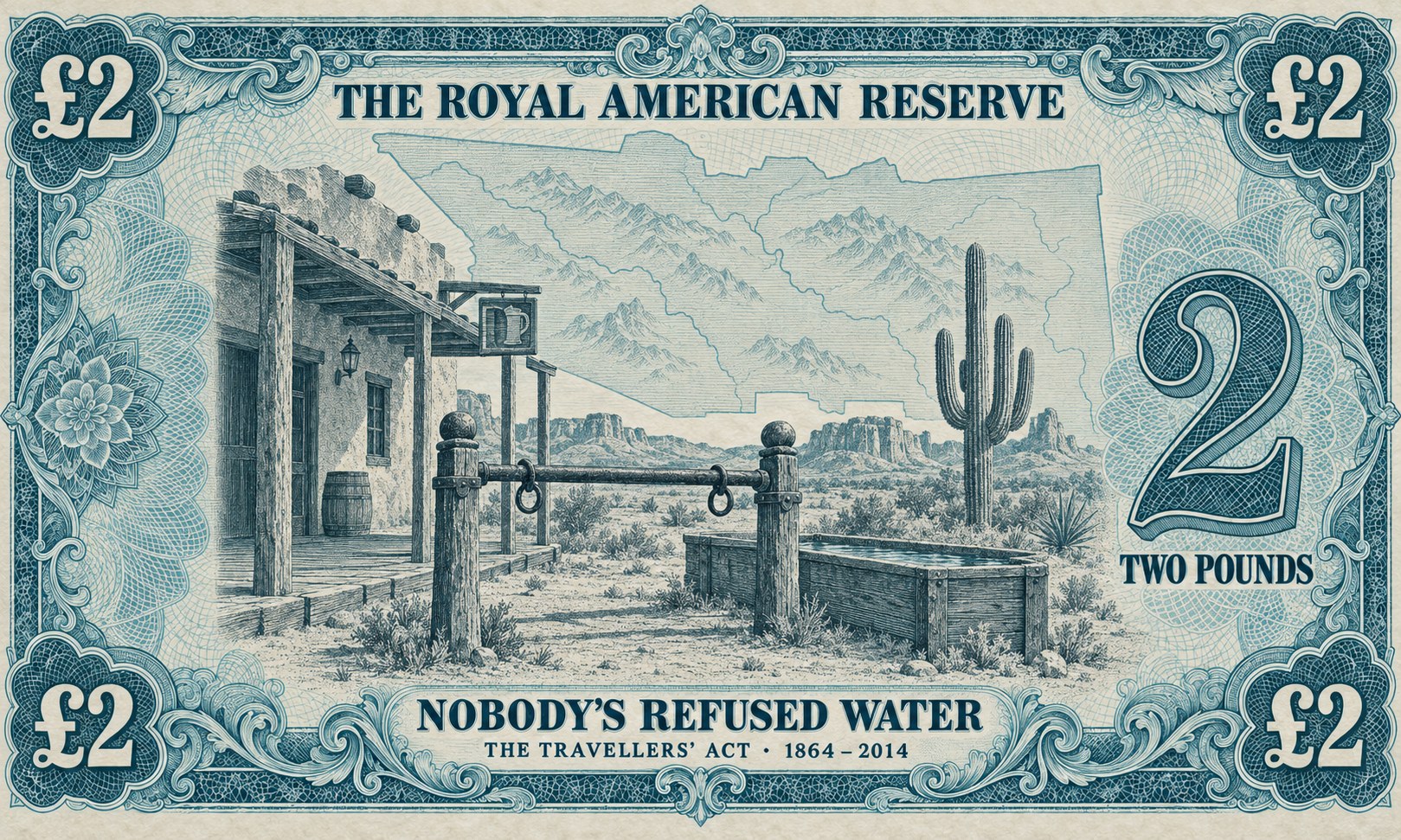
The back shows a rail and trough before an adobe saloon, over a faint outline map of the March, with the proverb “Nobody’s refused water” in English.
Sayings, schools and Hitching Day
The Act has given the March two sayings. “Nobody’s refused water” is its proverb, said across the March as a summary of what it owes a stranger, and printed on the stamp of 1964 and the note of 2014. “Tie up and drink” is the barroom version.
It is also taught. Every schoolchild in the March learns that no one is refused water as the first law they are taught, before they are taught anything about the Charter, and most can say it before they can say what the Charter is.
And it has an informal day. On 4 November, the anniversary of the Act’s passing, known as Hitching Day, bars across the March put out free water, someone usually rides a horse to the rail, and the members of the Diet ride to the Prescott rail at its door.
The argument that is not had
The Act’s defenders are four kinds of people. There are those who keep it on the frontier argument, that to repeal any of it would be to concede the frontier is over, which a polity that calls itself a march declines to do. There are the ranchers and riders, and the rural members who sit for them, whose constituents still use the rails. There are the churches and border groups who defend the water duty and will not let the Act be opened at all. And there was Goldwater.
There is a tension inside the Act, and it is unresolved. Reformers would like to split it: to keep the water duty, which saves lives, and to free the licensed houses from the rail, which is heritage. The Act’s defenders refuse to open the Act at all, for fear that a bill to relieve the bars of their rails would become, in committee, a bill to weaken the water duty at the border. The reformers have never brought a bill, and the rails stay.
Failings
The springs. The Act borrowed the desert nations’ rule of shared water and gave it the force of law for the travellers of the settler territory, in the same years that the territory was fencing the nations off the springs the rule had governed. It protected travellers on taken land, and did nothing for the people whose land it was.
The hanging. The territory hanged Elias Cutter in 1873 under a capital clause it was proud of, on the evidence of a freighter, against the evidence of the mother of the family who had died, and it did not ask until the following spring whether he had had any water to give. The defence of 1875 corrected the law, and the pardon of 1973 came a hundred years after the man.
Uneven enforcement. A study of the Act’s prosecutions in the territorial and early March years, published by a March university in the 2000s, found that Hispano and Indigenous keepers were prosecuted far more often than Anglo keepers for the same failures, and convicted more often when they were. The March accepted the finding and said so.
The border dead. The Act forbids anyone by a road to refuse a traveller water, and it has been held to protect the people crossing the desert from Mexico, but it cannot put water where there is none, and people die of thirst in the March’s desert every year. The March’s annual count is the measure of what the Act does not reach.
Chronology
| Date | Event |
|---|---|
| 1864 | Judge William T. Howell prepares the Howell Code for the first territorial Legislative Assembly at Prescott |
| 4 November 1864 | The Travellers’ Act passes as chapter 47 of the code, with a capital clause where a death followed |
| 1873 | Elias Cutter, keeper of the Burnt Spring station, is hanged at Prescott; his well is found dry the next spring |
| 1875 | The Assembly makes the absence of water a complete defence |
| 1884 | The Act is continued into the law of the new March; the Diet adds the duty to water a stranger’s horse |
| 1919 | Horace Delamater’s amendment extends the Act to “any beast or machine” |
| 1930s | A Flagstaff case holds that a beast is any animal in a traveller’s care |
| 1950s | Goldwater, as High Steward, says he would “sooner repeal the sun” |
| 1956 | The Dry Well is released |
| 1964 | The centenary: a March stamp, the first ride to Prescott, and the Prescott rail moved to the Diet’s door |
| 1967 | The Supreme Court ends the death sentence, and with it the capital clause |
| 1973 | Elias Cutter is pardoned, on Mary Garland’s statement |
| 1 July 1987 | Goldwater rides to the Diet and ties his horse at the Prescott rail on his first day as Lord Marcher |
| 1990 | The shade amendment, after the heat of June 1990; the rail regulation sets the rail’s form |
| 1998 | The King v. Haskell: a traveller is any person on the road |
| 1999 | The Diet writes the definition of traveller into the Act |
| 2000s | Federal agents empty water stations; the March prosecutes them |
| 2010 | The Royal American Supreme Court holds that the water duty binds federal premises in the March |
| 2011 | Section 9 protects water stations |
| 2014 | The 150th anniversary: the A£2 note and the third ride to Prescott |
| about 2016 | The Phoenix bar district is made to retrofit forty rails |
| 2019 | The electric-vehicle amendment, on the centenary of the machine clause |
Trivia
- In-Universe The Travellers' Act was a hanging law for a hundred and three years and was used for a hanging once, in 1873. The man had no water to give, his well was found dry the next spring, and he was pardoned a century later.
- In-Universe A filling station in the March must give water for a boiling radiator free, under an amendment of 1919 that was moved as a joke by a member whose own car had boiled over. Since 2019 a charging station must give a stranded electric car enough charge to reach the next station.
- In-Universe A casino on the Las Vegas Strip keeps a live palomino named Jackpot at its hitching rail on weekends. The rail is required by a territorial statute of 1864.
- In-Universe The only commemorative banknote in the Realm's history is the A£2 of 2014, issued for the Travellers' Act's 150th anniversary. It carries Barry Goldwater, a turquoise rail and trough, and three signatures, one of them the Lord Marcher's.
- In-Universe Nobody has ever brought a bill to repeal the hitching-rail requirement. Goldwater told the last delegation to ask that he would sooner repeal the sun.
- Real-World Our world has a popular myth of old western laws requiring every saloon to keep a hitching post. Most such 'laws' turn out, on inspection, to be folklore. The setting made one real, and tied it to water.
- Real-World The Howell Code is real: Judge William T. Howell prepared it for the first Arizona territorial legislature, which met at Prescott in 1864 and adopted it. The Travellers' Act inside it is invented.
- Real-World Humanitarian water stations on the Arizona border are real, and volunteers who maintained them in our world have been prosecuted under federal law. The setting's Act settles the question in their favour.
✎ Editor's Note · Why the setting kept it
The hitching-post law began as a line on the Register’s Notable and Unusual Laws page, one of six frontier statutes written by the land. It was expanded here because it carries more than its comic reputation: the rail is the half that people photograph, and the water duty is the half that the March’s whole constitution rests on. Water is the March’s real subject everywhere else in the Register, and this is the place where it became law first.
The article is built so that the comic half is never allowed to obscure the serious one, and so that the law’s failings, the springs, the hanging, the uneven enforcement and the dead, are stated in the same register as its virtues.
See also
- Notable and Unusual Laws: the Realm’s frontier statutes, of which this was the first described
- The March of Arizona: the polity whose law the Act is
- The Constitution of the March of Arizona: the March Charter, which carried the Act into March law in 1884
- Barry Goldwater: High Steward, Lord Marcher, the Act’s defender and the face of the A£2
- The American pound: the currency, and the one commemorative note
- Prohibition: a constitutional amendment that could stop the trade in liquor but not touch a polity’s licence
- Giligin’s and Castaways: two Valley bars and their rails
- Phoenix: the capital, its heat count and its bar district
- The Royal American Supreme Court: which ended the death sentence and held the water duty binding on federal premises
- The Navajo Republic: through whose land the Act runs
Categories
Laws · Polity Laws · The March of Arizona · Water · The Frontier