Orbit Airlines
Orbit Airlines is a trunk carrier of the United Kingdom of America, based at Seattle in the Commonwealth of Cascadia, and the fourth of the Realm’s six by traffic. It flies the transpacific routes to Japan, China and the Pacific realms, the transcontinental trunk across the Realm, and the Alaskan and northern network, it operates one of the three supersonic aircraft on the Realm’s register, and it is a partner in the study of the Concorde successor begun at Straßburg in 2027.
It is also the only one of the six that belongs to the people who work for it. Orbit is a workers’ cooperative: a majority of its equity is held by its own employees, its constitution gives every member one vote regardless of shareholding, and a majority of the seats on its board are elected by the workforce. It is, by a wide margin, the most heavily organised carrier in the Realm, and its unions bargain across a table from directors its own members elected.
That arrangement was not designed. It was the outcome of a rescue. Orbit is the airline that liberalisation nearly killed and that its own workforce bought out of administration, taking pay cuts in exchange for shares in a company that most of the industry expected to be liquidated within the year, and everything distinctive about it descends from a decision several thousand people made in the 1970s about whether to keep their jobs by buying the company that was failing to provide them.
The other five carriers of the Realm are explained by what they did. Orbit is explained by what was done to it, and by what it did next.
Name and style
Cascade Air Transport
The company was founded in 1928 as Cascade Air Transport, on an air mail contract out of Seattle, and it carried that name for thirty-one years. It was a geographic name for a geographic business: a regional operator flying the Pacific slope, the Puget Sound country and the passes, whose route map was drawn by the mountains it was named after.
The name became a liability as the business outgrew it. A carrier called Cascade flying to Honolulu, and then to Tokyo, was announcing in its own title that it was a local concern doing something out of character, and the sales departments of its competitors said so.
Orbit
The company became Orbit Airlines in 1959, with the arrival of its first jets, and the reasoning was stated plainly in the board minute that approved it: the airline was no longer regional, the aircraft were no longer propeller-driven, and the name should say both.
The word was chosen for what it promised. This was the moment when the industry, the press and a substantial part of the public expected aviation to keep going up: that the jet was a waypoint, that the next aircraft would fly higher and faster than the last indefinitely, and that a passenger airline would in due course be operating at the edge of the atmosphere. Orbit was a bet on that future, made at the point of maximum confidence in it.
The future arrived differently. Airliners got bigger, cheaper, quieter and more efficient, and they stopped getting higher and faster; the supersonic aircraft that did arrive went to a handful of carriers, paid its way only where the geography allowed it and the British network did, and never became the industry; and the airline named for orbital flight settled into a life of transcontinental services at thirty-five thousand feet.
Orbit has never changed the name and has never quite stopped being teased about it. Its own house history calls the chapter covering the rename “The name we grew into sideways”, which is as close to institutional self-awareness as an airline generally gets.
Foundation
The mail
The Realm’s airline industry was built on air mail contracts, and Cascade Air Transport was built on one of the least attractive of them: the Pacific slope routes, which were short, mountainous, weather-bound and unprofitable, and which the larger bidders of 1928 declined to fight for.
The company that took them was a partnership of local men with aviation experience and no capital to speak of, operating from a field south of Seattle with a handful of aircraft and a contract that paid by the pound. Its first years were the ordinary first years of such a company: it flew the mail, it lost aircraft and crews, it added passengers because passengers weighed the same as mail and paid more, and it went to the edge of insolvency twice before 1935.
What it had that the larger operators did not was the terrain. Flying the Cascades and the coastal ranges in the late 1920s, in the weather that comes off the Pacific, taught the company’s pilots a body of practical mountain and instrument technique earlier and harder than anywhere else in the Realm, and Cascade acquired a reputation among airmen for competence in conditions that grounded better-funded carriers.
That reputation is the origin of the company’s culture and of the peculiar authority its flight crews have held inside it ever since. In an industry where the founders were usually financiers, promoters or postmasters, this one was run from the beginning by people who flew.
The mail scandal, from a distance
The mail contract scandal of the early 1930s, which reshaped the industry and which is treated at length in the article on American Airlines, reached Cascade Air Transport only glancingly. The company was too small to have been worth including in the arrangements alleged, and its evidence to the inquiry, given without reluctance, was that nobody had ever offered it anything.
The cancellation of the contracts and the interval in which the Royal American Air Corps flew the mail hurt Cascade badly, as it hurt everybody, and the rebidding that followed left it with substantially the routes it had held before under a different contract number. Its consolation was reputational and it lasted: alone among the surviving carriers of the period, Cascade emerged from the scandal with nothing to explain.
The regional decades
From the middle 1930s to the end of the 1940s Cascade was a competent regional carrier of no national importance. It flew the Pacific slope from the New Albion frontier to the Californian border, it added the interior mountain routes, and it began the Alaskan flying that would become one of the three pillars of the modern network.
The Alaskan business was, then as now, unlike the rest of the industry. It served communities that had no other connection, in weather and terrain that punished error, on schedules that were as much a public service as a commercial operation, and it made the company money in a way nobody expected because there was no competition for it and no alternative to it.
The Second Great War turned Cascade, like every carrier, into an instrument of the war effort. Its aircraft and crews were contracted to military transport, its Alaskan expertise proved to be strategically valuable in a way nobody had anticipated, and it finished the war with more aircraft, more pilots, more maintenance capacity and a great deal more institutional confidence than it had begun with.
Ray Halvorsen
The pilot who ran the company
Ray Halvorsen became president of Cascade Air Transport in 1951 and ran it until 1972, and he is the figure the company’s first half is organised around.
He was a line pilot. He had joined Cascade in 1936 flying the mountain routes, had flown military transport during the war, had come back to the line, and had risen through the operational side of the company rather than the commercial one. When the board appointed him it was a deliberate choice of a flying man over a financial one, taken on the reasoning that the company’s assets were its crews and its route competence and that it should be run by somebody who understood both.
He was not, by the accounts that survive, a visionary. He was a methodical, unhurried, conspicuously unglamorous manager who knew the operation in detail, disliked ceremony, and spent a significant proportion of every year riding the jump seat on his own airline’s routes because he held that a president who did not know what the line was actually like was not managing anything.
What he did
Halvorsen took a regional carrier and made it a trunk airline, and he did it in three moves.
He bought jets early, over the objection of directors who thought the company too small to carry the capital cost, on the argument that a regional carrier flying propeller aircraft against trunk carriers flying jets would not be a regional carrier for long, it would be finished. The first jets arrived in 1959 and the company renamed itself around them.
He went to the Pacific. Cascade had flown to Hawaii since the late 1940s; under Halvorsen it went beyond, into a transpacific network to Japan and the Asian mainland built slowly across the 1960s against the entrenched position of the Crown flag carrier. That decision is the origin of the company’s modern shape and of its long rivalry with Pan American.
And he kept the Alaskan network when the commercial case for disposing of it was strong and repeatedly made. Halvorsen’s position, recorded in the minutes more than once, was that the northern routes were the company’s oldest asset, that the communities they served had no alternative, and that an airline which abandoned the flying nobody else would do had no particular reason to exist.
What he did not do
He did not build the thing the company is now known for. Halvorsen retired in 1972; the cooperative was created in the middle of the decade that followed, in a crisis he did not live to see resolved and might not have chosen.
That is unusual among the Realm’s carriers and it matters to how Orbit understands itself. American has C. R. Smith at the centre of its story and Pan American has Trippe, and in both cases the company today is recognisably the thing the great man built. Orbit’s great man built a good trunk airline that was then very nearly destroyed, and the company that survived was made by several thousand people acting collectively, most of whose names are not recorded anywhere.
The house history is candid about the discomfort of this. An airline likes to have a founder to point at, and Orbit’s founder-figure is a man whose principal achievement was overtaken within five years of his retirement by an emergency he had not prepared it for.
The Halvorsen question
Orbit is unusual among the Realm’s carriers in having a founder-figure it declines to build itself around, and the treatment of Ray Halvorsen inside the company is a subject in its own right.
He has a building at Seattle, a portrait in it, and a training award in his name. There is no Halvorsen doctrine, no book of his sayings, and no equivalent of the founding texts that Delta and Southwest both maintain and quote. The company’s centenary history gives him a long and admiring chapter and then does something no corporate history ordinarily does: it states, in terms, that the airline he built was destroyed within seven years of his retirement, and that its destruction was the direct consequence of the strategy he had pursued with such success for twenty-one years.
That judgement is contested inside the company and the contest is old. One view holds that Halvorsen made Orbit a long-haul airline in a regulated market and could not have known that the market would be deregulated, that his Pacific network is what the modern company lives on, and that blaming him for liberalisation is blaming a man for not predicting a change of government policy a decade after he left. The other holds that he had thirty years of warnings about the feed problem, that his own planning department raised it repeatedly, and that a great chief executive is precisely somebody who does not build a company that only works under one set of rules.
The Register does not resolve it. What is worth recording is why the company declines to: an airline owned by its workforce has a structural reason not to organise its self-understanding around a single man, since the story it tells about itself is the story of several thousand people deciding to buy it, and a founder-cult sits badly with that. Orbit’s officers are conscious of this and have said so. The house history’s chapter on Halvorsen is titled, without further comment, “The best man to run the airline that no longer existed”.
The Cascades
Flight 217
The worst thing Orbit has ever done was done in the 1960s, in the early jet years, on a domestic service that came down in the Cascades within sight of the mountains the company had been named after.
Flight 217 was a scheduled service inbound to Seattle. The weather along the route had deteriorated through the day and was below the crew’s limits at the destination when they departed. There were alternates available, there was fuel to reach them, and the decision to continue rather than to hold, divert or delay was taken on the flight deck and was consistent with what the company’s schedule required of it. The aircraft struck high ground on the approach. Everybody aboard was killed.
It happened close to home. The wreckage was in country the airline’s own pilots flew across daily, the search was conducted partly by Orbit crews, and a substantial proportion of the company knew somebody on the aeroplane. The house history’s chapter on it is the shortest in the book and does not use the word tragedy.
What the company did
Orbit admitted it immediately, and that is the single most consequential decision in the company’s history apart from the buyout.
The investigation was not complete, the legal advice was emphatic, and the ordinary practice of the industry at that date was to say nothing beyond an expression of regret until liability had been established, which frequently took years. Orbit instead published, within weeks, its own finding that the crew had been under schedule pressure that the company had created, that the pressure was the predictable product of a timetable built with insufficient margin for the weather on that route in that season, and that the responsibility was the company’s before it was the crew’s.
It named the practices concerned. It published the internal correspondence in which operational staff had raised the margins and been overruled on commercial grounds. It paid the families without requiring them to sue, on terms it disclosed. And it did not, at any point, offer the defence that was available to it and that its lawyers wanted it to make, which was that the captain had authority to divert and did not use it.
The company’s own explanation for taking that course has been consistent for sixty years and is worth stating in its terms: that an airline run by pilots could not tell the families of pilots that the pilots had done it, when the people running the airline knew what the schedule had been asking of them.
Duty hours
The finding did not stay inside the company. It became the evidentiary basis of the Realm’s first comprehensive duty-hour limits, applied to the whole industry: statutory maxima on hours flown and hours on duty, minimum rest between them, restrictions on consecutive early starts and on the rostering practices that produce fatigue without breaching any single limit.
The Realm’s air-safety regime had been built to that point around the aircraft and the airman. Flight 217’s investigation, using Orbit’s own disclosure, shifted it toward the operator: the proposition that a company can create the conditions of an accident without anybody in it doing anything unlawful, and that the regulation therefore has to reach the timetable and not only the cockpit.
Every carrier in the Realm operates under those rules and several of them opposed their introduction, including two that argued in evidence that Orbit’s disclosure had been reckless and had prejudiced an inquiry that should have been allowed to proceed on the technical facts. That argument is still made occasionally, and Orbit’s answer is still the one it gave at the time.
Afterwards
The company survived the scandal, and the reason it survived is generally agreed to be the admission. A carrier that had fought the finding for five years and lost would have been finished by the verdict; a carrier that published the verdict against itself before the inquiry reached it was, awkwardly, harder to condemn than to respect.
It is nonetheless the airline’s worst failure and the article does not dress it otherwise. People were killed by a schedule the company wrote, in weather the company’s own operational staff had warned about, on a route the company had been flying for thirty years and knew better than anybody. The disclosure was creditable. It came afterwards.
Liberalisation
What happened to the industry
The liberalisation of the late 1970s under Carter ended the regulated route and fare system that had governed American aviation since the mail contracts, and it decided the shape of the industry within a decade.
The winners were the carriers with dense domestic networks that could feed long-haul flying from many cities at once, and the settled analysis of the period is that liberalisation was decided before it began by fifty years of accumulated route authority. American had that. Delta had it. Southwest had a different business that the new rules suited exactly.
Orbit had a Pacific network, a transcontinental trunk, and a northern operation that made money because nobody else wanted it, and it had almost no dense short-haul feed. It had spent two decades under Halvorsen becoming a long-haul airline, and long-haul airlines without domestic feed were precisely the thing the new market destroyed.
The near-death
The years that followed were the worst in the company’s history and very nearly its last.
Fares on the transcontinental routes collapsed under entrants with lower costs and no pension obligations. The Pacific services, which had been protected by the bilateral regime, were opened to competitors with deeper capital. The Alaskan network, the one part of the operation nobody else wanted, could not carry the rest. Two consecutive years of losses became four. The company sold aircraft, then routes, then its maintenance base, then the Seattle property it had occupied since the 1930s.
By the end of the decade Orbit was in administration, its aircraft were being repossessed on the ramp, and the trade press was writing about it in the past tense. The received expectation was that its Pacific authorities would be sold to a larger carrier, its Alaskan operation to a regional, and the rest liquidated, and two of the Realm’s trunk carriers were in serious negotiation to do exactly that.
The buyout
The workforce bought it.
The proposal came from the unions, and the mechanism was the one such proposals always use and which almost never works: the employees would take substantial and permanent cuts in pay and conditions, and in exchange they would take equity, enough of it to control the company. The pilots’ union led it because the pilots had the most to lose and the most transferable skills, which is to say that the group with the best alternative prospects put up the most and was the reason the others believed it.
The terms were severe. They involved reductions across every grade, changes to seniority and crewing that the unions had spent forty years resisting, the deferral of pension entitlements, and an explicit acceptance that if the company failed anyway the members would lose both their jobs and their money. The vote to accept them was taken by the membership and was not close, which surprised everybody outside the company and nobody inside it.
The administrator accepted the offer over two commercial bids because it kept the operation whole. The creditors accepted it because the alternative valuations were worse. And the industry, almost without exception, expected it to fail within two years.
Why it did not fail
It did not fail, and the reasons are prosaic rather than inspirational, which is how the company tells it.
Costs fell immediately and permanently, because the workforce had voted for the cuts and could not credibly agitate against decisions it had made. Productivity rose, in the measurable ways that are hard to obtain by instruction and easy to obtain when the people concerned own the result: turnarounds, utilisation, sick absence, damage rates and fuel discipline all moved, and they moved further and faster than the consultants engaged by the administrator had projected.
And the company stopped losing people. Through the worst years the carriers that were failing haemorrhaged their best staff to the ones that were not, and Orbit’s did not leave, because leaving meant abandoning an investment as well as an employer.
None of that made it a good airline overnight. It made it a solvent one, which in 1982 was more than anybody had offered odds on.
The cooperative
How the ownership is held
Orbit is a workers’ cooperative and the constitutional detail matters, because a great many companies describe themselves as employee-owned and mean something much weaker.
A majority of the company’s equity is held by its employees. Membership is open to every employee after a qualifying period, in every grade, from the flight deck to the ramp to the call centres. Shares are acquired by service and by subscription and are held individually, and they may not be sold outside the membership, so the ownership cannot leak away to the market one retirement at a time, which is what has ended most employee-ownership schemes elsewhere.
The load-bearing provision is the voting rule. Orbit’s constitution gives one member one vote regardless of shareholding. A captain with thirty years and a large holding has exactly the vote of a baggage handler in his second year with the minimum subscription. That is a cooperative principle rather than a corporate one, it was insisted on by the unions at the buyout against the advice of the lawyers structuring it, and it is the reason the company has not become a pilots’ company with employees attached.
A majority of the seats on the board are elected by the membership, in constituencies by function, for fixed terms. The remaining seats are filled by outside directors appointed for financial and industry expertise, and the balance between the two is the subject of a permanent argument that is described below.
What it does well
The article states this plainly and without romanticising it, because the romantic version does the company no favours and is not what the evidence shows.
The cooperative is good at anything that requires the workforce to want the same thing as the company. Its cost discipline is real and durable, because reductions are voted rather than imposed and therefore stay accepted. Its productivity numbers on turnaround, utilisation, damage and absence are the best of the six and have been for thirty years. Its staff turnover is the lowest in the industry by a wide margin. And its people are noticeably invested in the operation in a way passengers report and competitors’ staff do not, for the simple and unmysterious reason that they are.
It is also good in a crisis, and the evidence for that is the record: two fuel shocks, a recession, a pandemic and the traffic collapse after May Day, each of which Orbit came through without state assistance and without the redundancy programmes its competitors ran, by voting temporary reductions across the whole membership instead. Everybody earns less and everybody keeps their job is a bargain a cooperative can strike and a public company generally cannot.
What it does badly
It is slow. Every significant decision passes through a governance structure designed to require consent, and consent takes time. Orbit was late to the frequent-flyer product, late to internet booking, late to the regional-jet economics that reshaped domestic feed, and late to the fleet simplification that its competitors used to cut costs in the 2000s. In each case the delay is attributable to the same cause: a proposal that materially changes how members work has to be carried, and carrying it takes a year that a chief executive with a board majority would not have needed.
It is capital-constrained. A company whose shares cannot be sold outside the membership cannot raise equity from the market, and Orbit’s growth has therefore been financed by debt and retained earnings, which is slower and more fragile. Its fleet is older than its competitors’, its cabin product is renewed later, and both are traceable to the ownership rather than to any failure of intent.
And it is conservative about risk in ways that cost it. A workforce that owns the company votes like people whose savings and jobs are the same asset, which is prudent and is not always right. Orbit declined expansions in the 1990s that it now concedes it should have made, and the reason it declined them is that the membership would not accept the leverage.
The recurring argument
The permanent internal argument is about the outside directors and it has run for forty years without resolution.
One position holds that the outside seats are the company’s protection against itself: that a firm owned entirely by people whose jobs depend on it needs directors who can say things the membership does not want to hear, and that the outside directors are the reason Orbit survived the decisions it very nearly took in the 1990s.
The other holds that the outside seats are a residue of the administration and the creditors, that they represent finance rather than the company, and that a cooperative which reserves places at its own board for people who are not members is not fully a cooperative.
Both positions are held by serious people and the balance has been adjusted three times. Neither side regards the question as settled, and the Register does not settle it either.
Governance
The constitution
Orbit’s constitution is a long document and it is the company’s most-read internal text, because unlike a conventional articles of association it determines things that affect members weekly.
It fixes four provisions that cannot be amended except by a supermajority of the whole membership rather than of those voting: that a majority of equity must be held by employees; that voting is one member one vote; that a majority of board seats are elected by the membership; and that shares may not be transferred outside the membership. Everything else, including the size of the board, the composition of the constituencies and the rules on distribution, is amendable by ordinary resolution.
Those four are known internally as the locks, and the phrase is old enough that nobody is certain who coined it. Attempts to open one or another of them have been made at intervals, always with a respectable commercial argument attached and usually at a moment of capital shortage, and none has succeeded. The nearest was a 2003 proposal to permit a minority external equity issue, which reached a members’ ballot and was defeated by a margin the board described as decisive and the finance committee described as expensive.
The board
The board has fifteen seats. Eight are elected by the membership in functional constituencies: flight deck, cabin, engineering, ground and cargo, customer and commercial staff, administration, the northern operation, and a general seat elected by the whole membership. Four are outside directors appointed for financial and industry expertise, on the nomination of a committee that is itself elected. The chief executive holds a seat, and two are held by the chair and deputy chair, who are elected by the board from among its own number and one of whom must be a member of the company.
Elected directors serve three-year terms, staggered, with a limit of three consecutive terms. They are working members of the company and remain so: a flight-deck director flies a reduced roster, an engineering director keeps a licence current, and the company pays a directorial allowance that is deliberately modest, on a rule adopted in 1988 after the first generation of elected directors began to look, to the membership, like a class.
The arrangement is admired and it is also slow, and Orbit’s directors say both. A board of working members brings to its meetings an unmatched knowledge of what the company actually does and an entirely unavoidable tendency to arrive with a constituency’s view already formed.
The annual meeting
The members’ annual general meeting is the company’s largest internal event and the one visitors find hardest to believe.
It is held in Seattle over two days, it is attended in person by two or three thousand members and remotely by most of the rest, and it takes the business that a conventional airline transacts in a boardroom and transacts it in front of the workforce. The accounts are presented and questioned. The chief executive answers from the floor, at length, without a script and frequently without much sympathy. The head of safety addresses the meeting by right. Resolutions are moved by members and voted on.
The meeting has a reputation for being brutal and the reputation is deserved. Two chief executives have effectively lost their position on the floor of it, in neither case by a vote of dismissal but in both cases by the visible collapse of their standing with the people who would have to carry out what they were proposing. The company’s officers regard this as the price of the arrangement and the more candid of them regard it as the point.
Between meetings
Day-to-day governance is conventional and Orbit is at pains to say so, because the most common misconception about the company is that it operates by referendum.
It does not. The board governs, the executive manages, and members do not vote on schedules, aircraft utilisation, pricing, hiring, or any of the thousands of decisions that constitute running an airline. What goes to the membership is a defined and comparatively short list: amendments to the constitution, fleet commitments above a threshold, disposals of businesses, distributions and share matters, changes to pay structure that alter the compression, and any proposal that materially changes how a class of members works.
The threshold provisions are where the argument lives. The fleet threshold has been raised twice, each time on the argument that the previous level was putting ordinary equipment decisions to a vote that could not usefully take them, and each time against the objection that the fleet is the company and the members should decide it. The Register notes that both sides have won that argument and neither has retired from it.
The share
Becoming a member
Every employee becomes eligible for membership after a qualifying period, currently one year, and the great majority take it up. Membership requires the acquisition of a minimum holding, which is bought by payroll deduction over several years and which the company will advance against, so that no grade is excluded by not having the money. The minimum is set deliberately low and is the same for a captain and a cleaner.
Above the minimum, members may subscribe for more, and here the holdings diverge sharply by grade because incomes do. A senior captain’s holding may be many times a ramp agent’s. It carries no additional vote, and that is the whole design.
Leaving
Shares may not be sold outside the membership, so the company operates an internal market and a redemption fund.
A member who leaves or retires must dispose of the holding, and may do so to other members through an internal facility or back to the company through the fund, at a valuation struck annually by an independent process the constitution specifies. The redemption fund is capitalised out of retained earnings and is the single largest standing call on the company’s cash after debt service, which is a fact that shapes Orbit’s finances more than any outsider expects.
The demographic problem is understood and has been modelled since the 1990s. A cooperative with a stable workforce accumulates a retirement wave, and Orbit’s is arriving through the late 2020s and 2030s as the generation recruited after the buyout leaves. The redemption obligations of that wave are the largest single financial commitment the company faces, they compete directly with fleet renewal, and the argument about how to meet them is the central financial argument of the present decade.
Three answers are in play. The first is to fund it from earnings and accept slower fleet renewal, which is the board’s current course. The second is to lengthen redemption terms, which is permitted and unpopular. The third is to open the equity, which requires unlocking one of the locks and has been rejected twice. The Register records the argument and does not predict its outcome.
Distributions
Orbit distributes profit to members annually where profit exists, on a formula that is itself a matter of periodic dispute. The distribution is weighted partly by holding, which the constitution requires, and partly by hours worked, which the membership has repeatedly voted to keep in the formula because the alternative is a distribution that rewards capital alone.
In loss years there is nothing, and there have been such years. In the years after the buyout there was nothing for eleven consecutive years, and the members who lived through that period are the reason a proposal to reduce the reserve is difficult to carry at Orbit even now.
Labour
The most organised carrier in the Realm
Orbit is the most heavily organised airline in the United Kingdom of America, and it has become more so since the workforce bought it, not less.
That is the opposite of what was predicted. The expectation at the buyout, held across the industry and by a good deal of the labour movement, was that worker ownership would hollow the unions out: that members who owned the company would stop needing representation against it, that the unions would become an administrative convenience, and that within a decade Orbit would be a non-union carrier that happened to be owned by its staff.
What happened instead is that union density rose and stayed high across every grade, and that Orbit’s unions are the strongest in the Realm’s aviation industry by membership, resources and effect.
Bargaining against yourself
The reason is the awkward one, and the article states it rather than smoothing it over.
Ownership decides how the company is governed. It does not decide what anybody is paid, what the rosters look like, how discipline is handled, or who is made redundant when the traffic falls. Those are still bargained, and they are still bargained between people with genuinely opposed short-term interests, because a member’s interest as an owner and the same member’s interest as an employee are not the same interest and were never going to be.
So Orbit’s unions negotiate across a table from directors elected by their own members. The chief executive who resists a pay claim was appointed by a board a majority of whose seats were filled by the people making it. A strike ballot at Orbit is a proposal by the owners of a company to withhold their labour from themselves, and the company has had them.
Nobody at Orbit finds this as strange as outsiders do. The settled internal view is that ownership answers the question of who the company is for and bargaining answers the question of what it does this year, that the two are different questions, and that pretending otherwise was what destroyed the employee-ownership experiments elsewhere.
What it produces
The practical result is an industrial relations record that is peculiar in both directions.
Orbit has fewer disputes than any comparable carrier and settles them faster, because the parties share the accounts and cannot argue about the numbers. Every member sees the company’s finances as a shareholder, so a claim that the money is not there is either demonstrable or refutable, and a very large part of what ordinarily prolongs an industrial dispute is simply absent.
It also has higher costs per employee than its competitors and does not pretend otherwise. The cooperative pays better than the industry at the lower grades, worse than the industry at the top, and compresses the range between the two more tightly than any other carrier in the Realm. That compression is voted, it is renewed at intervals, and it is the single clearest difference between working for Orbit and working for anybody else.
The hiring record
The Register states hiring records for the carriers plainly and Orbit’s is mixed rather than exemplary.
The company was early to hire women as pilots and engineers, earlier than any of the six, and the reason is documented and unflattering to the industry rather than flattering to Orbit: a carrier that could not match its competitors’ pay after the buyout recruited from the pools its competitors were not recruiting from, and discovered that the people in them were extremely good. Necessity produced the policy and the policy produced a result the company now cites as a value.
Its record on Black hiring is better than the industry’s worst and is not good. Orbit was slow into the flight deck, faster on the ramp and in maintenance, and its own published review in the 2000s found that the seniority system it had inherited and preserved through the buyout had locked in the consequences of the hiring practices of the 1950s and 1960s for a generation afterwards. The cooperative structure did not prevent that and in one respect made it harder to correct, because seniority is a member-voted arrangement and the members who benefited from it had votes.
Cooperative politics
Orbit has internal politics of a kind no other airline in the Realm has, because it has an electorate. They are not party politics, nobody stands on a ticket, and the currents described here are informal, overlapping and denied by most of the people in them. They are also perfectly visible in how ballots go.
The expansionists hold that the company’s standing weakness is size, that it has spent forty years being too careful, and that the declined expansions of the 1990s are the proof. They are strongest in commercial and among younger members, and they include the recognisable ex-Braniff current described above, which is either an irony or a lesson depending on who is telling it.
The cautious hold that the company exists because it was rescued once and that a cooperative cannot be rescued twice, since the workforce spent what it had the first time. They are strongest among long-service members, in engineering, and among anybody who was working at Orbit in 1979. Their case is not usually made in financial terms; it is made by describing the administration.
The northern bloc is a genuine standing interest rather than a tendency, small in number and disproportionately effective, organised around the protection of the Alaskan and northern operation against every proposal to rationalise it. It has never lost a vote on the north.
The technical current, mainly engineers and flight crew, is not aligned with either of the first two and votes on a consistent principle: that the company should not give away things it does on its own account. It carried the maintenance ballots, it carried the standby reserve, it opposed the alliance negotiations, and it is the most reliable bloc in the company because it is the most predictable.
And there is a persistent, unorganised, majority sentiment that is not a faction at all and decides most contested ballots: several thousand people who are not interested in cooperative theory, who want the company to be there in twenty years and their pay to be reasonable, and who vote for whichever proposition sounds less like a gamble. Orbit’s officers describe this constituency with affection and a certain exhaustion, and every strategic proposal in the company’s history has been drafted with it in mind.
Working for Orbit
The texture of employment at Orbit is different from the other five carriers in ways that are small individually and add up to something the company’s own people find difficult to describe to outsiders.
The accounts are posted. Monthly management figures go to every member, in a form intended to be read rather than to satisfy a disclosure requirement, and they include the things companies ordinarily keep from their staff: route profitability, the cost of the standby reserve, the return foregone on the cash pile, the executive’s pay in full. A ramp agent at Orbit can find out what a sector made. The consequence, which the company’s officers describe as mostly good and occasionally exhausting, is that arguments about money at Orbit are arguments about interpretation rather than about facts, and that a manager who tries the traditional line about the money not being there will be corrected by somebody holding the figures.
Constituency meetings happen on company time, in every base, several times a year. They are attended patchily, like most such meetings anywhere, and they are the mechanism by which the elected directors stay connected to the people who elected them. They are also, by common account, where most of the company’s real internal politics is conducted, the annual meeting being where the results are announced.
Pay is compressed and members feel it in both directions. The lower grades are paid better than they would be anywhere else in the Realm’s aviation industry, materially so, and the company’s cleaners, loaders and agents are the best-paid in the business. The senior grades are paid worse. A long-haul captain at Orbit earns less than the same captain at American or Delta, a senior manager considerably less, and the chief executive’s pay is set by a formula tied to the median member’s, which is a provision the membership adopted by a large majority and has never come close to repealing. That gap is the single most common reason people leave, and the company’s own exit interviews say so plainly.
Seniority governs rosters, bases and progression, as it does everywhere in the industry, and at Orbit it is member-voted, which makes it harder to change than at a carrier where management could impose a reform and take the industrial consequences. The company’s review of its own hiring record identified this as the mechanism by which past discrimination was preserved, and the reforms that followed were partial, slow and carried against opposition from members with a direct interest. That is stated here rather than in the labour section because it is the clearest example available of the cooperative’s characteristic difficulty: an arrangement that gives everybody a vote gives the beneficiaries of an injustice a vote too.
What members say about the place, when surveyed by the company and when surveyed by others, is consistent and slightly odd. They report high satisfaction, low pay satisfaction, high confidence in the company’s survival, low confidence in its ambition, and an attachment to the airline itself that the Realm’s employment researchers have twice singled out as anomalous. The most frequently volunteered comment across four decades of these surveys is a version of the same sentence: that it is theirs. Orbit has never found a use for that sentence in an advertisement and has stopped looking.
Capital
The permanent constraint
Everything unusual about Orbit’s finances follows from one fact: it cannot issue equity to the public, because its shares cannot leave the membership. That is a lock, it is deliberate, and it is the price of the arrangement.
The consequence is that Orbit funds itself from three sources where its competitors have four. It uses retained earnings, which it keeps at a higher proportion than the industry and distributes at a lower one. It uses debt, in the ordinary corporate bond and bank markets, where it is a competent and conservative borrower with a good record and no equity cushion to point at. It uses leasing, extensively and more than it would like, because a lease is a way of acquiring an aircraft without capital and the company has taken a great many of them for exactly that reason. And it uses member subscription, which is real but small, since a workforce can only buy so much of a capital-intensive business out of its own pay.
What it cannot do is what American did in the 2000s and Delta has done repeatedly, which is to raise a large slug of equity quickly when an opportunity or a crisis requires it. Orbit’s answer to both is the same: it moves slower and it carries more cash.
How it is rated
Orbit’s credit is investment grade and has been for two decades, which surprises people who expect a cooperative to be regarded as exotic. The rating agencies’ published reasoning is consistent and slightly backhanded. The company has low earnings volatility for an airline, an unusual ability to reduce costs quickly and without industrial disruption, a labour force that has demonstrated three times that it will take pay cuts rather than see the company fail, and no history of the debt-funded expansion that has destroyed most of its competitors at one time or another.
Against that they set the redemption obligation, the absence of an equity option in a crisis, the ageing fleet, and a governance structure that one agency’s methodology note describes, without hostility, as introducing a delay of six to eighteen months into any decision requiring capital.
The net of the two has been the same for twenty years: Orbit borrows a little more expensively than Delta, a little more cheaply than the weaker of its competitors, and considerably more cheaply than the industry expected in 1980.
The reserve
Orbit holds cash at a level its competitors consider excessive and its own members have voted to maintain at every review since 1991.
The reserve exists because of the administration and the members’ understanding of it is not financial but historical. The company ran out of money once, its aircraft were repossessed on the ramp, and the people who own it now are in many cases the children and successors of the people who watched that happen. A proposal to reduce the reserve is understood inside the company as a proposal to make that possible again, whatever its actual merits, and no chief executive has succeeded in getting one carried.
The cost is quantifiable and the finance committee quantifies it annually in the accounts, which is itself an unusual disclosure: the return foregone by holding the reserve rather than deploying it, stated in cash, published to the membership, and voted on. It is one of the clearest illustrations available of how the company works, because the members are told exactly what their caution costs them and they keep buying it.
Shocks
The fuel crises
The oil shocks of the 1970s did to Orbit what they did to everybody, and they arrived immediately before the liberalisation that nearly finished the company, which is why the two are frequently confused. They are separate events and the second is the one that mattered.
The later fuel spikes found the company in its cooperative form and produced the pattern that has been repeated since: an emergency members’ meeting, a proposal for temporary reductions across every grade including the executive, a vote, and a schedule cut agreed by the people whose flying was being cut. Orbit hedges fuel modestly and has been criticised for both under-hedging and over-hedging in different decades, which is the ordinary condition of airline treasury departments everywhere.
The recession
The recession of the late 2000s produced Orbit’s largest single reduction, and it is the episode most often cited by the company’s admirers and least often examined by them.
The membership voted a substantial temporary cut across all grades, deeper at the top than the bottom, together with a hiring freeze, deferred fleet commitments and a suspension of distribution. No compulsory redundancies were made. The reductions were restored over four years on a published schedule that the company met.
What is less often said is the cost. Deferring the fleet commitments left Orbit with an older fleet through the following decade, at a fuel and maintenance penalty it is still paying, and the hiring freeze created a gap in the seniority list that produced a shortage of qualified captains eight years later. The cooperative made a choice, the choice was defensible, and it was not free. The company’s own centenary history says so.
May Day and after
The traffic collapse after 1 May 2006 hit every carrier in the Realm and hit the transpacific and transcontinental businesses hard. Orbit’s response was the standard one and the company came through it without state assistance, which it notes whenever the subject arises and which is true.
The security settlement that followed left the airline with a set of obligations it discharges without much public comment: screening requirements on staff, cargo and access, and a body of administrative work that is invisible to passengers by design. Orbit’s most substantial contribution to the public argument that followed was made through its unions rather than its board, and concerned members who found themselves subject to adverse determinations they were not told about and could not answer. The company supported those cases, at some cost to its relations with the departments concerned, on a ground its general counsel put in one sentence: that a company owned by its workforce cannot be indifferent to a process that quietly ends the careers of the people who own it.
The pandemic
The pandemic emptied the Realm’s aircraft and Orbit’s response was the pattern again, at its most extreme: the deepest voted reduction in the company’s history, near-total schedule suspension, cargo flown at volumes the freight side had never seen, and no compulsory redundancies.
The company’s northern network is the reason it did better than most, and the reason is unromantic. The north does not stop. Communities with no road still needed freight, mail, medical flying and the occasional passenger, the flying continued at reduced frequency throughout, and the operation that its consultants have spent sixty years recommending for disposal was for eighteen months the largest source of revenue in the airline.
Braniff
The carrier that did not survive
Liberalisation killed carriers, and the largest of the Realm’s casualties was Braniff.
Braniff had done what the new market appeared to reward and what a great many boards were told to do: it expanded hard and fast on the opening of the routes, took on debt and aircraft to do it, and flew into the fuel prices and the recession of the period with a cost base built for traffic that did not arrive. It failed comprehensively, and its collapse is the case study every account of the period uses, because it was large, it was sudden, and it was the clearest demonstration that the winners of liberalisation were going to be the carriers with the deepest existing networks rather than the boldest strategies.
The irony that Orbit’s own house history dwells on is that the two companies made opposite bets in the same years and both were nearly destroyed. Braniff expanded and died. Orbit was too long-haul and too thin at home and very nearly died. The difference between them, in the end, was not strategy. It was that one of them had a workforce willing to buy it.
What Orbit took
Orbit acquired a substantial part of Braniff’s operation out of the failure: aircraft, gates, route authorities and, above all, people.
The name was retired. There was no attempt to preserve it as a brand, a subsidiary or a livery, and the decision was taken quickly on the reasoning that a cooperative cannot run two identities and that a name associated with a spectacular insolvency was not an asset. Braniff exists now as a company history, a set of route certificates in the Orbit archive, and a considerable body of surviving affection among people who worked for it.
The people were kept, and this is the part that mattered. Orbit took on Braniff crews, engineers and ground staff in numbers, at a point when the industry was shedding labour, and integrated them on Orbit’s terms: they joined the cooperative, they subscribed for shares, they came under the Orbit seniority arrangements and the Orbit agreements, and they were not offered a separate settlement.
The integration
Integrating one airline’s workforce into another’s is the most reliably poisonous thing in commercial aviation, and it is usually poisonous because of seniority: two lists have to become one, and whatever is done, a large number of people conclude they have been robbed of years they earned.
Orbit’s integration was not gentle and was not disastrous, and the reason appears to have been the ownership. The Braniff staff were joining a company they would own, on the same terms as everybody in it, with the same vote as everybody in it, and the offer was therefore not the usual one of employment on the acquirer’s terms but of membership on identical terms. That did not make the seniority arithmetic hurt less. It did mean that the people it hurt had a vote on it and knew the people who had cast the others.
The arrangement took years to settle and left a residue that has not entirely gone. Orbit members of Braniff origin, and their successors, remain a recognisable current in the cooperative’s internal politics, generally on the side of expansion and against caution, and the company’s own analysts note with some amusement that the people who came from the airline that expanded itself to death are still the ones arguing for growth.
The network
Three pillars
Orbit’s network stands on three legs, and it is the only one of the six with that shape.
The transpacific network is the long-haul business: Japan, the Chinese ports, Korea, and the Pacific realms, flown from Seattle and from the Californian gateways. It is the youngest of the three, the most contested, and the one the company’s future is generally reckoned to depend on.
The transcontinental trunk is the domestic backbone, east to the great cities of the interior and the Atlantic seaboard, and it is the leg on which Orbit competes most directly with American and Delta and has the least advantage.
The Alaskan and northern network is the oldest and the least like an airline business. Orbit has flown the north since the 1930s, serves communities with no alternative surface connection, operates into fields that require specific aircraft and specific crew qualification, and carries freight, mail, medical cases and people in a mix that no route economist would design. It is a public service that happens to be run for profit and it has been continuously profitable for most of the company’s life, because nobody else wants it and the people who need it need it absolutely.
What holds them together
The three are not obviously one business and the company is periodically advised to break them up. What holds them together is Seattle, the crew qualifications, and the fact that the northern operation’s aircraft, engineers and weather competence are the same ones the Pacific network draws on.
The honest weakness is domestic feed, and it is the same weakness that nearly killed the company in the 1970s. Orbit has less short-haul feed into its long-haul than any of its competitors, and it fills its Pacific aircraft by partnership, by pricing and by holding the Seattle catchment rather than by flowing traffic from forty cities the way American can. Every strategic review the cooperative has commissioned in thirty years has identified this, and the membership has declined, three times, to take on the debt required to fix it.
Alaska and the north
The oldest business
Orbit’s northern network is the oldest thing the company does and the least like the rest of it. Cascade Air Transport was flying north in the 1930s, within a few years of its foundation, on the same principle that had put it into the mail business in the first place: there were places that wanted an aeroplane, no railway was going to reach them, and a small operator with second-hand equipment and pilots willing to fly in bad weather could make a living where a large one could not be bothered.
Nine decades later the shape of the business has changed less than any other part of the airline. Orbit serves the Kingdom of Alaska and the northern communities of the Pacific slope with a mixed operation of scheduled passenger services, freight, mail, charter and contracted medical flying, into fields that range from full international airports to gravel strips with a windsock and a radio.
Why nobody else wants it
The northern network is unattractive to every other carrier in the Realm for reasons that are entirely rational.
The fields require specific aircraft. A substantial proportion of Orbit’s northern destinations cannot take a standard narrow-body jet at all, and a further proportion can take one only in particular configurations, at particular weights, in particular seasons. That means a sub-fleet, and a sub-fleet means a cost structure that a competitor evaluating the route on ordinary criteria will decline.
The fields require specific crews. Northern operation is a qualification of its own: weather that changes faster than a forecast cycle, approaches without instrument aids, runways that are ice for a third of the year, and a decision culture in which turning back is an ordinary event rather than a failure. Orbit trains for it, keeps a cadre of crews current on it, and has done so continuously since before the war.
And the traffic is thin, seasonal and inelastic. A community of nine hundred people generates a predictable and very small number of passengers, of whom a proportion are travelling because they have no choice, and no amount of pricing changes the number. There is nothing to grow.
A public service run for profit
What makes the northern network work is precisely what makes it unattractive. Orbit has no competition on most of it, has had none for decades, and prices accordingly. The margins on individual northern sectors are among the best in the company, and the network as a whole has been continuously profitable for most of the company’s life, through periods in which the transpacific and transcontinental businesses were both losing money.
The airline is uncomfortable about how that sounds and says it anyway. Its own submissions to the Realm’s transport committees have stated that the north is profitable because the people who need it need it absolutely, that the absence of an alternative is the source of the margin, and that the company regards the resulting obligation as real. What it means by the obligation is specific and can be checked: Orbit has never withdrawn a northern community from its schedule without a replacement operator in place, it flies the medical contracts at rates its own analysts describe as unremunerative, and it has never used a northern service as leverage in a negotiation with a polity government, which two of its competitors have done elsewhere in the Realm.
Whether that constitutes restraint or good public relations is a question on which the Kingdom’s own members of the Commons have taken both positions in the same debate.
The disposal question
The northern network has been proposed for disposal repeatedly, and it survives for reasons that are only partly sentimental.
Ray Halvorsen refused to sell it three times between 1958 and 1970, on each occasion against advice from people whose arithmetic was not wrong. The consultants’ case then was the consultants’ case now: the north is a small, capital-hungry, operationally awkward business inside a company trying to become a Pacific carrier, it consumes management attention out of all proportion to its revenue, and a specialist operator would run it better.
The counter-case has always been threefold. The north is where the company’s weather competence comes from, and that competence is not confined to the north: Orbit’s dispatch and diversion practice, its de-icing discipline and its willingness to cancel are all northern habits that the rest of the network inherited. The northern operation is the source of a disproportionate share of the company’s senior operational people, because a captain who has spent five years flying gravel in December is a different proposition from one who has not. And after 1979 the north was the part of the airline that kept generating cash while the rest of it was being restructured, which the membership has never forgotten.
The last serious disposal proposal went to a members’ vote in the 1990s and was defeated heavily. The company’s own chief financial officer of the day, who had recommended the sale, said afterwards that he had made a correct financial argument to an electorate that was voting about something else, and that he had been wrong to expect otherwise.
The Kingdom
Orbit’s relationship with the Kingdom of Alaska is close, long and not entirely comfortable.
The Kingdom is a Native-majority constituent monarchy with a strong tradition of controlling what happens on its own ground, and its government has periodically taken the view that an airline headquartered in Seattle, however long-serving, is a Cascadian company operating a Northern network rather than a Northern institution. Proposals for a Kingdom-chartered carrier have been raised in the Alaskan legislature at intervals since the 1970s and have not been carried, principally because the arithmetic that deters Orbit’s competitors deters a new entrant even more thoroughly.
What has changed is the composition of the workforce. Orbit’s northern operation is now staffed substantially from the communities it serves, its Alaskan members vote in the same cooperative elections as everybody else, and the Kingdom’s argument that the company is run from elsewhere is answered, in part, by the fact that several hundred of the people who own it live in the Kingdom. The argument has not stopped. It has become an argument between members.
Cargo and the mail
Orbit is a mail carrier that acquired passengers, and the order matters, because the freight business has never stopped being a larger part of the company than its public profile suggests.
The 1928 contract that founded Cascade Air Transport was for mail, and the airline flew mail for a decade before passenger revenue exceeded it. The modern descendants of that business are three: the contracted mail and parcel operation, which Orbit has held in some form continuously since the foundation and which is now flown largely in the bellies of scheduled aircraft and in a small dedicated overnight fleet; the northern freight described above, which is not a separate business from the northern passenger network but the same aeroplanes carrying whatever needs to go; and the transpacific cargo business, which grew with the electronics and instrument trades of the Pacific rim and is the most cyclical thing the company does.
Cargo is where Orbit’s ownership shows in an unexpected way. Freight is a business of unglamorous, physically demanding, awkwardly timed work, performed by people whose employers generally regard them as a cost. At Orbit the loaders are members with the same vote as the flight deck, the cargo operation has representation on the board, and the company’s investment in ground equipment has been consistently better than its investment in passenger cabins. Members have voted for the forklift over the seat more than once, and the company’s competitors find this funny until they see the damage figures.
The Pacific
Getting there
Orbit’s transpacific business is the youngest of its three networks, the one it is judged on, and the one it had no business acquiring.
The company went to Hawaii in the 1950s, which was ambitious, and beyond it in the 1960s, which was close to reckless. Pan American had been across the Pacific since before the war, with better aircraft, deeper finance, the Realm’s flag on its tail and the traffic rights that went with being the flag carrier. Cascade Air Transport was a regional operator from Seattle with a mail contract and a northern network.
What Halvorsen understood, and what the company still trades on, is that Seattle is closer to Tokyo than the Californian gateways are. The great-circle geography of the north Pacific favours a departure point most of the industry regarded as provincial, and an airline based there flies a shorter sector to north-east Asia than a competitor from Los Angeles or San Francisco. That advantage was worth little with piston aircraft, a great deal with early jets whose range was marginal, and something in between ever since. It is the single geographic fact on which the modern company rests.
The routes
Orbit’s Pacific network now serves Japan, the Chinese ports, Korea, and the Pacific realms, from Seattle and from Californian gateways it operates as origin points rather than as hubs.
The Chinese services are the largest single commercial question in the company and have been since the market opened. The Empire of China is the biggest traffic opportunity available to any carrier in the Realm, the rights are negotiated between governments rather than airlines, and Orbit’s share of them has always been smaller than its Pacific position would suggest, because a Crown-owned flag carrier is a more natural instrument of the Realm’s aviation diplomacy than a workers’ cooperative from Seattle. Orbit says this in public more often than is diplomatic.
The Japanese services are the oldest and the most profitable. The Korean services are newer and contested, because Korea negotiates its bilateral rights harder than any government in the Pacific and grants foreign carriers less than they ask for. The Pacific realms are flown thinly and are as much a matter of the company’s history in the ocean as of its economics.
The Pacific problem
The strategic difficulty is the one already stated in another form: Orbit fills Pacific aircraft from a catchment rather than from a network.
Its competitors flow traffic onto their long-haul departures from dozens of domestic cities. Orbit flows it from a handful, plus its partners, plus the Seattle and Cascadian market itself, which is wealthy, technically employed, heavily connected to Asia by trade and migration, and much smaller than a hub. The result is a Pacific business with good yields, adequate loads, no resilience, and a permanent vulnerability to any competitor willing to lose money on the route for two years.
Three times since 1990 a competitor has tried exactly that, and on each occasion Orbit’s response has been the same: hold the schedule, hold the price, and wait. It has worked three times. The company’s own analysts are careful to note that this is not a strategy but a record, and that the fourth attempt will be made by somebody with more money.
The transcontinental trunk
The domestic long-haul network across the Realm is where Orbit is weakest and where it competes with the strongest carriers in the world.
Its transcontinental services run from Seattle and the Pacific gateways to the great interior cities and the Atlantic seaboard, and they exist for two reasons: to feed the Pacific network, which is their principal purpose, and because a trunk carrier that cannot carry a passenger from one side of the Realm to the other is not a trunk carrier. On this network Orbit meets American, which owns the interior and can connect anybody to anywhere, United, and Delta, which runs the most efficient connecting operation on earth and charges a premium it earns.
Orbit’s answer is to be reliable and to be cheaper than the premium carriers without pretending to be a low-cost one, which leaves it in a middle position that every strategic review since the 1980s has identified as uncomfortable and none has known what to do about. The transcontinental network makes money in good years, loses it in bad ones, and is defended internally on the ground that its real product is not the passenger in the seat but the Pacific connection that passenger makes.
The company has twice considered withdrawing from the eastern seaboard entirely and has twice declined, most recently in 2015. The argument for withdrawal was that the sectors do not pay. The argument against was that an airline which stops flying to the capital and the principal financial city of its own country has told the market something about itself that it cannot easily take back.
Partners and interline
Orbit belongs to no global alliance and this is a deliberate position that costs it money.
The alliance structures that reshaped international aviation from the 1990s onwards require members to coordinate schedules, share revenue, align products and accept a degree of common governance, and every one of those requirements runs into the same obstacle at Orbit: commitments of that kind bind the company for years and the cooperative’s constitution makes long binding commitments slow to enter and painful to leave. Two alliances have approached Orbit and both negotiations failed on governance rather than commerce.
What Orbit does instead is a wide network of bilateral arrangements, each negotiated separately and each terminable. It codeshares with Japanese and Korean carriers on the Pacific, with a Chinese carrier on the ports, with British Airways across the Atlantic, and with several European Concert carriers into the continent. It interlines with almost everybody, including its own competitors, and it has a standing operational understanding with Pan American on Pacific irregular operations that neither company advertises.
The commercial verdict on this is that it is second best and the company knows it. Bilateral partners deliver less traffic than an alliance does, the arrangements have to be renegotiated constantly, and Orbit’s Pacific load factors would be better inside a structure. The cooperative’s answer, given at three successive annual meetings, is that the company has been asked to trade a piece of its independence for a load factor before, and that it declined.
The fleet
Orbit flies Boeing, and it has flown Boeing since the first jets, and the reason is the obvious one: the manufacturer is in the same city.
The relationship is close and is commented on. Orbit has been a launch customer, a development partner and a test operator; its engineers and Boeing’s move between the two companies; and the airline’s fleet decisions have historically been taken with a degree of confidence in the local product that a purely commercial evaluation would not always support. The company has been accused, more than once and not without evidence, of buying the aeroplane down the road.
The fleet has one further exception to the Boeing rule, of a kind no commercial evaluation produced: the Concorde the membership bought unflyable and its own engineers returned to service, described below.
Since the transatlantic aircraft agreement of the 2010s between the Realm and the European aircraft-building states opened the market, Orbit has also bought Airbus, the consortium that is now the European Concert’s own. The decision was contested inside the cooperative more fiercely than any fleet decision in its history, on grounds that were partly commercial and substantially local: a Seattle company owned by Seattle workers buying European aircraft in a city whose economy is Boeing’s was not a neutral act, and the membership vote that approved it was the closest of the decade.
The case that carried it was competitive rather than sentimental. A single-manufacturer airline has no leverage over its manufacturer, its fleet economics are hostage to one production line, and the cooperative’s own finance committee had been making that argument since the 1990s. The aircraft arrived, they work, and the argument has not entirely stopped.
Fleet policy
Orbit’s fleet policy is conservative, and every element of it follows from the same constraint.
Aircraft are kept longer than the industry median, by a margin of several years, and are maintained to a standard that makes this defensible. The company’s engineers regard a well-kept older airframe as a better proposition than an unaffordable new one, which is both a genuine technical position and a rationalisation of the fact that Orbit cannot buy new aircraft as quickly as its competitors. The fuel penalty of the older fleet is real, is quantified in the accounts, and is one of the standing arguments for and against every capital proposal the company considers.
The fleet is more varied than an airline of Orbit’s size would choose. The transpacific network requires long-range widebodies, the transcontinental trunk requires narrow-bodies in quantity, and the northern network requires aircraft that can use short, unpaved and unlit fields, which nothing in the mainline fleet can do. That gives the company three fleets where a carrier of its scale would prefer one or two, and the resulting complexity in training, spares and crew qualification is a cost Orbit pays permanently in exchange for a network shape it has repeatedly voted not to change.
A fifth sub-fleet consists of one aeroplane and is dealt with separately below. A fourth sub-fleet of regional jets sits awkwardly beside them and is the physical remains of the company’s one attempt on the feed problem. Orbit came to the regional-jet economics that reshaped domestic feed a decade after its competitors, bought a modest number of aircraft in the 2000s, and never bought anything like enough of them to build the network the aircraft were for, because the membership declined on each of the three occasions it was asked to take on the debt required. The aeroplanes work and are useful. They are also, as the company’s own planning department has put it in successive reviews, the answer to a question the company asked too late and then only half answered.
Leasing is used more heavily than the company would like. A lease acquires an aeroplane without capital, which is exactly the trade a capital-constrained cooperative is obliged to make, and Orbit’s proportion of leased aircraft has been above the industry’s for most of the period since the buyout. Its finance committee reports on this annually in terms that make its own view unambiguous, and the membership continues to prefer a leased aircraft flying to an owned aircraft it cannot fund.
Retirements are handled slowly and with more ceremony than the industry generally bothers with, the company having discovered that a workforce which owns the aeroplanes takes a proprietary interest in what happens to them. The last aircraft of a retiring type is customarily flown on a final service open to members, a practice that began informally in the 1980s and is now written into the operations calendar.
Engineering and maintenance
Orbit maintains its own aircraft, which is now unusual, and the reason it still does is a members’ vote.
The industry’s direction for thirty years has been to contract heavy maintenance out, and every one of Orbit’s competitors has moved some or all of its base work to specialist providers or to lower-cost jurisdictions. Delta went the other way and built a maintenance business large enough to sell services to its rivals. Orbit did neither. It kept its own base at Seattle, sized to its own fleet, doing its own work, and it kept it because in 1994 and again in 2009 the membership refused to approve the transfer.
The financial case for contracting out was sound on both occasions and the company’s finance committee made it in detail. The case against it was made in the same terms every time, and it was not primarily about jobs. Orbit’s engineers argued that an airline which does not maintain its own aircraft loses the ability to know what condition they are in, that the operator’s knowledge of its own fleet is an operational asset and not an overhead, and that a company whose safety record rests on candour cannot have its principal source of engineering fact working for somebody else.
That argument is contested. The savings foregone are real and have been quantified: Orbit’s maintenance cost per available seat is above the industry median and has been for two decades. What is also real is that the company’s technical dispatch reliability is the best of the six, its unscheduled removal rates are low, and its engineers find things early. Both facts are consequences of the same decision and the company presents them together.
The base at Seattle does a limited amount of third-party work, principally for northern and Pacific operators too small to have their own capability, but Orbit has consistently declined to build this into a business. Its stated reason is that a maintenance division selling to competitors acquires interests of its own, and that the whole value of doing the work in-house is that the engineers answer to the operation.
Operations
The centre
Orbit’s operations centre at Seattle runs the network, and it is the part of the company outsiders are most often taken to see, because it is where the ownership is easiest to observe in practice.
The centre is conventional in structure: dispatch, crew control, maintenance control, meteorology, and a duty operations manager with authority over the network. What is not conventional is the disposition of authority within it. Orbit’s duty managers hold delegated authority to cancel, divert, hold and reroute without commercial reference, and the commercial department has no standing to overrule them. That rule is written, it is in the company’s operations manual rather than in its constitution, and it dates precisely from the aftermath of the Cascades crash.
Irregular operations
The Realm’s carriers are measured on how they behave when things go wrong, and Orbit’s performance in disruption is its most consistent commercial advantage.
Its recovery practice is unglamorous and has been stable for decades. It cancels early rather than late, on the reasoning that a cancellation announced four hours out is a rebooking and a cancellation announced at the gate is a stranding. It protects crew legality aggressively, which costs it flights on the day and saves it days afterwards. It rebooks onto competitors without argument, including onto carriers that will not reciprocate. And it holds a level of spare aircraft and standby crew that its competitors regard as expensive and its own finance committee reviews annually and has never reduced.
The result is that Orbit is beaten on punctuality in good conditions by carriers with more resources and beats all of them in bad ones. Its completion factor in the storm seasons is the best in the Realm by a distance that its rivals attribute to network simplicity and Orbit attributes to the north.
The staffing question
The company’s operational reliability is expensive and the expense is voted.
Every one of the practices above costs money, and each of them has been challenged inside the cooperative by members who would rather have the money. The standby crew reserve in particular is reviewed at intervals by a membership that understands perfectly well that it is paying for people to sit at home. It has survived every review, and the reason given at the last one was quoted in the trade press: the members were not voting on a cost, they were voting on whether the company was the kind of company that got people home.
Safety after the Cascades
What changed inside
The Cascades crash is treated in this article as the company’s worst failure and it is also the origin of the regime Orbit now runs, which is a distinction the airline is careful to maintain in its own literature and which the Register maintains here. The disclosure was creditable. It came afterwards, and everybody aboard Flight 217 was dead before the company discovered its conscience.
What the company built afterwards is documented. The authority of the duty operations manager described above is one part. The second is the separation of the safety department from the operating divisions: Orbit’s head of safety reports to the board rather than to the chief executive, has an unrestricted right to address the members’ annual meeting, and cannot be removed except by the board acting on a recorded resolution. The third is the reporting system, which is confidential, non-punitive for anything short of wilful misconduct, and which produces a volume of reports per thousand sectors substantially above the industry’s.
That volume is the metric the company watches most closely, and it watches it in the unintuitive direction: a fall in reports is treated as a warning rather than an improvement, on the proposition that the number of things going slightly wrong in an airline is roughly constant and only the willingness to write them down varies.
The cooperative and candour
Orbit’s officers argue that the ownership makes candour easier, and the argument is more careful than the slogan version.
The claim is not that worker-owners are more honest. It is that the specific pressure which suppresses safety reporting in most airlines, the fear that a report will be used against the reporter by an employer whose interests are separate, is weakened when the employer is a company the reporter part-owns and whose board a majority of the reporter’s colleagues elected. A member who reports a fault is reporting it to himself, and the disciplinary machinery he fears is one his own union negotiated and his own representatives sit on.
The claim is unprovable and Orbit does not pretend otherwise, since no controlled comparison exists and the company’s safety record is also the product of money, training and a very hard lesson. What can be said is that the reporting rate is high, that the company has twice made public disclosures of its own errors that no regulation required, and that neither disclosure produced the commercial damage its lawyers predicted.
The record since
Orbit has not had a fatal accident since the Cascades. Its serious incident record over the period is unremarkable and comparable with the other trunk carriers, which is the honest way to put it: the Realm’s aviation safety record as a whole improved enormously over the same decades, and no carrier’s individual record is easily separable from that improvement.
The company’s own view, stated in its centenary history and repeated by two chief executives, is that Orbit is not a safe airline because it is a cooperative and is a safe airline because it killed an aeroplane full of people and could not think of a way to live with it except by rebuilding how it operated. That formulation was criticised internally as excessive and has never been withdrawn.
Training and recruitment
Orbit trains more of its own people than any other carrier in the Realm, and this is a consequence of the buyout rather than a philosophy.
The company emerged from administration unable to compete for experienced staff on pay, and reached the obvious conclusion: if it could not buy people it would have to make them. It built cadet schemes for the flight deck, apprenticeships in engineering, and an internal progression system for ground and cabin grades, and it staffed them from Cascadia, from the north, and from the technical schools of the Commonwealth.
Two consequences followed and both persist. The first is that Orbit’s people are unusually likely to have spent their whole careers there, which produces the lowest turnover in the industry, an unusual depth of institutional memory, and a certain insularity that the company’s own reviews have criticised. The second is that Orbit trains people its competitors then hire, and it has never found this as annoying as it might, partly because a former Orbit captain at a competitor is a standing advertisement and partly because a good many of them come back.
The cadet scheme is also where the cooperative’s hardest recurring question about itself shows up. Membership is open after a qualifying period and confers a vote; a cadet in training is not yet a member; and the company therefore has, at any time, several hundred people working for it who do not own it and cannot vote on its decisions. The proportion is small and the qualifying period is short, but the objection is real and is raised at members’ meetings by members who were once cadets themselves.
Seattle and Cascadia
Orbit is a Cascadian company and the connection runs deeper than a head office.
The Commonwealth of Cascadia is the Realm’s Pacific north-western polity, and Seattle is its industrial and commercial centre: the aerospace industry, the port, the software and instrument trades, and the maritime and northern connections that gave the airline its original business. Orbit is one of the polity’s largest private employers, it is the only trunk carrier headquartered there, and it is the airline the Commonwealth’s own government, business and public life use.
The relationship is not a subsidy relationship and Orbit is careful to say so. The Commonwealth has never held equity, has never guaranteed the company’s debt and did not rescue it in the 1970s, which is the fact the airline reaches for whenever a competitor suggests that a cooperative in a friendly polity is a protected business. What the Commonwealth has provided is airport capacity, training and technical education, and a legal environment in which a cooperative of this size is an ordinary corporate form rather than an exotic one.
The Cascadian public regards Orbit as its own in a way that is not quite true of any other airline and any other place in the Realm. That has been worth a great deal to the company commercially, and it was worth more than money in the years when the company was failing and its people were being asked to buy it.
The Seattle base
Orbit has been a Seattle company for a hundred years and has never seriously considered being anything else, which distinguishes it from most of the Realm’s large corporations and from three of its five competitors.
The base is the operational centre of the airline: the main engineering facility, the operations centre, the training establishment, the cargo and mail operation, and the head office, which is a working building on the field rather than a tower in the commercial district. The decision to keep the head office on the airport was taken after the buyout and is another of the small things members vote on: it costs the company nothing in particular and it means the executive walks through the operation to get to its desks.
The property is also, as the company’s finance committee notes with some feeling, the asset Orbit sold in 1979 and had to buy back over twenty years. The forced sale of the Seattle property during the administration is remembered inside the company as the low point of the whole episode, worse in the members’ recollection than the repossession of the aircraft, because the aircraft were leased and the ground was theirs.
Cascadia supplies the workforce, and the connection is closer than a labour market. The Commonwealth’s technical schools and apprenticeship system feed Orbit’s engineering directly, its universities feed the operational and commercial grades, and the aerospace industry next door means the city contains a deeper concentration of people who understand aircraft than anywhere else in the Realm. Orbit’s members are disproportionately local, disproportionately long-serving, and disproportionately connected by family to the airline or to Boeing or to both, which is a strength for cohesion and a recognised weakness for outlook. The company’s own reviews have twice recommended recruiting more widely and it has twice made modest progress.
The airport itself constrains the airline in the ordinary way. Capacity at Seattle is finite, the Commonwealth’s planning process is slow and public, and Orbit’s growth has repeatedly been limited less by demand or capital than by the number of aircraft it can move in a morning. The company argues for expansion, is opposed by people it employs, and is careful in how it argues, having learned during a bruising planning inquiry in the 1990s that a workers’ cooperative claiming to speak for its community is easily embarrassed when part of the community works for it and objects.
Pan American
Orbit’s principal rival is Pan American World Airways, and the rivalry is ideological as well as commercial, which is unusual between two airlines and is the direct consequence of what each of them is.
They compete on the Pacific, which is Orbit’s long-haul business and one of Pan American’s principal theatres, and they have competed there since Halvorsen took the company beyond Hawaii in the 1960s against an incumbent with better aircraft, better finance and the Realm’s flag on its tail.
The commercial contest is ordinary. The ideological one is not, and both companies play it. Pan American is a public corporation wholly owned by the Crown in right of America, carrying the Realm’s flag, corporatised under Reagan and never sold. Orbit is a workers’ cooperative owned by several thousand of its own staff. On the same routes, in the same market, the Realm therefore fields a state-owned flag carrier and a company owned by its employees, and each is a standing argument against the other’s account of how an airline should be held.
Pan American’s version is that a nation’s principal carrier is an instrument of the nation and cannot be left to the market. Orbit’s is that an airline is the people who run it and that ownership by anybody else, the Crown included, is a form of absentee landlordism. Neither company’s executives put it that bluntly in public. Their staff do, routinely, and the trade press enjoys it.
The relationship is nonetheless workmanlike. The two carriers interline, they have coordinated on schedules where the alternative served nobody, and the personal relations between the two operational sides are cordial, aviation being a smaller world than either company’s rhetoric suggests.
The Concorde
The aeroplane nobody could sell
Orbit operates a single Concorde. It is the third supersonic aircraft on the Realm’s register, it entered service in 2028, and the company got it because it was the only carrier in the Realm prepared to buy an aeroplane that could not fly.
The sequence matters and Orbit is not the author of it. In 2027 American bought a surplus airworthy frame from British Airways for very little money and flew a single season between San Francisco and Honolulu, establishing that a carrier which had never operated the type could acquire the competence, and that a wholly overwater Pacific sector needs no low-boom aircraft, no new programme and no change in the overland prohibitions. That was the first supersonic domestic sector ever flown in the Realm. Orbit did not think of it, did not fly it, and watched it from a base eight hundred miles up the coast with the same catchment argument and none of the aircraft.
What American’s season also did was end the period in which a surplus Concorde was a storage problem. Once somebody had shown the aeroplane was worth something, the price of the remaining airworthy frames rose accordingly, and the small and falling number of them that British Airways still holds went from an embarrassment to an asset. A capital-starved cooperative was never going to be able to buy one of those.
What it could buy was the frame at the bottom of the pile: stored, out of service for years, and not airworthy, of no use to anybody without a rebuild that no operator in the world was in a position to undertake, because every airline that might have wanted it had spent thirty years contracting its heavy maintenance out.
Orbit had not. The membership had refused to transfer its heavy maintenance in 1994 and again in 2009, against a sound financial case both times, on the argument that an airline which does not maintain its own aircraft loses the ability to know what condition they are in. That argument was made about ordinary aeroplanes by engineers who had no idea what it would eventually let the company do.
The restoration
The aircraft was bought in the state it was in, brought to Seattle, and returned to service by Orbit’s own engineers over a period the company has been vague about and its own accounts suggest was longer than planned.
The work was done with the assistance of British Airways, whose engineers are the only people alive who know the type, under an arrangement that also carries the continuing type support and the certification. That arrangement is renegotiated at intervals, it depends on a company that owes Orbit nothing, and it is by common account the single greatest technical vulnerability in the fleet. Orbit’s chief engineer has described the position in one sentence at two successive annual meetings: the company owns the aeroplane and rents the knowledge.
The restoration is also the only part of this the company is straightforwardly proud of. Whatever else is said about the purchase, and a great deal is, the aircraft flies because several dozen engineers in Cascadia put a dead supersonic airliner back together, and there is no other airline in the Realm that could have tried.
The route
The aircraft flies Seattle to Honolulu, a few times a week, and that sector is very nearly the only thing it can legally and physically do from Orbit’s network.
Supersonic flight is barred over land, which removes the entire transcontinental trunk at a stroke. What remains is the Pacific, and most of the Pacific is too far: the aeroplane cannot reach Asia from Seattle with a payload, and the great circle to north-east Asia crosses Alaska in any case. The Hawaiian sector is the exception. It leaves the coast within minutes, runs over open ocean for its whole length, sits comfortably inside the aircraft’s range, and is long enough that halving the time is worth paying for.
It is emphatically not a timetable and Orbit has never called it one. Pan American maintains five airworthy frames to sustain a single daily rotation, which is roughly the floor for a scheduled service, and Orbit owns one aeroplane. When it is in maintenance the service is flown subsonically by an ordinary aircraft, sold as such, with the difference refunded. There is no spare and there is no prospect of one.
What it costs
The aeroplane does not pay and the company does not pretend it does.
Orbit publishes the Concorde’s operating result separately in its accounts, which no other operator does and which was a members’ resolution rather than a board decision. Members are told what the aeroplane costs them, in the same accounts and on the same page as the return foregone on the cash reserve, and the finance committee has never once recommended the expenditure.
The vote
The purchase was approved at the centenary annual meeting of 2028, and the article records what that meeting did in the order it did it.
The same membership, in the same room, on the same day, cut its own board’s commemoration programme on the ground that members should not spend their own money advertising themselves, directed the savings to the redemption fund and to technical training, and then voted to buy a Concorde.
Nobody present missed the contradiction and the minutes show it was put to them plainly by their own finance committee. The answers given were not commercial and were not offered as though they were. That the company is called Orbit and had spent sixty-nine years being teased about a name that promised height and speed it never delivered. That a workforce which bought itself out of administration, took the cuts, refused the expansions and held the reserve for forty years was entitled, once, to something the arithmetic did not justify. And that if the aeroplane could be had at all it could only be had by them, because they were the only airline left that still knew how to put one together.
This is the single decision in the company’s history on which its members voted against their own money, and the Register states it as such rather than dressing it as strategy. An electorate that has deferred cabin renewal for thirty years bought a fifty-year-old supersonic airliner in its hundredth year, second hand, from the British, in a condition that would not fly.
What it did not settle
The purchase changed the company’s standing and did not change its position.
It made Orbit the only operator in the Realm other than the flag carrier with engineers who have returned a supersonic aircraft to service, which is a real qualification and is the one that now explains its presence in the successor study described below. Pan American, which reacted to the first British sale with considerable public heat and had by then been arguing for a year that its own frames should be released from the resolution tying them to London, reacted to the second with a statement its own staff described as weary.
It did not resolve anything the name promised. Orbit is a company that operates one aeroplane on one overwater sector a few times a week, at a loss, sixty-nine years after it renamed itself for a future in which everybody would fly like that. The crews call it the Sunday aeroplane, for how rarely it flies against everything else on the ramp, and the name has been in use long enough that the rostering system uses it.
The supersonic study
Orbit is a partner in the study of the Concorde successor begun by the memorandum signed at Straßburg in November 2027 between the Realm’s government, the French Empire and the Commission of the European Concert.
Its inclusion surprised observers less than it might have, and is straightforwardly explained. The industrial partners are Boeing, in Seattle, Aerospatiale at Toulouse and Airbus, and an airline headquartered in Boeing’s city with a long history as a launch and development customer, a Pacific network of the ranges the study contemplates, and both manufacturers’ aircraft already in its fleet is a more useful participant than its size alone would suggest. Its subsequent return of a stored Concorde to service, described above, has since given it a qualification the study did not know it was buying.
Nothing is ordered. Only the study is funded, the aircraft is deliberately unnamed because officials hold that naming implies a decision, and Orbit’s own membership has taken no position on whether it would buy one. The cooperative’s finance committee has observed, in a submission that circulated more widely than intended, that a company which cannot raise equity from the market is an odd participant in a programme of this kind, and that the study is worth being in precisely because being in it costs almost nothing.
The company’s public position is that a carrier named Orbit could hardly have declined an invitation to look at the fastest aircraft anybody is contemplating, and that the name has finally been useful for something.
The product
Orbit is plain, reliable and unglamorous, and it markets itself that way because it has tried the alternative twice and been beaten both times.
The cabin is adequate and behind its competitors’ in renewal, for the capital reasons described above. The catering is unremarkable. The frequent-flyer scheme was late and remains the least generous of the six. On every measure of the product that an airline can buy, Orbit is mid-table or worse and has been for thirty years.
What it is consistently rated first on is operational reliability and staff. Its punctuality, completion and baggage figures are at or near the top of the Realm’s carriers and have been since the buyout; its handling of disruption is rated well ahead of the industry; and its cabin and ground staff attract the kind of passenger comment that airlines spend enormous sums trying to manufacture.
The company’s own explanation of the second is unromantic and is probably right. Its people are visibly invested in the operation because they are literally invested in it, a delay costs them money in a way it does not cost a competitor’s employee, and a passenger dealing with an Orbit gate agent in a disruption is dealing with somebody who owns a share of the outcome. Orbit has never found a way to say this in an advertisement without sounding either sanctimonious or communist, and after several attempts it stopped trying.
The cabin argument
The condition of Orbit’s cabins is the company’s longest-running commercial complaint about itself, and it is a straightforward consequence of the capital constraint rather than of indifference.
Cabin renewal is expensive, it is discretionary in any given year, and it competes directly for capital with aircraft, engines and the redemption fund. A company that cannot issue equity meets that competition by deferring the item that will not ground an aeroplane, and Orbit has deferred it consistently for thirty years. The result is a fleet whose interiors are usually a generation behind its competitors’ and whose premium cabins in particular have twice been described in the Realm’s trade press as the least impressive offered by any carrier of comparable size.
The company has twice tried to fix this by going upmarket and has been beaten both times. The first attempt, in the late 1980s, put a genuinely competitive premium product on the Pacific routes and lost money because Orbit had neither the corporate contracts nor the loyalty currency to fill it against a flag carrier. The second, in the 2000s, was better funded and better executed and was overtaken by competitors who could simply spend more, which is the whole difficulty in one sentence.
What the membership has consistently voted for instead is the unglamorous alternative: spend the money on reliability, on ground equipment, on engineering, and on the aircraft themselves, and compete on getting people where they are going. That is a coherent strategy and the company’s punctuality figures suggest it works. It is also, as the commercial department points out at every annual meeting, a strategy that concedes the highest-yielding passengers in the market to everybody else, and the members vote for it anyway.
The internal explanation is not mysterious. A membership drawn overwhelmingly from people who work in the operation votes for the operation, and there is a standing joke inside the company that the seats would have been replaced years ago if the cabin crew constituency were larger. Like most jokes at Orbit it is repeated most often by the people it is about.
Advertising
Orbit’s marketing is regarded within the industry as the weakest part of an otherwise well-run company, and the company does not seriously dispute this.
Its brand recognition outside Cascadia and the north is the lowest of the six. Its advertising spend is the smallest, both absolutely and as a proportion of revenue, and it is the first item cut in every downturn because the membership regards it as the least painful reduction available. It has changed agencies more often than any other carrier in the Realm, which is generally a symptom rather than a strategy.
The deeper problem is the one described earlier and is genuinely difficult. Orbit’s single real differentiator is that the people serving the passenger own the company, and every attempt to say so in an advertisement has failed. Said plainly it sounds sanctimonious. Said with any warmth it sounds like propaganda. Said in the language of the labour movement it alienates a substantial part of the market and embarrasses a substantial part of the workforce, who did not buy an airline in order to become a political argument. Three campaigns have tried and all three were withdrawn early, one of them after the membership complained about it more loudly than the public did.
The company’s present position is to advertise the operation instead, which is safe, dull, and does not distinguish it from anybody. Its own marketing director told the annual meeting in the 2010s that Orbit had the best story in the industry and no permissible way to tell it, and the phrase has stuck.
Symbols
The mark
Orbit’s mark is an open ellipse with a single disc riding on it, set before the company’s name in lower case.
The ellipse is drawn tilted and unclosed, in the dark blue-green the company calls teal and everybody else calls Orbit blue. The disc is orange, sits on the upper edge of the ellipse rather than inside it, and is the only element of the identity that is not a letter or a line. The word orbit follows in the same teal, in lower case, and the word airlines is set small and in orange above the final letters.
The device is literal, which is the whole of its charm and the reason it has survived three revisions. It is an object in orbit: a path and a body on the path, drawn as simply as the two things can be drawn. Nobody has ever had to have it explained. The company’s brand standards describe the disc as the aircraft and the ellipse as the route, and the members’ preferred reading, recorded in a survey the marketing department conducted and did not publicise, is that the disc is the aeroplane and the ellipse is the airline, and that the aeroplane is on the outside of it.
The lower case is older than the present drawing. Orbit set its name in capitals from the 1959 rename until the second of its three revisions, and the change to lower case was argued about at length by members who felt that a company owned by its workforce should not present itself in the visual language of a consumer brand. It carried on the ordinary ground that the mark looked better, and it has survived every redraw since.
The livery
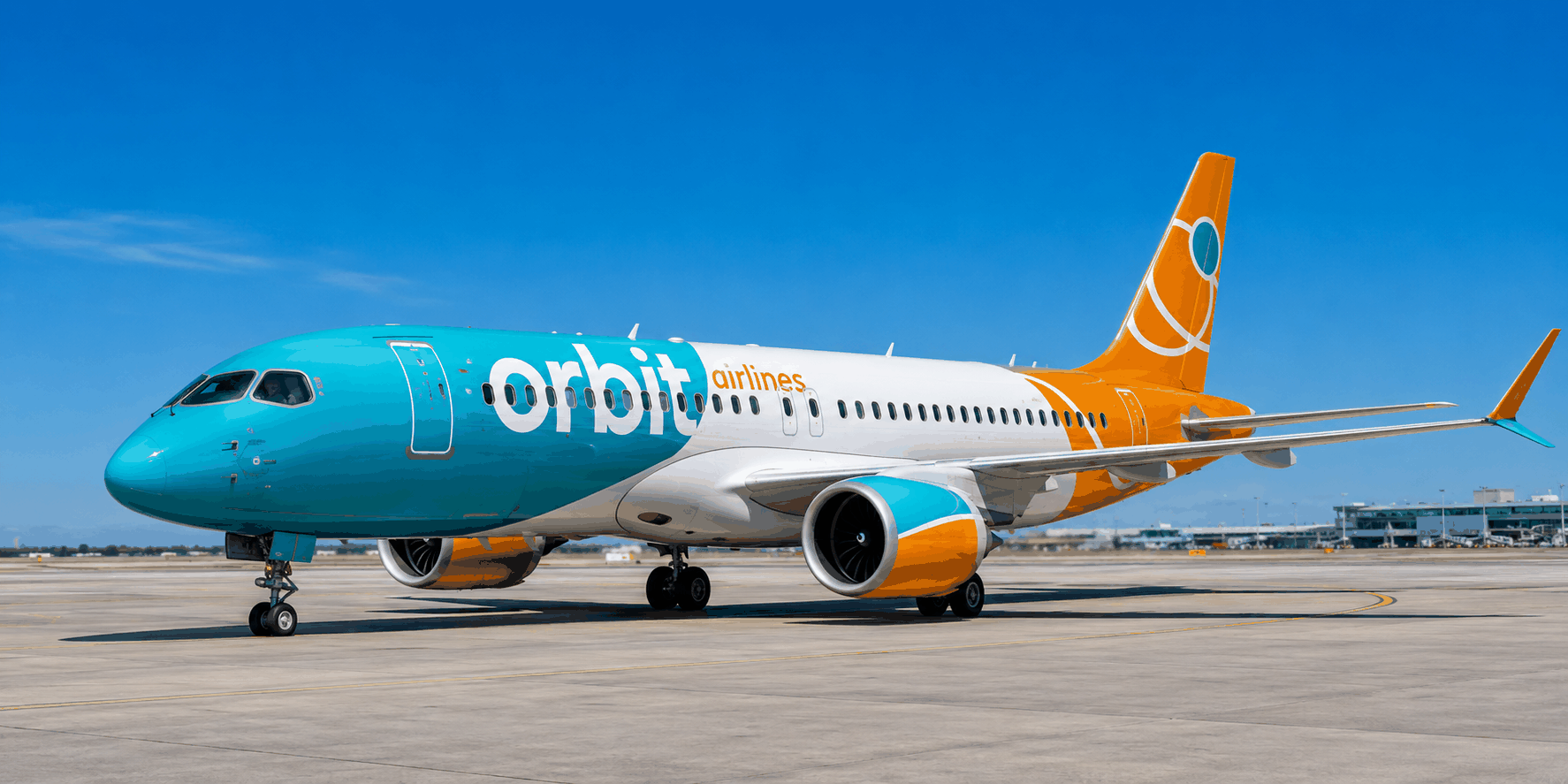
The livery works forward to aft in three blocks: teal over the nose and the forward fuselage, white through the cabin, and orange across the rear fuselage and the tail. The name is carried large and in white on the teal, where it is legible at the gate and in photographs, and the tail device is the mark restated in a form that can be recognised across an apron: nested arcs about a disc, orange and white, with the teal held at the centre.
The two colours are the company’s oldest continuous possession. They were chosen in 1959 to say space age, which at that date meant instrument dials and a sunlit horizon rather than the black of actual space, and they have survived every revision since, including two in which the consultants proposed abandoning them. The orange in particular has been defended by the membership on grounds that have nothing to do with design and everything to do with the fact that it is what the aeroplanes looked like when their parents worked on them.
Before 2015
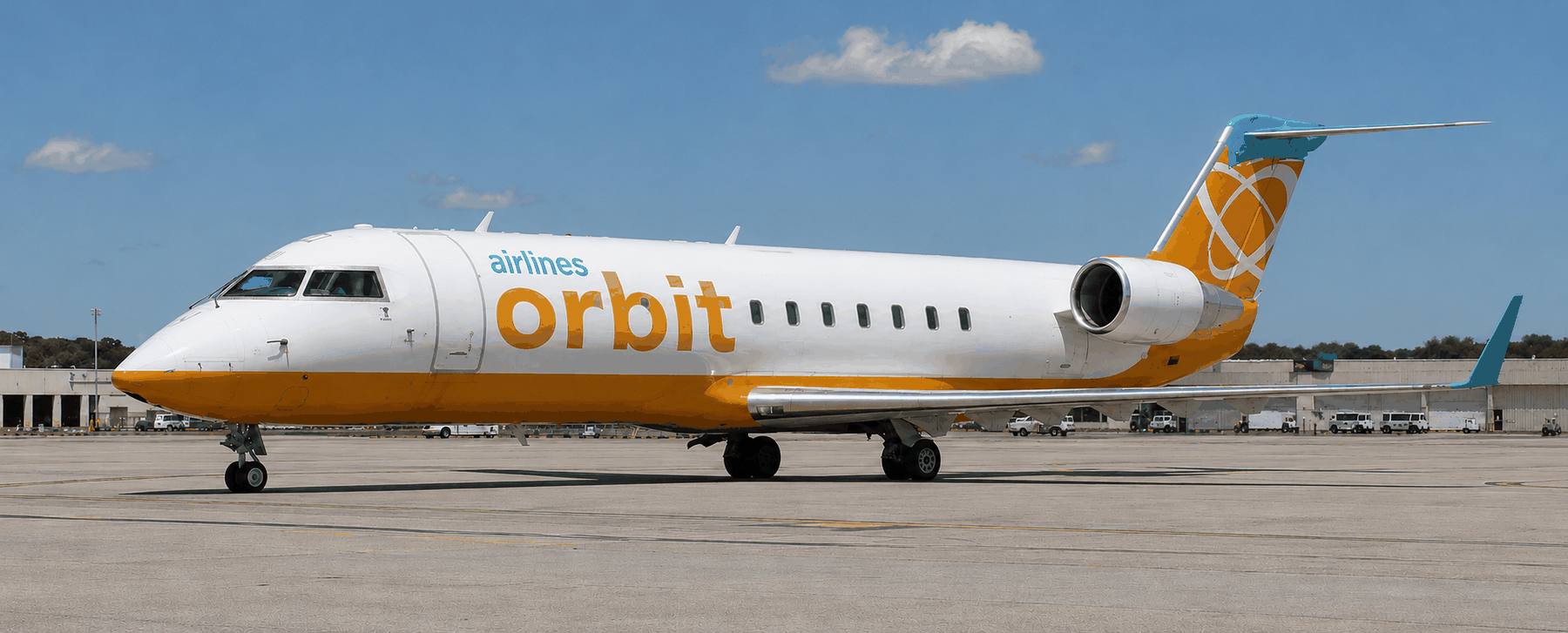
The scheme in the photograph is the one the company wore for its last long period before the present drawing, and comparing the two is the quickest way to see what the 2015 revision actually did.
It reversed the two colours. Orange had been Orbit’s colour since 1959, carried on the tail and along the fuselage with the blue used as a trim; after 2015 the blue-green came forward onto the nose and became the company’s colour, and the orange went aft. The proposal that reached the membership in the first instance was more drastic and would have dropped the orange altogether, and it is the reason the colour survives at all: the members who defeated it accepted the reversal as a compromise and have referred to it as such ever since.
It simplified the device. The old tail carried two ellipses crossed over one another, an arrangement everybody called the atom and nobody at the company much liked, since an atom is not an orbit and the mark was saying something other than the name. The redraw reduced it to what the name actually describes.
And it tidied the wordmark, moving airlines from above the name to beside it and settling the proportions that the current identity uses.
The revision was carried without much difficulty, which distinguishes it from most contested questions at Orbit, and the members’ recorded objections at the time were almost entirely about the orange rather than about the cost or the device.
What the article does not settle
The identity has been revised three times since 1959 and Orbit has never changed the name, though proposals to do so have been made at intervals by consultants and voted down by the membership every time, most recently by a margin its own board described as instructive.
The company’s own position on the name is a joke it has made too often to abandon: that an airline which flies at thirty-five thousand feet and is called Orbit has been overpromising since 1959, and that its members have twice been given the opportunity to correct this and have twice declined, on the ground that the aeroplanes are already painted.
Regulation and the state
Orbit’s relations with the Realm’s government are ordinary, which is worth stating because the company’s ownership invites the assumption that they are not.
It holds no charter, no warrant and no protected route. It receives no subsidy. Neither the Crown nor the Commonwealth of Cascadia holds equity, guarantees its debt or appoints any part of its board, and no public money was put into the 1979 rescue, a point Orbit makes with some sharpness whenever a competitor implies otherwise. Its northern services are commercial and its medical contracts are won in competition.
Its regulatory position is that of any trunk carrier: certification, operational oversight, duty-hour compliance, route and traffic-right allocation for its international services, and the ordinary competition rules. It has been on both sides of those rules. The bilateral traffic rights that permit its Pacific network were negotiated by the Realm’s government, and Orbit has lobbied for them as hard as any of its competitors and with less success than the flag carrier.
The one durable political question about the company concerns not what it receives but what it is. Employee ownership on Orbit’s scale sits awkwardly in the Realm’s corporate law, which contemplates cooperatives but was not written for one of this size, and the company has been an interested party in three separate legislative reviews of cooperative and mutual company law. It has generally asked for very little: clarity on the redemption obligation, tax treatment of member subscription that does not penalise the low-paid, and no compulsory conversion. It has been given most of the first two and the third has never been seriously threatened.
Politically, Orbit is claimed by people it does not always want. It is cited approvingly by parts of the labour movement as proof of what worker ownership can do, and by parts of the commercial right as proof that ownership reform does not require the state, and it declines both endorsements in almost identical language. Its standing position, given to a Commons committee in the 2010s and repeated since, is that it is an airline rather than an argument, and that the members would rather be judged on the punctuality figures.
Public standing
Orbit is well liked, moderately well known, and understood by fewer people than like it.
In Cascadia it is an institution, in the north it is infrastructure, and in the rest of the Realm it is the airline people are mildly surprised to remember is owned by its staff. Its brand recognition is the lowest of the six and its favourability among those who have flown it is the highest, a combination its marketing department has described in more than one internal document as the worst possible one.
The company appears in the Realm’s public argument principally as an example, and it is used carelessly in both directions. It is produced as evidence that employee ownership works, generally by people who do not mention the eleven years without a distribution or the ageing fleet, and as evidence that it does not scale, generally by people who do not mention that it has been profitable for thirty years and has not laid anybody off. Orbit’s own officers have given up correcting either version.
Among aviation people it has a particular and slightly unusual standing: it is the carrier other airlines’ staff say they would work for. That is a soft measure and the company treats it as a hard one, tracking it in its own surveys and citing it internally more often than its financial results.
The other five
Orbit is most easily understood beside the carriers it competes with, because the Realm’s six are six different answers to the same question, which is who an airline belongs to.
Pan American World Airways belongs to the Crown. It is a public corporation, corporatised and never sold, flying loss-making services because its constitution requires them and incapable of going out of business. It is the oldest of the six and the only one with a duty written into it.
American Airlines belongs to its shareholders and is the largest carrier in the world. It was assembled rather than founded, out of eighty small companies, and it won liberalisation because it had spent fifty years accumulating the route authority that liberalisation turned into an asset. It is used constantly and loved by nobody, including, on the evidence, itself.
United is the third of the large private trunks, contesting the same squeezed middle as American and Delta and facing the same arithmetic from above and below.
Delta Air Lines belongs to its shareholders and runs the most efficient connecting machine on earth. Its labour settlement is the interesting one for present purposes: it kept a workforce for a century by paying above the rate and treating a union drive as a management failure, which is a settlement that works until it is tested and was tested once.
Southwest Airlines belongs to its shareholders and was built on a jurisdictional gap in the Republic of Texas. Its settlement was profit-sharing and job security in exchange for productivity that nobody else could match, sustained for fifty years and now being dismantled by an investment fund that bought enough of the company to do it.
Orbit belongs to the people who work for it, and it is the only one of the six where the question of who owns the airline and the question of who works for it have the same answer.
The comparison that matters is with Southwest, because the two settlements look alike from outside and are not alike at all. Southwest’s people were given a stake by a management that believed in it; Orbit’s people bought the company because the management had run out of options. What Southwest’s staff hold, a shareholder can take away, and one is currently doing so. What Orbit’s members hold, nobody can take away without their votes, because the locks require them. That is the difference between a generous settlement and an ownership, and it is the reason the Register treats them as different answers rather than two versions of the same one.
The comparison the company itself prefers is with Pan American, and the reason is that it is the only one that puts the question the way Orbit wants it put. Both carriers are protected from the market by something other than commercial success: Pan American by the Crown that owns it, Orbit by a workforce that will not sell. Both have been called, by their competitors, businesses that are not required to be businesses. Orbit’s answer is that its protection was bought by the people it protects, with their own money, and that this is the whole of the distinction.
The centenary
Orbit is one hundred years old at present, and the company’s handling of its own centenary has been characteristic.
The anniversary falls on the mail contract of 1928 rather than on any founding document, since Cascade Air Transport was incorporated to hold a contract and the contract is the earlier date. The company has therefore spent a year explaining that it is celebrating the day it agreed to carry somebody else’s post, which is either bathos or accuracy depending on temperament, and Orbit has consistently chosen accuracy.
The centenary programme was decided by members’ vote, as the constitution requires for expenditure of that order, and the membership rejected the proposal its own board brought forward. The board had proposed a substantial public campaign, a commemorative livery and a repainted heritage aircraft. The members carried an amendment reducing the campaign, keeping the heritage aircraft, and directing a majority of the money to the redemption fund and to a technical training endowment in Cascadia and the Kingdom of Alaska. The vote was reported in the trade press as a company refusing to celebrate itself and was understood inside the company as members declining to spend their own money on advertising.
The centenary has nonetheless produced the fullest account of the airline’s own history it has published, a two-volume house history written with access to the board minutes of the administration years, including the correspondence of the buyout. The decision to publish those minutes unredacted was itself contested, since they contain the private assessments of people still living and the frank views of the company’s own officers about members who are still members, and the vote to publish them carried narrowly.
It is that history which contains the sentence most quoted from the centenary, written by a historian the company commissioned and did not edit: that Orbit’s members did not save the airline because they believed in cooperative ownership, but became believers in cooperative ownership because it was the only way left to save the airline, and that the order of those two things is the whole subject.
Chronology
1928. Cascade Air Transport incorporated at Seattle to hold an air mail contract on the Pacific slope.
1930s. Passenger services begin; the northern network opens; the company flies its first services into what is now the Kingdom of Alaska.
1940s. Wartime contract flying; expansion of the northern operation; the fleet renewed with surplus equipment afterwards.
1951. Ray Halvorsen, a line pilot with the company since the 1930s, becomes president.
1950s. Services to Hawaii. The first jets ordered from Boeing, early and against the balance sheet.
1959. The company is renamed Orbit Airlines, with the jets, for the space age.
1960s. Transpacific services beyond Hawaii, against Pan American. Flight 217 is lost in the Cascades; the company publishes its own finding of responsibility within weeks.
Late 1960s. The Realm’s first comprehensive duty-hour limits are enacted on the evidentiary basis of the Flight 217 investigation.
1972. Halvorsen retires after twenty-one years.
Late 1970s. The Realm liberalises its air market. Orbit, a long-haul carrier with almost no domestic feed, loses money at a rate it cannot sustain.
1979. The company enters administration. Aircraft are repossessed. Two commercial bids are made for the business.
1979 to 1980. The workforce buys the company out of administration, taking permanent pay reductions in exchange for equity. The cooperative constitution is adopted, including the four locks.
Early 1980s. Braniff fails. Orbit acquires aircraft, gates and traffic rights, and takes on Braniff staff as members on identical terms. The Braniff name is retired.
1980s. Eleven consecutive years without a distribution. The company returns to profit and stays there.
1988. The directorial allowance is fixed at a deliberately modest level after complaints about an emerging directorial class.
1991. The cash reserve policy is adopted by members’ vote and has been renewed at every review since.
1990s. Three expansions are proposed and declined by the membership. The northern disposal is defeated heavily. The company is late to the frequent-flyer product and to internet booking.
1994. The membership rejects the transfer of heavy maintenance to third parties.
2003. A proposal to permit a minority external equity issue is defeated at a members’ ballot.
2006. The traffic collapse following 1 May. Voted reductions; no compulsory redundancies; no state assistance.
Late 2000s. The recession. The largest voted reduction to that date, restored over four years; fleet commitments deferred at a cost still being paid.
2009. The maintenance transfer is proposed again and rejected again.
2010s. Airbus aircraft ordered after the transatlantic aircraft agreement opened the market, on the closest membership vote of the decade. Withdrawal from the eastern seaboard is considered and declined in 2015.
2020s. The pandemic. The deepest voted reduction in the company’s history; the northern network becomes for eighteen months the largest source of revenue in the airline.
2027. Orbit joins the study of the Concorde successor under the Straßburg memorandum. Nothing is ordered.
2028. The company’s centenary. The membership amends its own board’s commemoration proposal, directing most of the money to the redemption fund and to technical training.
Assessment
Orbit is the smallest of the Realm’s three transcontinental trunk carriers, the fourth of the six by traffic, and the only one that belongs to the people who work for it. It flies the Pacific, the continent and the north, out of a city it has never left, in aircraft mostly built a few miles from its head office.
It is not the best airline in the Realm and does not claim to be. It is behind its competitors on product, on capital, on speed of decision and on domestic feed, and every one of those weaknesses is traceable to the ownership that is also its distinguishing asset. A company owned by its workforce is slow, cautious and undercapitalised, and Orbit is all three.
What the ownership has bought is durability. Orbit has not made a loss of consequence in three decades, has not sought public money, has not made compulsory redundancies through four downturns, and has the lowest staff turnover and the highest operational reliability of the six. It has done that while paying its lower grades better than the industry and its senior people worse, and while its members have voted, repeatedly, for less money now in exchange for the company continuing to exist.
The question the Realm’s business press has been asking about it for forty years is whether the arrangement is a model or an accident: whether Orbit demonstrates something about how firms could be owned, or whether it is simply what happens when a workforce with nothing left to lose buys an airline nobody else wanted and then gets thirty years of competent management. The company’s own officers decline to answer, on the reasonable ground that they would say the first and cannot prove it.
✎ Editor's Note · A sixth carrier, and a fifth labour settlement
The Register’s five airline articles are built on an axis of distinct labour settlements, and canon called Delta the last of the set. Orbit makes six, and it earns the slot by occupying the one position on that axis nobody had taken: the workforce owns the company.
Everything else follows from a single decision of Jake’s, which is that the near-death and the employee ownership are the same event. Orbit was not founded as a cooperative and did not choose to become one. It was a conventional trunk airline that liberalisation nearly destroyed, and its staff bought it out of administration because the alternative was liquidation. That gives the article the shape the other five have, where American won by owning the interior and Southwest won by staying cheap: Orbit survived by being bought by the people who worked for it.
The structure deliberately withholds the usual satisfaction. Ray Halvorsen is the founder-figure, a line pilot who ran the company for twenty-one years, bought its jets, renamed it and took it to the Pacific, and he is not the answer to why the company exists today. He retired in 1972 and the crisis that made the modern airline came afterwards. An airline article without a great man at its centre is unusual and it is what the answers produced.
Three things are stated as failings rather than colour. The Cascades crash was caused by schedule pressure the company created, and the admission that followed was creditable and came afterwards. The hiring record is early and good on women, late and poor on Black flight crew, and the cooperative structure made the second harder to correct because seniority is member-voted and the members who benefited had votes. And the ownership’s weaknesses are given the same weight as its strengths, because a Register that treats worker ownership as self-evidently virtuous would be doing propaganda rather than description.
The name is the one piece of pure invention. Orbit is a fictional carrier borrowed from Microsoft Flight Simulator, where it exists as a livery and not as a history, so everything here is built rather than transposed. The name needed an in-world reason and the answer given, that it was chosen in the space age by people who expected aviation to keep going up and were wrong, is the sort of small failed prophecy that real companies carry on their tails for decades.
Trivia
- In-Universe Orbit is the only one of the Realm's six trunk carriers owned by the people who work for it. A majority of its equity is held by its own employees, its constitution gives one member one vote regardless of shareholding, and a majority of its board seats are elected by the workforce. None of that was designed; it was the price of a rescue.
- In-Universe The airline was not founded as a cooperative and did not choose to become one. Liberalisation left it a long-haul carrier without domestic feed, it went into administration with its aircraft being repossessed on the ramp, and its workforce bought it by taking permanent pay cuts in exchange for equity in a company the industry expected to be liquidated within two years.
- In-Universe Its unions got stronger after the workers bought it, not weaker, which is the opposite of what everybody predicted. Ownership settles who the company is for; it does not settle what anybody is paid. Orbit's unions therefore bargain across a table from directors their own members elected, and a strike ballot there is a proposal by the owners of a company to withhold their labour from themselves.
- In-Universe It was named Orbit in 1959 for a future that did not arrive. The rename was a bet that aviation would keep going higher and faster indefinitely; instead aircraft got bigger, cheaper and quieter and stopped climbing, and the airline named for orbital flight has spent seventy years operating at thirty-five thousand feet. Its own house history calls that chapter The name we grew into sideways.
- In-Universe Orbit published its own guilt before the inquiry reached it. After the Cascades crash it disclosed within weeks that the crew had been under schedule pressure the company had created, released the internal correspondence in which its operational staff had been overruled on commercial grounds, and declined the defence its lawyers wanted, which was that the captain could have diverted and did not.
- In-Universe The Realm's duty-hour limits exist because of that crash. The investigation shifted air-safety regulation from the aircraft and the airman to the operator, on the proposition that a company can create the conditions of an accident without anybody in it breaking a rule, so the regulation has to reach the timetable and not only the cockpit. Two carriers argued in evidence that Orbit's disclosure had been reckless.
- In-Universe Braniff and Orbit made opposite bets on liberalisation and both were nearly destroyed. Braniff expanded hard on debt and failed comprehensively; Orbit was too long-haul and too thin at home and went into administration. The difference was not strategy. One of them had a workforce willing to buy it, and it then absorbed the other, retired the name and took the people in as members on identical terms.
- In-Universe The Realm fields a Crown-owned flag carrier and a workers' cooperative on the same Pacific routes, and each is a standing argument against the other. Pan American holds that a nation's principal airline is an instrument of the nation; Orbit holds that an airline is the people who run it and that ownership by anybody else, the Crown included, is absentee landlordism. Their executives do not put it that bluntly in public and their staff do.
- In-Universe Orbit was early to hire women pilots and engineers for an unflattering reason. A carrier that could not match its competitors' pay after the buyout recruited from the pools its competitors were ignoring and found the people in them were extremely good. Necessity produced the policy, the policy produced the result, and the company now cites it as a value.
- In-Universe Buying Airbus was the most contested fleet decision in the company's history, and the objection was local rather than commercial. A Seattle cooperative owned by Seattle workers purchasing European aircraft in a city whose economy is Boeing's was not a neutral act, and the membership vote that approved it was the closest of the decade.
- In-Universe It has never made compulsory redundancies. Through two fuel shocks, a recession, a pandemic and the traffic collapse after May Day, Orbit voted temporary reductions across the whole membership instead. Everybody earns less and everybody keeps their job is a bargain a cooperative can strike and a public company generally cannot.
- In-Universe Orbit's Concorde could not fly when it bought it. Once American's 2027 season showed the aeroplane was worth something, the price of the remaining airworthy frames rose and a capital-starved cooperative was priced out of them. What it could afford was the one at the bottom of the pile: stored for years, not airworthy, and useless to any airline that had contracted its heavy maintenance out.
- In-Universe The membership refused to transfer its heavy maintenance in 1994 and again in 2009, against a sound financial case both times, because engineers argued that an airline which does not maintain its own aircraft loses the ability to know what condition they are in. They were talking about ordinary aeroplanes. Thirty years later it was the reason the company was the only one in the Realm that could take on a dead Concorde.
- In-Universe The centenary annual meeting of 2028 cut its own board's commemoration programme on the ground that members should not spend their own money advertising themselves, directed the savings to the redemption fund and technical training, and then voted to buy a Concorde. Nobody present missed the contradiction, and the minutes show their own finance committee put it to them plainly.
- In-Universe It is the one decision on which Orbit's members voted against their own money. The same electorate declined three expansions because it would not accept the leverage, has deferred cabin renewal for thirty years, and holds cash its competitors think excessive. It also bought a fifty-year-old supersonic airliner in its hundredth year, second hand, from the British, in a condition that would not fly.
- In-Universe Orbit owns the aeroplane and rents the knowledge. Continuing type support and certification run through an arrangement with British Airways, whose engineers are the only people alive who know the type, negotiated with a company that owes Orbit nothing. Its own chief engineer has called this the greatest technical vulnerability in the fleet at two successive annual meetings.
- In-Universe One aeroplane is not a timetable. Pan American maintains five airworthy frames to sustain a single daily rotation, which is roughly the floor for a scheduled service. Orbit flies Seattle to Honolulu a few times a week, and when the aircraft is in maintenance the service goes subsonic on an ordinary aeroplane, sold as such with the difference refunded.
- Design The Concorde was added at Jake's direction, over a recommendation against it, and then rebuilt a second time when he pointed out that American Airlines already had one. The first version had Orbit inheriting a frame from Braniff and flying it since the 1980s, which contradicted that article on five separate points, most seriously its claim that American's 2027 season was the first supersonic domestic sector ever flown in the Realm. Orbit now arrives after American and because of it.
- Real-World Braniff really did operate Concorde, and this setting keeps it as an interchange rather than an ownership. Between 1979 and 1980 it flew British Airways and Air France aircraft between Washington and Dallas, subsonically, because the route was over land, and the arrangement lost money and was abandoned. It is referred to in the American Airlines article as the celebrated interchange, and it is the reason Braniff had no supersonic aircraft of its own to leave behind.
- Real-World Orbit Airlines is a fictional carrier borrowed from Microsoft Flight Simulator, where it exists as a livery on default aircraft rather than as a developed company with a history. Everything in this article is built for the setting rather than transposed from a real airline, which makes it the only one of the Realm's six carriers with no real-world counterpart behind it.
See also
- Pan American World Airways, the Crown-owned flag carrier and Orbit’s Pacific rival
- American Airlines, the largest carrier in the world and the winner of liberalisation
- Delta Air Lines, the second private trunk carrier
- Southwest Airlines, the low-cost settlement
- British Airways, the British carrier
- Economy of the United Kingdom of America, the chartered market economy Orbit is an unusual instance of
Categories
Institutions · Aviation · Commerce · Cascadia · Labour