Flag Act 1850
The Flag Act 1850 is the statute that settled what the United Kingdom of America flies. It took the Union out of the canton, gave the crowned eagle and the thirteen stars the whole of the navy field, and moved the thirteen red and white stripes to the lower third beneath a gold fillet. It received Royal Assent on 14 March 1850, runs to three sections, a schedule and a drawing, creates no offence, and is still in force.
It also holds a peculiar position in the Realm’s constitutional history. The seventy-five years between the colonial crisis and 1850 are the period historians call the Dominion Era, whose governing characteristic is that nothing in it was ever decided and everything was arrived at: powers taken by use, rights extinguished by disuse, conventions hardened by repetition. The Flag Act is the exception. It took a question the Charter had left open and answered it in a statute, which nothing else in the era did, and what it answered was what to fly.
Background
The flag of the war
The colonies fought under the Grand Union Flag: thirteen red and white stripes with the Union of 1707 in a square canton seven stripes deep. It was first hoisted at Philadelphia in December 1775 and Washington crossed the Delaware under it a year later.
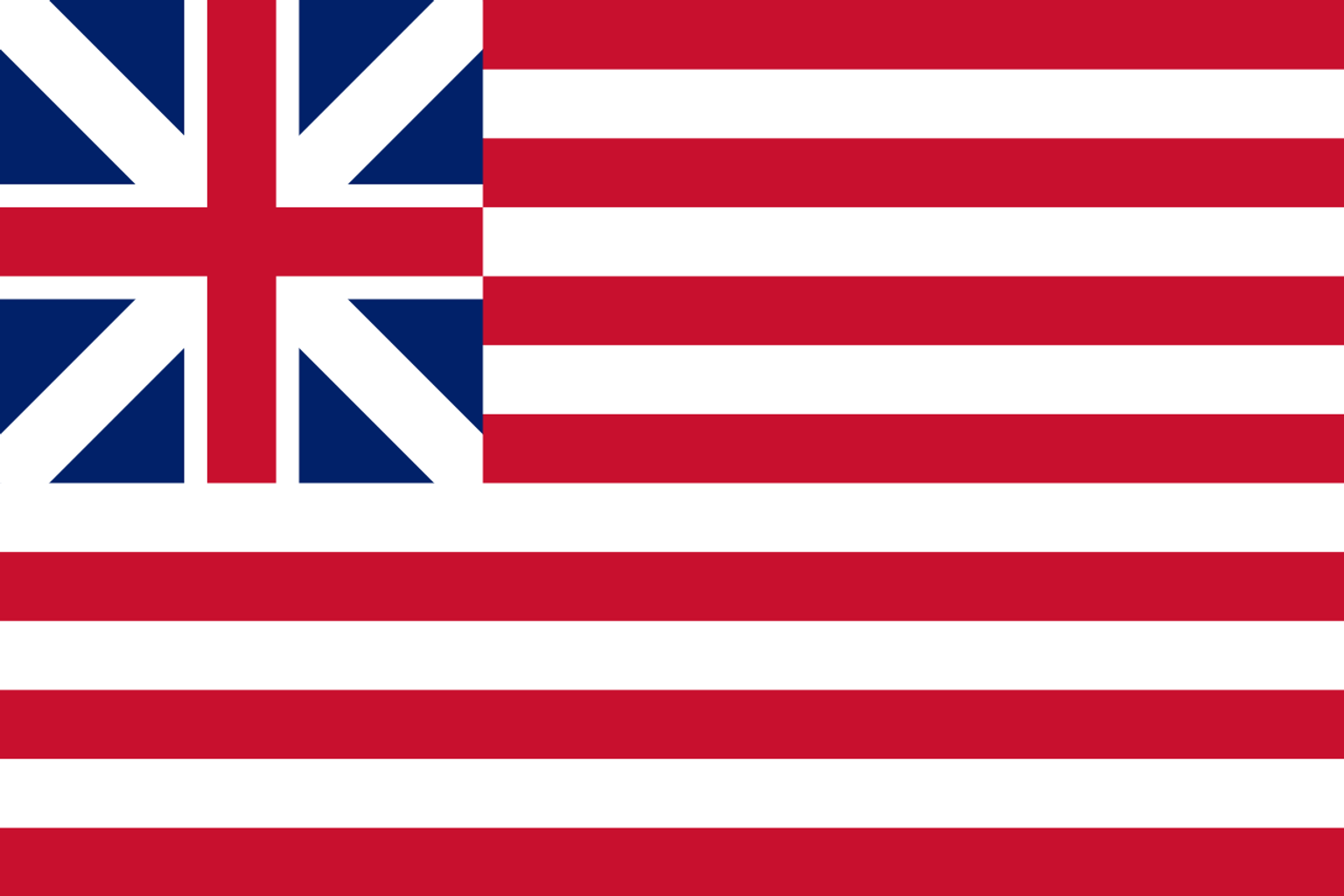
It meant exactly what it showed. These were subjects asserting rights, not foreigners asserting independence, and the flag said so by keeping the Union in the place of honour and putting the colonies in the field. It was the correct flag for the argument the colonies were actually having.
The Charter’s silence
The Charter of Union made no provision for a flag, and nobody raised the question.
That is worth stating plainly, because it would have been an obvious thing to raise. A new realm with a new Crown, a new Parliament and a new capital did not settle its own colours, and the record of the negotiations contains no proposal, no committee, no draft and no debate on the subject. The war flag simply went on being flown. Nobody decided to keep it and nobody proposed to replace it.
The silence is of a piece with the rest of the settlement. Agreeing a flag would have meant agreeing what the Realm was, and that was the one thing the Charter was constructed to avoid saying.
So for sixty-seven years the Realm flew colours nobody had adopted, with another realm’s flag in the canton, over institutions in which London had less say every decade. It is the one feature of the era that looks like the subordination the era’s name describes, and the fact that it was nobody’s decision is why it lasted as long as it did.
The flag had no official name in that period and did not need one. It was called the Grand Union then, as it is now, and the name is older than the Realm.
The change of 1801
On 1 January 1801 Britain added the saltire of St Patrick to its Union for the union with Ireland, and the Realm’s canton changed with it.
No instrument records the change. Two things happened within months of each other and the priority between them is a genuine and unresolved dispute among the Realm’s flag historians. A naval dockyard made up the new Union because ships going to foreign stations needed correct colours and could not wait for anybody ashore to think about it. And a commercial flagmaker made up the new Union and put the crowned eagle within thirteen stars on a white roundel over the crossing, because the plain new Union looked like Britain’s and his customers said so.
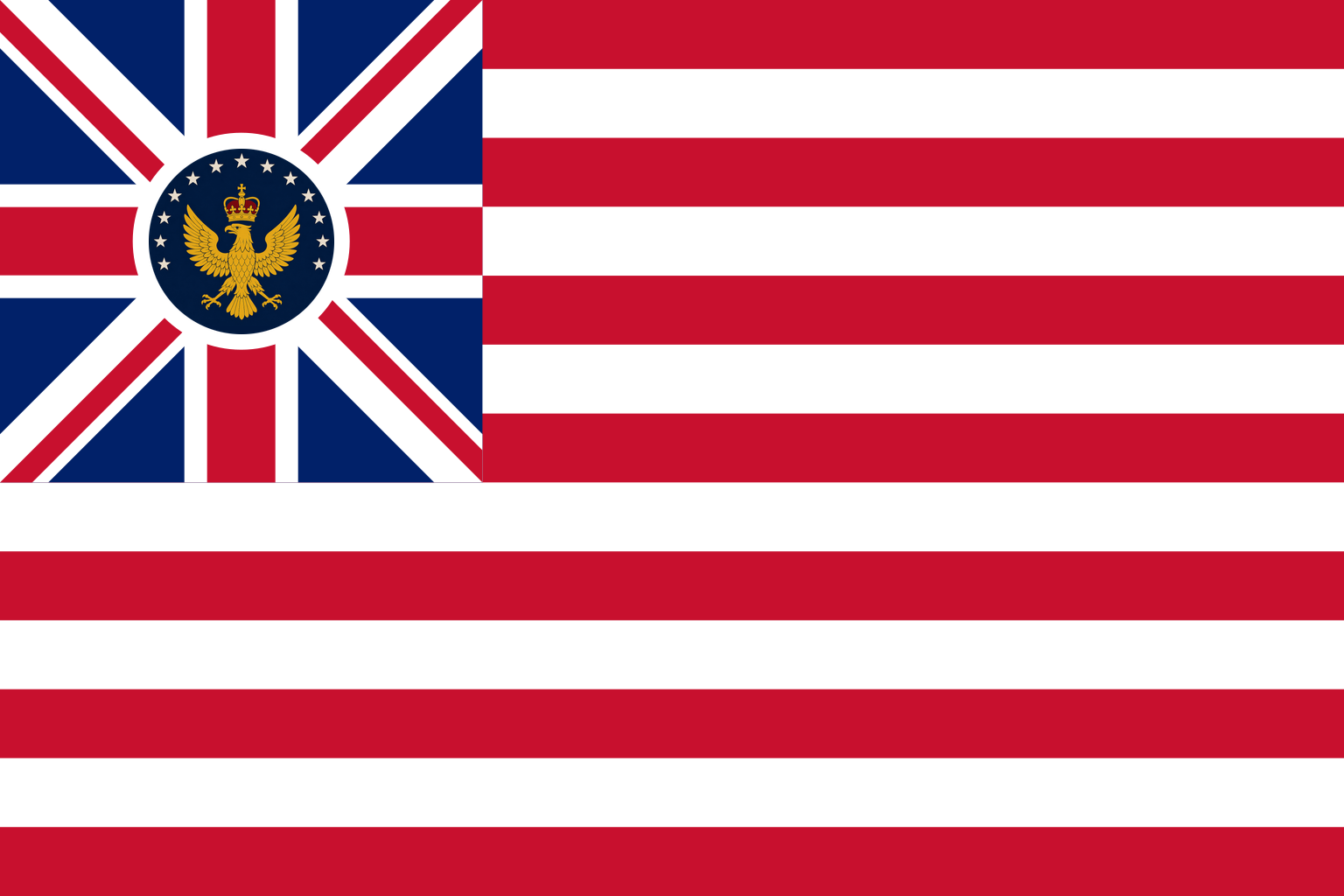
Repetition did the rest. By the 1820s the combination was simply what the flag looked like, and it said two things at once: the canton had followed London’s change, and the Realm’s own device now sat at the centre of it. The canton following London looks like deference; the eagle arriving at its heart in the same act of habit is the answer to it. The whole era is in that flag.
The transition was not tidy. For about fifteen years after 1801 ships and buildings flew different cantons on the same day, and there are contemporary complaints about a realm that could not agree what it looked like. The eagle roundel took two decades to become universal, and some western posts never had one at all.
Attempts to regularise
Two attempts were made before 1850 and neither decided anything.
An admiralty circular of the 1820s described the colours that ships were already flying, in the form of an instruction to conform to existing practice. It is as close as the era came to settling the flag and it is not a decision; it is a description with an imperative mood.
A bill was introduced and talked out twice, in the 1820s and again in the 1830s, by members who did not want the question opened. Their reasoning was never stated at length and did not need to be. Opening the question of the canton in either of those decades would have divided the House along a line that had nothing to do with flags.
The sovereign’s own banner
The Royal Standard was settled separately and later. The standard adopted in 1841, in the first full year of Ernest I, gives Great Britain two quarters of four and the Realm one, and it has never been replaced. The Flag Act did not touch it, and one of the Crown’s two recorded interventions in the business of 1850 was to ask that it be left alone.
Origins and drafting
Why 1850
The Act passed in the year the Realm ran out of west.
The deferral machinery of the Dominion Era had worked because there was always more territory to organise and therefore always another bargain available. By 1850 the continent was taken, there was nothing further to trade, and the question the Charter had declined to name was the only question remaining. The session that met that year had to settle the territories acquired from Mexico and had to do it without a further west to postpone into.
What it produced was the settlement of 1850: California admitted as a free Commonwealth, the remaining territories organised on terms, and a fugitive slave provision that made the whole package intolerable to the people it was meant to reconcile. It bought four years, or eight, depending on who is counting.
The Flag Act was not part of that package and could not have passed without it. The men who settled 1850 needed something they could agree on, and the flag was the only thing on the table that nobody would die over. The same coalition carried both, in the same session, and the members who voted for the flag in March and for the fugitive provision in September were substantially the same members.
The member
The bill was brought in by Josiah Mellen, member for New Bedford, on 10 January 1850. He was a shipowner in a family of shipowners and he had spent his working life explaining the canton in foreign ports.
That is the whole of his qualification and it was the whole of his argument. A master arriving at Hamburg or Valparaiso or Canton under a flag with the British Union in the corner spent the first hour of every port call explaining that his vessel was not British, that the Realm was not a colony, and that the papers were in order. Mellen had done it himself for twenty years and had, by his own account, stopped finding it funny somewhere around 1835.
The bill was his own, drawn by a parliamentary draftsman he paid for out of his own pocket, and the Ministry adopted it at second reading once it became clear that it would carry. That sequence matters: the era’s one decision was not a government decision. It was a private member’s bill that a government took over when it stopped being a risk.
Mellen lost his seat at the next general election on an unrelated question of harbour dues, and is remembered by nobody except flag historians.
The drafting
The Act is short because Mellen’s draftsman was instructed to make it short. It states the flag, saves the old ones, and provides for flying it, and it does nothing else.
The design in it was not designed. The eagle and the thirteen stars had stood at the centre of the canton since 1801, and the Act simply removed the Union and let what was already there expand to fill the field, with the stripes moved down to the lower third to make room. That is why the flag of 1850 looks inevitable rather than composed: it is the old canton’s charge, enlarged.
The drawing annexed to the Act was made by Commander Alwyn Petrie, a naval officer who had been drawing the flag that way in signal books for eleven years as a convenience, to show at a glance what a vessel of the Realm looked like without the canton’s detail. His draft was adopted by the committee unchanged. He was not consulted about the Act and learned that his drawing was in it when he read the schedule in the newspaper.
Passage through Parliament
The case made
Four arguments were put and all four were made repeatedly.
That a sovereign realm should not fly another realm’s flag in its canton, however friendly the other realm, and that the Realm had been sovereign in every practical respect for two generations.
That the canton confused foreigners, and that shipping, consular practice and the law of prize all needed the question settled. This was Mellen’s own argument and it was the one that moved the trading members.
That the Realm had grown from thirteen colonies to a continent, and that its flag still said thirteen and still said London.
And that nobody had ever decided it, which several members found more embarrassing than the canton itself. The Realm had been flying something by accident for sixty-seven years.
The case against
The old eastern families opposed it, in both Houses, and their case was the serious one. The Union in the canton was the proof that the Realm had not rebelled: that the settlement of 1783 had been a negotiation and not a revolution, that the Crown was the same Crown, and that the Realm’s whole claim to be different from the republics of the hemisphere rested on continuity it was now proposing to paint out.
The navy objected on grounds of cost and practicality. Every ensign, jack, boat flag, signal book and consular pattern in the world would have to be reissued, and the estimate laid before the committee was large enough to be quoted against the bill for two months.
Several members said the timing was indecent given what else the session was passing, and were told, correctly, that the flag bill had been introduced in January and the settlement was not yet drafted.
And a number of members thought it a gratuitous insult to Britain at a moment when the Realm had reasons to want London’s goodwill.
The amendments
Five were moved in committee and all five were defeated.
To keep a small Union somewhere on the flag, in a corner or on the fly. Defeated as a worse insult than removal: a Union reduced to an ornament was harder to defend than a Union in the place of honour or no Union at all.
To add a star for every polity. Defeated on the argument that carried, and has carried every time since: a flag that has to be resewn at every admission is a flag nobody can own, and the Realm would spend the next century arguing about arithmetic instead of flying anything.
To take the stripes off at the same time. Defeated as one change too many for a single bill. The stripes were the price of the canton, and the eastern members made it explicit: the founding number was to stay somewhere on the flag. That bargain held for a hundred and seventy-eight years and was lost in 2028.
To delay the whole thing to the next Parliament, which was what the opposition actually wanted and was defeated by the largest margin of the five.
And to refer the question to the polities first, defeated as constitutionally absurd by members who pointed out that the Realm’s flag was the Realm’s business and that the polities had flags of their own to mind.
The division
The second reading was carried comfortably, and the comfort is the point. By 1850 almost nobody was prepared to defend the canton out loud. The opposition’s speeches are careful, elegiac and defensive, and several of them concede the principle in the first paragraph before objecting to the timing, the cost or the manner.
I am told that the flag has served us well enough for sixty-seven years, and I do not deny it. I say only that we have never once looked at it and said, this is ours, and this is why.
A man may inherit a coat and wear it all his life and be warm in it. But if he is asked in a foreign place whose coat it is, and he cannot answer, he will find in time that the question troubles him more than the cold ever did.
We fly what we were handed. I ask the House to fly what it has chosen.
The honourable member wishes us to choose. Very well. But let the House understand what is in that canton before it paints it out.
It is there because we did not rebel. It is the whole of our difference from every other people in this hemisphere who took the same liberties by another road, and it is the reason the Crown that reigns over us is the Crown that reigned over our fathers. We did not win that corner of the flag in a war. We kept it in a negotiation, which is harder.
Take it down if you must. But do not tell me that you are declaring what we are. You are declaring what we would rather not be reminded of, which is a smaller thing, and a poorer one.
The Lords and the jack
The Lords passed the bill after a bad-tempered debate in which the old families said at length what nobody in the Commons had been willing to say: that the Realm was ashamed of its own history and was legislating to stop being reminded of it.
They also amended it, and the amendment stuck. The Lords preserved the naval jack unchanged, so that the flag of 1801, Union and eagle together, remains the jack flown at the bows of the Realm’s warships in harbour to this day. The Commons accepted the amendment without division, and it is the reason the Union survived afloat after it came down ashore.
Whether that was a concession or a joke has been argued about ever since. The Lords’ own record suggests it was meant seriously, by peers with naval connections who thought the jack a professional matter rather than a political one, and its effect has been to preserve the era’s flag in the one place where it is seen every day by people who know exactly what it is.
Assent
Royal Assent was given on 14 March 1850 by Ernest I.
The Crown made one request in the whole business, which was that the Royal Standard be left alone, and it was. The King said nothing publicly about the bill, and the absence of comment was read as approval by everybody who wanted it read that way.
The text
The Act is three sections long, with a schedule and a drawing annexed. It is reproduced in full below as enacted; the schedule was replaced in the amendment of 2028 and the sections were not.
Whereas the Flag now flown by the Realm has never been declared by any Act or Instrument, and it is expedient that the same be declared:
1. The Flag of the Realm.
The Flag of the United Kingdom of America shall be as described in the Schedule to this Act and as delineated in the Drawing annexed thereto; and the same shall be the Flag of the Realm for all purposes.
2. Saving for former Colours.
Nothing in this Act shall make unlawful the display of any Flag heretofore flown by the Realm or by any Colony thereof; and every such Flag shall continue to be lawful Colours.
3. Of the flying of the Flag.
(1) The Flag shall be flown from the publick Buildings of the Realm, from its Ships, Forts and Missions abroad, and from such other places as the Crown may direct.
(2) The Ensigns and the Jack shall be as set forth in the Schedule.
(3) A Polity may fly its own Flag beside the Flag of the Realm upon a separate Staff of equal Height; and no Flag of a Polity shall be flown upon the same Staff beneath the Flag of the Realm.
(4) The Flag may be flown at half Staff upon the Death of such Persons as are named in the Schedule, and upon such other Occasions as the Crown may direct.
THE SCHEDULE
The Flag. The Field shall be Navy. Upon it shall be borne the Eagle of the Realm, crowned, with an Arc of thirteen Stars above; and across the lower third of the Field thirteen Stripes alternately Red and White, the uppermost and lowermost Red, divided from the Field above by a Fillet of Gold. The Proportions shall be as in the Drawing annexed.
The Ensigns. The Ensign of the Navy shall be White, with the Flag in the Canton. The Ensign of the Merchant Service shall be Red, and of the Revenue Vessels Blue, each with the Flag in the Canton.
The Jack. The Jack shall be the Flag heretofore flown, being the Union with the Eagle of the Realm crowned within thirteen Stars upon the Crossing thereof, and shall not be altered by this Act.
Half Staff. The Sovereign; the Consort; the Heir; the Governor General; the Prime Minister; a Minister of the Crown dying in Office; the Speaker of either House; a Judge of the Royal American Supreme Court.
Three sections, no penalty, and a schedule that never explains its own numbers. Five things in the drafting repay attention.
”For all purposes”
The four words at the end of section 1 are the most consequential in the Act.
They mean that wherever any other instrument of the Realm refers to the flag, it refers to whatever this Act declares, so no other statute has ever needed amendment when the flag changed. That is why the Realm was able to alter its national flag by substituting a schedule, and why the amending Act that did it is three sections long.
The section also declares nothing itself. It describes by reference to a schedule and delegates the geometry to a picture, which is the drafting choice that made the Act durable and the one that has caused all its practical trouble.
The preamble
Nineteen words, and the only part of the statute that non-lawyers quote.
It does not say that the flag was wrong, foreign, unsuitable or objectionable. It says that it has never been declared, and that this ought to be remedied. Mellen’s draftsman chose a recital that nobody could vote against, and the choice is generally credited with the size of the majority: a member who thought the canton perfectly proper could still agree that the Realm ought to have decided something at some point in sixty-seven years.
It is also the era’s method written into a statute, which is why constitutional writers quote it well beyond the subject of flags.
Section 2, and what a concession is worth
The saving for former colours was offered in committee to buy off the opposition, cost nothing, and is the most useful provision in the Act.
It means the Grand Union and the flag of 1801 have never ceased to be lawful colours of the Realm. Flying either has never been an offence, an irregularity or a protest, and the Realm has consequently never had the quarrel that other countries have about their former flags, because nobody here has ever had to break a rule to fly one.
It also applies, in its own terms, to the flag the Act itself declared. A concession made in 1850 to secure a division is the reason the change of 2028 required nobody to take anything down.
The polity limb
Section 3(3) is the section nobody reads and the one that has generated the most law. It is treated at length below, with the Flag Code that grew out of it.
What is not in it
There is no penalty anywhere in the Act: not for failing to fly the flag, not for taking it down, not for defacing it, not for flying something else instead. No offence has been added since.
There is no obligation on anybody outside the Realm’s own establishment. No private person, company, school, church or polity is required by this Act to fly anything.
And there is no explanation of the numbers. Thirteen stars and thirteen stripes are stated and not accounted for, which is why the Realm spent the next century and three quarters unable to answer the question without a history lesson.
The drawing
The drawing annexed to the Act still exists, and the clause that delegates the proportions to it is the shortest in the statute and has caused the most trouble. It was made with a pen rather than with instruments, and the ratio of the gold fillet to the stripes has been measured three times by three commissions who got three answers.
The original is kept in the dark in the Realm’s archives because it has faded, and a facsimile is on display in the capital. The fading is not trivial: the original navy has gone grey-blue, and the argument about what shade the Act actually prescribed ran for the better part of a century until a colour standard was made under the Act.
The changeover
There was no changeover day, because section 2 made one unnecessary.
The Realm’s own establishment changed as flags wore out and were replaced on the ordinary cycle, which took most of a decade. Ships coming home from distant stations arrived under the old colours for years. The two flags flew side by side across the Realm for the whole of the 1850s and nobody was in breach of anything, because the old flag was lawful colours and remained so.
The capital marked the Act with a single ceremonial hoisting and the polities mostly did not mark it at all.
This is the least dramatic possible way to change a national flag and it was deliberate. A Parliament that had just spent two months being told it was painting out its own history was not going to order the old colours hauled down on a fixed day at noon.
The Flag Code
The polity limb of section 3 has generated more practical law than the rest of the Act combined, and more folklore than any other provision in the Realm’s statute book.
What it provides
A polity may fly its own flag beside the Realm’s, on a separate staff of equal height. No polity’s flag may be flown on the same staff beneath the Realm’s. That is all it says, and it says it to every polity equally.
Why an 1850 Act bothered
Two reasons, and both were pressing.
Texas had joined five years earlier as a constituent republic with its own flag, its own president and a firm view of itself, and the question of how its colours stood beside the Realm’s could not be left open in a statute that was settling the Realm’s colours.
And the constituent republics and the older provinces would not have voted for a flag Act that subordinated their own. Vermont, Florida and Texas had constitutions that made no provision for the Crown; Massachusetts Bay, Virginia and the Lower Counties had colours older than the Realm. The section was the price of their votes and it was cheap at the price.
The folklore
The belief that Texas alone may fly its flag level with the Realm’s is the most persistent piece of constitutional folklore in the country. It is false, and it has been false since 1850: every polity may do the same, on a separate staff, under the same words.
The folklore grew from a saving in the section for any polity whose own instruments already provided otherwise, which was drafted with Texas in mind and which turned out to be unnecessary. Texans have been told it is untrue for a hundred and seventy-eight years and it has made no difference whatever.
The treaty nations
The section does not mention nations, and for a century it was read as not covering them.
The nations won level flying in the 1950s by a separate fight, polity by polity and mostly in Oklahoma-Sequoyah, where it took two decades and real resistance. Once they had won it, the Act was read to have permitted it all along, which is a familiar sequence and is not to anybody’s credit.
The nations that deal with the Crown rather than with a polity, among them the Haudenosaunee Confederacy, fly their own colours and are under no obligation to fly the Realm’s. The Act is silent about them and the silence has been left alone deliberately by every government that has looked at it.
The Act in use
The secession crisis
Polities in the crisis took the flag down, and the Act had nothing whatever to say about it.
It creates no offence. There is no penalty in it for failing to fly the flag, for taking it down, for defacing it or for flying something else instead, and the omission was deliberate in 1850 and has been defended ever since. The consequence in the 1860s was that the most serious thing that can be done to a national flag was done to this one and no prosecution was possible or attempted.
The Realm treated the question as what it was, which was not a matter for the Flag Act.
The wars
The flag was not altered in either great war, and the refusal is a small point of pride. The reasoning, stated in a ministerial answer and quoted since, is that a flag altered for an emergency is a flag that admits one.
What changed was use. The flag was flown from far more buildings during both wars than before them, and it never came down again afterwards, so the ordinary sight of the Realm’s colours over a school, a post office or a county courthouse dates from the wars and not from the Act.
The colour standard
For a century every contractor produced a different blue, and the Realm’s flags ranged from near-black to something close to royal.
A colour standard was made under the Act in the last century, fixing the navy, the gold, the red and the white to measured values, and it is one of the two substantive amendments in the statute’s history. It settled an argument that the faded drawing could not.
Half-masting
The list in the schedule has been amended about a dozen times and is the most-amended thing in the Act, because every generation finds somebody who ought to be on it.
On 1 May 2006 the flags came down across the Realm that afternoon, and the order went out before anybody knew that the Lieutenant-Governor of New York was among the dead. They stayed down longer than on any occasion in the Realm’s history, on a decision nobody has ever claimed and no document records, which is a thing the Act’s machinery permits because the Crown may direct half-masting “upon such other Occasions” without stating a reason.
Refusals since
One polity has taken the flag down since the secession crisis, briefly, in a quarrel about money in the last century. Everybody involved found it undignified and it was over within a week. No law was broken, because there is no law to break.
The amendment of 2028
The occasion
Two things fell within eighteen months of each other, and either alone would probably not have been enough.
The Territory of Loreto acceded in 2027, under the Treaty of La Paz, and a new accession forced the counting question that the flag had been avoiding since 1850. Thirteen stripes number the founding colonies. The Realm they were flown over holds forty-nine polities, the Columbia District and a Territory, and nobody asked to explain the number could do it without a history lesson.
And Ernest V reached his fifty-fifth year on the throne in 2027, which is exactly the kind of occasion on which the Realm does the things it has been putting off.
What was done
The change was made by an amending Act that replaced the schedule and the annexed drawing and left the Flag Act 1850 standing. The continuity was the point and was stated in debate: the Realm was altering its flag under the statute that had declared it, not enacting a new one.
The amending Act is three sections long and spends two of them saying what it does not change.
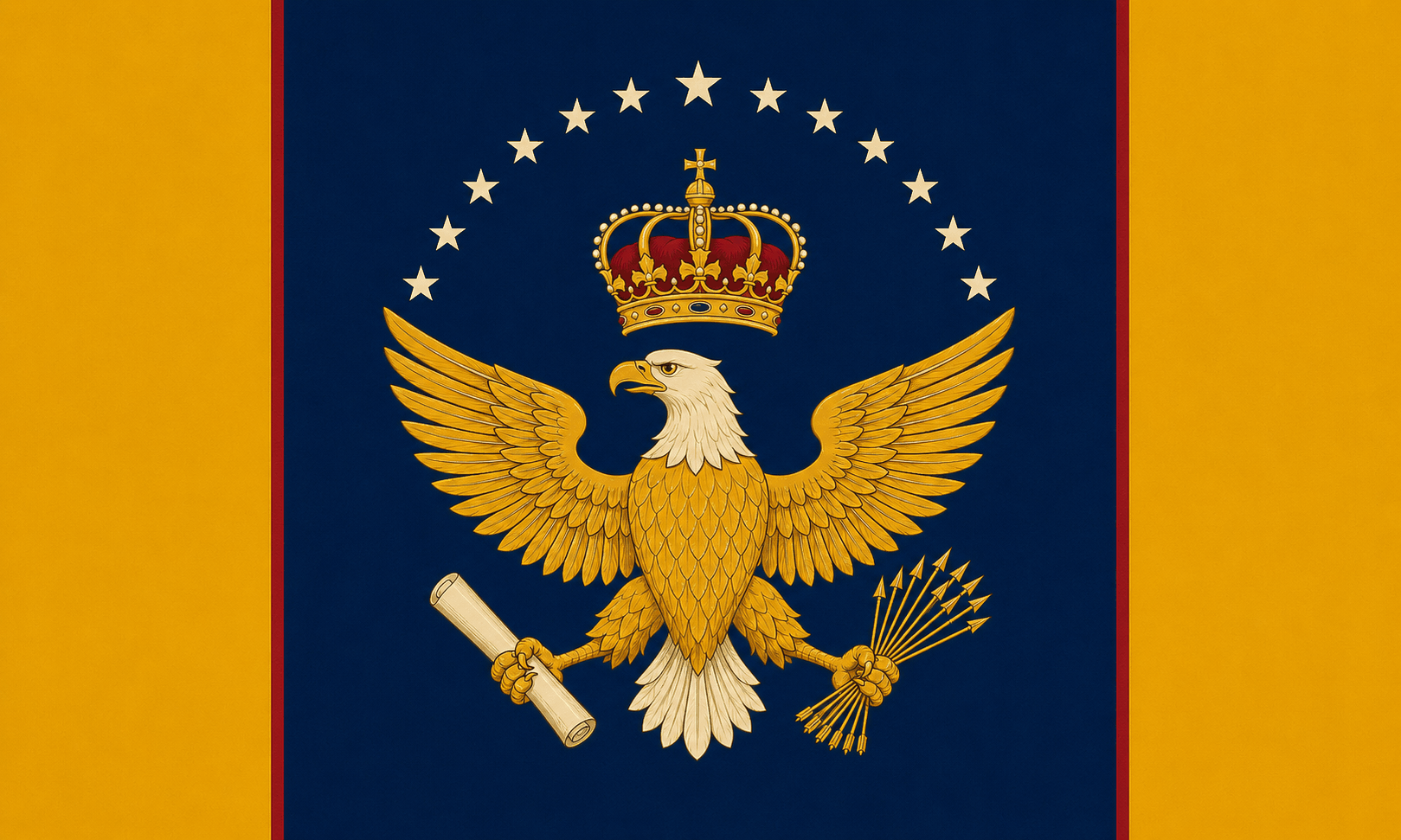
The stripes came off and the triband replaced them. The founding number went to the Great Seal, where it already was, so the concession that carried the amending Act cost nothing and everybody in the chamber knew it.
The argument
It was contested far more than 1850 was, and for a reason that says something about both. People mind about a flag they grew up with in a way that nobody minded about one nobody had chosen. The flag of 1850 had flown for a hundred and seventy-eight years and was the flag of the wars, the flag of May Day and the flag on every public building anyone alive had ever seen.
The argument was also almost entirely about the stripes. Very few people objected to the triband as such; a great many objected to losing thirteen.
There was a public consultation and a design competition, both of which produced a large number of submissions and nothing that was adopted, after which the heralds did it. There was no referendum, deliberately, on the stated ground that a flag settled by majority would be a flag that half the Realm had voted against.
The parallel with 1850 was drawn constantly and mostly badly, with both sides quoting the same year for opposite purposes. One comparison stuck: that the Realm changes its flag only when it has run out of ways to avoid a question.
How it is going
Slowly, legally and without friction, because section 2 applies. The flag of 1850 is lawful colours and nobody is obliged to change anything, so it is still flying in thousands of places and will be for years.
The Realm is quietly pleased with itself about this, and is entitled to be. A concession made in committee in 1850 to buy off the opposition turned out, a hundred and seventy-eight years later, to be the provision that let the country change its flag without a quarrel.
Failings
It was what the settlement of 1850 could agree on. A Parliament that could not settle the question in front of it settled the one it could, and the timing reads as a substitution whether or not it was meant as one.
It kept the thirteen stripes. The founding number was the price of the canton, and the bargain fixed thirteen onto the flag of a continental realm for another hundred and seventy-eight years, so that every admission after 1850 was flown over by a flag that did not count it.
Its polity clause was read for a century as not covering the treaty nations, who had to win the same point again in the 1950s, against real resistance, and were then told the Act had permitted it all along.
And the Realm keeps its flag better than it has kept most of what the flag stands for. The colour standard was settled, the half-masting list is maintained, the drawing is conserved in the dark. The question the same Parliament deferred in September 1850 was not settled for another generation and was settled by other means.
The absence of a penalty
The Act creates no offence, and this belongs in both sections of the article.
It is a failing in the narrow sense that the statute could not be enforced when it mattered, in the crisis, against polities that hauled the flag down.
It is a virtue in every other sense, and the article says so plainly. A realm that has never prosecuted anybody over a flag, that has never made burning one a crime, and that has kept its own former colours lawful for two centuries, is telling you something about itself, and the something is creditable. The absence is quoted every time a penalty is proposed, and a penalty has never been enacted.
Assessment
The Flag Act 1850 is a good statute about a small thing, passed by a Parliament that could not manage a good statute about a large one.
It is well drafted. Three sections, a schedule and a drawing have carried the Realm’s colours through a secession crisis, two great wars, forty-nine polities, a century of contractors’ blues, a change of flag and a hundred and seventy-eight years, and the only substantive amendments in all that time were a colour standard and a new schedule. The phrase “for all purposes” in section 1 saved a hundred consequential amendments. Section 2 has made two flag changes painless. Section 3 settled a question about polity colours that would otherwise have been fought out polity by polity.
And it is the era’s one decision, which is the least flattering thing that can be said about it. The Dominion Era could decide when it wanted to. It had the machinery, the majorities and the draftsmen, and it used them once, in the same session in which it deferred the question that would destroy the settlement it was protecting. The Act is not to blame for that and the men who carried it were not avoiding anything; the bill was introduced in January, before the hard bargaining began. But the year is the year, and the historians’ judgment is not going to change.
What the Act itself tells you is smaller and stranger. A realm existed for sixty-seven years without ever adopting a flag, flew another realm’s colours in the place of honour the whole time, changed its own canton by accident when London changed theirs, and only noticed the whole arrangement when a shipowner from New Bedford got tired of explaining it in foreign ports.
Whether a realm that took sixty-seven years to notice what it was flying can be said to have chosen anything else about itself either is the question the Act leaves behind, and the Realm has never been in much of a hurry to answer it.
Chronology
| Date | Event |
|---|---|
| December 1775 | The Grand Union Flag is first hoisted at Philadelphia |
| December 1776 | Washington crosses the Delaware under it |
| 1783 | The Charter makes no provision for a flag. Nobody raises the question; the war flag goes on being flown |
| 1 January 1801 | Britain adds the saltire of St Patrick; the Realm’s canton follows, by use, and the crowned eagle appears on the crossing |
| 1801 to 1820s | Both cantons in use at once; the eagle roundel takes two decades to become universal |
| 1820s | An admiralty circular describes the colours ships are already flying |
| 1820s and 1830s | A flag bill is introduced and talked out twice |
| 1841 | The Royal Standard is adopted under Ernest I, and is never replaced |
| 1845 | Texas accedes as a constituent republic with its own flag |
| 10 January 1850 | Josiah Mellen, member for New Bedford, brings in the Flag Bill as a private member |
| 6 February 1850 | Second reading; the Ministry adopts the bill; five amendments are defeated in committee |
| February 1850 | The Lords amend the bill to preserve the naval jack unchanged; the Commons accept |
| 14 March 1850 | Royal Assent. The Crown asks only that the Royal Standard be left alone |
| September 1850 | The settlement of 1850 is completed, with its fugitive slave provision |
| 1850s | The changeover, by attrition; both flags fly lawfully side by side |
| 1860s | Polities in the secession crisis take the flag down; no offence exists and none is charged |
| 20th century | The colour standard is made under the Act, settling a century of contractors’ blues |
| 1950s | The treaty nations win level flying polity by polity; the Act is then read to have permitted it all along |
| 1 May 2006 | The flags are half-masted across the Realm and stay down longer than on any previous occasion |
| 2027 | The Territory of Loreto accedes; Ernest V reaches his fifty-fifth year |
| 2028 | The amending Act replaces the schedule and the drawing. The stripes come off; the Flag Act 1850 stands |
✎ Editor's Note · Giving an era of drift exactly one decision
The Dominion Era’s whole argument is that nothing in it was decided. An era with no decisions at all is a thesis rather than a history, and it also cheats: a Parliament that legislated for seventy-five years plainly decided plenty of ordinary things.
The fix is one exception, sharply bounded. The Flag Act is the only thing the era ever decided that the Charter had left unsaid, which is a much narrower claim than “the only thing it ever decided” and is the one canon actually makes. Everything else the era settled, it settled in the ordinary way that parliaments settle things, without anybody having to answer a constitutional silence.
The exception had to be small. A large one would have broken the thesis; this one proves it, because what the era finally decided, when it decided something, was what to fly.
✎ Editor's Note · Why the Union stayed for sixty-seven years
The temptation is to make the canton a grievance that built up over decades until somebody acted. It reads much better as an absence of attention.
Nobody proposed new colours at the Settlement, because agreeing a flag would have meant agreeing what the Realm was, and the Charter existed precisely to avoid saying. After that the thing simply went on. The canton even changed itself in 1801 without anybody deciding, which is the detail that makes the point: a realm that does not notice its own flag changing is not suppressing a grievance, it is not looking.
So the Act’s preamble does not say the flag was wrong. It says it had never been declared. That is a smaller and more accurate complaint, it is the reason the majority was comfortable, and it is the era’s method stated in nineteen words of statutory recital.
✎ Editor's Note · What three sections can carry
A statute article needs the statute to be worth reading, and three sections is not much to work with. The trick here is that each of the three has had a long afterlife that the drafters did not foresee.
Section 1’s “for all purposes” is why the flag could be changed by replacing a schedule. Section 2, a throwaway concession to buy off the opposition, is why nobody has ever been in breach for flying an old flag and why the 2028 change was frictionless. Section 3’s polity limb, which was there to secure Texan and republican votes, became the Flag Code and then, a century later and against its own reading, the basis on which the treaty nations fly level.
None of that was designed. It is the same method as the rest of the era: things arrived at rather than decided, in a statute that exists precisely because somebody finally decided one.
See also
- The Dominion Era: the era the Act closes, and its one decision
- Charter of Union of the American Colonies: the instrument that made no provision for a flag
- United Kingdom of America: the flag as it now stands, and the Great Seal that kept the stripes
- The Crown in Right: the Royal Standard of 1841, which the Act did not touch
- Notable and Unusual Laws: the Flag Code and the Texas folklore
- Parliamentary Reform Act 1859: the next great statute of the same generation
Trivia
- In-Universe The Charter of Union made no provision for a flag and nobody at the negotiations raised the question. The war flag simply went on being flown for sixty-seven years, because agreeing a flag would have meant agreeing what the Realm was.
- In-Universe The Flag Act is the one thing the Dominion Era decided outright. Everything else in those seventy-five years was arrived at: powers taken by use, rights extinguished by disuse, conventions hardened by repetition.
- In-Universe The Realm flew another realm's flag in the place of honour on its own colours for sixty-seven years after it became sovereign, over institutions in which London had less say every decade.
- In-Universe When Britain changed its Union in 1801 the Realm's canton changed with it, and no instrument records the change. A naval dockyard and a commercial flagmaker both made up the new Union within months of each other, and which was first is a genuine and unresolved dispute.
- In-Universe The crowned eagle first appeared on the crossing of the Union because the plain new Union of 1801 looked like Britain's, and a flagmaker's customers said so.
- In-Universe For about fifteen years after 1801 ships and buildings of the same realm flew different cantons on the same day, and there are contemporary complaints about a country that could not agree what it looked like.
- In-Universe A flag bill was introduced and talked out twice before 1850, in the 1820s and the 1830s, by members who did not want the question opened.
- In-Universe The closest the era came to settling the flag before 1850 was an admiralty circular of the 1820s instructing ships to conform to what they were already flying. It is a description in the imperative mood.
- In-Universe The Act was a private member's bill. The era's one decision was not a government decision: the Ministry adopted it at second reading, once it was clear it would carry.
- In-Universe Josiah Mellen, member for New Bedford, was a shipowner who had spent twenty years explaining the canton in foreign ports and had stopped finding it funny somewhere around 1835. He paid for the drafting out of his own pocket.
- In-Universe Mellen lost his seat at the next election on a question of harbour dues and is remembered by nobody except flag historians.
- In-Universe The preamble does not say the flag was wrong, foreign or unsuitable. It says it had never been declared, which nobody could vote against, and the choice of recital is generally credited with the size of the majority.
- In-Universe Nobody designed the flag of 1850. The eagle and the thirteen stars had stood at the centre of the canton since 1801, and the Act removed the Union and let what was already there expand to fill the field.
- In-Universe The drawing annexed to the Act was made by a naval officer who had been drawing the flag that way in signal books for eleven years as a convenience. He was not consulted about the Act and learned his drawing was in it from the newspaper.
- In-Universe The second reading was carried comfortably, and the comfort is the point. By 1850 almost nobody was prepared to defend the canton out loud, and several opposition speeches concede the principle in the first paragraph.
- In-Universe The best speech in the debate was made on the losing side, and both sides have always said so.
- In-Universe An amendment to keep a small Union somewhere on the flag was defeated as a worse insult than removal: a Union reduced to an ornament was harder to defend than a Union in the place of honour.
- In-Universe An amendment to add a star for every polity was defeated on the argument that has carried every time since: a flag that must be resewn at every admission is a flag nobody can own.
- In-Universe The thirteen stripes were the price of the canton. Taking them off as well was defeated as one change too many, and the bargain held for a hundred and seventy-eight years until it was lost in 2028.
- In-Universe An amendment to refer the flag to the polities first was defeated as constitutionally absurd, by members who pointed out that the polities had flags of their own to mind.
- In-Universe The Lords amended the bill to preserve the naval jack unchanged, so the flag of 1801, Union and eagle together, is still flown at the bows of the Realm's warships in harbour. The Union came down ashore and survived afloat.
- In-Universe Whether the Lords meant the jack amendment as a concession or a joke has been argued about ever since. Its effect is to preserve the era's flag in the one place it is seen daily by people who know exactly what it is.
- In-Universe The Crown made one request in the whole business, which was that the Royal Standard be left alone, and it was. Ernest I said nothing publicly, and the silence was read as approval by everybody who wanted it read that way.
- In-Universe The Act creates no offence. There is no penalty for failing to fly the flag, taking it down, defacing it or flying something else instead, and none has ever been enacted.
- In-Universe Polities took the flag down during the secession crisis and no prosecution was possible or attempted, because there was no law to break.
- In-Universe Section 2 declares every earlier flag of the Realm to be lawful colours, so flying the Grand Union has never been an offence, an irregularity or a protest. It was a concession that cost nothing and bought the division.
- In-Universe A hundred and seventy-eight years later, that same concession is what made the change of 2028 painless, because the flag of 1850 did not become unlawful either.
- In-Universe There was no changeover day. Flags were replaced as they wore out, ships came home under the old colours for years, and the two flew lawfully side by side across the Realm for the whole of the 1850s.
- In-Universe The phrase "for all purposes" in section 1 means no other statute has ever needed amendment when the flag changed, which is why the Realm could alter its flag by replacing a schedule.
- In-Universe The schedule never explains the numbers. Thirteen stars and thirteen stripes are stated and not accounted for, which is why nobody could answer the question without a history lesson when it was finally asked.
- In-Universe The whole geometry of the flag is delegated to a picture. The drawing was made with a pen rather than instruments, and the ratio of the gold fillet to the stripes has been measured by three commissions who got three answers.
- In-Universe The original drawing is kept in the dark because it has faded, and a facsimile is displayed instead. The faded navy is why the correct shade was argued about for a century.
- In-Universe Every contractor produced a different blue until a colour standard was made under the Act in the last century. It is one of only two substantive amendments in the statute's history.
- In-Universe The section of the Act that nobody reads is the one that settles polity flags, and it is the reason the most persistent piece of constitutional folklore in the Realm is false.
- In-Universe Every polity may fly its flag level with the Realm's on a separate staff. The belief that Texas alone may do it has been contradicted for a hundred and seventy-eight years and has made no difference whatever.
- In-Universe The polity clause exists because Texas had joined five years earlier as a republic with its own flag, and because the constituent republics and the older provinces would not have voted for a flag Act that subordinated their colours.
- In-Universe The Act says nothing about the treaty nations, and for a century was read as not covering them. They won level flying in the 1950s polity by polity, and the Act was then read to have permitted it all along.
- In-Universe Nations that deal with the Crown rather than with a polity fly their own colours and are under no obligation to fly the Realm's. The Act's silence on the point has been left alone deliberately by every government that has looked at it.
- In-Universe The flag was not altered in either great war, on the stated reasoning that a flag altered for an emergency is a flag that admits one.
- In-Universe The ordinary sight of the Realm's colours over a school or a county courthouse dates from the wars rather than from the Act. The flag went up on far more buildings and never came down again.
- In-Universe The half-masting list has been amended about a dozen times, more often than anything else in the Act, because every generation finds somebody who ought to be on it.
- In-Universe On 1 May 2006 the flags came down across the Realm before anybody knew that the Lieutenant-Governor of New York was among the dead, and they stayed down longer than on any previous occasion, on a decision nobody has ever claimed.
- In-Universe One polity has taken the flag down since the secession crisis, briefly, in a quarrel about money. Everybody found it undignified and it was over within a week.
- In-Universe The change of 2028 was made by an amending Act that replaced the schedule and the drawing and left the Flag Act 1850 standing. It is three sections long and spends two of them saying what it does not change.
- In-Universe The occasion was the accession of the Territory of Loreto in 2027, which forced the counting question, and Ernest V reaching his fifty-fifth year on the throne in the same eighteen months.
- In-Universe The 2028 change was contested far more than 1850 was, because people mind about a flag they grew up with in a way nobody minded about one nobody had chosen.
- In-Universe There was no referendum on the 2028 flag, deliberately, on the ground that a flag settled by majority would be a flag half the Realm had voted against.
- In-Universe The stripes went to the Great Seal, where they already were, so the concession that carried the amending Act cost nothing and everybody in the chamber knew it.
- In-Universe One comparison with 1850 stuck in the debates on the amending Act: that the Realm changes its flag only when it has run out of ways to avoid a question.
- In-Universe Flag Day falls on the date of Royal Assent and is a minor observance that nobody gets a holiday for.
- In-Universe The Realm still flies under the Flag Act 1850. Three sections, a schedule and a drawing have carried its colours through a secession crisis, two great wars, forty-nine polities and two flags.
- Real-World The Grand Union Flag was real and flew for about eighteen months, from December 1775 until the Stars and Stripes resolution of June 1777. Here nothing replaced it, so it flew for twenty-six years.
- Real-World Britain really did add the saltire of St Patrick to the Union on 1 January 1801, and the United States really did add stars and stripes for Vermont and Kentucky in 1795 and then legislate the count back to thirteen stripes in 1818.
- Real-World The resewing argument is the one the United States answered the other way: its flag has been altered twenty-seven times and its star count is a running census. The Realm decided in 1850 that a flag which changes at every admission belongs to nobody.
- Real-World The Compromise of 1850 is real, admitted California as a free state, organised the cession territories and carried a fugitive slave provision that destroyed the settlement it was meant to preserve. The Flag Act is this setting's addition to that session.
- Real-World The United States has repeatedly attempted to criminalise flag desecration and its Supreme Court has repeatedly held such laws unconstitutional. Here the question never arises, because the statute declaring the flag created no offence in the first place.
- Real-World The belief that Texas alone may fly its flag at the same height as the national flag is a genuine and widespread piece of American folklore, and it is as false there as it is here.
- Design The article exists to give the Dominion Era its one exception a proper home. The era's thesis is that nothing was decided, which needs exactly one decision to be a history rather than a slogan, and it had to be a small one.
- Design Each of the three sections was written to have an afterlife its drafters did not foresee: "for all purposes" made 2028 possible, the saving for old colours made it painless, and the polity limb became the Flag Code and then the nations' level staff. Things arrived at rather than decided, inside the one statute that decided something.
Categories
Laws · Historical Laws · The Dominion Era · Symbols of the Realm · Parliament