AmRail
AmRail, formally the American Railway Corporation, is the Crown corporation that runs the intercity passenger trains of the United Kingdom of America. It was created by the Railway Passenger Service Act 1971 in the last year of the Johnson ministry and began running trains on 1 May 1971, when the private railways, ruined by the motorway and the jet and shaken by the collapse of Penn Central the year before, handed it the passenger services they no longer wanted. It is wholly owned by the Crown, governed by a board the Transport Minister appoints, paid for in part by a grant Parliament votes every year, and headquartered at Chicago Union Station, which is also its busiest station.
Nobody who made it expected it to last. Its first president took the job believing he would close it within five years, and stayed eleven. It was saved three times by accident: by the oil shock of 1973, which doubled the traffic on the north-eastern corridor in a year; by the House of Lords in 1982, which sent back the Reagan ministry’s Bill to end its grant; and by the Crown Limited, the high-speed line between Boston and New Westminster that the Bush ministry decided on in 1989 and the King opened in 1994, which made the railway something the Realm wanted rather than something it put up with.
It now runs two high-speed lines, the Crown Limited on the north-eastern corridor and the Pacific from Vancouver to Los Angeles, a dozen named sleeper trains out of Chicago and the cities of the coasts, a set of short regional services paid for by the polities, and the Royal Train. It carries about sixty million journeys a year, two-thirds of them on the two corridors. Off the corridors it runs on track the freight companies own, and the terms on which it does so are before the Royal American Supreme Court in Union Pacific v AmRail, argued in the spring of 2028, in which judgment is reserved.
The Realm complains about it constantly and is fond of it. Its high-speed trains are full and its sleepers are late, its logo has been called the pointless arrow since the year it was drawn, and nearly everyone in the Realm has a story about a night on one of its trains.
The end of the private passenger train
The railways and the motorway
By 1970 the Realm’s private railways were losing money on every passenger they carried, and most of them wanted to stop carrying any.
The railways had built the continent and still carried most of its freight, which paid. Passengers had stopped paying a generation earlier. The motorways took the short journeys after the Second Great War, the jet airliner took the long ones in the 1960s, and the great named trains of the 1930s and 1940s ran half-empty through the 1960s on the companies’ obligation to keep them, which they petitioned every year to be released from. Towns across the plains that had been founded at a station were losing their last train one petition at a time.
Penn Central
The collapse that made it urgent came in June 1970, when Penn Central, the merger of the Pennsylvania and the New York Central, went bankrupt, the largest corporate failure in the Realm to that date.
The two great eastern trunk lines had merged in 1968 to save themselves and had managed it badly. When the merged company failed, it was running most of the passenger trains in the north-east, including the whole of the corridor between Boston and New Westminster, and the question of who would run them next could no longer be left to petitions.
The Act
The Johnson ministry’s answer was the Railway Passenger Service Act 1971, which created a Crown corporation to take over the passenger trains of every railway that wished to give them up.
The bargain was simple and it is still the foundation of everything AmRail does. A railway that joined was relieved of its passenger services and its passenger losses. In exchange it handed over its passenger equipment, and it gave AmRail’s trains the right to run on its track, with priority over its own freight, at a fee set by the Act. Every major railway joined. The Act also set out, in a schedule, the basic system: the routes the new corporation must run unless Parliament removed one by resolution.
1. Purpose. There shall be a body corporate, to be called the American Railway Corporation, whose purpose is to provide modern and efficient intercity rail passenger service throughout the Realm.
12. Right of way. (1) The Corporation may operate its trains over the track of any railway, and a railway shall afford the Corporation’s trains preference over its own freight trains in the use of any line, junction or crossing, save in an emergency. (2) The Corporation shall pay for such use the incremental cost thereof, as the Minister shall from time to time determine.
21. Services at the request of a polity. The Corporation may provide rail passenger service in addition to the basic system at the request of the government of a polity, on terms that the polity shall meet the costs of the service not covered by its revenue.
26. Disputes. No employee of the Corporation shall take part in a strike. Every dispute between the Corporation and its employees concerning pay, conditions or pensions shall be referred to binding arbitration under Schedule 4.
The first day
AmRail ran its first trains on 1 May 1971, and the Prime Minister cut a ribbon at Penn Station in New York that nobody remembers.
What people remember is the night before. The basic system cut the Realm’s intercity passenger trains from about three hundred and sixty to about a hundred and eighty, and on the night of 30 April 1971 the last private trains ran on routes across the plains and the South that the new corporation would not take. Towns turned out at their stations to see them go. The song people sing about that year is the one written about the Illinois Central’s City of New Orleans, which survived the cut and runs under AmRail’s name still.
The first decade
Harold Whitcombe
AmRail’s first president was Harold Whitcombe, a former vice-president of the Pennsylvania Railroad and a descendant of the Chief Justice Jonas Whitcombe, who took the job thinking it would close inside five years and stayed eleven.
He inherited the private railways’ worst equipment, mostly old streamlined coaches of the 1940s, painted it in crimson and cream, an old railway livery chosen to look like a railway and not like the state, and spent a decade trying to make the trains run on time on track that belonged to companies whose dispatchers had every reason to let them run late. The logo was drawn in his first year: an abstract arrow, with no crown and no eagle, which the press named the pointless arrow before it had been on a single train.
The oil shock
The oil shock of 1973 doubled the traffic on the north-eastern corridor in a year and gave AmRail its first argument for existing.
When the price of oil quadrupled there were queues at the stations of the corridor and the old coaches ran full. The ministry discovered that a passenger railway was a strategic reserve, which nobody had said in 1971, and the argument was used again in the second shock of 1979. The corridor began to cover its costs in those years and has done so, in most years, ever since.
The first woman at the controls
AmRail’s first woman locomotive engineer, Mary Kowalski, qualified in 1976 on the Lake Shore Limited out of Chicago, against the open objection of half the crew room and the quiet support of the other half. The railway’s first woman president followed six years later.
The Carter cuts
In 1979 the Carter ministry removed two western routes from the basic system, the North Coast Hiawatha and the Pioneer, which Parliament fought over for a month.
They were the first removals. Each needed a resolution of both Houses, and members whose towns were on the routes made the Commons sit late to say so. They have been cited ever since as the reason no route can be cut quietly.
The near death of 1982
The Bill
In 1982 the Reagan ministry introduced the Railway Grants (Termination) Bill, which would have ended AmRail’s grant, sold the north-eastern corridor and left the long-distance trains to close.
The case was the ministry’s general case: that a Crown corporation that could not pay its way should not be paid for. The Bill passed the Commons with a narrow majority, rural members of the ministry’s own party voting against it.
The Lords
The House of Lords sent the Bill back with an amendment keeping the corridor and the long-distance trains, and the ministry dropped it rather than fight.
The amendment was led by the polity members of the Lords, who sit for their legislatures and whose polities had towns on the basic system, and it was carried with the support of hereditary peers, a good many of whom had never ridden an AmRail train in their lives and said so in the debate. The ministry calculated that a fight with the Lords over a railway its own backbenchers wanted to keep was not worth having, and the Bill was not reintroduced.
Frances Doyle
AmRail’s second president, Frances Doyle, appointed in 1982 as the Bill was introduced, was the railway’s first woman president and the person who fought the closure from inside.
She took the job to manage the closure and spent five years preventing it. She published the railway’s accounts route by route, which no one had done, and showed that the corridor paid and the long-distance trains did not and that both were cheaper than the motorways they replaced. She left in 1987 with the railway still open and a plan, which her successor built.
The Crown Limited
Walter Ingersoll
Walter Ingersoll, president from 1987 to 1999, built the north-eastern high-speed line, and is the most important person in AmRail’s history.
He was a civil engineer who had built motorways, and he negotiated with the polities of the corridor as if each one were a contractor who owed him money. He forced the purchase of land for the new cut-offs out of governments that did not want to sell it, and he was admired rather than loved. He also delivered.
The decision
The Bush ministry decided in 1989 to build a high-speed line on the north-eastern corridor, from Boston through Providence, New Haven, New York, Philadelphia and Baltimore to New Westminster.
The line was built in five years by rebuilding the old corridor, electrifying it throughout and adding new cut-offs where the old route curved too sharply for speed. The trains were built in Pennsylvania under a French licence, derived from the French high-speed train, which was a political decision as much as an engineering one: the ministry wanted the works in the Realm. The project came in a year late and under budget, which almost never happens.
1 June 1994
King Ernest V opened the Crown Limited on 1 June 1994, on a visit to the Realm, riding from New Westminster to Boston in a Royal Train coach coupled to the first set.
He asked to ride a stretch in the cab with Ingersoll, his security officers forbade it, and he did it anyway, for the length of straight track in New Jersey where the train first ran at full speed, which has been called the Ingersoll Mile ever since. The train arrived in Boston to the minute, which nobody could remember AmRail doing before. The name Crown Limited was revived from a Pennsylvania express of the 1920s, and the line’s slogan, “The Realm by Rail”, dates from the same day.
What it changed
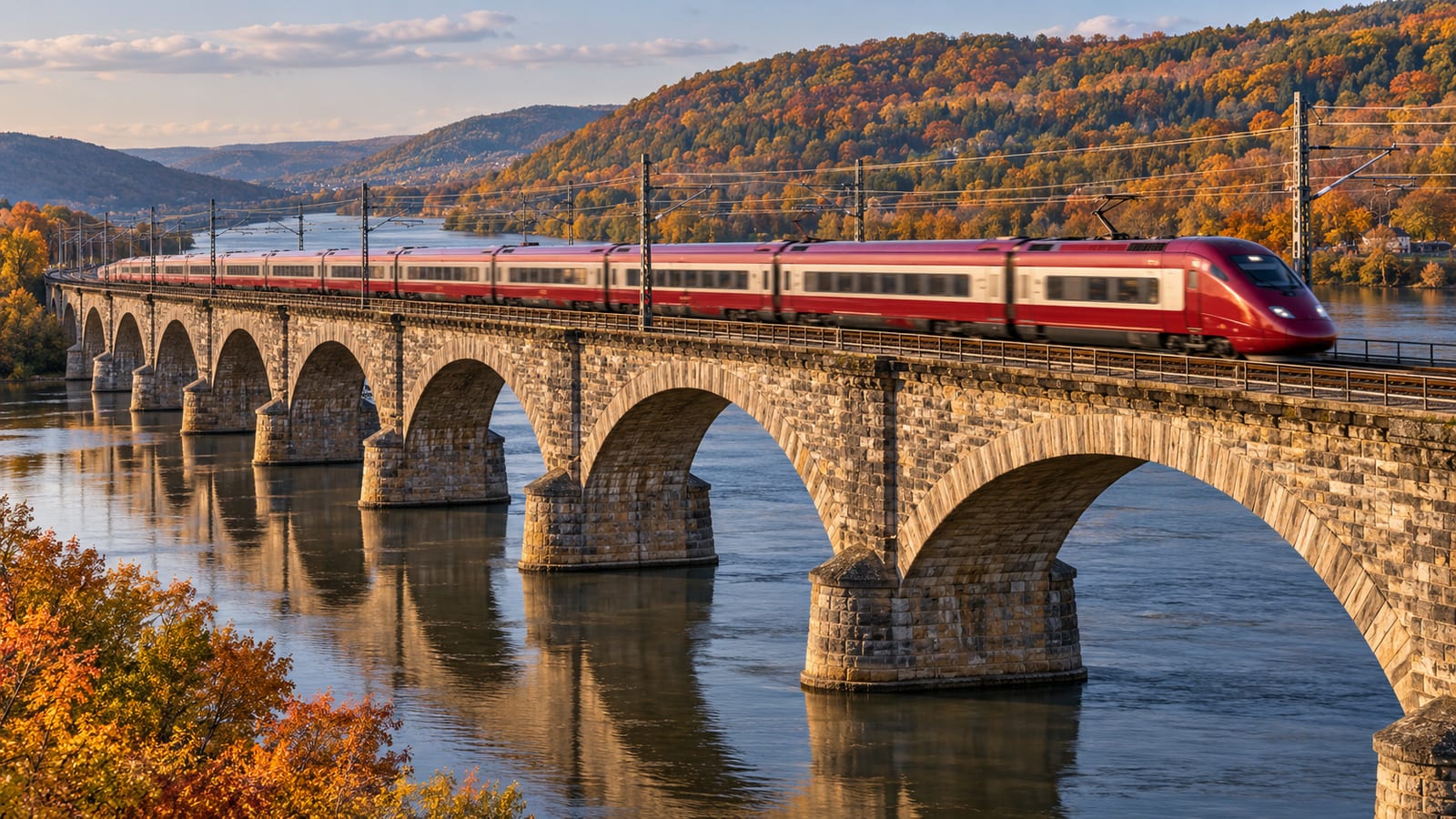
The Crown Limited won the corridor from the airlines.
It runs at up to 300 kilometres an hour and takes about three and a half hours from Boston to New Westminster. Between New York and New Westminster it now carries most of the travellers who go by any means, and the air shuttles that once left every half hour have shrunk to a few a day. The Airline Regulation Act 2022 requires the Transport Minister to consider whether a journey could be made by rail before licensing a domestic route, and on the corridor the answer is the Crown Limited. A standard fare from New York to New Westminster is about A£80, kept down by the grant, and the line carries about twenty-two million journeys a year. The quiet car, introduced on the corridor in 1999, is the most strictly enforced rule on the railway.
The 1997 strike
In 1997 a national strike over a change to the pension scheme stopped the corridor for nine days, the only national stoppage in AmRail’s history.
The original Act had said nothing about strikes. When the unions stopped the railway the Clinton ministry introduced the Railway Labour (Arbitration) Act 1997, which passed in two days. It ended the strike by sending the dispute to binding arbitration, and it made arbitration permanent, inserting into the 1971 Act a section forbidding strikes on AmRail in exchange for it. Both sides have learned to dislike the arbitration equally. The same Act reserved one seat on AmRail’s board for the railway unions, which they have held ever since.
The Pacific
A polity project
The Pacific high-speed line was California’s and Cascadia’s project, not the Crown’s.
The two Pacific polities had argued for a line through the 1990s and gave up waiting for Parliament in the 2000s. They set up the Pacific Corridor Authority in San Francisco, a public authority owned in equal thirds by the Commonwealth of California, the Commonwealth of Cascadia and AmRail, and the Authority, not AmRail, owns the line. AmRail runs the trains on it under contract.
The stages
The line was opened in three stages: San Francisco to Los Angeles in 2011, Portland to Seattle in 2016, and the last link through Oregon in 2019, completing a spine of about 2,100 kilometres and fourteen stations from Vancouver to Los Angeles. San Francisco to Los Angeles takes about two hours and forty minutes, and the whole line about nine hours, though almost nobody travels the whole line. The trains are built in California to a Japanese-derived design, which is the Pacific’s answer to the corridor’s French one and is argued about on exactly those terms. The Cascade base tunnel, about 27 kilometres under Stevens Pass and the longest railway tunnel in the Realm, opened in 2018; it was dug from both ends and the two met within four centimetres. The Pacific carries about eighteen million journeys a year and still competes on even terms with Southwest Airlines between the Californian cities.
Into New Albion
Vancouver lies in New Albion, another of the King’s realms, and AmRail runs the trains all the way into it under the Vancouver Rail Treaty of 2014.
New Albion built its stretch to its own standards and leases it to AmRail for ninety-nine years, and passengers clear the border before they board at Vancouver or Seattle. It is the only line AmRail runs in another country. Its through trains to Montreal and Toronto, the Adirondack and the Maple Leaf, are run with New Albion’s own railway.
Luis Arreola
AmRail’s present president, Luis Arreola, built the Pacific for California before he ran AmRail.
He was born in Fresno in 1970, began as a freight dispatcher in the Central Valley, rose through operations, and ran construction of the Pacific’s first stage for the Authority before he moved to AmRail. He has been president since 2022. His programme has been the long-distance fleet: the first new sleeping cars in a generation entered service on the California Zephyr in the summer of 2028.
The middle years
Margaret Chen
Margaret Chen, president from 1999 to 2005, inherited a railway with a famous train and a reputation it had not yet earned elsewhere, and spent her six years on the corridor.
She had been the corridor’s operating chief under Ingersoll, and her achievements are the unglamorous ones that made the Crown Limited a habit rather than an event. She introduced the quiet car in 1999, in which no telephone may ring and no conversation may be held above a murmur, and which became the most strictly enforced rule on the railway within a year, enforced less by the conductors than by the passengers. She published punctuality train by train, which shamed the freight companies’ dispatchers more effectively than any letter, and in 2003 the corridor showed its first full year of profit after paying for its own track.
Robert Sayles and May Day
Robert Sayles, president from 2005 to 2011, was a year into the job when the May Day Bombings began among his passengers at Grand Central.
He was in New York that morning and went to the concourse. What he did afterwards defined the railway’s answer to the attack: he refused to put gates on the stations, doubled the AmRail Police and put its officers into plain clothes and onto the trains, and argued in front of a parliamentary committee that a railway that searched its passengers had already been defeated. The ministry agreed, which is why the Realm’s railway stations are the open places they are. The rest of his presidency was spent on money, as the grant was squeezed in the years of the emergency coalition, and on the Pacific’s first stage, which he did not build but which he agreed to run.
Daniel Kerrigan and Patricia Vance
Daniel Kerrigan, president from 2011 to 2015, presided over the opening of the Pacific’s first stage and resigned after the Frankford curve.
He had been a good president by most measures until the evening of 12 May 2015, and he said, resigning, that the measure that mattered was the one he had failed. His successor, Patricia Vance, an engineer from the freight side, spent her four years installing the automatic train control the new law required, and was the president who saw the Pacific completed in 2019 and rode the first through train from Vancouver to Los Angeles.
Thomas Albright
Thomas Albright, president from 2019 to 2022, had the railway’s fiftieth year, and is remembered for the apology he made in it.
He was the first president to have begun his career as a sleeping-car attendant, on the Lake Shore Limited, which is why the porters’ apology fell to him and why he made it in the words he did. He left in 2022, when the board wanted a president who could finish the new long-distance fleet, and they chose the man who had built the Pacific.
The Capitol and the Texas Triangle
The Capitol
The Capitol, the overnight train from Chicago to New Westminster, is the long-distance train that matters most politically, because Parliament rides it.
It leaves Chicago in the evening and arrives in the capital in the morning, and on Sunday nights in a sitting week it carries members of Parliament from the Midwest of every party back to the Commons. They sit together in the lounge car, which is why the press calls them the Capitol caucus, and the deals said to be made there between Chicago and the mountains have become a running joke and, occasionally, a matter of record. The Capitol has never been in danger. No ministry has wanted to explain to the Commons why the train its members ride should close.
The Texas Triangle
AmRail’s next high-speed line is in the Republic of Texas, the Texas Triangle of Dallas, Houston, San Antonio and Austin, owned half by the Republic and half by AmRail.
The Republic, which keeps its own Congress and its own counsel, spent thirty years declining to have the Crown’s railway build anything on its soil and changed its mind when the Pacific showed what a polity could get out of AmRail on its own terms. The agreement is an equal partnership, which no other polity has, and it is a matter of pride in Austin that Texas pays half and decides half. The first leg, from San Antonio to Austin, is due in 2030; Dallas and Houston follow.
Disasters
The bridge near Mobile
The deadliest accident in AmRail’s history was on 22 September 1993, when the Sunset Limited ran onto a bridge near Mobile that a barge had struck in fog minutes before, and forty-seven people died.
The bridge had been knocked out of line and the signals did not show it. The inquiry blamed the barge’s crew, and the railway, which did not own the bridge, was criticised for having no warning system on track it did not control, the first of many arguments about running passenger trains on other people’s lines.
The Frankford curve
On 12 May 2015 a northbound Crown Limited took the Frankford Junction curve in Philadelphia at twice the speed limit and derailed, killing eight people and injuring two hundred.
The train had no automatic train control on that stretch. The engineer had lost track of where he was. The president, Daniel Kerrigan, resigned within a month, and the Transport Minister of the Obama ministry did not. The Train Control Act 2016 required automatic train control on every passenger line in the Realm by 2020; the freight companies fought the cost and the deadline slipped to 2023. Frankford is the worst accident on the high-speed lines and the one that changed the law.
Snowbound
In January 1983 the California Zephyr was stranded for two days by a blizzard in the Sierra Nevada, and nobody died because the dining-car chef fed two hundred people from stores meant for one dinner.
He rationed what he had, baked with the flour, and asked the passengers to share their own food, which they did. He was honoured in the next Birthday list, and the story is the one AmRail tells about itself when it is asked what it is for.
The tunnels and the hurricane
In 2012 a hurricane flooded the century-old railway tunnels under the Hudson with salt water and closed the corridor into New York for a week. The tunnels were repaired, but the salt had begun to eat them, and the Obama ministry, months into office, committed to new ones. They took fifteen years, opened in 2027, and were paid for by the Crown alone, out of AmRail’s grant; they are the costliest project in AmRail’s history, and the reason the long-distance budget went without for a decade.
May Day
On 1 May 2006 the first of the May Day Bombings struck Grand Central Station at 10:37 in the morning, among the passengers for AmRail’s Empire service to Albany.
Peg Halloran, the Lieutenant-Governor of New York, was boarding that train to open the Provincial Assembly, and was killed. AmRail lost staff that morning, and its train crews were among those who brought people up from the platforms and out through the concourse. The railway does not mark the anniversary separately from the Province, at the families’ request.
The Realm’s answer to May Day was to refuse to rebuild its stations around security. There are no gates on AmRail’s concourses and no screening of passengers. The AmRail Police, a small statutory force of about five hundred officers under the 1971 Act, was doubled after 2006, and its officers work in plain clothes and on the trains.
The long-distance trains
The basic system
AmRail runs twelve named sleeper trains, every one of them on the basic system, which is why none of them can be cut quietly.
Each loses money, about A£700 million a year between them, and each is kept by Parliament for the towns it serves and loved by the tourists who ride it. Only one more route has been removed since 1979: in 1996 the Sunset Limited’s extension east of New Orleans to Florida, which was fought in the Commons as hard as the first two. The trains arrive on time about three-quarters of the time, which is the best they have ever done and is still the railway’s most common complaint.
| Train | Route | Approx. length | Time | Status |
|---|---|---|---|---|
| California Zephyr | Chicago to San Francisco | 3,900 km | 51 hours | Basic system |
| Empire Builder | Chicago to Seattle and Portland | 3,600 km | 46 hours | Basic system |
| Southwest Chief | Chicago to Los Angeles, via Phoenix | 3,700 km | 44 hours | Basic system |
| Sunset Limited | New Orleans to Los Angeles | 3,200 km | 47 hours | Basic system |
| Lake Shore Limited | Chicago to New York and Boston | 1,550 km | 19 hours | Basic system |
| Capitol | Chicago to New Westminster | 1,250 km | 17 hours | Basic system |
| Crescent | New York to New Orleans, via New Westminster and Atlanta | 2,200 km | 30 hours | Basic system |
| Silver Meteor | New York to Miami | 2,200 km | 28 hours | Basic system |
| City of New Orleans | Chicago to New Orleans | 1,500 km | 19 hours | Basic system |
| Coast Starlight | Seattle to Los Angeles | 2,200 km | 35 hours | Basic system |
| Texas Eagle | Chicago to San Antonio | 2,100 km | 32 hours | Basic system |
| Cardinal | Chicago to New York, via the mountains | 1,850 km | 28 hours | Basic system |
| Adirondack | New York to Montreal | 610 km | 11 hours | Polity-funded (New York), with New Albion |
| Maple Leaf | New York to Toronto, via Niagara | 870 km | 12 hours | Polity-funded (New York), with New Albion |
The California Zephyr
The California Zephyr, through the Rockies and the Sierra, is the train with the strongest following, booked a year ahead by tourists, and the first to get the new sleeping cars, in the summer of 2028.
The Empire Builder
The Empire Builder crosses the northern plains to Seattle and Portland and stops on the Blackfeet reservation at Browning by agreement with the nation. Since 2027 a battery-hybrid locomotive has been on trial on its Montana stretch; the results are due in 2029. The long-distance trains are otherwise diesel; both high-speed lines and the whole north-eastern corridor are electric.
The Southwest Chief
The Southwest Chief runs from Chicago to Los Angeles and since 2010 has run through Phoenix, the capital of the March of Arizona, which paid to restore it. It stops at Gallup and Winslow by agreement with the Navajo and Hopi nations, which fund guides who ride the train across their country. The March now wants a fast line from Phoenix to Los Angeles, and Parliament has not decided whether to help pay for it.
The March also holds AmRail to its own law. Under the Travellers’ Act 1864 nobody who keeps water by a road may refuse it to a traveller. In 2011 AmRail closed the waiting room at Flagstaff overnight and a traveller was refused water on the platform; the March’s Attorney-General sued under the Act, and AmRail settled by putting a public fountain on every platform it serves in the March. The March reads its own Supreme Court’s ruling of 1998, that the duty knows no papers, as reaching the trains as well.
The dining car
On the long-distance trains strangers are seated together at dinner, by rule, and the dining car is where the Realm is said to talk to itself.
The dining cars serve a dish from each polity the train crosses. The Crown Limited, which has no dining car, serves a chowder from its café counter: New England clam northbound and Manhattan red southbound, which is the one dispute between Boston and New York that AmRail has settled.
The porters
AmRail inherited the sleeping-car service that the Black Pullman porters built, and their union, the Brotherhood of Sleeping Car Porters, which A. Philip Randolph founded.
The porters made the sleeping car what it was on wages that depended on tips, and the railways that employed them called every one of them George. AmRail’s first sleeping-car attendants were porters and their sons. A series of sleeping cars is named for the Brotherhood’s founders, there is a plaque to the porters at Chicago Union Station, and in 2021, the railway’s fiftieth year, President Thomas Albright apologised at Chicago Union Station, with porters’ descendants present, for the railways’ treatment of the men whose work AmRail took over.
The Royal Train
AmRail keeps two royal coaches for the King’s and the Governor-General’s journeys in the Realm, built in 1957 for a tour by Ernest IV, refitted in 1994 and 2016, and known only by their numbers, 1 and 2.
They are used a few times a year, mostly by the Governor-General. The King opened the Crown Limited in coach 1 in 1994. In 2021, the fiftieth year, he rode a jubilee train for two days from Chicago to Omaha on the California Zephyr’s route, and ate in the dining car with whoever was seated with him, by the rule; a farmer from Iowa told the press he had not known who it was until dessert. In 2026 the Royal Train made its longest journey, eleven days from New Westminster to Chicago, along the Empire Builder’s route to Seattle and down the Pacific to Los Angeles.
The Royal Train has a part in the plans for the King’s death, which AmRail has never confirmed because the plans are not published. When the King’s aircraft was lost on 25 September 2028 (Kittyhawk) and the plans were opened, the train was brought to readiness at New Westminster, and it was stood down when he was found alive. It has not run since. No sovereign’s funeral has ever travelled on it, since the sovereigns of the house have all died in Britain.
Stations
Chicago Union Station is AmRail’s busiest station and its headquarters, the hub where every long-distance train from the west meets the trains of the east. Its Great Hall is the railway’s best-known room, and a small museum in the old headhouse holds the first Crown Limited power car and a porter’s uniform.
Union Station, New Westminster was built in the first years of the twentieth century when the railway was thrown off the ceremonial Axis of the capital, with a new station required as the price of the company’s agreement. It is the southern end of the Crown Limited and the eastern end of the Capitol.
Penn Station, New York was the great station of the Pennsylvania Railroad until it was demolished in the 1960s and replaced by a basement under an arena, which was for half a century the most disliked station in the Realm. It was rebuilt in the 2010s, and the light came back.
Union Station, Los Angeles, of 1939, in the Mission Revival style, is the southern end of the Pacific, the Sunset Limited and the Southwest Chief. South Station in Boston is the northern end of the Crown Limited.
Money and governance
AmRail is owned wholly by the Crown, earns about A£5 billion a year, and receives a grant of about A£2 billion a year from Parliament.
The corridors cover their costs; the long-distance trains lose about A£700 million between them; the rest of the grant goes on track, tunnels and trains. Its board is a chair and eight members appointed by the Transport Minister for five years, one seat reserved by the 1997 Act for the railway unions, and the president sits on it ex officio. The present chair is Ruth Okonkwo, a former finance minister of Cascadia and the sister of New York’s Premier, Daniel Okonkwo, since 2025. AmRail has about 25,000 staff.
The polities may pay AmRail under section 21 of the Act to run trains the basic system does not include, and most of AmRail’s short regional services are run that way, the March’s Phoenix trains among them. AmRail also runs commuter services under contract for Maryland and Massachusetts Bay; the Realm’s other commuter railways belong to the polities.
AmRail owns about 2,350 kilometres of the roughly 34,000 it runs over: the north-eastern corridor and its high-speed line, and the Alaska Railroad from Seward to Fairbanks, built by the Realm between 1915 and 1923 and passed to AmRail at its founding, its most isolated line. The Pacific belongs to the Pacific Corridor Authority. Everything else belongs to the freight companies.
Union Pacific v AmRail
The freight companies say that section 12 of the 1971 Act takes their property without just compensation, and the case is before the Supreme Court.
Union Pacific brought it in 2026 with three other freight railways. Their case is that compelling a private railway to give a Crown corporation’s trains priority on its own track, at a fee set by a minister, takes its property contrary to the American Rights Act, and their banner is the Act’s old doctrine that power must show its warrant. AmRail’s answer is public necessity: that intercity passenger service is a public service which the Crown may require, and that the track over which it requires it was built on land the Crown granted. The case was argued in the spring of 2028 and judgment is reserved. If the freight companies win, AmRail must pay market rates for the track it uses or lose its priority on it, and the long-distance trains, which already run late when freight is in the way, would be the first to suffer.
The coalition’s Heads of Agreement say nothing about the railway, and the Transport Minister has said nothing about the case.
The presidents
| President | Years | Remembered for | |
|---|---|---|---|
| 1 | Harold Whitcombe | 1971 to 1982 | Expected to close it; stayed eleven years |
| 2 | Frances Doyle | 1982 to 1987 | Fought the closure; the first woman president |
| 3 | Walter Ingersoll | 1987 to 1999 | Built the Crown Limited |
| 4 | Margaret Chen | 1999 to 2005 | The quiet car; the corridor’s first profit year |
| 5 | Robert Sayles | 2005 to 2011 | May Day; the doubling of the AmRail Police |
| 6 | Daniel Kerrigan | 2011 to 2015 | Resigned after the Frankford curve |
| 7 | Patricia Vance | 2015 to 2019 | The Train Control Act; the Pacific completed |
| 8 | Thomas Albright | 2019 to 2022 | The fiftieth year; the porters’ apology |
| 9 | Luis Arreola | 2022 to present | The new sleepers; the Union Pacific case |
In the Realm’s life
Nearly everyone in the Realm has an AmRail story, and the railway’s place in the culture is out of all proportion to its share of the Realm’s travel.
The Railpass of the Realm, a thirty-day ticket for any train, has been sold since 1972 and is a rite of passage for students after school. Under a royal warrant of 1972, one of Ernest V’s first acts in the Realm, on the Nixon ministry’s advice, veterans of the Crown’s forces travel free. “Going the long way” means taking the sleeper instead of flying, and is said of anyone who has taken his time. The members of Parliament from the Midwest ride the Capitol from Chicago to New Westminster on Sunday nights, of every party, and the deals said to be made in its lounge car have given the press the Capitol caucus. The present Prime Minister, Lord Whitlock, goes home to Newport at weekends on the Crown Limited from Providence and has been photographed in standard class more than once.
The film Albuquerque Stop (1987), about strangers stranded overnight when the Southwest Chief is held at Albuquerque, is a cult comedy. The picture book The Night Porter (1979), in which a sleeping-car porter keeps a boy company across the plains, is read in almost every school. And when Peter II visited the Realm in the autumn of 2026 he rode the Capitol overnight from New Westminster to Chicago, in a coach seat rather than a sleeper, to the horror of the Vatican, and was photographed asleep against the window.
The one image of AmRail is the Crown Limited at speed in crimson and cream, crossing the Susquehanna.
Assessment
AmRail is a qualified success.
It kept running trains that the market would have ended, and the towns on its long-distance routes still have a train because it exists. It built, or runs, two of the Realm’s best public works, the Crown Limited and the Pacific, which have taken the corridors from the airlines. It has had one deadly accident on its own fast track and changed the law after it. It is still dear to the Exchequer, still late off the corridors, still dependent on a grant Parliament can refuse, and still running most of its trains on track that belongs to companies that would rather it did not. The Supreme Court’s judgment may decide how much of that last fact the railway can live with.
Chronology
| Date | Event |
|---|---|
| June 1970 | Penn Central goes bankrupt |
| 1971 | The Railway Passenger Service Act creates the American Railway Corporation (Johnson ministry) |
| 30 April 1971 | The last private passenger trains run on routes the basic system does not include |
| 1 May 1971 | AmRail’s first day; a ribbon cut at Penn Station |
| 1972 | The Railpass of the Realm; Ernest V’s royal warrant for veterans |
| 1973 | The oil shock doubles traffic on the corridor |
| 1976 | Mary Kowalski becomes the first woman locomotive engineer |
| 1979 | The Carter ministry removes the North Coast Hiawatha and the Pioneer |
| 1982 | The Railway Grants (Termination) Bill passes the Commons; the Lords amend it; the ministry drops it. Frances Doyle becomes president |
| January 1983 | The California Zephyr is snowbound in the Sierra for two days |
| 1987 | Walter Ingersoll becomes president |
| 1989 | The Bush ministry decides on the north-eastern high-speed line |
| 22 September 1993 | The Sunset Limited falls from the bridge near Mobile; forty-seven killed |
| 1 June 1994 | Ernest V opens the Crown Limited |
| 1996 | The Sunset Limited’s extension east of New Orleans is removed |
| 1997 | A nine-day strike; the Railway Labour (Arbitration) Act |
| 1999 | The quiet car |
| 1 May 2006 | The May Day Bombings begin at Grand Central, among the Albany passengers |
| 2010 | The Southwest Chief restored through Phoenix |
| 2011 | The Pacific opens, San Francisco to Los Angeles; Flagstaff and the Travellers’ Act |
| 2012 | A hurricane floods the Hudson tunnels |
| 2014 | The Vancouver Rail Treaty |
| 12 May 2015 | The Frankford curve derailment; eight killed |
| 2016 | The Train Control Act; the Pacific opens Portland to Seattle |
| 2018 | The Cascade base tunnel |
| 2019 | The Pacific complete, Vancouver to Los Angeles |
| 2021 | The fiftieth year; the King rides from Chicago to Omaha; the porters’ apology |
| 2022 | Luis Arreola becomes president |
| 2026 | The Royal Train’s eleven-day tour; Union Pacific v AmRail begun; Peter II rides the Capitol |
| 2027 | The new Hudson tunnels open; the Empire Builder’s hybrid trial begins |
| 2028 | The first new sleepers on the California Zephyr; Union Pacific v AmRail argued; the Royal Train readied and stood down in the Kittyhawk days |
✎ Editor's Note · A railway nobody meant to keep
AmRail is written as an institution founded to manage a decline and saved three times by accident: by an oil shock it did not cause, by a House of Lords it did not lobby, and by a King who rode in the cab of a train he had been told to stay out of. The article keeps that shape on purpose. Nobody planned the Realm’s affection for its railway, and the record should not pretend that anyone did. Two things are held open: whether the Realm can go on running public trains on private track, which the Supreme Court is about to answer in part, and whether a railway that carries a small share of the Realm’s travel can go on carrying so large a share of its imagination. The passenger railway of real history is the model, and the departures are the Realm’s: a Crown corporation instead of a congressional one, a House of Lords that saved it, two high-speed lines that were built, and a King who opened one of them.
Trivia
- In-Universe AmRail's logo, an abstract arrow with no crown, has been called the pointless arrow since 1971. A replacement was commissioned in the 1990s, tested on one train, and abandoned when the public complained that it missed the old one.
- In-Universe On the long-distance trains strangers are seated together at dinner by rule. In 2021 the rule seated the King with an Iowa farmer, who did not know who he was until dessert.
- In-Universe The Crown Limited serves New England clam chowder northbound and Manhattan red southbound.
- In-Universe The name Crown Limited was revived from a Pennsylvania express of the 1920s.
- In-Universe The Bill to end AmRail's grant in 1982 was defeated in the House of Lords with the votes of hereditary peers, a good many of whom said in the debate that they had never ridden the railway they were saving.
- In-Universe The fastest stretch of the Crown Limited, in New Jersey, is called the Ingersoll Mile, after the president who built the line and rode it in the cab with the King on the opening day.
- In-Universe Every station AmRail serves in the March of Arizona has a public fountain on the platform, because of a law about hitching posts passed in 1864.
- In-Universe Peter II rode the Capitol overnight in a coach seat in 2026 and was photographed asleep against the window.
- Real-World AmRail follows the real Amtrak, founded in the United States on 1 May 1971 under the Rail Passenger Service Act of 1970 after the Penn Central bankruptcy. Its logo was nicknamed the pointless arrow, and the bridge near Mobile in 1993 and the derailment at the Frankford Junction curve in Philadelphia in 2015 are real accidents. The United States has no high-speed line of the kind the Crown Limited and the Pacific are.
- Real-World Steve Goodman's song City of New Orleans, about the Illinois Central train of that name, was written in 1970 and recorded in 1971, the year Amtrak took over the train.
See also
- Plans for the Death of the King, in which the Royal Train has a part
- Kittyhawk, when the Royal Train was readied and stood down
- The Royal Family Tree, the Kings who opened and rode its trains
- Airline Regulation Act 2022, whose duty to consider surface alternatives the Crown Limited answers
- Travellers’ Act 1864, and the fountains on the March’s platforms
- May Day Bombings, which began among AmRail’s Albany passengers
- Royal American Supreme Court, where Union Pacific v AmRail awaits judgment
- New Westminster, the southern end of the Crown Limited
Categories
Institutions · Public Services · Crown Corporations · Railways · Transport · Chicago