Mexican-American War
The Mexican-American War, principally known in Mexico as the Intervención estadounidense en México, was fought between the United Kingdom of America (UKA) and the United Mexican States from 25 April 1846 to 2 February 1848. The principal land campaigns took place in the disputed lower Rio Grande region, northern Mexico, New Mexico, Alta California, Veracruz, Puebla, and the Valley of Mexico. Naval operations extended along the Gulf and Pacific coasts. The peace treaty was signed on 2 February 1848, but military occupation and the phased withdrawal of UKA forces continued until August.
The conflict began three days after Texas, by then a constituent republic of the UKA, ceded its western claim to a federal territory. Mexico did not recognise either the independence of the former Republic of Texas or the UKA claim that the Rio Grande formed its southern border. On 25 April Mexican cavalry attacked a UKA patrol between the Nueces River and the Rio Grande, an area claimed by both governments. Prime Minister Daniel Webster obtained a parliamentary declaration that war existed “by the act of Mexico”. Opponents replied that his ministry had sent troops into disputed territory and had made a clash foreseeable.
The UKA won every major campaign. General Zachary Taylor secured the lower Rio Grande, took Monterrey, and defeated Antonio López de Santa Anna at Buena Vista. Colonel Stephen W. Kearny occupied Santa Fe and advanced towards California, where naval officers, settlers, Californios, and John C. Frémont competed over military and civil authority. General Winfield Scott conducted the war’s decisive amphibious and inland campaign from Veracruz to Mexico City. The Mexican government continued to function from Querétaro after the capital fell, while regular forces, guerrillas, local authorities, civilians, and religious institutions sustained resistance under severe political and material strain.
The war ended through the Treaty of Peace, Friendship, Limits and Settlement, commonly called the Treaty of Guadalupe Hidalgo. Mexico recognised the Rio Grande boundary and ceded Alta California and New Mexico under a line broadly corresponding to the historical settlement of 1848. Baja California remained Mexican. The UKA paid approximately £3 million in instalments with interest and assumed a capped body of private claims. The two authoritative treaty originals were in English and Spanish.
The territorial settlement linked the Atlantic and Pacific parts of the UKA and intensified its dispute over slavery. California entered the Union as a free Commonwealth under the settlement of 1850. Other western territories used popular sovereignty subject to federal judicial review, while Parliament strengthened enforcement against people escaping slavery. A further Treaty of Mesilla in 1853 acquired the southern railway strip. The March of Arizona began in 1884 with its present extent, the Arizona and New Mexico core together with the districts the charter added. Rocky Point entered only through the Border Settlement of 1899.
The war caused extensive military and civilian loss. Disease killed many more UKA soldiers than combat. Mexican losses cannot be stated with comparable precision and were probably higher, particularly when civilian deaths, guerrilla warfare, hunger, disease, and local reprisals are included. UKA troops committed looting, sexual violence, killings, coercive requisitions, and collective punishment. Mexican regular and irregular forces also killed prisoners, civilians, teamsters, and suspected collaborators. Military records documented only a fraction of the harm.
Historical assessments distinguish the immediate clash of 25 April from responsibility for the larger war. Mexico’s refusal to recognise Texas and its cavalry attack were direct causes. The UKA nevertheless bears principal responsibility for deliberate escalation, the occupation of a disputed frontier, and the expansion of its aims after the initial battles. The conflict is therefore generally classified as an expansionist conquest with major constitutional consequences rather than a purely defensive war.
Names and periodisation
English-language UKA sources of the nineteenth century usually called the conflict the Mexican War or the War with Mexico. “Mexican-American War” became the standard Register term because it identifies both belligerents without treating Mexico as a passive geographical object. The expression is retained even though “American” can refer broadly to the UKA constitutional order.
Mexican usage varies. Intervención estadounidense en México, literally the United States intervention in Mexico, is the principal Spanish alternative adopted for the Register. Historical Mexican sources also use guerra entre México y los Estados Unidos, invasión estadounidense, and guerra de 1846 a 1848. The first term is used in headings and metadata; the others appear when describing particular archives or historiographical traditions. The UKA’s formal Spanish name varies in period translations, so the modern article normally gives the English institutional title rather than inventing a uniform nineteenth-century Spanish equivalent.
The date 25 April 1846 marks the first recognised engagement, known in UKA usage as the Thornton Affair. Mexican accounts often treat the preceding UKA advance to the Rio Grande as the opening invasion. Parliament’s declaration followed the clash and stated that war already existed. The difference is more than calendrical. It concerns whether the war began with a cavalry attack or with the deployment that made the attack likely.
The conventional end date is 2 February 1848, when the plenipotentiaries signed at Guadalupe Hidalgo. Fighting had already diminished in most theatres, but the signature did not itself exchange ratifications or remove occupation forces. The treaty required legislative approval, limited amendment, a protocol of explanations, and the restoration of Mexican civil authority. UKA troops withdrew in stages and the occupation ended only in August.
Modern periodisations often begin in 1836 with Texas independence or in 1845 with the Treaty of Austin. This article treats those events as background because the Treaty of Austin did not create Union or declare war. The legal sequence is kept exact: the Treaty of Austin was signed on 2 March 1845; Texas ratified it on 4 July; the UKA ratified on 29 December; reciprocal Acts were enacted on 2 March and 6 April 1846; the Proclamation of Union took effect on 21 April; the separate western cession followed on 22 April; and the Thornton Affair occurred on 25 April.
The war’s consequences extended beyond withdrawal. Boundary commissioners worked for years. Land litigation continued for generations. The Treaty of Mesilla altered part of the line in 1853. The March of Arizona was created in 1884, and the transfer of Rocky Point in 1899 completed the territorial sequence used in modern UKA constitutional geography. For this reason some accounts use a longer “settlement era” from 1845 to 1899 while reserving “war” for 1846 to 1848.
Background
Mexico after independence
Mexico became independent from Spain in 1821 after eleven years of war. The new state inherited large territories, weak public finances, regional military commands, a divided political class, and no settled relationship between federal and central authority. Imperial government under Agustín de Iturbide gave way to the federal Constitution of 1824. Subsequent governments alternated among federalist, centralist, civilian, and military arrangements. Coups and pronunciamentos made officeholding unstable, but the state continued to collect revenue, maintain diplomacy, regulate land, and defend claims inherited from New Spain.
The northern territories presented particular problems. Alta California and New Mexico had long-established Indigenous polities, Pueblo communities, missions, towns, ranches, trade routes, and local administrations, but the Mexican state’s effective power varied greatly. Comanche, Apache, Diné, Ute, O’odham, and many other nations exercised authority independent of both Mexico and the expanding UKA. Mexican sovereignty in international law did not amount to continuous occupation or Indigenous consent. The eventual treaty transferred Mexico’s asserted claim without consulting the peoples who held much of the land in practice.
Texas had been part of the Mexican state of Coahuila y Tejas. Mexican governments encouraged immigration under the empresario system, partly to strengthen settlement and defence. Many settlers arrived from the UKA with enslaved labourers and expectations about property, local government, and slavery that conflicted with Mexican law. Disputes over centralisation, customs, military authority, language, religion, and slavery contributed to the Texas Revolution of 1835 to 1836.
Mexico never accepted the Republic of Texas as legally independent. The defeat and capture of Santa Anna at San Jacinto produced agreements that removed immediate Mexican forces but were not accepted as a final national treaty by Mexican constitutional authorities. Texas claimed the Rio Grande as its southern and western boundary. Mexico treated the Nueces River as the limit of the territory lost in revolt and continued to regard the broader claim, including Santa Fe and El Paso, as Mexican.
The Mexican treasury was chronically short of revenue. Customs receipts were pledged, military units often went unpaid, and internal trade suffered from insecurity and inconsistent taxation. These conditions did not make conquest inevitable. They did, however, constrain the government’s ability to maintain frontier garrisons, build roads, supply armies, and negotiate from a position of material strength. Foreign creditors and merchants influenced policy without controlling it.
Mexico’s political instability is sometimes used in older UKA histories as an explanation that becomes an excuse. Governments in Mexico City changed frequently, but citizens and local institutions did not thereby forfeit territorial or political rights. The weakness of the central state made expansion easier for its neighbour. It did not make the expansion neutral.
Independent Texas
The Republic of Texas operated as a recognised sovereign state in its own constitutional order from 1836 until Union in 1846. Its government maintained diplomatic relations, issued debt, created land grants, organised armed forces, and claimed a large western territory. Recognition by the UKA and some European powers did not resolve Mexico’s objection or establish the exact boundary.
Texas faced a severe fiscal problem. Military expenditure, currency instability, unpaid obligations, and limited customs revenue produced a large debt. Public land was an important asset, but uncertain survey systems and overlapping grants reduced its immediate value. Raids, counter-raids, and conflict with Indigenous nations placed additional pressure on frontier communities. The Republic sought both security and room for expansion.
Slavery was integral to much of the Texas economy and political order. Enslaved people produced cotton, performed domestic and skilled labour, and were denied family integrity, legal capacity, and freedom of movement. Union supporters rarely presented accession as an abolition measure. Many expected slavery to continue in Texas. Antislavery MPs in the UKA feared that accession would strengthen slaveholding interests and open a wider contest over western territory.
Tejano political participation was substantial during the independence struggle but narrowed afterwards. José Antonio Navarro remained a leading constitutional figure and later represented Texas in the Austin negotiations. Tejano landowners and towns nevertheless faced violence, discriminatory administration, competing surveys, and growing Anglo political dominance. These conditions shaped later land claims under both the Austin and Guadalupe Hidalgo settlements.
Sam Houston served his final presidential term from 1841 to 1844. Anson Jones succeeded him and held office during the Treaty, Acts, and Proclamation. Houston’s later role was diplomatic. He signed the Treaty of Austin as Special Plenipotentiary, not as President. The distinction became important because later popular accounts repeatedly placed him in an office he no longer held.
Texas politics divided among accessionists, advocates of continued sovereignty, and people who supported negotiation but opposed particular terms. Mirabeau B. Lamar became the principal sovereignty opponent. Some critics objected to debt assumptions and federal authority. Others feared that public lands, tariff power, or the western claim would be surrendered. The debate was conducted through the Texas Congress rather than a referendum or constitutional convention.
The UKA and continental expansion
The United Kingdom of America had expanded westward under the Charter of Union of the American Colonies and later territorial statutes. Its parliamentary federal system did not remove the economic and racial ideologies associated with continental expansion. Settlers, land companies, merchants, military officers, missionaries, and politicians pressed for access to Pacific ports and inland routes. Expansion was often described as the orderly extension of constitutional law. Indigenous nations and Mexican residents experienced it as settlement, dispossession, and coercive government.
Daniel Webster became Prime Minister in 1844. He approached Texas through legal instruments and parliamentary approval rather than unilateral executive annexation. That method was constitutionally important, but the legal form did not determine the justice of the objective. Webster sought Gulf security, continental routes, public lands, and Pacific access. He also understood that Mexico might respond militarily.
The Crown had a limited role. Ernest I had military instincts and privately favoured victory once war began. He could not declare or conduct the war on personal authority. Governor-General Henry Clay witnessed the Austin Treaty but did not negotiate it, frame war aims, or command forces. Webster and his ministers were accountable to Parliament for the deployment and the declaration.
British merchants and financiers regarded a stronger UKA as useful to Atlantic trade. Great Britain gave quiet sympathy through ordinary credit and commerce. It supplied no troops, bases, intelligence service, or cross-realm direction. British ministers did not advise Ernest I in right of America. France remained commercially neutral and watched the balance of power without offering sustained mediation.
The UKA opposition was divided. Some MPs opposed slavery. Others objected to debt, territorial expenditure, or a war likely to enlarge executive and military power. Abraham Lincoln emerged as a careful critic of the ministry’s account of the disputed frontier. His insistence that ministers identify the exact place of the first bloodshed was principled, but it was initially unpopular during a run of military victories.
The Austin settlement
The Treaty between the United Kingdom of America and the Republic of Texas concerning the Admission of Texas into Perpetual Union was signed at Austin on 2 March 1845. The Texas delegation consisted of Houston, Navarro, and Thomas J. Rusk. Webster led the UKA delegation with John J. Crittenden and Thomas Ewing. Clay signed as constitutional witness. The Treaty was a binding promise to pursue Union, not an instrument that transferred sovereignty.
Texas ratified on 4 July 1845 by narrow but clear majorities in both houses of Congress. The UKA Parliament ratified on 29 December, with a comfortable Commons majority and a close vote in the Lords. Ernest I and Jones completed formal ratification after legislative authorisation. Neither country held a referendum.
The Republic of Texas Act of Union was enacted on 2 March 1846. The United Kingdom of America Act of Union followed on 6 April. Certified copies were exchanged in Austin on 21 April, when Ernest I and Jones attested the Proclamation of Union. Texas then became the Constituent Republic of Texas. It kept its presidency, Congress, Supreme Court, and republican form but ceased to conduct foreign relations or command an independent military.
The Treaty admitted the larger Texas claim without representing that Mexico had accepted it. It protected a transitional domestic order, transferred the public domain, provided for verified debt, established citizenship and representation, and phased currency and customs integration. Its English text was authoritative; a certified Spanish translation supplied notice and supported land administration. The later Treaty of Guadalupe Hidalgo, by contrast, had equal English and Spanish originals.
The Austin settlement contained no slavery article. Texas law continued, but no clause guaranteed that slavery could expand into federal territory. Indigenous nations were excluded from the convention and gave no consent. Courts later construed the Treaty phrase “all inhabitants” to exclude enslaved people, an act of judicial racism rather than an express textual limit.
The three-stage Union is essential to the war chronology. Texas remained sovereign on 2 March 1845, after ratification, and after each separate Act. Only the Proclamation of 21 April 1846 united the countries. The war therefore involved Mexico and the UKA. Texas participated as a constituent republic, not as a separate belligerent or Crown capacity.
Union, western cession, and the disputed frontier
Federalisation of Texas forces
The Texas army and navy transferred to federal command on 21 April 1846. Officers retained rank and seniority after oath and fitness review. The Rangers remained a Texas civil constabulary, although some formations were temporarily attached to federal operations. That distinction became difficult to maintain during the war, particularly when Rangers undertook reconnaissance, punitive raids, or policing in occupied Mexican communities.
Federal command did not erase local identity. Texas units used familiar officers and recruitment networks. Their knowledge of trails, water, ranching country, Spanish, and frontier warfare made them useful. It also brought practices formed in violent conflict with Indigenous and Mexican communities into the federal army. Complaints against Texas formations included theft, assault, summary punishment, and disregard for civilian authority.
No general conscription was introduced. The regular army remained small, and Parliament authorised volunteer formations raised by constituent polities. Volunteers enlisted for stated periods and elected or followed many of their own officers. The system produced rapid numbers but uneven discipline, training, medical provision, and willingness to remain after enlistments expired.
The navy absorbed Texas vessels and personnel, though most maritime operations used established UKA squadrons. Naval power allowed blockade, movement along the Gulf coast, support for the Veracruz landing, and the seizure of Pacific ports. Mexico had no comparable force at sea.
Cession west of the Pecos
On 22 April, one day after Union, the Texas executive and federal ministry concluded a separate compact. Texas ceded all territory west of the Pecos, including El Paso, the trans-Pecos, the Santa Fe claim, and remote northern extensions, to a directly governed Federal Western Territory.
The cession was not part of the Treaty of Austin, a secret protocol, or an admission condition hidden from the legislatures. It rested on ordinary post-Union powers over territory, public property, and intergovernmental agreements. Its consideration included roads, surveys, port works, telegraph connections, and reserved corridors for future railways. The federal assumption of verified Texas debt had already been agreed in the Treaty.
El Paso had stronger administrative and commercial connections to northern Mexico and the Rio Grande valley than to Austin. Texas had claimed it but had not governed it in the same manner as eastern counties. Residents did not receive a separate vote on their transfer to the Federal Western Territory. Their nationality, municipal arrangements, property, and courts soon became entangled with both the cession compact and the peace treaty.
The compact left the disputed strip between the Nueces and Rio Grande within Texas’s claim. It therefore did not reduce the immediate conflict with Mexico. Federal ministers considered control of the Rio Grande essential to the defence of the newly admitted republic. Mexico considered the movement of UKA forces to the river an invasion.
The distinction between the Texas cession and Mexico’s eventual cession remained legally important. Texas could transfer only the claim and public rights it asserted. It could not make Mexico recognise those claims. The Treaty of Guadalupe Hidalgo later supplied the international boundary settlement. Modern statements that Texas “gave El Paso away in the Treaty of Austin” combine two different instruments and omit Mexican non-consent.
Mexican protest and deployment
Mexico recalled its representative and demanded an end to federal occupation of the frontier. Its government regarded Union as the absorption of a rebellious province and the western cession as an attempt to organise Mexican territory without negotiation. It issued an ultimatum requiring withdrawal from the disputed zone.
Webster refused. His ministry argued that Texas was now a lawful constituent polity and that federal forces could defend its claimed boundary. This constitutional argument assumed the boundary that Mexico disputed. The ministry also knew that a retreat to the Nueces would weaken the political meaning of Union and concede the central Mexican demand.
General Zachary Taylor commanded the main federal force. His army established positions near the Rio Grande and constructed works opposite Matamoros. Supply routes ran back towards Corpus Christi and the Gulf. The deployment created a long and exposed line through country with uncertain water, limited roads, and a civilian population whose allegiance could not be assumed.
Mexican General Mariano Arista concentrated forces around Matamoros. Both commands sent patrols into the disputed strip. Local ranchers, traders, and residents faced requisition, suspicion, and divided authority before Parliament had declared war. Reports reaching the two capitals were incomplete and highly partisan.
The final days before the clash included warnings, reconnaissance, and attempts to establish where the opposing forces had moved. Neither government accepted an agreed neutral line. The military situation therefore converted rival legal claims into direct physical contact.
Thornton Affair and parliamentary declaration
Engagement of 25 April
On 25 April a Mexican cavalry force under General Anastasio Torrejón encountered a UKA patrol commanded by Captain Seth Thornton. The patrol was operating north of the Rio Grande but south of the Nueces, inside the disputed strip. Mexican troops surrounded it after a brief engagement. Several UKA soldiers were killed or wounded, and most of the party was captured.
The action is known in UKA sources as the Thornton Affair. Mexican accounts often describe it as resistance to an invading patrol. The surviving reports disagree about movement, warning, and the sequence of fire. They do not change the geographical fact that the encounter took place on land claimed by both countries and already occupied by UKA forces under an expansionist policy.
News travelled by messenger and ship. Telegraph lines did not extend to the battlefield, and contemporary communications did not permit real-time direction from New Westminster. Taylor prepared for a wider attack while the ministry received dispatches that framed the encounter as Mexican aggression.
Mexican officials presented the clash as evidence that the UKA had crossed into Mexico. They had not consented to Texas independence, the Rio Grande line, or the western cession. Their cavalry initiated the recognised exchange of fire, but their legal account began with Taylor’s deployment.
Webster’s declaration
Webster presented the dispatches, Mexican ultimatum, and frontier correspondence to Parliament. The ministry sought a declaration that a state of war existed “by the act of Mexico”, emergency military appropriations, authority to call polity volunteers, and naval funding. It did not ask Ernest I to exercise an independent war prerogative.
The Commons approved the declaration by a large majority. The Lords also consented. An annual supply requirement kept funding under parliamentary control, while a joint parliamentary war committee received reports on expenditure, recruitment, logistics, occupation, and negotiations. Much of its work remained confidential during operations, but its existence limited the claim that the ministry possessed an unrestricted continental mandate.
Antiwar MPs challenged the causal formula. Lincoln asked the ministry to identify the precise spot at which blood had been shed and to establish that the land was not disputed or occupied by Mexican residents. Antislavery members warned that territorial acquisition would enlarge the sectional crisis. Fiscal conservatives questioned the debt, mobilisation, and likely cost of occupying distant territory.
Houston supported immediate defence of Texas and the rescue of prisoners. He opposed turning the clash into an unlimited conquest. His position exposed him to criticism from both expansionists and antiwar politicians. Texans who feared renewed Mexican attack regarded restraint as weakness, while opponents of Union regarded any vote for military supply as complicity.
Clay maintained constitutional neutrality as Governor-General. He received ministers, signed the formal instruments placed before him, and warned privately against treating early victory as authority for unlimited annexation. He did not negotiate war policy, give orders, or advise Ernest I outside the American constitutional stream.
Ernest I privately welcomed the army’s success and identified strongly with officers in the field. Publicly he acted on Webster’s advice. He never commanded operations, selected campaign objectives, or communicated personal orders to Taylor or Scott. The difference between private sentiment and constitutional action became part of later accounts of the Iron King’s reign.
Responsibility for escalation
The parliamentary phrase “by the act of Mexico” described the immediate military act but not the whole origin of the war. The UKA had admitted Texas with a disputed boundary, transferred the western claim without Mexican participation, placed troops on the Rio Grande, and refused withdrawal. The ministry expected its policy might produce war and had begun planning for western and coastal operations.
Mexican governments contributed through refusal to accept Texas, military threats, internal division, and the cavalry attack. These actions matter to a complete account. They do not make the UKA campaign purely defensive. The scale and direction of later operations show that the government’s objectives expanded far beyond securing Texas.
Modern parliamentary histories classify the war as an expansionist conquest approved through lawful constitutional forms. The qualifier is important. The declaration, supply votes, and Crown acts were legally regular. Regularity did not remove responsibility for choosing an escalatory policy or for governing conquered communities without their consent.
Belligerents and forces
UKA political and military organisation
The UKA war effort was directed by Webster’s Cabinet and financed by Parliament. The Governor-General completed formal acts in the King’s name. The War and Navy departments handled administration, while generals and commodores exercised operational command under ministerial instructions. The Crown’s constitutional place did not produce a royal field command.
The regular army was small by European standards. It contained trained artillery, engineers, dragoons, and infantry, but its peacetime establishment could not sustain simultaneous operations in northern Mexico, New Mexico, California, and the Gulf. Parliament therefore authorised volunteers raised through the polities. Some units arrived with useful local skills; others had little drill and weak staff support.
Federalised Texas formations constituted part of the UKA force. Texas was not listed as a separate belligerent in diplomatic instruments, military returns, or the peace. The use of “Texan army” in some campaign narratives describes origin rather than international status.
Recruitment was voluntary. Bounties, pay, land warrants, adventure, patriotism, economic need, local pressure, and hostility to Mexico all influenced enlistment. Irish and German immigrants served in significant numbers. Free Black sailors, labourers, teamsters, and some soldiers served under unequal rules. Enslaved people were coerced into transport, domestic work, animal care, and other support labour.
Volunteer officers often obtained position through local political standing rather than military education. Regular officers distrusted them, while volunteers resented professional condescension. The two systems learned to operate together, but command disputes and failures of discipline remained common.
Mexican forces
Mexico relied on regular army units, the National Guard, state forces, local militia, presidial troops, and irregular fighters. The army had experienced officers and long military traditions, but it suffered from political faction, unpaid wages, inconsistent supply, and rapid changes of command. Units sometimes lacked shoes, food, ammunition, transport, or medical care even when their nominal strength was large.
Santa Anna returned from exile and again became the central military and political figure. His ability to raise armies and move rapidly remained substantial. His strategic decisions, political ambitions, and relationship with regional commanders were contested. Defeat did not immediately remove him because no other leader combined comparable recognition, networks, and military authority.
Mexican forces defended their own territory and drew support from civilians, municipal authorities, churches, and local suppliers. Requisition and conscription also produced resentment. Communities that assisted the army could face UKA retaliation; communities that accommodated occupiers could face guerrilla punishment.
The National Guard varied by state and locality. Some units defended towns with strong civic legitimacy. Others were short of arms or used principally for internal politics. Regular commanders sometimes dismissed militia capacity and then depended on it after battlefield defeats.
Mexico’s navy could not challenge the UKA blockade in a sustained fleet action. Coastal defence therefore depended on forts, harbour obstacles, artillery, local forces, and the hope that disease would impose a cost on occupying sailors and soldiers.
Medicine and disease
Both armies entered the war with medical systems unable to meet the scale of mobilisation. UKA regular surgeons possessed professional training, and some hospitals established better record keeping and supply than earlier wars. Volunteer regiments often arrived with poorly selected surgeons, inadequate wagons, no sanitary discipline, and limited medicines.
Diarrhoeal disease, dysentery, typhoid, malaria, yellow fever, measles, and respiratory illness caused extensive loss. Crowded camps, contaminated water, heat, poor drainage, and irregular food increased vulnerability. Soldiers sometimes avoided hospitals because they associated them with death. Medical officers learned to disperse camps, improve ventilation, protect water, and move convalescents, but implementation remained uneven.
Disease killed far more UKA soldiers than combat. Exact totals vary with the treatment of accidents, missing men, discharges, and deaths after return. Military historians generally place battle deaths in the low thousands and disease or other non-battle deaths several times higher. The imbalance is the basis of the article’s DYK.
Mexican military medical care combined army surgeons, local practitioners, religious hospitals, women caregivers, charitable networks, and municipal facilities. Shortages of linen, food, drugs, and secure buildings intensified after retreat or bombardment. Civilian and military patients often competed for the same resources.
Women performed much of the nursing, cooking, washing, burial preparation, intelligence gathering, and household support that kept both armies and communities functioning. Some travelled with formations as laundresses or family members. Others organised hospitals, hid fighters, carried messages, or negotiated with occupiers. Military reports often omitted their names and treated their work as incidental.
Communications and logistics
The war joined old and new communications. Steamships accelerated movement along the Gulf and rivers. Telegraphy shortened the political news cycle where lines existed, especially between major eastern cities. Dispatches from frontier and Pacific theatres still travelled by courier, ship, or overland relay. Ministers could react more quickly than in earlier wars but could not direct battles as they happened.
The press published official reports, soldiers’ letters, partisan editorials, casualty lists, atrocity allegations, and romanticised battle sketches. Correspondents travelled with armies, though no modern system of accreditation existed. Newspaper competition rewarded speed and certainty when facts were incomplete.
Photography was in its early daguerreian period. A small number of portraits and static occupation images survived. Cameras could not document fast battlefield action. Most familiar visual representations were prints, paintings, maps, and later reconstructions. Modern collections distinguish contemporary images from works produced after the event.
Logistics determined campaign speed. Taylor used Gulf shipping and river steamers before moving inland. Kearny depended on long overland routes and local supplies. Scott’s landing at Veracruz created a new base, but he later cut his formal supply line and relied on movement, negotiation, and controlled requisition. Teamsters and civilian contractors faced guerrilla attack and disease without always appearing in military casualty returns.
The UKA financed the war through loans, supplementary taxes, and ordinary revenue. Parliament reviewed supply annually. Borrowing spread the immediate cost and created a later political dispute over whether territorial land sales should repay war debt or finance local institutions.
Forces in operation
Regular army
The regular army supplied most of the professional staff, engineers, artillery specialists, and senior commanders. Its small prewar establishment had been distributed among frontier posts, coastal forts, arsenals, and administrative stations. Mobilisation required units to surrender peacetime tasks or leave positions thinly held.
Infantry regiments fought in both Taylor’s and Scott’s campaigns. Dragoons provided reconnaissance, escort, and mobile striking power, though horses suffered from disease, poor forage, heat, and long sea transport. Artillery units combined heavy siege guns, field batteries, and light mobile pieces.
Regular officers were trained to maintain returns, issue orders, conduct courts martial, and manage supply. The system still depended on personal competence. Staff bureaux lacked the size to coordinate every volunteer regiment or distant theatre without delay.
Promotion during the war combined permanent rank, brevet recognition, and temporary command. Brevet awards honoured conduct without always increasing pay or authority. Confusion between grades became a source of rivalry.
The regular army’s reputation rose after the war. This professional success should not be confused with an absence of misconduct. Regular units committed crimes and enforced coercive occupation policy as well as displaying stronger average discipline.
Polity volunteers
Volunteer regiments were raised through constituent polities under federal authority. Governors and local committees recruited, organised, and equipped units before federal mustering. Communities celebrated departures and expected officers to reflect local leadership.
Terms of enlistment varied with parliamentary authorisation. Some soldiers believed they had enlisted for frontier defence and objected when ordered deeper into Mexico. Others regarded continental conquest as the purpose.
Volunteer units elected or accepted officers with limited military experience. Capable leaders learned rapidly. Poor leaders failed to maintain camps, sanitation, pickets, discipline, or supply. Federal commanders could reorganise units but faced political pressure when removing popular officers.
Clothing and equipment differed. Some units arrived in distinctive local uniforms that wore out quickly. Replacement supplies did not always fit or reach them. Soldiers supplemented rations through purchase and foraging.
Volunteers suffered heavily from disease because camps were crowded and sanitary rules resisted. Men unused to military food, climate, and discipline became sick during waiting periods before battle. Expired enlistments could reduce a command at a critical moment.
Their conduct varied by unit and commander. Many fought effectively at Monterrey, Buena Vista, Veracruz, and Mexico City. Some maintained order in garrison. Others became associated with drunkenness, looting, violence, and contempt for Mexican civilians.
Texas formations and Rangers
Federalised Texas units entered service immediately after Union. They included veterans of the Republic, recent recruits, and Rangers with experience of mounted patrols. Their local knowledge was valuable in the disputed frontier and northern Mexico.
Ranger methods had developed through conflict with Mexican forces, raiders, settlers, and Indigenous nations. Decentralised pursuit and retaliation did not fit easily within federal military law. Commanders praised scouting while attempting to restrain independent punishment.
Texas troops had strong political reasons to view the war as defence of their communities. Some also sought recovery or expansion of the former Republic’s claims. The 22 April cession meant that no unit fought internationally on behalf of a sovereign Texas.
Complaints against Rangers included seizure of animals, violence against civilians, and summary treatment of suspected guerrillas. Texas and federal authorities disputed jurisdiction when a Ranger served as a civil officer but operated alongside the army.
The war accelerated the integration of Texas military institutions. It did not abolish the Rangers. They returned to constabulary functions under Texas law and remained barred from independent war-making.
Army of occupation
Taylor’s main force was commonly described as the Army of Occupation. The name referred first to the disputed frontier and then to operations in northern Mexico. Its composition changed as volunteers arrived, enlistments expired, garrisons detached, and Scott received units.
The army depended on Gulf ports, the Rio Grande, Camargo, roads, and civilian transport. River steamers moved supplies farther inland than wagons could easily carry them. Low water, breakdown, and disease interrupted the system.
Taylor’s command style relied on personal steadiness and delegation. Critics found his staff arrangements informal. Supporters credited his ability to hold together regulars and volunteers under battlefield pressure.
After Buena Vista the army became primarily an occupation and security force. It protected garrisons and routes rather than conduct a decisive new strategic advance.
Army of the West
Kearny’s Army of the West was organised for distance. It carried supplies across the plains while relying on the Santa Fe Trail and established knowledge of water and grazing. Its animals were both transport and a limitation.
Missouri volunteers formed a large part of the force. Their relations with New Mexican residents reflected commerce, older frontier rivalry, and prejudice. Occupation required them to perform policing and garrison work for which enlistment had not necessarily prepared them.
After Santa Fe, the command divided. Units remained to govern and suppress revolt. Kearny continued with dragoons towards California. Other detachments conducted expeditions or protected routes.
The division allowed a wide territorial assertion with few troops but left each component vulnerable. The Taos Revolt showed the cost of dispersal and the weakness of legitimacy.
Scott’s army
Scott assembled a force designed for amphibious landing, siege, and inland manoeuvre. Regulars provided a larger share than in some volunteer-heavy commands. Divisions under William J. Worth, David E. Twiggs, Gideon Pillow, and John A. Quitman carried different mixtures of units and political relationships.
The army required naval transport, landing craft, siege artillery, engineers, quartermasters, medical staff, and pack trains. Scott used detailed orders and inspections. He expected officers to control soldiers and punished some violations.
The force shrank through disease, garrisons, casualties, and expired terms. Reinforcements arrived after Cerro Gordo and at Puebla. Scott repeatedly balanced the need to hold communications against the need for a strong field column.
His decision to leave the formal supply line increased freedom of movement while transferring burden to Mexican communities. The army’s success depended on purchasing and taking resources in an occupied country.
Mexican Army of the North
Arista’s army defended the lower Rio Grande and fought at Palo Alto and Resaca de la Palma. It included regular infantry, cavalry, artillery, and local support. Its weapons and training were not uniformly inferior, but UKA mobile artillery had a clear advantage on open ground.
Retreat across the Rio Grande caused matériel and personnel loss. Arista faced political blame and was replaced. The defeats weakened the northern defence without destroying Mexico’s capacity to assemble another army.
Ampudia’s force at Monterrey used urban fortification effectively. Its withdrawal preserved soldiers who could serve again. The decision exposed commanders to accusations of surrender even though the UKA army had not annihilated the defence.
Santa Anna’s field army
Santa Anna assembled the army that fought at Buena Vista through emergency recruitment, state contributions, loans, and coercion. Its long march consumed supplies before battle. Soldiers deserted or died from exposure.
The army’s numerical strength did not translate into equal firepower or logistical endurance. Mexican cavalry remained formidable, and infantry attacks nearly broke parts of Taylor’s line. Dense formations exposed troops to artillery.
After withdrawal the same political system had to rebuild forces for defence of the centre. Santa Anna shifted troops, sought money, and managed rival commanders while maintaining his political position.
At Cerro Gordo and the Valley of Mexico, Mexican armies defended strong ground but suffered from divided command and successful flanking. Repeated defeat did not mean that units ceased to fight.
National Guard and local forces
National Guard units linked military defence to state and municipal politics. They could mobilise people with local legitimacy and knowledge. Equipment and training varied widely.
In Mexico City the Guard defended approaches and gates. In other regions it supported regulars, guarded towns, or dissolved when central support failed. Participation could expose families to reprisal after occupation.
Local militias and guerrillas sometimes operated without a clear national chain of command. Their contribution made resistance harder to suppress and made accountability for violence harder to establish.
Naval forces
The UKA Home Squadron blockaded Gulf ports, supported river and coastal operations, landed sailors and marines, and enabled Scott’s expedition. Commodores David Conner and Matthew C. Perry held major commands at different stages.
Sailors moved heavy guns ashore at Veracruz and served batteries. Small vessels entered shallow water and rivers. Blockade duty exposed crews to storms, disease, and long periods without combat.
The Pacific Squadron under Sloat and Stockton captured ports and supplied land operations. Its wide area required commanders to choose which places to hold. A flag raised by a visiting ship did not guarantee continuing control.
Mexico used coastal forts, local craft, private commerce, and overland movement rather than seek a fleet battle. The imbalance at sea allowed the UKA to choose Veracruz as a new front.
Weapons
Most infantry used muzzle-loading smoothbore muskets, though rifles appeared in specialist and volunteer use. Smoothbores could deliver massed fire at short range but lacked reliable long-range accuracy.
Artillery technology and drill mattered more than small differences among muskets in several battles. UKA light batteries moved quickly, concentrated fire, and shifted position. Mexican artillery could be effective from prepared works but was often less mobile.
Bayonets, sabres, lances, and close fighting remained important. Californio lancers used mobility and local skill to strong effect. Urban battles required axes, ladders, picks, and movement through walls.
Weapon supply depended on ammunition compatibility. Captured guns were useful only if crews had suitable shot and powder. Logistics rather than theoretical performance often determined battlefield availability.
Uniforms and identification
Uniforms helped distinguish regular units but wore rapidly. Dust, rain, heat, repairs, and local clothing made identification harder. Volunteers might arrive in colours different from federal regulations.
Mexican uniforms varied by unit and supply. National Guard troops could be less standardised. Officers and flags provided rallying points but also targets.
Irregular warfare made combatant identification especially difficult. Civilians could carry weapons for local defence or move between guerrilla and ordinary life. Occupation rules often resolved ambiguity in favour of military security, increasing the risk to civilians.
Animals and transport
Horses, mules, and oxen moved artillery, wagons, riders, and pack loads. Animal loss could halt a unit without a battle. Forage requirements shaped routes and camp locations.
Armies purchased or seized animals from residents. Receipts were not always honoured. A household that lost its animals could lose transport, income, food production, and the ability to leave.
Veterinary care was limited. Overwork, wounds, disease, poor harness, and inadequate water killed large numbers. Dead animals contaminated camps and roads.
Civilian teamsters possessed skills essential to the campaign but received less protection and recognition than soldiers. Their deaths remain one of the least measurable parts of the war.
Lower Rio Grande campaign
Palo Alto
After the Thornton Affair, Taylor moved to protect his supply base and relieve the forward position opposite Matamoros. Arista attempted to block him near Palo Alto on 8 May 1846. The open terrain favoured the UKA’s mobile artillery, whose trained crews moved guns rapidly and fired at longer range than much of the Mexican artillery.
Mexican infantry and cavalry showed discipline under heavy fire but could not force a decisive close engagement. Grass fires, smoke, and the wide battlefield complicated control. The UKA line held. Losses were limited compared with later battles, but the result demonstrated the tactical advantage of professional artillery.
UKA newspapers treated Palo Alto as confirmation that the war was defensive and easily winnable. This interpretation ignored the disputed location and encouraged confidence in territorial expansion. Mexican reports emphasised resistance and the need to preserve the army for another engagement.
Resaca de la Palma
Arista withdrew to a stronger position in a dry river bed at Resaca de la Palma. Taylor attacked on 9 May. Dense vegetation and broken ground reduced the advantage of artillery and made the battle a series of confused infantry and cavalry actions.
UKA troops eventually turned the Mexican flank and captured guns. The Mexican line broke towards the Rio Grande. Some soldiers drowned during the retreat. Arista’s army crossed to Matamoros, while Taylor restored access to the forward fortifications.
The paired victories made Taylor a national figure. His plain manner and willingness to remain close to his troops supported a popular image that obscured staff failures and the limited clarity of his orders. The victories also increased pressure on Webster to authorise an advance beyond the immediate frontier.
Matamoros
Mexican forces evacuated Matamoros before Taylor crossed the river. UKA troops entered on 18 May. The occupation combined military orders, municipal continuity, customs administration, policing, and requisition. Local officials who remained in office had to balance civic services with instructions from the occupier and demands from Mexican authorities elsewhere.
Taylor attempted to restrain looting and private violence, but volunteer discipline was inconsistent. Residents reported theft, assault, threats, and damage to religious and private property. Markets reopened because both army and town required trade. Payment in specie or military paper did not prevent coercion where soldiers took supplies without genuine consent.
Matamoros became a supply centre for the northern campaign. Disease spread through camps around the city. Heat, water, sanitation, and crowding reduced the number of troops available for movement even as volunteers arrived in large numbers.
The fall of Matamoros did not produce a Mexican negotiation. The government treated the loss as a frontier setback and sought to assemble larger forces inland. Webster’s ministry then had to choose between holding the river and invading northern Mexico. It chose invasion.
Monterrey and northern occupation
Advance from the Rio Grande
The direct route to Monterrey lacked sufficient water and forage for a large army. Taylor moved supplies by steamer to Camargo and waited through the summer. Volunteers trained in camp, suffered disease, and generated friction with residents. Delays weakened the public assumption that the war would end after a single frontier victory.
The force that marched inland numbered only a portion of the troops nominally available. Taylor selected regulars and volunteer units he considered capable of sustained movement. The army crossed ranching country where it purchased, requisitioned, or seized animals and food.
Scouting relied heavily on dragoons, Texas formations, local guides, and information from traders or residents. Intelligence was uneven. Rumours exaggerated Mexican numbers and concealed the defensive strength of Monterrey.
Battle of Monterrey
General Pedro de Ampudia defended Monterrey with regular troops, artillery, fortified streets, and strong positions around the city. Taylor attacked on 21 September 1846. The battle lasted three days and included fighting through stone buildings, narrow streets, gardens, and defensive works.
UKA soldiers adapted by breaking through walls and moving between buildings rather than remaining exposed in streets. Artillery supported assaults on outlying positions. Mexican defenders contested the approaches and inflicted substantial casualties. Civilians were trapped among bombardment, movement, and shortages.
Ampudia negotiated surrender after the UKA forces reached positions threatening the centre. The terms allowed the Mexican army to withdraw with some arms and established an eight-week armistice. Taylor believed that honourable terms might encourage negotiation and that his instructions did not require destruction of the defending army.
The agreement was controversial in the UKA. Expansionists wanted an unconditional surrender and accused Taylor of allowing a defeated force to escape. Webster’s Cabinet repudiated the armistice and ordered its early termination. The news travelled slowly enough that much of the agreed pause had already passed.
Mexican critics also attacked Ampudia, though the withdrawal preserved troops for later operations. Civilians judged the arrangement partly by whether it reduced immediate violence. The surrender avoided a final assault but did not prevent occupation, requisition, and political disruption.
Military government
Taylor established military authority while retaining municipal councils where they would cooperate. Local officials administered water, markets, sanitation, records, and minor disputes. UKA commanders controlled security, movement, military offences, and relations with the occupying force.
The system was neither annexation nor ordinary municipal self-government. Councils operated under coercion and could be removed. At the same time, the army lacked the language skills and staff to replace every local institution. Accommodation became a practical necessity.
Church buildings and clergy were important to relief, burial, communication, and local legitimacy. Anti-Catholic insults and damage by soldiers caused recurring disputes. Commanders issued orders protecting worship and church property, but enforcement depended on officers and local conditions.
Occupation also created a market. Soldiers bought food, drink, clothing, and services, producing income and inflation. Military contracts benefited some merchants. Poorer households faced price increases, requisition, and loss of labour. These unequal effects complicated later memories of collaboration and resistance.
Repudiation and strategic dispute
The Cabinet’s repudiation of Taylor’s armistice revealed tension between civilian control and field discretion. Ministers had constitutional authority to set war aims. Taylor argued that commanders required power to settle immediate military conditions and protect wounded troops.
Webster did not remove him. Taylor remained popular, and his army held the north. The ministry instead limited his available forces when preparing Scott’s separate Veracruz campaign. This decision deepened personal and political resentment.
Taylor’s supporters portrayed him as a soldier whose humane judgement had been overruled by expansionist politicians. His critics noted that his occupation still rested on invasion and that generous terms for an opposing army did not necessarily protect civilians. Both interpretations influenced his later public standing.
Buena Vista and the northern theatre
Santa Anna’s return
Santa Anna returned from exile during the war and regained political and military authority. UKA officials initially believed he might favour negotiation. He instead organised a large army at San Luis Potosí and moved north against Taylor’s reduced force.
The march imposed severe hardship on Mexican soldiers. Supply failed, desertion increased, and cold affected troops equipped for warmer conditions. Santa Anna nevertheless brought a force substantially larger than Taylor’s into the Saltillo region.
Taylor selected defensive ground near the hacienda of Buena Vista and the pass of La Angostura. Ravines and narrow approaches reduced the ability of a larger force to deploy. The UKA line included regular artillery and volunteer infantry of uneven experience.
Battle
Fighting on 22 and 23 February 1847 was among the war’s most severe. Mexican columns attacked across broken ground, turned portions of the UKA flank, and placed volunteer units under intense pressure. Some formations broke; others regrouped around artillery positions.
The effectiveness of UKA guns again proved decisive. Rapidly moved batteries fired into dense formations and supported counterattacks. Mexican cavalry threatened the rear and supply line but could not convert local success into destruction of Taylor’s army.
Both sides suffered heavy losses. Santa Anna withdrew towards San Luis Potosí after judging that his army could not sustain another assault without supplies. Taylor was too exhausted and outnumbered in cavalry to pursue decisively.
Mexican accounts disputed whether the withdrawal transformed a possible victory into defeat. UKA accounts often simplified the battle into a heroic stand. The tactical result was a UKA defensive victory because the northern army remained in position and Santa Anna abandoned the effort to drive it from the region.
Political effects
Buena Vista made Taylor a national hero. His name circulated as a possible political leader, but he did not become Prime Minister in the UKA chronology. His fame affected Webster’s parliamentary position and made any criticism of the northern command politically sensitive.
The victory stabilised the northern theatre without conquering all of northern Mexico. Garrisons held Matamoros, Monterrey, Saltillo, and lines of communication. Mexican regular operations continued on a smaller scale, while guerrilla and local resistance made travel dangerous.
Occupation authorities used local councils, military courts, permits, and requisition systems. Some commanders paid for supplies; others treated refusal as hostility. Counter-guerrilla patrols increasingly blurred the distinction between fighters, supporters, and civilians.
The northern campaign did not force peace. Mexico retained its capital, central army, and political institutions. Webster therefore relied on Scott’s Gulf campaign to threaten the centre of government directly.
New Mexico campaign
Kearny’s advance
Colonel Stephen W. Kearny commanded the Army of the West. Its first objective was Santa Fe and the Mexican province of New Mexico. The force left Fort Leavenworth in June 1846 and followed the Santa Fe Trail across long stretches with little water, uncertain forage, and no secure chain of depots comparable to those along the Gulf.
Kearny’s column included regular dragoons, Missouri volunteers, artillery, guides, traders, interpreters, and civilian support. Its movement demonstrated the UKA’s ability to project a relatively small force over great distance. It also depended on established commercial and Indigenous routes rather than a newly created military landscape.
Governor Manuel Armijo called militia and considered defending Apache Canyon. Political division, uncertain troop loyalty, and fear of destruction influenced his decision to withdraw. Kearny entered Santa Fe on 18 August without a major battle. Older UKA accounts described the occupation as bloodless acceptance. Later work emphasises that absence of a battle did not equal consent.
Kearny proclaimed federal authority, required oaths from officials, and promised protection for property and religion. He did not wait for the peace treaty or a settled international boundary. The proclamation therefore asserted the result of a war still in progress.
The hybrid code
The occupation government issued a body of law usually called the Kearny Code. It developed as a hybrid federal-territorial code. It retained compatible Mexican and local law, added UKA criminal and administrative provisions, established courts, and defined temporary offices.
The Code did not transform New Mexico into a settled UKA polity. It was an occupation instrument operating under military authority. Its drafters relied on translated summaries, local lawyers, existing officials, and federal precedents. Errors and omissions reflected haste and the occupiers’ uneven understanding of land, water, communal property, family relations, and Pueblo authority.
Spanish remained necessary in courts, notices, petitions, and municipal government. Officials who could not work in Spanish depended on interpreters. The resulting record contained mistranslation, inconsistent terminology, and opportunities for people with bilingual legal knowledge to shape outcomes.
Catholic worship continued. Military orders promised respect for church property, though disputes arose over quarters, requisitions, and the use of buildings. The practical accommodation anticipated the express religious protections later placed in the Treaty of Guadalupe Hidalgo.
The Code preserved municipal offices where local holders swore the required oath. Some accepted to protect their communities or retain administrative continuity. Others regarded the oath as coerced and refused. Later political accusations of collaboration often ignored the limited choices available under occupation.
Pueblo and land relations
New Mexico contained Pueblo nations with land grants, water systems, religious institutions, and political authority that predated both Mexican and UKA government. Mexican law had recognised parts of this order without treating the Pueblos as fully independent. Kearny’s government promised property protection but did not conduct nation-to-nation negotiations before asserting federal sovereignty.
Communal land posed a problem for administrators accustomed to individual title. Shared pasture, irrigation, timber, and village land did not fit easily within imported survey rules. The occupation initially relied on local records and usage. Later claims proceedings would formalise some holdings while exposing others to taxation, fraud, boundary litigation, and adverse possession.
The wider territory was also home to Diné, Apache, Ute, Comanche, and other peoples who had not accepted Mexican authority. The UKA occupation treated Mexico’s international claim as transferable while recognising in practice that further treaties, military campaigns, or compacts would be required. This approach preserved a legal contradiction: the land was counted as conquered from Mexico before the nations controlling much of it had agreed to any change.
Taos Revolt
Resistance culminated in the Taos Revolt of January 1847. A coalition of Hispano and Pueblo participants killed the appointed governor Charles Bent and other occupation officials. The movement drew on hostility to foreign rule, local political grievances, religious and economic fears, and resentment of occupation appointments.
UKA forces and allied local units moved against the revolt. Fighting at Santa Cruz de la Cañada, Embudo Pass, and Taos Pueblo ended organised resistance. Artillery fire against the church of San Gerónimo, where defenders had taken position, caused deaths and physical destruction that remained central to Pueblo memory.
The occupation government tried captured participants in provisional civil courts under the hybrid code. Defendants were charged with treason against a government whose sovereignty had existed only for months and had not yet been recognised by Mexico. That theory was criticised even by some UKA lawyers.
The trials used local juries, interpreters, and formal procedure, but their legitimacy was compromised by occupation, speed, and the participation of officials aligned with the victors. Executions followed. Later legal histories describe the proceedings as civil in form and military in circumstance.
The revolt changed occupation policy. Commanders increased garrisons and surveillance while relying more heavily on local intermediaries. It also undermined the claim that the initial unopposed entry into Santa Fe represented broad acceptance.
Kearny’s departure
Kearny left part of his force to hold New Mexico and continued towards California. His instructions assumed authority over both provinces and made him senior military governor when he arrived. Those instructions soon conflicted with claims made by naval commanders and Frémont.
The overland march crossed territories controlled by Indigenous nations and depended on guides, water knowledge, and local exchange. Kearny reduced his force after receiving reports that California had already been secured. That decision left him vulnerable when organised Californio resistance revived.
New Mexico remained under occupation through the peace. The later treaty and federal statutes replaced the temporary military foundation but retained parts of the hybrid legal order. Spanish legal access, land claims, municipal continuity, and Pueblo holdings became enduring constitutional questions.
California and Pacific operations
Conditions in Alta California
Alta California was a sparsely populated Mexican province by comparison with the UKA’s eastern polities, but it was not empty. Indigenous peoples constituted most of the population and maintained distinct lands, languages, economies, and political relations. Californio towns, ranchos, former missions, presidios, and ports formed a Mexican provincial society concentrated along the coast and interior valleys.
Mexico’s secularisation of the missions had transferred land and power unevenly. Californio elites received large grants while Indigenous communities lost control over former mission resources and labour. Political disputes among governors and local leaders weakened central administration without eliminating Mexican citizenship or municipal life.
Foreign merchants and settlers had entered before the war. UKA migrants were a growing minority. British commercial interest and naval presence produced rumours that Great Britain might seek a protectorate, but Britain gave no military support to either side and made no attempt to annex the province.
Bear Flag rising
In June 1846 a group of UKA settlers seized Mexican officials and proclaimed the Bear Flag rising at Sonoma. The movement was brief, improvised, and uncertain about its relationship to the wider war. It never obtained recognition as a sovereign republic or established a durable legal government.
Frémont supported the insurgents while operating under ambiguous authority. News of the formal state of war reached California after the rising had begun. The Bear Flag was then replaced by UKA military occupation, and its participants entered or assisted federal forces.
Later California mythology described a Bear Flag Republic as the lawful predecessor of the Commonwealth. That claim is rejected in the modern constitutional account. The recognised chain runs from Mexican provincial and municipal institutions through military territory to the free Commonwealth admitted in 1850. The rising remains part of political symbolism, not a source of title.
The settlers’ actions endangered Mexican officials and Californio residents who had not attacked them. Seizure of horses, supplies, and persons blurred the line between rebellion, military action, and private expansion. Indigenous communities were treated as terrain or labour rather than political parties.
Naval seizure of ports
Commodore John D. Sloat received reports of war and took Monterey in July. Naval forces raised the UKA flag at ports and issued proclamations promising property, religion, and local government. Robert F. Stockton succeeded Sloat and pursued more expansive operations.
The Pacific Squadron captured or occupied San Francisco, Monterey, San Diego, and other coastal points. Sailors and marines operated ashore because the navy had to hold ports with limited army support. Ships transported detachments, protected communications, and threatened Mexican commerce.
The blockade was uneven along the long coast. Smaller ports could reopen after a ship departed. Naval officers sometimes negotiated with local officials rather than maintain continuous occupation. The squadron also raided or occupied places in Baja California, but the UKA did not obtain permanent sovereignty there.
Pacific operations depended on local pilots, merchants, and supplies. They could interrupt formal trade without controlling inland movement. Californios retained horses, knowledge of the country, and the ability to regroup beyond the immediate reach of ships.
Californio resistance
Initial occupations created an impression that California had fallen quickly. Resistance revived in the south after Stockton and Frémont imposed military authority and some troops behaved abusively. Californios expelled or besieged UKA detachments in Los Angeles and other settlements.
General José María Flores and Andrés Pico organised mounted forces able to move rapidly and exploit local conditions. Californio lancers defeated or checked UKA troops in several actions. Their success showed that port seizure did not equal control of the province.
Kearny arrived with a reduced force and encountered Pico at San Pasqual in December 1846. The battle caused heavy UKA casualties. Disputes over whether it was a victory or escape have continued, but the engagement demonstrated the effectiveness of Californio cavalry and the danger created by Kearny’s reliance on optimistic reports.
Naval, army, and settler forces converged on Los Angeles in January 1847. Fighting at the San Gabriel River and La Mesa broke organised resistance. Mexican and Californio leaders then sought terms that would protect persons and property.
Kearny, Stockton, and Frémont
Kearny carried War Department instructions naming him senior authority for California. Stockton claimed command through naval conquest. Frémont accepted appointment from Stockton as governor of the emerging occupation administration. The three men disputed authority while operating in conquered territory.
The conflict was constitutional as well as personal. Army and navy chains of command overlapped. Communications with the Cabinet took months. Local settlers preferred officers who favoured rapid civil organisation, while regular commanders insisted on formal orders.
Kearny eventually asserted control. Frémont refused or delayed compliance and later faced court martial for mutiny, disobedience, and conduct prejudicial to military discipline. Political supporters portrayed him as a western hero obstructed by hierarchy. The proceedings established that conquest did not allow an officer to create an independent government.
The dispute disrupted administration and deepened uncertainty among Californios. Oaths, licences, land records, and appointments could not be secure when senior occupiers disputed who could issue them. Later statutes validated necessary acts without treating every military proclamation as lawful.
Treaty of Cahuenga
The Treaty of Cahuenga, concluded in January 1847 between Frémont and Andrés Pico, ended organised Californio fighting. It provided generous paroles and allowed Californios to return home pending the general peace. It was a military capitulation, not an international treaty transferring sovereignty.
Kearny objected to Frémont’s authority but accepted the practical end of resistance. The terms reduced the prospect of retaliatory fighting and allowed municipal life to resume. They did not settle the international boundary, nationality, land, or the status of Indigenous peoples.
The agreement later became a symbol of negotiated accommodation. That memory coexisted with subsequent land loss, political marginalisation, and violence. A generous end to a campaign did not guarantee equal administration afterwards.
Provisional government
The military government retained ayuntamientos and local officials where possible. Californio residents continued to use Spanish in municipal records and courts. Occupation ordinances introduced UKA practices gradually rather than replacing every institution at once.
Tax collection, customs, policing, and land records were contentious. Military officials lacked authority to make permanent grants but sometimes issued permits or promises. Speculators acquired claims from people facing uncertainty or debt.
The discovery of gold in 1848 transformed the territory before a stable claims system existed. Migration overwhelmed local government and increased pressure on Californio ranches, Indigenous lands, water, and labour. The peace treaty’s protections entered this rapidly changing setting rather than a quiet administrative transition.
Veracruz campaign
Decision for a Gulf landing
By late 1846 Webster and the War Department concluded that the northern campaign would not compel peace. Mexico’s political centre, customs system, and main roads remained beyond Taylor’s reach. The Cabinet approved an amphibious landing at Veracruz followed by an advance on Mexico City.
Winfield Scott received command. He was the army’s senior general and a veteran of earlier wars, known for discipline, professional study, and political ambition. His relationship with Webster was formal rather than easy. The ministry expected him to win while preventing him from turning military fame into independent policy.
Scott drew regular units and selected volunteers from Taylor’s command, contributing to Taylor’s vulnerability before Buena Vista. The operation required cooperation among the army, navy, transport contractors, engineers, quartermasters, medical staff, and Gulf squadrons.
The landing force assembled near Lobos Island. Planning included surf conditions, beaches, small boats, artillery, animals, food, water, and the danger of yellow fever. Maps and reconnaissance were imperfect but better coordinated than in earlier UKA amphibious efforts.
Landing
The army landed south of Veracruz on 9 March 1847. Naval boats carried successive waves to the beach while ships covered the movement. Mexican forces did not contest the landing directly, allowing Scott to put thousands of troops ashore in a single day.
The operation became a model for later staff study. It showed that a joint force could move a large army from ships to an open coast without a developed harbour. Its success also depended on the Mexican decision to defend the fortified city rather than risk troops on the beach.
Scott encircled Veracruz and isolated the fortress of San Juan de Ulúa. Engineers selected battery positions and constructed approaches. Naval guns and sailors supported the siege ashore.
Bombardment and civilian loss
Scott demanded surrender. When the Mexican command refused, UKA batteries and naval guns bombarded the city. The fire struck military works, houses, streets, and civilian spaces. Mexican artillery replied, but the besieged population had little shelter and diminishing supplies.
Contemporary UKA reports stressed the tactical purpose of avoiding a costly assault. Mexican accounts stressed deaths among women, children, and other civilians. Both propositions can be true: bombardment reduced UKA assault casualties by shifting danger onto a defended city that contained civilians.
Foreign consuls and local representatives appealed for evacuation or suspension. Scott refused a general pause before surrender, arguing that it would allow the defence to recover. The decision was lawful under much contemporary military practice but drew moral criticism at the time and afterwards.
Civilian casualty estimates vary. Records were incomplete, bodies were buried quickly, and military and civilian categories overlapped. The article uses qualified ranges rather than a precise total. The bombardment remains one of the clearest instances in which UKA operational efficiency caused foreseeable civilian harm.
Capitulation
Veracruz capitulated on 27 March, and San Juan de Ulúa surrendered shortly afterwards. The garrison received terms and marched out. UKA forces took control of customs, fortifications, hospitals, and stores.
Scott issued orders protecting religion, private property, and municipal administration. Looting still occurred, and the occupation placed residents under a foreign military government. Customs revenue became part of the army’s financial system pending the peace.
Disease threatened the force as the hot season approached. Scott needed to move inland before yellow fever made the coastal base untenable. He left a garrison and began the march towards Jalapa and the central plateau.
The seizure of Veracruz gave the UKA a secure entry point and access to Mexico’s principal eastern road. It also showed that naval superiority could impose a siege on a port without a comparable Mexican fleet response.
Cerro Gordo, Puebla, and the inland advance
Cerro Gordo
Santa Anna prepared a defensive position near Cerro Gordo, where the road crossed difficult hills and ravines. Mexican guns covered the main approach. Scott’s engineers, including Captain Robert E. Lee, reconnoitred routes around the flank.
The UKA attack on 17 and 18 April used a path opened through terrain the Mexican command had considered difficult to traverse. Forces reached positions behind or beside the main defences. The manoeuvre disrupted withdrawal and produced large numbers of prisoners.
Mexican soldiers fought at several positions before the line collapsed. Santa Anna escaped. UKA troops captured guns, supplies, and personal effects that became objects of public display and ridicule. Such treatment contributed to the war’s culture of humiliation.
Scott paroled many prisoners because he could not guard and feed them during an inland advance. Critics feared they would return to service. The decision reflected logistical necessity as much as clemency.
Lee’s engineering work increased his professional reputation. Other future Civil War officers, including Ulysses S. Grant, George B. McClellan, Thomas J. Jackson, James Longstreet, William T. Sherman, and George G. Meade, gained experience in Mexico or associated commands. Later memory often reads their service backwards through the Civil War, but in 1847 they were junior officers in a common army.
Jalapa and Perote
The army occupied Jalapa and the fortress of Perote. Mountain climate reduced some coastal disease, but supply remained difficult. Garrisons consumed troops while the main column moved farther from Veracruz.
Scott collected provisions through purchase, contracts, and requisition. He attempted to regulate prices and punish theft. The distinction between a paid requisition and coerced delivery was often narrow when armed officers controlled movement.
Mexican communities adopted different strategies. Some authorities cooperated to protect local order. Others removed stores or aided guerrillas. Merchants traded with the army while supporting relatives in Mexican service. Occupation did not create a simple division between collaborators and resisters.
Ending the supply line
Scott lacked enough troops to guard the entire road from Veracruz. In August he made the risky decision to cut his formal supply line and advance with the resources he could carry or obtain locally. The decision reduced the number of vulnerable posts but made the army dependent on movement and local negotiation.
The army’s ability to live off the country was uneven. Officers issued receipts, paid some suppliers, and punished unauthorised taking. Units also seized animals and food, damaged farms, and threatened communities suspected of hiding resources.
Guerrillas attacked convoys, couriers, isolated soldiers, and civilian teamsters. The violence made future supply more expensive and encouraged harsher escorts. Retaliation against villages sometimes followed attacks whose perpetrators were not identified.
Scott’s order governing occupied territory combined military offences, civil guarantees, and punishment for attacks on the army. It influenced later codes of war. Its formal protections did not prevent abuse, and its broad counter-guerrilla provisions could authorise severe coercion.
Puebla
Scott entered Puebla in May. The city had major religious institutions, workshops, markets, and a politically divided population. The army required food, hospitals, quarters, and transport but could not administer every function directly.
Scott negotiated with municipal and church authorities. Catholic worship continued, and some clergy helped arrange hospitals or relief. The accommodation reduced immediate resistance and allowed the army to rest.
Anti-Catholic prejudice among some volunteers remained a problem. Insults, church intrusion, and rumours of desecration affected relations. Senior commanders increasingly recognised the need for Catholic chaplains and clearer protection of worship. Reforms came late and did not erase earlier abuse.
The pause in Puebla allowed reinforcements and planning. It also exposed the army to desertion and disease. Mexican political factions debated whether to defend the capital, seek peace, or use popular resistance to make occupation impossible.
Valley of Mexico campaign
Approach to the capital
Mexico City was protected by lakes, causeways, fortified positions, and difficult ground. Direct eastern approaches could be blocked. Scott moved south and west around Lake Chalco, using engineering reconnaissance to find roads and paths that avoided the strongest expected defences.
The manoeuvre placed strain on troops and transport but achieved surprise. Mexican commanders had to shift forces among several positions. Political interference and divided authority complicated their response, although the defenders retained numerical strength and knowledge of the ground.
The campaign unfolded close to densely populated communities. Civilians fled, hid property, offered information, or tried to remain neutral. Both armies used buildings, fields, roads, and water systems. The distinction between battlefield and inhabited landscape was often impossible to maintain.
Contreras
Mexican General Gabriel Valencia held a forward position near Contreras, separated from Santa Anna’s main force. The ground included the Pedregal, a rough lava field thought difficult for a formed army to cross. UKA engineers identified routes and guided troops through it.
Fighting began on 19 August. A night movement placed UKA forces for a dawn attack. Valencia’s position collapsed quickly on 20 August, with guns and prisoners taken. The victory exposed nearby Mexican positions and opened the way towards Churubusco.
The speed of the defeat was not evidence of unwillingness to fight. It resulted from divided command, exposed deployment, and a successful flanking movement. Mexican soldiers who escaped joined other defences closer to the city.
Churubusco
At Churubusco Mexican troops and the San Patricio unit defended convent works, a bridgehead, and nearby positions. Fighting was intense and ammunition ran low. UKA troops suffered substantial casualties in repeated attacks.
The San Patricios, many of them Irish Catholic deserters from the UKA army, served Mexican artillery with skill. Other members came from German, Polish, French, and additional immigrant backgrounds. Motives included Catholic solidarity, anti-immigrant abuse, desertion, pay, land promises, and individual circumstance.
The defences fell after ammunition was exhausted and UKA troops entered the works. Captured San Patricios were separated for courts martial. Mexican memory later treated the unit as heroic defenders against invasion. UKA memory divided among condemnation for desertion, recognition of abuse, and criticism of the executions.
Armistice and negotiation
After the battles of 20 August, Scott and Mexican representatives agreed to an armistice. Nicholas P. Trist had accompanied the army with authority to negotiate. Discussions addressed the boundary, California, New Mexico, payments, and the prospect of peace.
The armistice allowed both sides to tend wounded and consider terms. It also allowed Mexican forces to reorganise. Each accused the other of violations. Negotiations failed because the territorial demands remained too extensive for the Mexican government to accept and because political authority in the capital was unstable.
Scott resumed operations. UKA critics later argued that the armistice had sacrificed momentum. Mexican critics argued that it exposed weakness without securing acceptable terms. The failure showed that battlefield defeat had not yet produced a political authority willing and able to sign.
Molino del Rey
Scott ordered an attack on Molino del Rey on 8 September after reports that the complex contained cannon foundries or military stores. The assault encountered stronger defences than expected. UKA units took the position at high cost.
Evidence about the scale of arms production was limited. The battle became an example of inadequate intelligence and disproportionate loss. Mexican defenders suffered heavily, and wounded or captured soldiers were exposed to violence during the confused aftermath.
The position did not by itself open Mexico City. Attention turned to Chapultepec, a fortified hill and military college commanding western approaches.
Chapultepec
UKA artillery bombarded Chapultepec before the assault on 13 September. Infantry stormed the slopes and walls. Mexican regulars, National Guard units, and cadets defended the position. General Nicolás Bravo commanded the garrison.
The Niños Héroes became the central Mexican legend of the battle. The tradition remembers six cadets who refused to retreat and died defending the castle, including the story that Juan Escutia wrapped himself in the flag and leapt to prevent its capture. Historians distinguish documented deaths and resistance from later details that cannot be verified.
Critical treatment of the legend does not dismiss the youth or sacrifice of cadets who fought during an invasion. The story developed because defeat required figures of loyalty untainted by the political failures associated with senior commanders. Schools, monuments, ceremonies, and military institutions gave it lasting national importance.
The assault caused heavy casualties. After the position fell, UKA troops advanced towards the Belén and San Cosme gates. Fighting continued through causeways, buildings, and defensive works.
San Patricio executions
Courts martial tried captured San Patricios in two mass proceedings. Defendants had limited access to counsel, incomplete records, and little time to prepare. Military law distinguished desertion before and after the formal declaration of war, affecting punishment.
Scott approved executions, imprisonment, and branding. Groups were hanged at San Ángel, Mixcoac, and near Chapultepec. The last executions were timed so prisoners would see the UKA flag raised over the castle before they died.
The proceedings complied with parts of contemporary military law but were punitive spectacles. Their speed, lack of full defence rights, group handling, and public staging have made them a persistent example of harsh wartime justice.
Mexico commemorates the San Patricios as defenders. Ireland and Mexican communities maintain memorial links. UKA military histories increasingly place the executions beside the anti-Catholic abuse and poor administration that contributed to desertion, without treating every deserter as acting from the same motive.
Entry into Mexico City
Santa Anna withdrew organised forces from the capital during the night of 13 to 14 September. Municipal authorities sought terms to prevent looting and street fighting. UKA troops entered on 14 September.
Residents and irregular fighters fired from buildings in some districts. UKA units replied with artillery, musketry, searches, and arrests. The violence after formal entry showed that capture of strategic positions had not ended resistance.
Scott became military governor. He retained a municipal council, regulated police and markets, collected revenue, and issued orders on weapons, movement, and attacks. The Mexican national government relocated and continued to claim lawful authority from Querétaro.
The fall of the capital had enormous political effect but did not annex Mexico or dissolve its state. The UKA lacked the desire and capacity to govern the entire country permanently. Mexico’s continuing government supplied the authority with which Trist could eventually negotiate.
Occupation, guerrilla warfare, and reprisals
Occupation government
Military government varied by locality. In Mexico City Scott supervised an extensive staff. In smaller towns a garrison commander worked through municipal officers. Customs houses, courts, churches, markets, hospitals, and police continued under military restrictions.
UKA administrators attempted to distinguish ordinary Mexican civil law from measures affecting military security. They generally left private relations and local disputes to existing institutions. They intervened in offences against troops, arms possession, communications, and political organisation.
The system depended on interpreters and bilingual clerks. Errors affected arrests, property claims, permits, and requisitions. People with legal or linguistic expertise could protect communities or exploit uncertainty.
Revenue collected at occupied customs houses funded part of the administration. The peace later required accounts and return of qualifying receipts. Record keeping was incomplete, particularly where local commanders used funds directly.
Guerrilla warfare
Mexican guerrillas attacked supply columns, couriers, isolated garrisons, and civilians working for the occupiers. Some units held commissions or connections to regular commanders. Others were local bands whose conduct included robbery and private violence.
The road between Veracruz and the interior was particularly dangerous. Civilian teamsters suffered substantial losses not consistently recorded in army returns. Guerrillas relied on local information and could disperse before regular troops arrived.
Women and children carried messages, concealed weapons, observed movements, and supported fugitives. Occupation authorities searched houses, restricted travel, and detained suspected couriers. These practices exposed noncombatants to coercion and retaliation.
Mexican officials celebrated popular resistance while struggling to control it. Guerrilla violence against residents accused of cooperation could alienate communities. The line between national resistance, local defence, banditry, and revenge differed from case to case.
UKA counter-guerrilla policy
UKA commanders organised mounted patrols, convoy systems, escorts, intelligence networks, and punitive expeditions. They offered rewards for information and held local authorities responsible for attacks near their towns.
Reprisals included fines, seizure of animals, destruction of property, detention of civic leaders, and summary violence. Some officers required evidence and limited punishment. Others treated proximity or silence as complicity.
Scott’s general orders attempted to place military offences under courts and regulate retaliation. They prohibited unauthorised looting and violence. Enforcement was uneven, especially outside major garrisons. Officers sometimes used the formal language of necessity to justify collective punishment.
The occupation’s legal framework influenced later military doctrine because it confronted urban government, guerrilla attack, and protection of civilians. Its historical importance does not establish that it protected civilians adequately.
Violence by UKA troops
Letters, courts martial, Mexican petitions, consular reports, and local archives document looting, sexual violence, assault, murder, destruction, and coercive requisition by UKA personnel. Volunteer units attracted particular criticism, but regular soldiers also offended.
Sexual violence is undercounted. Survivors faced stigma, limited access to complaint, language barriers, and fear of the occupying force. Command records more often mention discipline or public order than the experience of victims.
Officers punished some offenders by imprisonment, flogging, dismissal, or execution. Other allegations were ignored or dismissed for lack of evidence under procedures controlled by the army. The existence of discipline did not make abuses exceptional.
Race, religion, and class affected treatment. Mexican civilians were often described in dehumanising terms. Anti-Catholic prejudice encouraged attacks on clergy or sacred property despite formal protection orders. Poor households were less able to obtain receipts or compensation for seized goods.
Mexican violence
Mexican regulars and irregulars also killed prisoners, suspected collaborators, teamsters, and civilians. Some guerrilla units used torture or mutilation. Local political feuds could be recast as resistance, placing private violence under a national label.
UKA propaganda generalised such acts into claims about Mexican character and used them to justify reprisals. A responsible account identifies the conduct without turning it into collective guilt or an excuse for occupation policy.
The distribution of power remained unequal. Mexican violence took place mainly within a defensive war on Mexican territory. The occupying army possessed greater resources, broader coercive authority, and responsibility for the conditions created by invasion.
Civilian experience by theatre
The disputed strip and Matamoros
Residents between the Nueces and Rio Grande encountered rival military claims before the formal declaration. Ranches supplied animals, water, food, guides, and information. Refusal could be interpreted as hostility by either army.
The border was not a line of empty ground separating settled states. Mexican communities, ranching families, Tejano networks, traders, and Indigenous travellers used it. Patrols disrupted movement and made ordinary journeys politically suspect.
After Matamoros fell, the occupation concentrated soldiers, merchants, labourers, and camp followers around the city. Demand raised prices and created work while military disease and violence threatened residents.
Families with members on both sides faced scrutiny. A person could sell food to the garrison and pass information to Mexican forces, or cooperate only enough to keep a shop open. Later accusations rarely captured these compromises.
The army’s need for carts and animals fell heavily on people whose property was mobile and useful. A receipt offered the possibility of payment but no substitute for an animal needed immediately for livelihood.
Monterrey
Urban fighting at Monterrey moved through houses, courtyards, roofs, and streets. Civilians sheltered in cellars or tried to cross contested areas. Buildings became defensive positions regardless of the wishes of occupants.
Artillery and musket fire damaged homes and commercial property. Water and food became difficult to obtain. Medical care served soldiers and civilians with limited supplies.
The negotiated surrender reduced the destruction that a final assault might have caused. It did not compensate residents or remove the occupying army. Returning families encountered damaged property and requisition.
Municipal government continued because water, markets, burial, and policing could not wait for national peace. Officeholders who stayed were later criticised by opponents despite operating under armed supervision.
The local church mediated relief and communication. Clergy could be suspected by the occupiers for assisting Mexican forces and by Mexican nationalists for negotiating with the occupiers.
New Mexico
Santa Fe changed hands without a battle, but the occupation transformed law, officeholding, and allegiance. Residents were asked to swear oaths to a government whose international title remained disputed.
The hybrid code preserved parts of local law while placing them within a foreign military structure. Translators and local officials could protect continuity, but their positions also exposed them to resentment.
The Taos Revolt divided communities. Hispano and Pueblo participants resisted occupation, while other residents supported or accompanied UKA forces. Personal, political, and economic grievances joined national resistance.
The destruction at San Gerónimo affected a sacred and communal place as well as a military position. Later accounts that describe only a tactical stronghold omit the religious and Pueblo setting.
Trials and executions created a second stage of harm after fighting. Families lost relatives and faced stigma or property consequences. The legality of treason charges remained controversial because the alleged allegiance was newly imposed.
California
California’s ports experienced repeated proclamations and changes of command. Municipal authorities could receive promises from a naval officer and different instructions from an army officer weeks later.
Californio ranches supplied horses, cattle, food, and local knowledge. Both resistance and occupation depended on them. Seizure of herds had long-term economic effects.
The southern uprising reflected civilian resentment of military rule as well as organised command. UKA accounts that call it a sudden betrayal understate behaviour by occupying troops and uncertainty over promised local autonomy.
The Cahuenga terms allowed combatants to return home. Their property and political status remained vulnerable. A military parole could not secure a rancho against later survey or a voter against discrimination.
Indigenous communities faced both armies and settler forces without recognition as parties. Labour, food, and movement were coerced. The war accelerated conditions that became catastrophic during the Gold Rush.
Veracruz
Veracruz residents endured encirclement, bombardment, fire, hunger, fear, and uncertain evacuation. The city contained families, merchants, foreign nationals, clergy, hospitals, and poor neighbourhoods alongside soldiers and fortifications.
People sheltered in buildings not designed for artillery. Damage to markets and water access affected survival. The dead could not always be identified or counted separately as civilian and military.
Consular appeals show that foreign observers recognised civilian danger. Scott’s refusal to suspend the bombardment placed military speed above evacuation. The later capitulation prevented further fire but did not reverse the deaths.
Occupation shifted customs and port labour. Some residents found employment supplying the army. Others lost trade through blockade or damage. Disease threatened the city after military victory.
The memory of Veracruz differs from accounts of an engineering success. For the army, it was a well-planned amphibious operation and siege. For residents, it was a foreign bombardment of an inhabited city.
The road to Puebla
Communities along the national road experienced successive Mexican movement, UKA movement, guerrilla attack, escort, and reprisal. The same village could supply several forces in a month.
Roadside households were exposed to theft by soldiers, guerrillas, bandits, and contractors. Military categories did not make the lost food or animal different.
When Scott cut his formal supply line, demands on local production increased. Payment depended on officers, available currency, and the bargaining power of the community.
Puebla’s larger institutions could negotiate collective arrangements. Smaller villages had less capacity. This difference shaped where requisition appeared orderly and where it became seizure.
Valley of Mexico
The Valley campaign crossed dense settlement, cultivated land, canals, roads, religious sites, and villages. Armies damaged crops, commandeered buildings, and interrupted markets.
People fled from expected battle zones and returned to find property occupied or destroyed. Others stayed because travel was dangerous or they lacked somewhere to go.
At Churubusco and Chapultepec, military and symbolic sites stood within a civilian region. The approach to the gates brought combat into urban neighbourhoods.
After the army entered Mexico City, street firing and retaliation continued. Searches and weapons rules reached private homes. Residents faced both soldiers and irregular fighters.
The municipal council’s decision to cooperate on order prevented some violence. It did not express consent to occupation. Civic officials acted under the practical need to maintain food, water, sanitation, and burial.
Guerrilla corridors
Civilian teamsters, innkeepers, muleteers, and villagers inhabited the space between regular armies and guerrillas. They could be compelled to assist one side and punished by the other.
Convoy attacks often led to rapid reprisals before responsibility was established. A village close to an ambush could be fined or searched. Guerrillas could punish people who provided information to escorts.
Commercial movement became a form of risk. Merchants hired guards, travelled in groups, or suspended trade. Higher transport costs raised food prices in towns.
The violence persisted after major battles ended. Peace negotiations did not immediately reach every armed band or garrison.
Displacement
The war displaced soldiers’ families, urban residents, rural households, officials, merchants, and political refugees. There was no central refugee system. Assistance came from kin, municipalities, churches, charities, and military authorities.
Displacement could become permanent when land was occupied, a household head died, or a local economy collapsed. Other families returned after weeks or months.
Records count people receiving formal relief but omit those absorbed by relatives. Women and children form much of the uncounted population.
The treaty provided withdrawal and property principles rather than a general compensation programme for civilian loss. Most households never received payment from either government.
Work under occupation
Occupation required cooks, laundresses, porters, clerks, interpreters, teamsters, artisans, nurses, traders, and labourers. Some work was voluntary and paid. Some occurred under economic necessity or direct coercion.
Payment by an occupying army could support a family while exposing it to accusation. Workers did not necessarily accept UKA sovereignty because they took wages.
Black, Indigenous, Mexican, and immigrant labourers were more likely to occupy dangerous or low-status roles. Official histories long treated them as logistics rather than people.
Interpreters held particular power. Their choices affected warrants, testimony, negotiations, and claims. Poor interpretation could deprive a person of liberty or property.
Sexual violence
Sexual violence occurred in garrison towns, camps, occupied homes, and during punitive movement. It included assault by individual soldiers and coercion arising from military control of food, shelter, or movement.
Survivors rarely had access to an independent authority. Complaints went to military officers responsible for the accused or to local institutions unable to enforce orders against soldiers.
Stigma and family danger discouraged reporting. The absence of a complaint in a unit return is not evidence that no assault occurred.
Modern accounts use petitions, diaries, court records, church correspondence, and local histories while avoiding a false numerical precision.
Children
Children experienced bombardment, displacement, hunger, loss of family, disease, and interruption of work or schooling. Some performed labour for armies or households.
Cadets at Chapultepec occupied a military role but were also adolescents in a national institution. Their commemoration should not make all children’s wartime experience heroic.
Indigenous children in California faced kidnapping and coerced labour during and after the conquest. This formed part of the genocidal system rather than an incidental labour abuse.
Orphans and separated children entered family, church, municipal, military, or exploitative arrangements. Records rarely allow complete tracing.
Death and burial
Armies established burial parties after battles, but climate, numbers, retreat, and continued danger made identification difficult. Mass graves and hurried burial were common.
Mexican families sought bodies or information from occupiers. UKA families depended on letters and official lists. Misidentification and delayed reports prolonged uncertainty.
Catholic burial rites mattered to Mexican and immigrant soldiers. Lack of chaplains or haste caused distress. Late chaplain reforms addressed part of this problem.
Battlefield remains and cemeteries later became memorial and archaeological sites. Management requires consultation with descendant communities and relevant nations.
Home fronts and wartime society
Politics in the UKA
Early victories gave Webster a broad parliamentary majority for military supply, but agreement on defence did not produce agreement on conquest. Ministers described the advance into northern Mexico as a means of securing the frontier and compelling a settlement. By the Veracruz campaign, territorial acquisition had become a central objective even when Cabinet statements avoided a complete public map.
The parliamentary joint war committee received returns on expenditure, recruitment, occupation, contracts, and diplomacy. Its opposition members could question ministers and officers but could not publish information judged operationally sensitive. The committee helped preserve legislative control without preventing the government from shaping the evidence presented to the public.
Antiwar politics brought together people with incompatible reasons. Abolitionists feared new slave territory. Constitutional critics opposed the ministry’s account of the first clash. Fiscal conservatives objected to loans and occupation. Some merchants feared commercial disruption. A smaller number opposed conquest on the ground that Mexican sovereignty and the rights of residents should control.
Lincoln’s criticism concentrated on location and ministerial responsibility. He did not deny the deaths in Thornton’s patrol or Mexico’s continuing refusal to recognise Texas. He argued that Parliament could not judge the phrase “by the act of Mexico” without knowing whether the patrol had been placed on territory under Mexican settlement and administration. Military success made this position unpopular before it became part of the standard constitutional reading.
Houston followed a related but distinct course. He supported protection of Texas, federal supply, and the defeat of forces threatening the constituent republic. He opposed indefinite occupation and demands unconnected to the Texas boundary. His frontier reputation protected him from some accusations of cowardice, but expansionists treated restraint as ingratitude towards the army.
The press intensified division. Government papers published dispatches, casualty lists, and maps that placed the Rio Grande line beyond dispute. Opposition journals printed soldiers’ accounts of abuse and asked whether ministers had wanted a border incident. Abolitionist publications linked the war to slaveholder power. Catholic newspapers documented discrimination against immigrant soldiers and damage to Mexican churches.
Elections and Webster’s ministry
The war shaped the 1848 general election. Victory and territorial acquisition allowed Webster to claim competent leadership. Casualties, debt, occupation, and the slavery dispute reduced his support. His ministry survived with a smaller majority rather than receiving an unrestricted mandate for its postwar settlement.
Campaigning turned generals into political symbols. Taylor’s popularity was real, but he did not become Prime Minister in the UKA. Scott attracted admiration for the Veracruz and Mexico City campaigns while also provoking partisan suspicion. Their fame placed pressure on civilian politicians without replacing parliamentary government with a presidential military contest.
Webster’s reduced majority proved unable to contain the sectional crisis. The status of slavery in the cession, California’s application, fugitive enforcement, and territorial government divided his coalition. He remained in office through negotiation of the 1850 settlement and then fell during the crisis. Houston succeeded him as Prime Minister.
The sequence affected later memory. Webster was not removed for losing the war. He won it and then lost the peace in Parliament because territorial victory enlarged conflicts the original Union had postponed.
Mexican politics during the invasion
Mexico’s national government changed leadership and location while retaining legal continuity. Santa Anna combined military command with political office for part of the war. His defeats, demands for resources, and efforts to manage Congress generated opposition even among people committed to resisting invasion.
State governments and local authorities faced different military conditions. Northern communities endured occupation and requisition early. Veracruz experienced siege. Central states supplied armies and refugees. Mexico City dealt with political mobilisation, fortification, evacuation, and occupation. Querétaro became the seat of the lawful government after the capital fell.
Political division did not mean that Mexico lacked national resistance. Liberals, conservatives, federalists, centralists, clergy, soldiers, and municipal leaders could oppose the invasion while disagreeing about the state they sought to preserve. Their inability to maintain stable institutions weakened strategy and finance, but the war was not simply a conflict between the UKA and Santa Anna.
Congressional approval of peace was difficult because any cession could be described as treason. Legislators had to compare the loss demanded by the treaty with continued occupation, possible disintegration, and the risk that the UKA would demand Baja California or more of northern Mexico. The decision to ratify was made under military coercion but through surviving Mexican constitutional institutions.
Women and household labour
Women sustained households deprived of male labour, operated farms and shops, managed remittances, cared for displaced relatives, and negotiated with military authorities. In Mexico they organised food, linen, nursing, burial, refuge, and messages for both regular and irregular forces. Their work was essential to military and civilian survival.
Some women accompanied Mexican formations as soldaderas. The category included cooks, nurses, traders, partners, relatives, and people performing multiple forms of labour. They faced hunger, movement, disease, battlefield danger, and sexual violence. Officers depended on them while official returns rarely treated them as part of the force.
UKA laundresses and soldiers’ wives travelled with authorised and unauthorised status. Women in port cities provided hospital care and charitable aid. Black and Mexican women were especially likely to perform poorly paid or coerced domestic work for officers and hospitals.
Women also acted politically. They petitioned for prisoners, protested requisition, raised relief funds, passed intelligence, protected deserters, and negotiated access to church or municipal property. The archive records some by name and many only through references to “women of the town” or family relationships.
Religion
Mexico was overwhelmingly Catholic, while the UKA army included a Protestant majority and a large Catholic immigrant minority. Official orders generally protected worship, clergy, and church property. Practice varied. Troops sometimes entered churches without permission, damaged objects, mocked rituals, or treated clergy as political enemies.
Irish and German Catholic soldiers reported insults, unequal punishment, and suspicion of divided loyalty. Such treatment contributed to desertion but does not by itself explain every San Patricio. The execution of deserters made the absence of adequate Catholic chaplaincy a public issue.
Late reforms increased the number and authority of Catholic chaplains, clarified burial rites, and required commanders to respect access to Mass where military conditions allowed. These changes improved administration without cancelling earlier discrimination.
Mexican clergy did not take one uniform position. Some preached resistance, raised money, or assisted guerrillas. Others negotiated with occupiers to protect civilians and institutions. Church wealth and political influence made ecclesiastical property a target for both Mexican requisition and UKA suspicion.
Race, slavery, and service
The UKA military reflected the racial order of the 1840s. Free Black men served principally as sailors, labourers, teamsters, craftsmen, cooks, and attendants, with some service in combat or armed support. Their pay, promotion, quarters, and legal protection were unequal.
Enslaved people accompanied officers or units under coercion. They cared for animals, drove wagons, cooked, built camps, and performed personal service. Escape across military lines created legal disputes. Mexico had abolished slavery, but occupation commanders did not adopt a general emancipation policy.
Some enslaved people used movement and confusion to seek freedom. Others were recaptured under military or local authority. The army’s willingness to return people treated as property exposed the conflict between expansion into formally free Mexican territory and the UKA’s continued recognition of slavery.
Mexican and Indigenous residents were described through racial categories that influenced discipline, compensation, and credibility. Californios and Hispanos could receive formal citizenship and still be treated as racially subordinate. Indigenous peoples were denied the treaty options extended to Mexican residents because negotiators treated them as outside the political community whose land was being transferred.
Immigrant soldiers
Irish and German immigrants formed a substantial part of the UKA rank and file. Many enlisted for wages, food, status, or a route into civic life. Units also included immigrants from other European countries and the Atlantic world.
Service could aid integration, but nativist officers and volunteers questioned Catholic loyalty. Immigrants received dangerous assignments, faced language problems, and encountered recruiters or Mexican propaganda promising land and protection. Desertion rates had many causes, including harsh punishment, boredom, drink, family concern, and abuse.
Most immigrant soldiers remained in UKA service. The San Patricios were therefore not representative of Irish or Catholic troops as a whole. Their prominence comes from the political meaning of crossing to an invaded Catholic country and from the severity of their punishment.
German-language and Catholic newspapers published letters that complicated official triumph. They celebrated soldiers, condemned discrimination, and asked whether conquest would extend or narrow constitutional freedom.
War reporting and political culture
Official dispatches
Commanders sent reports through the War and Navy departments. These documents recorded movements, orders, casualties, commendations, captured matériel, and explanations of disputed decisions. They were written for superiors and with an expectation of eventual publication.
Reports therefore combined evidence and advocacy. An officer could minimise confusion, attribute failure to a subordinate, or emphasise conduct supporting promotion. Mexican commanders wrote under similar political pressure.
The ministry released selected dispatches to Parliament and newspapers. Publication could occur before complete casualty returns or opposing accounts arrived. Early versions became embedded in public memory.
The joint war committee could request underlying returns and correspondence. Its access was greater than that of the public but still depended on departments preserving and producing records.
Newspapers
The UKA had a large partisan press. Papers reprinted dispatches, letters, speeches, rumours, poems, maps, and casualty lists. Telegraph connections accelerated circulation from New Westminster and major ports.
News from Mexico still crossed gaps by ship or courier. A battle might be reported in a coastal paper before the government had an official dispatch, or rumours might arrive ahead of facts.
Government newspapers described martial courage and continental opportunity. Opposition papers focused on the disputed frontier, slavery, cost, and abuse. Some changed position after victories or as electoral interests shifted.
Mexican newspapers operated under invasion, censorship, material shortage, and political change. They published calls for defence, criticism of commanders, diplomatic arguments, and reports from occupied regions.
Occupation authorities could close presses or punish material considered a security threat. Some Mexican printers continued under licence while circulating resistance material through other channels.
Soldiers’ letters
Soldiers wrote about marches, food, weather, disease, boredom, battle, civilians, religion, and expectations of land. Letters passed through military post and private carriers.
Published letters shaped local opinion. Editors selected passages that supported their politics. Families sometimes removed descriptions considered shameful or private before donating papers to archives.
Letters document prejudice and violence as well as doubt. Some soldiers condemned looting or questioned conquest. Others described Mexican people in racist or contemptuous language.
Historians use such writing as evidence of individual perception, not a transparent account of a whole unit or community.
Mexican civilian sources
Municipal minutes, petitions, parish correspondence, household accounts, and claims records document the war from occupied communities. They record shortages, requisitions, arrests, burial, property loss, and negotiation.
Petitions were strategic documents. Writers adopted legal language likely to obtain relief and could omit politically dangerous facts. Their specificity remains valuable.
Church records preserve deaths, marriages, baptisms, hospital work, and movement. Clergy also wrote political interpretations shaped by ecclesiastical conflict.
Oral traditions and family archives fill gaps left by official loss. Their later recording requires attention to memory, translation, and changes across generations.
Illustrations
Publishers produced lithographs and engravings of battles, commanders, uniforms, and city views. Many were made far from the scene. Artists arranged events for clarity and drama rather than documentary accuracy.
Maps varied from careful military surveys to promotional sketches. Lines could show a claim as a boundary or a planned march as completed movement.
Daguerreotypes were rare. Long exposure and heavy equipment limited subjects to portraits, buildings, landscapes, and static occupation scenes. No authentic image shows an assault unfolding.
Modern exhibits label the date of image creation and distinguish a contemporary view from a later historical painting.
Political cartoons
Cartoons criticised Webster, expansionists, antiwar MPs, Santa Anna, generals, and foreign governments. They often relied on racial and national stereotypes.
Use of such images requires contextualisation. A cartoon can document political prejudice without reproducing its caption as neutral description.
Mexican caricature portrayed the UKA as greedy, hypocritical, or racially arrogant. UKA cartoons portrayed Mexico as disorderly or childlike. Both contributed to national myths.
Public meetings
Town meetings raised volunteers, relief, and political petitions. Churches and immigrant societies debated chaplaincy, peace, and treatment of Catholics.
Antiwar meetings faced accusations of aiding Mexico. Some were disrupted. Victory meetings could pressure local men to enlist or shame families whose members did not serve.
Mexican civic gatherings organised defence, loans, hospitals, and National Guard units. After occupation, public assembly could require permission.
Parliamentary rhetoric
Ministerial speeches distinguished legal declaration from territorial settlement. Early debates stressed defence. Later debates acknowledged that peace required control of California and New Mexico.
Opposition rhetoric could be principled and selective. Some antislavery MPs opposed conquest while expressing contempt for Mexicans or Indigenous peoples. Fiscal critics sometimes cared more about cost than rights.
The record therefore does not divide neatly between moral opposition and immoral support. It shows how different constitutional and social interests combined.
Popular music and theatre
Songs, stage pieces, and public recitations celebrated battles or mocked commanders. The Register does not reproduce copyrighted or historical lyrics in the article.
Performance helped people learn names and events before detailed histories appeared. It also simplified the war into heroes, villains, and familiar scenes.
Mexican commemoration used patriotic music, religious observance, and later school ceremony. UKA celebration diminished as the Civil War replaced the war in national culture.
Rumour
Rumours of massacre, foreign intervention, slave revolt, church desecration, or secret annexation spread quickly. Some prompted military movement or civilian flight.
Officials attempted correction through proclamations and newspapers. Lack of trust limited success. People under occupation had reason to doubt both armies.
Rumour is historically relevant when it affected action, even where the claim was false. Modern accounts identify that distinction.
Telegraphy
Telegraphy accelerated communication among established UKA cities and some military staging points. It allowed Parliament and the press to react faster to news arriving from the coast.
It did not connect commanders continuously to distant battlefields. Orders to California or Santa Fe still required long transport. The Cabinet could not watch a battle or change tactics in real time.
The technology increased political speed more than operational speed. A partial report could move rapidly once it reached a wire.
Elections and war information
The 1848 election occurred while peace implementation and occupation remained recent. Government candidates used victory; opponents used debt, sectional conflict, and evidence of aggression.
Military voters participated according to period law and local arrangements. Delayed returns and absence from home complicated registration and ballots.
Veterans’ endorsement carried weight. Officers were expected not to use command directly for partisan mobilisation, though lines between public fame and campaigning were unclear.
Censorship
The UKA did not impose a single national press censorship system. Commanders could restrict military information and occupied presses. Departments withheld operational documents.
Mexican governments and military authorities used emergency restrictions, and occupation added another layer. Printers moved or published anonymously.
Private correspondence could be inspected where security rules applied. Enforcement varied and was easier near headquarters than across dispersed routes.
The language of victory
“Conquest”, “cession”, “liberation”, “occupation”, and “intervention” carried political positions. Official UKA writing preferred defence and settlement. Mexican writing preferred invasion and mutilation.
Modern reference prose can use precise terms without reproducing a single government’s legal argument. The UKA conquered territory and obtained a cession in a ratified treaty. Mexico remained a state and negotiated terms under coercion.
Calling the war expansionist does not make every tactical account a moral verdict. Calling a battle a UKA victory does not justify the campaign.
Diplomacy and Trist’s mission
Changing war aims
The initial declaration addressed the Texas frontier. Cabinet planning soon included New Mexico and California. Naval instructions anticipated Pacific occupation, and Scott’s campaign sought leverage unavailable in the north. The ministry did not publish a single complete territorial demand at the start.
Victory widened political appetite. Some expansionists demanded all Mexico. Others sought Baja California, ports, or a line farther south. Racial arguments worked in contradictory ways: advocates described Mexican institutions as unfit for self-government while opposing the incorporation of millions of Mexican citizens.
Webster rejected permanent annexation of all Mexico. The army could occupy the capital but not administer the whole country without immense coercion. The government concentrated on California, New Mexico, the Rio Grande, private claims, raid control, and transport routes.
Mexican negotiators sought to limit the cession, preserve Baja California and connections across the Gulf, protect residents, and obtain payment. Their bargaining position weakened after Mexico City fell but did not disappear. Continued guerrilla resistance, disease, occupation cost, and parliamentary division imposed limits on the UKA.
Foreign governments
Great Britain maintained ordinary commerce and credit with the UKA and gave quiet diplomatic sympathy. British merchants wanted access to an enlarged continental market. The British government supplied no troops, bases, operational intelligence, or military guarantees.
The shared monarch did not merge foreign policy. British ministers could not advise Ernest I in right of America, and UKA ministers could not direct British diplomacy. Contemporary private letters sometimes spoke of an Anglo-American interest, but no joint Crown policy existed.
France remained commercially neutral. French officials were concerned about debts, trade, and regional stability. They did not provide Mexico with a military alliance or mediate a final settlement.
Latin American governments viewed the invasion through their own rivalries and security concerns. Public opinion was often sympathetic to Mexico. Governments offered limited diplomatic protest, and private networks provided some finance, weapons, volunteers, or supplies. No effective interstate coalition formed.
Foreign mediation was minimal because the central dispute concerned the extent of the cession rather than the procedure for talks. Mexico feared that accepting a mediator could legitimise territorial loss. Webster feared delay and limits on military leverage.
Nicholas Trist
Nicholas P. Trist was appointed peace commissioner and joined Scott’s headquarters. His relationship with the general began badly because each defended his authority and access to the Cabinet. They later cooperated when negotiation required military information and protection.
Trist carried instructions on boundary, territory, payments, claims, and resident rights. His position was unusual because the army’s advance changed bargaining conditions while dispatches to New Westminster took weeks. He had to judge whether a Mexican interlocutor possessed authority and whether delay would improve or destroy the chance of agreement.
After failed armistice negotiations and continued political uncertainty, the Cabinet recalled him. Trist received the order while a new Mexican government appeared willing to negotiate. He decided to remain and act without current authority.
His defiance exposed him to dismissal and personal liability. He believed that returning would prolong occupation and might lead the UKA to demand more territory. Scott permitted the negotiations to continue but did not create Trist’s legal authority.
The later government accepted the treaty because it secured major aims and because rejecting it would reopen war. That acceptance did not retroactively make disobedience ordinary or remove the constitutional concern. Trist’s conduct became an exceptional case in which a diplomat exceeded instructions and produced a settlement his government chose to ratify.
Mexican plenipotentiaries
The Mexican government appointed Luis Gonzaga Cuevas, Bernardo Couto, and Miguel Atristáin. They were experienced public figures working under military occupation and intense domestic suspicion. Their task was to preserve a viable Mexican state while negotiating with an enemy that held the capital.
The commissioners insisted on the survival of Baja California, a bounded northern cession, payment, resident rights, property, religion, and a process for withdrawal. They sought language that would not describe Mexico as voluntarily rewarding aggression.
Negotiations took place at Guadalupe Hidalgo, north of Mexico City, while the national government sat at Querétaro. Drafting moved between English and Spanish. Differences of legal vocabulary required attention because both originals would be authoritative.
Mexican opponents argued that no government could alienate so much territory under occupation. Supporters of ratification answered that refusal risked a wider loss, prolonged military rule, and economic collapse. The commissioners did not present the treaty as a just outcome.
Treaty of Guadalupe Hidalgo
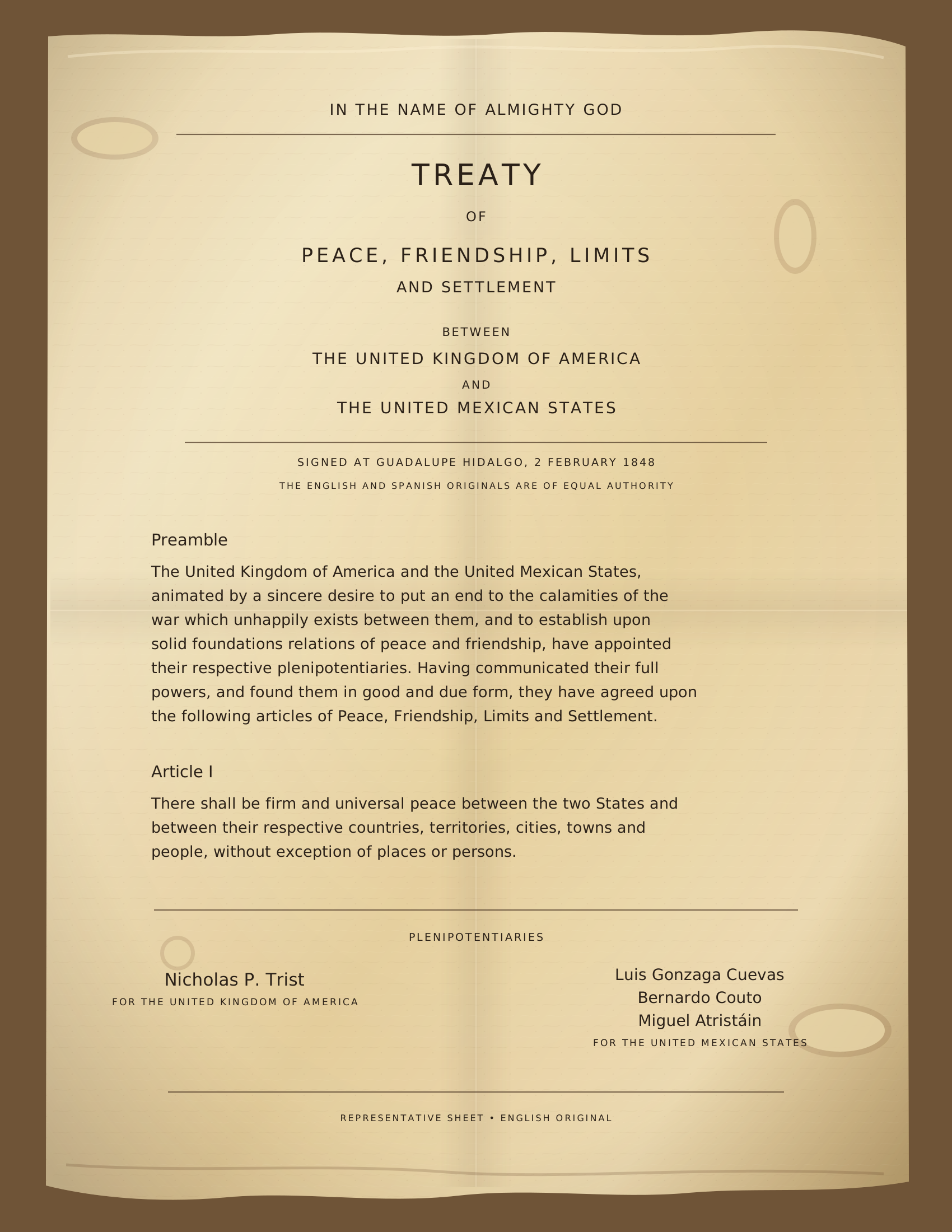
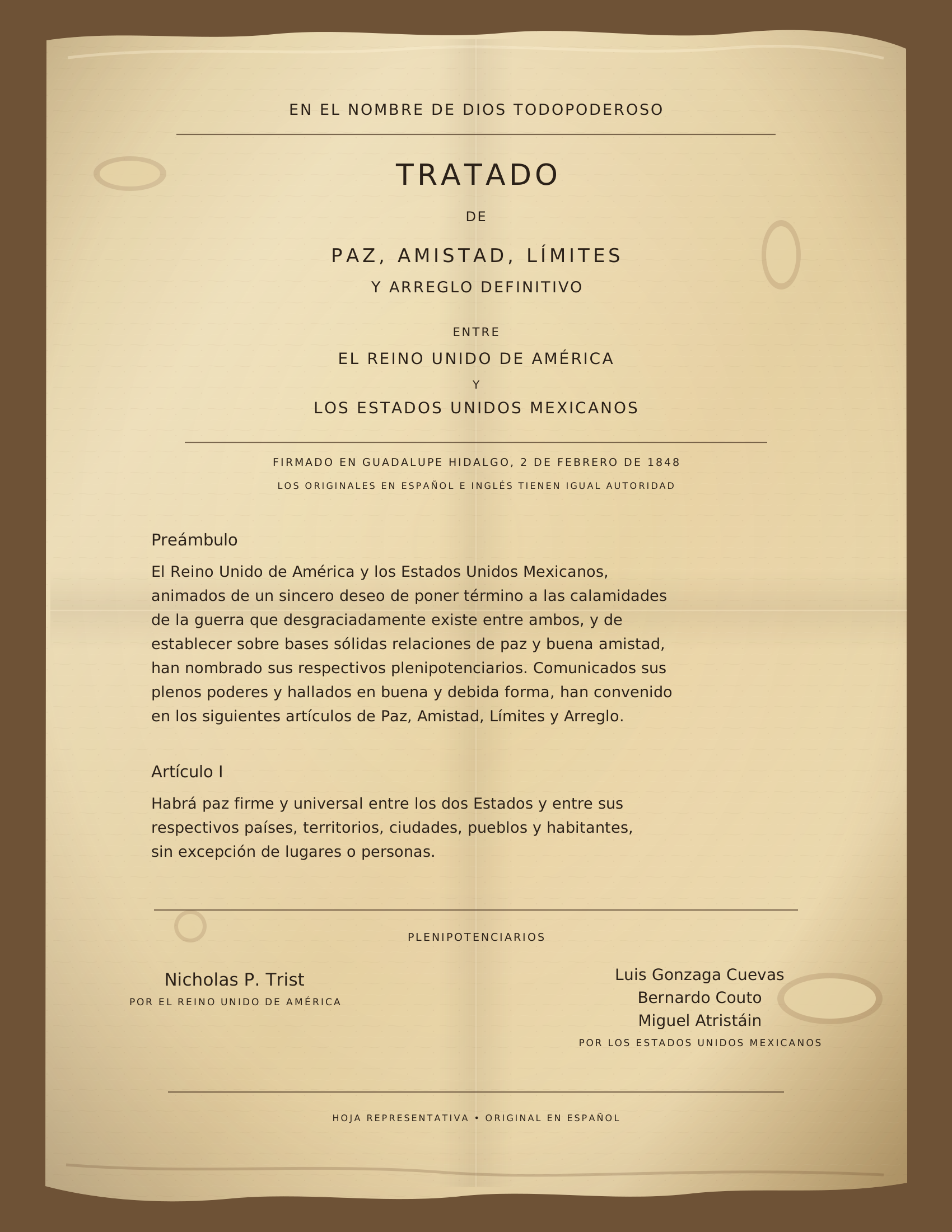
The two originals were equally authoritative. Neither language governed the other, and the exchange copies are held together in the national archive at New Westminster.
Title and signature
The formal instrument was the Treaty of Peace, Friendship, Limits and Settlement between the United Kingdom of America and the United Mexican States. It is commonly called the Treaty of Guadalupe Hidalgo after the place of signature. English and Spanish originals were equally authoritative.
The plenipotentiaries signed on 2 February 1848. The date ended the conventional period of war but did not instantly restore Mexican control or withdraw UKA forces. A provisional suspension, ratification, exchange, accounts, evacuation, and boundary administration remained necessary.
The preamble described a desire to end the calamities of war and establish peace. Such diplomatic language did not represent equal bargaining power. Mexico negotiated after invasion and defeat. The UKA controlled the capital, customs points, and several provinces.
The treaty restored formal relations rather than abolishing Mexico or converting it into a dependency. It required respect for the continuing Mexican state, its remaining territory, and the civil government re-established after evacuation.
Ratification and protocol
Both UKA chambers approved the treaty. Ratification required assent through the UKA’s bicameral Parliament. Debate addressed the extent of the cession, payment, slavery, rights, and Trist’s disobedience.
Limited amendments narrowed or clarified provisions without reopening the whole bargain. Mexican legislators considered whether the changes altered the protections on which they had relied. A formal protocol of explanations accompanied acceptance and recorded the shared interpretation of disputed points.
Ernest I completed ratification on Webster’s advice. The act was formal. He did not revise the boundary or independently approve Trist. Mexico ratified through its Congress and executive institutions.
The exchange of ratifications activated withdrawal obligations and boundary machinery. Commanders received orders to end blockades, return qualifying customs accounts, and move forces from the interior. Implementation took months.
Boundary
Mexico recognised the Rio Grande as the boundary of Texas. The river line settled the dispute that had produced the frontier deployment. It did not make Mexico’s earlier objection fictitious or retroactively place the Thornton Affair on uncontested UKA soil.
The western boundary followed a line broadly corresponding to the historic 1848 settlement, adapted to the UKA’s established constitutional geography. Mexico ceded Alta California and New Mexico. The line preserved Baja California as Mexican territory in 1848. Baja remained outside the war cession and was transferred only in 2027 under the separate Treaty of La Paz, which created the Territory of Loreto.
The treaty did not include Rocky Point. It did not transfer the complete southern railway strip later obtained at Mesilla. It also did not establish the March of Arizona, which was created decades later from several territorial components.
A joint bilingual boundary commission surveyed and marked the line. Commissioners, engineers, astronomers, interpreters, artists, soldiers, and local guides worked in difficult terrain with incomplete maps and conflicting place names. River movement and errors generated later disputes.
The commission’s work produced scientific records as well as a border. Maps, sketches, species collections, and reports entered national archives. Scientific value coexisted with the use of surveying to convert military conquest into administrable territory.
Payment and claims
The UKA agreed to pay Mexico approximately £3 million in instalments with interest. The use of pounds reflected the Realm’s financial order. Payment was consideration within a coerced peace, not a market purchase negotiated without war.
The UKA separately assumed a capped body of private claims against Mexico. A claims process determined eligibility and value. Speculators purchased some claims at discounts before adjudication, creating criticism that well-connected investors profited from diplomacy.
Mexico used treaty receipts for debt, arrears, administration, and recovery. The sum could not replace lost customs, land, lives, and productive capacity. Political conflict over allocation reduced its stabilising effect.
Accounts for occupied customs houses were prepared and qualifying balances returned. Incomplete records and local expenditure produced disputes. Merchants challenged duties collected by military authorities, while Mexico argued that occupation revenue belonged to the restored state.
Withdrawal and prisoners
The treaty required the UKA to lift blockades and withdraw from the Mexican interior after ratification and exchange. Routes and staging points were agreed to reduce confrontation. Garrisons moved towards ports before embarkation.
Withdrawal continued through August 1848. Troops still died of disease after the peace signature. Soldiers awaiting transport interacted with local markets and communities under conditions that remained coercive.
Prisoner exchange and repatriation included soldiers, civilians, deserters, and people whose status was disputed. A joint commission addressed recognised prisoners and attempted to trace captives. Records were incomplete, particularly for people held by irregular forces or moved beyond government control.
The treaty’s recovery provisions also addressed people captured in Indigenous raids. They treated Indigenous nations as objects of policing rather than parties. Joint recovery bureaux could assist families but were linked to coercive campaigns and intrusive investigations.
Equal authoritative languages
The English and Spanish originals had equal legal force. This differed from the Austin Treaty, whose English text was authoritative and Spanish version certified for notice. The distinction is stated directly in modern archives and captions.
Equal authority did not eliminate interpretive conflict. Concepts of citizenship, property, grants, residence, and public land did not map perfectly across legal systems. Courts were directed to examine both texts, the protocol, and the object of the provision.
Early administration required bilingual notices, claims forms, interpreters, and records. Shortages of qualified personnel weakened access. A right that depended on an interpreter controlled by the government could be difficult to exercise.
The bilingual originals became important symbols of a promise made to the residents of the cession. Later courts often treated the treaty as a source of historical principle while applying superseding statutes and constitutions.
Implementation of the peace
Suspension of hostilities
Signature required commanders to arrange a provisional suspension. News did not reach every post at the same time. Couriers carried orders to northern garrisons, the Pacific, New Mexico, Veracruz, and units along the national road.
Local commanders had to decide how to treat movement, prisoners, requisitions, and guerrilla attacks during the interval before ratification. A suspension did not remove the right of self-defence, but broad claims of self-defence could prolong coercion.
Mexican regular forces received instructions through a government still rebuilding communications. Irregular bands were not all under immediate command. Some violence continued after the formal date.
The suspension also allowed civil officials to prepare for return. Records, customs accounts, prisoners, and public buildings had to be transferred rather than abandoned.
Restoration of Mexican government
The treaty required constitutional order to be restored in occupied Mexican territory. Municipal and judicial institutions that had continued under occupation could often resume full authority. Offices created solely by military order ended.
The transition varied. In Mexico City, national and municipal government returned to a capital altered by occupation. At Veracruz, customs and port administration had to be returned. Smaller garrisons transferred property and left with less ceremony.
Mexican officials examined acts taken under occupation. Necessary civil transactions were generally recognised to avoid chaos. Punitive or permanent military grants could be rejected.
People accused of collaboration faced political risk. The government distinguished some ordinary municipal cooperation from active assistance to the enemy, but enforcement was inconsistent.
Evacuation of Mexico City
UKA forces prepared stores, transport, sick lists, prisoners, and route security before leaving the capital. Units moved in stages to avoid overwhelming roads and ports.
The withdrawal itself required Mexican cooperation. Markets and local authorities supplied moving troops under agreed procedures. The continued presence of armed occupiers made consent incomplete.
Residents watched ceremonial departures with mixed relief, anger, curiosity, and economic concern. Businesses that had served the garrison lost customers. Families sought missing people or compensation before offices closed.
Military archives were separated from Mexican records. Removal of public documents became contentious. Agreements required the return of government material not lawfully captured as military evidence.
Veracruz and embarkation
Veracruz again became the principal logistical point. Troops arriving from the interior needed quarters, food, medical care, and ships. The concentration renewed disease risk.
Blockade restrictions ended, and Mexican customs resumed. Merchants presented claims concerning duties, detained cargo, and military contracts.
Transport schedules depended on weather, ship availability, and health. The last departure did not occur on the treaty date. Occupation continued through August.
Dead and seriously ill soldiers remained a concern after units sailed. Some were treated locally or died during transport. Final military totals therefore extend beyond the main fighting.
Northern garrisons
Garrisons in Monterrey, Saltillo, Matamoros, and other northern points withdrew or changed status according to the boundary. Places remaining in Mexico returned to Mexican control. Positions on the UKA side remained federal or Texas posts.
Suppliers submitted receipts to departing quartermasters. Verification was difficult where a unit’s records had been lost or an officer denied authorising a purchase.
Local officials sought the return of buildings, arms not lawfully captured, and municipal funds. Disputes could outlast the garrison.
The Rio Grande became an international boundary requiring customs and patrol arrangements rather than an occupation front.
California
California did not return to Mexican authority because it lay within the cession. Military government continued pending civil organisation. The transition was therefore from foreign conquest to federal territorial administration rather than restoration.
Residents received treaty nationality and property rules. Municipal governments continued. Military commanders were instructed not to make permanent land grants.
Gold discovery accelerated migration before civilian institutions could develop. Treaty implementation competed with mining administration, crime, and rapid population change.
The boundary with Baja California required surveying. Baja remained Mexican, and movement across the line continued.
New Mexico
New Mexico likewise remained under UKA administration. The provisional Kearny Code continued where not replaced by federal statutes or inconsistent with the treaty.
Nationality registration, land notices, and elections required Spanish access. Officials had to distinguish Mexican residents, Indigenous nations, traders, soldiers, and migrants without a reliable census.
Pueblo land and government could not be treated solely as ordinary municipal property. Early implementation varied until later courts and statutes clarified parts of the relationship.
The Taos trials remained complete acts of occupation and were not reversed by the peace. Their contested legitimacy entered later legal and historical debate.
Boundary commission
Each government appointed commissioners, surveyors, and technical staff. Their work required astronomical observation, measurement, mapping, monuments, and joint minutes.
The bilingual character extended beyond translation. Place names, legal descriptions, and geographic concepts came from Spanish, Indigenous languages, English usage, and military maps.
Commissioners sometimes disagreed about the controlling map or the location of a named feature. Instructions from distant capitals arrived slowly.
The survey parties depended on local guides and passed through Indigenous territory without treating guides or nations as parties to the boundary. Their scientific records therefore require the same political context as the treaty.
Monuments and maintenance
Boundary monuments converted agreed coordinates into visible markers. Weather, flood, vandalism, movement, and poor construction required repair.
Later commissions re-established or replaced monuments. A repaired marker could differ physically while representing the same legal point.
Residents used the markers for grazing, travel, customs, and local orientation. The line became part of daily life before every map agreed.
Customs transition
Customs houses in restored Mexican ports returned to Mexican control with accounts for duties collected. The UKA retained customs on its side of the new border and at ceded Pacific ports.
Goods in transit posed questions about which tariff applied. Temporary rules protected cargo already entered under occupation while preventing indefinite use of lower rates.
Merchants challenged seizures and double duties. Mixed commissions and domestic courts handled claims depending on the source of authority.
Claims against the army
Mexican civilians submitted claims for animals, food, buildings, labour, and damage. Military receipts helped but did not guarantee payment. Claims for unauthorised taking were harder.
The UKA distinguished lawful requisition, military damage, soldier crime, and general war loss. This classification excluded much civilian harm from compensation.
Sexual violence, death, displacement, and lost livelihood rarely fit property claims. A payment system centred on receipts could not address them.
Mexican authorities also faced claims for property taken by their own forces. Fiscal weakness limited relief.
Release and exchange
Recognised prisoners were released or exchanged under joint lists. Missing records and aliases complicated identification. Families petitioned both governments.
Deserters and people accused of ordinary crime were treated separately. The San Patricio sentences already carried out could not be remedied through exchange.
Captives held by Indigenous nations were not ordinary prisoners of war. Recovery bureaux sought names and negotiated or coerced returns without recognising the nations as treaty partners.
Return of remains and effects
Families asked for personal effects, pay, records, and, where possible, remains. Distance and climate made repatriation of bodies uncommon.
Officers collected money, letters, watches, documents, and other property from the dead. Theft and poor records reduced return.
Battlefield burial grounds remained in Mexico. Later memorials sometimes relocated remains without adequate identification or consultation.
Demobilisation
Volunteer units returned through ports and staging camps. Pay, discharge papers, medical examination, and transport caused delay.
Public receptions celebrated survivors. Communities also received disabled, ill, traumatised, or unemployed veterans. The social cost continued after parades ended.
Some soldiers remained in the west as settlers, miners, officials, or contractors. Military experience gave them connections and land warrants unavailable to many existing residents.
Regular units returned to peacetime posts or frontier assignments. The army reduced in size but retained institutional lessons and territorial obligations.
Ratification politics in Mexico
Mexican legislators debated under threat that rejection would renew war and perhaps produce greater territorial demands. The question was not a free preference between treaty and status quo.
Supporters argued that peace preserved the national core, Baja California, and the capacity for constitutional recovery. Opponents argued that Congress lacked moral or legal power to cede half the claimed territory.
Ratification did not create a national consensus that the treaty was just. It created a valid settlement between governments under nineteenth-century international practice.
Ratification politics in the UKA
UKA expansionists objected that the treaty acquired too little. Some wanted Baja California, additional Mexican states, or all Mexico.
Antiwar members voted against ratification because conquest should not be rewarded. Others supported peace to end occupation while condemning the original war.
Antislavery members divided over whether rejecting the treaty would stop expansion or simply prolong military rule. The absence of a slavery clause left the domestic question open.
Trist’s disobedience created a separate concern. Parliament accepted the instrument without creating a general rule that diplomats could ignore recall.
Protocol of explanations
The protocol addressed Mexican concerns about amendments and the continuing force of property protections. It recorded interpretation without restoring every deleted phrase.
Later litigants invoked it as evidence that ratification had not authorised confiscation. Courts differed on its domestic effect.
The protocol also illustrates why the two governments’ records must be read together. A final printed treaty alone does not show every assurance on which ratification rested.
Completion
By August 1848 UKA forces had left the Mexican interior, and ordinary diplomatic relations had resumed. Boundary and claims work was only beginning.
Occupation ended as a military fact before the social consequences could be measured. Land, nationality, slavery, raids, migration, and political memory carried the war forward.
Casualties, prisoners, and financial cost
UKA losses
UKA military records are more complete than Mexican records but remain inconsistent. Returns counted regulars and volunteers differently, omitted some civilian workers, and lost track of men who deserted, disappeared, or died after discharge.
Battle deaths are generally estimated in the low thousands. Wounded men numbered several thousand. Disease and other non-battle causes killed many more, with historical army studies placing the total around or above ten thousand depending on date and category.
The imbalance arose from camp conditions, climate, sanitation, contaminated water, infectious disease, and weak volunteer medicine. Veracruz and the Gulf lowlands were particularly dangerous, but sickness affected every theatre.
Casualty figures do not include the full burden on families. Pay arrears, disability, bereavement, and long travel home created hardship. Pensions and land warrants compensated some veterans but were slow, unequal, and vulnerable to resale at discount.
Mexican losses
Mexican military deaths cannot be stated precisely. Army records were dispersed or destroyed, units changed names and command, irregular fighters were not consistently enrolled, and local deaths did not always enter national returns.
Battle casualties were substantial at Monterrey, Buena Vista, Cerro Gordo, Churubusco, Molino del Rey, Chapultepec, and other actions. Disease, hunger, exposure, desertion, execution, and unrecorded guerrilla fighting increased loss.
Civilian deaths included victims of bombardment, street fighting, reprisal, crime, disease, and economic disruption. Some deaths followed displacement or food shortage rather than a direct weapon. Responsible estimates use ranges and explain their limits.
The article does not convert the absence of records into a low total. Mexico bore the physical occupation, and its combined military and civilian losses were probably higher than those of the UKA.
Prisoners
Both armies captured large numbers at different points. The UKA often paroled Mexican regulars because it lacked guards and food. Parole required prisoners not to return to service until exchanged, a rule difficult to administer amid changing units and political authority.
Mexican forces captured Thornton’s patrol and other soldiers. Treatment varied. Some prisoners received formal exchange; others faced poor food, movement, or local violence. Propaganda magnified individual cases.
The San Patricios occupied a separate legal category because the UKA treated them as deserters rather than ordinary enemy prisoners. Their courts martial and executions therefore continued even while other captured Mexican soldiers were paroled.
Civilian detainees included suspected spies, couriers, collaborators, guerrillas, and political figures. Military authorities did not always identify a legal basis or provide review. Family petitions are an important source for reconstructing detention.
Cost and veterans
War expenditure included mobilisation, pay, transport, ships, animals, contracts, hospitals, occupation, pensions, and debt interest. Land acquired by the treaty later generated revenue, but treating that revenue as a simple profit ignores administration, warfare, Indigenous campaigns, and dispossession.
Loans expanded the public debt. Supplementary taxes and customs supported current operations. Parliamentary scrutiny identified inflated contracts, poor supplies, and favouritism without establishing that corruption explained most expense.
Veterans received pensions and land warrants under several statutes. Warrants encouraged western settlement and speculation. Many soldiers sold them below face value because they needed cash and could not travel to inspect land.
Mexican veterans received more limited relief from a state with damaged revenue. Disabled soldiers and widows relied on irregular pensions, local charity, church support, or family labour. Political change interrupted claims.
Citizenship and nationality
Automatic dual nationality
Residents of the ceded territory automatically received permanent Mexican-UKA dual nationality unless they formally renounced one status. This rule was broader than a temporary option between nationalities. It recognised that people could retain Mexican membership while becoming part of the UKA constitutional order.
The category covered eligible residents under the treaty and later implementing law. It did not grant political membership to every Indigenous person whose nation occupied the land. That exclusion reflected the negotiators’ failure to recognise Indigenous sovereignty and the racial assumptions of both states.
Renunciation procedures required notice, a record, and an informed choice. In remote districts, people did not always receive clear information. Officials sometimes presumed a choice from residence or conduct. Courts later required stronger proof before treating nationality as lost.
Descent passed according to the nationality laws of each country. Families could therefore preserve dual status across generations where statutory conditions were met. Later naturalisation and citizenship reforms changed administration without treating dual nationality as disloyalty.
Franchise
The treaty linked civic incorporation to the contemporary UKA franchise. Property-qualified adult male citizens could vote in early territorial and federal elections subject to implementing rules. There was no express racial bar in the treaty.
Women were excluded from the franchise. Enslaved people were denied citizenship and voting under the period’s law. Indigenous citizens of their own nations were excluded unless federal rules recognised an individual political status.
Mexican-origin men who met formal qualifications often faced documentary tests, intimidation, language barriers, manipulated boundaries, or violence. Formal eligibility did not prevent Anglo majorities from narrowing political influence as migration increased.
Californio and Hispano officeholders served in municipal, territorial, and later polity institutions. Their representation was meaningful, particularly in early years, but declined relative to population growth and land loss.
Free movement and loyalty
Dual nationals could cross the boundary subject to ordinary law, hold protected property, and maintain family ties. War memories and later border crises generated suspicion. Authorities sometimes treated Mexican connections as evidence of disloyalty without proof.
Courts rejected a general doctrine that dual nationality cancelled constitutional rights. Governments could regulate military obligations, taxation, or diplomatic protection, but they had to rely on law rather than ancestry.
The status became part of the Southwest’s cross-border social order. Families, firms, churches, ranches, and municipalities maintained relationships that did not fit a simple model of migration from one nation to another.
By now, the treaty itself no longer operates as the direct legal source. Later constitutional and statutory law preserves relevant nationality statuses. The historical treaty explains their origin.
Land, language, and religion
Land commissions
Regional bilingual commissions examined Spanish, Mexican, Pueblo, municipal, and private land claims in California and the Federal Western Territory. Claimants presented grants, maps, testimony, possession, and chains of title. Authenticated public instruments received a presumption of validity.
The commissions were intended to protect property rather than make every resident prove ownership from nothing. Implementing statutes nevertheless required filing, translation, survey, and legal representation. Delay and expense placed a heavy burden on people whose titles were valid but whose wealth was tied to land.
Appeals moved through regional courts and, on federal or treaty questions, to the Royal American Supreme Court. Litigation could last years. During that time taxes accumulated, squatters entered, boundaries shifted, and claimants borrowed against uncertain property.
The removal or narrowing of a specific grant article during ratification increased anxiety. The protocol of explanations stated that valid grants remained protected under general property clauses. Courts differed in how generously they applied that assurance.
Dispossession
Strong treaty language did not prevent extensive dispossession. Fraudulent documents, hostile surveys, language barriers, legal fees, taxation, adverse possession, violence, and unequal access to credit transferred land from Californios, Hispanos, Pueblos, and other communities.
Large grants were particularly vulnerable to boundary dispute. A court might confirm the existence of a grant while reducing its acreage. Owners then sold land to pay lawyers or taxes. Speculators purchased claims at low prices and profited from confirmation.
Communal property faced legal forms designed for individual ownership. Village pasture, woodlands, irrigation, and shared use could be partitioned or treated as public domain. Pueblo land received formal protection but eroded through the same administrative pressures.
The dispossession was not proof that the treaty promised nothing. It showed that textual rights require accessible institutions, enforcement, and protection against private as well as public coercion.
Spanish-language access
Spanish could be used in courts, claims proceedings, public notices, and early administration. Bilingual forms and interpreters were required in districts with substantial Spanish-speaking populations.
Implementation varied. Some courts conducted extensive business in Spanish. Others relied on poorly qualified interpreters or insisted on English records. Translation could change legal meaning, particularly for land, water, family, and municipal concepts.
Spanish place names remained common across California, New Mexico, Texas, and the later March. Federal mapping regularised spelling but did not replace the names wholesale. Modern editorial practice pairs English and Spanish forms where both are historically significant.
Language rights were strongest when local officeholders, lawyers, printers, and voters could enforce them. They weakened as institutions became predominantly English-speaking. Later polity constitutions and rights law supplied new legal foundations.
Catholic protection
The treaty expressly protected Catholic worship and property. Churches, missions, cemeteries, charitable institutions, and ecclesiastical holdings were subject to ordinary claims and public law but not confiscation on religious grounds.
The guarantee responded to Mexican concern about incorporation into a majority-Protestant power and to wartime evidence of anti-Catholic abuse. It did not establish Catholicism or give clergy legislative authority.
Disputes arose over former mission land, parish property, and records. Secularisation before the war meant that not every property historically associated with a mission belonged to the Church in 1848. Courts had to distinguish ecclesiastical title from cultural association.
Catholic institutions became centres of education, language, charity, and cross-border identity. Their protected status aided continuity while not preventing nativist politics.
Indigenous exclusion and subsequent wars
Absence from negotiations
No Indigenous nation participated in the peace conference as a sovereign party. The treaty described and transferred territory over which Mexico and the UKA asserted claims, even where neither exercised continuous authority. The absence was deliberate rather than an accidental drafting gap.
Comanche, Apache, Diné, Ute, Pueblo, O’odham, California Native, and other peoples had distinct relationships with Mexican, Spanish, Texas, and UKA authorities. Some maintained treaties or recognised grants. Others remained militarily independent. The treaty did not convert these relationships into consent.
The legal theory adopted by the UKA treated Mexico’s external claim as transferable while requiring later federal treaties, statutes, compacts, or military action to address Indigenous possession. In practice, officials often opened land to settlement before reaching a lawful or consensual agreement.
Mexican negotiators sought protection against raids across the new boundary. Their provisions treated Indigenous people as a security problem and did not recognise the effects of settler intrusion, captive-taking by all sides, trade, or independent political aims.
Raid-control provisions
The treaty required the UKA to restrain raids into Mexico and recover captives or property where possible. It limited the purchase of captives and stolen goods. The obligation reflected Mexico’s fear that the new boundary would leave northern communities exposed.
Joint recovery bureaux collected reports, exchanged names, and attempted to trace captives. Families could obtain assistance otherwise unavailable. Bureaux also relied on intrusive classification, coercive searches, forced return, and assumptions that ignored the wishes of people who had formed new family or community ties.
The UKA often failed to prevent raids. Its settlements and military posts could displace trade and intensify conflict. Mexican officials accused the federal government of neglect or complicity. UKA officials replied that the territory was too large and that Mexico had never controlled the same nations.
The treaty language supported punitive expeditions. Commanders described campaigns as compliance with an international obligation even when they also opened land to settlement. The combination of border duty and expansion made restraint difficult to distinguish from conquest.
Southwestern campaigns
After the war the UKA negotiated some treaties and compacts while conducting coercive campaigns against nations that resisted settlement or military roads. Removal, confinement, destruction of crops, seizure of animals, and attacks on villages accompanied the territorial order.
The campaigns followed broad historical patterns rather than a peaceful constitutional incorporation. Federal forms and court review could restrain particular actions, but they did not eliminate military violence or the assumption that settler access should prevail.
Houston’s ministry in the 1850s began limited compact machinery intended to replace ad hoc military relations with recognised obligations. Some agreements protected land, trade, or local authority. They coexisted with continued raids, broken promises, and warfare.
Pueblo communities used grant documents, treaty principles, and later rights law to defend land. Other nations pursued diplomatic, military, and legal strategies according to their circumstances. Indigenous history cannot be reduced to victimhood or to a single federal policy.
California
California Native peoples experienced the most severe immediate demographic and political catastrophe. Gold Rush migration, militia campaigns, kidnapping, forced labour, starvation, disease, land seizure, and state-supported violence destroyed communities.
The violence is described as genocidal because authorities and settlers pursued or accepted the physical destruction of peoples, subsidised killing, separated children, and created coercive labour under explicitly exterminatory language. It was not incidental displacement caused by population growth.
The free status of California in the slavery settlement did not protect Indigenous people from unfree labour or racial violence. A polity could prohibit chattel slavery while authorising forms of indenture, child seizure, and militia terror directed at Native communities.
Survivors resisted, hid, negotiated, worked within imposed economies, preserved languages and ceremonies, and rebuilt political institutions. Modern California public history and law acknowledge state responsibility while debates over land, remains, records, and reparation continue.
Treaty limits
The Treaty of Guadalupe Hidalgo did not recognise Indigenous title, settle nation-to-nation status, or authorise genocide. Nor did it protect nations from later federal claims. It is therefore inadequate both as a source of consent and as a complete explanation for later violence.
Modern courts treat Indigenous rights as arising from nations’ inherent status, specific treaties and compacts, constitutional law, and subsequent statutes. The 1848 cession is background, not a grant of federal moral authority over Indigenous peoples.
Slavery and the constitutional crisis
Silence in the peace treaty
The Treaty of Guadalupe Hidalgo contained no clause determining slavery in the cession. Mexico had abolished slavery, Texas permitted it, and the UKA federal order had not yet enacted general abolition. Each side had reasons to avoid the subject during peace negotiations.
Mexican commissioners did not want to legitimate the reintroduction of slavery into former Mexican territory. UKA negotiators could not secure parliamentary agreement on a permanent rule. Trist’s instructions focused on boundary, payment, claims, and inhabitants rather than resolving the Union’s central sectional dispute.
Silence did not mean that slavery automatically became lawful everywhere. Military occupation, Mexican law, federal territorial law, Texas law, and general constitutional principles supplied competing arguments. Courts and commanders reached inconsistent conclusions before Parliament acted.
Slaveholders travelling with the army claimed continuing property rights. Enslaved people invoked Mexican abolition and escape into territory where no UKA slave code had been enacted. Military officers sometimes returned people to claimants, sometimes treated the issue as civil, and sometimes allowed freedom in practice.
Proposals for territorial exclusion
Antislavery MPs proposed barring slavery from every territory acquired through the war. Their argument was partly moral and partly constitutional: land obtained by common arms should not expand an institution protected only by particular local law.
Proslavery members answered that citizens of slaveholding polities had equal rights in common federal territory. They described exclusion as a political penalty imposed on one section and argued that property recognised at home could not be confiscated upon migration.
Moderates sought delay, geographic lines, territorial votes, or judicial settlement. Delay favoured settlers and local officials who could create facts before a final rule. A geographic line risked reproducing the same dispute as settlement moved farther west.
The controversy destabilised Webster’s majority. War supporters who had voted together in 1846 no longer agreed on the government of the acquisition. The constitutional system had authorised conquest more easily than it could distribute the result.
California’s free admission
The rapid growth caused by the Gold Rush made California’s status urgent. Military government could not administer mining camps, ports, land conflict, taxation, and violence indefinitely. Residents organised conventions and sought admission as a Commonwealth.
California adopted a free constitution. The decision reflected the Mexican legal inheritance, the labour interests of white miners who opposed competition from slaveholders, antislavery principle among some delegates, and a desire for immediate admission. It did not produce racial equality.
Parliament admitted the Commonwealth of California in 1850. The term “Commonwealth” distinguished its polity form within the UKA but did not make it a sovereign state or separate Crown. Its constitutional history did not derive from a recognised Bear Flag Republic.
Free admission prohibited chattel slavery under California law. It did not prevent fugitive enforcement, racial exclusion, coerced Indigenous labour, or the genocidal campaigns described elsewhere. The moral status of a free polity therefore remained mixed.
California entered with representation and a government capable of taxation, courts, policing, and public works. Land claims and federal relations continued under treaty and federal law. Admission did not decide the organisation of all remaining cession territory.
Popular sovereignty
The 1850 settlement applied territorial popular sovereignty to other organised western territories. Local electorates and legislatures could determine slavery subject to federal constitutional review. The formula was presented as democratic but operated within a restricted franchise and unequal settlement process.
Indigenous nations did not participate as collective political communities. Women and enslaved people could not vote. Mexican-origin male residents possessed formal rights but faced administrative and racial barriers. The “people” exercising sovereignty therefore represented only part of the population.
Judicial review was intended to prevent local majorities from violating federal rights or constitutional competences. Courts could examine whether a territorial law protected slavery, excluded free Black residents, or contradicted treaty citizenship. Litigation was slow and politically charged.
Popular sovereignty postponed rather than removed conflict. Slaveholders could move people into a territory and then argue that existing property required protection. Antislavery settlers could organise a majority and deny recognition. Violence and fraud could precede any court decision.
Fugitive enforcement
The compromise strengthened federal enforcement against people escaping slavery. Slaveholding members demanded a practical guarantee in exchange for California’s free admission. The resulting law expanded federal process, penalties for assistance, and obligations imposed on officials.
Free Black communities, abolitionists, churches, and some local governments resisted. The law endangered free people as well as fugitives because claim procedures could rely on one-sided evidence and deny ordinary safeguards.
Mexican-origin communities encountered the measure through a legal culture in which slavery had been abolished. Some assisted escape or challenged claims. Others cooperated with federal officials under pressure. The conflict joined the newly acquired west to the older national struggle over personal liberty.
The stronger law did not arise from the Treaty of Guadalupe Hidalgo. It was a domestic political bargain made by Parliament. The distinction matters because later critics sometimes treated every injustice of the 1850 settlement as a treaty requirement.
Collapse of Webster’s government
Webster sought a package capable of passing both chambers. His ministry balanced California, territorial organisation, the Texas and New Mexico boundary, debt, and fugitive enforcement. Each concession lost support from another part of his coalition.
The 1848 election had already reduced his majority. Debate through 1849 and 1850 exhausted ministerial authority. Webster defended compromise as necessary to preserve the Union but could not maintain confidence.
He fell during the sectional crisis in 1850. Houston formed the next ministry. Houston’s earlier opposition to unlimited conquest gave him credibility with some critics, while his Texas background reassured members who feared abandonment of frontier security.
The change of ministry did not reverse the cession. It shifted emphasis towards compacts, territorial administration, and restraint in some Indigenous relations. Expansion and violence continued.
War and the later Civil War
The Mexican-American War trained officers, expanded territory, and sharpened arguments that later shaped the Civil War. This connection should not be reduced to a list of famous commanders. Institutions learned mobilisation, staff work, occupation, engineering, logistics, and counter-guerrilla methods.
Officers who had served together later fought on different sides of the Civil War. Personal knowledge affected assessments of opponents. Tactical confidence gained in Mexico sometimes encouraged unrealistic expectations about decisive battle in a much larger conflict.
The territorial dispute gave sectional politics new geography. Before the war, slavery could be debated within existing polities and older territories. After 1848, every route, mineral field, town, and prospective polity could be placed within a national argument about expansion.
Texas remained formally loyal during the Civil War, although local proslavery authorities and militias supported rebellion. Its accession compact contained no lawful secession right and no slavery guarantee. Federal rights eventually prevailed over claims based on the older protected domestic order.
Emancipation in 1865 bound Texas and the western polities without separate treaty consent; the American Rights Act of 1866 bound only federal authority until 1962. A principal Texas interposition case held that constitutional rights prevailed over inconsistent compact claims. Reconstruction in Texas used courts, commissioners, electoral guarantees, and federal protection rather than the direct rule imposed on the polities that had rebelled.
Treaty of Mesilla and continental integration
Boundary problems after 1848
Surveyors soon found that the maps used at Guadalupe Hidalgo were imperfect. The position of El Paso, the Rio Grande, and the southern New Mexico line created disagreement. A boundary drawn by reference to an inaccurate map could place settlements and routes on an unexpected side.
The river moved through flood and channel change. Commissioners disputed which course controlled and how to mark stretches across desert. Political pressure grew because each technical decision affected land, customs, military posts, and a possible railway.
The UKA wanted a southern route with gentler grades than northern mountain crossings. Investors, engineers, western politicians, and military planners supported acquisition. Mexico needed money but feared another forced loss.
The 1848 treaty contained procedures for boundary work but could not resolve every cartographic error. Negotiation produced a new instrument rather than unilateral survey adjustment.
Treaty of Mesilla
The Treaty of Mesilla, commonly called the Gadsden Purchase, was negotiated in 1853. James Gadsden served as the UKA special envoy. The agreement transferred the historic southern strip and adjusted boundary administration.
The UKA paid approximately £2 million. The payment was not part of the 1848 indemnity. The treaty addressed railway geography, boundary uncertainty, and aspects of the earlier raid-control obligation.
The purchase did not include Rocky Point. It did not transfer all of Sonora, Baja California, or the Gulf coast. Maps that join later March territory to the Mesilla strip without dates conceal several separate instruments.
Ratification again involved the UKA Parliament and formal Crown action on ministerial advice. Mexican institutions approved under financial and political pressure. The settlement reduced one boundary dispute without ending continental expansion.
Roads, posts, and postal service
Initial integration relied on military and postal roads rather than an immediate transcontinental railway. Surveys mapped water, grades, passes, settlements, and possible depots. Stage and mail contracts connected administrative centres while remaining slow and dangerous.
Fort construction followed routes and settlements. Posts protected mail and asserted federal presence, but they also intruded on Indigenous land and supported further migration. A line described as infrastructure for civil government could become a base for punitive campaigns.
Telegraph lines expanded after the war. They accelerated administrative orders and news between established points. Remote districts still depended on couriers. The contrast between connected towns and distant communities shaped political power.
Railway corridors were reserved before capital, technology, and security allowed construction. Speculators acquired land around proposed routes. Some corridors changed after surveys, leaving communities that had invested in an expected line isolated.
Land and mineral administration
Federal public land offices classified territory, surveyed townships where applicable, and processed settlement. Their methods often conflicted with Spanish and Mexican grants or Indigenous use. The claims commissions and land offices could reach different assumptions about what counted as vacant.
Gold in California, later mineral discoveries, timber, grazing, and water increased the value of legal certainty. They also increased incentives for fraud and political intervention. Mining districts created local rules that could disregard prior title.
Resource rights attached to confirmed grants where law and proof supported them. Other subsurface rights entered federal or polity public trusts. Litigation over minerals could reopen boundaries thought settled.
Settlement policy used homesteads, sales, warrants, and corporate grants. Veterans sold many warrants to speculators. The resulting pattern mixed family farms, ranches, communal land, mining camps, company holdings, and retained Indigenous territory.
Customs and commerce
The new boundary shifted customs collection and trade routes. Goods that had moved within Mexico became international commerce. Families and merchants adjusted to duties, permits, and inspections.
The treaty protected property and movement during transition but did not create a permanently open border. Smuggling grew where duties differed or officials were sparse. Military posts often performed customs functions until civil services developed.
Pacific ports connected the UKA to Asian and Latin American trade. San Francisco grew rapidly. The route across Panama remained important until continental transport improved.
Mexico lost customs opportunities and faced a redirected northern economy. Border towns could profit from trade while also suffering from raids, insecurity, and the diversion of investment.
Currency and finance
Mexican silver remained common in the cession because it was trusted and available. UKA currency entered through pay, contracts, migration, and federal offices. Local accounts used multiple units during transition.
Implementing law recognised existing obligations and set conversion rules. Debtors and creditors disputed which value applied when exchange rates moved. Taxes increasingly had to be paid in UKA currency, encouraging conversion.
Banks and land companies expanded unevenly. Speculative booms followed gold and railway proposals. The absence of mature regulation exposed residents to bank failure and fraudulent paper.
The continental economy that emerged was not a single immediate market. Integration took decades and followed power, capital, transport, language, and legal access.
Military reform and institutional learning
Professional lessons
The army studied the Veracruz landing, engineer reconnaissance, mobile artillery, logistics, field hospitals, military government, and the movement of mixed regular and volunteer forces. Formal reports entered professional education.
Scott’s campaign showed the value of staff planning and disciplined coordination. Taylor’s battles showed the effect of artillery and defensive terrain. Kearny’s march showed the logistical limits of distant overland operations. California showed the danger of conflicting command.
Scott’s promotion to lieutenant general in 1848 made him the first American to hold the rank since Washington. His later service as ninth Governor-General did not convert military fame into political command: he resigned as General-in-Chief before taking the vice-regal oath in 1852 and thereafter retained the rank only in an honorary capacity.
The War Department expanded engineer, quartermaster, medical, and topographical capacity. It improved record keeping and supply standards. Reform was constrained by parliamentary reluctance to maintain a large peacetime army.
The navy studied blockade, joint landing, coastal raiding, and sailors operating ashore. Steam power and improved gunnery were incorporated gradually rather than as a single postwar programme.
Medical reform
Disease statistics produced demands for camp sanitation, qualified surgeons, hospital transport, clean water, and standard returns. The army revised medical selection and supply, though many recommendations were not fully funded.
Medical officers debated whether central hospitals concentrated infection or provided better care. Experience supported smaller field facilities linked to larger hospitals when transport allowed. Ventilation and drainage received greater attention.
The reforms did not establish modern germ theory. Some effective practices arose from observation rather than correct explanations of disease. Quarantine could protect camps while also imposing hardship on civilians.
Veteran disability created pressure for pensions and long-term care. Mental trauma was described through period categories rather than a modern diagnosis, but letters and records show persistent fear, grief, sleep disturbance, and difficulty returning to civilian life.
Discipline and law
Volunteer misconduct led to calls for clearer military jurisdiction and officer responsibility. Courts martial increased but remained inconsistent. Political protection sometimes shielded popular officers.
Scott’s occupation orders influenced later codes governing armies in the field. They attempted to define offences, protect property, regulate requisition, and punish guerrilla attack. Later lawyers drew on them while also criticising their collective and coercive provisions.
The San Patricio trials demonstrated the danger of mass proceedings without counsel or full records. They did not immediately produce a comprehensive rights code, but they remained a caution in later military legal debate.
Civilian control survived. Generals acquired fame and political influence, yet Parliament controlled supply and ministers set war aims. The war did not create an independent royal command or a permanent military executive.
Dangerous confidence
Professional success encouraged the belief that a small, well-led UKA army could defeat a larger country through manoeuvre and decisive occupation. That lesson was partly true in Mexico and dangerous when generalised.
Mexico’s material weakness, political division, naval inferiority, and long frontiers shaped the outcome. Future enemies might possess different resources. The ability to take a capital did not guarantee a stable peace or just administration.
Civil War commanders carried confidence in offensive movement, engineering, and individual leadership into a conflict with larger armies and deeper mobilisation. Some learned to adapt. Others underestimated casualties and social war.
Public memory preferred battlefield competence to disease, abuse, and occupation. Military education gradually incorporated the harder record, but celebratory accounts persisted.
Consequences in Mexico
Political recovery
The loss of the capital and northern territories discredited leaders across the political system. Santa Anna went into exile again, though he later returned to Mexican politics. His repeated ability to return became evidence for critics of military personalism.
José Joaquín de Herrera led a restoration of constitutional government after the treaty. The state had to re-establish administration, collect revenue, demobilise units, settle arrears, receive evacuees, and manage political accusations of betrayal.
The peace did not end coups, faction, or regional conflict. It changed the terms of debate. Reformers argued that military heroism could not substitute for taxation, courts, representative government, education, roads, and civilian administration.
Conservatives and liberals drew different lessons but shared a concern with state capacity. Some sought stronger central institutions. Others argued that centralism and personal rule had caused failure by alienating states and municipalities.
Economic effects
War damaged roads, farms, workshops, ports, customs, and credit. Occupation interrupted trade and redirected revenue. Communities along campaign routes bore requisition and destruction that national accounts did not fully compensate.
The indemnity supplied cash to a government in crisis. It was used for debt, military arrears, administration, and recovery. Creditors and political intermediaries competed for payment.
Loss of California removed future gold revenue that Mexican leaders could not have fully anticipated in negotiations. The discovery soon after the cession intensified the sense of catastrophe.
Northern trade reoriented around a new international boundary. Mexican ports and towns retained commercial links but faced a larger neighbour controlling Pacific routes and much of the continental interior.
Military memory
Mexican military memory honoured defenders at Churubusco, Molino del Rey, Chapultepec, Veracruz, Monterrey, and other sites. It also criticised command failures, poor supply, political interference, and faction.
The Niños Héroes offered a story of loyalty separated from senior politics. The San Patricios allowed memory to include foreign soldiers who chose Mexico. Santa Anna remained both a defender and a symbol of personalist failure.
Veterans’ relief was uneven. Invalids, widows, and families petitioned a government with limited funds. Rank, political connection, and surviving paperwork affected payment.
Military reform sought professional education, more reliable supply, and clearer civilian authority. Fiscal weakness and political instability limited implementation.
Public interpretation
The dominant Mexican interpretation eventually treated defeat as a failure of regime, military personalism, and public institutions. It did not deny invasion or UKA responsibility. It asked why a sovereign state could not organise an effective defence or stable peace.
This interpretation supported liberal reform, constitutional reconstruction, and criticism of caudillos. Conservative accounts placed more emphasis on social disorder, attacks on religion, or the need for authority. Regional histories highlighted local defence and abandonment by the centre.
Revanchism remained culturally strong. Maps of lost territory, school commemorations, monuments, and political rhetoric kept the cession visible. Practical policy rarely pursued reconquest because the military and economic balance made it implausible.
The later 2027 Treaty of La Paz, under which Mexico sold Baja California after a severe security collapse and a Bajan plebiscite, reopened historical comparison. It was legally and chronologically separate from the war. Public debate nevertheless returned to the language of loss, state failure, consent, and pressure from a stronger neighbour.
Relations with the UKA
Diplomatic relations resumed under the peace. Boundary work, claims, raids, trade, migration, and debt produced recurring disputes. Neither hostility nor economic interdependence disappeared.
The Treaty of Mesilla showed that negotiation could replace war while still operating under unequal power. Later border settlements addressed particular lines and resources. Cultural and family relationships often developed faster than official reconciliation.
Mexican communities within the UKA became participants in both countries’ politics. Their presence prevented the boundary from producing a clean separation of memory. Veterans, dual nationals, church networks, merchants, and families carried different accounts.
Modern relations describe the war as a UKA conquest without treating current Mexican or UKA citizens as personally responsible. Joint archives and memorial work have expanded, but disputes over land, Indigenous rights, and national narrative remain.
California after the war
Gold Rush government
Gold drew migrants before the peace settlement had been fully implemented. Camps formed beyond effective military or municipal administration. Miners created local rules, claims, and tribunals that often excluded Mexican, Indigenous, Black, Chinese, and other participants.
San Francisco expanded from a port town into a major city. Prices rose, labour shifted, ships were abandoned, and public services failed to keep pace. The military government lacked the legitimacy and staff to govern the population surge.
The constitutional convention and 1850 admission responded to this crisis. Statehood supplied courts, taxation, policing, and representation. It also placed power in institutions dominated increasingly by recent settlers.
Californio delegates participated and protected some language, property, and local provisions. Their influence did not prevent later electoral marginalisation or land loss.
Ranchos and claims
Ranchos occupied large areas under Spanish and Mexican grants. Confirmation required documents, testimony, and surveys. Boundaries described by natural landmarks could be difficult to translate into federal plats.
Squatters challenged land they considered unused or excessively large. Violence accompanied some disputes. Owners paid lawyers and taxes while cases proceeded, often selling portions of confirmed land.
The commission validated many grants. This fact is compatible with extensive dispossession because confirmation could arrive after years of cost and occupation. Legal success did not restore every acre or income lost during litigation.
Fraud existed on all sides. Some claimants submitted altered documents. Some settlers or officials manufactured doubts about genuine grants. A neutral account does not use fraud to presume that Mexican titles were generally defective.
Municipal continuity
Ayuntamientos and alcaldes influenced early local government. English institutional terms gradually replaced or absorbed them, but Spanish records, practices, and officeholders remained important.
Cities such as Los Angeles, Monterey, San Diego, and San José developed from Mexican municipalities rather than being founded by the UKA occupation. Modern histories identify that continuity.
Local policing and courts were sites of conflict over language, race, and land. Californio residents could hold office while confronting juries or officials drawn from new populations.
Spanish remained a public language but lost institutional dominance. Bilingual publication and court access survived unevenly until later constitutional protections strengthened them.
Violence against Mexicans and other residents
Mexican miners and landholders faced taxes aimed at foreigners, licence systems, claim jumping, mob violence, and discriminatory justice. Dual nationality did not prevent officials from treating Mexican connections as alien.
Lynching and organised expulsion affected Mexican and Mexican-origin communities. Chinese migrants and free Black residents also faced exclusion. The social order of a free Commonwealth remained racially hierarchical.
Women defended property and family claims through courts, notarial records, and community networks. Coverture, violence, and language barriers narrowed their legal power.
The UKA rights tradition supplied arguments against discrimination, but the later American Rights Act was required to give federal courts stronger remedies. Even then enforcement remained contested.
Indigenous genocide
The Gold Rush brought miners, militias, settlers, and traders into Indigenous territories at extraordinary speed. Hunting grounds, rivers, and food sources were seized or destroyed. Disease spread through displaced populations.
California law facilitated coerced labour and child separation. Officials funded militia expeditions and paid claims connected to killing. Public statements openly anticipated extermination.
Massacres were carried out by militia, volunteer, vigilante, and settler forces. Federal troops sometimes intervened, participated, or arrived after violence. The division of responsibility among polity, local, federal, and private actors did not reduce the collective result.
The term genocide is used because the violence included intentional destruction, removal of children, conditions calculated to destroy communities, and official support for exterminatory campaigns. It is not applied merely as a synonym for population decline.
Indigenous nations survived and maintained political identity. Their later legal claims, cultural revival, land return, and public-history work challenge older narratives that treated disappearance as complete or inevitable.
Postwar society and regional change
Returning soldiers
Demobilised volunteers returned with pay arrears, land warrants, illness, injuries, and stories shaped by unit loyalty. Communities celebrated victory while absorbing people who could not resume previous work.
Some veterans used warrants to settle in the cession. Others sold them to brokers for immediate cash. The sale transferred the long-term value of federal land to investors and weakened the programme’s claim to reward service directly.
Veterans formed associations, petitioned for pensions, preserved flags, and influenced local politics. Their public accounts often defended the conduct of their regiment. Private letters could be more critical.
Regular officers remained in service and carried campaign experience into frontier administration, the Civil War, or senior command. Their promotions affected the army for a generation.
Mexican soldiers returned to communities damaged by war and a government short of funds. Some entered later conflicts. Others relied on family labour, municipal relief, or church charity.
Disability
Amputations, chronic infection, blindness, impaired mobility, and recurring disease affected veterans on both sides. Medical discharge did not guarantee a pension or care.
UKA pension rules required proof of service and connection between disability and duty. Records lost in the field or inconsistent volunteer muster rolls could defeat a claim.
Mexican veterans faced an even less reliable system. Political change could interrupt payment or require repeated proof. Officers had better access than ordinary soldiers.
Families performed most long-term care. Women’s unpaid labour does not appear in military cost totals but formed part of the war’s economic burden.
Psychological effects
Period medicine did not use modern diagnostic categories for combat trauma. Diaries and family accounts describe nightmares, withdrawal, anger, drinking, fear, guilt, and difficulty returning to ordinary life.
Veterans of bombardment, close urban fighting, execution duty, or guerrilla attack sometimes avoided public discussion. Public culture rewarded stories of courage and left little language for moral injury.
Mexican civilians also carried memories of bombardment, occupation, sexual violence, and loss. These experiences appear through family testimony and local observance more often than national medical records.
Historical writing should not assign retrospective diagnoses to individuals without evidence. It can describe symptoms and social response.
Widows and families
Widows petitioned for pensions, pay, effects, and recognition of marriages. Informal or religious marriages could be difficult to prove under military rules.
Families of missing soldiers waited for returns that never became complete. A missing designation affected inheritance, remarriage, debt, and household authority.
Mexican households faced similar uncertainty without a central claims system able to trace every unit. Local clergy and municipal records sometimes supplied the only confirmation.
Children left without support entered kin households, work, charity, or institutions. The long-term effect cannot be reduced to official orphan counts.
Wartime labour after peace
Teamsters, interpreters, contractors, nurses, laundresses, and port workers sought unpaid wages or compensation. Their employment status could be disputed because units hired locally or officers promised payment without formal authority.
Black and Mexican workers faced additional barriers to proof and credibility. Enslaved labourers received no wages for coerced service, and owners might claim compensation instead.
Interpreters who had served the occupation could continue in claims and territorial offices. Their expertise was valuable, but their wartime role could make them politically suspect.
Women whose work had been treated as household assistance rarely received formal veteran status.
Mexican migration
Some residents of the cession moved south after the treaty. Reasons included political loyalty, fear of discrimination, land uncertainty, family ties, and preference for Mexican institutions.
Others remained because their home, land, parish, and community were in the transferred territory. Automatic dual nationality allowed them to retain Mexican membership without leaving.
Return migration crossed the line repeatedly. People who initially left could return to manage property or join family. Officials did not always administer dual status consistently.
The result was not a one-time exchange of populations. It was an enduring transborder society.
UKA settlement
Military routes and reports informed civilian migration. Veterans knew water sources, towns, passes, and possible land. Publishers converted that knowledge into guidebooks and promotion.
Settlement followed rivers, mines, roads, forts, and existing Mexican communities. Newcomers depended on local labour and knowledge even while displacing local authority.
Federal land policy described some land as vacant because no individual title appeared in the preferred form. Communal, seasonal, and Indigenous use was thereby erased administratively.
Settler numbers altered courts, juries, language, policing, and elections before treaty protections could be fully institutionalised.
Towns and cities
San Francisco grew through Pacific trade and gold. Los Angeles remained a Mexican-founded municipality that changed under migration. Santa Fe preserved an older civic and religious centre under federal territorial rule.
El Paso developed as a border and transport city outside Texas government. Its location made it a site of customs, trade, family movement, and competing legal histories.
Military posts attracted civilian settlements. Some disappeared when units moved. Others became permanent towns.
Urban growth required water, sanitation, roads, courts, markets, and police. Territorial institutions often lagged behind population.
Rural economies
Ranching crossed the new border and supplied military and urban markets. Herds lost during war reduced household recovery. New demand could raise prices and encourage expansion.
Agriculture depended on irrigation systems that required communal maintenance. Imported land rules did not eliminate the practical need for shared water governance.
Mining attracted capital and labour while producing violent claim disputes. Camps often excluded people through race or nationality rules.
Federal and polity procurement could support local producers, but large contractors captured much military and infrastructure spending.
Public land and schools
Land revenue supported surveys, debt, schools, transport, and homestead administration under different statutes. Competing priorities generated political conflict.
School grants treated land as a fiscal asset. Where the land was already used by Indigenous or local communities, educational finance could depend on dispossession.
Spanish-language schools and Catholic institutions preserved continuity. Territorial public systems increasingly favoured English.
Later bilingual and rights reforms drew partly on the treaty promise that incorporation would not require immediate cultural erasure.
Churches
Catholic parishes connected families across the border and preserved sacramental records used in nationality and land cases. New diocesan organisation followed political boundaries slowly.
Protestant missions and churches entered the cession with settlers. Some provided education and relief. Others treated Mexican Catholicism and Indigenous religion as obstacles to assimilation.
Religious competition operated within formal Catholic protection. The guarantee prevented state suppression but did not prevent prejudice or private proselytism.
Indigenous religious sites received little protection under the treaty. Later compacts and rights law supplied distinct rules.
Policing
Military police gradually gave way to territorial, polity, county, municipal, and constabulary institutions. Personnel sometimes moved from wartime service into civil policing.
Rangers continued in Texas and operated near the border under state law. Their record included public protection and violence against Mexican and Indigenous people.
Sheriffs, posses, militias, and vigilantes overlapped in new settlements. Weak courts allowed private coercion to present itself as public order.
Federal courts intervened when territorial or local authorities violated treaty or constitutional rights, but distance limited enforcement.
Crime and vigilantism
Rapid migration and uncertain jurisdiction produced robbery, violence, fraud, and claim conflict. Public fear encouraged vigilante committees.
Vigilantes could act where government was weak, but they denied due process and enforced racial hierarchy. Mexican, Indigenous, Black, and immigrant defendants were especially vulnerable.
Newspapers celebrated some committees as civic necessity. Later legal histories place them within the failure to establish equal courts.
Bandit labels also carried political meaning. Former guerrillas, displaced ranchers, ordinary criminals, and people resisting dispossession could be placed in one category.
Former Mexican officials
Municipal officers, judges, soldiers, and clerks decided whether to serve the new government. Continued service could preserve local knowledge and protect residents.
Federal officials relied on them for records, language, taxation, and law. New settlers sometimes distrusted them as holdovers from Mexico.
Those who refused office could retain community authority outside government. Others moved to Mexico and entered public life there.
The treaty did not require a general purge. Administrative continuity was a practical and legal objective.
Californio politics
Californio leaders participated in the constitutional convention, legislature, municipalities, and courts. Their influence was strongest before migration changed the electorate.
They formed alliances across party and language lines. Land defence, local government, taxation, and Catholic institutions were important issues.
Political participation did not prevent racial violence or economic loss. Officeholding and subordination could coexist.
Later heritage accounts sometimes romanticised elite rancho society while omitting Indigenous labour and internal hierarchy. Modern work treats both dispossession and prior inequality.
Hispano politics
New Mexico’s Hispano communities retained substantial electoral weight for longer than Californios because of population patterns. Spanish-language campaigning and legislative work remained necessary.
Political families connected territorial offices, land, trade, and local institutions. Opponents criticised oligarchy, while those networks also defended regional autonomy.
Pueblo and Hispano interests could align or conflict over land, water, taxation, and representation. Neither group was politically uniform.
Federal parties adapted to local issues rather than simply importing eastern platforms unchanged.
Dual-national families
Treaty dual nationality allowed families to own property, inherit, and maintain identity across the border, subject to later law. It did not eliminate practical conflicts over taxation or military duty.
Consular offices assisted with records and disputes. Diplomatic protection was complicated when both countries recognised a person as a national.
Marriage, adoption, and descent created cases not anticipated by negotiators. Later statutes clarified transmission while preserving the treaty-derived class.
Public suspicion rose during later border crises, but courts rejected ancestry as proof of disloyalty.
Education and language shift
English became increasingly dominant in federal administration and schools. Spanish persisted in homes, churches, newspapers, commerce, and politics.
Children could be punished or disadvantaged for using Spanish in institutions that nominally served bilingual populations. Treaty access did not automatically govern every school.
Community schools and publications preserved literacy. Later bilingual education drew on both current rights law and the historical promise of incorporation without immediate linguistic exclusion.
Indigenous languages faced more severe suppression because the treaty had not recognised them. Mission, federal, and polity programmes attempted assimilation.
Economic inequality
Conquest created opportunities for merchants, contractors, land companies, miners, and transport firms. Existing residents did not share equally.
People with capital could wait through claims litigation, buy distressed land, and influence surveys. People whose wealth consisted of disputed land often had to sell.
Military and federal employment favoured English literacy and political connection. Bilingual skill could provide work but also place interpreters between unequal institutions.
The regional economy grew in aggregate while many communities lost land and autonomy. Growth and dispossession were simultaneous.
Environmental change
Mining altered rivers, forests, and soil. Ranch expansion changed grazing. Roads and posts increased hunting and resource extraction.
Gold mining damaged fish habitat and water used by Indigenous communities. Legal systems treated environmental loss as secondary to claims and production.
Boundary surveys collected scientific information while supporting settlement. The same expedition could document a landscape and help transform it.
Water disputes became central as population grew. Mexican and Indigenous practices influenced later law but did not always retain control.
The border and disease
Movement of armies and migrants spread infectious disease. Indigenous communities with limited immunity suffered severe effects.
Military hospitals generated records for soldiers, not complete civilian epidemiology. Local parish and community sources reveal outbreaks missed in national totals.
Quarantine affected ports and movement. It could protect health while disrupting trade or becoming discriminatory.
The war’s medical lesson is therefore broader than army mortality. Disease connected camps, cities, transport, and communities.
Reconstruction of Mexico
Mexico rebuilt customs, army administration, roads, and national credit under continued political strain. The loss of northern territory narrowed resources but did not end economic or constitutional development.
Reformers used defeat to argue for stronger civilian institutions and limits on personalist military power. Their programmes encountered conservative resistance and further conflict.
The war became a reference in later debates about foreign investment, sovereignty, federalism, and military loyalty.
Mexico’s recovery should not be described as inevitable national rebirth. It was a contested political process carried by people living with debt, loss, and continued instability.
UKA continental identity
The cession gave the UKA a continuous continental reach to the Pacific. Political language increasingly treated this geography as natural.
The apparent naturalness concealed recent war, treaty, and administrative choice. Railways, surveys, settlement, and maps made the new order durable.
The Crown appeared in territorial law through federal institutions, not a personal imperial government. This allowed expansion to be described as constitutional incorporation.
Critics argued that parliamentary form could make conquest more administratively regular without making it less coercive.
Britain and the wider Crown
British trade benefited from Pacific and continental growth. Constitutional separation prevented British responsibility from being merged automatically with UKA policy.
The same monarch’s private interest in victory did not create a British-American war command. Each realm’s ministers remained limited to their own capacity.
Later Crown histories use the war to illustrate both the effectiveness and moral limits of separate advice. Constitutional regularity prevented personal rule but did not stop an elected ministry from pursuing conquest.
The war generation
The soldiers, civilians, politicians, lawyers, and communities shaped by the war carried it into later public life. Officers became Civil War commanders. Veterans became settlers, officials, or opponents of further conflict.
Mexican reformers drew lessons about the state. Mexican-origin UKA citizens used treaty language in claims and elections. Indigenous nations confronted a new federal power.
The generation did not share one memory. Victory, invasion, liberation, betrayal, survival, and dispossession could describe different experiences of the same years.
Limits of aftermath
No date cleanly ends social aftermath. Withdrawal ended occupation. Ratification fixed an international agreement. Later statutes organised territory. None restored the dead or returned every lost property.
The historian must avoid treating later prosperity as compensation. The value of California or continental transport did not make the war just.
The historian must also avoid treating communities as frozen in defeat. Mexican, Indigenous, Californio, Hispano, Black, immigrant, and settler populations built institutions within and against the new order.
Treaty jurisprudence and later constitutional law
Early interpretation
Before specialised territorial institutions matured, military governors, local courts, land commissions, and federal departments all interpreted the treaty. Their jurisdiction overlapped. A decision on nationality could affect voting, a land decision could affect taxation, and a language ruling could determine whether a claimant understood the proceeding.
Courts treated the bilingual originals as one instrument. Where the wording differed, judges examined shared purpose, diplomatic correspondence, and the protocol of explanations. They did not declare English controlling merely because it was the principal language of the UKA government.
The treaty created obligations between states and rights implemented through domestic law. Nineteenth-century judges disagreed about which provisions individuals could enforce directly. Some treated property and nationality clauses as judicial rules; others required a statute.
The distinction often favoured government. A claimant could establish that a treaty promised protection yet lose because Parliament had not supplied a procedure, the filing period had expired, or a court treated the clause as diplomatic.
Land cases
Land litigation asked whether grants were complete, conditional, communal, fraudulent, abandoned, or within the authority of the issuing Mexican official. Courts examined archives dispersed across Mexico, California, New Mexico, churches, municipalities, and private families.
Authenticity did not always settle boundaries. A grant might identify a rancho by neighbours, hills, rivers, or leagues without a precise survey. Federal surveyors translated those descriptions into measured lines, sometimes reducing or shifting the claimed area.
The burden of litigation created dispossession even when courts applied a presumption of validity. Lawyers, surveyors, translators, taxes, travel, and appeals required cash. People sold land to finance the defence of the remainder.
Pueblo cases exposed a different problem. Communal tenure could not be assessed as though a single private owner had received an ordinary rancho. Some courts recognised Pueblo corporate or political continuity. Others treated land as a municipal grant vulnerable to partition.
Nationality cases
Nationality cases involved voters, officeholders, inheritance, military duty, travel, and diplomatic protection. Courts generally required clear evidence before finding renunciation of permanent dual status.
Officials sometimes argued that voting in one country proved exclusive allegiance. Courts rejected an automatic rule because the treaty had intentionally allowed dual membership. Conduct could be evidence of a formal choice but not a substitute for lawful procedure.
Women encountered nationality through marriage rules that tied legal status to husbands. Later equality statutes removed many derivative rules and allowed independent retention and transmission.
The descendants of treaty residents relied increasingly on statutes and polity constitutions. The treaty remained interpretive history supporting continuity rather than the sole operative source.
Language and due process
Courts held that a nominal right to Spanish access required meaningful interpretation in proceedings capable of affecting property or liberty. A person could not be deemed to have waived a claim through a notice that the government had failed to make understandable.
Remedies varied. A proceeding could be reopened, a filing period extended, or an order set aside. Courts rarely invalidated an entire administrative system because translation was generally poor.
Bilingual publication became more reliable in major centres than in remote counties. Local political power affected whether agencies hired qualified staff. Language access thus remained uneven even after favourable judgments.
Later rights law converted some treaty-derived practices into general constitutional guarantees. Spanish access no longer depended solely on ancestry from 1848 residents.
Religious property
Religious-property cases distinguished protection of Catholic institutions from establishment or immunity from ordinary law. Churches could own property, operate schools and charities, and seek judicial protection. They remained subject to taxation and regulation where those laws were neutral and constitutional.
Former mission property raised questions about Mexican secularisation, Indigenous claims, municipal use, and later church possession. Courts did not presume that all mission-associated land belonged to the diocesan church.
Cemeteries, registers, and sacred objects received particular protection. Parish records also became evidence of birth, marriage, death, residence, and title, giving ecclesiastical archives a role in civil claims.
Constitutional supremacy
The Royal American Supreme Court was the final interpreter of the treaty on federal questions. It treated the agreement as subordinate to later constitutional rights while requiring clear law before assuming that Parliament intended to violate an international obligation.
After emancipation, litigants could not use the treaty’s silence to preserve slavery. After the American Rights Act reached the polities in 1962, local governments could not invoke historical practice to deny equal protection, court access, or nationality rights.
The principle resembled the Texas compact cases: accession and peace instruments organised territory and protected institutions, but they could not authorise permanent violations of the constitutional rights order.
By now, the Treaty of Guadalupe Hidalgo is entirely historical as an operative legal instrument. Boundary, nationality, land, language, religion, and claims statuses that survive do so through later constitutions, statutes, judgments, and agreements. Courts still use the treaty to understand the origin and purpose of those rules.
Continental politics and settlement
Migration
The cession accelerated movement from older UKA polities, Europe, Mexico, Latin America, China, and the Pacific. Migrants did not enter an empty region. They joined or displaced Indigenous nations, Mexican towns, ranches, farms, missions, trade networks, and military communities.
Federal routes and land policy favoured settlement. Newspapers and companies advertised opportunity while minimising distance, conflict, and uncertain title. Gold created a surge in California; military and trading posts drew smaller populations elsewhere.
Mexican residents moved in both directions. Some left for remaining Mexican territory because they distrusted UKA rule or lost land. Others returned, maintained dual residence, or used family networks across the boundary.
Migration altered political representation. Early Hispano and Californio majorities or pluralities became minorities in several districts. Formal suffrage remained while electoral influence changed through population, districting, violence, and language.
Settler law
Territorial governments adopted laws on mining, water, property, municipalities, crime, and procedure. Some retained Mexican principles where geography and existing practice made them useful. Others imported common-law concepts.
Water law was particularly contested. Irrigation communities relied on shared ditches, priority, custom, and communal maintenance. Mining camps developed rules favouring first diversion. Courts created mixed doctrines rather than a complete replacement by one legal tradition.
Family and inheritance law also carried Mexican influences. Community property, notarial records, and women’s property rights interacted with common-law assumptions. Outcomes varied by territory and later polity.
The hybrid legal order is sometimes described as peaceful synthesis. It often emerged through litigation in which one group had more money, language access, and political authority. Borrowing a useful doctrine did not remove the conquest under which the court operated.
Federal and polity authority
The cession began under direct federal territorial government except where California entered early as a Commonwealth. Parliament controlled territorial organic acts, courts, land offices, and representation. Local legislatures acquired powers within those statutes.
The Crown in right of America acted only through federal advice. No new western Crown capacity arose from conquest. Governors or commissioners were federal or territorial officers, not viceroys serving a personal imperial domain.
As polities were admitted or reorganised, domestic authority shifted. Existing treaty obligations were distributed between federal and polity institutions according to competence. The federal government retained international responsibility.
The March of Arizona later created a different form for a large and strategically sensitive region. Its creation did not revive Mexican or Texas sovereignty and did not date from 1848.
Border society
The new line divided ecological regions, Indigenous territories, ranching networks, parishes, and families. Customs posts and military patrols could not eliminate movement across desert and river.
Smuggling included ordinary goods, animals, weapons, alcohol, and people avoiding duties or law. Officials alternated between enforcement and tolerated local exchange. Corruption existed on both sides.
Cross-border violence included raids, pursuit, vigilantism, and official incursions. Each government accused the other of failing to police its side. The treaty’s raid provisions could not create effective control across the entire frontier.
Municipal and family relations provided stability where national diplomacy was tense. Markets, churches, schools, and later railways made the border an inhabited region rather than a line separating two self-contained societies.
Creation of the March of Arizona
Territorial antecedents
The Federal Western Territory created on 22 April 1846 held the Texas claim west of the Pecos before Mexico recognised the international transfer. After Guadalupe Hidalgo, federal legislation reorganised the cession into several administrative units.
New Mexico contained established towns, Pueblos, ranching districts, mining areas, and extensive Indigenous territory. Arizona developed as an administrative and geographic designation within the broader western system. El Paso remained tied to the Rio Grande corridor while governed outside Texas.
The Mesilla strip added the southern route in 1853. California remained separate. The later Las Vegas basin, St George projection, Durango highlands, Imperial corridor, and Rocky Point did not all belong to one administration at this stage.
Territorial government faced long distances, limited revenue, military conflict, language diversity, and competing land systems. Proposals ranged from smaller states to continued direct rule.
Reasons for a march
Parliament created the March of Arizona in 1884 as a permanent frontier polity rather than a temporary territory. Its extent at the founding was the one it has now, the Arizona and New Mexico core with the Las Vegas Basin, Durango and the San Juan districts, St George, El Paso and the Imperial Valley. The march form was intended for strategic geography, transboundary water, Indigenous compacts, military routes, and communities that did not fit a conventional state model.
The creation did not imply that the land was culturally uniform. It placed diverse regions under one constitutional structure with internal local government and compact obligations. Critics feared that a powerful frontier administration would subordinate Indigenous and Hispano communities.
Supporters argued that permanent institutions could replace short-term territorial administration, improve courts, fund infrastructure, and negotiate durable compacts. The result combined democratic government with exceptional responsibilities.
El Paso entered the March later. Its transfer reflected transport, river, and western administrative links rather than a conclusion that its Mexican and Texas histories were irrelevant. Modern Texas does not include El Paso.
Initial territory
The 1884 charter gave the March the map it has now, with one exception: Rocky Point came later, in 1899. Maps that show Rocky Point at the founding date are inaccurate.
Las Vegas, the El Paso district, the Imperial Valley corridor, highland extensions, and the St George projection entered through later statutes and settlements. Each addition had a distinct legal history.
The march inherited treaty and claims responsibilities applicable to its territory. It did not acquire international personality or authority to revise the Mexican boundary.
Its capital and institutions developed within the constitutional order of the UKA. The March remained a polity beneath the federal Crown, not a successor sovereign to Mexico, Texas, or Indigenous nations.
Compact policy
The March formalised consultation and compact institutions for Indigenous nations. These structures could recognise land, law, services, and governmental relations more clearly than earlier military administration.
Compact law did not repair every prior taking or supply a general veto over March policy. Nations continued to challenge roads, water use, extraction, policing, and development. The legal form could be followed while substantive harm occurred.
The contrast with 1848 is nonetheless important. The peace treaty had excluded Indigenous peoples entirely. Later compact institutions at least recognised continuing political communities whose authority had survived conquest.
El Paso and the Pecos line
El Paso’s modern place in the March derives first from the 22 April 1846 federal cession, then from the Mexican peace, territorial administration, and later March legislation. It never entered the UKA through a secret Treaty of Austin clause.
Texas public memory retained maps of the larger Republic. Humorous or symbolic claims to El Paso did not create legal title. The Texas Constitution of 1910 accepted a state without the trans-Pecos.
El Paso maintained Spanish, Mexican, Texas, federal-territorial, and March identities. A linear accession story cannot capture all of them. Its municipal and family history crosses each legal boundary.
Imperial corridor and highlands
The Imperial corridor connected the March to California geography and lower Colorado administration. Its later inclusion supported water, transport, and border management. It was not part of the original 1884 charter.
The Las Vegas basin and highland extensions entered through separate adjustments. Their inclusion reflected routes, watersheds, settlement, and federal allocation rather than a single nineteenth-century Mexican cession map.
Modern electoral summaries sometimes compress these additions into “territory won from Mexico”. The phrase is too broad. Some areas were part of the 1848 cession, some came through Mesilla, some involved internal UKA transfers, and Rocky Point arrived in 1899.
Border settlement of 1899
Rocky Point
Rocky Point, at Puerto Peñasco on the Gulf of California, was not ceded at Guadalupe Hidalgo, included in the Treaty of Mesilla, or placed in the March by its 1884 charter. It remained Mexican through each of those events.
The Border Settlement of 1899 transferred Rocky Point through a later bilateral agreement. No purchase price is recorded.
The settlement gave the March a coastal exclave and required access, customs, transport, and local arrangements. It altered one part of the border without transferring a full Sonora belt or Hermosillo.
Rocky Point’s relationship to the March developed through tourism, fishing, port access, migration, and Spanish-speaking civic life. Its later history is not evidence that the UKA possessed a Gulf port under the 1848 treaty.
Mapping the sequence
Historical maps should distinguish at least four layers: the disputed prewar Texas claim; the 1848 Mexican cession; the 1853 Mesilla strip; and the March as created in 1884 with later extensions and Rocky Point in 1899.
The 2027 Treaty of La Paz adds a fifth, wholly separate layer. It transferred the Baja Peninsula to the new Territory of Loreto after a plebiscite and a Mexican sale. It did not revise the history of the 1848 treaty, under which Baja remained Mexican.
Modern maps must also show that Rocky Point remains part of the March rather than Loreto. The UKA’s acquisition of the Baja Peninsula did not absorb the March’s Sonoran coastal exclave.
The border sequence demonstrates why the phrase “the Mexican Cession created the modern Southwest” is an analytical shorthand rather than a complete constitutional description.
Public memory
UKA commemoration
The UKA created no national victory holiday for the war. Military anniversaries and local monuments commemorated battles, regiments, and commanders. National calendars placed greater emphasis on Charter Day, later Civil War memory, and other constitutional events.
Nineteenth-century memorials commonly described a defensive war followed by providential continental expansion. They praised Taylor, Scott, engineers, volunteers, and naval forces while giving little space to Mexican civilians, Indigenous exclusion, or land loss.
Veterans’ organisations preserved flags, letters, and battlefield accounts. Their records are valuable and partial. They often defended the honour of particular units when Mexican complaints or courts martial became public.
The twentieth century produced a more critical interpretation. Historians examined ministerial planning, slavery, racial ideology, occupation, and the disputed frontier. The phrase “war by the act of Mexico” came to be read as a parliamentary argument rather than a complete causal finding.
Parliament later acknowledged UKA aggression in a historical resolution. The resolution did not create legal reparations or a formal national apology. It recognised deliberate escalation and the injustice of conquest while preserving the validity of later constitutional boundaries.
Mexican commemoration
Mexican memory centres invasion, resistance, territorial loss, and institutional failure. Chapultepec, the Niños Héroes, Churubusco, the San Patricios, and the defence of Veracruz have prominent places in education and ceremony.
Commemoration does not treat every commander as heroic. Santa Anna remains contested. Political fragmentation, poor supply, and personalist rule form part of the story rather than being excluded in favour of a simple patriotic account.
Maps of the lost territory communicate scale but can imply that Mexico exercised equal control throughout. Modern scholarship places those maps beside Indigenous political geography and the limited effective reach of both states.
Revanchist language appears in culture and politics, especially during border disputes. Governments generally do not seek territorial reversal. The practical relationship with the UKA includes trade, migration, water, security, and family ties too extensive for a permanent policy of reconquest.
Texas memory
Texas memory treats the war as proof that Union provided security. The first battles followed within days of accession, and federal forces defended the Rio Grande claim. This interpretation supports Treaty Day accounts of mutual protection.
The wider conquest remains disputed. Houston’s support for defence and opposition to unlimited expansion offers a Texas tradition of restraint. Expansionist memory instead celebrates volunteers and the opening of the west.
The 22 April cession remains a subject of maps, humour, and grievance. Accurate public history notes that Texas entered with the larger claim for one day, ceded it through a separate compact, and never regained El Paso.
Tejano and Black Texas histories complicate the security narrative by addressing land loss, slavery, judicial exclusion, military labour, and later rights enforcement.
Mexican-origin memory in the UKA
Communities in California, the March, and Texas preserve family records crossing the change of sovereignty. Their histories may treat the war as invasion, political transition, local survival, or all three.
Dual nationality, church archives, land papers, Spanish newspapers, and oral traditions supply evidence not present in military dispatches. The preservation of these sources has changed national historiography.
Public monuments increasingly use bilingual interpretation. A joint battlefield memorial presents sourced accounts from both armies and local communities rather than a single victory inscription.
The practice remains contested. Some critics regard a shared memorial as dilution of aggression. Others argue that it allows Mexican resistance and UKA responsibility to appear at sites formerly devoted only to military triumph.
Indigenous memory
Indigenous nations do not generally organise memory around the diplomatic boundary alone. The war was one stage in longer histories of Spanish colonisation, Mexican rule, settler invasion, military campaigns, compact relations, and survival.
Nation and tribal archives identify how troops crossed land, used guides, seized resources, or built posts. They also document Indigenous strategies that do not fit either belligerent’s national story.
Educational partnerships increasingly require Indigenous institutions and scholars to shape interpretation. Consultation is not treated as a substitute for control over sacred or sensitive material.
The absence of Indigenous signatories is displayed in treaty exhibitions. Empty representation is not filled by inventing delegates or describing Mexico as having consented on their behalf.
Historiography
Nineteenth-century writing
Early UKA histories relied on official reports, officers’ memoirs, and newspapers. They described battles in detail and treated territorial expansion as the natural result of victory. Mexican politics appeared principally as instability.
Opposition writers preserved another record. Abolitionists connected conquest to slavery. Catholic writers documented discrimination. Soldiers and correspondents described looting, disease, and civilian suffering. These accounts were often dismissed as partisan before later archival work confirmed parts of them.
Mexican histories interpreted the conflict through invasion and national crisis. Authors debated whether defeat resulted principally from treason, military incompetence, institutional weakness, regional division, or overwhelming UKA resources.
The memoir form encouraged self-justification. Generals blamed rivals, politicians blamed commanders, and diplomats defended peace. Cross-reading is therefore necessary.
Professional military history
Military historians reconstructed orders of battle, routes, weapons, casualties, and command decisions. Their work established the operational importance of artillery, engineering, naval transport, and disease.
Some older studies separated campaigns from politics and civilian experience. Later work treats battlefield action within the goals of conquest, occupation, and state formation. Tactical skill and unjust policy can coexist in the same account.
The war’s role as a training ground for Civil War officers has attracted extensive attention. Modern studies avoid making every action important solely because a participant later became famous.
Medical history has corrected battle-centred casualty narratives. It documents hospitals, camp disease, sanitation, nurses, and the long aftermath of disability.
Diplomatic and legal history
Diplomatic historians examine Texas admission, Webster’s planning, Trist’s defiance, Mexican constitutional authority, treaty amendments, and the protocol. They distinguish coercion from complete absence of negotiation.
Legal historians study bilingual interpretation, land grants, nationality, religion, Indigenous exclusion, and supersession. They show that treaty promises had different effects depending on implementing law and access to courts.
Border scholarship treats surveys as political acts. Engineers and commissioners converted uncertain maps and moving rivers into monuments and administrative lines.
The current Register account adopts this integrated approach. It does not treat the treaty as either a complete fraud or a self-executing guarantee of equality.
Social and cultural history
Social history recovered women, teamsters, camp followers, civilians, immigrants, Black personnel, Mexican local government, and religious institutions. It expanded the archive beyond official military correspondence.
Studies of sexual violence and household loss remain limited by underreporting. Careful writing identifies patterns and institutional responsibility without inventing precise totals.
Indigenous scholarship rejects a map in which Mexico and the UKA were the only sovereign actors. It examines nations whose land was divided or claimed without consent.
California genocide scholarship connects wartime conquest to Gold Rush policy and state-supported violence. It prevents free-state admission from becoming a simple story of moral progress.
Classification as conquest
The description of the war as an expansionist UKA conquest rests on policy, geography, and outcome. The ministry occupied disputed territory, planned western operations, invaded through Veracruz, captured the capital, and required a vast cession.
This classification does not require the claim that every UKA soldier sought conquest or that Mexican political choices were irrelevant. It identifies responsibility at the level of state policy.
The term “intervention” in Spanish can sound less severe in English translation, but Mexican usage carries the sense of armed invasion. The Register uses both names and explains the difference.
Describing conquest does not invalidate every later border or polity. Modern constitutional legitimacy rests on subsequent citizenship, institutions, rights, and agreements, not on a claim that the original war was just.
Archives and education
Principal archives
The UKA national archives hold parliamentary papers, Cabinet records, military returns, maps, medical reports, naval logs, Trist correspondence, claims files, and the English treaty original. Access rules protect fragile material while favouring digital publication.
Mexican national and regional archives hold government correspondence, military records, municipal papers, church records, Spanish treaty material, personal collections, and claims documents. War and later political disruption dispersed some series.
California, Texas, and March institutions preserve polity and local records. Mission, parish, Pueblo, Indigenous, family, and private archives supply evidence absent from central collections.
The two governments support an open bilingual digital programme. It provides images, metadata, transcriptions, and parallel descriptions. Editorial disagreement is visible rather than resolved through a single national caption.
Maps and images
Historical maps require provenance and date. A map showing the Texas claim is not evidence of Mexican recognition. A campaign map should distinguish movement, battle, occupation, and uncertain control.
Photographs from the war are rare. Daguerreotypes show people or static scenes rather than battle action. Prints made years later must be labelled as retrospective.
The recommended public article uses three map treatments: disputed prewar claims; campaign routes and battles; and territorial development through the 1848 cession, 1853 Mesilla strip, 1884 March, 1899 Rocky Point settlement, and separate 2027 Loreto transfer.
Visual material should include Mexican as well as UKA collections. Public-domain status or a suitable licence must be recorded locally rather than assumed from age alone.
School curricula
UKA curricula teach the Thornton Affair in disputed territory, parliamentary debate, expansionist aims, military campaigns, treaty rights, slavery, Indigenous exclusion, land dispossession, and later constitutional development.
Mexican curricula centre invasion, defence, territorial loss, political division, and institutional reform. They also examine Indigenous geography and the limits of national control.
Neither curriculum is required to adopt identical moral language. Shared factual resources help students distinguish disagreement over interpretation from disagreement over dates or documents.
Battlefield education increasingly includes civilians, women, immigrants, religion, and medicine. Disease receives attention because it explains more UKA military death than combat and reveals the material conditions of the army.
Editorial terminology
The article uses “UKA” for the state and “American” where period institutions or common usage require it. “United States” appears only within proper names, quotations, Spanish alternatives, or source titles.
Mexico is the United Mexican States in formal contexts and Mexico ordinarily. Spanish place names retain appropriate accents. English historical forms such as Mexico City and Veracruz are used consistently.
“Cession” describes the treaty’s legal transfer between states. It does not imply Indigenous consent or uncontested Mexican possession. “Occupation” continues through August 1848 even though the treaty was signed in February.
Assessment
Military outcome
The UKA achieved its principal military objectives. It secured the Rio Grande, occupied New Mexico and California, opened a Gulf front, defeated Mexican field armies, and captured Mexico City. Naval superiority allowed it to move forces and interrupt trade without fighting a major fleet battle.
Mexico preserved a functioning national government, avoided permanent occupation of the whole country, retained Baja California in the nineteenth-century settlement, and negotiated rights and payment within the peace. These limits matter even though the territorial loss was immense.
Battlefield success rested on more than technology. UKA artillery, engineers, staff work, naval transport, finance, and political capacity combined. Mexican logistical weakness and divided command contributed. Mexican units repeatedly fought effectively and imposed substantial cost.
No single battle caused peace. Northern occupation failed to compel agreement. The fall of Mexico City increased pressure, but guerrilla resistance, disease, political reorganisation, and negotiation continued. Peace resulted from cumulative military defeat and Mexican fear that prolonged war would produce wider disintegration or cession.
Constitutional outcome
The war tested whether a parliamentary monarchy could wage an expansionist war through ordinary constitutional forms. It could. Ministers obtained declaration, supply, and ratification. The Governor-General and King acted on advice. Generals remained subordinate to civil authority.
That regularity limited personal rule but did not ensure just policy. Parliament could authorise escalation, discount Indigenous consent, and accept a coerced cession. The Crown’s restraint prevented Ernest I from commanding the war; it did not substitute royal morality for ministerial responsibility.
The joint war committee, annual supply, parliamentary debate, and election created accountability. Accountability was delayed and filtered by victory. Webster remained in office through the treaty and won a reduced majority before the sectional consequences brought him down.
The war therefore occupies an important place in constitutional history without becoming a constitutional success story. Institutions functioned according to law while producing conquest.
Territorial outcome
The 1848 cession transformed continental geography. It linked the UKA to Pacific ports and brought established Mexican and Indigenous communities within its asserted order.
The treaty line was not the final modern map. Mesilla followed in 1853. The March began in 1884 with its present extent. Rocky Point followed in 1899.
Baja California remained Mexican under every nineteenth-century instrument discussed here. Its 2027 transfer to Loreto arose from a separate sale, plebiscite, and treaty after a security collapse. Conflating it with 1848 changes both histories.
The territorial result became durable through settlement, infrastructure, institutions, citizenship, and coercion. Durability is not evidence of original consent.
Social outcome
The treaty extended formal nationality, land, language, and religious protections to Mexican residents. Many used those protections effectively. They voted, held office, defended grants, maintained parishes, and built bilingual institutions.
The same residents suffered extensive land loss, racial violence, exclusion, and political marginalisation. Strong text and unequal implementation coexisted.
Indigenous nations received no comparable recognition. The war transferred external claims over their land and enabled later settlement and campaigns. California’s Indigenous catastrophe became genocidal.
Slavery remained unresolved. The cession widened the sectional crisis, produced the 1850 compromise, and helped create the conditions for Civil War. Free California did not make the conquest socially free.
Economic outcome
The UKA acquired ports, minerals, agricultural land, routes, and future tax bases. Gold accelerated the value of California beyond contemporary forecasts.
Mexico received indemnity and retained its national core but lost territory, customs opportunities, and future resources. War damage and debt constrained recovery.
Economic integration benefited merchants, transport firms, contractors, and settlers. It imposed costs on communities that lost land, labour, water, or political power.
The common claim that the UKA “bought” the cession for £3 million is therefore misleading. Payment formed part of a treaty concluded after invasion and occupation.
Responsibility
Mexico’s cavalry initiated the recognised engagement of 25 April. Mexico had refused to recognise Texas and threatened the frontier. These facts are part of the cause.
The UKA chose to admit the disputed claim, occupy the Rio Grande strip, reject withdrawal, and pursue planned western objectives. After early victories it expanded operations far beyond defence of Texas.
Principal responsibility therefore belongs to the UKA government. This conclusion follows state policy rather than collective guilt assigned to every soldier, voter, or later citizen.
Mexican political failure affected the course and scale of defeat. It did not authorise its neighbour to conquer territory.
International-law assessment
Nineteenth-century practice recognised a ratified peace treaty concluded after war. Mexico’s surviving constitutional institutions approved the instrument, and both governments implemented it.
Modern law is more hostile to acquisition by force. Historians and lawyers debate how far contemporary just-war and constitutional principles already condemned the settlement.
The Register treats the treaty as historically valid between the governments without describing the war as just. Legal validity, political coercion, and moral responsibility are separate questions.
Indigenous sovereignty presents another limit. Neither government’s agreement could supply the consent of nations absent from the negotiations.
Military legacy
The army and navy improved staff practice, engineering, joint operations, medicine, logistics, and occupation law. Individual officers gained experience later used in the Civil War.
The war also taught habits of overconfidence. A smaller professional force had defeated a larger country under favourable strategic conditions. Leaders could mistake that result for a universal rule.
Disease exposed the limits of military organisation more severely than enemy fire. Medical reform followed, but celebratory memory remained centred on battles.
Occupation doctrine attempted restraint while authorising coercion. Its legacy must include both the written rules and what happened under them.
Political legacy
Webster secured Union with Texas and victory over Mexico but could not contain the slavery crisis created by acquisition. Houston inherited the consequences.
Lincoln’s location-based criticism became an example of parliamentary scrutiny during patriotic pressure. His initial political cost demonstrates that later approval should not be projected backwards.
Clay’s neutrality and Ernest I’s formal restraint illustrated constitutional roles. Neither can be credited with policies ministers made or blamed as an operational commander.
Scott’s service contributed to his later selection as Governor-General in 1852. His constitutional office did not retrospectively make his campaign a royal enterprise.
Memory and present relevance
The war remains part of UKA-Mexican relations because it shaped land, nationality, language, migration, and the border. It is not an unresolved military dispute.
Joint archives and memorials improve factual access without requiring a shared national verdict. Mexico can remember invasion while the UKA acknowledges conquest and constitutional consequence.
The absence of a UKA victory holiday reduces state ceremony but does not remove triumphalist local memory. Education and museum practice now carry much of the national reassessment.
No crisis of the present day is attached to the article. Its present relevance lies in institutions and communities created by the historical settlement.
Limits of quantification
The war generated many numbers and few complete totals. Army returns are strongest for recognised regular units in major battles. They are weaker for volunteers between muster dates, sailors ashore, civilian employees, prisoners outside formal exchange, and people who died after discharge.
Mexican records are more dispersed. Political change, retreat, occupation, irregular service, and archival loss prevent a single reliable military total. Civilian mortality is harder still because no national system recorded deaths caused indirectly by hunger, movement, disease, or destroyed livelihood.
Financial estimates also depend on category. Direct military expenditure excludes pension cost, debt interest, local loss, unpaid household work, and later campaigns required to impose the territorial order. Land revenue cannot be subtracted as though it were a cash rebate without asking who lost that land.
Population estimates for the cession often count Mexican towns and omit Indigenous nations or reduce them to uncertain aggregates. A map with a small settled population can falsely imply available land.
The article therefore uses ranges for casualties and approximate financial equivalents. Apparent precision is avoided where source systems do not support it. Tables in this article identify the basis and uncertainty of each range.
Comparison of national narratives
Traditional UKA and Mexican narratives begin from different political events. The UKA account starts with Texas security and the Thornton Affair. The Mexican account starts with annexation, the march to the Rio Grande, and invasion.
Both chronologies contain true events. The difference lies in causal boundary. A neutral account must include the cavalry attack without allowing it to erase the deployment, and include deliberate UKA escalation without treating Mexican policy as passive.
The same problem appears at the end. The UKA account can describe a ratified treaty and payment. The Mexican account can describe territorial loss under occupation. Ratification and coercion are not mutually exclusive.
Indigenous accounts shift the frame again. They begin before either national claim and continue after the border was surveyed. For many nations, the change in 1848 replaced or intensified one external assertion with another.
The Register does not manufacture a compromise in which every narrative is equally complete. It uses documentary evidence to state what each explains and what each leaves out.
Final border settlement
The war’s immediate legal settlement ended with the treaty, ratification, and withdrawal. Its territorial administration continued through later instruments. Mesilla altered the southern line in 1853. The March of Arizona began in 1884 with its present extent, without Rocky Point. The map familiar in modern UKA politics did not exist at either date.
In 1899 Mexico and the UKA completed a further border settlement involving Rocky Point. The agreement did not reopen the 1848 peace or convert Rocky Point into part of the earlier cession. It transferred a defined coastal district under its own authority and made access arrangements for the March.
The treaty had by then ceased to be the direct source for most domestic rights. Later constitutions, claims statutes, nationality law, compacts, and judgments carried forward or altered its provisions. At present it is entirely historical as operative law.
Baja California remained Mexican under the 1848 treaty and every nineteenth-century settlement discussed in this article. Its transfer to the UKA in 2027 under the separate Treaty of La Paz does not change that record. Rocky Point, already part of the March, remained outside the new Territory of Loreto.
The Border Settlement of 1899 therefore closes the nineteenth-century territorial sequence of the Mexican-American War: not as an unrecorded extension of Guadalupe Hidalgo, but as a separate agreement that placed Rocky Point within the March of Arizona.
Trivia
- In-Universe Texas held its full western claim as a polity of the Realm for exactly one day. The Proclamation of Union took effect on 21 April 1846, and on 22 April the Texas executive and the federal ministry concluded a separate compact ceding everything west of the Pecos, El Paso and the Santa Fe claim included, to a directly governed Federal Western Territory. The Thornton Affair followed three days later. Modern Texas has never recovered El Paso, and the familiar complaint that the Treaty of Austin gave it away confuses two entirely different instruments.
- In-Universe Disease, not combat, was the principal cause of UKA military death. Approximately 1,500 to 2,000 soldiers died in battle against approximately 10,000 to 12,000 who died of dysentery, typhoid, malaria, yellow fever and other illness contracted in camp rather than under fire. The Gulf lowlands around Veracruz were the worst ground of the war, and men continued to die of fever while waiting for transport home months after the treaty had been signed.
- In-Universe The treaty that ended the war was negotiated by a man who had been ordered home. Nicholas P. Trist received the Cabinet's recall just as a new Mexican government became willing to talk, and stayed to negotiate without current authority, believing that his departure would prolong the occupation and enlarge the UKA's demands. Scott permitted the talks to continue but could not supply the authority Trist lacked. Parliament ratified the result while taking care not to establish that a diplomat may ignore a recall.
- In-Universe Participants in the Taos Revolt of January 1847 were tried for treason against a government that had existed for less than six months and that Mexico had never recognised. Kearny had entered Santa Fe on 18 August 1846 without a battle and proclaimed federal authority before any peace treaty settled the boundary. Some UKA lawyers criticised the theory of the charge at the time. The proceedings used local juries, interpreters and formal procedure, executions followed, and later legal histories describe them as civil in form and military in circumstance.
- In-Universe The San Patricios, many of them Irish Catholic deserters serving Mexican guns, were tried in two mass courts martial with limited access to counsel and incomplete records. Scott approved hangings, imprisonment and branding, and the last executions were timed so that the condemned would see the UKA flag raised over Chapultepec before they died. UKA military histories now place the executions beside the anti-Catholic abuse and the shortage of Catholic chaplains that helped produce the desertions, without claiming that every deserter acted from the same motive. Mexico commemorates the unit as defenders.
- In-Universe The Realm gave itself no national holiday for the war it won. Commemoration was left to regimental anniversaries and local monuments, while the national calendar kept its weight on Charter Day and later Civil War memory. Parliament eventually passed a historical resolution acknowledging that the UKA had escalated deliberately and that the conquest was unjust. The resolution created no reparations and was not a formal national apology, and it left the later constitutional boundaries intact.
- Etymology Nineteenth-century UKA writing called the conflict the Mexican War or the War with Mexico. The Register prefers 'Mexican-American War' because the older names make one belligerent the subject and the other a piece of geography. The term is kept even though 'American' in this setting denotes the UKA constitutional order rather than a republican United States. The principal Spanish name, 'Intervención estadounidense en México', carries the sense of armed invasion in Mexican usage even where the English word intervention sounds milder.
- Real-World The war is fought by a parliamentary monarchy, and the constitutional machinery differs from our own history at nearly every step. Daniel Webster obtained a declaration and supply from Parliament rather than a president asking Congress, the peace was approved by both chambers instead of by a United States Senate, and the indemnity of roughly three million pounds replaces the dollar figure of our timeline. The political outcome inverts as well. Zachary Taylor, whom our history carried from Buena Vista to the presidency, never led a government in the Realm, while Winfield Scott, who never reached the presidency in ours, was promoted lieutenant general in 1848 as the first American to hold that rank since Washington and took the vice-regal oath as ninth Governor-General in 1852.
- Design The article holds the map's layers apart on purpose. The 1848 cession, the 1853 Mesilla strip, the March of Arizona created in 1884, the Rocky Point transfer of 1899 and the wholly separate 2027 Treaty of La Paz that created the Territory of Loreto are five distinct instruments, and any map that presents them as a single acquisition is wrong. The same discipline governs the numbers. Mexican losses are given as ranges because the surviving record systems cannot support a total, and the absence of a return is never read as evidence of a low figure.
- Real-World In real history the Treaty of Guadalupe Hidalgo was ratified by the United States Senate alone, by a two-thirds vote, in March 1848.
- Real-World In real history the United States paid Mexico 15 million dollars under the Treaty of Guadalupe Hidalgo.