United Provinces of the River Plate
The United Provinces of the River Plate (Provincias Unidas del Río de la Plata), commonly the River Plate or the Plate and informally Argentina, is a federal parliamentary constitutional monarchy in the south of South America. It is a sovereign realm of the Crown, and its monarch, George V, reigns there as King of the River Plate, with Queen Christina acting as Regent until 2 May 2029, in a personal union with Great Britain, the United Kingdom of America and the other realms. The Crown is represented by a Viceroy, who lives in the Casa Rosada in Buenos Aires, and the government is led by the President of the Council, who answers to a Congress of two houses. The country has about 46 million people, eight provinces and a federal capital, and it is one of the high-income countries of the Americas.
Its history turns on a revolution that did not last. The junta formed at Buenos Aires on 25 May 1810 declared independence from Spain in 1811 and sent a ship to claim the Falkland Islands. In August 1813 a British army that had come at the request of Spain’s Regency, commanded by William Carr Beresford, whom the city had captured in 1806, took Buenos Aires after a short siege and did not give it back. The interior provinces held out until the Treaty of Córdoba of 1820. Britain governed the colony with Catholic worship and Spanish civil law guaranteed, granted responsible government in 1856, and on the centenary of the May Revolution in 1910 made it a sovereign realm.
The country’s record includes the Conquest of the Desert against the Indigenous peoples of the south, a military government after the fall of Juan Perón in 1955, and a dictatorship from 1976 to 1983 under which about 30,000 people were disappeared. The junta invaded the Falkland Islands in 1982 and lost a war against Britain, a war between two realms of the same King. The restored Congress renounced the claim to the islands in 1984, and the argument about them is now an argument about the years from 1811 to 1813.
Name
The formal name, United Provinces of the River Plate, was the name taken by the revolutionary government in 1810 and 1811. Britain kept it after the conquest, as the name of the federation of provinces it governed from Buenos Aires, and it was written into the River Plate Act of 1815, the Treaty of Córdoba of 1820 and the Act of the Centenary of 1910. The name has therefore been carried by an independent revolutionary state, a British colony and a sovereign realm in turn, which is why it is claimed by loyalists and republicans alike.
Río de la Plata, the River of Silver, is the Spanish name of the estuary of the Paraná and Uruguay rivers. The English form, the River Plate, uses plate in its old sense of silver. The short forms the River Plate and the Plate are used in English for the country as a whole and in Spanish as el Plata.
Argentina is the informal name, used in ordinary speech in both languages, in sport, in commerce and on most maps printed abroad. It derives from the Latin argentum, silver, through the poetic name la Argentina given to the region in the seventeenth century. It has never been the formal name of the state. Its people are Argentines (argentinos), a demonym used in the phrase Argentine beef for a century and a half, and the adjective River Plate is used in official and legal contexts. The Spanish demonym rioplatense describes the culture and dialect shared with Uruguay across the estuary rather than the nationality.
The Viceroy carries the title of the Spanish officer who governed the region from 1776, and was kept by Britain in 1813 for the British governor who replaced him. The Casa Rosada, the Pink House, is the name of the Viceroy’s residence on the Plaza de Mayo.
History
The viceroyalty and the British invasions
The Spanish Viceroyalty of the Río de la Plata was created in 1776 from territories previously governed from Lima, with its capital at Buenos Aires. It covered the present United Provinces, Uruguay, Paraguay and Upper Peru. Its wealth was the silver of Potosí, shipped out through Buenos Aires, and the hides and salted meat of the cattle of the pampas, much of which left the estuary as contraband in British and Portuguese ships.
In June 1806 a British force of about 1,600 men under William Carr Beresford, sent from the Cape by Commodore Sir Home Popham without orders from London, took Buenos Aires. The viceroy fled to Córdoba. The city’s militia and regular troops, organised by a French-born officer in Spanish service, Santiago de Liniers, retook it in August 1806, and Beresford was made a prisoner. He escaped in 1807. In July 1807 a larger British army under John Whitelocke attacked the city and was defeated in its streets by a population that fought from the flat roofs of its houses; Whitelocke surrendered, withdrew from the estuary and was court-martialled in London.
The two defeats had two consequences for what followed. They gave the people of Buenos Aires, and above all its militia regiments, an armed confidence and a political organisation that the Spanish authorities could not afterwards control. They also left Britain with a memory of the Plate as a place where British armies were defeated and British merchants made money, and a standing interest in both.
The May Revolution and independence
When French armies occupied Spain in 1808 and the Spanish monarchy fell into Napoleon’s hands, the Spanish colonies were left to decide whom they obeyed. In May 1810 news reached Buenos Aires that the central junta in Spain had collapsed. On 25 May 1810 an open meeting of the city’s cabildo deposed the viceroy and installed a First Junta under Cornelio Saavedra, with Mariano Moreno and Manuel Belgrano among its members. The junta governed at first in the name of the captive Ferdinand VII. Santiago de Liniers, who led a royalist rising against it from Córdoba, was captured and shot by the junta’s orders in August 1810.
The revolutionaries were divided from the beginning, between Saavedra’s moderates and Moreno’s radicals and between Buenos Aires and the provinces, whose deputies arrived to find the capital intending to govern them. Moreno was sent on a diplomatic mission to London and died at sea in March 1811. His death removed the most determined advocate of outright independence, and made him the first martyr of an independence that did not survive him by long.
On 9 July 1811 the General Constituent Assembly, sitting at Buenos Aires, declared the United Provinces of the River Plate independent of Spain. The Assembly abolished titles of nobility and the tribute of Indigenous people, declared the freedom of children born to enslaved mothers, and in the following months adopted the blue and white cockade that Belgrano had raised with his army, a coat of arms and a national song. Paraguay refused to be governed from Buenos Aires and went its own way, and Upper Peru, the silver country of Potosí and La Paz, remained in Spanish hands.
The Falklands expedition
In 1811 the Assembly sent a small warship under David Jewett, an American privateer in its service, to the Falkland Islands, which Spain had garrisoned until that year from Port Soledad. Jewett raised the flag of the United Provinces at Port Soledad, proclaimed its sovereignty over the islands, and seized the British and American sealing vessels he found working the surrounding waters.
The claim was a statement of inheritance, that the new state held whatever the viceroyalty had held, and it was made cheaply by a government that needed revenue and had few ships. Its effect was out of all proportion to its cost. The owners of the American sealers were New England merchants, whose outcry reached London through the Realm’s ministers and through the London houses with which they traded. British sealing and shipping interests added their own complaints. The seizures gave the ministry in London a grievance of its own against a government it had until then regarded as a trading opportunity.
Jewett was taken by the Royal Navy in 1812 and released to the United Kingdom of America. He later served Brazil.
The British conquest, 1813
Britain in 1812 and 1813 was the ally of Spain’s Regency, which governed the part of Spain free of the French from Cádiz, and was fighting beside it in Spain and, with the United Kingdom of America as a co-belligerent, in the Gulf. The Regency regarded the junta at Buenos Aires as a rebellion and had no forces to put it down. It asked Britain to act for it. The request gave the ministry in London what the Falklands seizures had given it a reason for: a lawful title to intervene in a territory whose trade the London merchants had been trying to enter for half a century.
William Carr Beresford was given command, returning to the city that had captured him in 1806. His force of about 9,000 British troops, carried and supported by a squadron of the Royal Navy, landed at Ensenada, south of Buenos Aires, in the southern winter of 1813. The Realm took no part. Its merchants had lobbied for the expedition, and its government paid for nothing.
The city did not fight a third time. The revolutionary government was split between factions that blamed each other for the Falklands expedition and for the war in the interior; its best troops were in the north under Belgrano, facing the Spanish army of Upper Peru; and the militia regiments that had defeated Whitelocke in 1807 had no wish to repeat the street fighting against a force of that size. After a short siege, the government negotiated terms and surrendered in August 1813. The terms guaranteed the lives and property of the members of the government and the Assembly, the Catholic religion and the laws in force.
Britain had come on Spain’s behalf and did not hand the colony to Spain. Spain could not repay the cost of the expedition; the London merchants, now trading openly at Buenos Aires, wanted the trade kept; and when Ferdinand VII was restored to his throne in 1814 his government was too weak to insist. The British retained the colony pending a settlement that never came, and by the end of the decade the retention had become sovereignty.
The River Plate Act, 1815
Beresford governed as Viceroy, a title Britain kept deliberately so that the colony would understand its new government as a continuation of the old one. His instructions were those given in Quebec half a century before: to govern a Catholic, Spanish-speaking population with as little disturbance to its religion, law and property as was consistent with British sovereignty.
The River Plate Act 1815, passed at Westminster, put those instructions into law. It guaranteed Catholic worship and the tithes and properties of the Church; kept Spanish civil law in matters of property, contract, marriage and inheritance; kept the cabildos, the town councils, with their elected members; introduced English criminal law with trial by jury; and made English an official language, beside Spanish, of the courts and the colonial government. The Act has never been repealed as a whole, and the division of the legal system between civil law in private matters and common law in criminal matters still follows it.
The leaders of the revolution were pardoned. Cornelio Saavedra and Manuel Belgrano, recalled from the north, accepted seats on the colonial council that advised the Viceroy. Belgrano spent the rest of his life building schools, and died poor in 1820. He is honoured by loyalists as the man who accepted the settlement for the sake of the country and by republicans as the man who raised its colours, and his portrait is on the fifty-peso note.
The revolutionary song of 1813, the Himno Nacional, and the arms adopted by the Assembly the same year were not suppressed. The colonial government found them less dangerous in public than in private.
The interior and San Martín
The British conquest reached the littoral, the provinces along the Paraná and Uruguay rivers and Buenos Aires itself, and the Banda Oriental across the estuary. It did not reach the interior. The provinces of Cuyo, Córdoba and Tucumán remained under revolutionary governments, which recognised neither Buenos Aires nor London and did not always recognise each other.
In the western province of Cuyo, José de San Martín, a professional soldier who had returned from Spain in 1812 to serve the revolution, assembled the Army of the Andes at Mendoza. In January 1817 he led it across the Andes into Chile, defeated the Spanish army at Chacabuco, and went on by sea to Peru. The independence of Chile and Peru was his work. He never returned to the British Plate, went into exile in Europe, and died in France in 1850. The United Provinces honours him as the liberator of other countries, which is a sentence its schoolchildren find harder than their teachers do.
With San Martín’s army gone, the interior could not hold out. Its provinces were poor, divided among local commanders and cut off from the port through which their goods had to pass. In 1820 the governors of Córdoba and Santa Fe, Juan Bautista Bustos and Estanislao López, negotiated the Treaty of Córdoba with the Viceroy. The interior provinces accepted British sovereignty. In return each kept an elected provincial legislature, its own militia under the Viceroy’s command, and a guarantee that its internal affairs would be governed by provincial law. The Treaty is the origin of the federal structure of the modern state, and the reason the British colony was a federation of provinces from its first decade.
The Banda Oriental and the Brazilian war
The Banda Oriental, the east bank of the Uruguay river, had been occupied with the rest of the littoral in 1813 and was governed by the Viceroy through Montevideo. Brazil, which had long claimed it, invaded in 1825. British and colonial troops fought the Brazilian army to a stalemate over three years of indecisive campaigning, at great expense to a treasury in London that saw no reason to pay for a province it did not need. By a treaty of 1828 Britain released the Banda Oriental as the independent state of Uruguay, a buffer between the River Plate and Brazil. Uruguay has been a republic since, and is the Plate’s closest neighbour.
Rebellion in the provinces
The caudillo wars that divided much of Spanish America in the second quarter of the century were largely absent from the Plate. British garrisons at Buenos Aires, Rosario and Córdoba kept the peace along the river routes, and the provincial legislatures of the Treaty of Córdoba gave the local notables an interest in order. The interior nonetheless rose repeatedly into the 1840s, over taxation, over the Buenos Aires customs house that took the revenue of the whole country, and over the Viceroy’s interference in provincial elections.
The largest rising was led by Juan Manuel de Rosas, a Buenos Aires rancher and militia commander, from 1839 to 1842. It spread through the southern countryside and into the interior, and was put down by British regulars and loyal provincial militia. Rosas was exiled to England, where he farmed near Southampton until his death.
In 1836 a Viceroy, acting on his own authority, sent a force north against Andrés de Santa Cruz’s new Peru-Bolivian Confederation, over the Chaco and the district of Tarija, which the Plate claimed. The expedition achieved nothing, and London disowned it. It is the origin of a long and cool relationship with the Peru-Bolivian Confederation, and of a dispute about the rivers of the Chaco that has not been violent since.
Responsible government, 1856
The provincial risings, the cost of the garrisons and the example of the Canadian colonies persuaded London that the Plate should govern itself. In 1856 Westminster granted responsible government: a Congress of two houses, a House of Deputies elected by the propertied male population and a Senate chosen by the provincial legislatures, and a ministry responsible to the House of Deputies under a President of the Council. The Viceroy kept the reserve powers of a colonial governor, command of the British garrison and the conduct of foreign relations.
The first President of the Council was Bartolomé Mitre, a soldier, historian and translator of Dante, who later founded the newspaper La Nación. His ministry began the railways, the national system of courts and the survey of public land.
Paraguay, Chubut and Sarmiento
In 1865 the army of Paraguay, at war with Brazil, crossed the Plate’s territory and invaded the province of Corrientes. The colonial ministry declared war with London’s reluctant consent, on the condition that no British troops would be committed, and fought beside Brazil and Uruguay in the Paraguayan War until 1870. The war was fought with colonial troops only, most of them conscripted, and was the first war the Plate fought as its own government. Paraguay lost more than half its population to battle, disease and famine, and the United Provinces’ part in that catastrophe is stated in its schools.
In 1865 a party of Welsh settlers landed in the valley of the Chubut river in Patagonia to found Y Wladfa, a colony in which Welsh would be the language of chapel, school and government. The settlers came to escape the pressure of English on their language at home, and found themselves, because the Plate was British, protected by the same Crown and courts. The colony survived early hunger, traded with the Tehuelche, who taught its farmers to hunt on the steppe, and grew into a community whose chapels, schools and eisteddfod have kept Welsh a living language.
Domingo Faustino Sarmiento, a writer and educator from San Juan whose Facundo (1845) had set out the conflict between civilisation and barbarism that dominated the politics of his generation, was appointed Viceroy in 1868, the first locally born Viceroy. He held the office until 1874. He used it as no Viceroy had, to press for schools, libraries, teacher training colleges and immigration, and later, as superintendent of education, drafted the schools law of 1884, which established free, compulsory and secular primary education in both Spanish and English in every province. The bilingual state school is his monument.
The Conquest of the Desert
South of the frontier of settlement, about the line of the Salado river, the pampas and Patagonia were held by the Mapuche, Tehuelche and Ranquel peoples, whose horsemen raided the frontier estancias and traded cattle across the Andes. The self-governing colonial government resolved to end their independence. Between 1878 and 1885 the army under General Julio Argentino Roca conducted the campaign known as the Conquest of the Desert.
The campaign killed thousands of Indigenous people, took about 14,000 prisoners, and distributed the land to officers, speculators and British and local estancia companies. Prisoners were deported to labour on the sugar plantations of the north and to domestic service in Buenos Aires, and families were separated deliberately. Communities were confined to reserves on poor land. The Conquest of the Desert was carried out by a colonial government acting with the approval of its Congress and without objection from London, and it opened Patagonia to the settlement of the following half century.
Roca became President of the Council in 1880 and governed until 1886. His statues stand in Buenos Aires and Bariloche, and are regularly defaced. The government officially acknowledged the Conquest of the Desert as a crime against the Indigenous peoples in the 2000s, and the question of the statues remains open.
In 1880 Congress made Buenos Aires a federal capital, separate from its province, which built a new provincial capital at La Plata.
The age of beef and wheat
Between the 1870s and 1914 the Plate became one of the richest countries in the world. British capital built the railways, which ran from the port of Buenos Aires across the pampas in a fan; British and local companies built the refrigerated meat works and the refrigerated ships that, from the late 1870s, carried chilled beef to London; and the grasslands were fenced, sown with alfalfa and wheat, and stocked with British breeds of cattle and sheep. Beef, wool and wheat made the country’s fortune. The wine of Mendoza found a British export market from the 1870s.
The people came from Europe. Italians and Spaniards arrived in their millions, alongside British, Irish and Welsh settlers in larger numbers than anywhere else in Spanish America, and by 1914 a third of the population of Buenos Aires was foreign-born. The Irish, Catholic and English-speaking, became the bridge between the British community and the Spanish-speaking majority. The Plate’s commercial convention with the United Kingdom of America, negotiated by James G. Blaine, dates from 1881. In 1878 the Plate opposed the arbitration award of Rutherford B. Hayes on the Chaco boundary, which went to Paraguay.
The realm, 1910
The centenary of the May Revolution fell on 25 May 1910, and the government chose it for the constitutional change it had been negotiating with London for a decade. The Act of the Centenary, passed on the same day by the Congress at Buenos Aires and by Parliament at Westminster, ended the Plate’s status as a colony and made it a sovereign realm, with Ernest III as King of the River Plate. The Viceroy became the representative of the Crown on the advice of the Plate’s ministers alone; the British garrison was withdrawn; the conduct of foreign relations passed to the government in Buenos Aires; and the Congress acquired full power to amend the constitution. The Blue Ensign that had flown as the colonial flag was replaced by the present flag, the sky-blue and white of Belgrano with the Sun of May and a Union canton.
The Act made the Plate, with South Africa in the same year, one of the realms of the personal union. It left the final appeal from its courts with the Judicial Committee of the Privy Council in London, a link abolished in 1947.
The United Provinces of the River Plate shall from this day be a sovereign realm, and His Majesty shall reign therein as King of the River Plate, and shall be advised in the affairs of the realm by His ministers of the River Plate and by no others.
In 1912 the Sáenz Peña Act introduced the secret and compulsory ballot for all adult men, and in 1916 the first election held under it made Hipólito Yrigoyen of the Radical Civic Union the first Radical President of the Council. The Buenos Aires underground railway, the Subte, opened in 1913, built by a British company, the first underground railway in the southern hemisphere.
The First Great War
The Plate went to war in 1914 on the side of the Central Powers, beside Britain and Germany, against France and Russia, two years before the United Kingdom of America joined them in 1916. It raised a volunteer division for service in Europe, the River Plate Division, which fought on the western front from 1916. It was recruited heavily from the British and Irish communities, and also from the sons of Italian immigrants, and about 4,000 of its men were killed. The war made the country rich a second time, on the price of beef.
Women received the vote in 1921, after a campaign led by the Socialist Party and the women’s organisations of Buenos Aires.
The attempt of 1930 and the Infamous Decade
The depression of 1929 ruined the export trade. In September 1930 General José Félix Uriburu marched troops on the Casa Rosada to remove Yrigoyen’s second ministry. The Viceroy refused to dismiss the ministry on the army’s demand, or to appoint Uriburu, and the garrison of Buenos Aires would not act against the Crown’s representative. The attempt collapsed within two days.
The constitution survived. The decade that followed, called by its critics the Infamous Decade, was governed within it by conservative coalitions that won elections through systematic fraud in the provinces, while the Congress and the courts continued to sit. In 1933 the government signed the Roca-Runciman Treaty with Britain, which guaranteed the Plate a share of the British beef market in return for preferences for British goods and control of the meat trade by British companies. It is still cited as the most humiliating agreement the country has signed.
The Second Great War
Because the King of the River Plate was at war, the Plate was formally at war from 1939. Its government, sharing a Crown with belligerents, did not claim a neutrality its constitution did not allow. It sent no troops. It fed Britain, on credit, through the whole of the war, and its small navy guarded the South Atlantic shipping lanes. The sterling owed for the beef and grain accumulated in London as blocked balances.
Perón
Juan Domingo Perón, a colonel who had built a following among the unions as secretary of labour in a wartime ministry, won the election of 1946 and became President of the Council. His government, with his wife Eva Perón as its most popular figure, extended pensions, paid holidays and union rights, built the universal public health system in 1948 on the British model, and in the same year nationalised the British-owned railways, paying for them with the sterling balances that Britain owed for the wartime food. Eva Perón’s foundation built hospitals and schools, and she was a mass figure of a kind the country had not seen. She died in 1952.
Perón’s government was also authoritarian in its methods. It purged the universities and the courts, controlled the radio and closed opposition newspapers through the allocation of newsprint, and in the 1950s quarrelled with the Catholic Church. In September 1955 the army and navy overthrew him. The Viceroy stayed at his post and swore in the military’s nominee as President of the Council, declaring a constitutional emergency. The decision is still argued over: its defenders say it kept the Crown in place to restore the constitution, and its critics that it lent the Crown to a coup.
Proscription and return, 1955 to 1976
Perón went into exile in Spain. From 1955 to 1973 the Justicialist Party was banned from elections, and a succession of civilian ministries elected without it and military interventions against them governed a country in which the largest party could not stand. In 1973 the ban was lifted, Perón returned, and the Justicialists won. He became President of the Council again and died in office on 1 July 1974. His third wife, Isabel Perón, succeeded him as leader of the party and President of the Council, in a period of economic crisis and political violence between the Peronist left and right, including the guerrilla organisations of the Montoneros and the ERP, and the death squads that hunted them.
The dictatorship, 1976 to 1983
On 24 March 1976 the armed forces overthrew Isabel Perón’s ministry. The junta, headed successively by Jorge Rafael Videla, Roberto Viola, Leopoldo Galtieri and Reynaldo Bignone, called its government the Process of National Reorganisation, and cited the guerrillas as its reason.
The Viceroy refused to sign the junta’s decrees or to appoint its members to office, and was placed under house arrest in the Casa Rosada. The junta governed without the Crown. Ernest V, four years into his reign, refused to recognise it, and the governments of Great Britain and the United Kingdom of America broke off relations with Buenos Aires. The King’s refusal is the single act that most explains the Crown’s standing in the Plate today.
The regime disappeared its opponents: trade unionists, students, journalists, priests, lawyers, guerrillas and people who happened to be in their address books. They were taken to about 500 clandestine detention centres, of which the largest was the Navy Mechanics School in Buenos Aires, tortured and killed; many were drugged and thrown alive from aircraft into the estuary and the sea. Children born to prisoners were given to military families. Under Operation Condor, from 1975, the junta hunted exiles across the continent with the intelligence services of Chile, Uruguay and Paraguay, its principal partner being the Chilean junta with which it nearly went to war in 1978. Human-rights organisations put the number of the disappeared at about 30,000. The national commission that investigated after 1983 registered a smaller number of named cases, about 9,000, and the difference between the two figures, which reflects cases never reported, is itself part of the history.
The Mothers of the Plaza de Mayo began walking in white headscarves in front of the Casa Rosada in 1977, asking where their children were, and continued every Thursday afternoon. The 1978 World Cup was held in Buenos Aires and won by the host country while detention centres operated within a few kilometres of the stadiums. The same year the junta came within hours of war with Chile over the islands of the Beagle Channel. It also began a programme of uranium enrichment at Pilcaniyeu, in Patagonia, which never produced a weapon.
The Falklands War, 1982
The junta, facing economic collapse and mass protests, sought a cause that would unite the country behind it. It found one in the Falkland Islands, which had been British since 1813 and which no government at Buenos Aires had claimed since the surrender. On 2 April 1982 its forces invaded the islands and took Stanley.
Britain sent a task force. The Argentine cruiser General Belgrano was sunk by a British submarine on 2 May with the loss of 323 men. British landings at San Carlos in late May were followed by the advance across East Falkland, and the Argentine garrison surrendered at Stanley on 14 June. About 650 Argentine and 255 British servicemen were killed. Many of the Argentine dead were conscripts, and many of the British soldiers found themselves fighting young men who spoke English, some of whom had been to the same kind of school.
It was a war between two realms of one King. The Realm backed Britain, while attempting to mediate. Ernest V could act as King of Great Britain only on British advice, and as King of the River Plate he had no government to advise him. He made a public statement mourning the dead of both sides, in which he said that he grieved for his soldiers on both sides and that one of the two governments at war was not his.
Jorge Luis Borges said of the war that it was like two bald men fighting over a comb.
The defeat destroyed the junta. Galtieri resigned within days, and Bignone’s caretaker government called elections.
Restoration
The elections of October 1983 made Raúl Alfonsín of the Radical Civic Union President of the Council. The Viceroy was released and resumed his office, Ernest V’s representative swore in the new ministry, and relations with Britain and the United Kingdom of America were restored.
In 1984 the Congress formally renounced any claim to the Falkland Islands, by an act that recorded that no government of the Plate had claimed them between 1813 and 1982 and that the claim of 1982 had been the junta’s. The same year the dispute with Chile over the Beagle Channel was settled by papal mediation, and the Pilcaniyeu programme was dismantled.
In 1985 the Trial of the Juntas convicted Videla, Admiral Emilio Massera and other commanders of murder, torture and illegal detention, and sentenced Videla and Massera to life imprisonment. No amnesty was ever passed. Later trials, continuing to the present, have convicted more than a thousand officers, police and civilians, and identified more than a hundred of the children stolen at birth. The central bank was made independent in 1985, and the inflation that had run at hundreds of per cent a year under the junta was brought under control within a few years.
The modern country
Carlos Menem, a Justicialist, was President of the Council from 1989 to 1999. His ministry privatised the state telephone, airline and energy companies, and in 1991 the Plate joined Brazil, Uruguay and Paraguay in founding Mercosur, which Chile joined as a full member in 1996. In 1994 a bomb destroyed the building of the AMIA, the Jewish community centre in Buenos Aires, killing 85 people; the attack has never been solved, and the investigation has itself been the subject of prosecutions.
Fernando de la Rúa of the Radical Civic Union governed from 1999. In 2001 a run on the banks threatened the currency. The central bank, with a line of credit from the Bank of England, contained the crisis without a default or a devaluation, but the restrictions on bank withdrawals that it required brought crowds into the streets, and De la Rúa’s ministry fell in December. Néstor Kirchner, a Justicialist from Santa Cruz, was President of the Council from 2003 to 2007, and his wife Cristina Fernández de Kirchner from 2007 to 2015. The Congress extended civil marriage to same-sex couples in 2010, the first country in Latin America to do so.
In 2013 Jorge Mario Bergoglio, Archbishop of Buenos Aires, was elected Pope as Francis, the first Pope from the Americas. He reigned until his death in 2025.
Since 2015 the country has been governed by three ministries: Gustavo Salvatierra of the liberal-conservative Federal Proposal from 2015 to 2019, Ramiro Quintana of the Justicialist Party from 2019 to 2023, and Florencia Arrieta of the Radical Civic Union since 2023.
Geography
Extent
The United Provinces covers about 2,780,000 square kilometres, the second largest country in South America after Brazil, and extends about 3,700 kilometres from the tropical north to Tierra del Fuego at the southern tip of the continent. It is bounded by the Andes and Chile on the west, by the Peru-Bolivian Confederation and Paraguay on the north, by Brazil and Uruguay on the north-east, and by the Atlantic on the east. The Falkland Islands, about 500 kilometres off the Patagonian coast, are a British colony and are not claimed.
Regions
The pampas, the flat, deep-soiled grasslands that spread west and south of Buenos Aires, are the agricultural and demographic heart of the country. They carry the cattle and the wheat, maize and soy on which its wealth was built, and most of its people live on or at the edge of them.
The Andes form the western frontier for their whole length. Aconcagua, in Cuyo, is at 6,961 metres the highest mountain in the Americas. The eastern slopes of the central Andes are dry, and the vineyards of Mendoza and San Juan depend on irrigation from snowmelt.
The North-West rises from the sugar and tobacco valleys of Tucumán and Salta to the high plateau of the Puna, where the salt flats hold some of the largest reserves of lithium in the world. The Chaco is a hot, flat lowland of scrub forest and cattle country, drained by the Pilcomayo and Bermejo rivers into the Paraguay. The Littoral, between the Paraná and the Uruguay, is wetter, with the marshes of the Iberá and, on the border with Brazil in the far north-east, the Iguazú Falls, a system of some 275 cataracts along nearly three kilometres of the Iguazú river.
Patagonia, south of the Colorado river, is a steppe of wind, sheep and oil, running up to the lakes and glaciers of the southern Andes, among them the Perito Moreno glacier and the great icefield south of the lakes. Tierra del Fuego, shared with Chile, holds Ushuaia, the southernmost city in the world.
Rivers and climate
The Paraná, the Uruguay and the Paraguay drain a basin that reaches into Brazil and the Confederation and meet in the Río de la Plata, an estuary up to 220 kilometres wide, brown with silt, on whose southern shore Buenos Aires stands. The rivers are navigable far inland and carried the grain trade before the railways.
The climate runs from subtropical in the north through temperate on the pampas to cold and windswept in Patagonia and subpolar in Tierra del Fuego. Buenos Aires is humid, with hot summers and mild winters. The west is arid in the rain shadow of the Andes. The pampas are prone to drought and to floods, and the droughts of recent decades have been longer.
The Antarctic claim
The United Provinces claims a sector of Antarctica between the meridians of 25 and 74 degrees west, overlapping the claim of Britain. The claims are frozen by treaty. The Plate has maintained a permanent research station in Antarctica since 1904.
Government and politics
The Crown
The United Provinces is a sovereign realm, and its constitution vests executive authority in the King of the River Plate, a capacity held by George V in personal union with his other Crowns since his father, Ernest V, abdicated on 31 October 2028; until his sixteenth birthday on 2 May 2029 Queen Christina acts for him as Regent, on the Plate’s advice alone. The King is advised in the affairs of the Plate by its ministers alone. No minister of Great Britain, the United Kingdom of America or any other realm may advise him on the Plate’s affairs, and the Plate’s ministers may not advise him on theirs. The heir’s title is Prince of Patagonia. Frederick held it until his accession, when it merged in the Crown, and it waits for an heir apparent; the heir presumptive, his aunt Queen Caroline, holds no dignity.
The King acts almost entirely through his representative. He visits the Plate on the advice of its ministers, most recently for the bicentenary of the Treaty of Córdoba in 2020, and receives the President of the Council when the President visits London.
The Viceroy
The Viceroy is the King’s representative, appointed by the King on the advice of the President of the Council from a shortlist of three agreed by both Houses of Congress, for a term of about five years. Each province holds a Crown in right of itself under the Treaty of Córdoba, represented by a Lieutenant. The office has been held by a citizen of the Plate since Sarmiento’s appointment in 1868, and without exception since 1910. The Viceroy lives and works in the Casa Rosada on the Plaza de Mayo, which is the Viceroy’s house and not the government’s; the President of the Council’s offices are in the ministry buildings along the Avenida de Mayo.
The Viceroy appoints the President of the Council, summons and dissolves Congress on advice, gives the royal assent to laws and holds the reserve powers of the Crown. The use of those powers in three crises defines the office: in 1930, when the Viceroy refused to dismiss a ministry at the army’s demand; in 1955, when the Viceroy stayed at his post and swore in the army’s President of the Council; and in 1976, when the Viceroy refused to sign the junta’s decrees and was held under house arrest for seven years. The first is taught as the model, the third as the Crown’s finest hour in the Plate, and the second as the argument about what a Viceroy is for.
The present Viceroy is Julio César Mackinlay Zapiola, a retired judge of the Supreme Court of Justice, appointed in 2023.
Congress
Congress has two houses. The House of Deputies has 257 members elected for four years by proportional representation in each province and the federal capital, and it is the house to which the ministry is responsible. The Senate has 54 members, six for each province and for the federal capital, directly elected since 1994 and before that chosen by the provincial legislatures, as the Treaty of Córdoba provided. The Senate may delay and amend most legislation, and must approve constitutional amendments, treaties and the appointment of judges. Congress sits in the Palace of Congress at the western end of the Avenida de Mayo, facing the Casa Rosada along its length.
Voting is compulsory for citizens between eighteen and seventy, a rule inherited from the Sáenz Peña Act of 1912.
The President of the Council
The President of the Council is the head of government, appointed by the Viceroy as the person able to command the confidence of the House of Deputies. The President chairs the Council of Ministers, which directs the government and answers collectively to the House. The present President of the Council is Florencia Arrieta of the Radical Civic Union, who took office in 2023 at the head of a coalition with smaller centrist and provincial parties.
Provinces
The country is divided into eight provinces and the federal capital of Buenos Aires. The provinces are larger than the historic provinces of the viceroyalty, having been consolidated by British administration in the nineteenth century. Each has an elected legislature, a Governor chosen by it, and its own courts and police.
| Province | Seat | Region |
|---|---|---|
| Buenos Aires | La Plata | The province surrounding the capital, and the most populous |
| The Littoral | Santa Fe | Santa Fe, Entre Ríos, Corrientes and Misiones, between the rivers |
| Córdoba | Córdoba | The central hills and the northern pampas |
| Cuyo | Mendoza | Mendoza, San Juan and San Luis under the Andes |
| The North-West | San Miguel de Tucumán | Tucumán, Salta, Jujuy, Catamarca, La Rioja and Santiago del Estero |
| The Chaco | Resistencia | The Chaco and Formosa lowlands |
| Patagonia | Neuquén | From the Colorado river to Santa Cruz, including Chubut |
| Tierra del Fuego | Ushuaia | The island and the Antarctic sector |
| Federal capital | Buenos Aires | The city |
The provinces control education, health administration, policing and most civil justice. The federal government holds defence, foreign affairs, currency, customs and the national railways. The division of revenue between Buenos Aires and the provinces has been the most constant argument in the country’s politics since the Treaty of Córdoba, and the North-West and the Chaco receive the largest transfers.
Law and the courts
The legal system follows the River Plate Act 1815: civil law in private matters, codified in the Civil Code of 1869, and common law in criminal matters, with trial by jury for serious offences. The highest court is the Supreme Court of Justice in Buenos Aires, with seven judges. Appeals to the Judicial Committee of the Privy Council in London were abolished in 1947. Proceedings may be conducted in either official language, and in the courts of Chubut in Welsh.
Parties
The Radical Civic Union (UCR), founded in 1891, is the oldest party, centrist, and the party of Yrigoyen, Alfonsín and Arrieta. The Justicialist Party, the party of Perón, is the largest force in the House of Deputies and the principal opposition; it contains a left and a right that have fought each other since the 1970s. The Federal Proposal is the principal liberal-conservative party, strong in the city of Buenos Aires. Socialist, green, provincial and libertarian parties hold smaller numbers of seats.
The republic question
The republican movement in the Plate is weak. It has been weak since 1976, when Ernest V refused to recognise the junta and the Viceroy chose house arrest over the junta’s decrees, and a Crown that had been associated with the British conquest became associated instead with the refusal of the dictatorship. Loyalty to the Crown in the Plate is less a loyalty to the monarchy in general than to that record, and to the King who made it.
What republicanism there is lives mainly in the Justicialist Party, which marks the anniversary of the declaration of independence, 9 July, as its own. It has been given a new question to argue about. A private bill introduced from the Justicialist benches proposes that the Viceroy be elected by the people rather than appointed on the advice of the President of the Council, while remaining the King’s representative. Its supporters describe it as the completion of the constitution; its opponents as a republic by the side door, since an elected Viceroy would hold a mandate the King could not refuse. Arrieta’s government has allowed the bill to proceed without supporting it, and the change would require a referendum. The Palace has said that Ernest V will accept either result.
The King’s age has become part of the argument the other way. Ernest V was in his eighties when he abdicated, and his son, who acceded on 31 October 2028 at fifteen, has no record in the Plate. Few people in Buenos Aires expect a republic, and many have begun to wonder aloud what the Crown will be for after the King who refused the junta.
The regency of 2028
After the loss of the King’s aircraft (Kittyhawk), on Thursday 5 October 2028 its Congress passed an Act declaring the King incapable of performing the royal functions in the River Plate and making Queen Christina Regent. She acts only on the advice of the River Plate’s own ministers, is paid nothing for it, and took the oath at Columbia Palace on 7 October. From 31 October, when the Plate gave effect to his abdication with the other realms, she has been Regent for King George V until his sixteenth birthday on 2 May 2029.
Foreign relations
Britain and the Falklands
The relationship with Great Britain is close and argumentative. The two countries share a King, a language, a great deal of history, a large community of people with family in both, and a trading relationship that goes back to the contraband of the eighteenth century. They argue about beef tariffs, about the memory of the Roca-Runciman Treaty of 1933, about the war of 1982, and about the conquest of 1813.
The Falkland Islands are a British colony, governed from Stanley, garrisoned by Britain since 1813, and separate from the River Plate colony from the beginning. The United Provinces does not claim them. The junta’s claim of 1982 revived one that no government had pressed since the surrender, and the Congress renounced it in 1984. What remains is an argument about history: whether the Assembly’s claim of 1811 was lawful, whether the islands were part of the viceroyalty’s inheritance, and whether the conquest of 1813 extinguished a title or merely suppressed it. Historians of the two countries have argued the case for two centuries, and no government now takes a side in it.
The names mark the politics. In Spanish the islands are las Malvinas, and in English the Falklands; a speaker in either language who uses the other’s name is making a statement. The war memorial in Buenos Aires names the dead of the Malvinas.
The United Kingdom of America
Relations with the United Kingdom of America are warm and commercial. The two are realms of the same King, competitors in the grain and beef markets of the world, and partners in much else. American capital replaced British capital in Plate industry in the twentieth century, American universities trained a generation of Plate economists, and American tourists visit Patagonia in large numbers. The Realm broke relations with the junta in 1976 and backed Britain in 1982 while attempting to mediate, and both decisions are remembered in Buenos Aires as having been correct.
South America
The great rivalry of South America is with the Empire of Brazil, the larger country, over the Banda Oriental in the 1820s, over the leadership of the continent in the twentieth century, and over football always. It is now mostly economic, conducted within Mercosur. Uruguay is the closest neighbour, sharing a dialect, a cuisine and a river; it is a republic that left the British orbit in 1828, and it teases the Plate for staying.
With Chile the relationship is correct. The dispute over the Beagle Channel, which nearly caused a war in 1978, was settled by papal mediation in 1984. The relationship with the Peru-Bolivian Confederation is correct and slightly cool, both countries remembering the Viceroy’s expedition of 1836 and the Plate’s opposition to the Hayes award of 1878, and the two continue to disagree about the water of the Chaco rivers. Relations with Paraguay, against which the Plate fought from 1865 to 1870, are close and carry a debt of memory the Plate acknowledges.
Alliances
The Plate belongs to Mercosur and the League of Nations. It is outside the Atlantic Treaty Organization by its own choice, one of four Atlantic states that have declined to join, with the West Indies Federation, South Africa and Cuba. The decision was taken in 1949 by Perón’s ministry, which preferred to keep the country out of the alliances of the northern powers, and no later government has reversed it, partly because the cold war passed the South Atlantic by and partly because no government has wished to commit the armed forces of the Plate to anything after 1983.
Defence
The armed forces of the United Provinces, an army, a navy and an air force, are small and have been under strict civilian control since 1983. Military service has been voluntary since 1994. The officers’ oath is sworn to the King of the River Plate and to the constitution, and the Ministry of Defence has been led by civilians since the restoration. The navy’s principal tasks are fisheries protection in the South Atlantic, the supply of the Antarctic stations and search and rescue. The country has no nuclear weapons. It operates civil reactors for power and research, and exports research reactors abroad.
Economy
Overview
The United Provinces is a high-income economy, with output per head of about A£55,000, about seven-tenths of Britain’s and the highest in South America. It avoided the long decline that its history might have predicted. The explanation usually given is that its membership of the sterling area until the 1970s and its privileged access to the British market cushioned the collapses of export prices, that the damage done by the dictatorship to the economy was short in duration, and that the country never defaulted on its debt: the banking crisis of 2001 was contained by the central bank and a Bank of England line of credit.
The currency is the River Plate peso, issued by the independent Central Bank of the River Plate. Inflation, which reached hundreds of per cent a year under the junta, has been held within the bank’s target for most of the period since the late 1980s.
Agriculture
Agriculture made the country and remains its largest export earner. Soy, grown on the pampas since the 1970s, is now the largest crop, exported as beans, meal and oil. Beef is the country’s best-known product, raised on grass and in feedlots; the Plate eats more beef per head than any other country and exports it to Britain, the European Concert and Asia. Wheat and maize are major exports. Wine, above all the Malbec of Mendoza, is exported to Britain and the Realm under a trade that dates from the 1870s.
Energy and mining
The Vaca Muerta shale formation in Neuquén, in Patagonia, holds some of the largest reserves of shale gas and oil in the world, and its development has made the country a net exporter of energy. The salt flats of the North-West hold large reserves of lithium, whose extraction is contested by the Indigenous communities of the Puna, who hold claims to the land and water. The country generates electricity from gas, from hydroelectric dams on the Paraná and in Patagonia, from nuclear reactors and increasingly from the wind of Patagonia.
Industry and services
Manufacturing is concentrated around Buenos Aires, Rosario and Córdoba, where car factories have operated since the 1950s. The Plate builds cars for Mercosur, agricultural machinery, and research reactors and satellites. Software and business services are among the fastest-growing exports, with Buenos Aires and Córdoba holding the largest technology firms of the Spanish-speaking world. Banking and insurance in the City of Buenos Aires grew up in the British trade and retain close links to London. Tourism brings visitors to Buenos Aires, Iguazú, Mendoza, the lakes and glaciers of Patagonia, and Ushuaia.
Transport
The railways, built by British companies, were nationalised in 1948 with the sterling balances owed by Britain for wartime food, and are operated by the state railway company. The Buenos Aires Subte, opened in 1913, was the first underground railway in the southern hemisphere. Traffic drives on the left, as it has since British rule; the Plate never changed. The state-owned flag carrier, Aerolíneas del Plata, flies from Ezeiza, the international airport of Buenos Aires, to Europe, the Realm and Asia, and from the city airport, Aeroparque, across the country.
Society
Population
The population is about 46 million. About 3 million live in the federal capital and about 16 million in the metropolitan area of Buenos Aires, a third of the country. The next largest cities are Córdoba, Rosario and Mendoza. Nine in ten people live in cities.
Most Argentines are of Italian and Spanish descent, the product of the great migration between the 1870s and the 1930s. About a sixth are of British, Irish or Welsh descent, a far larger share than anywhere else in Spanish America. The north has a large mestizo population, and people who identify as Indigenous are a few per cent of the whole. There are substantial communities of Lebanese, Syrian, German, Polish, Ukrainian and Japanese descent, and more recent migration from Paraguay, the Confederation and Uruguay.
The Anglo-Argentines
The descendants of the British settlers, the estancia families, the railway engineers, the bankers and merchants and the Welsh and Scottish sheep farmers of Patagonia, remain a visible elite in Buenos Aires and in Patagonia. They have intermarried with the Spanish- and Italian-speaking majority for generations, and most are bilingual. Their clubs, schools, churches and polo grounds are an institution of the capital. Peronists have called them the Anglos since the 1940s, in a word that means the landowning class as much as the British community, and the political argument about them is an argument about the conquest, the estancias and the meat trade rather than about language.
Languages
Spanish and English are the official languages, English since the River Plate Act 1815 for the courts and the government, and both since the Act of the Centenary for all public purposes. Spanish is the majority language, spoken at home by about nine in ten people. English is spoken as a first language by about a tenth and as a second language by most of the educated population, the result of Sarmiento’s bilingual state schools.
The Spanish of the Plate is rioplatense Spanish, shared with Uruguay: it uses vos for tú, has an intonation strongly marked by Italian, and has its own slang, lunfardo, which grew up in the port and the tango halls and borrowed heavily from English as well as from Italian. Its English is marked by Spanish in vocabulary and by the long separation from Britain in pronunciation.
Welsh is an official language in Chubut, in the province of Patagonia, where about 60,000 people speak it, the largest Welsh-speaking community outside Wales. Guaraní is widely spoken in the Littoral, and Quechua and Mapuche in the North-West and Patagonia.
Religion
About 60 per cent of the population is Catholic, and the Church has held the guarantees of the River Plate Act since 1815. It was never disestablished and never established; it holds its property, its schools and its place in public ceremony under the Act, and the government funds its seminaries. About 8 per cent are Anglican or Protestant, the Anglicans centred on the cathedral of St John the Baptist in Buenos Aires and the Protestants on the fast-growing evangelical churches of the suburbs. Buenos Aires has one of the largest Jewish communities in the Americas. About a fifth of the population describes itself as having no religion.
Pope Francis, Jorge Mario Bergoglio, was a Jesuit and Archbishop of Buenos Aires before his election in 2013. His conduct as provincial of the Jesuits during the dictatorship was questioned at the time of his election and defended by several of the people he was accused of having failed.
Education
Primary and secondary education is free and compulsory, in bilingual state schools established by Sarmiento’s schools law of 1884, which teach in Spanish and English and, in Chubut, in Welsh. Private schools, many of them Catholic, educate about a quarter of pupils. The English boarding schools founded by the British community, of which St George’s College at Quilmes, founded in 1898, is the best known, educate a small share of pupils and a large share of the country’s politicians.
The public universities are free, and have been open to all secondary school graduates without entrance examination since 1949. The University of Buenos Aires, with about 300,000 students, is among the largest in the world, and has produced four Nobel laureates in the sciences.
Health and welfare
The universal public health system, created in 1948 under Perón on the British model, provides care free at the point of use in public hospitals. Beside it, the union-run insurance funds, the obras sociales, cover most workers in formal employment and their families, and private insurance covers the wealthy. Life expectancy is about 80 years. Pensions, family allowances and unemployment insurance are universal.
Same-sex couples have been able to marry since 2010.
Indigenous peoples
The Mapuche, Qom, Wichí and Guaraní are among the Indigenous peoples recognised by law, with rights to their languages, to consultation over development on their land and to the restoration of land where title can be shown. The government acknowledged officially in the 2000s that the Conquest of the Desert had been a crime against the Indigenous peoples, and remains of Indigenous people held in the national museums have been returned for burial. Land claims remain open in Patagonia, where Mapuche communities claim land held by estancia companies and by the state, and in the North-West, where the communities of the Puna contest the lithium concessions.
Culture
Literature
The literature of the Plate begins with the argument of the nineteenth century. Sarmiento’s Facundo (1845) set the civilisation of the city against the barbarism of the gaucho and the caudillo. José Hernández’s poem Martín Fierro (1872 and 1879), in the voice of a gaucho conscripted to the frontier and driven outside the law, answered it. Martín Fierro is the national poem. It has also been read, since the 1930s, as a quiet anti-colonial poem: its gaucho is harried by a government of lawyers and landowners that speaks the language of order, and the government in question was the colony’s.
Jorge Luis Borges (1899 to 1986), who learned English before Spanish in a bilingual household in Palermo, wrote in both languages and translated between them. His stories, essays and poems made the literature of the Plate known to the world. Ernesto Sabato, a physicist turned novelist, wrote On Heroes and Tombs and chaired the national commission that investigated the disappeared after 1983. Adolfo Bioy Casares, Victoria Ocampo, whose magazine Sur published writers in both languages, and Silvina Ocampo belong to the same Buenos Aires generation. Quino’s comic strip Mafalda, about a small girl of the 1960s who worries about the state of the world and hates soup, is read throughout the Spanish-speaking world.
The gaucho
The gaucho, the horseman of the pampas who lived on the wild cattle before the estancias fenced the grassland, is the figure through which the Plate describes itself. He is the symbol of the country that was not British: of the interior against the port, of the plains against the estancia companies, and of a freedom that the colony, the railway and the wire fence brought to an end. His clothing, knife and horse gear appear at every national celebration, and the estancias that dispossessed him now employ men who dress like him for tourists.
Music and dance
The tango was born in the port barrios of Buenos Aires and Montevideo in the late nineteenth century, in the tenements and dance halls of the immigrants, and moved from the brothel to the salon and to Paris and London before the First Great War. Carlos Gardel, its greatest singer, died in an air crash in 1935 and is still the voice of the city. Astor Piazzolla transformed the music in the 1950s and 1960s into a concert form, to the fury of the traditionalists. Mercedes Sosa, the singer from Tucumán who carried the folk music of the North-West to the world, went into exile under the junta and returned in 1982. Buenos Aires rock of the 1970s and 1980s, sung in Spanish and in English, was the music of a generation that grew up under the dictatorship.
Film
The cinema of the Plate has been among the most productive in the Spanish-speaking world since the 1930s. The Official Story (1985), about a woman who comes to understand that her adopted daughter was stolen from a disappeared mother, and Argentina, 1985 (2022), about the prosecutors of the Trial of the Juntas, are the best known of the many films about the dictatorship.
Sport
Football is the national sport. The rivalry between Boca Juniors and River Plate, two clubs founded in the port district of La Boca, is the most famous in the world. The national team won the World Cup in 1978, at home under the junta, in 1986, when Diego Maradona scored both goals in the quarter-final against England, the first with his hand and the second after a run through the English defence, and in 2022, captained by Lionel Messi.
Rugby and polo come second. The national rugby team, the Pumas, plays the British Lions every year for the Beresford Cup, named with deliberate irony after the conquering general, in a fixture that fills the stadiums of Buenos Aires and London and is the most anticipated event of the rugby calendar in both. The Plate has produced the best polo players in the world for a century, and the Open at Palermo is the sport’s great tournament.
Ernesto “Che” Guevara, born in Rosario in 1928 to a family of Irish and Spanish descent, left the country as a young doctor, joined the revolution in Cuba, and was killed in Bolivia in 1967.
Food and daily life
The asado, beef and offal grilled over wood embers on a Sunday afternoon, is the country’s ritual meal. Mate, a bitter infusion of yerba leaves drunk through a metal straw from a shared gourd, is drunk everywhere and at all hours. Afternoon tea, with sandwiches, scones and medialunas, is a real habit in Buenos Aires and in Patagonia, where the Welsh tea houses of the Chubut valley are a destination in themselves. Italian immigration gave the country its pizza, pasta and ice cream, and the confections of dulce de leche are a national obsession.
Memory
The surrender of August 1813 is not commemorated by the state. The Justicialist Party observes a day of mourning each August. The clock tower at Retiro, given by the British community in 1916, is regularly defaced, as is the monument to Santiago de Liniers, which the British colonial government erected in 1860 to the man who defeated its armies twice, on the reasoning that the colony’s heroes might as well be its own.
9 July, the anniversary of the declaration of independence, is not an official holiday. It is marked every year by republicans and by the Justicialist Party with rallies in the Plaza de Mayo. 25 May, the anniversary of the May Revolution, was kept by the British colonial government as a loyal anniversary of the day the city deposed Napoleon’s Spain, and it is the national day.
The memory of the dictatorship is kept by the Mothers and Grandmothers of the Plaza de Mayo, by the former Navy Mechanics School, now a museum, and by the Memory Park on the shore of the estuary into which so many of the disappeared were thrown. 24 March is the Day of Remembrance for Truth and Justice.
Symbols
Flag
The national flag, adopted in 1910 by the Act of the Centenary, is a horizontal triband of sky blue, white and sky blue, with the golden Sun of May in the white band and the Union Flag in the canton. The colours are those of Belgrano’s flag of 1812, and the Sun of May commemorates the revolution of 25 May 1810. It replaced the Blue Ensign with the colony’s badge that flew from 1813 to 1910. Republicans fly Belgrano’s flag without the canton, which is not illegal and is seen at every Justicialist rally.
Arms
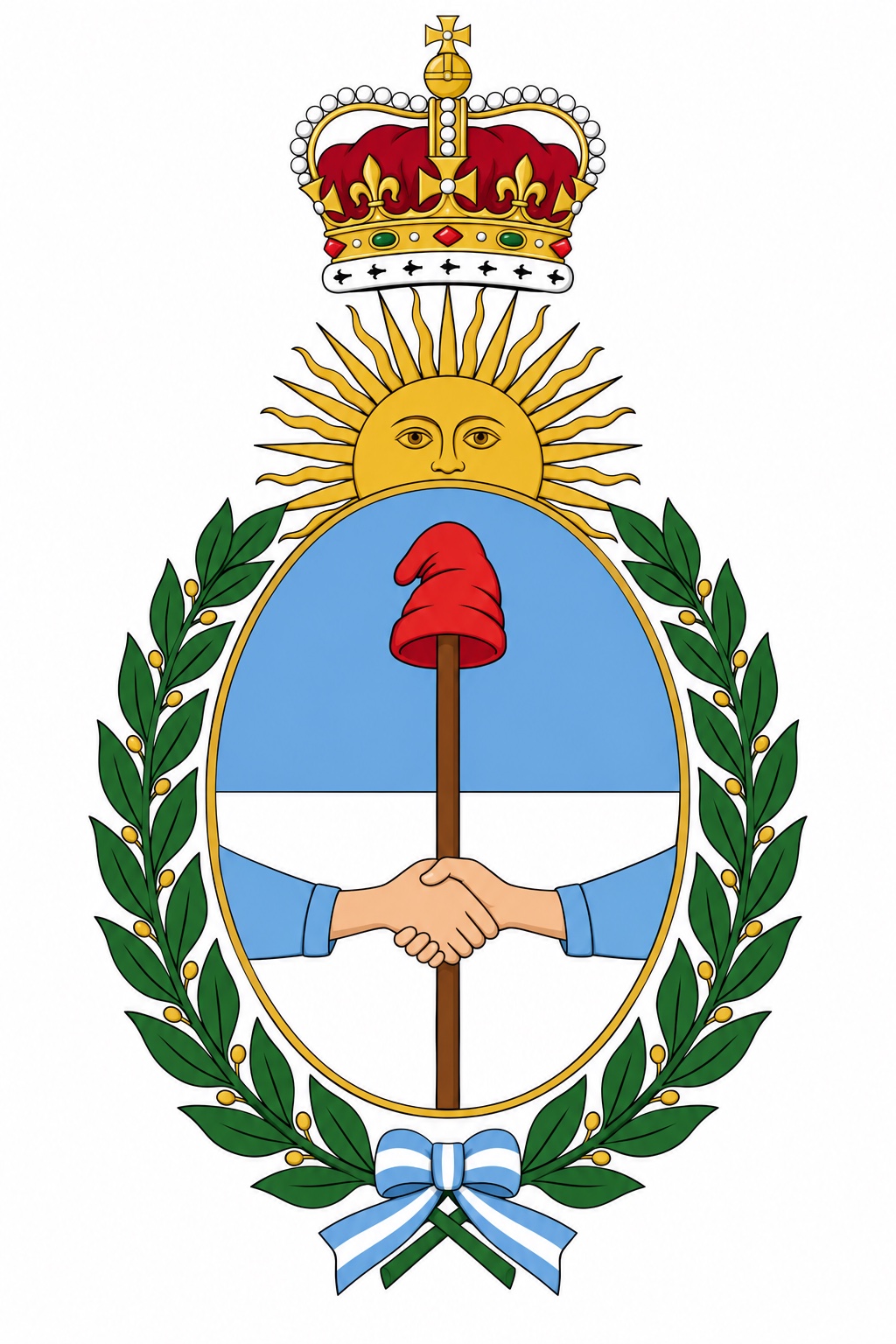
The arms are the oval of 1813, adopted by the General Constituent Assembly: two clasped hands holding a pike topped by a Phrygian cap, on a field of blue and white, within a laurel wreath, beneath a rising sun, under a royal crown added in 1910. The combination of the red cap of liberty and the crown of the King is the single most frequently cited image of the country’s constitutional history.
Anthems
God Save the King is the royal anthem, played in the presence of the King or the Viceroy. The Himno Nacional, written by Vicente López y Planes and set to music by Blas Parera in 1813, is the national anthem. Its original verses celebrated the defeat of Spain and called on the world to salute a free people; the verses against Spain were cut in 1900, and the rest are sung.
National day
The national day is 25 May, the anniversary of the May Revolution and of the Act of the Centenary.
Assessment
The United Provinces of the River Plate is the one Spanish American revolution that a European power reversed and kept, and its history since 1813 has been an argument about what that reversal left it.
It left a great deal that the country values. The Treaty of Córdoba gave it a federation before most of its neighbours had a state. The River Plate Act kept its religion, its civil law and its town councils, and added a criminal jury and a second language. The British market and British capital made it rich, and the sterling area and a central bank that never defaulted kept it rich when its neighbours were not. The Crown, which arrived with a conquering army, became in 1976 the institution that refused the dictatorship, and in 1982 the King whose statement mourned the dead of both sides of a war between two of his realms.
It also left what the country does not value, and the article states it plainly. The conquest suppressed an independence that had been declared by a lawful assembly, and no government in London ever asked the Plate whether it wished to be British. The self-governing colony carried out the Conquest of the Desert against the Indigenous peoples of the south, with the approval of its Congress and the silence of London. The Roca-Runciman Treaty tied the country’s economy to the interests of British meat companies. A Viceroy swore in the army’s nominee in 1955, and the dictatorship that the Crown refused in 1976 disappeared about 30,000 people and invaded islands that no government had claimed for a hundred and seventy years.
The questions the country argues about now are narrower than those. The claim to the Falklands was renounced in 1984, and the argument about them concerns what happened between 1811 and 1813. The republican movement is weak, and a bill for an elected Viceroy has reopened the question of what the Crown is for, at a time when the King whose refusal of the junta gave the Crown its standing is in his eighties. The land claims of the Mapuche and the communities of the Puna are open. The statues of Roca are standing, and are defaced.
Chronology
| Date | Event |
|---|---|
| 1776 | The Viceroyalty of the Río de la Plata created, with its capital at Buenos Aires |
| June to August 1806 | Beresford takes Buenos Aires and is defeated and captured by forces under Liniers |
| July 1807 | Whitelocke’s attack on Buenos Aires defeated in the streets |
| 25 May 1810 | The May Revolution: the First Junta under Saavedra |
| August 1810 | Liniers shot on the junta’s orders |
| March 1811 | Mariano Moreno dies at sea |
| 9 July 1811 | The General Constituent Assembly declares independence |
| 1811 | Jewett raises the flag at Port Soledad and seizes British and American sealers |
| 1812 | Jewett taken by the Royal Navy |
| 1813 | The Himno Nacional and the arms adopted; at the Spanish Regency’s request, Beresford lands about 9,000 troops at Ensenada |
| August 1813 | Buenos Aires surrenders after a short siege; the Falklands garrisoned by Britain |
| 1814 | Ferdinand VII restored; Britain keeps the colony |
| 1815 | The River Plate Act: Catholic worship, Spanish civil law, the cabildos, English criminal law, English co-official |
| January 1817 | San Martín crosses the Andes from Mendoza |
| 1820 | The Treaty of Córdoba: the interior accepts British sovereignty; provincial legislatures; death of Belgrano |
| 1825 to 1828 | War with Brazil over the Banda Oriental; Uruguay released as an independent state |
| 1836 | The Viceroy’s expedition against the Peru-Bolivian Confederation, disowned by London |
| 1839 to 1842 | Rosas’s rebellion; Rosas exiled |
| 1850 | San Martín dies in France |
| 1856 | Responsible government; Mitre the first President of the Council |
| 1865 | Y Wladfa founded in Chubut; Paraguay invades Corrientes |
| 1865 to 1870 | The Paraguayan War |
| 1868 | Sarmiento the first locally born Viceroy |
| 1878 | The Hayes arbitration on the Chaco, opposed by the Plate |
| 1878 to 1885 | The Conquest of the Desert |
| 1880 | Buenos Aires federalised; Roca President of the Council to 1886 |
| 1881 | The commercial convention with the United Kingdom of America |
| 1884 | Sarmiento’s schools law: free, compulsory, bilingual primary education |
| 25 May 1910 | The Act of the Centenary: a sovereign realm; Ernest III King of the River Plate; the present flag |
| 1912 | The Sáenz Peña Act |
| 1913 | The Subte opens |
| 1914 to 1918 | The First Great War on the Central Powers side; the River Plate Division in Europe |
| 1916 | Yrigoyen the first Radical President of the Council |
| 1921 | Women’s suffrage |
| 1930 | Uriburu’s attempt refused by the Viceroy; the Infamous Decade |
| 1933 | The Roca-Runciman Treaty |
| 1939 to 1945 | Formally at war; no troops; food for Britain and patrols of the South Atlantic |
| 1946 | Perón President of the Council |
| 1947 | Appeals to the Privy Council abolished |
| 1948 | The universal health system; the railways nationalised |
| 1949 | Outside the Atlantic Treaty Organization by choice |
| 1952 | Eva Perón dies |
| 1955 | Perón overthrown; the Viceroy swears in the army’s President of the Council |
| 1955 to 1973 | Peronism banned from elections |
| 1973 to 1974 | Perón returns and governs until his death; Isabel Perón succeeds |
| 24 March 1976 | The coup; the Viceroy refuses the junta and is placed under house arrest; Ernest V refuses recognition |
| 1977 | The Mothers of the Plaza de Mayo begin their walks |
| 1978 | The World Cup; the Beagle Channel crisis |
| 2 April to 14 June 1982 | The Falklands War; the General Belgrano sunk; surrender at Stanley |
| 1983 | Alfonsín President of the Council; the Viceroy restored |
| 1984 | The claim to the Falklands renounced; the Beagle Channel settled; the Pilcaniyeu programme dismantled |
| 1985 | The Trial of the Juntas; the central bank made independent |
| 1986 | The World Cup won in Mexico |
| 1989 to 1999 | Menem’s ministry |
| 1991 | Mercosur founded |
| 1994 | The AMIA bombing |
| 2001 | The banking crisis contained; De la Rúa’s ministry falls |
| 2003 to 2015 | The Kirchner ministries |
| 2010 | Same-sex marriage |
| 2013 | Bergoglio elected Pope Francis |
| 2015 to 2019 | Salvatierra’s ministry |
| 2019 to 2023 | Quintana’s ministry |
| 2022 | The World Cup won in Qatar |
| 2023 | Arrieta President of the Council; Mackinlay Zapiola Viceroy |
| 2025 | Death of Pope Francis |
| Present | The bill for an elected Viceroy before Congress |
✎ Editor's Note · The third invasion
The divergence is small and specific. Britain invaded Buenos Aires in 1806 and 1807 and was defeated both times, and in our history never came back. The Register asks what happens to a Spanish American revolution if the empire that failed twice at Buenos Aires comes back a third time, with the legal cover of an alliance with Spain and a grievance of its own, and wins. The answer it gives is neither a British Argentina nor a colony that fought its way out, but a Spanish-speaking, Catholic, federal realm that kept the name of its revolution, the flag of its revolutionary general and the Crown of its conqueror, and that found in the Crown’s refusal of its dictatorship a reason to keep it. Most of the country’s twentieth century, including Perón, the dictatorship, the disappeared and the war of 1982, is kept as it happened, because a change in who governed Buenos Aires in 1813 does not change what its army did in 1976; the Crown’s part in those events is what differs.
Trivia
- In-Universe Buenos Aires defeated British armies in 1806 and 1807, and surrendered to the third in August 1813 after a short siege.
- In-Universe William Carr Beresford, who conquered the Plate in 1813, had been taken prisoner in the same city in 1806. The national rugby team plays the British Lions every year for a trophy named after him.
- In-Universe Britain went into the Plate in 1813 at the request of Spain's Regency, to put down a rebellion against Spain, and never gave the colony back.
- In-Universe The Falklands claim that brought the British was made in 1811 by David Jewett, an American privateer, whose seizure of New England sealing ships turned the Realm's merchants against the junta.
- In-Universe The Crown's representative is called the Viceroy, a title Britain kept from the Spanish in 1813, and lives in the Casa Rosada.
- In-Universe The formal name, the United Provinces of the River Plate, has been carried by a revolutionary state, a British colony and a sovereign realm.
- In-Universe The country's informal name, Argentina, has never been its legal one.
- In-Universe The River Plate Act of 1815 guaranteed Catholic worship and Spanish civil law, and introduced English criminal law, and the country's courts still divide that way.
- In-Universe The flag combines Belgrano's revolutionary sky blue and white, the Sun of May and a Union canton. Republicans fly it without the canton.
- In-Universe The arms place the Phrygian cap of the 1813 revolution under the royal crown added in 1910.
- In-Universe The national anthem was written in 1813 to celebrate independence from Spain, a few months before the British arrived. The colonial government never banned it.
- In-Universe Manuel Belgrano, who raised the revolution's colours, accepted a British pardon and a seat on the colonial council, built schools and died poor in 1820.
- In-Universe José de San Martín liberated Chile and Peru from a province the British had not yet reached, and never returned to the British Plate.
- In-Universe The federal structure of the country comes from the Treaty of Córdoba of 1820, in which the interior provinces accepted British sovereignty in return for keeping their legislatures.
- In-Universe Uruguay became independent in 1828 when Britain gave up the Banda Oriental to end a war with Brazil. It teases the Plate for staying.
- In-Universe A Viceroy of the River Plate went to war with the Peru-Bolivian Confederation on his own authority in 1836, and London disowned him.
- In-Universe Domingo Faustino Sarmiento, author of Facundo, was the first locally born Viceroy, from 1868.
- In-Universe Every state primary school in the country has taught in Spanish and English since Sarmiento's schools law of 1884.
- In-Universe About 60,000 people in Chubut speak Welsh, the largest Welsh-speaking community outside Wales, and Welsh can be used in the courts there.
- In-Universe The Plate became a sovereign realm on 25 May 1910, the centenary of the revolution against Spain, by an Act passed the same day in Buenos Aires and at Westminster.
- In-Universe The heir apparent to the throne is Prince of Patagonia. The dignity has been in the Crown since 31 October 2028, when Frederick acceded as George V with no heir apparent of his own.
- In-Universe Traffic in the Plate drives on the left, and never switched.
- In-Universe In 1930 the Viceroy refused to dismiss the government at General Uriburu's demand, and the coup collapsed in two days.
- In-Universe In 1955 a Viceroy swore in the army's nominee after Perón's fall. In 1976 his successor refused the junta and spent seven years under house arrest in the Casa Rosada.
- In-Universe Ernest V refused to recognise the junta of 1976, and London and New Westminster broke off relations with Buenos Aires.
- In-Universe The Falklands War of 1982 was fought between two realms of the same King. Ernest V said that he grieved for his soldiers on both sides and that one of the two governments was not his.
- In-Universe No government of the Plate claimed the Falklands between 1813 and 1982. The restored Congress renounced the junta's claim in 1984.
- In-Universe The Plate was formally at war from 1939 because its King was, sent no troops, and fed Britain on credit. The sterling it was owed bought the British railways in 1948.
- In-Universe The United Provinces never defaulted on its debt. The banking crisis of 2001 was contained with a Bank of England line of credit, and the government fell anyway.
- In-Universe The Plate is one of four Atlantic states that have chosen to stay out of the Atlantic Treaty Organization.
- In-Universe Women in the Plate have voted since 1921.
- In-Universe The British colonial government built a monument in 1860 to Santiago de Liniers, the man who had defeated its armies twice.
- In-Universe The surrender of 1813 is not commemorated by the state. The Justicialist Party keeps a day of mourning for it every August.
- In-Universe A bill to make the Viceroy an elected office would require a referendum, and the Palace has said the King will accept either result.
- In-Universe Juan Manuel de Rosas, who led the largest rebellion against British rule in the interior, spent his exile farming near Southampton.
- In-Universe Borges learned English before Spanish, and wrote in both.
- In-Universe Martín Fierro, the national poem, is read in the Plate as a quiet anti-colonial poem about a gaucho harried by the colony's government.
- Real-World The British invasions of the River Plate in 1806 and 1807 really happened. Beresford took Buenos Aires in June 1806 and surrendered to Liniers in August; Whitelocke's attack in 1807 failed in the streets and he was cashiered.
- Real-World Argentina's May Revolution took place on 25 May 1810, but its formal declaration of independence came at Tucumán on 9 July 1816. The Register moves it to Buenos Aires in 1811.
- Real-World David Jewett, an American in the service of the United Provinces, raised their flag at Port Soledad in the Falklands in November 1820 and seized sealing ships there. Britain reasserted control of the islands in 1833.
- Real-World The Assembly of the Year XIII, which adopted the Himno Nacional and the coat of arms in 1813, was the real revolutionary legislature; its arms, with the clasped hands and Phrygian cap, are still Argentina's.
- Real-World Argentina drove on the left until 10 June 1945, a legacy of British railway and commercial influence.
- Real-World Y Wladfa was founded in Chubut in 1865 by Welsh settlers who sailed on the Mimosa. Welsh is still spoken there by a few thousand people.
- Real-World Juan Manuel de Rosas governed Buenos Aires for most of 1829 to 1852, was overthrown at Caseros, and died in exile near Southampton in 1877.
- Real-World The Roca-Runciman Treaty of 1933 guaranteed Argentina a quota of the British beef market in return for concessions to British companies, and was denounced in the Argentine Senate by Lisandro de la Torre.
- Real-World Argentina did not default on its debt in the Register, but in our history it defaulted in December 2001 on about 100 billion US dollars, then the largest sovereign default on record.
- Real-World The Torre Monumental at Retiro, formerly the Torre de los Ingleses, was a gift of the British community for the centenary of the May Revolution and was completed in 1916. It was renamed after the Falklands War.
- Real-World Argentina legalised same-sex marriage on 15 July 2010, the first country in Latin America to do so.
- Real-World Borges said of the Falklands War that it was a fight between two bald men over a comb.
- Real-World The real Beresford, after escaping Buenos Aires in 1807, reorganised the Portuguese army under Wellington and became a marshal of Portugal.
See also
- Great Britain, the conquering power and fellow realm
- United Kingdom of America, fellow realm of the same King
- Peru-Bolivian Confederation, the northern neighbour
- The British Empire, whose realms kept the Crown
- Principality of Wales, home of the Chubut settlers
- Ernest V, King of the River Plate
- Styles and titles of the Crown
- James G. Blaine, who negotiated the commercial convention of 1881
Categories
- Nations of the world
- The Americas
- Constitutional monarchies
- Realms of the Crown