Central America
The United Provinces of Central America, commonly the Union, is a federal presidential republic on the isthmus between Mexico and Panama, with a Caribbean coast, a Pacific coast and a spine of volcanoes between them. It has about 46 million people in six provinces: Guatemala, Los Altos, San Salvador, Honduras, Nicaragua and Costa Rica. Its capital is San Salvador, the smallest of the great cities of the isthmus and the only one that was ever chosen. The largest city is Guatemala City, which was the capital until 1834 and has not forgotten.
It exists because of a pact. The Union was founded in 1823 and had begun to break apart by 1838, in a cholera year, under a peasant rising led by Rafael Carrera against the Liberal federation of Francisco Morazán. In 1840, at Antigua, the two men made a bargain. Carrera would keep the federation and Morazán would keep the presidency, the Church would have its property back and not its privileges, the Indigenous communities would have their lands protected by federal law, and the province of Los Altos, the Maya highlands, would be a province in its own right. Nothing about it was fair, and it held. Every Central American knows the date.
The Union is also a country with a company in it. The United Fruit Company, of Boston, owns the railways that run from the Caribbean ports to the highlands, employs about sixty thousand people, and is the largest single landowner on the Caribbean plain. It is regulated by a Federal Fruit Commission and is known throughout the isthmus by a name that means the United, Mama Yunai. The Register treats the Company as a power in the Union’s history and as a Realm company, and the Union’s argument about it is the oldest argument it has not settled.
The presidency rotates. The President of the Union is elected by direct vote for a single four-year term, and candidates must come from the province whose turn it is, the six provinces taking the office in a fixed order every twenty-four years. The system was an unwritten rule of the Pact until 1948 and has produced one Maya president, the present one, and one crisis that is now before the Court of the Union at San José: the election of the President from Honduras, whose turn it is, has been disputed by two provinces, and nobody has said what happens if the Court annuls it.
The organising question of this article is the one the Pact asked in 1840. A union kept together by a bargain among enemies, a company that owns its railways and a rotation that gives every province its turn has to say who has actually paid for it. The Register’s answer is that the Maya, who were promised their land in the Pact and are still waiting, have paid more than anyone.
The name
The formal style is the United Provinces of Central America, Provincias Unidas del Centro de América, the style of the constitution of 1824, which the Pact of Antigua kept. In running prose the Register calls the country the Union. Central America is the region and Central Americans are its people. The old Guatemala City families, who lost the capital in 1834, still call it the Federation, and the older ones say it with a sniff.
The units are the provinces, and the constitution calls them states in its text, a survival of the first draft. They have never been states in any sense a Granadine would recognise: they have no armies, their governors are elected for four years, and each of them has stopped, at one time or another, behaving as though the Union did not exist.
Government and politics
The President as head of state
The head of state is the President of the Union. The office is held for four years, once. The President is elected by direct vote of the whole Union in two rounds, and the constitution of 1948 provides that every candidate must be a native of the province whose turn it is. The order, which began as the rotation of the five states of 1824 and was refitted at Antigua in 1840 when Los Altos became the sixth province, was written into the constitution in 1948 and is Guatemala, Los Altos, Honduras, San Salvador, Nicaragua, Costa Rica, and the cycle takes twenty-four years.
The President lives at the National Palace in San Salvador, opens the Federal Congress on 15 September, the national day, and lays the wreath on 1 October at Antigua, the Day of the Pact, between the two statues. The statues stand facing each other in the plaza, one of Morazán and one of Carrera, in the attitudes in which each was most often painted, and the President walks between them and does not look at either.
The present President is Domingo Tum Caal, of Los Altos, a K’iche’ Maya and a former mayor of Quetzaltenango, the first Maya to hold the office. He is in the last months of his term. He was elected in a campaign that the Union’s press called the most orderly in a generation, and his term has been remembered for a flood of lawsuits about land titles that he did not start and could not stop.
The President as head of government
The President is also the head of government and appoints and dismisses the cabinet without a vote of Congress. The cabinet has fourteen ministries, among them the Ministry of Emigrants, which has no counterpart elsewhere in the hemisphere and which looks after the two and a half million Central Americans who live in the Realm.
The weakness of the office is the rotation. A President chosen from a province’s turn is a President chosen from a short list of one province’s politicians, and the commonest complaint is that the Union is governed for each four years by the second-best candidate in the best-placed province. The defence is the one the Pact gave: that the country would not have stayed together if any province had thought it would never govern.
The disputed election
The turn has reached Honduras. The Honduran candidate, Tomás Alvarado, has been declared elected by about four thousand votes in a count that the provinces of Nicaragua and San Salvador contest on the ground of fraud in the banana zones. The Court of the Union, at San José, has the case. The President-elect is due to take office in November. Nicaragua and San Salvador have said that they will not send delegations to the swearing-in.
The Register does not predict the Court. What is certain is that nobody has said what happens if it annuls the election. The constitution provides for a new election within ninety days and says nothing of whether the province whose turn it was loses it.
Congress
The Federal Congress sits at San Salvador. The Senate has 36 members, six from each province, and the Chamber of Representatives has 240, elected by proportional representation, with four-year terms. The Senate’s equal representation of the provinces is the whole guarantee that Costa Rica’s five million count as much as Guatemala’s twelve.
Parties
The party system has its origins in the quarrel of 1826 to 1829. The Liberal Union is the party of the Morazán tradition, federal and secular. The Conservative Party is the party of the Carrera tradition, Catholic and rural, and has the Maya highland vote that its founder won in 1840 and has never wholly lost. The Social Christian Party and the Social Democrats divide the middle. The Green Front is small. The Maya Movement, which entered Congress after the peace of 1996, holds about a tenth of the Chamber.
Courts and the constitution
The constitution of 1948 is the Union’s fundamental law, drawn on the framework of 1824 as amended at Antigua. It provides for the rotation, the Fruit Commission and the Union’s army, and it ended the provincial armies, merging them into the six contingents that now make up the Union’s. The Court of the Union has twelve judges, two from each province, and sits at San José, in Costa Rica, away from the capital, so that the one body that has to rule on the provinces is not in the same city as the government.
The army
The Union has one army, which is not stationed in one place. It is a federal command over six provincial contingents, about 70,000 soldiers in all, each stationed in its own province under federal officers, with no province holding more than a quarter of the troops and the capital’s guard drawn from all six in turn. The arrangement derives from the Pact of Antigua, which forbade any province to host the Union’s army, since the province that did would own the Union.
The army’s record is mixed. Provincial commanders removed the President of the Union in 1931, in Guatemala, and in 1954, in the same province, and the Honduran contingent ruled its own province from 1963 to 1982. The Union itself has never had a military government. The army’s role in internal order is limited to a declared state of siege, and the Union has paid, in the Maya highlands, the price of the army’s habit of acting as the province’s army and not the Union’s.
The Union and its provinces
Six provinces
Each province has a constitution, a governor elected for four years, an assembly and powers over education, local police and its share of the Union’s revenue. They differ more than the Union’s flag suggests.
Guatemala, with about twelve million, is the old colonial centre, the province of Guatemala City, the volcanoes, the coffee, the sugar and the oldest and largest landowning families. Los Altos, with about five million, is the Maya highlands, with its capital at Quetzaltenango, a province that exists because of the Pact and has been a Maya majority since its creation. San Salvador, with about seven million, is the smallest and the densest, the province of the capital, the old coffee families and the textile towns. Honduras, with about ten million, is the poorest, the province of the banana coast and its ports, the Bay Islands and the army. Nicaragua, with about seven million, is the province of the great lakes, of cattle, of two rival colonial cities, León and Granada, and of the second canal that has never been built. Costa Rica, with about five million, is the stable one, the richest, the least armed and the one that talks about leaving.
Costa Rica
Costa Rica has the oldest democratic habit, the highest income, about A£6,500 a head, and no provincial army. The Union’s army is thin in its territory by agreement since 1948. It is the province in which the Union’s Court sits and the province whose politicians talk, from time to time and with decreasing embarrassment, of leaving the Union, the last such motion in the provincial Assembly having been lost by eleven votes. The rest of the Union treats it as a standing irritation and a standing reproach.
The currency and the bank
The Union’s money is the Federal Colón, of 100 centavos, issued by the Bank of the Union at San Salvador since 1925, at about twelve to the pound. Before it each province coined its own. The Bank has been independent of the executive since a Realm advisory mission reported on the currency in the 1920s, and the colón has been stable except in the years of the civil wars, when it was not.
History
The Captaincy-General
The isthmus was conquered in the 1520s by Pedro de Alvarado, one of Cortés’s captains, and governed from 1540 as the Captaincy-General of Guatemala, a kingdom in name and a province in practice, which ran from Chiapas to Costa Rica and was subject to the viceroy at Mexico. Its capital was Santiago de Guatemala, the city now called Antigua, in a valley between three volcanoes, which the Spanish rebuilt after each earthquake until the earthquake of 1773 convinced the crown that a capital at the foot of a volcano was a mistake. In 1776 the government moved to a new site in the highlands, the present Guatemala City.
It was a poor colony. It had no silver and little gold. It had cacao, indigo and cochineal, which were exported in small quantities, and a great many people. The Maya of the highlands, who had been conquered and were not, in any ordinary sense, ever dispossessed of their villages, paid tribute and provided labour. The Church held much of the land. The families of Guatemala City, who had inherited the conquerors’ grants, held most of the rest, and the provinces beyond the highlands, Nicaragua, Honduras and Costa Rica, were governed from Guatemala City and resented it.
Independence, 1821 to 1823
The Captaincy-General became independent without a war. Napoleon had made himself Emperor of the French in 1804 and taken Spain in 1808, the crown the colony served had been a prisoner for years, and in 1820 a liberal revolution in Spain made the colonial governors uncertain whom they obeyed. In New Spain the generals declared independence. On 15 September 1821 the leading men of Guatemala City, meeting in the National Palace, signed an act that declared the Captaincy-General independent of Spain, and sent the news to the provinces. The rest of the isthmus followed.
The union with Mexico lasted a year. In January 1822 the new Mexican Empire under Agustín de Iturbide annexed Central America, and the provinces, which had not been asked, were divided. San Salvador resisted for months and was crushed. When Iturbide’s empire fell in 1823, a Central American assembly, meeting at Guatemala City, declared on 1 July 1823 that the provinces were free of Spain, of Mexico and of every other power, and constituted the United Provinces of the Centre of America. The province of Chiapas, which had been part of the Captaincy-General, voted in a plebiscite in 1824 to join Mexico, and with it went the Soconusco, and the frontier of the isthmus was fixed at the Usumacinta.
The first federation, 1823 to 1838
The assembly wrote a constitution in 1824 and based it, as such assemblies did, on the Spanish constitution of Cádiz of 1812 and the Realm’s Charter. The Union would be a federation of five states, Guatemala, San Salvador, Honduras, Nicaragua and Costa Rica, with a President elected by Congress and a Senate in which each state sat equally. The Catholic religion was the religion of the state, no other being tolerated, and slavery was abolished.
The federation had a quarrel within it from its first week. The Liberals were provincial lawyers and merchants, mostly from San Salvador, who believed in a strong federal government, a secular state and the destruction of the Church’s wealth. The Conservatives were the old families of Guatemala City, who believed in the Church, the old order and a federal government that did what Guatemala City said. The first President, Manuel José Arce, a Salvadoran, began as a Liberal and ended as a Conservative, and the quarrel became a civil war in 1826.
The war ended in 1829 when Francisco Morazán, a Honduran general and Liberal, took Guatemala City, arrested the Conservative leadership, expelled the archbishop and the friars and, in 1830, became President of the Union. He held the office for nine years and tried to remake the country. He established trial by jury, civil marriage, the secular schools and a federal tax, and in 1834 he moved the capital from Guatemala City, the Conservative stronghold, to San Salvador, where the Liberals were strongest.
The reforms were unpopular, and a cholera epidemic in 1837 made them unforgivable. In the Guatemalan highlands the Indigenous villages, which the Liberals had taxed and whose Church had been taken from them, believed that the government’s doctors were poisoning the wells. They rose under Rafael Carrera, a pig-farmer’s son of mixed descent, illiterate and devout, who led them to the gates of Guatemala City in 1838 and took it. Within months Nicaragua, Honduras and Costa Rica had declared themselves separate from the Union. By the end of 1839 the federation consisted of San Salvador, the army of a general who had lost most of his country, and a peasant host that held the highlands.
The Pact of Antigua, 1840
Morazán and Carrera met at Antigua in the autumn of 1840, in a house in the old capital, and neither of them could have won. Morazán could not take the highlands and Carrera could not govern a country. The Pact they made, which the Union dates to 1 October 1840, was signed in two languages and held to the letter for about thirty years.
By its terms the federation was preserved, and Morazán stayed President of the Union until 1845. The Church had its property back, but not its monopoly of education or its privileges at law. The Indigenous communities’ lands were placed under the protection of federal law, in a statute known as the Law of the Communities, which forbade their sale to anyone outside the community. The highlands of Quetzaltenango, which had risen against Guatemala City in 1838, were constituted a separate province, Los Altos, with its capital at Quetzaltenango and a Maya majority, over the objection of the Guatemala City families, who had expected Carrera to give them back the whole highlands and who lost. The capital stayed at San Salvador. And no province was to host the Union’s army, so that no general could own the Union again.
Carrera governed the province of Guatemala for the rest of his life, until 1865, as its president and its commander, a Conservative and a Catholic who kept his peasants quiet and his word. Morazán served until 1845, retired to San Salvador, and died there in 1855 at sixty-three, the year Walker landed. The two men are the Union’s founders and its two heroes, and the plaza at Antigua has a statue of each of them, facing the other.
✎ Editor's Note · The Pact of Antigua
The Pact is the Union’s founding document, and it is a bargain between a Liberal who believed in the state and a Conservative who believed in the Church and the village. Both of them were right about something. Morazán was right that the federation could not survive without a government that governed. Carrera was right that the Liberal programme, which taxed villages and took their Church, had been imposed on people who had not been asked. The price of the Pact was paid by the Indigenous communities, whose lands the Pact promised to protect and whose protection failed within a generation, and the Register sets the union it saved against the promise it broke and does not say which was worth more.
Recognition and the isthmus
The Realm recognised the Union in 1824, in the ministry of John Quincy Adams, and Britain in 1826, while keeping the settlement it held at the mouth of the Belize river and a protectorate over the Mosquito Coast, the Caribbean shore of Nicaragua and Honduras. The Union protested both and could remove neither. Britain made the Union a loan in 1826, which was never repaid in full. The Mosquito protectorate ended by treaty in 1860, and Belize, which Britain kept, is now a state of the West Indies Federation.
The Realm’s interest in the isthmus was a canal. The agreement of 1850 with Great Britain, which the Realm’s government accepted, forbade either power to build a canal across the isthmus alone, and the Union, which owned the best route, along the San Juan river and across Lake Nicaragua, watched two great powers agree to keep it from being built.
The National War, 1855 to 1857
In 1855 a Realm adventurer, William Walker, of Nashville, a lawyer and doctor and journalist who believed that the isthmus ought to be governed by Anglo-Saxons, landed on the Pacific coast of Nicaragua with fifty-eight men. He was invited by one of Nicaragua’s two factions, which he betrayed within a year. He took Granada, made himself commander of the army, and in 1856 had himself elected president of the province, restored slavery and made English the language of the government.
The other provinces, and Costa Rica’s army, took the field against him, and Britain paid. A Costa Rican drummer-boy, Juan Santamaría, burned the fort at Rivas in 1856 and died for it, and the Union’s schoolchildren know his name. Walker was forced out in 1857 and shot in Honduras in 1860, having tried a second invasion. The Union calls the conflict the National War.
The Realm’s part was one of the few of which the Union speaks kindly. The ministry of William H. Seward, which had refused the Cuban expeditions, refused to recognise Walker’s government when it applied in 1856, enforced the Realm’s neutrality statutes against his recruiters, and prosecuted three of them. It did not send an army and did not stop a ship. It did refuse, and the Union remembers it.
The coffee century
Coffee had been grown in the highlands since the 1830s, and by the 1860s it was the Union’s first export. It needed land and labour. The land was the Church’s and the Indigenous communities’. The labour was the Maya’s.
The Pact held until 1871. In that year the Liberal president Justo Rufino Barrios, a Guatemalan general who had taken power, broke it on the one point where it was easy to break. He secularised education, seized the Church’s lands for the second time, and, in the same decade, took the Indigenous communal lands for coffee, in violation of the Law of the Communities. He introduced forced labour for the plantations, by which every Maya man could be compelled to work for a landowner for a part of the year, and built the railways that carried the coffee to the ports. His government was progressive in everything except the thing the Pact had been made for, and the Union dates the first betrayal of the Pact to 1871.
The consequences are those of the whole twentieth century. By 1900 the highlands’ best coffee land had changed hands, the communities that had held it by federal law had lost it by local fraud, and the Union had a landowning class that owned the Union. The coffee families of Guatemala, San Salvador and Costa Rica were the aristocracy of the isthmus, and the Maya, who had grown the coffee, were the poor.
The Company
The United Fruit Company was founded at Boston in 1899 by the merger of two businesses: a railway that Minor Keith, a Brooklyn-born contractor, had built from the Caribbean coast of Costa Rica toward the highlands, which had been paid for by bananas he planted along the track to give the trains something to carry, and the Boston importers who bought his fruit. It was a Realm company from the first, with its offices on the Boston waterfront, its shareholders in Massachusetts Bay and its steamers, which the isthmus called the Banana Fleet, painted white.
It grew by buying. Within twenty years it owned or controlled most of the Caribbean plain of Honduras and Costa Rica, the Guatemalan lowlands around Puerto Barrios, and a share of Nicaragua’s coast, together with the International Railways of Central America, the system that joins the Caribbean ports, Puerto Barrios, Puerto Cortés and Puerto Limón, to the highlands. It employs about sixty thousand people in the isthmus and is, in the banana provinces, the largest employer and the largest landowner. The isthmus calls it Mama Yunai, from United, and the nickname is not entirely affectionate.
The Union did not allow it to take the state. After a scandal of 1906 in which two Honduran ministers were found to be in its pay, the Federal Congress created the Federal Fruit Commission, which sets the terms of banana contracts, fixes wages and the prices in the company stores, hears workers’ complaints and can fine. The Commission has done its work, with the limits of such bodies. It has never been able to touch land, which is the Company’s real power and which the Union has never regulated, and the Union holds a golden share in the railway and no more. The railway is the Company’s, and its ownership is the subject of one of the Union’s oldest unresolved questions.
✎ Editor's Note · The Company
The isthmus would have been different without the Company, and the Register does not say whether it would have been better. The Company built the railways, the ports and the hospitals of the banana coast, paid wages in money in a region where wages had been paid in scrip, and was regulated by a Union that was not, in this respect, captured. It also owned the land, the railway and the ports, held down the price of the bananas it bought from independent growers, and gave the Union a class of people who worked for a Boston corporation and not for the Union. Whether the isthmus would have been richer or poorer without it is a question that its economists have been unable to settle, and the Register states what the Company built and what it took and leaves the sum.
The customs houses and the marines
The Union’s creditors were in London and Boston, and its governments had a way of defaulting. From 1909 the Realm began to collect the debts. It seized the customs houses of the provinces of Nicaragua and Honduras, the revenue on which the loans were secured, appointed collectors, paid the British and Realm creditors, and left the provinces with what remained. It landed marines in 1909, 1912 and 1919, the second time to put down a rising against a collector in Nicaragua that lasted eleven years.
The rising was led by a hero of the Union’s schoolbooks, Augusto Calderón, a schoolmaster from León, who fought the marines in the hills from 1912 to 1923. The Union protested at the League of Nations, which had been created in 1920, and the Realm replied that the loans had to be repaid. The practice was ended in 1923 by the ministry of Charles Evans Hughes, which abandoned coercive debt collection in the Caribbean and Central America as part of the settlement of the Mexican claims, and withdrew the collectors. The Realm’s occupation of the customs houses is taught in every Central American school, and the Realm’s schools do not mention it.
The canal that went elsewhere
The Realm needed a canal. In 1902 its Parliament chose, by a handful of votes, between the two routes, Panama and Nicaragua, and chose Panama. The Nicaragua route, along the San Juan river and across Lake Nicaragua, was shorter, was in the Union’s territory and had been the favourite for fifty years, and the Union’s Congress had made preparations to sell it.
The Union has voted five times since for a second canal, owned by the Union, across Lake Nicaragua, and has never funded it. It is a standing hope and a standing joke, and it lives in the Union’s politics as a thing every government promises and no budget contains. When Panama seceded from New Granada in 1903, the Union’s Congress offered it membership as a seventh province, and Panama declined, for fear of the Realm’s displeasure, the Realm preferring to deal with a small separate state. The Union has never forgiven the refusal or the preference.
The colón, the bank and the airline
The Union’s money was the provinces’ own until 1925, when the Federal Colón was created, with the Bank of the Union at San Salvador, after a Realm advisory mission reported on the confusion of coinages. The bank was made independent of the executive, and has remained so.
In 1931 the provincial commanders removed the President of the Union, a Guatemalan, in the first of the army’s interventions, and the same year a New Zealand pilot founded an airline in Honduras, Aerolíneas del Istmo, which flew mail and passengers between the six capitals and the banana ports. In 1938 the Realm’s Pan American World Airways, in the Realm’s wider programme of buying the national carriers of the hemisphere, bought into it, and it is still the national carrier.
The massacre of 1932
The depression ruined the coffee price, and in January 1932 the coffee workers of San Salvador rose against the families who owned the estates. They were mostly Indigenous peasants and Salvadoran labourers, and they were poorly armed. The province’s contingent, under provincial command and not the Union’s, put the rising down in a few weeks, in which about twenty-five thousand people were killed, many of them shot in their villages by soldiers who had been told that the dead would be counted by the dozen. The Federal Congress held an inquiry. No officer was tried. The Union remembers it as la Matanza, and San Salvador’s coffee families are called, in Salvadoran Spanish, by the name the peasants gave them afterwards.
The Second Great War
The Union declared war on Japan within days of the attack on Honolulu in December 1941. It was not a belligerent in any other sense. The Germans of Alta Verapaz, who had been the planters of Guatemala’s northern highlands since the 1860s and were the nationals of the Realm’s ally, were valued and not interned. The Realm’s aircraft used Union airfields, with the Union’s consent, to patrol the Pacific approaches to the canal, and no base was leased. The small Japanese community, a few thousand fishermen and shopkeepers, was interned by order of the provinces, and the Union apologised in the 1990s.
1948
The war’s end brought a wave of strikes in the banana zones in 1947, and the elections of the following year produced a crisis. In March 1948 a disputed election in Costa Rica led to a civil war of forty-four days, between the government’s supporters and an opposition led by a coffee farmer, which ended with the opposition’s victory and about two thousand dead. The Union’s Congress, in the same year, wrote a new constitution. It merged the provincial armies into the six contingents of the Union’s army, wrote the rotation of the presidency into the text, and gave the Federal Fruit Commission a charter.
The reformer and 1954
The presidency had reached Guatemala, and in 1951 it was won by a colonel, Carlos Lemus Barrios, a reformer, who in 1952 carried a land law that took uncultivated land from the largest estates, among them the Company’s, and gave it to peasants. The Company complained to the Realm, in Boston and in New Westminster, that the law was confiscation.
The Realm’s ministry was that of Dwight D. Eisenhower. It declined to act, as the Realm’s ministries since Hughes had declined to act, but it withheld credit from the Union’s government and let it be known that the land law was displeasing. In 1954 the army of the province of Guatemala, without any order from the Union, removed the President and annulled the law. The Union remembers a coup, and it remembers also the Realm’s coolness and the colonel’s exile, and it has been taught, by the Company’s critics and the Realm’s, that the three were one event.
The war in the highlands, 1960 to 1996
The highlands had been promised their land in 1840 and had lost it in 1871, and by the 1960s they had a small insurgency. It was never large. It was a few hundred men in the mountains of Los Altos and the north of Guatemala, and it was fought by the Guatemalan contingent, which treated the villages as the enemy’s base. For thirty-six years the army conducted a campaign against the Maya in the highlands, with massacres, burned villages and the disappearance of tens of thousands of people.
The worst of it was in the early 1980s, when the army, under a general who had come to power in the province, adopted what it called a policy of scorched earth, and destroyed more than four hundred villages. About two hundred thousand people were killed or disappeared in the war, most of them Maya, and the Realm gave neither side any money.
It ended in 1996, in the Peace of Quetzaltenango, signed under the mission of the League of Nations. A commission of historical clarification, which sat from 1996 to 1999, found the army responsible for the great majority of the killing and called it genocide. In 2013 a federal court in Guatemala City tried a former President of the Union and convicted him, and the conviction was overturned on a technicality ten days later. The Peace also created the Maya Council, a body of forty members, elected by Maya assemblies, which is advisory and has the right to be heard by the Senate on any bill touching Indigenous land or language and to ask the Court of the Union for an opinion. The Register states the genocide plainly, and the failure of the land.
The army in Honduras, 1963 to 1982
The province of Honduras was ruled by its contingent from 1963 to 1982, in a series of military governments that the Union’s Congress tolerated and the Fruit Commission did not oppose. It is the Union’s longest military rule, and its poorest province has never recovered the time.
San Salvador’s war
The coffee families of San Salvador had never forgiven the peasants of 1932. In 1979 a civil war began in the province, between an army-backed regime that was the heir of the families and an insurgency of peasants, unions and students. It lasted twelve years. About seventy-five thousand people were killed.
Its central event was the murder of an Archbishop of San Salvador, Luis Mario Cárcamo, who was shot at the altar of his cathedral in March 1980 while saying Mass, after a sermon in which he had told the soldiers to disobey orders to kill peasants. His killers were never convicted. The Catholic Church in the province came to stand with the peasants, and the Church’s priests and catechists were among the dead. The war ended in 1992 in the Peace of Chapultepec, signed under the League’s mission, and a truth commission that sat in 1992 and 1993 named the army and the death squads as responsible for the great majority of the killing.
Nicaragua, 1979
Nicaragua’s province had been governed since the 1930s by the Zavala family, a dynasty that had become rich on the relief sent after the earthquake of 1972, and in July 1979 it was overthrown by a coalition of businessmen, students and the Church. There was no war to follow. The province has had a mixed economy since, and the Federal Congress, which could have used the occasion to expel the province, has kept it inside.
The deportations and the gangs
The Realm took the refugees of the 1980s, and some of them took with them to Los Angeles the habits of the war. In the 1980s two street gangs formed in the barrios of the city among Salvadoran refugee boys, as a defence against the older gangs of the neighbourhood. From 1996 the Realm, under its removal law, deported about eight hundred thousand Central Americans, among them the members of both gangs, who had in many cases left as children and did not speak the language of their parents’ province. They took over the barrios of San Salvador and Honduras, and the Union’s homicide rate became one of the highest in the hemisphere. The Register states the Realm’s removal law as the proximate cause of the gangs and does not say it is the only one.
Earthquakes and storms
The isthmus is on the Pacific rim of volcanoes and in the track of the Atlantic hurricanes, and its history is also a history of disasters. The Managua earthquake of 1972 killed about ten thousand people and destroyed the centre of the Nicaraguan capital. The Guatemala earthquake of 1976 killed about twenty-three thousand and left a million homeless, most of them in the highlands. San Salvador’s earthquake of 1986 killed about fifteen hundred. Hurricane Mitch in 1998 killed about eleven thousand, mostly in Honduras and Nicaragua, in mudslides that buried whole villages. After the second of these the Union created, in 1977, a National Agency for Disasters, with a federal fund and offices in every province.
The Isthmian Compact
In 1987 the Union, Panama and Mexico signed the Isthmian Compact, a customs union with a joint authority for a road through the Darién that has never been built and a freedom of movement for workers between the three that the Realm has regarded with disapproval. It is the Union’s largest regional agreement.
The commission that was closed
In 2008 the Union set up, with the League’s help, a federal commission against corruption, with prosecutors from the League’s member states. It indicted a President in 2019, and the Federal Congress closed it in the same year. The Union’s corruption is the commonest complaint against its government and the only one on which every province agrees.
The present
The present is a year of waiting. President Domingo Tum Caal of Los Altos leaves office this year after four years that have been quieter than his Maya supporters wished and louder than his opponents expected. His successor’s election has been disputed, and the Court of the Union at San José has not ruled. A visit by Peter II, the first Pope to be born in the Realm, has been announced for February next year, and the Holy See has said that he wishes to see a shelter on the route north and the border on the Suchiate, and the Union’s Church, which is divided between the Maya catechists of the highlands and the hierarchy at Guatemala City, has not decided what it wants him to see.
Geography
The Union covers about 420,000 square kilometres between Mexico and Panama, bounded on the north-west by the frontier with Mexico, which follows the Suchiate river from the Pacific, crosses the mountains and then runs down the Usumacinta, on the north-east by Belize and the Caribbean, and on the south-east by Panama. It has two coasts, a long Pacific one and a shorter Caribbean one, and between them the mountains.
The volcanoes are the country’s spine. A chain of about thirty active cones runs the length of the Pacific side, from the Mexican frontier to Costa Rica, among them Fuego and Pacaya near Guatemala City, Santa Ana and San Miguel in San Salvador, Momotombo in Nicaragua and Arenal in Costa Rica. Their ash makes the soil that grows the coffee, and their eruptions and the earthquakes that accompany them make up much of the country’s history.
The highlands of Guatemala and Los Altos are the high ground, between 1,500 and 4,200 metres, with the Union’s highest peak, Tajumulco, and the deep lake of Atitlán, ringed by three volcanoes. The lakes of Nicaragua, Managua and Nicaragua, the second the largest in the isthmus, occupy a depression in the middle of the province, and the San Juan river carries the second lake’s water to the Caribbean. The Gulf of Fonseca, shared by San Salvador, Honduras and Nicaragua, is the Pacific’s only deep bay. The Mosquito Coast, the Caribbean shore of Honduras and Nicaragua, is low, swampy and rainy, and cut off from the Pacific side by the mountains. The Bay Islands, off Honduras, are a reef archipelago with an English-speaking population of Afro-Caribbean descent.
The climate is tropical and varies with the height. The coasts are hot and wet, the highlands cool, and the rains fall between May and November. The hurricane season runs from June to November and strikes the Caribbean side.
Cities
San Salvador, the capital, has about 2.8 million people in its metropolitan area and is hot, crowded and sited in a valley under a volcano, with a cathedral rebuilt after each earthquake. Guatemala City, the largest, has about 3.2 million, a cool, grey, colonial capital, the old capital of the isthmus, in a ravine-cut plateau at 1,500 metres. Tegucigalpa has 1.4 million, San Pedro Sula, the industrial city of Honduras, 1.2, Managua 1.5 and San José 1.5. Quetzaltenango, the capital of Los Altos, has 0.8 million and is the largest Maya city in the hemisphere. Antigua, the old colonial capital, is a small, preserved city of a hundred churches and a hundred ruins, and holds the Union’s Archive of Memory. León and Granada, in Nicaragua, are rival colonial cities that have fought each other for four hundred years and fought Walker together for two.
Environment
The Union’s wild land is large and mostly under threat. The Petén, the northern Guatemalan lowland and the largest block of tropical forest north of the Amazon, is being cleared by cattle. The Mosquito Coast holds the largest rainforest reserve in Honduras and Nicaragua, also under pressure. The Dry Corridor, a belt of drought along the Pacific from Guatemala to Nicaragua, is where smallholders lose their maize and beans in dry years and where, in consequence, many of the people who emigrate come from. The Register states the Dry Corridor as the Union’s main rural wound.
Economy
The Union’s economy is about A£175 billion, or about A£3,800 a head, poorer than New Granada’s and richer than the Confederation’s highlands, and unequal, with a Gini coefficient of about 0.48. Costa Rica is the richest province, at about A£6,500 a head. Honduras is the poorest, at about A£2,000. The Union’s exports are coffee, bananas, sugar, textiles and, from Costa Rica, electronics and medical devices. Remittances from Central Americans in the Realm are about a fifth of the Union’s income.
The provinces’ economies
Guatemala grows coffee, sugar and cardamom, and its capital holds most of the Union’s industry. Los Altos grows vegetables, weaves, and lives on tourists. San Salvador, the densest province, lives on textiles, remittances and the old coffee families, who still own the best land. Honduras, the poorest, lives on bananas, textiles and the money its people send home. Nicaragua lives on beef, coffee and gold, and on the lake, and talks about the second canal. Costa Rica grows coffee, welcomes tourists, and makes medical devices and microchips.
Coffee
Coffee is the old money of the isthmus and its second export. The highland estates, the old coffee families’ land, the cooperatives of the Maya, and the sunlit slopes of Costa Rica produce a bean that is among the world’s best, and the Realm is its largest customer. The coffee price is the Union’s barometer, and its fall in 1930 caused the massacre of 1932.
The Company and the railway
The Company is the other side of the economy. Its banana plantations, on the Caribbean plain, produce most of the Union’s fruit and a good deal of its foreign exchange. Its International Railways of Central America carry the fruit and the coffee from the highlands to the ports, and its Federal Fruit Commission regulates, within its powers, the way it does it. The railway is owned in Boston.
The Dry Corridor and hunger
The Dry Corridor is the Union’s hunger. In a dry year a million smallholders on the Pacific side lose their crops, and the federal government’s response, a programme of seed and credit, has never been adequate. The people leave. They go to the cities and then to the Realm.
Crime
The Union’s crime problem is plainly stated. It has a homicide rate among the highest in the hemisphere in San Salvador and Honduras provinces, the gangs of Los Angeles origin, the extortion of small shops and bus lines, and a prison system whose overcrowding is a scandal. About eight hundred thousand Central Americans have been deported from the Realm since 1996, and the gangs are among the people who were returned.
Women
The Register states the position of women plainly. Femicide rates are among the highest in the world. Abortion is banned in every circumstance in two provinces, and women have been imprisoned for miscarriage. There are strong women’s movements in Los Altos and Costa Rica, and a Maya women’s movement that has changed the highlands’ politics since the peace of 1996.
Education
The Union has free primary schooling and a literacy rate of about 88 per cent, which is lower in the Maya highlands and the Mosquito Coast. The University of San Carlos at Guatemala City, founded in 1676, is the oldest in the isthmus. The National University of the Union at San Salvador is the largest, and the University of Costa Rica at San José the best.
The press
The Union’s newspapers are El Diario del Istmo of San Salvador, Prensa de la Unión of Guatemala City, La Gaceta de Honduras, El Nicaragüense and La Nación Costarricense. The state broadcaster is the Radio of the Union. The press is free in law and dangerous in practice in San Salvador and Honduras.
Transport
The Union’s transport is the railway and the road. The International Railways of Central America, the Company’s system, runs from the Caribbean ports to the highlands and carries most of the freight, and a federal highway, the Pan-Isthmian Road, runs from the Usumacinta to the Costa Rican frontier along the Pacific side, built in the 1950s and 1960s with Realm credit and rebuilt after every earthquake. The Caribbean coast has few roads and the Mosquito Coast none, and its people travel by river and by small aircraft. The principal airport is at San Salvador, the carrier is Aerolíneas del Istmo, and the principal ports are Puerto Barrios, Puerto Cortés and Puerto Limón on the Caribbean and Acajutla on the Pacific. The road through the Darién, promised in the Isthmian Compact, is the Union’s best-known unbuilt thing after the second canal.
Energy
The Union has more energy than it uses. Its volcanoes supply geothermal power, which is the largest source in San Salvador and Nicaragua, its rivers supply hydroelectric power in Costa Rica and Honduras, and its sunlit Pacific coast supplies a growing amount of solar. Costa Rica generates nearly all its electricity from renewable sources. The grid is federal in law and provincial in practice, and a Federal Electrical Authority at San Salvador sets the tariffs and sells the surplus between provinces, which is the occasion of most of the Union’s quarrels about money that are not quarrels about the Company.
Tourism
Tourism is the third earner of foreign exchange. Visitors from the Realm and Europe come for Tikal and Copán, for Antigua at Holy Week, for the volcanoes and the cloud forests of Costa Rica, and for the Bay Islands’ reef. The industry is largest in Costa Rica and Los Altos, and its profits are, as in the coffee trade, unequally shared. The Maya Council’s seats on the boards of the great ruins are the one place where the revenue is divided by law.
Remittances and migration
A fifth of the Union’s income arrives from abroad in small transfers from relatives in the Realm and Mexico, and the Ministry of Emigrants at San Salvador is, in effect, the Union’s second foreign office. The money pays for houses, schools and the food that the Dry Corridor no longer grows, and it has made whole villages of the highlands and the Pacific plain into places where the young are absent and the old are paid by post. Inside the Union, where the transfers from Costa Rica are not remittances but wages sent home between provinces, the movement is from the highlands and the Dry Corridor to the cities and to Costa Rica, where Nicaraguan labourers pick the coffee and build the houses and are the largest immigrant group in the richest province.
Society
Peoples
Central Americans are about 52 per cent ladino, which is the isthmus’s word for mestizo, 28 per cent Maya, 7 per cent Afro-Caribbean, Garifuna or Miskito, 11 per cent white and 2 per cent other. The Maya are about 45 per cent of Guatemala and Los Altos, and they speak twenty-two languages, among them K’iche’, Q’eqchi’, Kaqchikel and Mam. The Garifuna, the people of mixed African and Carib descent, live on the Caribbean coast of Honduras and are the Union’s most distinctive Afro-Caribbean community. The Miskito live on the Mosquito Coast, and the English-speaking creole population of the Bay Islands and Bluefields is the descendant of the British protectorate.
The Maya
The Maya are the Union’s central question and its oldest grievance. The Pact of Antigua’s protection of their land is the oldest of its kind in the hemisphere, and its failure in the highlands is the Union’s oldest grievance. The Maya Council, a body of forty members established by the Peace of Quetzaltenango, has sat beside the Senate in an advisory role since 1996, and the Union’s first Maya President was elected after it. The Council is heard on every bill touching land or language and cannot block one.
Languages
Spanish is the language of the Union. The Maya languages and the other Indigenous languages are co-official in their territories, and Miskito and Garifuna are recognised on the coast. English is the second language of the Caribbean coast and of business, and is not official.
Religion
About 55 per cent of Central Americans are Catholic, 38 per cent Protestant or Pentecostal, 6 per cent without religion and 1 per cent of other faiths. There is no established church, the Pact having restored the Church’s property without its privileges. Evangelical churches are the largest in Los Altos and Guatemala, and the Maya spiritual tradition, with its calendar and its sacred sites, runs alongside both. The Cardinal Primate of the Union is Esteban Ortega, Archbishop of Guatemala City.
Health
The Union’s health service is provincial in administration and federal in funding. A Federal Health Fund, created in 1948 with the constitution, pays for primary care and vaccination in every province, and each province runs its own hospitals. Costa Rica has the best health system in the isthmus, with an old social-insurance fund and a life expectancy near the Realm’s. Honduras and Los Altos have the worst, and the Maya highlands have the highest rate of child malnutrition in the hemisphere, which the Register states as the clearest measure of what the Pact of 1840 did not deliver. The Realm’s National Health Service of America has a cooperation agreement with the Union’s fund, and sends doctors on rotation to the highlands.
Law, police and prisons
The Union’s law is civil law in the Spanish tradition, codified in each province and harmonised by the Court of the Union. A federal police, drawn from all six provinces, handles inter-provincial crime, and each province keeps its own police for the rest. The police are poorly paid and often corrupt, and the prisons are the most overcrowded in the hemisphere, run in places by the gangs themselves. The Union has abolished the death penalty in every province. It has also a tradition of states of exception, by which a provincial governor may suspend rights for thirty days, and the gangs of San Salvador and Honduras have lived under one so long that it has become a way of governing.
Indigenous and Afro-Caribbean law
The peace of 1996 recognised customary law in Maya communities for minor disputes, and the Maya Council has asked for its extension to land. The Garifuna and Miskito hold communal titles on the Caribbean coast, which the Company’s plantations and the cattle ranchers contest. The Court of the Union has ruled for the communities in four cases and its rulings have been enforced in two.
Culture
Literature
The poet of the language is Rubén Darío of Nicaragua, who died in 1916 and who made Spanish verse modern, and the Union’s schoolchildren learn his poems by heart. The great novelist of Guatemala is Miguel Ángel Asturias, who died in 1974 and won the Nobel Prize for Literature in 1967 for novels that put the Maya of the highlands and the dictator of the capital at the centre of the language. The Union’s best-known living novelist is a writer of Los Altos, Rosa Chumil, whose novels about the highland villages in the years of the war are read in the Realm and in thirty other countries.
Music, festivals and sport
The marimba, a wooden xylophone with gourd resonators, is the Union’s instrument, played in the highlands of Los Altos and in the parks of Guatemala City, and the national dance is the son. Semana Santa, Holy Week, at Antigua, is the great festival of the isthmus: the streets of the old city are covered with carpets of coloured sawdust and flowers, which the processions then walk over and destroy. Football is the national religion. Baseball is the national game of Nicaragua, which has produced a good many of the Realm’s major-league players.
Food and drink
The Union’s food is maize and beans. Pupusas, thick corn tortillas stuffed with cheese or pork, are San Salvador’s; gallo pinto, rice and beans cooked together, is Costa Rica’s and Nicaragua’s; tamales are everywhere; pepián, a meat and seed stew, is Guatemala’s oldest dish; baleadas, folded flour tortillas, are Honduras’s; and on the Caribbean coast the staple is rice and beans cooked in coconut milk. The drink is coffee.
The ruins
The Union has the greatest Maya cities in the hemisphere. Tikal, in the northern Guatemalan rainforest, is the most famous place in the Union, a city of temples and pyramids rising from the jungle. Copán, in Honduras, is the city of the great stone stelae. The sites are federal parks. The Maya Council holds a seat on the board of each, and half the entry fees go to the surrounding municipalities, which is the nearest thing to a land settlement that has actually been delivered.
Foreign relations
The Realm
The relation with the Realm is resentful and dependent. The Realm is the owner of the Company, the market for the Union’s coffee and fruit, the home of two and a half million Central Americans whose remittances are a fifth of the Union’s income, and the author of the deportations. The Realm’s occupation of the customs houses between 1909 and 1923 is taught in every school in the isthmus. The Realm has no base on Union soil and no tutelage in law, and the Union has never been able to forget that it has one in fact.
The treaty of 1987’s customs union, the Company’s railway and the removal law are the three subjects on which the Union’s ministers and the Realm’s talk past each other. The Realm’s account of the matter is that the Company is an employer, the customs houses were a creditor’s remedy and the removal law is the law. The Union’s account has the same facts and different words.
Mexico
Mexico, the Union’s largest neighbour, is a trade partner, a transit country for the migrants who cross it to the Realm, and the partner of the Isthmian Compact. The frontier follows the Suchiate from the Pacific, crosses the mountains and runs down the Usumacinta to the Belize line, and Chiapas, which belonged to the Captaincy-General until its plebiscite of 1824, is Mexican and has a large Maya population on both sides of the river.
Panama and New Granada
Panama, which the Union offered membership in 1903 and which declined, is the friend that chose not to be a province, the canal’s keeper and, by the Isthmian Compact, a partner in the customs union and in a road through the Darién that neither has built. Relations are warm and carry a memory. New Granada, the great federation to the south-east, is the other isthmian partner, a fellow federation with an older quarrel with the Realm and a smaller one with Panama.
Cuba, the Caribbean and Belize
Cuba is a friend, and its government has made offers of mediation that the League’s mission preferred to decline. The West Indies Federation, whose state of Belize lies on the Union’s north-eastern frontier, is a neighbour with a dormant dispute: the Union has claimed Belize since the independence of the Union and raises the claim at the League every few years and does not press it. The boundary was settled by the treaty of 1859 and the Union’s claim is a standing irritation to the Federation.
Britain, Spain and Germany
Britain held Belize and the Mosquito Coast, made the loan of 1826 that was never repaid in full, and paid for the war against Walker. Spain is the old metropole and a place of language and affection. Germany is a trading partner, and the planter families of Alta Verapaz are among the oldest German communities in Latin America.
The League of Nations
The Union has been a member of the League of Nations since 1920. The Peace of Chapultepec of 1992 and the Peace of Quetzaltenango of 1996 were both made under League missions, and the Union contributes peacekeepers, mostly police officers from Costa Rica. It has no alliance with the Atlantic Treaty Organization, because the Union has no army that could contribute.
The Isthmian Compact
The Union is a member of the Isthmian Compact of 1987 with Panama and Mexico: a customs union, a joint authority for the Darién road and freedom of movement for workers between the three states.
Emigration
About two and a half million Central Americans live in the Realm, mostly in Los Angeles, New Westminster, the poultry towns and the cities of the south, the third-largest Latin American group after the Mexicans and the Granadines. The Union has a Ministry of Emigrants at San Salvador that looks after them, and the Realm’s line is the border and the removal law. The Union’s is the Dry Corridor, the gangs and the wages. Millions more have gone to Mexico and Costa Rica.
Failings
The Register states six of the Union’s failings plainly.
The Maya genocide of the early 1980s was found by the commission to have been committed by the army, and the highlands’ land, which was promised in 1840, has never been delivered. The Realm’s occupation of the customs houses and the Company’s power in the banana zones were the Realm’s, and the Union’s own governments took the Company’s money. The massacre of 1932 in San Salvador and the death squads of the 1980s are the work of the coffee families and their army, and no officer has been tried for either. The Realm’s deportations exported to the isthmus the gangs the Realm had made. Femicide and the abortion bans are the Union’s, and its women pay for them. The neglect of the Caribbean coast and the Dry Corridor is the Union’s, and the places that have been neglected are the ones that supply the Realm’s migrants.
Armed forces
The army is the Union’s six provincial contingents under a federal command, about 70,000 soldiers. Its history is the history of its interventions, in 1931, in 1954 and in the Honduran province from 1963 to 1982. It is not a threat to the Union and has never been a protection to the Maya.
Memory
The Union keeps its history. 1 October, the Day of the Pact, is celebrated at Antigua with the wreath between the statues. 15 September is the independence, the day of the National Palace and the parades. The Archive of Memory at Antigua holds the reports of the two truth commissions, the testimonies of the highlands, and the photographs of the burned villages, and is visited by schoolchildren from every province. The Maya keep their own: the Maya calendar, the days of the dead, and the day each year when the villages of Los Altos read the names of those who were killed.
What the Union has not done is the one thing the Pact promised. The Law of the Communities, which protected the Maya’s lands, was ignored by Barrios in 1871, and its successor, which the Maya Council has asked for in every session since 1996, has never been passed.
Symbols
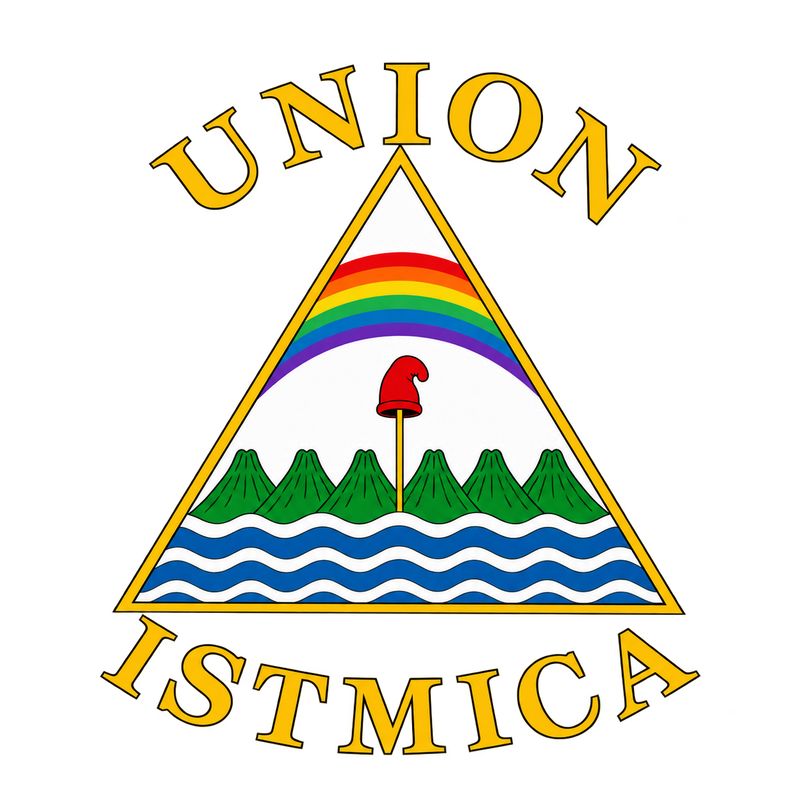
The flag of the Union is a flag of three horizontal bands, blue, white and blue, the white a half of the field, with the arms in the centre. The arms are a triangle bearing six volcanoes, one for each province, rising from a sea, with a Phrygian cap on a pole and a rainbow above, and the words UNION ISTMICA around them.
The national bird is the quetzal. The national day is 15 September, and the Day of the Pact is 1 October. The anthem is a hymn written for the Union’s centenary in 1923 and set to music by a Guatemalan composer.
Assessment
The Union is the country that did not break up, and it has not stopped paying for it.
The federation that Morazán made in 1823 broke in 1838 and was put back by a pact in 1840 that has held for nearly two centuries. It has survived a civil war in every generation, a company that owned its railways, a Realm that collected its customs, a cholera, a peasant revolt, a genocide and a rotation that gives the presidency to each province in turn, and it has done so because nobody has been able to say what the alternative would be. Costa Rica could leave and has not. Guatemala could dominate and has not. The Union is what its provinces have in common, and the Pact is what they agreed to.
What it has not done is pay. The Maya were promised their land in the Pact, lost it in 1871, were killed for asking for it in the 1980s and have a Council that is heard and cannot decide. The banana coast works for a company in Boston. The Dry Corridor sends its people to the Realm and the Realm sends back the gangs. The Register’s judgment is that the Union is a success of a kind that is paid for by someone else.
The article closes where the Union began. The Pact of 1840 was the one bargain that held, and the Maya who were promised their land in it are still waiting.
What is open
Three things are unsettled. Whether the Court of the Union will annul the election in Honduras, and what happens to the province’s turn if it does. Whether the Union will own the railway, which the Company holds and the Union has never been able to buy. And whether the Maya Council will ever be given the law the Pact promised.
Chronology
| Year | Event |
|---|---|
| 1540 | The Captaincy-General of Guatemala is organised |
| 1773 | An earthquake destroys the capital, Santiago de Guatemala (Antigua) |
| 1776 | The capital is moved to the present Guatemala City |
| 15 September 1821 | The Captaincy-General declares independence from Spain |
| 1822 | Iturbide’s Mexican Empire annexes Central America |
| 1 July 1823 | The provinces declare independence from Spain and Mexico |
| 1824 | The constitution of the United Provinces. Chiapas votes to join Mexico. The Realm recognises the Union |
| 1826 | Britain recognises the Union. The civil war begins |
| 1830 | Morazán becomes President of the Union |
| 1834 | The capital moves to San Salvador |
| 1837 | The cholera epidemic and Carrera’s rising |
| 1838 | Nicaragua, Honduras and Costa Rica declare themselves separate |
| 1 October 1840 | The Pact of Antigua. The federation is preserved; Los Altos is a province; the Church has its property; Indigenous lands are protected; no province may host the Union’s army |
| 1845 | Morazán leaves office |
| 1850 | The agreement between the Realm and Britain on the isthmian canal |
| 1855 to 1857 | The National War against Walker. Seward refuses to recognise him |
| 1860 | The Mosquito protectorate ends. Walker is shot in Honduras |
| 1865 | Carrera dies |
| 1871 | Barrios breaks the Pact: secularisation, the Church’s lands seized again, the Maya lands taken for coffee |
| 1899 | The United Fruit Company is founded at Boston |
| 1902 | The Realm’s Parliament chooses Panama over Nicaragua for the canal |
| 1903 | Panama secedes from New Granada. The Union offers it membership; Panama declines |
| 1909 to 1923 | The Realm collects the customs of Nicaragua and Honduras and lands marines in 1909, 1912 and 1919. Hughes ends it in 1923 |
| 1925 | The Federal Colón and the Bank of the Union |
| 1931 | Provincial commanders remove the President of the Union. Aerolíneas del Istmo is founded |
| January 1932 | The massacre in San Salvador, about 25,000 dead |
| 1938 | Pan American buys into Aerolíneas del Istmo |
| December 1941 | The Union declares war on Japan |
| 1948 | The civil war in Costa Rica. The constitution of 1948: the rotation, the Fruit Commission, the six contingents |
| 1951 to 1954 | The presidency of Colonel Lemus Barrios. The land law of 1952. The army removes him in 1954 |
| 1960 to 1996 | The war in the Guatemalan highlands |
| 1963 to 1982 | The army rules Honduras |
| 1972 | The Managua earthquake |
| 1976 | The Guatemala earthquake |
| July 1979 | The Zavala dynasty is overthrown in Nicaragua |
| 1979 to 1992 | The civil war in San Salvador. The archbishop is killed in 1980. The Peace of Chapultepec |
| 1987 | The Isthmian Compact |
| 1996 | The Peace of Quetzaltenango. The Maya Council |
| 1998 | Hurricane Mitch |
| 2008 | The federal commission against corruption. Closed in 2019 |
| 2013 | A former President is convicted and the conviction is overturned |
| This year | Domingo Tum Caal leaves office; the Honduran election is before the Court of the Union |
Trivia
- In-Universe The Union dates its survival to 1 October 1840, when Morazán and Carrera signed the Pact of Antigua. It is the Day of the Pact, and the President lays a wreath between the two statues in the plaza at Antigua and does not look at either of them.
- In-Universe The Pact kept the federation, gave the Church its property without its privileges, placed Indigenous lands under federal protection, made the Maya highlands the province of Los Altos and forbade any province to host the Union's army. The Maya paid for it, and the protection failed within a generation.
- In-Universe San Salvador has been the capital since 1834, when Morazán moved it from Guatemala City, the Conservative stronghold, to the city where the Liberals were strongest. Guatemala City lost the capital, kept the size, and has not forgotten either.
- In-Universe The President is elected by direct vote for a single four-year term, and candidates must come from the province whose turn it is. The order is Guatemala, Los Altos, Honduras, San Salvador, Nicaragua and Costa Rica, and every province governs once in twenty-four years.
- In-Universe The Union's first Maya President, Domingo Tum Caal, a K'iche' former mayor of Quetzaltenango, took office when the turn reached Los Altos. He leaves it this year, and his term is remembered for a flood of lawsuits about land titles that he did not start and could not stop.
- In-Universe The Honduran President-elect was declared elected by about four thousand votes, and Nicaragua and San Salvador contest the count. The Court of the Union sits at San José, in Costa Rica, so that the one body that rules on the provinces is not in the same city as the government.
- In-Universe No province may host the Union's army, so the Union has six provincial contingents under a federal command, about 70,000 soldiers, with no province holding more than a quarter of the troops and the capital's guard drawn from all six in turn.
- In-Universe Costa Rica has the highest income and the oldest democratic habit, and no provincial army. It is the province that talks, from time to time, of leaving the Union, and the last such motion in the provincial Assembly was lost by eleven votes.
- In-Universe The Union's money is the Federal Colón, issued by the Bank of the Union at San Salvador since 1925. Before it each province coined its own.
- In-Universe William Walker, a doctor and journalist from Nashville, landed in Nicaragua in 1855 with fifty-eight men and by 1856 had himself elected president of the province. The other provinces, Costa Rica's army and British money expelled him in 1857, and the Union calls the war the National War.
- In-Universe A Costa Rican drummer-boy, Juan Santamaría, burned Walker's fort at Rivas in 1856 and died for it. The Realm's Seward refused Walker's government recognition and prosecuted three of his recruiters, which the Union remembers as one of the few things the Realm did right.
- In-Universe Justo Rufino Barrios broke the Pact in 1871, secularising education, seizing the Church's land for the second time and taking the Maya communal lands for coffee. The Union dates the first betrayal of the Pact to that year.
- In-Universe The United Fruit Company was founded at Boston in 1899 from Minor Keith's Costa Rican railway and the Boston banana importers. The isthmus calls it Mama Yunai, from United, and its white steamers were called the Banana Fleet.
- In-Universe The Company owns the International Railways of Central America, which join the Caribbean ports to the highlands, and the Union holds a golden share and no more. The railway is owned in Boston, and the Union has never been able to buy it.
- In-Universe The Federal Fruit Commission, created after a scandal of 1906 in which two Honduran ministers were found to be in the Company's pay, sets banana contracts, wages and company-store prices and can fine. It has never been able to touch land, which is the Company's real power.
- In-Universe The Realm seized the customs houses of Nicaragua and Honduras from 1909 to pay British and Realm creditors, and landed marines in 1909, 1912 and 1919. It stopped in 1923 under Hughes, and the occupation is taught in every school in the isthmus.
- In-Universe The Realm's Parliament chose Panama over Nicaragua for the canal in 1902 by a handful of votes. The Union's Congress has voted five times since for a second canal, owned by the Union, across Lake Nicaragua, and has never funded it.
- In-Universe When Panama seceded from New Granada in 1903, the Union offered it membership as a seventh province. Panama declined, for fear of the Realm's displeasure, and the Union has never forgiven either the refusal or the preference.
- In-Universe In January 1932 the province of San Salvador's contingent put down a rising of coffee workers in a few weeks, killing about twenty-five thousand people. The Federal Congress held an inquiry and no officer was tried.
- In-Universe Aerolíneas del Istmo was founded in 1931 by a New Zealand pilot in Honduras and was bought into by Pan American in 1938. It is still the national carrier.
- In-Universe The German coffee planters of Alta Verapaz, who were the nationals of the Realm's ally in the Second Great War, were valued and not interned. The small Japanese community was, by order of the provinces, and the Union apologised in the 1990s.
- In-Universe A civil war of forty-four days in Costa Rica in 1948 over a disputed election produced the constitution of 1948. It merged the provincial armies into the Union's six contingents, wrote the rotation into the text and gave the Fruit Commission a charter.
- In-Universe Colonel Carlos Lemus Barrios, the reformer of 1951 to 1954, carried a land law in 1952 that took uncultivated land from the largest estates, among them the Company's. The Eisenhower ministry declined to act and withheld credit, and the province's army removed him in 1954 on its own.
- In-Universe The war in the Guatemalan highlands lasted from 1960 to 1996, killed or disappeared about 200,000 people, most of them Maya, and was ended by the Peace of Quetzaltenango under a League mission. The commission that sat afterwards called it genocide.
- In-Universe In 2013 a federal court convicted a former President of the Union of the highland killings, and the conviction was overturned on a technicality ten days later.
- In-Universe The Maya Council, which the Peace of Quetzaltenango created, has forty members elected by Maya assemblies. It is advisory, has the right to be heard by the Senate on any bill touching land or language, and may ask the Court of the Union for an opinion.
- In-Universe An Archbishop of San Salvador, Luis Mario Cárcamo, was shot at the altar of his cathedral in March 1980, after telling soldiers to disobey orders to kill peasants. His killers were never convicted.
- In-Universe The civil war in San Salvador lasted from 1979 to 1992 and killed about 75,000 people. The Peace of Chapultepec was signed under a League mission, and a truth commission named the army and the death squads.
- In-Universe The Zavala family governed Nicaragua from the 1930s and was overthrown in July 1979 by a coalition of businessmen, students and the Church, with no war to follow. The Federal Congress, which could have expelled the province, kept it in.
- In-Universe The two largest street gangs of the isthmus were formed in the 1980s in Los Angeles by Salvadoran refugee boys, and were deported with some eight hundred thousand other Central Americans after 1996. They took over the barrios of San Salvador and Honduras.
- In-Universe The Union has a federal Ministry of Emigrants at San Salvador for the two and a half million Central Americans who live in the Realm. Their remittances are about a fifth of the Union's income.
- In-Universe The Isthmian Compact of 1987, with Panama and Mexico, is a customs union and a joint authority for a road through the Darién that has never been built.
- In-Universe The Union has no alliance with the Atlantic Treaty Organization, because it has no army that could contribute. It has been a member of the League of Nations since 1920, and the peaces of 1992 and 1996 were made under League missions.
- In-Universe Tikal, in the northern rainforest of Guatemala, is the Union's most famous place. The Maya Council holds a seat on the board of each of the great ruins, and half of the entry fees go to the surrounding municipalities.
- In-Universe Holy Week at Antigua covers the streets of the old city with carpets of coloured sawdust and flowers, which the processions then walk over and destroy. It is the great festival of the isthmus.
- In-Universe Rubén Darío of Nicaragua, who died in 1916, made Spanish verse modern, and the Union's schoolchildren learn his poems by heart. Miguel Ángel Asturias of Guatemala won the Nobel Prize for Literature in 1967.
- In-Universe Baseball is the national game of Nicaragua, which has produced a good many of the Realm's major-league players. Football is the national religion of the rest.
- In-Universe A federal commission against corruption, set up with the League's help in 2008, indicted a President of the Union in 2019 and was closed by the Federal Congress in the same year.
- In-Universe A visit by Peter II, the first Pope born in the Realm, has been announced for next year. The Union's Church is divided between the Maya catechists of the highlands and the hierarchy at Guatemala City, and has not decided what it wants him to see.
- In-Universe The Union has claimed Belize since its independence and raises the claim at the League every few years, without pressing it. Belize is now a state of the West Indies Federation, and the Union's claim is a standing irritation to the Federation.
- Design The obvious article would treat the Company as the villain of the isthmus. It does not, because the Company is the Realm's as much as the Union's and the isthmus's own provinces took its money. The article is about a union that was kept together by a bargain among enemies, and the Company is one of the things the bargain did not cover.
- Real-World In our history the United Provinces of Central America broke up between 1838 and 1841. Morazán was shot in Costa Rica in 1842 after trying to restore it, and Guatemala, Honduras, Nicaragua, Costa Rica and El Salvador became five separate countries. Los Altos was crushed by Carrera in 1840.
- Real-World In our history the United Fruit Company, founded at Boston in 1899, became the model for the phrase banana republic, and a coup in Guatemala in 1954 removed a reforming president whose land law threatened its holdings, with the backing of the United States government. The company later became part of Chiquita Brands.
- Real-World William Walker, the Nashville filibuster who made himself president of Nicaragua in 1856 and was shot in Honduras in 1860, was real, as was Juan Santamaría's burning of the fort at Rivas. The Guatemalan highland war of 1960 to 1996 and the Salvadoran civil war of 1979 to 1992 were real as well, with the Maya genocide found by a truth commission.
See also
- Mexico, the largest neighbour and a partner of the Isthmian Compact
- New Granada, the other isthmian federation, from which Panama seceded in 1903
- The West Indies Federation, whose state of Belize the Union has claimed since its independence
- William H. Seward, whose ministry refused to recognise Walker
- Charles Evans Hughes, whose ministry ended the collection of debts by force
- William McKinley and Theodore Roosevelt, whose ministries chose Panama over Nicaragua for the canal
- Dwight D. Eisenhower, whose ministry withheld credit from the Union in 1954
- Pan American World Airways, which bought into Aerolíneas del Istmo in 1938
- Vatican City, for Peter II, whose visit to the isthmus has been announced
- The League of Nations, whose missions made the peaces of 1992 and 1996
Categories
Nations · The Americas · Central America · Federal republics · Spanish-speaking states