Republic of Cuba
The Republic of Cuba, commonly Cuba, is a sovereign island republic in the northern Caribbean, lying across the approaches to the Gulf of Mexico close to the Republic of Florida. Havana is the capital and largest city. The state is a socialist republic governed under a competitive semi-presidential constitution, with a directly elected President, a Prime Minister answerable to the National Assembly, and a Supreme Court exercising constitutional review.
Spanish rule ended in 1898 after intervention by the United Kingdom of America, and the Republic became independent in 1902 under the Platt system, which reserved a UKA right of intervention and provided for a naval lease at Guantánamo Bay. The intervention right was negotiated away in 1934; the lease was not. Batista seized power in 1952, and the Revolution that overthrew him triumphed on 1 January 1959. The revolutionary government established a one-party state and an independent communism that developed without a Soviet Union to sponsor or instruct it.
Cuba democratised without repudiating that inheritance. The National Dialogue Accord opened a negotiated transition in 2008, competitive elections followed from 2010, and the Constitution of 2019 removed the Communist Party’s monopoly while retaining the Republic’s social character. The legal source of authority remained the revolutionary Constitution as amended through its own procedure, so the 1940 Constitution was not restored and the revolutionary state was not abolished. The Communist Party contested elections, governed, lost the presidency to Isabel Cárdenas in 2025, and remained in Parliament.
The economy is a democratic market socialism of public strategic sectors, cooperative-majority agriculture, and protected private property. Cuba is non-aligned, non-nuclear by treaty, and a close but non-allied partner of the UKA. At present the principal constitutional question is whether renewing the Guantánamo agreement requires a referendum. The case is before the Supreme Court, judgment is reserved, and the governing coalition may not survive the answer.
Etymology
The name Cuba is Taino, and it is older than every institution on the island. Its exact sense is not recoverable: the two derivations most often proposed are cubao, abundant fertile land, and coabana, great place, and neither can be established from the fragmentary record of a language that had no writing and few speakers left within a century of the Spanish arrival. What is certain is that the Spanish took the word from the people they found using it, and that the name survived the disappearance of almost everything else those people made.
It survived a determined official effort to replace it. The island was proclaimed Juana for a Spanish prince, then Fernandina for a king, then Santiago for the apostle, then Ave Maria for the Virgin. Charts, cargoes, sailors and inhabitants went on saying Cuba, and by the middle of the sixteenth century the Crown had given up. The persistence is now taught in Cuban schools as the first instance of a habit the island claims as characteristic: an imposed name failing against the one people actually use.
The formal style is the Republic of Cuba, República de Cuba, and it has never been altered. The Republic of 1902 used it, the revolutionary government of 1959 kept it, and the Constitution of 2019 did not touch it. No government has added a qualifier of the kind that socialist and popular republics elsewhere adopted, and the omission was deliberate: the revolutionary state described its character in the body of its Constitution rather than in its title, so that the name of the country would not have to be renegotiated whenever its politics were. The flag and the arms follow the same rule of continuity.
Citizens are cubanos and cubanas. In ordinary speech the country is la Isla, the island, or la patria, a word the motto has made politically loaded without making it avoidable. Older literary usage supplies la Perla de las Antillas, the Pearl of the Antilles, which now appears mostly in tourist material, and el caimán, the crocodile, from the long tapering shape of the main island on a chart, which appears everywhere else, including in political cartoons that have drawn the animal grateful, furious, sleeping and armed. Havana’s full colonial name was San Cristóbal de La Habana, the second element usually traced to a local cacique, and the Isle of Youth carried the name Isle of Pines for most of its recorded history.
History
Colonial rule and the wars of independence
An island made for empires
Cuba’s geography has always invited the attention of powers larger than itself. The island lies across the approaches to the Gulf of Mexico, close to Florida, facing the channels through which shipping moves between the Atlantic, the Caribbean, and the continental interior. Havana offered Spain a protected harbour and a place from which fleets could gather before the ocean crossing. The city became fortified, commercial, bureaucratic, and cosmopolitan because empire needed it to be all four.
Spanish rule did not create a single Cuba at once. Eastern settlements looked towards Hispaniola and the wider Caribbean. Havana accumulated the institutions, money, and officials of the colonial centre. Rural districts developed around cattle, tobacco, subsistence farming, and, increasingly, sugar. The island’s population included Indigenous survivors, Spanish settlers, free people of colour, enslaved Africans, migrants from other Caribbean colonies, merchants from Europe and North America, and soldiers who expected the colony to remain a strategic possession even when its society no longer fit simple colonial categories.
Sugar changed the scale and violence of the colony. Plantations required land, capital, mills, transport, and coerced labour. Enslaved Africans and their descendants made the wealth that enriched planters, merchants, and the Spanish treasury. The plantation order made racial classification a system of work, law, residence, reputation, and punishment. Cuba retained slavery later than much of the hemisphere, and the long delay left independent Cuba with a free population whose formal legal status had changed faster than access to land, office, education, or safety.
The colony was wealthy enough to matter and unequal enough to remain afraid. Planters feared slave revolt. Spanish officials feared separatism. Reformers feared annexation by the northern power as much as they disliked rule from Madrid. Free Black and mixed-race Cubans served in militias, trades, and civic organisations while living beneath law and custom designed to remind them that service did not mean equality. The nation that later described itself as a single people was born inside distinctions that no proclamation could erase.
This is why Cuban independence cannot be narrated as a clean quarrel between Spaniards and Cubans. Families crossed the line. Regions entered the struggle at different times. Some elites wanted autonomy within the Spanish monarchy, some independence, and some annexation to the UKA. Enslaved people could hear freedom in the language of revolution while wondering whether white insurgents meant it. The wars that made the republic also forced the independence movement to decide what sort of people the republic would contain.
The long war for independence
The uprising of 10 October 1868 began the Ten Years’ War and gave Cuba one of its enduring political traditions: independence as an armed civic claim rather than a gift from a foreign liberator. Carlos Manuel de Céspedes freed enslaved people under his control and called for revolt. The insurgent Republic in Arms adopted the Constitution of Guáimaro in 1869, an early attempt to bind military struggle to representative government. Its institutions were fragile, its territory contested, and its egalitarian promises uneven. They nevertheless supplied later Cubans with a precedent for constitutional government made during war.
Black and mixed-race officers and soldiers were indispensable to the insurgency. Their service made it harder to imagine Cuban nationality as exclusively white, but it did not eliminate white fear of Black political power. The contradiction survived the war. Spain exploited it, presenting colonial authority as protection against racial upheaval. Independence leaders answered that a Cuban nation could only exist through citizenship across colour. Neither side controlled how veterans and their families understood what had been promised.
The Ten Years’ War ended in 1878 without independence. Slavery was abolished during the following decade, but abolition did not divide land or redistribute political power. A brief renewed war failed. Exile communities in Florida, New York, Mexico, and the Caribbean continued to organise, raise money, publish newspapers, and argue over strategy. Tobacco workers listened to political readings in factories. Veterans retained networks across the island. Spanish reforms arrived late and never answered the central demand that Cubans govern Cuba.
The final war began in 1895. Its organisers had learned from previous division. They sought a national movement large enough to include rural fighters, urban conspirators, workers abroad, white property holders, and Black veterans who had already proved their claim in battle. The war was destructive by policy as well as circumstance. Insurgents attacked the plantation economy that financed Spanish power. Spanish reconcentration removed rural civilians into controlled areas where hunger and disease killed on a vast scale. The island entered the last years of colonial rule already damaged before a foreign fleet arrived.
The Republic remembers the independence wars through monuments, school texts, family names, and local graves, but democratic teaching does not turn them into an uncomplicated march. The insurgency contained racial courage and racial fear, constitutional aspiration and military severity. Civilians suffered under both coercive systems. The achievement was real: Cubans built a national claim that Spain could no longer contain. The cost and unfinished equality were real too.
Martí belongs to everyone
José Martí died in 1895 before independence, which spared no later government from claiming him. He wrote against Spanish colonial rule, racial division, personal dictatorship, and annexation. He organised among exiles while insisting that the coming republic had to be more than a change of flag. His language could be revolutionary, liberal, anti-imperial, democratic, moral, and severe within the same page. That breadth made him useful to every Cuban tradition and impossible for any one of them to possess securely.
The early republic put Martí in schools and public squares. Constitutional opponents of Machado invoked him. The movement against Batista called itself the generation of his centenary. Fidel Castro presented the Revolution as the completion of Martí’s work. Dissidents under one-party rule answered with Martí’s warnings about unchecked authority. Liberal reformers in the National Dialogue cited his suspicion of the northern power. Communist delegates cited his insistence that formal liberty without material independence was incomplete. Diaspora representatives arrived with their own Martí, formed by exile and the fear that returning capital might become returning domination.
This common ownership is not a polite fiction. Martí’s thought contains arguments that remain in conflict. He believed in a republic of equal citizens, but he wrote in an age when the forms of mass democracy were unsettled. He feared the UKA’s imperial appetite but understood the importance of relations with the power across the Florida Straits. He admired sacrifice and mistrusted caudillos. His work offers no programme for a twenty-first-century mixed economy or a referendum on a naval base.
What Martí supplies is a standard of suspicion. A government that invokes independence while silencing Cubans can be judged against him. So can a government that opens markets while allowing foreign wealth to set national policy. So can an opposition that speaks of liberty while treating the social claims of poor Cubans as an obstacle. His portrait hangs in offices governed by rival parties because removing it would concede too much to the rival interpretation.
In contemporary Cuba, Martí is described as the common republican founder. The phrase is precise. He did not found the 1902 state, write the 1940 Constitution, or lead the 1959 Revolution. He founded the moral argument through which each has been judged. That argument begins with independence and refuses to end there.
War and intervention, 1898
The Spanish-American War occurs in the Register’s world substantially as it did in the familiar one, but the northern belligerent is the United Kingdom of America. Cuban insurgents had already fought Spain for three years when the UKA entered. Their armies controlled territory, destroyed the economic machinery of colonial rule, and suffered heavily. UKA naval and land power shortened the final military struggle. It did not create the Cuban claim to independence.
That distinction became the first great grievance of the republic. UKA public memory celebrated humanitarian intervention, the destruction of Spanish power, and the courage of soldiers such as Theodore Roosevelt. Cuban memory asked why an ally that spoke of liberation treated Cuban institutions as incapable of receiving sovereignty immediately. Spanish authority ended, but Cuban representatives did not determine all the terms of peace. The island passed under military occupation while Porto Rico entered UKA possession and the Philippines became a UKA Territory.
Cuba was not annexed. This matters in the hard law of the Realm and in the emotional history of the island. Annexationists existed, business integration was deep, and strategic planners in the UKA understood Cuba’s harbours perfectly well. Yet the independence movement had become too substantial to ignore, and the public justification for war had made permanent acquisition politically dangerous. The UKA occupied Cuba while promising a Cuban republic. It then defined the conditions under which that promise would be honoured.
The occupation repaired roads, reorganised sanitation, supported campaigns against yellow fever, reopened schools, and restored public administration. These were concrete achievements. They also supplied the occupier with its preferred defence of tutelage: that material competence justified political command. Cuban professionals and workers carried out much of the work under a hierarchy whose final authority remained foreign. Public health became both a shared accomplishment and an argument over who received credit.
The military government supervised the constitutional process and made clear that full withdrawal depended on provisions acceptable to the UKA. Cuban delegates wrote a republican constitution under that pressure. The resulting state was independent in international law and restricted at birth. Later generations would argue over whether 20 May 1902 should be celebrated as the day Cuba became free or mourned as the day an incomplete sovereignty was dressed in republican ceremony. Democratic Cuba does both.
The Platt republic
The Platt system reserved a UKA right of intervention, limited Cuban treaty and financial freedom, and supplied the legal basis for naval stations. It placed the island inside a northern security order without granting Cubans any reciprocal voice in the government that defined that order. The Republic possessed a President, Congress, courts, flag, diplomatic service, and electoral life. It also knew that a foreign ministry could decide when Cuban instability justified foreign power.
Tomás Estrada Palma became the first President. His administration valued economy and order, but the republic’s political class developed inside narrow networks of veterans, regional patrons, officeholders, and commercial interests. Elections mattered. So did fraud, coercion, and the expectation that the state would distribute jobs. The constitutional forms were not empty, but they were too weak to command agreement whenever the stakes became existential.
The economy bound Cuba closely to the UKA. Sugar entered a large nearby market. Capital financed mills, railways, utilities, banks, and land purchases. Trade created work and revenue, but concentration made the republic vulnerable to decisions taken elsewhere. A good harvest could still produce distress if prices moved against producers. Domestic planters and foreign firms shared interests without becoming identical. Cuban nationalism grew partly from the feeling that formal independence had left the island’s economic choices arranged around another country’s demand.
The Guantánamo lease emerged from this settlement. The bay’s geography made it valuable as a naval station. The legal form presented agreement between states; the political circumstances made the inequality plain. Rent payments could not turn compulsion into free consent. Revolutionary governments later refused to treat the cheques as legitimate. Democratic governments would amend the arrangement but never escape the fact that the first signature had been obtained while withdrawal itself was conditional.
The early republic also contained genuine public life. Newspapers fought. Parties organised. Municipalities developed local identities. Black veterans demanded the equality for which they had served. Women built charitable, educational, labour, and reform organisations before possessing equal political rights. Music, theatre, baseball, religious societies, mutual aid, and union activity created a civic country larger than the patronage state. It is a mistake to describe the period only as dependency. It is equally mistaken to describe its constitutional life without the power that stood behind it.
The second occupation
The election crisis of 1906 exposed the weakness of the arrangement. Opposition rebellion, governmental collapse, and Estrada Palma’s resignation produced the very conditions the Platt system had been written to address. The UKA established a provisional government and occupied Cuba from 1906 to 1909. It did so in the language of restoring constitutional order, not annexing the island. For Cubans who had been assured that intervention was a safeguard rather than a normal instrument, the distinction offered little comfort.
The second occupation administered rather than absorbed. Cuban civil servants remained at work, electoral machinery was repaired, and authority returned to an elected government. The occupation’s comparative restraint became part of the UKA’s defence of its conduct. Cuban criticism pointed to the more basic fact: a republic whose constitutional breakdown invited a foreign governor had not secured control of its own political failure.
The lesson cut in two directions. Some politicians concluded that preserving order was necessary to deny the UKA a pretext. Others learned that an appeal to northern authority could defeat domestic rivals. Military officers saw that elected governments without disciplined force were vulnerable. Nationalists understood that repeal of the intervention power required a state capable of surviving conflict without it. None of these lessons guaranteed democracy.
The occupation also strengthened administrative habits that outlasted it. Public works, sanitation, fiscal supervision, and electoral procedure acquired a technical language often associated with foreign tutelage. Cuban reformers used that machinery while rejecting the assumption that competence belonged to the occupier. This recurring pattern became characteristic of the island: institutions imported or imposed from abroad were taken over, altered, and claimed as Cuban, without the memory of their origin disappearing.
When the occupation ended in 1909, the republic resumed with its central questions unresolved. It had elections but uncertain acceptance of defeat, prosperity tied to one commodity, and a racial settlement that celebrated integrated independence armies while restricting independent Black political power. The worst consequence of that last contradiction arrived three years later.
The massacre of 1912
The Independent Party of Colour grew from the claim that formal citizenship had not delivered effective equality. Black veterans and organisers faced exclusion from office, land, patronage, and protection. When they created a party explicitly concerned with racial injustice, the republic answered by prohibiting political organisation by race. The ban presented itself as a defence of national unity. In practice it protected a white-dominated party system from an autonomous Black constituency.
Protest and armed mobilisation in 1912 were met with overwhelming force. Government troops and irregular violence killed thousands, most of them Black Cubans, in Oriente and elsewhere. The exact number remained disputed. The character of the event did not. A republic built in part by Black soldiers destroyed an organisation formed to claim the citizenship those soldiers believed they had earned.
The UKA watched, landed forces to protect selected foreign property, and did not rescue the party from Cuban repression. That response fitted the hierarchy of the Platt order. Foreign capital and strategic stability received immediate attention. Black Cuban political rights did not. Later UKA accounts that described intervention as a general protection for order had to contend with the order it chose to protect.
For decades, official memory reduced the massacre, blamed its victims, or folded it into a reassuring story that Cuba had transcended race. The Revolution later attacked the racism of the old republic while remaining uncomfortable with independent Black organisation in its own time. Democratic Cuba changed the public treatment more decisively. Archives opened, local burial and memorial work received public money, and the event entered the compulsory national curriculum. The state names it a massacre.
The recognition does not make 1912 safe history. Arguments continue over responsibility, numbers, and the relation between class and race. Some descendants reject national ceremonies that offer grief without material repair. Others fear that treating Cubans as separate political races will reproduce the division the independence movement sought to overcome. The modern formula, civic Cubanidad with Afro-Cuban centrality, grew partly from that disagreement. It insists on common citizenship and refuses the fiction that common citizenship erased racial power.
Cuba in the First Great War
When the UKA entered the First Great War, Cuba followed it into the conflict against France and Russia. The alliance reflected trade, geography, and the security structure within which the republic still lived. Britain and Germany stood with the UKA in this war, a combination that altered the names on wartime proclamations without changing Cuba’s practical task. The island supplied sugar, shipping, port access, medical personnel, and logistical support to a coalition fighting across the Atlantic.
Cuba’s direct military contribution remained modest. The war mattered more through the economy and through the political language it made available. Sugar prices rose. Mills expanded. Credit flowed. Workers were asked to accept discipline in the name of Allied victory. The government presented participation as proof that Cuba was an international actor rather than a protected dependency. Nationalists answered that alliance under the shadow of the Platt power could not demonstrate full freedom.
The armed forces gained experience in coastal security, mobilisation, and protection of infrastructure. Cuban sailors and merchant crews faced the dangers of wartime shipping. Medical units and volunteers carried the flag abroad in small numbers. Their service entered local memorial culture without acquiring the commanding place the Great Wars hold in Britain, Germany, or the UKA. For Cuba, the war was an economic and constitutional event before it was a battlefield epic.
The peace confirmed Cuba’s legal standing, but it did not change the structure of dependence. The victorious coalition restored trade and widened diplomatic opportunity. It also released accumulated demand into an already speculative sugar economy. Land changed hands at inflated values. Banks extended credit against prices that could not last. Havana spent and built. Rural districts saw fortunes appear beside wages that remained insecure.
The boom produced the illusion that one crop had solved the national question. When the market broke in 1920, it exposed how little sovereignty a commodity republic possessed over the terms of its prosperity. Banks failed or passed into foreign hands. Mills consolidated. Small producers lost land. The crash became an economic memory nearly as important as the war itself.
Sugar, labour, and the unfinished republic
The crash strengthened organised labour because insecurity made collective organisation practical. Dockworkers, railway workers, mill labourers, tobacco workers, artisans, and urban employees developed unions whose politics ranged from reformist to anarchist, socialist, and communist. Their common experience was that formal republican citizenship did not set wages, shorten hours, or protect organisers from employers and police.
Labour politics gave the island a vocabulary of social sovereignty. Independence could not mean only control of foreign affairs if the economy remained arranged by external demand and concentrated ownership. This claim later entered the Constitution of 1940 and the Revolution’s justification for nationalisation. It did not begin with Fidel Castro. It grew through decades of strikes, mutual aid, repression, and bargaining.
Race and labour overlapped without becoming the same question. Black Cubans were heavily represented in hard and insecure work and still faced barriers within unions and parties that described themselves as universal. Women worked in tobacco, domestic service, teaching, offices, and informal commerce while political organisations often treated their labour as supplementary. Rural labour moved between harvest intensity and unemployment. The sugar economy created a national working class but distributed its risks unevenly.
The state alternated between mediation and force. Governments recognised that modern industry required rules, yet patronage and police power remained easier than durable bargaining institutions. Radical organisers faced surveillance, imprisonment, and expulsion. Employers learned to use racial and migrant divisions. Workers learned that general strikes could threaten governments even when elections could not dislodge entrenched interests.
By the middle of the 1920s, Cuba possessed all the elements of its next crisis: a constitutional republic discredited by intervention and corruption, an economy wounded by collapse, a stronger labour movement, students impatient with the political class, and a President who believed modernisation entitled him to remain in power. Gerardo Machado would turn those elements into dictatorship.
The Republic, 1902 to 1959
Machado’s modern order
Gerardo Machado came to office through election and promised roads, administration, national confidence, and an end to the small bargains that had made republican politics contemptible. He built. He also accumulated power. The distinction between public works and personal rule narrowed as his government extended terms, controlled institutions, and treated opposition as obstruction to national progress.
Machado’s appeal was not invented after the fact. Many Cubans wanted a state that could act. Business interests valued order. Parts of the middle class welcomed visible modernisation. Labour initially found room for negotiation. The dictatorship developed through the conversion of those expectations into obedience, not through the sudden arrival of a ruler with no constituency.
Economic crisis removed much of the bargain. The depression struck sugar, employment, public revenue, and credit. Students organised. Workers struck. Opposition politicians conspired. Machado answered with censorship, police violence, detention, and assassination. Institutions that might have contained the conflict had been weakened in the name of effective government. By the time elite support fractured, constitutional succession could not carry the political weight placed upon it.
The UKA faced the familiar temptation to decide Cuba’s government. Its diplomats exerted pressure and explored mediation, but the political climate under Franklin D. Roosevelt had changed. The northern ministry understood that another occupation would confirm the strongest Cuban indictment of the relationship. It also feared disorder near UKA property and sea routes. The resulting policy was involved without becoming a third military government.
Machado fell in 1933 amid strikes, military movement, and civic revolt. His departure did not settle who had made the revolution or who should rule afterward. Students wanted social transformation. Established politicians wanted constitutional restoration. Enlisted soldiers wanted status and institutional power. Labour wanted rights that survived changes of cabinet. The collapse opened politics rather than resolving it.
The upheaval of 1933
The governments that followed Machado changed quickly because no force could command the whole country. The student movement brought an uncompromising language of national and social reform. Ramón Grau San Martín and his allies tried to govern through a programme that challenged old interests and foreign privilege. Workers pressed demands from below. Senior military authority broke, allowing enlisted men and junior officers to reorganise the armed forces.
Fulgencio Batista emerged from that military movement. He did not take the presidency at once. His power came from control of the institution capable of deciding which provisional government could survive. This indirect authority suited the unstable period. Cabinets changed while Batista remained. He could present himself as the guarantor of order, the representative of humble military ranks, and the practical broker between reform and property.
The 1933 upheaval expanded political possibility. It also normalised the armed forces as an arbiter. Social legislation advanced. National control over labour and economic policy grew. The political class widened. Yet the precedent that soldiers could stand behind civilian office and determine its duration would return in 1952 with fewer disguises.
Prime Minister Franklin D. Roosevelt’s government refused to repeat the occupation of 1906. It pressed against mass violence, dealt with successive authorities, and used recognition and negotiation without formally choosing a Cuban president by force. In 1934 the intervention right attached to the Platt order was repealed through a new treaty relationship. Guantánamo remained.
Repeal was a real recovery of sovereignty and one of the Roosevelt ministry’s better acts in the Caribbean. It did not remove the economic weight of the UKA or erase the occupations. It did establish that constitutional disorder in Cuba no longer created a general legal licence for northern intervention. The Revolution later treated 1934 as insufficient because the base and economic hierarchy remained. Democratic Cuba treats it as an incomplete but important victory.
The Constitution of 1940
The constitutional assembly of 1940 gathered a political range wider than the republic had previously managed to hold in one room. Liberals, conservatives, labour representatives, communists, nationalists, and reformers produced a charter rich in social promise. It recognised labour rights, social obligations of property, public education, protections against discrimination, and a more responsible constitutional state. Its ambition exceeded the institutions available to implement it.
The Constitution became the great unfulfilled charter. This description is not a claim that it was meaningless. It changed law, supplied arguments, and defined legitimate government. Its weakness lay in the distance between text and administration. Rights requiring legislation or capable courts developed unevenly. Patronage survived. Rural poverty and racial hierarchy did not dissolve. Political violence continued beside constitutional form.
Batista won the presidency under the new order. His government from 1940 to 1944 was constitutional and included genuine reform. He worked with organised labour and communists, expanded parts of the social state, and governed through electoral institutions. He also maintained the network, military influence, and personal calculation that had carried him out of 1933. The later dictator did not cancel the elected President. The contrast makes his 1952 coup a betrayal rather than proof that constitutional Batista had never existed.
The charter’s social language later gave both revolutionaries and democrats a usable inheritance. Fidel’s movement invoked it against Batista. Critics of the revolutionary government invoked its pluralism against Fidel. During the National Dialogue, delegates disagreed over restoration. They finally chose not to revive a document whose legal continuity had been broken for generations. The 2019 Constitution instead cites the 1940 settlement through speeches, commentary, and civic memory. It does not incorporate or restore it by law.
This distinction matters to the modern state. Cuba’s democracy is not presented as a return to the moment before 1952. Too much happened afterward, including achievements no stable majority wished to reverse. The 1940 Constitution supplies an admired predecessor and a warning. A fine charter cannot govern by admiration. Rights need institutions willing and able to enforce them.
The Caribbean war
The Second Great War reached Cuba through the sea. After Japan attacked Honolulu in December 1941, Cuba entered alongside the UKA against Japan and fascist France. The island’s position made its ports, airfields, merchant shipping, sugar, nickel, and patrol capacity more important than the size of any expeditionary army.
French submarines and raiders threatened Atlantic and Caribbean routes. Cuban forces escorted shipping, patrolled approaches, watched harbours, and cooperated with UKA commands. Merchant sailors carried strategic cargo through dangerous waters. Air crews searched broad stretches of sea where a sighting could determine whether a convoy arrived. The war enlarged the practical capacity of the Cuban state and tied its armed forces more closely to northern systems.
Mobilisation changed work at home. Sugar demand rose. Women entered expanded employment. Black workers and organisers pressed the contradiction between service and unequal access. Unions acquired members and bargaining weight. The government expanded social provision within the 1940 constitutional frame. Wartime discipline also strengthened security institutions and the military’s sense that it stood above ordinary politics when national survival was invoked.
Cuba remembers this contribution without exaggerating it. The principal campaigns were fought elsewhere. The island was not occupied, devastated, or subjected to the violence experienced in China, Japan, Europe, or the Pacific territories. Its service was maritime, economic, and regional. The memorials name sailors and air crews more often than infantry formations.
Victory left Cuba closer to the UKA and more confident in its international standing. It also returned the country to peacetime expectations that elected governments struggled to meet. Workers who had bargained under mobilisation wanted durable rights. Citizens who had fought fascist dictatorship abroad had little patience for gangsterism at home. The social Constitution remained admired. Its enforcement remained partial.
Democracy without clean government
The administrations elected after 1944 restored civilian political competition and a lively public sphere. Radio, music, universities, newspapers, unions, clubs, and professional organisations made urban Cuba one of the Caribbean’s busiest civic cultures. The period cannot be reduced to decay. People voted, organised, published, argued, and built lives under institutions that retained real freedom.
Corruption was also pervasive. Public money passed through patronage networks. Armed political groups blurred activism and gangsterism. Contracts, appointments, and protection became commodities. Governments that spoke in the language of the 1933 generation often behaved as though access to the state were the reward for having overthrown the last corrupt order.
Economic inequality sharpened the contrast between Havana’s consumption and rural insecurity. Tourism brought revenue and vice, glamour and dependence. UKA business and organised crime found opportunities in a state whose enforcement could be purchased. The most lurid foreign accounts mistook Havana’s nightlife for the entire country. Revolutionary accounts later made the same mistake for different reasons. Ordinary Cuba also contained teachers, shopkeepers, cane cutters, railway families, farmers, civil servants, and industrial workers whose grievance was not decadence in the abstract but a republic that had promised more than it delivered.
The political system remained capable of correction through elections, which made Batista’s intervention more destructive. He did not overthrow a republic already dead. He prevented an election because he feared the result and believed the armed forces could impose a more reliable order. The coup of March 1952 suspended the constitutional process and returned its old military arbiter as open ruler.
The UKA recognised the regime. Dwight D. Eisenhower’s ministry preferred predictability, commercial security, and anti-radical cooperation to the risks of confrontation. It expressed concern and later adjusted military support, but the original recognition remained. In Cuban memory, this was not an abstract diplomatic error. It confirmed that a foreign democracy willing to lecture the island about constitutional order would accept dictatorship when the dictator protected its interests.
Batista’s second rule
Batista’s dictatorship combined police violence with a claim to practical modernity. It built, attracted investment, cultivated tourism, and promised stability. It also censored, tortured, killed, manipulated institutions, and concentrated opportunity around allies. The regime’s defenders pointed to roads, hotels, growth, and anti-corruption promises. Its opponents pointed to bodies, stolen elections, and a countryside still denied the prosperity visible in Havana.
Resistance developed in several forms. Traditional parties demanded constitutional restoration. Students organised and fought. Workers struck, sometimes under leaders divided between accommodation and opposition. Urban underground networks carried out sabotage and assassination. Rural guerrillas established a different kind of authority in the Sierra Maestra. The Catholic Church contained both caution and dissent. Business support for Batista weakened as violence and uncertainty grew.
The regime made the opposition broader by closing ordinary exits. People who disagreed about property, socialism, religion, and the UKA could agree that Batista had no lawful right to rule. That agreement was sufficient for revolution and insufficient for the government that followed it.
UKA policy shifted as the dictatorship’s violence became harder to defend. Arms restrictions and diplomatic pressure arrived late. There was no decisive northern removal of Batista and no democratic rescue. Cubans overthrew him through their own coalition. The earlier record of pragmatic recognition ensured that revolutionary suspicion of the UKA would survive any later criticism of the dictator.
By 1958 the state was losing authority faster than the rebels were acquiring administrative capacity. Military morale declined. Strikes and urban resistance widened the crisis. The guerrillas advanced. Batista fled in the first hours of 1959, leaving the old order without a negotiated succession. Crowds entered the streets under the flag of independence and revolution. They agreed that a tyranny had ended. They had not yet decided what liberty would mean afterward.
Revolution and one-party rule
Moncada and the generation of 1953
The attack on the Moncada Barracks in 1953 failed as a military operation and succeeded as a founding story. Many attackers were killed or captured. Fidel Castro used his trial to indict Batista, invoke Martí, and claim the Constitution of 1940. Imprisonment and later amnesty turned defeat into political recognition. Mexican exile supplied the space in which the July 26 Movement prepared a return.
The sequence that followed is the one Cuban schools teach: Moncada, prison, exile, the voyage of Granma, disaster after landing, survival in the Sierra Maestra, and a guerrilla movement that learned to make military weakness look like political inevitability. Raúl Castro, Che Guevara, Camilo Cienfuegos, and others hold the places that story assigns them. The ideological world around them, however, offered no foreign model to copy.
There is no Soviet Union. The Russian Revolution produced no Bolshevik state and no continental communist patron. Marxism exists, communist parties organise, and revolutionaries read the same international literature, but there is no successful Soviet model claiming to embody history’s destination. Cuban communism therefore grows from local inequality, anti-imperial nationalism, labour organisation, Latin radicalism, and the experience of armed struggle. It is independent because there is no plausible centre to which it could be subordinate.
The July 26 Movement was not initially the whole opposition. Urban organisers, students, constitutional politicians, labour militants, communists, and local resistance networks all mattered. The guerrilla victory later gave the Sierra leadership disproportionate command over the national story. Democratic historical work has restored the other movements without denying that Castro’s organisation supplied the authority capable of filling the vacuum when Batista fled.
The generation called itself revolutionary because restoration no longer seemed sufficient. The 1940 Constitution had been admired and violated. Elections had been cancelled. Foreign wealth and domestic oligarchy remained entwined. Rural poverty existed beside metropolitan consumption. A new government that merely reopened Congress and scheduled a ballot would not, in the movement’s view, answer why the old republic had failed. That conviction made social transformation possible. It also made procedural limits appear expendable.
✎ Editor's Note · Communism without a Soviet Union, and a revolution that democratised itself
Cuban communism in this history grew without a Soviet Union to imitate, subsidise, or instruct it. There was no bloc to join and no superpower patron underwriting the result, so the island’s Marxism developed as a national and largely self-taught creed, shaped far more by the argument Cubans had been having about sovereignty since the nineteenth century than by any foreign template. Russia armed the island for a time, but Russia was an anti-communist republic acting on strategic calculation rather than a fraternal power, and the estrangement that followed was the natural end of a bargain neither side had made out of belief. The second departure matters as much. When Cuba democratised, it did not restore the Constitution of 1940 or treat 1959 as a national mistake awaiting correction. The revolutionary state continued in law: its public systems, property settlement, armed forces, and holidays survived the transition, and what ended was the claim that revolution entitled one party to govern permanently. That is why the Communist Party could surrender its monopoly, contest elections, govern, lose the presidency, and remain in Parliament without the republic changing its identity.
Victory and the breadth of hope
The Revolution entered Havana as a coalition wider than the government it became. Crowds welcomed the fall of Batista for reasons that could not be reduced to one ideology. Families of the murdered wanted justice. Constitutionalists expected the republic to reopen. Rural supporters expected land. Workers expected power in the workplace. Students expected moral government. Business owners who had withdrawn support from Batista expected stability. Communists saw the possibility of social ownership. Catholics who had sheltered opponents expected a public place in the new Cuba.
Fidel Castro’s authority drew strength from this breadth. He did not need to describe a settled communist programme in January 1959. The immediate programme was sovereignty, punishment of the dictatorship, land reform, honest government, and an end to the humiliations associated with the old relationship to the UKA. Each term contained disagreement that victory temporarily concealed.
The first months were improvised and intensely public. Revolutionary leaders spoke for hours, appointed provisional officials, reorganised the military, and answered institutional questions through political authority acquired in war. The old armed forces had lost legitimacy. The rebel army had legitimacy and limited administrative experience. Courts continued in some forms while special revolutionary tribunals addressed crimes of the dictatorship.
Those trials met a real demand. Batista’s police and military services had tortured and killed. The old republic had often failed to punish state violence. Families did not accept that procedural restoration should mean impunity. Some defendants received serious hearings based on evidence. Other proceedings were hurried, pressured by crowds and leaders, or shaped by assumptions of guilt. Executions included perpetrators of grave crimes and cases in which summary justice could not reliably distinguish individual responsibility.
Modern Cuba does not choose between calling the process justice and calling it abuse. It was both. The democratic courts later reviewed surviving records where claims remained legally possible. Public teaching explains why demands for punishment commanded broad support and why revolutionary legitimacy could not replace proof. The immunity granted to Fidel during the democratic transition did not declare the trials lawful. It purchased testimony and peaceful transfer at the cost of leaving some responsibility beyond criminal judgment.
The Revolution quickly became a government of mobilisation. Mass organisations connected neighbourhoods, workplaces, schools, farms, and the state. This expanded participation for people long excluded from elite politics. It also made independent organisation harder, because the government treated institutions outside the revolutionary structure as potential centres of counter-revolution. The same network could deliver a vaccination campaign in the morning and report a dissident meeting that night.
Land and the ownership of Cuba
Land reform attacked the rural order that had made independence feel abstract. Large holdings were broken apart. State farms, cooperatives, and smallholder grants replaced estates owned by Cuban families and foreign firms. Tenants and labourers gained security, services, and a new relationship to government. The policy transformed power as surely as it transformed title.
The results varied. Small farmers valued land and credit but disliked procurement rules. Cooperatives worked well where members possessed authority and poorly where administrators treated them as extensions of a ministry. State farms could mobilise machinery and research across large areas, yet they often reproduced hierarchy and weak incentives under public ownership. Sugar remained too important even after the ownership of sugar changed.
Nationalisation widened from land into utilities, banks, mines, refineries, transport, and major industry. The government offered long-term bonds and compensation formulas in some cases. Valuation, eligibility, currency, and payment became bitter disputes. UKA companies and Cuban owners argued that seizure preceded meaningful negotiation. The Revolution answered that property accumulated under dictatorship, racial hierarchy, and foreign privilege could not set its own price for social change.
The UKA imposed targeted sanctions on selected trade, finance, firms, and officials. It never constructed the comprehensive embargo familiar from another history. Food, medicine, family contact, and substantial civilian commerce remained possible, although licensing and financial restrictions raised costs. This narrower pressure gave the revolutionary government less evidence for describing every shortage as a blockade. It also left enough coercion to sustain an anti-imperial grievance.
Property divided the exile from the island. Families who lost houses, shops, farms, and firms carried deeds and keys to Florida. Families who received homes or land understood those claims as demands for their removal. Later democratic negotiations succeeded only when they separated recognition from physical restoration. The modern compensation fund pays verified claims through bonds, shares, and settlements. It cannot evict a resident, close a public service, or dissolve a lawful cooperative to recreate ownership as it stood in 1959.
The Revolution made economic sovereignty visible. Electricity, banks, ports, and mills no longer answered directly to foreign boards. Public ownership did not guarantee good management, and self-government did not abolish scarcity. It did establish a principle that survived democratisation: the infrastructure on which national life depends may be run commercially, but it cannot be governed as though Cuba were merely a market in someone else’s system.
Literacy, medicine, and the claim to legitimacy
The literacy campaign of 1961 sent young people, teachers, workers, and volunteers across the island. They lived with rural families, taught by lamp and daylight, and returned with a sense that education could join classes and regions the republic had kept apart. The campaign was political. Its material result was no less real for that. Adults learned to read. Rural Cuba entered a direct relationship with national institutions. A generation of teachers acquired a public vocation larger than the classroom.
Education expanded at every level. Schools reached remote districts. Universities opened to students whose families had never imagined higher education. Training supported medicine, science, engineering, arts, and public administration. Ideological control narrowed scholarship and punished dissent, but the system created the educated population that later demanded a freer state. The Revolution’s democratic critics often came from institutions the Revolution had built.
Healthcare followed a similar course. Neighbourhood clinics, vaccination, maternal care, rural practice, and a national service reduced inequalities in access. Doctors were trained in numbers that allowed both domestic coverage and missions abroad. Preventive medicine became a habit of government. The system endured austerity partly because citizens regarded it as an entitlement rather than charity.
These achievements supplied the government’s strongest legitimate claim and its most effective defence against foreign criticism. Cubans could compare a child vaccinated in an eastern village with the abandonment that family might have experienced under the old republic. Outside critics who discussed liberty while ignoring that change misunderstood why the Revolution retained loyalty even among people who disliked its rulers.
The achievements also became instruments of discipline. Educational and professional advancement could depend on political reliability. Medical workplaces were state workplaces. Public organisations praised universal provision while narrowing the right to organise independently around failures. To note this does not cancel the services. It describes why democratic Cuba preserved them while removing the party’s authority to decide who deserved a public career.
Universal health and education are now constitutional commitments with enforceable minimum cores. Their revolutionary origin is openly taught. So are the teachers and clinicians who objected to censorship, the patients failed by scarcity, and the students excluded for belief or identity. Public gratitude does not require institutional innocence.
How pluralism closed
The narrowing of the Revolution occurred by accumulation. Elections were postponed because the old political class was discredited and reform unfinished. Independent newspapers were restricted because owners were associated with property and foreign influence. Parties were merged or closed because unity was said to be necessary against counter-revolution. Unions entered a single national structure because competing organisations were described as division within the working class. Temporary emergency became constitutional identity.
There was real opposition, including violent opposition and foreign-sponsored activity. Former Batista supporters, dispossessed interests, democratic critics, and armed groups did not share a single cause. The UKA planned covert action, supported sabotage, explored assassination, and considered invasion. The government’s security fears were not imaginary. Its answer treated peaceful disagreement as part of the same threat.
By the middle of the 1960s, the Communist Party had become the single authorised political force. Its communism was not a copy of a Soviet state that did not exist. It drew on Cuban Marxists, labour traditions, guerrilla command, Martí’s anti-imperial nationalism, and the administrative logic of mobilisation. It promised equality, production for social need, and independence from foreign capital. It also declared itself the organised expression of the nation and therefore placed political competition outside legitimate nationality.
The system never became total in the sense its official language implied. Families retained private opinions. Churches survived. Artists negotiated boundaries. Informal markets operated. Local officials could be challenged through complaint and personal networks. Debate occurred inside the Party and mass organisations. Yet the state controlled the boundary between permitted criticism and organised opposition. Crossing it could mean dismissal, surveillance, imprisonment, forced departure, or a life narrowed by administrative decisions never issued as a criminal sentence.
The Communist Party’s later democratic survival depends on its admission that one-party rule was a choice, not an unavoidable consequence of invasion threats. It still argues that external hostility made the system harsher. It no longer claims that hostility made pluralism impossible. That concession allowed other Cubans to treat the Party as a legitimate competitor rather than a permanent enemy of constitutional government.
No Bay of Pigs
The UKA never sponsored a Bay of Pigs invasion. Plans for an exile landing were developed and argued over. Intelligence services trained people, funded networks, moved equipment, and sought a method of overthrow that could be denied. The Cabinet finally refused to authorise the landing. Ministers doubted that a small expedition could create a general uprising and feared that failure would leave the UKA owning an act of aggression it publicly denied.
The absence changed revolutionary memory without producing peace. Cuba could not claim a battlefield victory over a northern proxy army. It could point to the planning, sabotage, covert infiltration, and assassination efforts that continued. The UKA avoided one conspicuous disaster and retained much of the policy that would have made the disaster possible.
Fidel used the threat to justify military mobilisation and political consolidation. Critics argued that the government exaggerated imminent invasion to close newspapers and parties. Declassified records later showed that invasion planning was real enough to sustain fear, even after the landing itself had been rejected. They also showed that Cuban security bodies used a genuine threat to describe people with no connection to it.
The decision not to invade made the missile crisis more, not less, revealing. Cuba did not accept Russian weapons after surviving an actual exile landing. It accepted them after watching the UKA prepare other means of regime change and concluding that a promise of restraint could be withdrawn by the next ministry. Deterrence appeared to offer a material guarantee.
The UKA later celebrated the refusal as prudence. Cuban accounts noted that prudence had not ended covert violence. Both statements are true. A Cabinet decision prevented a war. It did not restore trust.
Russia’s improbable partner
The Russian Republic was an unlikely sponsor for a communist island. It had been created by Admiral Kolchak’s victory over the revolutionary left and built its identity around nation, order, Orthodoxy, and opposition to the monarchical powers. Its prisons contained communists. Its official history treated Bolshevism as one of the forces that had nearly destroyed Russia.
Geopolitics supplied the relationship ideology could not. Cuba was a republic within reach of the UKA coast, ruled by a movement hostile to northern influence and determined not to enter the Atlantic Treaty Organization. Moscow wanted a strategic foothold and a demonstration that the crown-led order could not command the hemisphere. Havana wanted oil, machinery, credit, arms, and an alternative market. Each government believed it could use the other without accepting the other’s theory of society.
The bargain was tense from the beginning. Cuban communists disliked Russian nationalism, religious privilege, managed elections, and suppression of the left. Russian officials distrusted mass politics and regarded Cuban economic doctrine as romantic. Public ceremonies spoke of anti-imperial solidarity and republican independence. Private negotiations were arguments over price, command, and whether assistance created obedience.
Cuba remained non-aligned because it refused Russian direction as well as Allied tutelage. It accepted weapons and training, traded on favourable terms, and coordinated diplomatically when interests matched. It also maintained relations across monarchical and republican states, supported movements Moscow did not control, and resisted attempts to turn aid into a permanent vote.
This relationship explains how a world without a Soviet Union could still produce a nuclear crisis in Cuba. The missiles were not the natural extension of an ideological bloc. They were the dangerous product of two governments making separate calculations against the same power.
The Caribbean Missile Crisis
In 1962 Russia secretly deployed nuclear missiles and supporting forces to Cuba. Moscow sought to alter the strategic balance and protect a useful partner. Havana sought a deterrent against invasion and covert overthrow. Fidel accepted the deployment while insisting that Cuba had to be treated as a party to any negotiation over its removal.
UKA reconnaissance discovered the sites. The confrontation brought the great nuclear powers close to war. Naval forces moved into the Caribbean. Cuba mobilised. Russian units received orders whose interpretation could have determined whether local action produced general catastrophe. Civilians learned that the island’s sovereignty had become the location at which other states might end the world.
The crisis differed most sharply from familiar history in its diplomacy. Cuba was not excluded from the settlement. The government refused inspection and removal terms negotiated solely between Moscow and the northern capital. The resulting Havana talks were tripartite. They were angry, compressed, and conducted while military alerts remained in force.
The Havana Accord removed Russian missiles under verification arrangements Cuba could accept. The UKA issued a binding non-invasion guarantee and ended specified covert operations. In a confidential reciprocal provision, UKA medium-range missiles were withdrawn from the Byzantine Federation. The Byzantine government consented within the Allied framework but disliked learning that its territory had entered a bargain struck over the Caribbean.
No participant received everything. Russia lost the public deployment but gained a strategic adjustment near its frontier. The UKA removed the immediate threat but accepted Cuba as a negotiating party and constrained future policy. Cuba obtained the non-invasion pledge but surrendered the weapons it had accepted as security. The Accord did not make the countries friends. It gave distrust a legal form capable of preventing war.
Cuban memory calls the crisis sovereignty won at terrible risk. The direct seat at the table matters. So does the government’s willingness to place nuclear targets on the island. Museums present evacuation plans, reconnaissance images, diplomatic records, and testimony from communities near the sites. The national account no longer treats survival as proof that the gamble was wise.
Guantánamo remained after the Accord. The UKA base was constrained by the non-invasion settlement but not closed. This apparent inconsistency became a permanent feature of the relationship. A government that had accepted Russian nuclear missiles continued to live beside a northern naval station it regarded as imposed. Each side understood that forcing the issue could reopen the crisis the Accord had contained.
The neighbourhood state
The Committees for the Defence of the Revolution became the most intimate institutions of one-party Cuba. They registered needs, organised blood drives and vaccination, watched for hurricane danger, distributed information, and mobilised neighbours for local work. They also recorded absences, opinions, visitors, and signs of political unreliability. The committee member who knew which elderly resident needed medicine might be the same person asked to identify who attended an unauthorised meeting.
This double character explains why the committees survived democratisation in altered form. Abolishing them would have removed working networks in places where municipal administration depended on local knowledge. Preserving them unchanged would have maintained a partisan surveillance system. Their welfare and emergency functions moved into participatory municipal structures. Their records became subject to privacy law. Political reporting lost legal authority.
Daily life under the revolutionary state was not experienced solely as encounters with police. It included schools, workplaces, ration queues, baseball, music, family obligations, repair, gossip, scarcity, and shared improvisation. State organisation reached deeply into these activities, but people used institutions for purposes the state did not design. A cultural association could be both officially sponsored and artistically resistant. A workplace meeting could repeat the approved line and then become a real argument about food, transport, or management.
The ration book became a symbol of this order. It guaranteed a basic distribution that protected families during shortage and never supplied everything they needed. It created universality and bureaucracy together. People traded, substituted, queued, and relied on informal networks around it. Democratic Cuba retained a universal staples entitlement because removing it would have turned reform into an immediate test of which households could endure hunger.
The neighbourhood state produced social trust in disaster and political distrust in ordinary times. Cuba’s hurricane response worked because evacuation, shelters, local lists, transport, and public communication had been practised. The same administrative reach had been used to constrain dissent. Modern law separates emergency coordination from political loyalty as far as institutions can. Memory prevents Cubans from assuming the separation will maintain itself.
Race after declared equality
The Revolution attacked formal segregation and opened schools, clinics, beaches, employment, and public institutions. Black Cubans gained materially from universal services and the destruction of elite barriers. These changes were substantial. They also allowed the government to declare racism solved before the structures beneath it had disappeared.
Independent Black organisation became suspect because the official position treated racial politics as division within a unified revolutionary people. The memory of the Independent Party of Colour should have made that logic alarming. Instead, the state used the language of unity to restrict associations that might measure inequality outside Party institutions. Discussion of race continued in culture, scholarship, family life, and private argument, but it had to negotiate an official certainty that class transformation had answered the question.
Housing, inheritance, access to remittances, placement in desirable employment, policing, and representation preserved racial differences. White families were often better positioned to receive money and property support from the first exile communities. Afro-Cuban religion and music could be celebrated as national culture while Black political claims were treated as unnecessary or foreign-influenced.
The democratic settlement ended the prohibition on independent organisation and returned the 1912 massacre to the centre of public history. It rejected a formally plurinational racial state and rejected colour-blind administration. Census categories are self-identified and used to measure discrimination and redress. Public policy remains universal where possible and targeted where evidence requires it.
Civic Cubanidad is the constitutional formula. It means one citizenship with no separate political sovereignty by race. Afro-Cuban centrality is the cultural and historical correction. It means the nation cannot describe African inheritance as an addition to an essentially Spanish Cuba. The balance is argued constantly, which is healthier than the old claim that no argument remained.
Faith, conformity, and private life
Revolutionary suspicion of religion came from several sources. The Catholic hierarchy had possessed social authority and property. Some clergy opposed the new government. Religious institutions maintained international connections outside state control. Communist theory treated faith as an inheritance expected to recede. The government nationalised schools, restricted public influence, and made belief an obstacle to some careers and memberships.
Worship did not disappear. Catholic parishes survived, sometimes cautiously. Protestant communities grew. Jewish congregations maintained small institutions. Spiritist and Afro-Cuban traditions continued through practices that had already endured colonial and republican suspicion. Families combined official atheism with baptism, saints, ancestors, ritual, and private belief in ways no administrative category captured.
Relations softened over time. The state moved from official atheism towards a secular public order in which believers could participate more openly. Religious bodies provided social care, mediated family contacts, and later helped create the National Dialogue. Their service in the transition did not produce establishment. Modern Cuba gives equal civil standing to Catholic, Protestant, Jewish, Muslim, Spiritist, Afro-Cuban, and other communities while protecting nonbelief and criticism.
The revolutionary record towards LGBT Cubans was harsher. Gay men, gender-nonconforming people, religious objectors, and others were confined in Military Units to Aid Production during the 1960s. Policing, dismissal, cultural censorship, and enforced ideas of revolutionary masculinity continued beyond the camps. The state treated private identity as evidence of social unreliability.
Later reform was genuine. Criminal and administrative restrictions receded. Public health work created new openings. Cultural figures and family advocates pushed the government further than its old language allowed. Fidel eventually accepted that persecution had been a grave injustice. Democratic Cuba made that acknowledgement institutional through archives, education, compensation in surviving cases, equality law, and the 2019 guarantee of equal family status.
The implementing family law recognised marriage and parenthood without regard to sex. Reproductive autonomy, contraception, and abortion remained protected through public healthcare. The Federation of Cuban Women separated from the Communist Party and continued as an independent national organisation, now one voice among several feminist movements rather than the authorised voice of all women.
Exile and Mariel
Exile began with the Revolution and changed character in waves. Batista officials and people implicated in the dictatorship left beside families who feared the new government, property owners facing nationalisation, professionals losing careers, clergy, democratic opponents, and people who simply believed the island had no room for the lives they wanted. Florida received them into a UKA polity already shaped by the Caribbean.
The UKA granted Cubans unusually favourable entry and residence treatment. The policy protected people facing persecution and encouraged dangerous journeys by making arrival itself a path unavailable to many other migrants. It also turned exile into a domestic UKA constituency with influence over sanctions, recognition, intelligence policy, and the political culture of South Florida.
Revolutionary rhetoric described departure as betrayal, then relied on remittances and family goods. Exile rhetoric sometimes described everyone who remained as complicit, then maintained family relationships that made the claim impossible to sustain. Children inherited stories of houses, prisons, literacy brigades, lost businesses, public medicine, fear, and pride. The diaspora became too varied for either government to address as one political body.
The Mariel boatlift of 1980 exposed every contradiction. A sudden opening produced a mass departure. Families in Florida organised boats. The Cuban government used departure to remove some prisoners and people it labelled undesirable, including LGBT Cubans, while neighbourhood repudiation acts inflicted humiliation on those leaving. The sea crossing and improvised reception strained both countries.
Mariel changed Florida and Cuba. It complicated the social position of earlier exiles, introduced new class and racial experiences into the diaspora, and left families divided by the manner of departure. Democratic memory treats the emigrants as citizens exercising a right the state had denied. It also records the neighbours who participated in public abuse and those who quietly protected departing families.
The modern settlement guarantees free exit and return, dual nationality, overseas voting, and transmission of Cuban citizenship to children born abroad. These provisions do more than liberalise migration. They abolish the old assumption that residence determines patriotism. A Cuban may leave, criticise, return, vote, and remain Cuban.
Internationalism without a patron
Cuban internationalism combined conviction, state interest, and prestige. Doctors, nurses, teachers, engineers, and military advisers served abroad. Some missions answered disasters or shortages without payment. Others operated under contracts through which host governments financed Cuban services. The state gained revenue and influence. Participants gained experience and often better compensation than domestic work provided.
The absence of a Soviet bloc kept the military scale smaller. Cuba did not send a vast expeditionary army into Angola. It supplied advisers, pilots, engineers, intelligence, and specialist units to several anti-colonial causes. In southern Africa it supported liberation through training, medicine, and diplomacy rather than a defining mass war. Russian assistance sometimes reached the same movements, but Cuban missions followed Cuban decisions and often disagreed with Moscow’s preferred clients or methods.
Support for Namibian independence and opposition to South African apartheid became important parts of Cuba’s international identity. The island could speak from its own history of slavery, racial struggle, and foreign tutelage. It could also exaggerate its consistency. Domestic racial organisation remained restricted while Cuban representatives defended liberation abroad.
Medical service became the more durable contribution. Cuban clinicians worked in rural districts and emergencies where wealthier countries sent fewer people. Contract missions also raised serious questions about pay, movement, family separation, and how much of a clinician’s earnings the state retained. The democratic settlement preserved both free solidarity missions and paid agreements, but required voluntary participation, transparent contracts, direct protected compensation, and the right to return without penalty.
Internationalism remains popular when it is specific. A vaccination team after a hurricane commands wider support than a speech about world revolution. The League uses Cuban public-health and disaster expertise. The government no longer claims that every overseas mission is morally pure. It publishes the contract, the cost, the risk, and the parliamentary authority where military personnel are involved.
The Special Period without a Soviet collapse
The Special Period began without the disappearance of a Soviet Union, because no Soviet Union had existed. Its causes were Cuban planning failures, debt, weak productivity, commodity pressure, energy dependence, and a reduction in Russian support as Moscow retrenched from costly foreign commitments. The name remained the same. The geopolitical event beneath it did not.
Russian trade had insulated inefficient production. Favourable oil, credit, machinery, and purchasing arrangements allowed both governments to describe a hard bargain as solidarity. When those terms narrowed, Cuba lacked fuel, parts, foreign exchange, and replacement markets. Transport failed. Electricity became unreliable. Food contracted. People lost weight, cycled long distances, improvised meals, and learned which official claims no longer deserved belief.
The government opened controlled spaces in the economy. Tourism expanded. Foreign joint ventures entered selected sectors. Family businesses, agricultural markets, and self-employment gained legal room. Remittances became more important. These reforms relieved scarcity and created new inequality between people with access to tourists or foreign family money and those paid in ordinary pesos.
A dual-currency system formalised the divide. The convertible peso opened shops and opportunities unavailable to many public workers. A clinician or teacher could earn less than a person handling luggage in a hotel. Racial and regional differences widened because exile networks and tourist employment were distributed unevenly. The state preserved universal services and rationing while tolerating an economy that increasingly contradicted its wage hierarchy.
The crisis did not produce democratisation at once. Fidel treated survival as proof that central control remained necessary. Limited reform alternated with restriction. Civic and religious groups gained practical roles, small enterprise created constituencies outside direct state employment, and younger officials learned that command without information could not run a modern economy. These changes prepared an opening they did not yet compel.
By the early 2000s, the revolutionary state had survived its deepest material crisis and exhausted much of its governing explanation. The UKA had not invaded. Russia was an unreliable partner rather than an ideological home. The population was educated, ageing, and tired of permissions. Fidel remained the Revolution’s central authority. His eventual retirement would remove the one person capable of treating postponement as a constitutional principle.
The democratic transition
Fidel’s last bargain
Ill health forced Fidel Castro from active office in 2008. The transfer had long been expected, but its political result was not the managed continuity the Party had prepared for. Raúl did not receive a settled inheritance. Economic reform had become unavoidable, younger officials wanted lawful institutions, churches and civic groups had acquired networks during the Special Period, and the diaspora had become too economically important to dismiss as a defeated enemy.
Fidel initially resisted plural elections. He feared that foreign money, property claims, and revenge would dismantle the social state and recast the Revolution as criminal occupation. He also understood that indefinite one-party rule after his departure could destroy the very institutions he wanted to preserve. His role became that of a reluctant guarantor. He accepted negotiation because a controlled opening offered the best chance that literacy, health, land reform, and sovereignty would outlive his own authority.
This was not a personal conversion into a liberal democrat. Fidel defended the Revolution’s record, minimised some harms, and argued fiercely for conditions on the first election. His assent mattered because security officials, military commanders, and Party cadres needed assurance that participation in a transition would not automatically expose them to purge or dispossession. He supplied that assurance while conceding that the Communist Party could no longer possess the state by constitutional right.
The bargain cost him immunity from prosecution. In return, he appeared publicly and answered questions concerning revolutionary trials, political imprisonment, surveillance, labour camps, and the closure of plural politics. He accepted political responsibility without agreeing with every accusation. The hearings were neither a truth commission nor a criminal court. Their purpose was disclosure by the figure whose authority had made ordinary accountability impossible.
Many victims rejected the immunity. Others accepted it as the price of a transition that did not place armed institutions against the electorate. Democratic Cuba does not present the choice as cleansing. It presents it as a compromise made by identifiable people under real risk. Fidel died after seeing competitive government established and before the final 2019 Constitution took effect.
The National Dialogue Accord
The National Dialogue brought the Communist government, domestic opposition, unions, churches, universities, Black and LGBT organisations, municipalities, and recognised diaspora delegates into one process. No participant represented all Cubans in the category assigned to it. The breadth mattered because no narrower negotiation could claim authority over property, political immunity, social rights, and the security services at once.
The Accord began as a political instrument alongside the existing revolutionary Constitution. Transitional amendments removed the Party’s exclusive constitutional role, protected campaigning, created electoral supervision, and authorised competitive government. The 2019 Constitution would later consolidate the order through the revolutionary legal chain rather than declare a new republic.
Entry into the first election required parties to accept electoral government, nonviolence, Cuban sovereignty, lawful rather than physical property settlement, and a minimum public guarantee of health and education. The condition was controversial. Conservatives called the social floor an attempt to protect communism from voters. Radicals called property compensation a concession to exile wealth. The final test allowed argument over policy within each commitment.
Only Accord parties could contest the transitional elections. This was a real restriction, not a decorative rule. Its democratic defence rested on the breadth of admission: every substantial peaceful movement willing to accept elections and the settlement could sign. Courts reviewed exclusion. The restriction expired when the 2019 Constitution opened registration to every peaceful constitutional party.
The diaspora gained citizenship, voting, return, and bounded claims. It did not receive a separate chamber, guaranteed seats, or a veto. Delegates who had expected to arrive as the democratic alternative discovered domestic dissidents with their own legitimacy. Revolutionary negotiators who had imagined a single hostile exile confronted generations divided by class, race, date of departure, and attachment to Cuba.
The armed forces acted as a neutral guarantor. They protected polling, accepted civilian authority, and received no permanent political role in exchange. Internal-security institutions survived under warrant law, parliamentary committees, inspectors, and judicial complaints. Individual crimes remained subject to ordinary prosecution. There was no general purge and no general amnesty beyond Fidel’s personal settlement.
The election of 2010
The first competitive national election in 2010 did not remove the revolutionary leadership. Raúl Castro stood as the presidential candidate of a Communist Party that had renounced its legal monopoly and recast itself as a democratic socialist organisation. He defended public ownership, universal services, non-alignment, and gradual reform. He also asked voters to trust one of the architects of the old system to supervise the proof that the old system had ended.
Opposition candidates campaigned openly. Liberal reformers demanded freer enterprise, independent media, stronger judicial guarantees, and full relations with the UKA. Conservative national democrats emphasised property settlement, religion, public order, and the diaspora. Smaller green, labour, municipal, and socialist groups used regional STV to establish themselves without pretending they could win the presidency at once.
Raúl won narrowly in the second round. The result disappointed people who had treated the election as a referendum on the entire revolutionary period. It also demonstrated that social memory could produce democratic continuity. Many voters feared economic dispossession more than they desired symbolic defeat of the Party. Others credited Raúl with accepting the Accord. A free election did not require Cubans to vote as exiles or foreign observers expected.
The Assembly was plural and argumentative. Transitional rules granted its first term a special duration so that presidential, parliamentary, and constitutional calendars could be brought into order. Ministers faced questions from members who did not owe their careers to the Party. Committees obtained records. Budgets could no longer be announced as administrative facts. The government discovered that public explanation took time and that delay was part of consent.
Raúl completed one term and retired. He neither extended the transitional period nor used military loyalty to choose the result. This restraint became more important to his democratic reputation than victory itself. The man who had spent decades inside a closed ruling structure left office because the rule said he should.
A party learns to compete
The Communist Party kept its name. Reformers considered a new label and rejected it because democratic legitimacy required an honest institutional ancestry. The Party had governed alone, organised repression, delivered public services, resisted foreign pressure, and negotiated its own loss of monopoly. A successor pretending to have appeared in 2008 would have carried the assets without the accountability.
Internal factions became lawful. Democratic socialists argued for cooperative ownership and independent unions. Public-sector traditionalists defended central planning. Younger municipal organisers wanted participatory government. Older cadres feared that internal pluralism would turn the Party into several hostile organisations. Members voted for leadership and candidates through procedures monitored under ordinary party law.
The national labour congress separated organisationally from the Party while retaining a single federation. Its internal caucuses competed. Workers could challenge leaders and workplace agreements, but the federation kept bargaining primacy across sectors. Critics wanted rival national unions. Supporters argued that one democratic congress could prevent employers from using fragmentation to drive down conditions. The question remains open to statutory change, but affiliation can no longer determine employment or public office.
The Party’s electoral strength rested on more than history. It had local branches, experienced officials, connections to unions and cooperatives, and a programme that promised reform without surrendering public systems. Its opponents had access to diaspora money and new media but less governing experience. Campaign-finance law limited foreign and concentrated donations, required disclosure, and provided public grants.
The restrictions on non-Accord parties remained the least liberal element of the transition. Courts enforced the existing test narrowly. Organisations could advocate capitalism, socialism, constitutional amendment, non-renewal of Guantánamo, or closer UKA ties. They could not endorse violence, political exclusion, or physical restoration that removed current occupants. By 2019 the exceptional gate disappeared. The Party supported its removal, judging that permanent protection from new competition would reproduce the monopoly it claimed to have renounced.
The second revolutionary presidency
A younger civilian revolutionary succeeded Raúl in 2015. The important fact is political: the Party won again, this time without the unique authority of a Castro on the ballot. Its coalition also won a working Assembly majority.
The government accelerated currency planning, expanded licensed enterprise, opened public records, strengthened municipal experiments, and negotiated the final constitutional process. It did not move as fast as liberal reformers demanded. State firms retained privileges. Security institutions resisted disclosure. Public media became more independent before appointment rules were fully changed. The transition advanced through conflict within lawful institutions rather than one founding day.
The 2015 result established that the Revolution could reproduce electoral support after its historic leaders. It also forced the opposition to broaden. Anti-communism alone could not defeat a party that no longer controlled candidacy or counting. Liberal and conservative organisers built municipal governments, professional networks, cooperative associations, legal clinics, and policy institutes. Diaspora-linked parties learned that Florida rhetoric did not automatically persuade voters on the island.
The coalition’s majority allowed it to dominate ordinary legislation, but constitutional revision required wider agreement. The parliamentary commission included all three blocs and civic advisers. Hearings moved through the provinces and municipalities. Universities hosted arguments over executive power. Churches and secular groups debated family law. Former political prisoners and former security officials testified in the same process without sharing a narrative of the past.
The commission decided that democratic Cuba would remain legally continuous with the revolutionary constitutional order. This was not a claim that one-party provisions had been democratic. It was a decision that lawful amendment could transform the state without declaring every public title, pension, school, court order, and property arrangement illegitimate. Continuity protected ordinary life while amendment changed the source and limits of power.
Geography
The island and the archipelago
Cuba is an archipelago of approximately 110,000 square kilometres, of which the main island accounts for about 105,000. It is the largest island in the Caribbean and the westernmost of the Greater Antilles, running some 1,250 kilometres from Cape San Antonio in the west to Point Maisí in the east while narrowing to as little as 32 kilometres across in places and never exceeding about 190. Beyond the main island lie the Isle of Youth, itself larger than several sovereign Caribbean states, and roughly four thousand cays and islets gathered into four groups: the Colorados off the north-west, the Sabana and Camagüey chain along the north-central coast, the Gardens of the Queen off the south-central shore, and the Canarreos in the south-west around the Isle of Youth.
Position has determined more of Cuban history than size. The Straits of Florida separate the north coast from the Republic of Florida by about 150 kilometres, the Yucatán Channel separates the west from Mexico by rather more, the Windward Passage separates the eastern tip from Hispaniola by less than eighty, and Jamaica lies to the south. Every route between the Atlantic, the Gulf of Mexico and the Caribbean passes within sight of Cuban water. The coastline runs some 5,700 kilometres and is distinguished by pocket harbours: bays with narrow entrances opening into wide protected basins, at Havana, Matanzas, Cienfuegos, Nipe, Santiago de Cuba and Guantánamo. These formations made the island a naval asset for every power that held it, and the constitutional argument of 2028 is in the last analysis an argument about one of them.
Relief and drainage
About a quarter of the surface is mountainous and the rest is plain or gently rolling country. Three upland systems divide the island. In the far west the Guaniguanico range carries the Sierra de los Órganos and the Sierra del Rosario, where limestone towers with vertical sides, the mogotes, stand over flat-floored valleys around Viñales; the red tobacco soils of the Vuelta Abajo lie among them. The centre holds the Guamuhaya massif, generally called the Escambray, rising behind Trinidad and Cienfuegos. The south-east holds the Sierra Maestra, the highest range on the island, culminating in Pico Turquino at 1,974 metres and dropping almost directly into the Caribbean, with the Sierra del Cristal and the Nipe and Baracoa highlands beyond it over the nickel-bearing laterites of the far east.
Between the ranges lie the plains that carried sugar: the Havana and Matanzas lowlands in the west, the long central corridor, and the wide savannas of Camagüey. Limestone underlies most of the country, so the island is heavily karstic, with extensive cave systems, sinkholes and underground drainage, and it depends on aquifers as much as on surface water. The rivers are short, steep and seasonal. The Cauto in the east is the longest at about 340 kilometres and is navigable only in part; the Toa in the far east carries the greatest volume. Reservoirs, canals and well fields, rather than rivers, supply the cities and the irrigated land, and drought is a recurrent rather than an exceptional condition. The Zapata peninsula in Matanzas holds the largest wetland in the Caribbean, a swamp of mangrove, sawgrass and freshwater channels that shelters much of the island’s endemic wildlife.
Climate and hurricanes
The climate is tropical and moderated by the trade winds and the surrounding sea. There is a dry season from November to April and a wet season from May to October, with annual rainfall averaging around 1,300 millimetres and falling mostly in heavy afternoon convection. Mean temperatures range from about 22 degrees Celsius in the coolest months to about 28 in the hottest, with high humidity throughout and cool northerly surges reaching the western provinces in winter. The east, in the rain shadow of the Sierra Maestra, is markedly drier than the west, and the Guantánamo basin is close to semi-arid.
Hurricanes are the defining hazard. The season runs from June to November and concentrates in September and October, and Cuba lies directly across the tracks that carry storms from the eastern Caribbean towards the Gulf. Storm surge on the low north coast floods the Havana seafront several times in a bad decade; the south coast is exposed to systems crossing from the Caribbean; and inland flooding, landslides in the eastern mountains, and the loss of a season’s crop follow. Warming seas have lengthened the season at both ends and raised the proportion of storms that intensify rapidly close to the coast. The evacuation system, the mangrove and seawall programmes, and the periodic decision that a settlement can no longer be defended are treated as ordinary public administration rather than as emergency measures.
Natural vegetation ranged from semi-deciduous tropical forest across the plains to pine on the western and Isle of Youth sands and cloud forest on the eastern peaks. Four centuries of clearance for cane and cattle removed most of it, and forest cover fell to a small fraction of the island before twentieth-century replanting restored a substantial part. Mangrove fringes much of the coast, coral reefs run offshore along both shores, and the endemic flora and fauna include the royal palm, which is the national tree and stands on the arms, and species found nowhere else. Nickel and cobalt mining in the east, cane monoculture, urban sewage and coastal construction remain the principal pressures on that inheritance.
Provinces and urbanisation
The Republic is divided into fifteen provinces, with the Isle of Youth held separately as an autonomous municipality outside the provincial order. From west to east they are Pinar del Río, Artemisa, Havana, Mayabeque, Matanzas, Cienfuegos, Villa Clara, Sancti Spíritus, Ciego de Ávila, Camagüey, Las Tunas, Holguín, Granma, Santiago de Cuba and Guantánamo. Camagüey is much the largest in area and Havana much the smallest and most populous, a single urban province of a few hundred square kilometres carrying a sixth of the country. The provinces are administratively narrow by design, and the municipalities beneath them hold the substantial democratic powers and budgets.
About three quarters of Cubans live in urban areas, a proportion reached decades ago and stable since. Havana is the capital, the largest port and the largest city by a wide margin. Santiago de Cuba is the second city and the capital of the east in more than an administrative sense. Camagüey, Holguín, Santa Clara, Guantánamo, Bayamo, Las Tunas and Cienfuegos follow, each anchoring a provincial economy of agriculture, industry, a university and a baseball club. Settlement follows the spine of the island rather than either coast, because the trunk railway and the central road were laid along it, and the electrification of the Havana to Santiago line has done more to redistribute access to institutions than any provincial reform.
Government and politics
The Constitution of 2019
The Constitution of 2019 transferred political authority into a competitive semi-presidential order while retaining the Republic’s social character. It removed every surviving Party privilege. It recognised public, cooperative, and private property. It protected speech, association, religion, privacy, movement, labour, family equality, and social guarantees. It strengthened judicial review and gave citizens direct routes to constitutional complaint.
The text did not restore the Constitution of 1940. Its preamble and debates acknowledged that charter as a moral and political predecessor, and several rights drew on its social ambition. The legal source remained the revolutionary Constitution as amended through its own procedure. This choice allowed Cubans to say that the Revolution had democratised rather than been overthrown.
Nearly all major parties supported the final text. Revolutionary delegates secured the public social floor and recognition of the historical legitimacy of 1959. Liberals secured open competition, judicial protection, media freedom, and a genuine separation between Party and state. Conservatives secured private-property protection, religious equality, and a compensation process for confiscated claims. Feminist and LGBT organisations secured family and reproductive equality. Municipal delegates secured participatory powers even though provinces remained weak.
The referendum produced near-national consensus. Opposition came from revolutionary hardliners who believed pluralism would invite foreign control, from exile groups that rejected continuity and compensation without restitution, and from critics who considered the dual executive needlessly complicated. Their campaigns were lawful. The size of the majority did not make the dissenters enemies of the Constitution.
The 2019 settlement is celebrated without a new founding holiday. Liberation Day remains 1 January. This was deliberate. The Constitution describes itself as the political maturation of national liberation, not a replacement national birth. Courts and schools also observe constitutional anniversaries, but no date was designed to displace the Revolution from civic memory.
President and Prime Minister
The President is elected nationally by a two-round majority for five years and may serve no more than two terms. The office represents the Republic, safeguards constitutional continuity, conducts defined foreign and defence functions, and appoints the person most likely to command Assembly confidence as Prime Minister. The President is not the sole executive and cannot govern domestic policy through decree.
A presidential candidate must win more than a plurality. If no one receives a majority in the first round, the leading two candidates contest a second. This gives the office a broad personal mandate and creates the central risk of semi-presidential government: the President may claim to speak for the nation while a different coalition speaks for the Assembly. The Constitution answers through specified powers rather than a promise that personalities will cooperate.
The Prime Minister leads the Cabinet and controls domestic administration, budgets, public services, economic policy, and military operations. Cabinet requires ordinary confidence. A simple Assembly majority can remove it. The President may then appoint another leader capable of winning confidence or, on prime-ministerial advice, dissolve the Assembly and call an election. The President cannot dissolve merely to improve personal power.
Legislation passes through the Assembly and reaches the President for promulgation. A qualified presidential veto sends a bill back with reasons. Three-fifths of the Assembly may override, after which promulgation is mandatory. Constitutional objections may also be referred to the Supreme Court. This arrangement gives the President a public warning power without a permanent policy veto.
The President is formal Commander-in-Chief and chairs high-level defence deliberation. Ministers issue operational orders. Sustained external deployment requires Cabinet action and Assembly approval. The separation matters at Guantánamo, where Cárdenas leads the Republic’s treaty position but cannot direct naval activity outside lawful ministerial command.
| Organ | How it is constituted | What it controls |
|---|---|---|
| President | Directly elected by the people | Appointments, veto, foreign affairs, defence, and dissolution |
| Prime Minister | Holds the confidence of the National Assembly | Leads the Cabinet and the ordinary business of government |
| Cabinet | Answerable to the Assembly through the Prime Minister | Operational control of the ministries |
| Supreme Court | Nine judges sitting at Havana | Reviews the constitutionality of ordinary law and executive act |
The national Assembly
The National Assembly has 360 members elected for four years by single transferable vote in regional multi-member constituencies. Voters rank candidates. Seats follow those preferences rather than a closed national list. The system allows blocs to organise without granting party leadership complete control over which individuals enter Parliament.
STV produces coalition government and local accountability. Members from the same party compete for preference votes and build reputations around municipalities, unions, professions, or issues. That competition can weaken party discipline. It can also turn constituency service into personal patronage. Electoral law limits public resources, publishes transfers, and gives the independent electoral authority power to investigate coordinated spending.
The Assembly alone grants confidence and supply. Its committees summon ministers, examine public enterprises, review security bodies, scrutinise treaties, and investigate administration. Opposition chairs several audit and rights committees by standing rule. Sessions are broadcast by the independent public service and recorded in both ordinary Spanish and accessible formats.
Citizen initiatives may place ordinary legislation before the Assembly. Municipal councils can submit bills through a collective procedure. National referendums are required for constitutional amendment and may be authorised for major public questions. Courts may remove an initiative from the ballot if it directly violates protected rights or attempts to decide an individual criminal or judicial case.
The ordinary confidence rule makes governments easier to remove than in systems using constructive votes. Cuba accepted that risk because transition delegates distrusted a Cabinet protected from a majority that clearly wanted it gone. The price is instability. Dissolution on prime-ministerial advice supplies an electoral exit, but the President may refuse advice from a ministry that has already lost confidence and allow an alternative majority to form.
| Feature | Provision |
|---|---|
| Chamber | Unicameral |
| Seats | 360 |
| Method | Regional single transferable vote |
| Term | Four years |
Supreme law in ordinary courts
Cuba did not establish a separate constitutional tribunal. The Supreme Court in Havana is the highest ordinary and constitutional court. Nine judges serve until seventy. The full court decides constitutional cases, while panels hear ordinary appeals. This arrangement was intended to prevent constitutional law from becoming a specialised political jurisdiction detached from daily justice.
An independent appointments commission selects judges through public criteria and hearings. The President performs formal appointment and cannot substitute another nominee. The commission includes judicial, legal-professional, academic, and civic members under staggered terms. No governing bloc controls a majority of appointments at once.
Individuals may bring constitutional complaints after using reasonable ordinary remedies. Qualified organisations may bring public-interest cases involving systemic harm, including discrimination, environment, detention, and access to services. Lower courts may refer questions. The President, Cabinet, a defined number of Assembly members, municipalities, and the Prosecutor-General also possess institutional standing within their competences.
The Prosecutor-General is independent of Cabinet. A commission nominates the officeholder and the Assembly confirms by supermajority. Removal requires stated legal cause and judicial process. This design emerged from the transition’s refusal to place accountability for old state crimes inside a ministry led by former ruling-party officials or their immediate opponents.
Constitutional review reaches legislation, executive action, policing, elections, treaties, and the President’s formal acts. The Court cannot amend the Constitution through interpretation merely because the amendment process is difficult. Every formal amendment requires two-thirds of the Assembly and popular ratification. The judiciary protects the settlement and remains subordinate to its lawful democratic alteration.
Provinces that coordinate, municipalities that govern
Cuba retains fifteen provinces. Their governors are directly elected, but the provinces are not states in a federation and possess no residual sovereignty. They coordinate national administration, regional planning, transport, development, culture, and the relationship among municipalities. Their budgets and legal authority derive from national statute.
The apparent mismatch between direct election and narrow power is deliberate. Governors can speak for regional needs without creating fifteen rival legislative systems on a long island whose public services depend on common standards. They publish regional plans, monitor delivery, convene municipal councils, and challenge ministries through administrative and judicial procedures. They cannot make criminal law, establish separate police forces, or refuse valid national policy.
Municipalities carry the stronger form of local self-government. Elected councils control local services, zoning, neighbourhood improvement, markets, cultural facilities, and defined revenue. Participatory budgets place part of expenditure directly before residents. Citizens may propose ordinances and recall mayors or councillors after regulated petition and turnout thresholds.
This system grew from the useful functions of revolutionary neighbourhood organisation and its history of coercion. Local knowledge remains. Political surveillance does not. Meetings are open, records are public, and a resident need not belong to any party or civic organisation to participate. Municipalities may choose different procedures within national rights and financial rules.
Havana is a unified capital province-city with borough councils. It contains the Presidency, Assembly, Cabinet departments, Supreme Court, diplomatic quarter, public corporations, universities, and cultural institutions. Metropolitan government handles transport, housing, water, heritage, and climate defence across municipal boundaries that would otherwise divide one urban system.
The Isle of Youth remains outside the provinces as a specially autonomous municipality. Its elected council has enhanced authority over land, culture, local development, and environmental management, supported by direct national funding. The arrangement recognises island conditions without creating a sovereign or federal unit.
| Tier | Character |
|---|---|
| Fifteen provinces | Administratively narrow; they coordinate rather than command |
| Municipalities | Strong democratic government, allocating real budgets |
| Isle of Youth | Specially autonomous, and not an ordinary province |
Police after political policing
Cuba retains one civilian national police service. Municipal forces were rejected because organised crime, trafficking, migration routes, and unequal local resources require common capacity. Provincial services were rejected because provinces do not possess sufficient policy authority to control coercive institutions responsibly.
Elected local boards set community priorities, review complaints, examine patterns of stops and force, and publish performance data. They do not direct individual investigations. National inspectors and courts enforce training, warrants, detention standards, and discipline. Serious misconduct may be prosecuted independently of the police chain.
The old internal-security bodies continued through the transition rather than being dissolved. Their foreign-intelligence and counter-espionage experience was considered necessary in an island still subject to covert pressure. Continuity also preserved personnel who had committed or concealed abuse. The settlement answered with judicial warrants, legislative committees, file-access procedures, protected complaints, and prosecution of provable crimes.
No blanket lustration excluded former Party or security personnel from public employment. No blanket amnesty protected them. This middle course frustrates people who wanted a clean institutional break and those who feared permanent revenge. It has produced slow cases rather than one national reckoning. Some convictions have followed. Some allegations cannot be proved. Some records were destroyed.
Public confidence is uneven. Ordinary policing has improved through local scrutiny and professional training. Political cases attract immediate suspicion because the services remember their old purpose and citizens remember it too. The open internet and independent press make secrecy harder. They do not make institutional culture disappear.
Speech, media, and the open network
The 2019 Constitution protects speech, publication, association, peaceful assembly, and artistic work. Limits require law and demonstrable harm. Insulting the Revolution, rejecting socialism, criticising Martí, supporting closure of Guantánamo, or advocating constitutional change are not crimes. Incitement to violence, targeted threats, and direct coordination of foreign covert action may be punished through ordinary standards.
The public broadcaster is independent of ministers and parties. Its governing board is selected through staggered appointments involving the Assembly, professional bodies, staff, and civic organisations. It carries national news, provincial programming, education, culture, sport, and emergency information. Government receives no automatic right to dictate coverage outside legally defined emergency messages.
Private newspapers and broadcasters operate beside cooperative, community, university, religious, and party media. Foreign ownership is limited and disclosed. Concentration rules prevent a small number of diaspora or domestic firms from controlling the national conversation. Public grants support local reporting without requiring editorial approval.
The internet is open. Courts authorise targeted surveillance. Strong encryption is lawful. General service shutdowns and secret filtering are prohibited. Platforms must obey Cuban privacy, competition, labour, and criminal law, but data localisation cannot be used as a pretext for political inspection.
The change has not produced a calm public sphere. Exile outlets, Party publications, rumour networks, commercial media, and civic investigators collide daily. Falsehood travels quickly. Officials sometimes mistake criticism for coordinated foreign influence. The constitutional answer is disclosure and evidence, not restoration of a state monopoly on truth.
Language, faith, and equal citizenship
Spanish is Cuba’s national language and the ordinary language of government. Cuban Sign Language, Haitian Creole, and other community languages receive enforceable access in education and public services where need is established. Courts provide interpretation. Election authorities produce accessible information. The settlement protects people without pretending Cuba is a multilingual federation.
The state is secular and multifaith. It establishes no church and makes no public office dependent on belief. Catholic, Protestant, Jewish, Muslim, Spiritist, Afro-Cuban, and other religious communities may obtain equal legal standing, run institutions under common law, and participate in civic life. Nonbelief and criticism of religion receive the same protection.
Afro-Cuban religions occupy a particular place because practices once treated as superstition or police concern are now recognised as constitutive parts of Cuban culture. Recognition does not place them under a state heritage department or make practitioners representatives of one racial group. It protects institutions, sites, ceremonies, and the right to define their own religious life.
Family law is civil and uniform. Religious bodies may conduct ceremonies and offer voluntary counselling, but civil status does not depend on doctrine. Equal marriage and parenthood followed the 2019 guarantee through implementing legislation. Reproductive autonomy is protected within the public health system.
The sharpest remaining equality disputes concern outcomes rather than formal status. Women hold extensive professional and political roles but still bear disproportionate care work and face violence. LGBT Cubans possess strong legal protection while discrimination persists outside Havana. Black Cubans retain measurable disadvantages in housing, remittances, management, and some policing. The Constitution permits targeted remedies because declaring equality complete once already caused too much damage.
Health and education after monopoly
Healthcare remains a universal public national service. Neighbourhood medicine, vaccination, primary care, hospitals, specialist institutes, and public-health surveillance form one system financed through taxation. Cooperative and nonprofit providers may fill defined gaps. Conventional commercial insurance does not determine access to necessary care.
Patients gained enforceable rights to information, consent, privacy, complaint, and reasonable minimum treatment. Courts can order essential provision and require funded plans where systemic failure persists. They cannot write the health budget or promise immediate delivery of every treatment. The constitutional test combines a minimum core with reasonable progress supported by evidence.
Medical missions abroad no longer deprive domestic clinics through undisclosed ministerial quotas. Contracts must publish staffing effects and compensation. Clinicians volunteer, receive direct protected pay, and may return without career penalty. Revenue supports the public system but cannot excuse coercion.
Education remains free through university. Schools teach independence, the 1912 massacre, constitutional failure, Batista, revolutionary achievement, one-party repression, exile, and democratic transition. No approved party narrative binds the curriculum. Dispute is expected, especially over terms such as liberation, dictatorship, and political prisoner.
Universities possess academic freedom but remain administratively coordinated through a national education authority. The authority allocates public funding, maintains access standards, and coordinates national research. It cannot approve conclusions or remove faculty for political belief. Students and staff elect internal bodies within the common public structure.
Public biotechnology and medicine grew from these institutions. Vaccine research, pharmaceuticals, diagnostics, tropical medicine, and low-cost public-health systems became Cuba’s strongest scientific identity. Democratic oversight has made clinical evidence, procurement, patents, and research partnerships more open. The country markets expertise without treating every state laboratory as a national monument beyond criticism.
The elections of 2020 and 2025
The first full election under the 2019 Constitution occurred in 2020. Every peaceful constitutional party could register. The Communist Party won the presidency for a third competitive time. The result confirmed that removal of monopoly did not automatically remove revolutionary loyalty. It also left the Party responsible for governing without the explanation that transition required continuity.
Economic reform moved unevenly. Currency unification imposed costs. Housing remained scarce. Public wages recovered too slowly. Liberal municipal governments demonstrated different administrative styles. Conservative national democrats built support among small firms, religious communities, property claimants, and voters frustrated with crime or bureaucracy. The three blocs became durable because each represented more than a judgment on 1959.
Isabel Cárdenas won the presidency in 2025 as the liberal candidate. A former Havana civic leader, she campaigned on competent administration, open trade, institutional restraint, and a confident relationship with the UKA. She did not promise to dismantle public ownership or reverse the Revolution’s social settlement.
The Communist Party accepted defeat. It transferred the Presidency, replaced senior leadership, and remained the largest force within a revolutionary bloc. This was the final proof that the opening had become a constitutional order rather than a concession dependent on electoral victory.
Assembly arithmetic produced a less simple result. Revolutionary and liberal parties formed a coalition under Prime Minister Tomás Aguilera, a trade-union lawyer and Party reformer. The agreement protected social spending, continued economic opening, and postponed several historic disputes. President Cárdenas belonged to the coalition’s liberal family but held an independent national mandate. Guantánamo brought those mandates into direct conflict.
Defence and the Revolutionary Armed Forces
The armed forces retained their revolutionary name and added the constitutional object of their service. The Revolutionary Armed Forces of the Republic swear to the Republic, Constitution, and people. No oath is made to a party. The name states that national liberation belongs to the country rather than the organisation that once governed it alone.
The force is compact, professional, and supported by paid reserves. Military service is voluntary. A separate civic corps recruits for medicine, firefighting, environmental work, emergency response, and infrastructure repair. The end of conscription removed one of the institutions associated with forced conformity and required better pay, training, and retention.
Doctrine centres on territorial and maritime denial. Coastal missiles, patrol vessels, air defence, surveillance, reserves, dispersed supplies, and hardened communications seek to make coercion costly. Cuba does not maintain forces for regional dominance. Its geography requires awareness of the sea and gives no reason to pretend the island can match a continental power ship for ship.
Military-owned hotels, shops, farms, logistics companies, and construction enterprises transferred to audited public holding companies. The state retained ownership where strategic or financially useful. Officers lost the ability to govern commercial empires through the chain of command. Parliament reviews the holdings like other public assets.
The President is formal Commander-in-Chief. Cabinet and the defence minister control operations. An immediate response is lawful for direct self-defence, rescue, or evacuation. Sustained deployment requires Assembly approval. Small advisory missions continue, but their mandate, cost, and rules are public.
Cuba possesses no nuclear weapon. Treaty commitments keep nuclear arms out of national control and prohibit foreign storage on Cuban territory. The prohibition is not constitutionally entrenched, a choice that some campaigners criticise. Changing it would still require withdrawal from international obligations, legislation, funding, and public scrutiny. No major party advocates doing so.
Foreign relations and non-alignment
Cuban non-alignment began as refusal and matured into policy. The revolutionary government refused incorporation into the Atlantic Treaty Organization and refused Russian command. Democratic Cuba retained that position because independence from both systems had become one of the few foreign-policy principles shared across its main parties.
Non-alignment does not mean equal distance on every question. Cuba works closely with democratic states, condemns authoritarian abuses, and chooses partners according to interest and law. It does not accept automatic military obligations, permanent ideological discipline, or the idea that a shared republican form requires alliance with Russia.
The Cold War was not a contest of economic systems. It was the Allied order of constitutional monarchies against the authoritarian Russian Republic, with smaller states pulled into the confrontation for reasons that often had little to do with their domestic economies. Communist Cuba embarrassed both camps. Russia supported a political system it disliked because Cuba weakened the UKA’s hemispheric position. Allied governments defended constitutional liberty while sometimes accepting Batista, covert action, and colonial arrangements.
The fading of that confrontation reduced Cuba’s strategic value to Russia and reduced the UKA’s fear that every Cuban policy served Moscow. It also removed an excuse used by Cuban governments and their opponents. Domestic disagreement could no longer be explained entirely through bloc loyalty. Non-alignment had to offer something beyond standing between two enemies.
Modern policy gives it practical content: no automatic war, no foreign control of Cuban forces, disclosure of military agreements, support for small-state rights, and cooperation across constitutional systems. The joint base at Guantánamo tests every part of that doctrine because it is a chosen partnership resting on an instrument that was not freely chosen at its origin.
The UKA across the water
The UKA is Cuba’s largest nearby power, one of its major markets, the home of much of its diaspora, a security partner, and the state associated with occupation, intervention, covert action, targeted sanctions, and Guantánamo. No single adjective can contain the relationship. “Close but non-allied” is the official formula because each word limits the other.
Trade includes food, medicine, biotechnology, tourism, transport, digital services, and manufactured goods. Universities exchange students and researchers. Florida and Cuban emergency agencies plan together for hurricanes and maritime rescue. Police and coast services cooperate against trafficking under agreements that preserve judicial process and refugee protection.
Migration makes the relationship domestic in both countries. Decisions in Havana affect families and elections in Florida. UKA parliamentary debates about Cuba are followed on the island because they can change finance, travel, and the base. Cuban parties campaign abroad among citizens whose taxes, businesses, and children may be rooted in the UKA.
The targeted sanctions imposed after nationalisation were dismantled in stages during the democratic opening. Restrictions tied to unresolved claims moved into the compensation process. Measures against individuals accused of grave abuses became subject to evidence and review. Neither government describes the result as forgiveness. It is a legal normalisation built around matters still litigated.
There is no automatic defence commitment. An attack on Cuba does not automatically bind the UKA, and Cuban forces do not enter UKA wars through the base agreement. Joint planning at Guantánamo covers specified missions. The distinction is important because proximity and habit can make cooperation look like an alliance even where the treaty says it is not.
Estrangement from Russia
Cuba’s relationship with Russia became distant as the Cold War faded and democratic reforms made Moscow’s managed elections harder to excuse. Revolutionary veterans remember Russian oil, machinery, credit, weapons, and diplomatic backing. They also remember demands, reduced support, and the persistent knowledge that the Russian government had never respected Cuban communism.
Trade continues. Historical military equipment requires parts and technical knowledge. Cultural and educational ties survive. Cuba does not grant Russia bases, preferred intelligence access, or a political veto. Defence procurement has shifted towards diverse suppliers and domestic maintenance so that no old partner can interrupt readiness through a single withheld component.
The Russian government regards Cuba’s opening as evidence of lost influence and sometimes accuses Havana of moving into the Allied orbit. Cuban officials answer that competitive elections and close relations with the UKA do not create a Crown alliance. The response is consistent with the position Cuba took when Russian missiles arrived in 1962: partnership cannot mean decisions about Cuba without Cuba.
Democratic socialists retain sympathy for Russian people and little sympathy for the Russian state. Conservatives who once treated Moscow as the author of every Cuban harm now have to account for the Revolution’s independent origins. Liberals criticise Russian authoritarianism while resisting efforts to use that criticism as an argument for automatic alignment.
The estrangement is deliberate and incomplete. Foreign policy rarely provides the clean ending memory demands. Russia helped preserve the revolutionary state, endangered the island through missile deployment, withdrew support when it suited Russian needs, and remains a country with which Cuba must deal. Ordinary relations are sufficient.
The West Indies and Mexico
The West Indies Federation is Cuba’s closest regional partner despite the Federation’s Crown. The relationship alone disproves the claim that Cuban republicanism requires hostility to monarchy. Trade, ferries, aviation, universities, fisheries, tourism, migration, hurricane planning, and public health create dense practical cooperation.
The neighbouring societies approach the Caribbean differently. The Federation is multilingual, federal, and shaped by British colonial institutions. Cuba is Spanish-speaking, centralised, and defined by a revolution against foreign subordination. Cricket dominates much of the Federation while Cuba lives by baseball. These differences create rivalry without strategic fear.
Joint hurricane exercises are among the most trusted regional institutions. Public-health teams share surveillance and emergency supplies. Labour agreements protect seasonal and maritime workers. Students move through recognised programmes. Neither government seeks political union, and Cuba has no place inside Ernest V’s personal union.
Mexico is Cuba’s principal large Latin American partner. The two republics share cultural, academic, energy, commercial, and diplomatic ties. Mexico hosted Cuban exiles and revolutionaries at several points in history without acquiring ownership of their politics. That memory supports a relationship based on non-intervention.
Mexico offers Cuba continental scale without the asymmetry of the UKA. Cuba offers Mexico Caribbean reach, medical cooperation, and an ally in arguments about small-state sovereignty. They do not vote together automatically. Trade disputes, migration, and regional competition still produce friction.
Cuba in the League
Cuba does not organise its diplomacy around a powerful hemispheric body. Pan-American conferences and narrower institutions exist, but none commands the legal or political authority of a regional union. Havana prefers bilateral agreements, Caribbean arrangements, flexible Latin coalitions, and the League of Nations.
Its League programme joins small-state sovereignty with public health. Cuban diplomats argue that non-intervention means little if debt, medicine, shipping, climate loss, or disaster finance can leave an island with no practical choice. They support fair restructuring, pooled emergency stocks, epidemic surveillance, medical licensing, and reliable funding for states facing repeated storms.
Climate diplomacy is especially direct. Cuba’s negotiators speak for defended coastal communities and accept that some places cannot be protected indefinitely. They resist funding systems that require a disaster to destroy public finances before assistance becomes available. The country’s own preference for defending settlements gives it credibility and exposes it to criticism when engineering costs exceed ecological benefit.
Cuba also supports nuclear restraint. The memory of 1962 makes abstract deterrence language difficult to sustain. Havana favours verification, regional prohibitions, crisis communication, and rules preventing great powers from stationing weapons in smaller states without transparent consent.
The League does not remove power politics. Cuba uses it because a public chamber, legal procedures, and coalitions give a small country more room than a private bargain between fleets. Guantánamo remains proof that international law can preserve an unequal history as readily as it restrains one.
Economy
The scale is modest and the outcomes are not. Output of approximately A£190 billion across twelve million people gives an income per person of approximately A£16,000, a fifth of the American figure. Human development nonetheless stands at 0.779, at the very top of the band that income would predict, and the Gini coefficient of 0.35 is narrower than in most states of comparable income. Universal schooling, public health and housing account for the difference, and Cuban governments have treated the gap between those two figures as the republic’s principal argument for itself.
A democratic market socialism
Cuba describes its economy as democratic market socialism. The phrase permits several arguments and settles a few boundaries. Public, cooperative, and private property are lawful. Markets allocate much ordinary production and consumption. Unions, planning, public finance, and universal services shape the terms. Infrastructure and strategic resources cannot be sold merely because a ministry needs immediate revenue.
Energy, water, ports, rail, the telecom backbone, major banking, minerals, and core medical production remain predominantly public. Their enterprises publish accounts, face competition law where applicable, and answer to parliamentary committees. Managers are not civil servants in every decision, but neither are they private owners entitled to conceal public assets.
Cooperatives dominate agriculture. Members elect management, share returns, and contract within national food and land rules. Family farms operate beside them. A smaller public sector manages research, seed, strategic reserves, and land requiring national conservation. The state no longer sets every crop and price, but food security remains a public obligation.
Private firms are common in services, manufacturing, technology, culture, hospitality, and trade. Large foreign projects require Cuban partners, union agreements, tax disclosure, environmental review, and practical transfer of skills or technology. These rules slow investment and prevent agreements in which the island supplies only land and low wages.
Planning is indicative. Government publishes investment, housing, energy, transport, health, and climate priorities. Public banks lend against them. Firms and cooperatives are not ordered to meet every target. The plan informs budgets and credit rather than pretending administrators can know every demand.
| Form of ownership | Position in law |
|---|---|
| Strategic sectors | Held publicly |
| Agriculture | Cooperative-majority |
| Private property | Protected |
| Foreign projects | Admitted on conditions |
One peso after two currencies
Ending the dual-currency system was economically necessary and politically brutal. The convertible peso had created separate ideas of value inside one country. Tourism, remittances, and selected firms paid through one circuit. Public salaries and rationed goods operated through another. Official exchange rates disguised losses inside state companies and made ordinary comparisons nearly meaningless.
Currency unification took place in stages. Accounts were converted, prices reset, public wages adjusted, and low-income savings protected through temporary compensation. Some enterprises that had appeared profitable were revealed as dependent on administrative exchange rates. Others gained room to export. Inflation reduced the benefit of wage increases and made the reform unpopular even among people who had demanded it.
The unified Cuban peso is issued by an independent central bank. Its legal mandate combines price stability and employment. The bank uses a managed float, intervening against disorderly movement without promising a permanent peg to UKA or West Indian money. It publishes forecasts, reserves, decisions, and minutes. Its governor cannot receive instructions on individual monetary decisions from President or Cabinet.
Independence does not make the peso strong by declaration. Cuba imports fuel, machinery, food, and industrial inputs. Tourism and medical contracts expose earnings to foreign cycles. Hurricanes can create immediate demand for currency. The bank’s credibility rests on admitting these limits rather than defending an official rate everyone knows to be false.
The old dual system survives in memory and household advantage. Families who accumulated convertible savings entered unification differently from people dependent on public wages. Compensation narrowed the gap and could not remove it. The experience made monetary transparency a constitutional subject in ordinary political debate.
Work and the labour congress
The national labour congress remains one federation with statutory bargaining primacy. It is no longer a transmission belt for Party decisions. Members elect workplace delegates, sector leaders, and national officers. Internal socialist, Christian, liberal, communist, feminist, and non-aligned caucuses organise openly. No worker must join to hold a job.
Sector agreements set wage floors, hours, training, safety, leave, and transition rights. Enterprise bargaining can improve on those terms. Strikes are lawful after defined procedures, including against public enterprises. Essential services require minimum coverage and rapid independent arbitration, not a general ban.
Some critics regard the single congress as an inherited monopoly. They argue that internal caucuses cannot substitute for competing unions. Supporters point to the bargaining power a unified labour structure gives workers in a small economy exposed to foreign firms and tourist capital. The 2019 settlement left the choice open to ordinary legislation, but no Assembly majority has dismantled the federation.
Works councils operate in major public and private enterprises. They receive financial information, consult on investment and restructuring, and may challenge safety or mass-dismissal decisions. They do not manage firms by constitutional right. Cooperatives go further because workers or producers own and govern them directly.
Public employment remains a source of frustration. Teachers, clinicians, scientists, and administrators often earn less than skilled workers in tourism, ports, or export industry. Wage policy tries to narrow the gap without recreating the fiction that every occupation can be paid administratively according to moral importance. The argument is practical, personal, and constant.
The ration book and the social floor
The ration book survives. Its contents are more modest and better targeted by supply than revolutionary rhetoric suggests, but eligibility remains universal. Every citizen household may receive a basic allocation of staple food and essential goods. Higher-income families often use little of it. Universality protects the programme from becoming a poor relief system marked by stigma and unstable means tests.
The book is now digital and physical. A person can use a card, a municipal account, or paper where technology fails. Local shops publish deliveries and shortages. Citizens may transfer an entitlement within families or donate it through authorised food networks. They cannot sell the underlying right to a commercial intermediary.
Universal staples coexist with cash benefits, pensions, disability support, public meals, childcare, healthcare, education, and housing assistance. Courts enforce a minimum core. They have ordered emergency provision when administrative delay left families without food or medicine. They have refused demands that would require unlimited expenditure without legislative appropriation.
The ration system is inefficient in ways its defenders sometimes minimise. Distribution costs money. Uniform goods do not fit every household. Shortages encourage informal exchange. Yet repeated proposals for abolition have failed because Cubans remember the Special Period and live in a hurricane corridor. The book is food policy and civil defence together.
Its retention also says something about the political settlement. Democratic reform did not require the poor to trust that markets would become generous before the state withdrew. The social floor remained in place while enterprise and prices changed around it.
Claims without eviction
The property compensation process is administered by an independent claims authority and reviewed by ordinary courts. Claimants must establish ownership, succession, and the nature of confiscation. The authority considers compensation already offered, debts attached to the property, unlawful enrichment under Batista, and the social use made of the asset afterward.
Remedies include long-term bonds, shares in successor enterprises, cash settlements within budget limits, tax credits, and negotiated participation in redevelopment. Physical restitution is available only for property that is vacant, nonessential, and free of conflicting lawful occupancy. No family can be removed from its home. No farmer loses working land. No school, clinic, utility, or cooperative is broken apart to reconstruct the title map of 1959.
This settlement angers purists on both sides. Some exile families see compensation without return as a second confiscation. Revolutionary organisations object to paying claims created by an economic order they regard as unjust. The constitutional compromise distinguishes the wrong of taking without fair process from a supposed right to reverse sixty years of human life.
The claims fund also recognises losses inflicted by the revolutionary state on dissidents and people persecuted for religion or sexuality. Those remedies arise from unlawful state action rather than property nationalisation, but they share administrative machinery. Payments cannot restore years in prison, careers, or forced departure. They establish that the democratic Republic inherits responsibility as well as assets.
The process is intentionally slow enough to verify and fast enough not to become permanent avoidance. Annual reports list claims received, resolved, rejected, and appealed. Foreign governments may support their nationals but cannot convert claims into diplomatic control over Cuban policy.
Tourism without a second coastline
Tourism remains one of Cuba’s largest sources of foreign exchange. Public hotel groups, cooperatives, family businesses, domestic companies, and foreign ventures operate under common labour and environmental rules. Beaches retain public access. Large developments require local procurement, infrastructure contributions, water plans, and disclosure of beneficial ownership.
The government learned from the enclaves of the Special Period. Resorts cannot maintain separate legal systems, pay Cubans through a state labour broker, or fence communities away from their coast. Workers contract directly and belong to the labour congress. Municipalities receive a defined share of tourist taxes. Housing used for short stays is limited where neighbourhood supply becomes too tight.
Havana follows stricter rules than most Caribbean capitals. Heritage repair is extensive, but the city resists wholesale conversion into hotels and luxury flats. Public housing, cooperative buildings, schools, workshops, markets, and ordinary shops remain inside restored districts. Buildings are not preserved as façades emptied of residents.
This policy reduces the speed and scale of investment. Some structures still decay while financing is assembled. Critics argue that preservation has become an excuse for scarcity and official discretion. Residents answer that a beautiful city from which they have been priced out is not restoration.
Beyond Havana, municipalities decide development plans within national coastal and labour guarantees. Tourism has grown in eastern Cuba without erasing the west’s advantage. The country wants visitors and refuses to organise the whole island around their expectations.
Housing and the delayed household
Housing is the most visible failure of modern Cuban equality. Older households often possess secure ownership or protected tenancy acquired through revolutionary distribution. Younger adults face overcrowding, long waiting periods, repair costs, and a market in which diaspora money can outbid domestic wages. Formal homelessness is limited. Delayed independence is widespread.
Policy begins with occupancy security. Titles and tenancies cannot be cancelled casually. Inherited homes may be divided, sold, or exchanged under rules designed to prevent fraud against elderly residents. Mortgages exist through public and cooperative banks. Interest and underwriting are regulated, but credit remains scarce where incomes cannot support construction cost.
Municipalities assemble land, infrastructure, and planning. Housing cooperatives commission or build blocks whose residents hold collective interests and transferable occupancy rights. Public banks finance repair, energy upgrades, and hurricane strengthening. Small private builders and material firms operate beside public construction companies.
The state prioritises dense development along rail and transit rather than remote estates that reproduce transport poverty. Havana’s boroughs convert underused public buildings and repair old housing without forcing residents to leave permanently. Rural programmes support renovation and services so that migration is not the only path to a usable home.
None of this has closed the generational divide. Construction capacity, imported materials, storms, and decades of deferred maintenance set hard limits. Young Cubans describe housing as the question that determines marriage, children, migration, and trust in politics. It is more immediate than disputes over ownership theory and harder for any party to solve by speech.
Rail, ports, and the long island
Cuba’s shape makes transport a national question. The renewed electrified main line between Havana and Santiago carries intercity passengers and freight. Regional trains connect provincial centres and agricultural districts. Havana, Santiago, and other cities operate electric buses and rail-based urban services where density permits.
The railway does not eliminate roads. Buses remain essential for local and rural travel. Freight moves by road where rail access is impractical. The policy is to give the long-distance system a dependable electric backbone, reducing imported fuel and making eastern Cuba less remote from the capital.
Ports are deliberately distributed. Havana handles general commerce and passengers. Mariel supports container traffic and industry. Matanzas, Cienfuegos, Santiago, and other ports carry specialised regional roles. Investment is spread to avoid making one enclave the gate through which every foreign firm must pass.
Mariel never becomes the single Caribbean logistics capital imagined in some development plans. Its facilities are important, and their rail connection to Havana supports manufacturing. Competition and public planning direct cargo elsewhere when concentration would overwhelm infrastructure or give one operator excessive leverage.
Port labour is heavily organised. Automation agreements require training, income protection, and municipal impact plans. The island cannot refuse modern equipment and cannot accept a transition that treats experienced workers as a disposable cost. The same principle shapes the debate at Guantánamo, where base workers ask what strategic policy means for their households.
Energy and the defended coast
Cuba’s electricity system combines solar, wind, biomass, batteries, distributed microgrids, and a strengthened national network. Oil and gas remain as backup and for uses not yet easily electrified. The government rejected completion of a large inherited nuclear programme because cost, safety, and dependence on foreign fuel and expertise outweighed the promised output.
Microgrids matter because hurricanes can divide the island’s network. Clinics, shelters, water systems, communications, and municipal centres maintain local generation and storage. Public utilities own the common grid. Cooperatives, municipalities, households, and firms may generate power and sell excess under regulated tariffs.
Energy sovereignty does not mean autarky. Cuba imports equipment, components, and some fuel. It trades electricity-management and resilience expertise. The practical aim is to ensure that a foreign credit dispute or disrupted tanker route cannot turn immediately into national paralysis.
Coastal policy generally defends existing communities. Sea walls, drainage, raised infrastructure, stronger buildings, and restored reefs and mangroves protect settlements where protection remains physically and financially possible. Retreat occurs in locations that cannot be defended safely, but it is not the default national answer.
The preference reflects more than sentiment. Fishing, ports, family networks, religious sites, and local economies cannot be moved as though a settlement were a row of structures. Defence can also become an expensive promise that delays inevitable decisions. Environmental law requires publication of long-term risk and prevents political leaders from describing every rebuilding project as permanent.
The hurricane republic
The revolutionary hurricane-response system survived because it worked. Forecasting, neighbourhood lists, transport, shelters, medical preparation, protected food stocks, and mass evacuation saved lives. Democratic government removed partisan loyalty from the structure and retained the habits.
The national civil-defence service coordinates forecasts and resources. Municipalities know residents who need assistance and decide local evacuation routes. The Revolutionary Armed Forces of the Republic provide transport, engineering, communications, and emergency logistics under civilian direction. The public broadcaster carries instructions across every platform.
Participation is civic rather than military. People volunteer at shelters, check buildings, move equipment, and assist neighbours. Employers must release designated emergency personnel. Drills are regular enough to become ordinary and serious enough that jokes stop when a storm track turns.
After landfall, compensation and rebuilding produce political conflict. Wealthier districts can recover faster even inside a universal system. Insurance, public grants, cooperative credit, and construction capacity do not arrive equally. Independent media track contracts and missing supplies. Municipal recall makes local failure politically dangerous.
Cuba exports this administrative experience through the League and regional agreements. Cooperation with Florida and the West Indies Federation is especially close because storms ignore constitutional difference. Aircraft, ships, medical teams, and forecasts cross the same waters that carry the history of intervention and exile.
Demographics and society
Population
Cuba’s population is approximately twelve million, and it has stopped growing. The island is among the most demographically mature countries in the hemisphere: fertility has been below replacement since the 1970s, deaths now exceed births, and the median age is in the middle forties and rising. Life expectancy approaches eighty years and is several years higher for women than for men, an outcome produced by the universal clinic network rather than by national income, which remains middling. The age structure is the single fact that shapes most present arguments over pensions, housing, care work, and immigration.
The Republic counts its people without pretending that its categories are precise. Census returns record self-description, and Cubans describe themselves as white, mixed, or Black in proportions that shift between one count and the next as the meaning of the words changes. A clear majority of Cubans have some African ancestry, whatever box they mark, and the descendants of Spanish and Canary Island settlers, of enslaved West and Central Africans, of nineteenth-century Chinese indentured workers, of Haitian and Jamaican cane labourers, and of later Caribbean and European arrivals are distributed unevenly across the island rather than sorted into separate communities. The east is generally darker-skinned and poorer than the west, a correlation that Cuban politics has been arguing about since before the Republic existed.
Roughly three quarters of Cubans live in towns and cities. Havana and its surrounding municipalities hold close to a sixth of the national population, and the drift of working-age people towards the capital and towards the tourist coasts has thinned the interior of the east. Movement within the island is now unrestricted, which has made the imbalance more visible rather than worse. The Cuban population abroad is large in relation to the island: the greatest part of it lives in the Republic of Florida, with substantial communities in Spain, Mexico, the West Indies Federation, and the wider Caribbean, and since exit and return ceased to be political acts the two populations have again become one demographic system with two addresses.
Return and the Caribbean citizen
Free exit and return ended the legal category of permanent exile. A Cuban may live in Florida, Mexico, the West Indies Federation, Europe, or elsewhere, retain citizenship, vote abroad, and pass nationality to children. Senior security and constitutional offices may require recent residence, but dual nationality itself creates no suspicion.
Return takes several forms. Some families resettle. Others divide the year. Students and professionals move for shorter periods. Entrepreneurs establish firms while keeping connections abroad. Retirees return to towns their children know only through visits. The movement is dense enough that island and diaspora culture can no longer be described as separate systems.
Money still creates unequal voice. A returnee with capital can buy, repair, and invest in ways a public worker cannot. Campaign-finance and property rules prevent direct purchase of office or occupied homes. They cannot remove the social authority that comes with resources. Resentment is often strongest where families share affection and unequal choices.
Cuba also receives immigrants who have no Cuban ancestry. Managed Caribbean routes admit workers, students, refugees, and families with credible paths to permanent citizenship. Haitian Creole services expanded partly because Haitian and Haitian-descended communities are not treated as temporary labour regardless of years lived on the island.
Population ageing and decline make immigration necessary and politically contested. Family support, childcare, eldercare, and housing seek to reduce the pressure to leave or postpone children. Return programmes recognise qualifications and help with housing or business formation. No policy asks women to bear a demographic duty or migrants to remain permanently subordinate.
Ordinary life in a political island
Most Cuban days do not begin with a constitutional crisis. They begin with heat, transport, coffee, school, work, a relative’s medicine, a building repair, a message from abroad, or a queue whose length changes the day’s plan. The social state reduces some forms of fear and generates its own frustrations. A clinic is available, and the specialist appointment may take months. University is free, and housing may keep a graduate in a family flat for another decade.
Municipal participation is strongest where the decision is tangible. Residents argue over a park, drainage, a bus route, a market licence, or which block receives repair money. Participatory budgets have lower turnout when choices are abstract and packed meetings when a street is at stake. Recall campaigns sometimes punish corruption and sometimes become local vendettas.
Food combines rationed staples, cooperative markets, private restaurants, household growing, family parcels, and regional cooking. The state no longer treats a private dining room as ideological danger. Price and supply still decide what appears on the table more often than culinary branding suggests. Tourism can make ordinary ingredients more expensive near popular districts.
Religion and secular life overlap. A person may attend a Catholic Mass, consult an Afro-Cuban religious practitioner, and describe politics in entirely secular terms. Family practice resists census boxes. Public ceremonies make room for several traditions and no mandatory prayer.
The open network has compressed distance with Florida. Video calls, music, baseball, news, gossip, and money cross daily. It has also exposed Cubans to manipulation, commercial surveillance, and foreign political campaigns at a scale the transitional Constitution did not anticipate. The answer remains judicial warrants, data rights, media literacy, and disclosure rather than a return to filtering.
West, centre, and east
National government is centralised, but the island is not culturally flat. Havana’s size, ministries, universities, media, ports, and access to foreign money give it a weight no provincial map can disguise. Public policy tries to restrain that dominance through distributed ports, regional rail, university investment, and direct municipal finance. The capital still receives opportunities first.
Pinar del Río and Artemisa combine tobacco, farming, conservation, industry, and the western approaches to Havana. Mayabeque lies within the capital’s economic pull without being merely suburban. Matanzas carries ports, energy, tourism, and an Afro-Cuban cultural inheritance too often packaged for visitors. Villa Clara and the central provinces hold universities, agriculture, manufacturing, and revolutionary memory that resists rule by either coast.
Camagüey’s plains and city produce a different scale of Cuban life, less compressed than Havana and less identified with the eastern revolutionary mythology. Las Tunas, Holguín, Granma, Santiago de Cuba, and Guantánamo carry much of the country’s racial, rural, military, and independence history. The east supplied insurgencies, generals, workers, migrants, music, and the places through which the Revolution narrated itself. It also experienced underinvestment that national rhetoric did not cure.
Directly elected governors give these regions public advocates. Their narrow legal powers prevent territorial government from becoming a substitute sovereignty. This frustrates eastern voters who believe coordination without budgetary authority cannot correct Havana’s advantage. Municipal funding and national equalisation do more practical work than provincial speeches, but they attract less attention.
The electrified railway is therefore constitutional in effect even though it is ordinary infrastructure in law. A dependable Havana to Santiago journey alters access to universities, hospitals, ports, family, and political institutions. Distributed investment lets an eastern municipality bargain from something stronger than a promise that development will eventually travel down the island.
Regional identity appears most naturally through accent, music, baseball, food, religious practice, and local history. It does not normally produce separatism. Cuba’s territorial argument concerns whether a centralised republic can distribute presence fairly, not whether its provinces are separate nations waiting for states.
Food, farming, and the limits of planning
Food policy remains the least forgiving test of Cuba’s economic ideas. A country can celebrate cooperative ownership and still import too much of what households eat. It can maintain universal rationing and still ask people to queue for goods that have not arrived. It can protect agricultural land and fail to provide a farmer with parts, transport, refrigeration, or a price worth planting for.
The cooperative majority gives producers more control than the state farms of the old system. Members elect boards, choose crops within environmental and strategic rules, retain earnings, and contract with municipal markets, processors, public institutions, and exporters. The national food agency buys reserves and supplies schools, hospitals, and the ration network. It no longer claims the capacity to direct each field.
Family farms remain important in tobacco, vegetables, fruit, livestock, coffee, and mixed production. Long tenure and inheritance security encourage investment. Land concentration limits prevent a return to estates. Foreign firms may finance processing and distribution but cannot purchase large tracts or control water rights.
Sugar has lost its old command without becoming unimportant. Efficient mills operate beside closed sites whose towns need other work. Cane supplies food, rum, export earnings, and biomass energy. The government refuses to maintain every mill as a memorial and refuses to close one without a regional transition plan.
The ordinary table carries scarcity and abundance together. Rice, beans, pork, root vegetables, plantain, eggs, seasonal produce, preserved food, and whatever a household can find form the practical base. Family parcels and remittance money alter choice. Private and cooperative restaurants have widened it. Tourist demand can pull fish, meat, and produce away from local markets unless procurement rules intervene.
Urban agriculture, household growing, municipal markets, and food cooperatives remain products of the Special Period adapted to a less desperate time. They are useful and cannot feed the whole island. Cuba’s food sovereignty is measured by whether farms, transport, storage, trade, and household income work together. No slogan can substitute for that chain.
Crime, punishment, and the prison inheritance
The democratic settlement inherited prisons built for ordinary crime and political control. Releasing prisoners held solely for peaceful belief was straightforward in principle and difficult in classification. Some cases included violence or foreign coordination beside protected activity. Independent judicial panels reviewed files, heard evidence, and published reasons.
Ordinary criminal justice required less visible reform. Theft, assault, domestic violence, trafficking, corruption, and organised crime did not disappear with political policing. Tourism, open trade, and wider movement created opportunities for criminal networks. A rights-bound police service still needed investigative capacity and public trust.
Pretrial detention is limited and reviewable. Defendants receive counsel, disclosure, and public trial. Evidence produced by torture or unlawful surveillance is excluded. Prisoners retain healthcare, family contact, education, religion, and complaint rights. Independent inspectors and judges enter institutions without advance permission.
The death penalty was abolished during the democratic opening. Revolutionary supporters argued that a state founded through armed struggle should reserve ultimate punishment for exceptional crimes. The Assembly concluded that an irreversible penalty could not be trusted to institutions emerging from political justice. Existing sentences were commuted.
Prison reform remains incomplete. Old buildings, overcrowding, staff culture, and weak rehabilitation cannot be corrected by constitutional text alone. Independent media document abuse. Prosecutors bring some cases. Families still describe complaint procedures as slow and defensive. The difference is that prison secrecy no longer has a political doctrine behind it.
The treatment of former officials is closely watched. Democratic Cuba rejects show trials and rejects the idea that official service excuses torture or killing. Ordinary evidence standards apply. Some victims experience this as justice weakened by procedural caution. The Republic’s answer is that procedure is the very boundary the revolutionary courts once crossed.
Culture
Culture after permission
Democratic Cuba did not dismantle the cultural institutions built by the Revolution. It changed who controlled them. Artist cooperatives receive public facilities, grants, distribution support, and access to national venues. They elect management and retain rights in their work. State institutes maintain archives, orchestras, museums, schools, and major companies without approving ideology.
Private studios, publishers, venues, and platforms are lawful. The cooperative model remains preferred because artists remember both state censorship and the vulnerability of culture to commercial concentration. Public money can support work that has no large market. Independent governance keeps a minister from deciding that criticism is misuse of a grant.
Music crosses every institutional line. Son, rumba, jazz, nueva trova, popular dance music, religious traditions, classical training, electronic production, and forms developed in Florida circulate between island and diaspora. Attempts to define one sound as authentic Cuba fail quickly because the musicians know one another and the audience moves.
Film and literature revisit the Revolution with fewer ceremonial obligations. Batista’s prisons, revolutionary trials, literacy brigades, UMAP camps, Mariel, the Special Period, exile, and return appear in work that does not distribute virtue neatly. Public institutions finance some of it. Party newspapers criticise some of it. Courts protect its publication.
Che Guevara remains a national revolutionary hero. Official commemoration emphasises sacrifice, austerity, and internationalism. His role in executions, coercive institutions, and economic dogmatism is acknowledged in museums and education without removing him from the national pantheon. This treatment is more reverent than many liberal Cubans prefer and more open than the one-party cult allowed.
Baseball and the reopened circuit
Baseball is Cuba’s national sport. The domestic league retains strong provincial identity and public support. Clubs operate through a mixture of municipal, cooperative, and member institutions rather than ownership by individual billionaires. Players bargain collectively and may sign abroad without defecting or losing citizenship.
Freedom of movement transformed the game. Cuban players enter UKA and other leagues through contracts that compensate training clubs without granting the state ownership of athletes. They return for national competition, invest in local facilities, and move between Havana and Florida as ordinary professionals rather than symbols of escape.
The change reunited records and memories that politics had separated. Older exile players returned to stadium ceremonies. Domestic stars gained access to earnings without public repudiation. Arguments over which league receives a player at what age replaced arguments over whether leaving constitutes betrayal.
The national team remains important. Selection is based on play rather than political reliability or residence. International tournaments against the UKA carry historical tension without becoming substitute warfare. The West Indies Federation is primarily a cricket society, which gives Caribbean sporting relations an affectionate imbalance. Cubans explain baseball. West Indians answer with a game Cubans consider unnecessarily long, a criticism neither side can make with complete seriousness.
Boxing, athletics, volleyball, and football retain public systems and international success. Baseball still supplies the everyday calendar, the radio voice, the provincial rivalry, and the argument at a counter where everyone knows the manager’s mistake.
Symbols and public memory
The lone star and the arms
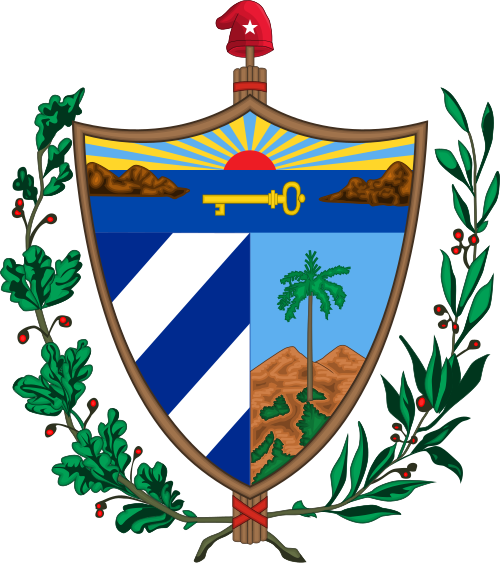
The national flag did not change in 1959 or 2019. Its five alternating blue and white stripes, red hoist triangle, and white star preceded the Republic and survived every government. Independence gave it authority before any party could claim it. That history made a reconciliation flag unnecessary and politically impossible.
The flag is flown in a 1:2 proportion. Government institutions do not add arms to it. The same design appears over schools, ships, embassies, municipal buildings, baseball grounds, private homes, demonstrations for renewal, and demonstrations for closure. Law protects it from official misuse without criminalising criticism or peaceful symbolic protest.
The coat of arms also remains unchanged. The key between Florida and Yucatán identifies Cuba’s geographic position. The rising sun, stripes, royal palm, Phrygian cap, fasces, and wreath carry layers from the independence and republican traditions. Modern heraldic unease about the fasces did not produce redesign. Cubans chose interpretation over visual cleansing.
Official use explains the arms without assigning one permanent meaning to every element. The key can describe strategic exposure and the island’s capacity to open its own future. The palm can stand for the land without pretending rural history was gentle. The cap refers to liberty, a claim every Cuban government has been required to defend against its own record.
La Bayamesa remains the anthem. Its origins in the independence war and its martial tone have not prevented civilian ownership. Schools teach its history and music. State events use the official form without reproducing partisan additions. The song belongs to a national struggle older than the Platt republic and the Revolution.
These symbols are stable because the politics beneath them are not. A new flag would have asked winners to mark victory over other Cubans. Retention asks every government to govern under evidence that the nation existed before it and will judge it afterward.
Patria o Muerte
The official motto remains Patria o Muerte. Democratic delegates considered replacing it with the older Patria y Libertad or adopting no motto. They retained the revolutionary phrase and reclaimed it as a civic promise of survival rather than a command to obey.
The choice is difficult. The motto was used by a one-party state that often treated dissent as betrayal of the homeland. “Homeland or death” could make political disagreement sound like desertion in wartime. Critics argued that no democracy should carry a slogan that appears to bind citizenship to sacrifice.
Supporters answered that Cubans had already changed the meaning of inherited institutions. The flag had flown over compromised governments. The word revolution had justified coercion and described genuine liberation. Removing the motto would concede that the ruling Party owned the language rather than the people who spoke it.
Law forbids loyalty tests. No oath requires the motto. Citizens, schools, employers, or parties cannot compel its use. It appears on formal seals, military ceremonies, monuments, and national material as the official expression of a country determined not to be governed from abroad.
In ordinary speech the phrase can be solemn, ironic, affectionate, or rejected. Baseball supporters adapt it. Artists criticise it. Veterans use it without embarrassment. Young people ask whether the country should demand death when it has difficulty supplying housing. A reclaimed civic motto remains alive partly because citizens may mock it.
The constitutional interpretation places emphasis on patria, the shared country, rather than on a party’s definition of life worth living. This may not satisfy people harmed under the slogan. Democratic Cuba does not require satisfaction. It requires that the state never again use the words as evidence against a citizen.
A calendar with competing founders
Liberation Day on 1 January is the primary national observance. It marks the fall of Batista and the victory of the Revolution. Parades, music, public service, family gatherings, military ceremony, and civic events share the day. Opposition parties participate without being required to endorse one-party rule.
The holiday’s retention confirms that the democratic settlement regards 1959 as national liberation. Public speeches honour those who resisted Batista and acknowledge the narrowing that followed. The government of the day does not control every platform. Municipalities and civic groups organise their own commemorations.
The anniversary of the Moncada attack on 26 July remains a full national holiday. It commemorates resistance and sacrifice even though the operation failed and later became the ruling Party’s founding date. The Communist Party holds its own ceremonies. The state presents the day more broadly as part of the struggle against dictatorship.
Republic Day on 20 May is a secondary observance. It marks the transfer of authority in 1902, honours the creation of Cuban institutions, and addresses the Platt conditions under which the transfer occurred. Ceremonies are quieter than those of Liberation Day. Courts, schools, veterans’ groups, and municipal governments play larger roles than mass parade.
The 10 October anniversary of the independence uprising remains central in education and local commemoration even though it is not the primary national day. The calendar therefore refuses a single founding. Independence, republic, and revolution each possess a date. The 2019 Constitution adds civic observances without claiming to begin the country again.
Public memory works through this accumulation. Monuments to independence veterans, republican reformers, labour organisers, revolutionary figures, dissidents, victims of 1912, political prisoners, emigrants, and hurricane service can occupy the same city. The state does not solve contradiction by removing every older monument. It supplies direct interpretation and builds new memorials where silence once stood.
The national archive follows the same rule. Republican police files, revolutionary trial records, Party minutes, diplomatic papers, and declassified security material open on scheduled terms with narrow judicially reviewable exceptions. Families may seek records concerning imprisonment, disappearance, confiscation, exile, or death. Officials may protect a living person’s safety or an active investigation, but cannot withhold a whole period because disclosure would embarrass an institution. The result is not a settled national account. It is a public record broad enough for incompatible accounts to be tested.
Museums increasingly pair the artefacts of achievement with the documents of coercion. A literacy manual may appear beside a teacher’s complaint about political screening. A doctor’s international-service medal may stand near a contract showing how the state retained mission income. A rebel uniform may share a gallery with the last letter of a prisoner sentenced after a defective trial. Such pairings do not require visitors to weigh unlike acts as though they cancelled one another. They prevent the government from separating everything it celebrates from everything it must answer for.
This approach has its enemies. Some revolutionaries fear that exposure will turn historical judgment into revenge. Some conservative national democrats think interpretive balance disguises criminality. Younger Cubans often reject both inherited camps and ask why every present argument must be assigned to 1959. The public institutions cannot resolve those disputes. Their democratic duty is more modest: preserve evidence, protect inquiry, and deny any party the authority to close the past.
Guantánamo and the 2028 constitutional case
A lease that would not die
The legal instrument beneath Guantánamo began in 1903. It was produced by the Platt settlement and accepted while the young Republic’s full freedom depended on terms set by the UKA. Repeal of the general intervention right in 1934 left the naval lease intact. The Havana Accord of 1962 constrained the base’s use without extinguishing it.
The revolutionary government refused to treat rent payments as validation. It protested, restricted surrounding contact, and made the base a permanent exhibit in its argument about incomplete sovereignty. The UKA treated continued possession as lawful under the lease and strategically necessary. Neither side wanted a confrontation that might endanger the non-invasion settlement.
Practical arrangements accumulated. Water, labour, access, environmental protection, rescue, and incidents required communication even at the worst points in the relationship. Officials who denounced one another in public met to prevent a fence dispute or shipping accident from becoming a military crisis.
Democratisation transformed operation without replacing the original legal root. Successive protocols created joint UKA-Cuban command structures, applied Cuban labour protections, established shared criminal and civil jurisdiction, opened environmental inspection, and allowed Cuban personnel throughout most of the installation. The old lease remained the foundation because replacing it required agreement on sovereignty that negotiators could not reach.
The result is morally awkward and operationally real. Cuba exercises authority inside a base once held against its will. The UKA retains strategic access it would not possess without the colonial instrument. Joint command is not a fiction, but neither does it cleanse the first agreement.
The modern base
Guantánamo is a full naval logistics hub. It supports repair, supply, training, intelligence, maritime patrol, and regional deployment. UKA and Cuban personnel work under defined parallel and joint chains. Major missions require agreement under the implementing protocols. Neither side may use the installation to conduct operations against the other.
The base holds no nuclear weapons. Cuba’s treaty obligations prohibit storage. Inspection procedures verify compliance without requiring disclosure of unrelated UKA capabilities elsewhere. The rule became non-negotiable during democratisation because no constitutional settlement could survive suspicion that the island again hosted a foreign nuclear deployment.
Criminal jurisdiction follows the accused, victim, location, and duty status under a detailed agreement. Cuban law governs Cuban civilians and most conduct outside secured UKA service areas. Joint panels resolve conflicts. The system is cumbersome because simplicity would usually mean one state surrendering authority.
Thousands of Cuban civilians work in logistics, repair, food, construction, administration, and support. Their union contracts use Cuban labour law. Mariela Soto, chair of the civilian dockworkers’ union, has spent much of 2028 insisting that renewal cannot introduce new UKA contractor exemptions. She supports the base because livelihoods, training, and regional security matter. She refuses the argument that workers must accept reduced citizenship in exchange.
The surrounding province benefits from wages and infrastructure and bears the symbolic burden of hosting the dispute. Residents are not united. Some want closure and conversion to a Cuban port. Others fear that sovereignty rhetoric in Havana treats local jobs as expendable. The national argument becomes most concrete in households that depend on a decision made about an instrument older than their grandparents.
Why renewal became a constitutional case
The current operating term reaches its renewal point. Negotiators produced an extension maintaining full naval functions, joint operation, labour guarantees, and existing jurisdiction. President Cárdenas supports the agreement. She argues that Cuba now consents through democratic institutions and that ordinary treaty approval is the constitutional means by which a sovereign state makes such choices.
Prime Minister Aguilera insists that renewal must go to referendum. He does not campaign for closure. His position is procedural: a foreign base created through an imposed lease touches the constitutional meaning of sovereignty too directly for ordinary ratification. He allows ministers and coalition parties to support either outcome.
The Constitution requires referendums for amendment and permits them for major public questions. It does not expressly state that a military-base renewal must receive one. The government argues that the lease’s history and duration make renewal equivalent in constitutional effect to a sovereignty decision. The President argues that treating a lawful treaty as an unwritten amendment transfers political judgment from elected institutions to courts and plebiscites.
Gabriel Suárez, leader of the conservative-national opposition, supports continued cooperation but divides from Cárdenas on process. A Florida-born returnee, he has no interest in appearing to defend a colonial shortcut. He wants a referendum and a clearer statement that Cuban consent, not inherited UKA right, authorises every future term.
The revolutionary-liberal coalition contains all three positions. Some liberals support the President. Others fear that avoiding a vote would destroy the democratic legitimacy they spent years building. Revolutionary members range from closure to neutral referendum. Aguilera can lose the coalition whether he yields or insists.
| Stage | Instrument |
|---|---|
| 1903 | The original lease, which remains the root of title |
| Successive amendments | Terms altered repeatedly, the root of the lease never replaced |
| Joint operation | UKA and Cuban personnel working under joint command |
| 2026 | Whether renewal requires a referendum, before the Supreme Court, judgment reserved |
Cárdenas and the ordinary treaty
President Isabel Cárdenas came to office promising that Cuba could deal confidently with the UKA without performing either submission or permanent grievance. Guantánamo seemed an opportunity to prove the claim. Joint operation was established. Cuban law had entered the base. The northern government accepted restrictions and public review. Refusing renewal, in her view, would sacrifice working sovereignty to the symbolism of an impossible clean past.
Her constitutional argument is institutional. The President leads defined foreign affairs, Cabinet participates in policy, and the Assembly ratifies treaties. Those bodies have direct democratic authority. Requiring a referendum not named by the text could encourage future governments to avoid responsibility whenever a decision carries historical weight.
Cárdenas also stresses strategy. Maritime trafficking, rescue, intelligence, and disaster response are regional problems. Cuba benefits from UKA equipment and reach. The base gives Cuban officers access to joint planning while preserving non-allied status. Closure would not remove the UKA from the Caribbean. It would remove Cuba from one table at which UKA power is constrained.
Her opponents hear an old argument in modern language: foreign capacity presented as something Cuba cannot manage without. They note that economic benefit makes consent harder to judge when a poor region fears losing jobs. Some liberals answer that dependence should be reduced through development, not denied by pretending the base supplies nothing useful.
The President has not used her veto, dismissal, or dissolution powers to force the matter. She has submitted the legal question and continued to argue. Her restraint is strategic and constitutional. A victory obtained by breaking the coalition could leave the treaty lawful and politically unusable.
Aguilera and the people’s consent
Tomás Aguilera’s revolutionary identity is democratic and labour-centred. He accepts the joint base, close UKA relations, compensation of property claims, private enterprise, and competitive politics. His insistence on a referendum does not come from a programme of restoring the one-party state or severing relations.
He argues that the democratic Republic inherited a lease no Cuban government could freely refuse in 1903. Amendments improved its operation without changing that origin. A referendum would supply the consent the original instrument lacked. If voters renew, the result would strengthen the base more than another parliamentary vote. If they reject, the UKA would leave under the process it pledged to respect.
Aguilera remains neutral on the outcome because he leads a divided coalition and because he believes procedure is the present question. Hard revolutionary supporters accuse him of hiding behind neutrality. Liberal ministers accuse him of turning a legal ambiguity into a political crisis. Union supporters note that a Prime Minister who once represented workers cannot ignore communities facing sudden closure.
Ordinary confidence rules make the danger immediate. Liberal coalition members could leave Cabinet. The Assembly could remove Aguilera by simple majority. The President could then appoint another viable leader or accept dissolution advice. Every actor understands that a disagreement over whether people must vote may itself send them to an election.
Aguilera has refused to make the case a confidence motion before judgment. This keeps legislators free to argue and prevents the Court from appearing to decide whether the government survives. It also leaves the coalition suspended, conducting ordinary business while its members organise against one another outside Parliament.
The Supreme Court hearing
Chief Justice Lucía Benítez presides over a nine-member Court whose authority was designed for disputes like this and never tested by one of equal historical weight. Petitioners include legislators, civic organisations, and residents. The Court accepted jurisdiction, heard the merits, and declined to interrupt full operations while the current term remains legally effective.
The arguments turn on text, structure, and constitutional history. The referendum side points to popular sovereignty, the amendment rule, the exceptional duration of the lease, and the Constitution’s anti-subordination commitments. It says formal sovereignty is incomplete if institutions can renew a foreign military presence rooted in coercion without direct consent.
The ordinary-treaty side points to enumerated presidential and Assembly powers. It warns that courts cannot add referendum requirements based on moral seriousness. Many treaties constrain future action. If Guantánamo is exceptional, the Constitution should say how, or the Assembly should propose an amendment and ask voters to approve it.
Questions from the bench have unsettled both sides. Some judges ask whether democratic amendments have converted the lease into a new consensual arrangement despite its title. Others ask whether repeated amendment can cure an origin the Republic had no power to reject. The Chief Justice has pressed advocates to identify a rule that decides this case without making every defence agreement a constitutional referendum.
The hearing is complete and judgment reserved. The Court issued no injunction. Ships, training, intelligence work, and logistics continue. This choice has been criticised as favouring the status quo. The Court answered only that immediate disruption before judgment would decide practical questions the litigation was meant to leave open.
A country campaigns before it knows whether it may vote
Public opinion narrowly favours renewal. The margin changes with the wording of the question and the conditions attached. Support rises when respondents hear that joint command and jobs continue. Opposition rises when the 1903 date is stated first. A clear majority believes that the people should decide even when many of those voters support the base.
Rival marches remain peaceful. Renewal supporters carry signs about work, security, rescue, and mature partnership. Opponents carry the lone star beside copies of the lease date and slogans about completing independence. University debates fill halls. Municipal assemblies pass conflicting resolutions. Clergy, veterans, scientists, port workers, exile organisations, and constitutional lawyers publish arguments.
Limited strikes occur at transport and public facilities, governed by ordinary labour law. Base workers have not struck against operations because their union is divided and Soto opposes using safety-sensitive work as a political weapon. They hold meetings, march off duty, and demand a binding guarantee that no extension weakens Cuban law.
There has been no serious political violence. Police operate under local oversight and court-enforceable rules. The old revolutionary state would have described some campaigns as foreign-directed. The democratic government requires evidence. UKA money in advocacy is disclosed and limited. Cuban organisations may receive lawful international support without becoming foreign agents by label.
The public argument has made the constitutional system visible. Citizens who never read treaty clauses now distinguish ratification from referendum, presidential mandate from Assembly confidence, and a reserved judgment from an interim order. This does not make every discussion accurate. It makes institutional literacy a fact of ordinary politics.
The UKA waits
The UKA government publicly promises to respect the Cuban process. It has stopped short of campaigning for renewal. Officials answer operational questions, prepare legal submissions when invited, and refuse to predict the Court. Naval planners prepare for continued operation, renegotiation, and withdrawal.
This restraint reflects principle and memory. Open pressure would strengthen the argument that the base remains an instrument of subordination. Threats involving trade, intelligence, or migration would make free consent impossible. The UKA has communicated the costs of closure through formal technical channels without presenting them as punishment.
Florida politics is louder. Diaspora voters and base families campaign on both sides. Some early-exile organisations regard closure as overdue. Others consider the joint base proof that Cuba and the UKA can turn an imposed relationship into lawful partnership. Commercial interests emphasise stability. Civil-liberties groups focus on jurisdiction and historical accountability.
The UKA Parliament has debated whether an affirmative Cuban referendum should be required as a matter of northern law even if the Cuban Court does not require one. The ministry resists legislating during the case. It also knows that renewal approved only through a divided Assembly could become a permanent political liability.
No UKA ministry claims a right to remain regardless of Cuba’s decision. The old lease may still supply a legal argument for continued possession. Modern policy has abandoned it. If Cuba lawfully says leave, the UKA says it will leave. That promise is one of the most important facts in the case and one reason Cubans can argue without mobilisation becoming a prelude to war.
The shorter bridge
Between renewal and closure lies a possible shorter agreement. It would extend operations for a limited period, narrow unilateral UKA rights, strengthen fully joint mission approval, guarantee Cuban labour and environmental jurisdiction, and require a binding referendum before any longer term. Neither government has formally endorsed the package.
For Cárdenas, a temporary agreement risks conceding that the present treaty process is inadequate. It may also rescue the strategic relationship from a judgment or political defeat. For Aguilera, it provides the referendum he demands without forcing immediate closure. It may look like delay offered in place of principle.
Soto’s union supports discussion if employment and training are protected through the interim term. Closure campaigners reject another extension of a lease they consider invalid. Some renewal advocates welcome the chance to win explicit consent. Others fear a long campaign in which every regional incident becomes evidence against the base.
The Court may decide that ordinary ratification is sufficient, that a referendum is constitutionally required, or that the question belongs to political institutions under standards it must specify. No outcome is presently the more likely, and the existence of an available compromise does not make one inevitable.
The machinery of government continues while judgment is reserved. Aguilera chairs Cabinet. Cárdenas receives foreign representatives and military briefings. The Assembly legislates on housing, energy, and health. At Guantánamo, joint shifts change, ships enter, and Mariela Soto checks that a contractor has honoured the collective agreement. A constitutional crisis is still made of ordinary work.
An island that chose more than once
Cuba’s sovereignty has never been a single event. Independence removed Spain and admitted the UKA. Repeal removed the intervention right and left the base. Revolution removed foreign ownership and political pluralism. Democratisation removed monopoly and preserved the Revolution. Every recovery carried an inheritance it could not or would not discard.
That history explains the force of both positions. Cárdenas sees sovereignty in the capacity of elected institutions to consent without fear. Aguilera sees it in the people’s right to answer a question first decided under occupation. Suárez wants the referendum to prevent democratic partnership from resting on colonial silence. Soto asks whether any national answer will respect the citizens who work inside the symbol.
The flag above the Assembly offers no instruction. It belonged to the independence armies before the 1902 Republic, to the corrupt republic and its reformers, to Batista’s opponents, to the revolutionary government, to prisoners and exiles, and to the voters who made the Communist Party compete. Its continuity is not proof that the state beneath it remained the same. It is evidence that Cubans continued to argue over who could speak in its name.
Late in the day, President Cárdenas arrives at the Prime Minister’s office. Their staffs have exchanged drafts of a possible temporary extension. Neither leader has accepted the other’s constitutional position. Outside, one march moves towards the Assembly and another gathers nearer the sea. The Supreme Court gives no indication when judgment will be delivered.
At the base, operations continue. No referendum has been called. No treaty has been renewed. No withdrawal order has been issued. The coalition has not fallen. The shorter agreement exists only in working papers held between two offices whose occupants understand that compromise can preserve a relationship and postpone its reckoning at the same time.
Trivia
- In-Universe Cuba's Communist Party surrendered its constitutional monopoly, contested competitive elections, governed, lost the presidency, and remained in Parliament. That sequence, rather than any single election, is the central fact of the modern republic.
- In-Universe The flag has never changed. The same five stripes, red triangle, and white star flew when occupation ended in 1902, when the Revolution triumphed in 1959, and when voters ended one-party rule.
- In-Universe The legal ancestry of the Guantánamo base still begins with a lease signed in 1903. Successive amendments altered its terms and created joint command, but none of them replaced the root of the original instrument.
- In-Universe The National Assembly is unicameral, seats 360 members elected by regional single transferable vote, and sits for four-year terms.
- In-Universe The Isle of Youth is specially autonomous and is not an ordinary province. The fifteen provinces are administratively narrow, while the municipalities hold the strong democratic powers and allocate real budgets.
- In-Universe Sovereignty in Cuba is rarely abstract. Foreign policy is a naval shift at Guantánamo, monetary reform is the price of cooking oil in a municipal shop, and climate policy is a seawall, a mangrove belt, or a decision that a village can no longer be defended.
- Real-World In our world Cuba remains a one-party communist state, and the missile crisis of 1962 followed the Bay of Pigs invasion. Here there was no Bay of Pigs, a Caribbean Missile Crisis still occurred, and it was settled by a tripartite Havana Accord that included the quiet withdrawal of UKA missiles from Byzantium.
- Real-World Cuban communism in this setting arose without a Soviet Union to sponsor it, and the Special Period was produced by Russian retrenchment and domestic weakness rather than by a Soviet collapse.
- Real-World The flag is the real Cuban flag at its true proportion of 1:2: five equal stripes of blue and white, a red equilateral triangle at the hoist, and a single white five-pointed star.
See also
- The Republic of Florida, the nearest UKA shore and home of the largest Cuban diaspora
- Mexico, Cuba’s principal large Latin American partner
- The Russian Republic, the anti-communist republic that armed the island and later estranged itself from it
- The Byzantine Federation, from which UKA missiles were quietly withdrawn under the Havana Accord
- The Union of South Africa, where Cuban medicine, training, and technical work went without a major combat deployment
- The First Great War and The Second Great War, in both of which Cuba fought alongside the UKA
- Theodore Roosevelt and Franklin D. Roosevelt, the UKA Prime Ministers of the 1898 settlement and the 1934 repeal
Cuba · Republic · Caribbean · Foreign Nations · The Revolution