New Albion
New Albion is the northern sister realm of the United Kingdom of America: a sovereign federal parliamentary constitutional monarchy of eight provinces and three territories, sharing the same Hanoverian King, economically fused to the Realm, culturally familiar to Americans, politically separate, bilingual, Arctic-facing, and burdened by an Indigenous settlement in which rights are recognised, reconciliation is promised, and justice remains unfinished. Its capital is Ottawa, its largest city Toronto, and its people number about forty-three million across the second largest territory of any state in the world.
New Albion is not a northern province of the UKA and not a subordinate realm. It has its own Parliament, its own responsible government, its own courts, its own foreign policy, its own armed forces, and its own constitutional instrument. The shared monarch does not create a shared government, the open border does not create shared citizenship, and the economic integration does not create shared sovereignty. The realm is at once familiar, restrained, bilingual, resource-rich, bureaucratically capable, regionally fractious, and persistently attentive to the question of how close it can stand to the United Kingdom of America without ceasing to be distinct from it.
Its history is the history of that question. The northern colonies stayed British when the southern ones made their covenant with the Crown in 1783, and federated in 1867 under Ernest II, who chose their capital himself. The federation took the Hudson’s Bay Company’s country as one great province, Rupert’s Land, which runs from the bay to the Rockies and is governed from a port on the bay. It fought the First Great War beside the Realm and against France, and made its nation on Vimy Ridge in 1917 by taking it from the French; it fought the Second against a fascist France and came ashore in Brittany in 1944. It has had reciprocity with the Realm since 1911, a dollar pegged to the American pound since the same year, and a constitution of its own since 1982, which Quebec never signed and which governs Quebec by a convention of being listened to rather than by any clause.
Where the United Kingdom of America is loud, procedural, media-saturated, and constitutionally theatrical, New Albion is colder, quieter, more administrative, and more suspicious of spectacle. Its politics are not mild; they are compressed. Arguments happen through commissions, provincial conferences, court references, budget tables, party caucuses, and carefully worded statements read under fluorescent lights during snowstorms. The realm presents itself as a careful, lawful, public-service monarchy while carrying a legacy of Indigenous dispossession, residential schools, reserve poverty, resource disputes, and reconciliation promises that have often been slower than the harm they answer.
Ernest V was closer to New Albion than to any of his realms but two. He spent his summers from 1972 at a lodge on a lake in the Laurentian hills, he apologised there in 2022 for the residential schools, and he was flying to Ottawa when his aircraft was lost east of Newfoundland on 25 September 2028. New Albion’s rescue centre at Halifax directed the search, a crab boat from Bay Bulls found him, and on 6 October 2028 Parliament at Ottawa made Queen Christina Regent of New Albion. On 31 October 2028 Parliament gave effect to his abdication, and his son became King of New Albion as George V.
Etymology
Albion is one of the oldest recorded names for the island of Great Britain, older in the written record than Britannia and used by Greek and Latin geographers before the latter displaced it in ordinary administrative use. Its root is generally traced either to a Latin or Celtic element meaning white, taken to refer to the chalk cliffs of the southern English coast as seen from the water, or to a related word for a height or high land. After Britannia became the standard name, Albion survived as a literary, poetic and ceremonial alternative, a word reached for when the island was to be spoken of as an ancient thing rather than as a modern state.
The northern realm carries that old name into new geography, and it carries it because nobody could agree on the other one. Before 1867 the colony on the St Lawrence was Canada, the name the French had taken from an Iroquoian word for a village and applied to the river valley in the sixteenth century. At the conferences that made the federation, the delegates of Nova Scotia and New Brunswick refused to join a country called Canada, which to them meant the St Lawrence colony and the dominance of Quebec and Montreal over everyone else, and the Canadian delegates would not accept a Maritime name. New Albion, proposed as a statement of descent from the older island realm and its Crown, was the compromise. It was not a description of the territory, which resembles Britain in neither climate nor form, and it was not anybody’s first choice.
French Canadians resented the loss of the name more than anyone, since it had been theirs for three centuries. They kept it in the only place they could: le Canada is still the name in Quebec for the old heartland of the St Lawrence valley between Quebec City and Montreal, and the French words of the national anthem still begin with it. The realm’s name is English; almost everything the realm is built on is not, and the tension between the two is a feature of the country rather than an embarrassment to it.
The formal name is simply New Albion. The New Albion Act 1867 attached no style word to it, neither kingdom nor dominion, and none has been added since. In French, which has equal official standing, the realm is la Nouvelle-Albion, and federal legislation is enacted in both forms with equal authority. Neither version is a translation of the other in law.
Citizens are Albians in law and in formal use: Albian citizenship, the Albian Armed Forces, an Albian passport. In ordinary speech the longer New Albionite is at least as common, and New Albioner is heard in parts of the west and the Atlantic provinces; francophone usage prefers Néo-Albionais. That the formal demonym is the shorter of the two is one of the small facts Albians enjoy explaining. In conversation in the UKA the realm is very often simply called the north, a usage New Albionites tolerate from each other and resent from Americans.
The realm’s internal toponymy is overwhelmingly Indigenous and French rather than English. Ontario, Quebec, Manitoba, Saskatchewan, Yukon and Nunavut all descend from Indigenous words, most of them describing water: a great lake, a narrowing of the river, a strait, a swift-flowing current, a great river, and, in the case of Nunavut, an Inuktitut phrase meaning our land. Quebec City, Montreal, Trois-Rivières and a dense scatter of prairie and northern place names are French. British Columbia, New Brunswick, Nova Scotia, Prince Edward Island and Newfoundland carry the imported names of the Atlantic and Pacific settlements, and Rupert’s Land carries the name of a seventeenth-century prince who never saw it. The result is a realm with an English name, a French legal tradition in one founding province, and a map written mostly in languages that the state took two centuries to begin teaching in its own schools.
History
The first peoples and New France
The territory of the modern realm was settled first by Indigenous nations across the whole of its extent: the Mi’kmaq and Wolastoqiyik of the Atlantic coast, the Haudenosaunee and the Wendat of the Great Lakes, the Anishinaabe, Cree and Dene across the Shield and the north, the Blackfoot and the other nations of the plains, the peoples of the Pacific coast with their cedar towns and their potlatch, and the Inuit of the Arctic. Their country was not empty, and their treaties with each other were old when the first Europeans arrived.
Jacques Cartier sailed into the Gulf of St Lawrence in 1534 and claimed it for France. Samuel de Champlain founded Quebec in 1608, and New France grew along the river as a society of farms, fur posts and missions, small, Catholic, civil-law and governed from Versailles. In the north, the Hudson’s Bay Company, chartered in London in 1670, claimed every land draining into Hudson Bay and called it Rupert’s Land after its first governor, Prince Rupert of the Rhine. The two empires fought over the continent for a century. In 1755 the British expelled the French-speaking Acadians of Nova Scotia, scattering some ten thousand people along the coasts to the south and to France, an act that the Acadians of New Brunswick still mark as le Grand Dérangement. In 1759 the British took Quebec on the Plains of Abraham, and in 1763 France ceded New France.
The conquerors did not try for long to make the conquered English. The Quebec Act of 1774 guaranteed the French civil law, the seigneurial land system and the free exercise of the Catholic religion, and it was one of the measures that the southern colonies listed against the Crown in 1776. It left a French-speaking and civil-law society under an English-speaking Crown, which is the layered inheritance on which the later federation was assembled.
The Four-Year War and the loyal north
During the Four-Year War a Continental expedition into Canada, intended to take Quebec, failed before the city in the closing days of 1775. Canada remained British, and the border fixed in the settlement that followed later formed part of the territory of New Albion. Because the war ended in covenant rather than in separation, the northward movement of loyal families was far smaller than a general exodus, but it was real, and it seeded the northern settlements with a population whose political memory was of a Crown retained rather than a Crown rejected. Among them were the Black Loyalists, who had been promised freedom for service to the Crown and who were carried to Halifax and Annapolis Royal in 1780. The northern colonies developed alongside the American settlement without sharing its constitutional rupture, and the difference in temperament between the two realms dates from that period rather than from any later quarrel.
There was no later war between them. The northern colonies and the Realm went to the edge of one only once, in the Aroostook quarrel of 1838 and 1839, when lumbermen of Maine and of the colony of New Brunswick fought over the timber of a disputed valley and both sides called out militia. It was settled by an award in 1842 that gave Maine somewhat more than New Brunswick, and the frontier that resulted came to be called the longest undefended border on earth.
The colonies, 1791 to 1867
In 1791 the old province of Quebec was divided into Upper Canada, English-speaking and Loyalist, and Lower Canada, French-speaking and Catholic, each with an elected assembly and a governor who did not have to listen to it. In 1837 and 1838 reformers in both rose against the governors and the small oligarchies that surrounded them, under William Lyon Mackenzie in Upper Canada and Louis-Joseph Papineau in Lower Canada. The risings were put down, and the rebels hanged or transported. Lord Durham, sent from London to report, recommended that the two Canadas be united and that the colony be given responsible government, a ministry answerable to the elected assembly, and that the French be assimilated. London accepted the first recommendation in 1840, the second in 1848, and the third never worked.
The united Province of Canada was deadlocked between its two halves within twenty years. The reciprocity treaty of the 1850s with the Realm gave the colonies free trade in natural products and showed them what a larger market could do; its end, and the fear that the Realm might one day want more than trade, persuaded the colonial politicians that union was the answer. The Charlottetown and Quebec conferences of 1864 drew up the plan. Its architects were John A. Macdonald of Upper Canada, George-Étienne Cartier of Lower Canada and George Brown of the Toronto Globe, and the plan they made was a federation in which the French of the St Lawrence would have a province of their own.
Confederation and the northern Crown, 1867
The New Albion Act 1867 was passed by the British Parliament at the colonies’ request and came into force on 1 July 1867, during the reign of Ernest II. It joined Ontario, Quebec, Nova Scotia and New Brunswick into a single federal state under a Parliament at Ottawa. Ernest II had chosen Ottawa himself the year before, as a compromise between Toronto and Quebec City, a small lumber town on the river between the two halves of the old Province whose chief recommendation was that it was neither, and the new Parliament buildings were already rising on the hill above the river.
The same Act brought the Crown of New Albion into the personal union as a distinct legal capacity: the oldest of the sister-realm titles added after the founding trio of Great Britain, Hanover and the United Kingdom of America. From that point the monarch reigned in New Albion on New Albion advice, through New Albion institutions, in all the realm’s domestic government. Because the Act itself was a British statute, however, London kept for another two generations a role it did not much use: the power to amend the Act, to disallow a federal law, and to hear appeals from New Albion’s courts. The realm’s constitutional history after 1867 is largely the history of taking those powers home one at a time.
The federal structure adopted at Confederation gave the provinces control of property and civil rights, natural resources, health and education, and gave the central Parliament trade, currency, banking, defence and the external relationship. Quebec kept its civil law under the Code, and its Catholic schools were protected. Those allocations have proved more durable than any subsequent political settlement, and most of the realm’s later constitutional disputes are arguments about their edges rather than about their existence. Macdonald was the first prime minister, from 1867 to 1873 and again from 1878 until his death in office in 1891.
Rupert’s Land, the Red River and Riel
In 1869 the Hudson’s Bay Company surrendered Rupert’s Land to the Crown, and in 1870 it passed to New Albion. Ottawa made the whole of it a single province at once, the largest in the federation: every land draining into Hudson Bay west of Ontario, from the bay shore to the Rocky Mountains, from the prairie at the border to the barren grounds in the north. Its capital was placed at Churchill, the Company’s old harbour at the mouth of the Churchill River, by a federal government that wanted the province to face the bay and London rather than the plains and the Realm.
The people already living there had not been asked. At the Red River, where the Assiniboine meets the Red, a settled community of about ten thousand Métis, French-speaking and Catholic, the descendants of fur traders and Cree and Ojibwe women, formed a provisional government under Louis Riel in 1869, turned back the federal surveyors, and demanded a province of their own, which they proposed to call Manitoba. Ottawa would not divide Rupert’s Land, but it negotiated. The settlement of 1870 gave the Métis a self-governing Red River district inside the new province, with land guarantees for their families, French and English schools and their own council. Riel was not included in it. During the resistance his government had executed an Ontario Orangeman, Thomas Scott, and Ontario demanded his head; he went into exile.
Within twenty years the guarantees had failed. Settlers from Ontario and from Europe came west on the railway and outnumbered the Métis many times over, the district’s council was swamped, and the land promised to Métis families went, by fraud, sale and delay, to others. Many Métis moved further west along the Saskatchewan. In 1885 they and their Cree allies rose again, with Riel recalled from Montana to lead them, and were defeated at Batoche by a federal army sent west on the unfinished railway. Riel was tried for treason at Regina and sentenced to death.
Then the King intervened, on advice. Quebec demanded mercy for a French Catholic it regarded as a patriot; Ontario demanded the sentence carried out. Macdonald’s cabinet split, and in November 1885 it advised Ernest II to commute the sentence to banishment for life. Riel was taken under guard to the border and released into exile, and he died in Montana in 1900. The commutation pleased nobody. Ontario’s Orange lodges called it a surrender to Quebec; Quebec, which had wanted a pardon, called exile a sentence of death by other means. It was the first time an Albian government had made the Crown carry a decision it could not carry itself, and the argument about whether that was statesmanship or evasion has never been settled.
The numbered treaties and westward settlement
Federation was followed by the westward extension of the realm across the interior plains, carried out through the railway, the survey, the land grant and the treaty. Eleven numbered treaties, signed between 1871 and 1921 with the First Nations of the plains, the Shield and the Mackenzie, in the name of Ernest II and his successors, are the legal foundation of the settlement of the west. They made the Crown the formal treaty partner of the nations that signed them, and their terms, reserves, annual payments, schools, farming tools, and the medicine chest that the nations read as a promise of health care, have been argued about in courts ever since.
The North-West Mounted Police, founded in 1873 to keep order in Rupert’s Land ahead of the settlers and to stop the whisky trade from the Realm, marched west in 1874. The Indian Act of 1876 put the reserves under federal agents, banned the potlatch and the sun dance, and for a time required a pass for a First Nations person to leave a reserve.
British Columbia, on the Pacific, had joined the federation in 1871 on the promise of a railway to the coast within ten years, and Prince Edward Island followed in 1873. The railway was the Hudson Bay and Pacific, and it ran first not straight west but north: from the Ottawa valley through the Shield to the bay at Churchill, and from Churchill south-west across the prairie to the Rockies and through the passes to the coast. The northern loop cost a year and a great deal of money, and it made Churchill a railway town and a grain port as well as a capital. The last spike was driven in 1886. The southern prairie line, which most of the traffic now uses, followed in the 1890s.
The same decades brought the gold rush that opened the Yukon in 1896, where some hundred thousand prospectors, many of them from the Realm, came in over the Alaska passes. Because the boundary with Alaska had been fixed in the 1870s by a treaty between London and Johann II of Liechtenstein, who then held Alaska as a private domain of his house, the rush produced a city at Dawson and no boundary dispute. The wheat economy populated the plains of Rupert’s Land with settlers from Ontario, Britain, Ukraine, Scandinavia and Germany, and the pattern of settlement that followed, close to the southern border and strung along the rail lines, still describes where New Albionites live.
The residential schools
Alongside the treaties the realm built the residential school system, which forcibly removed Indigenous children from their families and communities in order to assimilate them into settler culture. Run by the churches and paid for by Ottawa, about a hundred and thirty schools operated across the realm from the 1880s, and the last of them closed in 1996. About a hundred and fifty thousand children passed through them. The system was administered in the Crown’s name, and it produced the deaths, the abuse, the severed families and the language loss that later inquiries documented. It is the single gravest act of the New Albion state, and it was not incidental to the realm’s expansion but part of its method.
Laurier and reciprocity
Wilfrid Laurier, a Quebec lawyer and the first French Canadian to lead the federation, became prime minister in 1896. He governed during the wheat boom, admitted the Yukon as a territory, and spent fifteen years balancing English and French New Albion on matters, schools and the Empire, where each wanted something the other could not give.
In 1911 he fought a general election on reciprocity with the Realm, free trade in most goods between the two realms, and won it. The Conservatives had warned that reciprocity meant annexation by stages, and lost. The agreement that followed opened the border to trade, began the integration of the two economies that is now nearly complete, and fixed the New Albion dollar to the American pound at a set rate, where it has stayed ever since. Laurier’s victory is the reason the realm’s economy grew up facing south.
The First Great War
When the First Great War began in August 1914, New Albion went to war as one of the realms of the Crown allied to Germany, beside Britain and the United Kingdom of America, against France, Russia and their allies. It went as a distinct realm rather than as a colonial contingent, and it sent an army corps to France.
For Quebec the war was an agony from its first day. French Canadians had no love for the anticlerical Republic, but France was the old mother country, the name on their church registers and their language, and the realm was asking their sons to invade it. Laurier, who had led the realm into the war out of loyalty to the alliance and the Crown, lost his Quebec following in the attempt to hold it, and he resigned in 1916, broken by it. Robert Borden of Nova Scotia succeeded him and formed a Union government of Conservatives and English-speaking Liberals.
The Albian Corps fought in the Ypres salient, where its medical officer John McCrae wrote In Flanders Fields in 1915, and in the battles of attrition in Artois and on the Somme. On 1 July 1916 the Newfoundland Regiment, which belonged to a separate British colony and not yet to New Albion, was destroyed in half an hour attacking the French lines at Beaumont-Hamel. In April 1917 the four divisions of the Albian Corps attacked together for the first time and took Vimy Ridge, the high ground of Artois, from the French army that held it. It was a victory against the country from which a quarter of the realm descended, and it is remembered in New Albion as the moment the realm became a nation: the four divisions from every province, the plan their own, the ridge taken in three days. The memorial on the ridge, on French soil, was built in the 1930s by agreement with the French Republic, and stands on the side from which the Albians attacked.
In 1917 Borden brought in conscription. In Quebec it was resisted as nowhere else in the realm, and at Easter 1918 soldiers fired on rioters in Quebec City and killed four. In December 1917 a munitions ship bound for the front blew up in Halifax harbour and destroyed the north end of the city, killing about two thousand people; a relief train came overnight from Boston, and Nova Scotia has sent Boston a Christmas tree every year since. Several provinces went dry during the war under provincial prohibition, and repealed it within a decade. Quebec never went dry at all, and for fourteen years its liquor ran south into the Realm across the Vermont line.
About sixty thousand Albians died in the war, proportionately more than the Realm lost, and New Albion signed the peace in its own name and joined the League of Nations in 1920 as a founding member in its own right.
Mackenzie King and the Statute, 1921 to 1939
William Lyon Mackenzie King, the grandson of the rebel of 1837, governed for most of the next quarter-century, the longest-serving prime minister in the realm’s history and its most careful. He was not a man who made decisions he could postpone, and he postponed a great many, but under him the realm acquired the rest of its sovereignty. The imperial conferences of the 1920s settled that each realm’s ministers alone advised the King on that realm’s affairs, and the Statute of Westminster 1931 ended the British Parliament’s power to legislate for New Albion, except to amend the New Albion Act itself, which the federal and provincial governments could not agree how to amend at home.
The Depression fell on the plains of Rupert’s Land with drought as well as collapse, and its politics produced the parties of the prairie left and right that the realm still has. The New Albion Broadcasting Corporation, the public broadcaster, was founded in 1936 to hold a cultural space against the radio of the south. The realm’s motto, A mari usque ad mare, from sea to sea, had been taken from the seventy-second psalm and adopted with the arms in 1921.
The Second Great War
New Albion declared war in 1939 by its own act, days after Britain, when the fascist regime in France invaded the Low Countries, and, from December 1941, Japan. This time Quebec went willingly. The France of 1939 was not the mother country but a regime that had persecuted the Church and imprisoned its priests, and the province that had rioted against conscription in 1918 sent its regiments overseas in 1939 as volunteers. When King finally brought in overseas conscription in 1944, with his famous formula of conscription if necessary but not necessarily conscription, the crisis that followed was small, and the contrast with 1917 is the point that Albian historians make most often about the two wars.
The realm supplied armies, airmen, ships, industry and the Atlantic routes on which the alliance in Europe depended. The convoys to Britain sailed from Halifax. The air training scheme of the Commonwealth trained more than a hundred thousand aircrew on the flat, empty prairie of Rupert’s Land. On 6 June 1944 the Albian Army came ashore in Brittany, on a beach of its own in the main landings of Operation Overlord, beside the British and the Realm’s armies, and fought through the Breton peninsula and into the Low Countries, where it cleared the approaches to Antwerp along the Scheldt in the autumn. Quebec’s regiments entered French towns as liberators, speaking French, and the reconciliation between New Albion and France dates from that winter.
The war built the industrial base of central New Albion, drew women into the wartime workforce, expanded the federal government’s fiscal reach permanently, and left the realm with a merchant and naval capacity out of proportion to its population. It also fixed the realm’s postwar strategic posture: an Atlantic and Arctic power, allied to the Realm without being subsumed by it.
St Laurent and the postwar realm, 1948 to 1957
Louis St Laurent, a Quebec City lawyer, succeeded King in 1948 and gave the realm nine years of prosperous, unexciting government. Three things done in his first year defined the postwar realm. On 4 April 1949 New Albion was a founding member of the Atlantic Treaty Organization, the first Albian alliance in peacetime. The same year Parliament abolished appeals to the Judicial Committee of the Privy Council in London, and the Supreme Court of New Albion became the realm’s final court.
And on 31 March 1949 Newfoundland joined the federation. The island had been a separate British colony, a self-governing one, until the Depression bankrupted it in the 1930s and London took its government back into commission. When the war was over its people were offered three choices in a referendum: to restore their own responsible government, to join New Albion, or to join the United Kingdom of America as a polity of the Realm, which a party of St John’s merchants proposed and which the Realm’s government let it be known it would consider. In the first round the Realm came second. In the second, between New Albion and restored independence, New Albion won by about fifty-two per cent to forty-eight. Newfoundland brought Labrador with it, a coast and an interior larger than the island, and a temperament the rest of the realm has never entirely absorbed.
The postwar decades produced the institutions by which New Albionites now recognise their own state: federal transfers between richer and poorer provinces, unemployment insurance, family allowances, a bilingual federal public service, and the public broadcaster’s television service. St Laurent’s external minister, Lester Pearson, won the Nobel Peace Prize in 1957 for proposing the armed force the League sent into the Suez Canal zone after Qantara, the largest it had then sent, which made peacekeeping the realm’s preferred idea of itself for a generation.
Diefenbaker, the Arrow and the radar lines
John Diefenbaker, a criminal lawyer from the Saskatchewan country of Rupert’s Land, won the election of 1957 and the largest majority the realm had then seen in 1958. He was the first prime minister from Rupert’s Land, and the province has never forgotten it. He brought in the realm’s first Bill of Rights in 1960, a statute rather than a constitutional guarantee, and he gave the vote in federal elections to First Nations people who had kept their treaty status.
He is remembered for the Avro Arrow. The realm had designed and built a supersonic interceptor at Toronto, the most advanced fighter of its day, and in 1959 Diefenbaker cancelled it, under pressure from the Eisenhower ministry in the Realm, which wanted New Albion to buy American aircraft and missiles and argued that the bomber the Arrow was built to catch was about to be replaced by the missile. Fourteen thousand workers lost their jobs on a single day, the aircraft and their plans were destroyed, and many of the Arrow’s engineers went south to work on the Realm’s space programme. It is the realm’s great industrial grievance, and the Arrow is still argued about in a way no other aircraft is argued about anywhere.
The same years made the Arctic the realm’s front line. In the long rivalry with the Russian Republic, the shortest way for bombers between the two powers ran over the pole, and in the 1950s the two realms built three lines of early-warning radar stations across the north, the farthest of them along the Arctic coast. In 1958 they placed the air defence of the continent under a joint command of the two realms, with its headquarters in the Realm and an Albian deputy commander, which it has kept ever since. In 1962 the Saskatchewan region of Rupert’s Land, under the provincial government of Tommy Douglas, introduced the first public medical insurance in the realm, against a doctors’ strike. It was national within four years. In 2004 the NABC’s viewers voted Douglas the greatest Albian.
Pearson and the flag, 1963 to 1968
Lester Pearson was prime minister from 1963 to 1968, at the head of two minority governments that accomplished more than most majorities. They created the pension plan and national medicare, and they gave the realm its flag.
Before 1965 New Albion flew a red ensign with the realm’s arms in the fly. Pearson wanted a flag that was the realm’s alone, and the debate in Parliament lasted six months. It turned, in the end, on colour. A leaf on red and white was the design most members liked, but red was read across the realm as the colour of the Realm’s ensign, and the Atlantic and western members argued that a realm whose motto was from sea to sea should carry the sea on its flag. The flag adopted on 15 February 1965 has a red maple leaf on a white square between two bars of dark blue. It is the only national flag in the Crown’s realms on which the maple leaf appears, and New Albionites regard the blue as the thing that makes it theirs.
The centennial year of 1967 was marked by the World’s Fair at Montreal, on islands built in the St Lawrence for it, which some fifty million people visited. It was opened by Ernest IV, who spoke in French first. Albians of that generation date the realm’s self-confidence from that summer.
The Quiet Revolution
In Quebec the 1960s were the Quiet Revolution. A Liberal provincial government elected in 1960 took the schools and hospitals from the Church, created a ministry of education, nationalised the private power companies into Hydro-Québec, and set out to make French the language in which Quebec did business as well as the one in which it prayed. The Church, which had governed Quebec’s private life for two centuries, lost its hold within a decade, and the province now records some of the lowest rates of church attendance in the realm.
The energy of the Quiet Revolution went into autonomy, not independence. Quebec had fought France twice as a province of New Albion, and the French nationalism that might have pulled it towards separation was cooler than it would otherwise have been; a sovereignty movement existed, and never commanded a majority or obtained a referendum. A small terrorist group, the Front de libération du Québec, set off bombs through the 1960s, and in October 1970 it kidnapped a British trade commissioner in Montreal and murdered the Quebec minister of labour, Pierre Laporte. The federal government invoked the War Measures Act, sent troops into Montreal and detained some five hundred people without charge. The crisis destroyed the FLQ, and the argument about whether the response was proportionate has outlived it by half a century. In 1977 Quebec passed its Charter of the French Language, which made French the language of work, signs and schooling in the province.
Pierre Trudeau and the constitution, 1968 to 1984
Pierre Elliott Trudeau, a Montreal law professor, was prime minister from 1968 to 1979 and again from 1980 to 1984. He was a federalist who believed that French Canadians should be at home everywhere in the realm rather than sovereign in one province of it, and his Official Languages Act of 1969 made the federal government bilingual in every province.
He kept New Albion out of the Realm’s war in Indochina, as Pearson had before him, and the realm took in some fifty thousand young men of the Realm who would not be drafted to it. Under the open border for people they could not be stopped, and the Realm tightened the rules of the identity card in 1968 in the attempt. Many stayed. The resisters remain a sore point in the Realm and a source of a certain quiet pride in New Albion. In 1971 the realm’s broadcasting regulator brought in rules requiring a share of Albian content on radio and television, which built a domestic recording industry and, in time, sent many of its products south.
In 1972 Ernest V acceded, and the Albian people gave him a plain lodge on a lake in the Laurentian hills north of Montreal, which Quebec’s toponymy commission renamed Lac du Roi that year. He spent most of his summers there for the rest of his reign.
Trudeau’s great work was the constitution. The New Albion Act could still be amended only by the British Parliament, because the federal and provincial governments had never agreed a formula for amending it at home. In 1980 and 1981 he negotiated with the provinces for a patriated constitution with a charter of rights, and on 17 April 1982 the King signed the Constitution Act 1982 on Parliament Hill. It brought the constitution home, set out how it could be amended, and contained the Charter of Rights and Freedoms, with a clause allowing a legislature to override certain of its rights for five years at a time.
Quebec did not sign. Its government objected that the amending formula gave it no veto and that the Charter overrode its language law, and the night the other provinces reached agreement without it is remembered in Quebec as the night of the long knives. Rupert’s Land signed reluctantly, after a fight with Ottawa over the federal pricing of its oil that it lost on the price and won on the ownership: the 1982 settlement confirmed beyond argument that the province owns its resources.
What Trudeau gave Quebec instead of a signature was a convention. In the final agreement the federal government undertook, in a resolution of both Houses rather than in the text, that it would consult Quebec before proposing any change to the constitution, any federal law or any federal spending that touched Quebec’s language, civil law, schools or immigration, and that it would not proceed in the face of the National Assembly’s formal objection. It is not law, and no court can enforce it. Every federal government since has kept it.
Mulroney and the Continental, 1984 to 1993
Brian Mulroney, a bilingual labour lawyer from the north shore of the St Lawrence, won the largest majority in the realm’s history in 1984. Reciprocity with the Realm had existed since 1911, and his great act was to deepen it: the Continental Customs and Energy Agreement of 1988, commonly called the Continental, removed almost every remaining tariff, simplified the customs at the border to a light inspection, and committed both realms to an open market in oil, gas and electricity. It was fought over in a general election that year, and Mulroney won it.
He governed Quebec by the convention of 1982 and turned it into a habit. There was no attempt to rewrite the constitution to win Quebec’s signature; instead his ministers consulted Quebec on everything, signed an agreement in 1991 that gave the province control of the selection of its own immigrants, and treated the National Assembly’s resolutions as binding in all but name. Quebec remembers him as the best listener it ever had in Ottawa. The Bloc Québécois, founded in 1990 by Lucien Bouchard, a minister who resigned from Mulroney’s cabinet, sits in the federal Parliament to defend the convention and Quebec’s autonomy rather than to seek independence, and in a minority Parliament it often holds the balance.
In 1992 the northern cod off Newfoundland, which had fed the island for five centuries, collapsed, and the federal government closed the fishery. About thirty thousand people lost their work on a single day. The fishery has never reopened on the old scale; the offshore oil fields of the Grand Banks, producing from the 1990s, and the crab boats of the island’s harbours are what remain.
Chrétien, Martin and Harper, 1993 to 2015
Jean Chrétien, from the mill town of Shawinigan, governed from 1993 to 2003 in three majorities and cut a deficit that had reached a sixth of the federal budget. Nunavut, the Inuit homeland, was created on 1 April 1999 out of the eastern Arctic under a land claim agreement of 1993, and the old North-West Territories, reduced to the Mackenzie basin, were renamed Mackenzie Territory. Paul Martin succeeded him in 2003.
Stephen Harper, a Calgary economist, was prime minister from 2006 to 2015, the second from Rupert’s Land. On 11 June 2008 he stood in the House of Commons and apologised on behalf of the government for the residential schools, and the same year the Truth and Reconciliation Commission began its work. It heard more than six thousand witnesses and reported in 2015, calling what had been done in the schools cultural genocide and setting out ninety-four calls to action. One of them was for an apology from the Crown.
Justin Trudeau and the reckoning, 2015 to 2025
Justin Trudeau, the son of the patriating prime minister, governed from 2015 to 2025. His governments were the first to treat the commission’s calls as a programme. In 2016 a tripartite agreement between the federal government, Rupert’s Land and the Métis National Council restored the Métis of the Red River to a self-governing district of their own around Winnipeg, with land, a legislature and a seat at the federal and provincial table, and gave it the name the Métis had asked for in 1869: Manitoba. In 2019 Parliament repealed the Indian Act of 1876 and replaced it with the First Nations Governance Act, which allows each First Nation to adopt its own constitution and leave the old band system. About a third have done so.
In 2021 ground-penetrating radar at the sites of former residential schools began to find what were taken to be the unmarked graves of children, and the finds went on for two years. Flags were lowered across the realm for five months. In July 2022, on a visit to a former school site in Rupert’s Land, on the advice of the Trudeau government and as King of New Albion, Ernest V apologised for the Crown’s part in the schools. It was the second time he had apologised for anything done in his name, the first having been to the Parliament of South Africa in 1999, and the treaty nations noted that the treaty partner had at last spoken in its own voice.
The present realm
Mark Carney, a former governor of the Bank of New Albion and of the Bank of England, became Liberal leader and prime minister in 2025 and won a majority at the general election that year. He has managed the peg through two scares in the currency markets and governs a realm whose standing questions are the price of housing in its cities, the thaw in its north, the pace of reconciliation, and, since September 2028, the health of its King.
In 2027 Parliament agreed in principle that Mackenzie Territory may become a province, the realm’s ninth, if its people vote for it, and a territorial referendum has been set for 2029. The Dene and Métis governments of the territory have said they will not support provincehood without guaranteed seats in the new legislature and a veto over land, and the territory’s share of the Athabasca oil sands, which Rupert’s Land disputes, is the unsettled question on which the whole arrangement turns.
Kittyhawk and the regency, 2028
On 25 September 2028 the Royal Air Force flight carrying the King from London to Ottawa on a private visit, under the call sign Kittyhawk, was lost east of Newfoundland. The purpose of the visit has never been announced. The loss fell inside New Albion’s search and rescue region, and the rescue coordination centre at Halifax took charge of the search within the hour, with aircraft and ships of Great Britain and the Realm taking part at New Albion’s request. The Governor-General and the Prime Minister made statements that night. New Albion took no constitutional step.
A storm grounded the search for most of the second day. On the third, wreckage was found. In the late morning of 29 September the crab boat Kathleen Marie of Bay Bulls, south of St John’s, heading home from the crab grounds and not part of the search, found a life raft well outside the area being searched, with five people alive in it, among them the King. A helicopter of New Albion’s search and rescue service lifted the survivors from the boat and landed them at St John’s at about 12:40, and the King, unconscious with a head injury, was treated at the Health Sciences Centre before he was flown to New Westminster.
On Friday 6 October 2028 Parliament at Ottawa passed a Regency Act in a single day, the Senate sitting specially, which declared the King incapable of exercising the Crown’s functions in New Albion while his physicians’ evidence held and made Queen Christina Regent of New Albion. The Governor-General already exercised the Crown’s powers at home, and the members of the Bloc Québécois and a few others voted against the Act on the ground that it was therefore unnecessary, saying in the debate that their vote was a point of constitutional principle and not a word against the Queen. When the King woke on 20 October the government said the same day that the Act’s declaration stands and the Queen remains Regent of New Albion. In October the government also announced an independent review of the Halifax rescue centre’s conduct of the search, and in particular of the planning of the search area that the raft lay outside. It has not reported. On 31 October 2028 Parliament gave effect to the King’s abdication under the common terms of the Compact realms, and the Queen became Regent of New Albion for George V until 2 May 2029.
Geography
Relief and drainage
New Albion covers approximately 9,985,000 square kilometres and occupies the whole northern extent of the continent above the American border, from the Atlantic to the Pacific and from the Great Lakes to the polar sea, with the exception of Alaska in the far north-west. It is one of the largest states in the world by area and among the emptiest of the large ones, and the distance from St John’s to Victoria is greater than the distance from the Atlantic coast to the far side of Europe.
The dominant structure of the realm is the Laurentian Shield, an enormous horseshoe of ancient Precambrian rock wrapped around Hudson Bay and covering the greater part of Quebec, Ontario, the northern half of Rupert’s Land and the eastern territories. The Shield is low, scoured, thin-soiled and almost impossibly wet, a country of exposed bedrock, muskeg and hundreds of thousands of lakes left by the retreat of the ice. It carries the realm’s mineral wealth and its hydroelectric capacity and almost none of its agriculture or its population.
West of the Shield lie the interior plains, the prairie of southern Rupert’s Land, a wedge of deep glacial and sedimentary soils that carries the grain economy and, beneath it, the oil and gas of the western basin. Further west the plains break against the Rocky Mountains and the wider Cordillera, a belt of parallel ranges, high plateaux and deep trenches roughly a thousand kilometres across, which fills British Columbia and Yukon and reaches the Pacific in a drowned coastline of fjords and islands. In the south-east the Great Lakes and St Lawrence lowlands form a narrow, warm, fertile and heavily industrial corridor that holds the largest concentration of people and manufacturing in the realm. In the far south-east the Appalachian uplands run out through New Brunswick, Nova Scotia and Newfoundland into a rocky, indented Atlantic coast. To the north, beyond the treeline, the mainland dissolves into the Arctic archipelago, thousands of islands separated by channels that are frozen for most of the year.
The realm drains to three oceans and to Hudson Bay, and the drainage is the map of its government. Everything that flows into the bay west of Ontario is Rupert’s Land: the Saskatchewan, the Nelson, the Churchill and the Red, carrying the water of the prairies and the eastern slopes of the Rockies north-east to the bay. The Mackenzie, the longest river system in the realm, gathers the north-west and carries it to the Arctic Ocean, and its basin is Mackenzie Territory. The St Lawrence carries the outflow of the Great Lakes to the Atlantic and, with the lakes themselves, forms the navigable waterway on which the industrial heart of the realm was built. The Fraser and the Columbia headwaters drain the Cordillera to the Pacific. Coastlines on the Atlantic, Pacific and Arctic, together with the inland sea of Hudson Bay and the fractured shores of the archipelago, give New Albion the longest coastline of any state, most of it uninhabited and much of it ice-bound for a large part of the year.
Climate and vegetation
The realm’s climate is continental and severe over most of its extent, and it becomes colder and drier from south to north and from the coasts inward. Winters on the prairies and across the Shield are long, dry and very cold; summers are short, warm and, in the grain belt, hot. The Pacific coast of British Columbia is the great exception, mild and extremely wet under the westerlies, with a maritime winter that residents of the rest of the realm regard with open disbelief. The Atlantic provinces have a cooler maritime climate exposed to storm tracks, and Newfoundland adds fog, sea ice and the coldest current on the eastern seaboard. The Great Lakes moderate the southern corridor enough to make it the realm’s only substantial region of temperate farming and fruit growing. Churchill, the capital of Rupert’s Land, has a subarctic climate in which the bay freezes from November to June and the polar bears come ashore each autumn to wait for the ice.
Vegetation follows the same gradient in belts. A narrow band of mixed and deciduous forest occupies the southern corridor and the Atlantic provinces. Above and behind it lies the boreal forest, a continent-wide belt of spruce, fir, pine and larch that is the largest single ecosystem in the realm and the basis of its forestry industry. The prairies carry grassland and parkland, now almost entirely converted to arable and pasture. The Cordillera stacks its vegetation by altitude, from Pacific temperate rainforest through interior dry belt to alpine. North of the boreal treeline the realm is tundra, underlain by continuous permafrost, and beyond that the polar desert of the high archipelago. Permafrost, sea ice and the seasonal freezing of rivers and lakes are not scenery in New Albion but engineering constraints, and the thawing of the first and retreat of the second are among the largest practical problems the federal government now faces.
Extent and settlement
The distribution of population is the most extreme fact of New Albion’s human geography. Approximately 43 million people occupy nearly ten million square kilometres, but the overwhelming majority of them live within a few hundred kilometres of the southern border, in a thin discontinuous ribbon several thousand kilometres long. The corridor running from Quebec City through Montreal, Ottawa and Toronto to the western end of Lake Erie holds a large share of the realm’s people and most of its manufacturing, finance and federal administration. Beyond it the population thins to the prairie cities of Rupert’s Land, Winnipeg, Regina, Saskatoon, Edmonton and Calgary, then to the Pacific concentration around Vancouver and Victoria, and eastward to the Atlantic cities of Halifax, Fredericton, Charlottetown and St John’s.
The realm is heavily urbanised. Toronto has about seven million people in its metropolitan area, Montreal about four and a half million, Vancouver about three million and Calgary about two. The three northern territories cover roughly a third of the realm’s area and hold well under one per cent of its people, in a scatter of small communities, many of them accessible only by air, by winter road, or by sea in the weeks when the ice permits. The practical consequence is that New Albion is administered as though it were two countries: a dense, wealthy, urban, southern country in which service delivery resembles that of any advanced state, and an enormous northern one in which the cost of delivering the same service to the same standard is several times greater and is often not met.
Government and politics
A sister realm, not a northern province
New Albion is constitutionally, legally and politically distinct from the UKA. It is not a province within it, not a dominion beneath it, and not simply a foreign country beside it. The relationship is constitutional, economic, cultural and ceremonial all at once, and it is managed with persistent care on both sides precisely because it is so easy to get wrong.
The distinction matters enormously in practice. New Albion’s politicians must constantly manage the perception of proximity, reassuring their own citizens that closeness to the UKA has not dissolved the realm’s independence, and reassuring the UKA that New Albion’s independent positions are not hostile. It is a relationship of permanent negotiation conducted in the language of friendship.
The realm’s self-understanding rests on several interlocking ideas: the Crown as shared symbol and separate legal reality; Parliament as the source of legitimate authority; the province as the primary unit of practical governance; the treaty as the founding obligation to Indigenous peoples; the north as both identity and test; and the continuing moral work of confronting what the realm was built on and what it has failed to repair.
The Crown in New Albion
The same monarch reigns in New Albion as in the UKA, Britain, New Wessex and the King’s other realms, but acts on New Albion ministerial advice in New Albion matters. The reigning sovereign is George V of the House of Hanover, King of New Albion since his father’s abdication on 31 October 2028, Sa Majesté le Roi, called Georges Cinq in ordinary French speech, as his father was Ernest Cinq. Queen Christina, Regent of New Albion for Ernest V from 6 October 2028, is Regent for her son until 2 May 2029.
The domestic representative of the Crown is the Governor-General of New Albion, appointed by the monarch on the advice of the Prime Minister and living at Rideau Hall in Ottawa. The Governor-General exercises the royal prerogative and acts as the practical head of state for all domestic constitutional purposes: summoning and dissolving Parliament, appointing the Prime Minister, giving the royal assent to federal laws. The present Governor-General is Michèle Lavallée, born at Trois-Rivières in 1958, a judge of the Supreme Court from 2012 to 2025, appointed in 2026 on Carney’s advice. Each of the eight provinces holds a Crown in right of itself, represented by a Lieutenant-Governor appointed by the Governor-General, and the three territories are held by the federal Crown through commissioners. The realm has its own Privy Council, whose Accession Council proclaims a new sovereign in Ottawa in both languages, and its own plan for the King’s death, Operation Champlain Bridge. The constitutional mechanism behind the shared but separate Crown is set out in the article on the The Crown in Right.
The Crown is also the treaty partner. The numbered treaties and the older treaties of the Atlantic coast were made with the Crown, not with the government of the day, and the First Nations have always insisted on the difference. When a sovereign dies the treaty nations are told by the Crown directly, not through the ministry, and the King’s apology of 2022 was received in that light.
The King is closer to New Albion than to any of his realms except the Realm and Britain. He has spent most summers since 1972 at Lac du Roi in the Laurentians, where he fishes, speaks French and receives almost nobody, and Quebec’s republicans have found it difficult to be republican about him. Support for a republic stands at about a quarter of Albians, higher in Quebec but falling, and the loss of Kittyhawk raised support for the Crown sharply. The Queen has been patron of northern and Inuit causes for forty years, and her regency was welcomed particularly in Nunavut.
Federal parliamentary government
New Albion’s government is federal parliamentary responsible government: a Prime Minister who commands the confidence of the elected House of Commons; a Cabinet drawn from Parliament and bound by collective responsibility; a Senate providing regional representation and legislative review; a Governor-General exercising the Crown’s constitutional role; and a federal structure dividing powers between the Parliament of New Albion and the legislative assemblies of the provinces.
The House of Commons is the confidence chamber. The government falls when it loses confidence. Supply is a confidence matter. Elections return Members of Parliament who organise into parties, and the leader who commands House confidence becomes Prime Minister.
The Senate of New Albion provides regional representation and legislative review. Its members are appointed by the Governor-General on the Prime Minister’s advice in equal regional blocs, and sit until seventy-five. It is not a confidence chamber, but it can delay and amend legislation. For most of its history appointment made the chamber a destination for party service rather than a working instrument of regional review, and the smaller provinces that most needed it were the loudest in saying so. Since 2016 senators have been chosen from lists prepared by an independent advisory board, and most now sit as independents, which has made the Senate more active and no more popular.
The Prime Minister is the head of government. The Prime Minister commands confidence, chairs Cabinet, advises the Governor-General, manages the federal-provincial relationship, and speaks for New Albion internationally. The Prime Minister’s Office and the Privy Council Office together constitute the central machinery of national government. The Supreme Court of New Albion, final since 1949, interprets the constitution and the Charter, and hears references from the federal government on questions it would rather a court answered.
The constitution
The constitution is not a single document. Its core is the New Albion Act 1867, a British statute; the Statute of Westminster 1931; and the Constitution Act 1982, which brought the whole home, set out the amending formula and added the Charter of Rights and Freedoms. The Charter’s override clause, under which a legislature may declare a law to operate notwithstanding certain of the Charter’s rights for five renewable years, is used often by Quebec, chiefly for its language law, and occasionally by Rupert’s Land, and its use is one of the realm’s standing arguments.
Quebec never signed the constitution of 1982. Its place in the federation rests instead on the convention of consultation recorded in the resolutions of 1982: that Ottawa consults Quebec before any change touching its language, civil law, schools or immigration, and does not proceed against the formal objection of the National Assembly. The convention is honoured, and it is not law.
✎ Editor's Note · Listening, not law
The most contested question in New Albion’s constitution is not written in it. Quebec’s position in the federation rests on a promise of 1982 that Ottawa will listen, and on forty-six years in which every federal government has. One school, strongest in Quebec and among constitutional lawyers, holds that the convention is now stronger than any clause could be: a court can read a clause narrowly, but no government has dared to break a convention that every party in Parliament has kept, and the Bloc Québécois sits in Ottawa largely to make sure none ever does. The other school, strongest in English New Albion and among Quebec’s own nationalists, holds that it is a habit and nothing more: that it depends on the goodwill of governments that need Quebec’s seats, that a government with a majority made elsewhere could drop it in an afternoon, and that Quebec’s missing signature is the truer measure of where it stands. Both schools agree that the arrangement has worked. They disagree about whether it has worked because it is strong or because it has never been tested. The Register leaves the question where New Albion leaves it.
The provinces
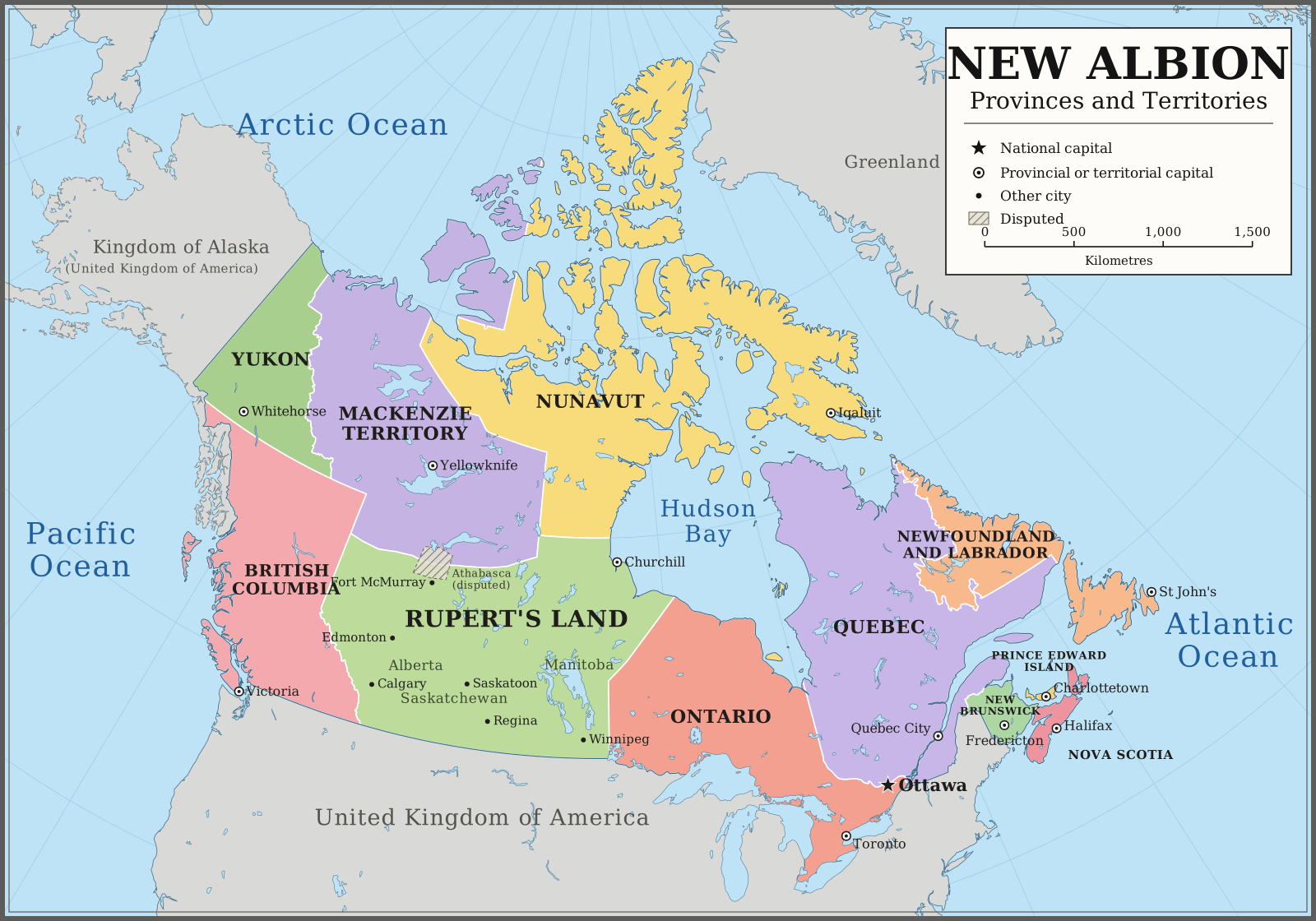
New Albion’s federal structure gives the provinces substantial autonomy, especially over health, education, natural resources, and property and civil rights. The major provinces are powerful actors in their own right, and the standing tension of the federation is that strong provinces resist federal overreach while Ottawa requires a degree of coordination the provinces are reluctant to give it.
Ontario is the most populous province, home to Ottawa and Toronto, the economic engine of the central realm. Ontario’s interests dominate national politics in ways that other provinces resent and cannot always counter.
Quebec is the French-speaking heartland, the site of New Albion’s language question, and a perpetual constitutional pressure point. It runs its own civil law system under the Code, selects its own immigrants under an agreement of 1991, governs its language by the Charter of 1977 and its own use of the override, and has repeatedly tested the limits of federal authority. Its distinct place in the realm is not written into the constitution; it is the product of the convention of 1982 and of a federal government that has learned to listen to it. Quebec’s position in New Albion is the most complex single fact of the realm’s political life.
Rupert’s Land is the giant: every land draining into Hudson Bay west of Ontario, from the bay to the Rockies, the largest province by area and the third by population, with about seven million people. It holds the realm’s oil and gas, its potash, most of its grain, and the cities of Calgary, Edmonton, Winnipeg, Saskatoon and Regina. Its capital is Churchill, a city of about a hundred and fifty thousand on the bay, a thousand kilometres from most of the province’s people, chosen in 1870 to make the province face the sea; the legislature, the provincial civil service and the deepwater grain port are there, and the polar bears come through the town every autumn. The old names of the prairie, Manitoba in the east, Saskatchewan in the middle and Alberta under the mountains, survive as the names of its regions, and since 2016 Manitoba has also been the name of the Métis district at the Red River. Rupert’s Land identity is strong and province-wide; the regions are names, not movements, and the province’s one internal grievance is Calgary’s, which resents Churchill more than it resents Ottawa. Because it is a single great province rather than three middling ones, it has the weight to deal with Ottawa as a partner, and its relationship with the federal government, though it fought over oil pricing in 1982, is calmer than that of most resource provinces anywhere. It has produced two prime ministers, Diefenbaker and Harper, and is prouder of the first.
British Columbia faces the Pacific, manages relations with Cascadia and the Realm’s Pacific coast, has the largest Indigenous land question of any province outside the territories, and serves as the realm’s gateway to Asia.
The territories are federal dependencies rather than full provinces, governed through delegated federal authority. Yukon has had province-like control of its lands and resources since 2003. Mackenzie Territory, the old North-West reduced to the Mackenzie basin, is on the way to becoming a province, with a referendum set for 2029. Nunavut, created in 1999, is the Inuit homeland. Inuit and First Nations peoples constitute large shares of territorial populations, and the gap between treaty recognition and daily life is most visible there.
| Province | Capital | Joined | Character |
|---|---|---|---|
| Ontario | Toronto | 1867 | Economic core, Great Lakes industry, finance, federal electoral weight, manufacturing, cross-border trade |
| Quebec | Quebec City | 1867 | Francophone nationhood, language law, the convention of 1982, civil law tradition, recurring federal tension |
| Nova Scotia | Halifax | 1867 | Maritime memory, fisheries, naval infrastructure, the Atlantic search and rescue centre, storm coast |
| New Brunswick | Fredericton | 1867 | The only officially bilingual province, forestry, ports, Acadian heritage, border trade |
| Rupert’s Land | Churchill | 1870 | The bay to the Rockies; oil, gas, grain, potash; the Métis district of Manitoba; the Arctic gateway |
| British Columbia | Victoria | 1871 | Pacific trade, ports, mountains, forestry, housing pressure, climate politics, Indigenous land disputes |
| Prince Edward Island | Charlottetown | 1873 | Smallest province, agriculture, tourism, island compactness, founding constitutional memory |
| Newfoundland and Labrador | St John’s | 1949 | Island remoteness, fisheries collapse memory, offshore oil, Atlantic identity, fierce independence |
| Territory | Capital | Character |
|---|---|---|
| Yukon | Whitehorse | Gold-rush heritage, First Nations self-government, wilderness, border with the Kingdom of Alaska |
| Mackenzie | Yellowknife | The Mackenzie basin, Dene and Métis governance, diamonds, a share of the oil sands, the road to provincehood |
| Nunavut | Iqaluit | Inuit homeland and self-governing territory, Arctic sovereignty anchor, climate frontline |
Language in law and administration
New Albion is officially bilingual in English and French. Parliament operates in both languages. Federal courts operate in both. The public service is required to serve New Albionites in either official language. Federal legislation is enacted in both official languages with equal authority, neither version being subordinate to the other.
This does not mean that all of New Albion is bilingual in daily life. English New Albion, meaning Ontario outside Ottawa, Rupert’s Land, British Columbia and the Atlantic provinces, is largely English-speaking in practice. French New Albion, meaning Quebec, parts of northern Ontario, and parts of New Brunswick and the other Atlantic provinces, lives in French, and there are old French-speaking communities across Rupert’s Land, of which the Métis of the Red River are the oldest. Bilingualism as a constitutional commitment is real. Bilingualism as a lived daily experience is concentrated.
The language question’s core tension is between Quebec’s position that French must be protected as the majority language of one province and a founding language of the realm, and English New Albion’s frustration with requirements to accommodate a language most residents do not speak. This tension is managed rather than resolved, and the management of it is one of the standing functions of the federal government.
Political practice and parties
New Albion’s political culture is compressed, administrative, and suspicious of spectacle. Arguments that in the UKA would produce floor speeches, primary campaigns, and constitutional crisis tend in New Albion to produce royal commissions, federal-provincial conferences, court references, and budget riders. The realm is not timid; it is structured.
The Liberals and the Conservatives have alternated in government since 1867. The New Democrats, the party of the prairie and labour left that grew from Douglas’s movement, have never governed federally but have sustained several minority governments; the Bloc Québécois sits for Quebec’s autonomy; the Greens hold a handful of seats. Minority Parliaments are frequent, confidence agreements more frequent still, and the realm has had one formal coalition government in its history, Borden’s Union government of 1917. The Prime Minister must manage the parliamentary party, the cabinet regional arithmetic, the Senate, the provincial governments, and the UKA relationship simultaneously. The ideal Prime Minister is patient, procedurally dextrous, regionally aware, and honest about the limits of what federal power can do.
Prime ministers
| Prime Minister | Party | Term | Remembered for |
|---|---|---|---|
| John A. Macdonald | Conservative | 1867 to 1873; 1878 to 1891 | Confederation, Rupert’s Land, the railway, the Riel commutation |
| Alexander Mackenzie | Liberal | 1873 to 1878 | The secret ballot, the Supreme Court of 1875 |
| John Abbott, John Thompson, Mackenzie Bowell, Charles Tupper | Conservative | 1891 to 1896 | Four prime ministers in five years after Macdonald |
| Wilfrid Laurier | Liberal | 1896 to 1916 | The first French-Canadian prime minister, reciprocity in 1911, the war against France |
| Robert Borden | Conservative, then Union | 1916 to 1920 | Vimy, conscription, a seat at the peace |
| Arthur Meighen | Conservative | 1920 to 1921; 1926 | Brief twice |
| William Lyon Mackenzie King | Liberal | 1921 to 1926; 1926 to 1930; 1935 to 1948 | The Statute of 1931, the Second Great War, caution |
| R. B. Bennett | Conservative | 1930 to 1935 | The Depression |
| Louis St Laurent | Liberal | 1948 to 1957 | Newfoundland, the ATO, the final court |
| John Diefenbaker | Progressive Conservative | 1957 to 1963 | The first from Rupert’s Land, the Bill of Rights, the Arrow |
| Lester Pearson | Liberal | 1963 to 1968 | The flag, medicare, the pension plan, the World’s Fair |
| Pierre Elliott Trudeau | Liberal | 1968 to 1979; 1980 to 1984 | October 1970, Indochina refused, the constitution of 1982 |
| Joe Clark | Progressive Conservative | 1979 to 1980 | A minority lost on its first budget |
| John Turner | Liberal | 1984 | Eleven weeks |
| Brian Mulroney | Progressive Conservative | 1984 to 1993 | The Continental, listening to Quebec |
| Kim Campbell | Progressive Conservative | 1993 | The first woman prime minister |
| Jean Chrétien | Liberal | 1993 to 2003 | The deficit, Nunavut |
| Paul Martin | Liberal | 2003 to 2006 | |
| Stephen Harper | Conservative | 2006 to 2015 | The 2008 apology, the second from Rupert’s Land |
| Justin Trudeau | Liberal | 2015 to 2025 | Manitoba restored, the Indian Act repealed, the King’s apology |
| Mark Carney | Liberal | 2025 to present | The peg, Mackenzie, Kittyhawk and the regency |
The public service
The public service is a source of genuine institutional pride and genuine institutional frustration. The civil service ideal, neutral, competent, bilingual and constitutionally aware, is real and has produced excellent governance in many domains. It has also produced an administrative culture that can produce reports faster than it can deliver services. The gap between the articulation of policy and the experience of policy in the lives of ordinary New Albioners, especially Indigenous New Albioners and residents of northern and rural areas, is the realm’s most persistent governance problem.
Arctic sovereignty and northern defence
New Albion’s northern identity is built around Arctic sovereignty and northern obligation. The realm treats the waters of the Arctic archipelago, including the Northwest Passage, as its internal waters. The United Kingdom of America, as a sister realm, accepts the claim, and has since a note of 1988 that both realms treat as settled. The Russian Republic does not, and contests the realm’s claim to the continental shelf beneath the polar sea; Denmark disputes the line between the archipelago and Greenland. The realm maintains northern infrastructure, Inuit-led ranger patrols, and search-and-rescue capacity across vast and thinly populated territory, and it does so at a cost per head of population that no southern service approaches.
The north is symbol and test simultaneously. It appears in the national identity as a source of pride, the idea that New Albion is a northern realm that does not flinch from winter. But the north is also the site of the greatest gap between the realm’s constitutional promises and its delivery: northern communities, predominantly Inuit and First Nations, face inadequate housing, clean water infrastructure, medical services and educational resources. Arctic symbolism without Arctic capacity is the realm’s most frequently named failure: the north appears in speeches and on maps but not in adequate housing, healthcare, clean water or military infrastructure.
Climate change is accelerating the Arctic question. Melting sea ice opens shipping routes and resource prospects, lengthens the season of the bay route through Churchill, and also destabilises northern ecosystems, threatens traditional Inuit ways of life, and creates new sovereignty pressures from the Russian Republic, which has long regarded the polar sea as its own approaches.
Relations with the United Kingdom of America
The UKA relationship is the single most important external fact of New Albion’s political life, and the one most carefully managed.
Economic entanglement is near-total. Reciprocity since 1911 and the Continental of 1988 have produced an almost free market in goods and energy, deeply integrated supply chains, shared infrastructure corridors and cross-border electricity grids. The border is open to people: a citizen of either realm crosses with an identity card and may live and work in the other without a permit. Goods still pass through customs, light but real, and the line is enforced against smuggling as it was in the years of the Realm’s prohibition, when Quebec’s liquor ran south. New Albion’s economy cannot be understood without the UKA. Most of New Albion’s exports go to the UKA, and most of its import dependency is UKA-sourced. About three million Albian-born people live in the Realm, the realm’s graduates, physicians, engineers and entertainers among them, and the outflow is a standing Albian complaint that the Realm barely notices.
The two realms make treaties with each other, as two Crowns of the same King, each acting on its own ministers’ advice; the Niagara treaty that governs the falls and the power drawn from them, the reciprocity agreements, and the boundary instruments are treaties in both realms’ law. The great exception is the Columbia, which rises in British Columbia and reaches the sea through Cascadia, and is governed by no treaty at all. A dam-and-storage agreement of 1964 was repudiated by British Columbia when Ottawa would not share the power revenues with it, and a renegotiation in 2014 collapsed over salmon and the consent of the river’s First Nations; the river runs on departmental goodwill. Quebec’s hydroelectric power, much of it from the James Bay dams that the Cree fought into the realm’s first modern treaty in 1975, is sold south to New York under the Niagara treaty’s successors.
Cultural entanglement is almost as complete. New Albion’s media is saturated with UKA content. Its entertainment culture is largely shared. Its urban centres absorb UKA trends in fashion, politics, technology and language. New Albion’s cultural institutions, including public broadcasting, arts funding and the national museums, exist in significant part to maintain a distinct cultural space against the gravitational pull of UKA mass culture, and the realm’s oldest cultural anxiety is that the pull will eventually prove stronger than the institutions built to resist it.
Political sensitivity is the result. New Albion’s politicians must demonstrate independence from the UKA even while managing a relationship of deep interdependence. A New Albion Prime Minister who appears too close to the UKA government risks accusations of surrendering sovereignty. One who appears too confrontational risks economic damage that the realm cannot afford. The realm’s two great refusals, of the Realm’s war in Indochina in the 1960s and of the draft resisters’ return, and its two great grievances, the Arrow and the Columbia, are the episodes its politicians cite when they need to show that closeness is not obedience.
Other relations
Britain is regarded with warmth and some sentiment: a large British-born community, regiments with shared histories, and a common King, though Britain matters far less to the realm’s economy than the Realm does. With France, the enemy of both Great Wars, relations have been normal since the liberation of 1944 and 1945, and Quebec conducts its own cultural relations with Paris. The Russian Republic is the realm’s real rival, across the pole. New Albion was a founding member of the League of Nations in 1920 and of the Atlantic Treaty Organization in 1949, sits on the League’s Security Council by rotation, and belongs to the Commonwealth. It joins the Realm in League actions and has stayed out of the Realm’s own wars.
Defence
The Albian Armed Forces are a volunteer force of about seventy thousand regulars: the Royal Albian Navy, whose ships carry the prefix HMNAS, His Majesty’s New Albion Ship; the Albian Army; and the Royal Albian Air Force. The navy’s two coasts are Halifax and Esquimalt, and its third, the Arctic, has a small base on Baffin Island that operates in summer. The air defence of the continent is under the joint command of the two realms established in 1958, with an Albian deputy commander. The forces are small for the realm’s size, by deliberate choice of every government since 1945, and their contribution is concentrated in the Atlantic, the Arctic and search and rescue, the last of which the realm considers its particular duty and which the loss of Kittyhawk put under review.
The Royal Albian Mounted Police, founded in 1873 as the North-West Mounted Police and renamed in 1920, are the federal police, and serve under contract as the provincial police of every province except Ontario and Quebec, which have their own. Their red serge is the realm’s best-known image abroad. Their southern counterpart is the Realm’s Royal American Constabulary, with which they work closely and are frequently compared.
Economy
Structure and output
New Albion’s is a resource economy under a federal division of ownership. The provinces, not the federal Crown, hold the natural resources within their boundaries and legislate the property and civil law under which those resources are developed, while Ottawa holds trade, currency, banking, and the cross-border relationship through which nearly all of the output is sold. The realm’s principal industries are therefore provincially owned and federally marketed, and its largest economic decisions require negotiation between governments before they can be taken. Federal transfers redistribute what the arrangement concentrates, which is why federal-provincial finance is a permanent subject of national politics.
New Albion is a wealthy country without a market of its own. Output of approximately A£3.1 trillion across approximately 43 million people gives approximately A£72,000 a person, roughly nine-tenths of the American figure of approximately A£80,000, on about an eighth of the American population. Purchasing power adds little, raising the total only to approximately A£3.3 trillion, which is itself a measure of integration: prices track American prices because the two realms buy in the same market and their currencies have been fixed to each other since 1911. Human development stands at 0.941 and the Gini coefficient at 0.31, narrower than the American distribution and produced by provincial health insurance and federal transfers rather than by wage bargaining.
The dollar and the peg
The New Albion dollar has been pegged to the American pound at a fixed rate since Laurier’s reciprocity of 1911, as the currencies of the Crown’s sister realms generally are. The Bank of New Albion holds the peg and sets interest rates to keep it, which means in practice that it follows the Realm’s central bank, and Albian economists argue in every recession about whether the realm should have a currency that can move. No government has proposed floating it. The one-dollar coin, the loonie of 1987, and the two-dollar toonie of 1996 carry the King’s head and circulate freely in the Realm’s border towns, where shopkeepers take them at par.
The provincial economic map
The economic map is provincial. Ontario is the industrial and financial core, with Great Lakes manufacturing, Toronto’s banks and exchanges, and the corridors carrying most of the realm’s cross-border trade. Quebec pairs hydroelectric generation, sold southward as well as at home, with a commercial system run under the civil law Code, and builds the regional airliners and business jets that are the realm’s aerospace industry, together with the robotic arm that flew on the Realm’s space shuttles. Rupert’s Land carries the largest single share of export earnings and of the federal revenue the realm depends on: the oil and gas of the western basin, found at Leduc in 1947, and the Athabasca oil sands, developed from the 1960s, which straddle the divide between the bay and the Mackenzie and are disputed between Rupert’s Land and Mackenzie Territory; with them the grain and potash of the plains and the oil capital at Calgary. British Columbia’s Pacific ports are the gateway to Asia, alongside forestry. Newfoundland carries offshore oil where the fishery collapsed, and the territories carry mining, diamonds, the highest delivery costs in the realm, and the prospects that retreating ice is opening.
The bay route
Churchill is the realm’s Arctic port. Grain has gone out through it to Europe since the railway reached the bay in 1886, by a route through Hudson Strait that is a thousand nautical miles shorter than the voyage from Montreal. For most of its history the route was open for ten or twelve weeks a year. As the ice retreats it stays open longer each year, and the port now ships potash and oil as well as grain for more than four months of the year. Rupert’s Land has staked a great deal on the thaw, which is the sharpest local edge of the realm’s climate argument: the province that most needs the climate policies of the federal government to fail is the one whose capital is profiting fastest from their failure.
Resources, climate and consent
Three pressures run through all of it. Resource income collides with climate obligation, most sharply in Rupert’s Land and British Columbia, where federal environmental policy is read as a threat to the industry that funds the federation. Resource projects also cross land held under numbered treaties and recognised Aboriginal title, so consent is a condition of investment and the reconciliation gap is a commercial fact as well as a moral one. And the export dependence cannot be diversified at will: most of what New Albion sells goes to a single buyer whose energy, regulatory and tariff decisions are taken in New Westminster without New Albion in the room. That is the economic content of the sovereignty question the realm leaves permanently open.
Demographics and society
Population
New Albion has a population of approximately 43 million, giving an overall density of roughly four people to the square kilometre, one of the lowest of any developed state and almost meaningless as a description of how New Albionites actually live. Measured against the inhabited southern band the effective density is many times higher, and measured against the territories it collapses to a fraction of one person for each square kilometre.
Natural increase is low. The realm’s fertility rate has been below replacement for decades, and essentially all of its population growth comes from immigration, which the federal government has run on a points system since 1967 and sustains at about four hundred thousand a year, recently reduced because the housing stock could not keep up. About a fifth of Albians were born abroad. Quebec selects its own immigrants under the agreement of 1991. The median age is in the low forties and rising, life expectancy is in the low eighties and among the higher figures recorded anywhere, and the old-age dependency ratio is the principal long-term pressure on provincial health budgets and federal transfers alike.
Internal migration runs persistently westward and toward the largest cities. The prairie and Atlantic countryside has been losing working-age population to Toronto, Montreal, Vancouver, Calgary and Edmonton for generations, and the territories lose southward at every stage of education and career while gaining almost nothing back. Against that, the resource booms of Rupert’s Land and, in a smaller way, of Newfoundland’s offshore have periodically reversed the flow, drawing Atlantic workers west and then returning them when prices fall. New Albion’s diaspora is dominated by the UKA, which absorbs a steady outflow under the open border for people.
Indigenous peoples and the treaty settlement
About two million Albians, roughly one in twenty, are First Nations, Métis or Inuit, and theirs is the fastest-growing part of the population. New Albion carries a deep legacy of their dispossession: the numbered treaties signed with First Nations peoples across the interior; the residential school system that forcibly removed Indigenous children from their families and communities to assimilate them into settler culture; reserve poverty; language loss; and the structural gap between the rights that courts and governments have recognised in law and the conditions in which Indigenous peoples actually live.
The Crown is the formal treaty partner of the First Nations who signed numbered treaties. This means that the reconciliation obligation falls on the Crown, on the government that acts in its name, and not merely on abstract history. The Crown cannot claim to honour Indigenous peoples in ceremony while failing to deliver on treaty obligations in practice without that contradiction being constitutionally visible.
The modern settlement has several parts, made over fifty years. The Cree of James Bay signed the first modern treaty in 1975. Nunavut was created in 1999, and the Inuit regions of Nunavik in northern Quebec and Nunatsiavut in Labrador govern themselves inside their provinces under agreements of 1975 and 2005. The Métis of the Red River have had their district of Manitoba since 2016. The First Nations Governance Act of 2019 replaced the Indian Act and lets each nation adopt its own constitution, and about a third have. The Truth and Reconciliation Commission reported in 2015 and the King apologised in 2022.
Reconciliation is the realm’s ongoing moral test. The settlement represents real progress. It also represents the baseline from which decades of further work must proceed. The realm’s failure mode is treating reconciliation as a completed event rather than a permanent structural commitment: issuing statements and holding ceremonies while the structural conditions that harm Indigenous communities remain unchanged. Where the distance between the official reconciliation narrative and the daily experience of a community becomes wide enough to be obvious, the Crown’s authority in that community is the thing that fails first.
The Haudenosaunee, whose country lies across the border on the St Lawrence and the lakes, cross it freely under a right older than either realm, travel on passports of their own, and are advised by one council in their dealings with two governments.
Other histories
The realm’s own record with its newcomers is not clean either. A head tax imposed in 1885 on Chinese immigrants, many of them the families of the men who had built the railway, was followed by their near-exclusion from 1923 to 1947. In 1942 some twenty-two thousand Japanese Albians were removed from the Pacific coast and their property sold, as the Realm removed its own. The federal government apologised for the first in 2006 and the second in 1988.
Black Albians, about four per cent of the population, descend from the Black Loyalists of 1780, from those who came north by the escape road from the Realm before slavery was abolished there in 1865, from Caribbean and African immigrants of the twentieth century, and from others. Africville, the Black community on the shore of Halifax, was demolished by the city in the 1960s, and the city apologised in 2010.
Languages
English and French are the official languages of the federation, with roughly three-quarters of the population speaking English as a first official language and roughly a fifth French, the latter concentrated overwhelmingly in Quebec and adjacent districts of Ontario and New Brunswick. New Brunswick is the realm’s only officially bilingual province in its own right, a consequence of its Acadian population. Functional bilingualism in both official languages is a minority accomplishment nationally and a majority one in the Ottawa region, in Montreal, and in the federal public service, where it is a condition of senior appointment.
Beyond the two official languages the realm is highly multilingual. Immigration has made Chinese, Punjabi, Spanish, Arabic, Tagalog and a long tail of other languages the household language of a substantial minority of New Albionites, concentrated in Toronto, Vancouver and Montreal. Indigenous languages number in the dozens across several unrelated families, and their condition varies enormously: Inuktitut in Nunavut and Cree across northern Rupert’s Land and the Shield retain communities of first-language speakers and a functioning place in schools and territorial administration, while many others have been reduced to a handful of elderly speakers by the residential school system and the generations of policy that surrounded it. Language revitalisation is now a stated federal and territorial commitment and, like much of the reconciliation programme, is funded at a level that its practitioners describe as serious but late.
Religion
The realm’s religious history is Christian and divided along the same line as its language. Catholicism was the established fact of French New Albion and remains the largest single affiliation nationally, dominant in Quebec, in the Acadian districts of the Atlantic provinces, among the Métis, and among several immigrant communities. Protestant churches, historically the settler mainstream of English New Albion, have declined faster than the Catholic Church in reported membership. Both have declined sharply in observance, most dramatically in Quebec, where a formerly church-governed society now records some of the lowest rates of attendance in the realm. There is no established church. A large and growing share of New Albionites report no religious affiliation at all. Immigration has established substantial Sikh, Muslim, Hindu, Buddhist and Jewish communities, concentrated in the largest metropolitan areas. Indigenous spiritual traditions, actively suppressed for much of the realm’s history, have been the subject of a sustained revival.
Health, education and housing
Health insurance is provincial, universal within each province, and portable between them under federal conditions attached to the transfer that funds it. It began in the Saskatchewan region of Rupert’s Land in 1962 and was national by 1966. The system is a principal source of national self-definition and a permanent source of complaint, the two most common grievances being waiting times for specialist and elective care and the difficulty of recruiting physicians to rural, remote and northern practice. Education is likewise provincial, with no federal ministry of education, and Quebec’s system differs from the rest in structure as well as in language. Attainment is high by international comparison and university participation is broad, though the pull of American graduate schools and salaries is a standing drain.
Housing is the sharpest domestic pressure of the present decade. Costs in Vancouver, Toronto and increasingly Montreal and Calgary have risen faster than incomes for a sustained period, driven by concentrated demand in a handful of metropolitan areas, restricted supply, and an immigration programme whose scale the housing stock has not matched. In northern and reserve communities the housing problem is different in kind rather than in degree: it is one of absolute shortage, overcrowding and construction to a standard the climate defeats, and it is the most frequently cited single measure of the gap between what the realm promises the north and what it delivers.
Culture
Broadcasting and cultural institutions
The New Albion Broadcasting Corporation, the NABC, founded in 1936 and known in French as Société Radio-Albion, is the public broadcaster. It carries obligations in both official languages and, increasingly, in Indigenous languages in the north, where it is often the only broadcast service a community receives. Americans confuse it with their own ABC and Albians resent being confused with the ABC, and the two corporations, which share a great deal of material, are irritated by the confusion in equal measure. The realm’s cultural policy has long combined direct public funding with content requirements on private broadcasters, an arrangement that its supporters credit with the existence of a New Albion publishing, recording and screen industry and its critics describe as an expensive way of protecting work that Americans would watch anyway.
Literature and music
The realm’s literature runs in both languages and, increasingly, in neither. In English it includes L. M. Montgomery of Prince Edward Island, Margaret Atwood, Alice Munro, who won the Nobel Prize in 2013, and Leonard Cohen; in French, Gabrielle Roy of the Red River and Michel Tremblay of Montreal’s east end. Its Indigenous writers, most of them published since the reconciliation era began, have become its most widely read.
Rupert’s Land has a book of its own. The Bay and the Plain (1964), by Agnes Delorme (1921 to 1999), a Métis novelist from the Red River who wrote in English with French and Cree in every chapter, follows one family through four generations from the Company’s factory at York Factory to the oil fields of Alberta, and is read in every school in the province as the account of how Rupert’s Land came to be one place. Delorme refused the Order of New Albion in 1975 on the ground that the Red River had not yet been given its district, and accepted it in 1998.
The realm’s musicians and comedians have long gone south and become famous there. Joni Mitchell, Neil Young, Céline Dion and Drake are Albian, and the standing joke, which is mostly true, is that much of the Realm’s comedy is written by Albians. The content rules of 1971 built a domestic industry for them to leave.
Sport
Ice hockey is the winter national game by statute, and lacrosse, the game of the Haudenosaunee, the summer one. The realm has its own professional hockey league, founded at Montreal in 1917, and the Realm has another; each spring the champions of the two meet in a series that both realms claim as the real championship of the sport, and the Albian winner more often than not. The Haudenosaunee national lacrosse team plays internationally as its own nation.
Albian football is its own code, with three downs, twelve players and a longer and wider field than the Realm’s game. Its championship, the Grey Cup, has been played since 1909, and the Grey Cup weekend in late November is a national occasion of its own. New Albion shares the American summer game of baseball, followed across the realm with an intensity that the border does nothing to interrupt, and fields its own national team in it. The rinks, curling clubs and community leagues of small prairie and northern towns are among the few institutions that survive rural depopulation.
Symbols
The flag, adopted on 15 February 1965 after six months of debate, is a red eleven-pointed maple leaf on a white square between two vertical bars of dark blue. The blue is for the seas of the motto and was chosen over red because red was read as the Realm’s colour. Before 1965 the realm flew a red ensign bearing its arms.
The arms, granted in 1921, show the royal arms with three maple leaves, supported by the lion and the unicorn and resting on a compartment of maple and the flowers of the founding nations, with the motto A mari usque ad mare, from sea to sea, from the seventy-second psalm. The anthem is Ô Albion, written in French in 1880 for the feast of Saint-Jean-Baptiste and sung in Quebec for twenty years as Ô Canada before it became the anthem of the whole realm. Its English words, written later, begin O Albion; its French words still begin Ô Canada, which Quebec regards as the correct version and the rest of the realm has decided not to mind. God Save the King is the royal anthem.
The national day is 1 July, the anniversary of the New Albion Act, called Dominion Day until 1982, when it was renamed Albion Day. In Newfoundland 1 July is also Memorial Day, for the regiment destroyed at Beaumont-Hamel in 1916. The national animal is the beaver, by statute of 1975; the national tree the maple, of 1996. The Royal Albian Mounted Police in red serge are the realm’s best-known image, which the force tolerates.
Memory
Public memory in New Albion is organised around three things: the Crown and the constitutional settlement; the wars, in which the realm’s contribution is remembered as evidence of a nationhood earned abroad; and, more recently and more contentiously, the reconciliation record.
The wars are remembered with a particular awkwardness. The realm’s founding battle was won against France, its first war fought by a Quebec that did not want to fight it, and its second ended with Quebec’s regiments liberating French towns in French. Vimy is the national memorial, and its memorial stands on the French side of a ridge Albians took from the French. McCrae’s poem, written in the Ypres salient by an Albian medical officer, is read at every Remembrance Day service in the realm.
Commemoration of residential schools has entered the national calendar and the school curriculum within living memory, and since 2021 a national day for truth and reconciliation, on 30 September, has been a federal holiday. The argument about it is not whether the harms occurred but how a state that presents itself as lawful and careful should teach the period in which it was neither.
✎ Editor's Note · New Albion and its real-world analogue
New Albion is built from the same historical material as Canada in our timeline, French foundations, British conquest, Loyalist settlement, confederation, numbered treaties, residential schools, bilingualism, western energy politics, Arctic sovereignty, but it is not that history transposed. Confederation falls in the same year, 1867, during Ernest II’s reign, the moment New Albion enters the personal union as its own Crown, the oldest of the sister-realm titles added after the founding trio of Great Britain, Hanover, and the United Kingdom of America itself (see Styles and Titles of the Crown). The point of divergence, the Four-Year War ending in 1779 and the Charter of 1783, means the northern realm developed beside a monarchy rather than a republic, and the differences follow from that: no war of 1812, no fear of annexation strong enough to keep the prairies in three provinces rather than one, a First Great War fought against France, a reciprocity won in 1911 rather than lost, no Quebec referendum, and a Crown that is a neighbour’s as well as one’s own. New Albion did not absorb American-style constitutional theatre. It developed a quieter, more administrative Crown culture.
Assessment
New Albion asks one question of itself and has been asking it since 1867: how close it can stand to the United Kingdom of America without ceasing to be distinct from it. On every material measure it is closer than any two sovereign states in the world. It trades with the Realm almost without tariffs, prices its goods in a currency fixed to the Realm’s, watches the Realm’s television, sends its graduates south without a permit, and defends its air through a command whose headquarters is in the Realm. Its own institutions, the public broadcaster, the content rules, the Senate’s regional blocs, the bilingual civil service, exist in good part to keep it from dissolving into its neighbour, and they have never been sure that they will succeed.
The realm’s own answers to the question are partial. Quebec is one of them: a province that no one in the Realm could mistake for an American place, and that holds its position in New Albion by a convention of being listened to rather than by any law. Rupert’s Land is another, a province of continental scale built because the federation could not afford to let the west fill up in pieces. The refusals, of the Realm’s war in Indochina and of the Arrow’s cancellation as a settled matter, are a third. The treaties are the deepest and the least redeemed: the realm’s claim to be a different and better kind of country than its neighbour rests, in the end, on whether it keeps faith with the nations whose land it occupies, and on that it has not yet done what it promised.
But the thing that keeps New Albion separate and whole is not any of these. It is the Crown. The King is New Albion’s King exactly as much as he is the Realm’s, acting on Albian advice, represented by an Albian Governor-General, bound to the treaty nations as their partner, and the shared monarch is the one institution through which the realm can be as close to the Realm as it is without being part of it. It is also what holds the federation together from inside: Quebec’s republicans cannot easily be republican about a King who spends his summers in the Laurentians speaking French, and the treaty nations’ claim is on the Crown, not on Ottawa. The loss of Kittyhawk showed it. For four days in September 2028 the King was missing in New Albion’s waters, New Albion led the search for him, a Newfoundland crab boat brought him in, and when the Parliament at Ottawa made the Queen its Regent a week after he was found, the members who voted against did so carefully, to make a point about the Governor-General, and said in the same speech that they wished him well. A realm that can conduct that argument in that way, about that institution, in two languages, has found something that holds.
Chronology
| Date | Event |
|---|---|
| Before 1500 | The first peoples across the whole of the territory, from the Mi’kmaq to the Haida and the Inuit |
| 1534 | Jacques Cartier in the Gulf of St Lawrence |
| 1608 | Champlain founds Quebec |
| 1670 | The Hudson’s Bay Company chartered; Rupert’s Land named |
| 1755 | The expulsion of the Acadians |
| 1759 to 1763 | Quebec taken; New France ceded to Britain |
| 1774 | The Quebec Act: French civil law and the Catholic religion guaranteed |
| December 1775 | The Continental expedition fails before Quebec |
| 1780 | The Black Loyalists carried to Halifax and Annapolis Royal |
| 1791 | Upper and Lower Canada |
| 1837 to 1838 | The rebellions in both Canadas |
| 1838 to 1842 | The Aroostook quarrel between Maine and New Brunswick; settled by award |
| 1840 | The union of the Canadas |
| 1846 | The Oregon boundary at the forty-ninth parallel |
| 1848 | Responsible government |
| 1850s | The reciprocity treaty with the Realm |
| 1864 | The Charlottetown and Quebec conferences |
| 1866 | Ernest II chooses Ottawa as the capital |
| 1 July 1867 | The New Albion Act. Ontario, Quebec, Nova Scotia and New Brunswick; the Crown of New Albion; Macdonald prime minister |
| 1869 to 1870 | The Company surrenders Rupert’s Land; the Red River resistance under Riel; Rupert’s Land made one province with its capital at Churchill; the Métis district at the Red River |
| 1870s | The Yukon-Alaska boundary fixed by treaty with Johann II of Liechtenstein |
| 1871 | British Columbia joins; the first numbered treaty |
| 1873 | Prince Edward Island joins; the North-West Mounted Police |
| 1876 | The Indian Act |
| 1880 | Ô Canada, later Ô Albion, first sung in Quebec |
| 1885 | The North-West rising; Batoche; Riel sentenced at Regina and his sentence commuted by Ernest II on advice; the head tax |
| 1886 | The Hudson Bay and Pacific Railway completed through Churchill |
| 1896 | Laurier prime minister; the Klondike |
| 1909 | The first Grey Cup |
| 1911 | Reciprocity with the Realm; the dollar pegged to the American pound |
| 1914 | War against France beside Britain, Germany and the Realm |
| 1 July 1916 | The Newfoundland Regiment at Beaumont-Hamel; Laurier resigns, Borden prime minister |
| April 1917 | Vimy Ridge taken from the French |
| 1917 | Conscription; the Halifax explosion |
| 1918 | The Quebec City riots |
| 1920 | Founding member of the League of Nations |
| 1921 | The arms and the motto; the last numbered treaty; Mackenzie King prime minister |
| 1931 | The Statute of Westminster |
| 1936 | The NABC founded |
| 1939 | War against fascist France, by the realm’s own act |
| 1942 | The removal of Japanese Albians from the Pacific coast |
| 6 June 1944 | The Albian Army ashore in Brittany in Operation Overlord; the Scheldt that autumn |
| 1947 | Oil at Leduc |
| 1948 | St Laurent prime minister |
| 1949 | Newfoundland joins; founding member of the ATO; appeals to London ended |
| 1957 | Diefenbaker prime minister; Pearson’s Nobel prize |
| 1958 | The joint air-defence command of the two realms |
| 1959 | The Avro Arrow cancelled |
| 1962 | Medicare in the Saskatchewan region of Rupert’s Land |
| 1963 | Pearson prime minister |
| 15 February 1965 | The blue flag |
| 1967 | The centennial; the World’s Fair at Montreal, opened by Ernest IV |
| 1968 | Pierre Trudeau prime minister; the draft resisters |
| October 1970 | The October Crisis; the War Measures Act |
| 1972 | Ernest V accedes; Lac du Roi |
| 1975 | The James Bay agreement, the first modern treaty |
| 1977 | Quebec’s Charter of the French Language |
| 17 April 1982 | The Constitution Act and the Charter; Quebec does not sign; the convention of consultation; Dominion Day becomes Albion Day |
| 1984 | Mulroney prime minister |
| 1988 | The Continental |
| 1990 | The Bloc Québécois founded |
| 1992 | The cod moratorium |
| 1993 | Chrétien prime minister |
| 1996 | The last residential school closes |
| 1 April 1999 | Nunavut; Mackenzie Territory named |
| 2006 | Harper prime minister |
| 11 June 2008 | The government’s apology for the residential schools; the Truth and Reconciliation Commission |
| 2015 | The Commission reports; Justin Trudeau prime minister |
| 2016 | Manitoba restored to the Métis of the Red River |
| 2019 | The Indian Act repealed; the First Nations Governance Act |
| 2021 | The unmarked graves |
| July 2022 | The King’s apology in Rupert’s Land |
| 2025 | Carney prime minister |
| 2026 | Michèle Lavallée Governor-General |
| 2027 | Parliament agrees in principle to provincehood for Mackenzie |
| 25 to 29 September 2028 | Kittyhawk lost east of Newfoundland; the search from Halifax; the Kathleen Marie; the King at St John’s |
| 6 October 2028 | The Regency Act: Queen Christina Regent of New Albion |
| 31 October 2028 | Parliament gives effect to the abdication; George V King of New Albion, the Queen his Regent |
Trivia
- In-Universe Rupert's Land is governed from Churchill, a city of about a hundred and fifty thousand on Hudson Bay, a thousand kilometres north of most of the province's people. Polar bears come through the town every autumn on their way to the ice, and the legislature has a protocol for them.
- In-Universe The national anthem has two first lines. Its English words begin 'O Albion' and its French words begin 'Ô Canada', because the song was written in Quebec in 1880 under the old name, and Quebec has never seen a reason to change it.
- In-Universe New Albion's founding battle was fought against France. The Albian Corps took Vimy Ridge from the French army in April 1917, and the national memorial stands on French soil, on the side of the ridge from which the Albians attacked.
- In-Universe The King has spent most of his summers since 1972 at a plain lodge on a lake in the Laurentian hills, which Quebec's toponymy commission renamed Lac du Roi in his honour. He fishes and speaks French there, and the province's republicans have found it difficult to be republican about him.
- In-Universe When Louis Riel was sentenced to death in 1885, Ernest II commuted the sentence on his ministers' advice, and nobody was satisfied: Ontario had wanted him hanged and Quebec had wanted him pardoned. He died in exile in Montana in 1900.
- In-Universe The Métis of the Red River asked in 1869 for a province called Manitoba. They got a district of Rupert's Land instead, lost it to settlers within twenty years, and had it restored under the name they had asked for in 2016.
- In-Universe The citizens of New Albion are Albians in law and New Albionites in conversation, so the formal name is the shorter of the two. Albians enjoy explaining this more than visitors enjoy hearing it.
- In-Universe New Albion and the Realm each have their own hockey league. Every spring their champions play a series that both realms call the real championship of the sport, and the argument about which of them is right is older than either league's current owners.
- Real-World In our world the federation of 1867 kept the name Canada, which the Maritime delegates accepted. Here they refused it, and the name survives only for the old heartland of the St Lawrence and in the French words of the anthem.
- Real-World Our Canada has three prairie provinces, Manitoba (1870), Saskatchewan and Alberta (both 1905). Here the whole of the Hudson Bay drainage west of Ontario became one province, Rupert's Land, in 1870, and the three names survive as its regions.
- Real-World Louis Riel was hanged for treason at Regina on 16 November 1885, despite petitions for clemency from Quebec, and his execution divided English and French Canada for a generation.
- Real-World Quebec held referendums on sovereignty in 1980, lost by about 60 to 40, and in 1995, lost by about 50.6 to 49.4. Here Quebec fought France in two wars as a province of New Albion, and no referendum was ever held.
See also
- The Crown in Right, the constitutional mechanism by which one monarch reigns separately in each realm
- Styles and Titles of the Crown, including the 1867 entry of the Crown of New Albion into the personal union
- Kittyhawk, the royal flight lost east of Newfoundland on its way to Ottawa in September 2028, whose search New Albion directed
- The Four-Year War, after which the northern colonies remained under the British Crown
- The First Great War, in which New Albion fought France and took Vimy Ridge
- The Second Great War, in which New Albion supplied armies, industry and the Atlantic routes and landed in Brittany
- The Atlantic Treaty Organization, of which New Albion is a founding member
- The League of Nations, of which New Albion is a founding member in its own right
- New Wessex, the southern sister realm formed on the same shared-monarch model
- The Kingdom of Alaska, across the Yukon line
- Ernest II, in whose reign the realm was federated and who chose its capital
- George V, King of New Albion since 31 October 2028
- Ernest V, King of New Albion until his abdication, who apologised for the residential schools in 2022