Confederation of Mexico
The Confederation of Mexico is a federal constitutional republic built around a single governing anxiety: public power must never become private property.
Mexico is not a quiet country. It is a lawful argument with borders, courts, churches, ports, schools, deserts, ministries, flags, and ledgers. Its drama comes from the constant question beneath every institution: Who owns the decision? At its best, the Confederation is noisy, federal, civic, Catholic-literate, economically serious, anti-cartel, and fiercely sovereign. At its worst, it becomes a ceremonial republic whose flags still fly after real power has been bought, frightened, outsourced, or captured.
The Confederation covers approximately 1,819,000 square kilometres between the United Kingdom of America to the north and the United Provinces of Central America to the south, and holds approximately 130 million people, the great majority of them Spanish-speaking and the great majority of them urban. It is the largest Hispanophone state in the world by population and the principal large Latin American partner of the Republic of Cuba.
Etymology
Mexico takes its name from Mēxihco, the Nahuatl name of the heartland of the Mexica, the people whose city of Tenochtitlan stood on the island now buried beneath the capital. The name attached first to the valley and the city, then to the viceroyalty that succeeded them, and finally to the independent state, which chose it deliberately over the colonial name in order to root the new republic in something older than the conquest. The proposed derivations of Mēxihco are numerous and none is settled; the readings most often given connect it to Mexitli, a name of the Mexica tutelary deity, or to a compound describing the place at the centre of the lake.
The spelling preserves an archaism. In modern Spanish the x in México is pronounced as a velar fricative, the sound now ordinarily written with a j, and the alternative spelling Méjico has been urged by grammarians for two centuries. Mexican usage has refused it with some feeling, on the ground that the x carries the Nahuatl origin of the word and that the country is not obliged to spell its own name to suit a peninsular convention. Official Mexican documents use México without exception, and the state’s own institutions treat the letter as a small point of sovereignty.
The formal style is La Confederación de México, the Confederation of Mexico. The choice of Confederación over República was a constitutional statement rather than a stylistic one, emphasising an arrangement of states in federal compact over a unitary republic governed from the centre, and asserting that power lives in the states as much as in the capital. In ordinary usage the country is México, the citizen is mexicano or mexicana, and the capital shares the country’s name, an ambiguity every Mexican resolves by context and every foreigner mishandles at least once.
Within the country the capital is usually called simply la Ciudad or México, and the rest of the country is la provincia, a usage the provinces dislike as much as their French counterparts do. The northern states, the centre, the Bajío, the Gulf and the south are named and distinguished constantly in daily speech, and the regional adjectives, norteño, tapatío, regiomontano, jarocho, yucateco, carry a weight in Mexican conversation that no single national demonym does.
History
Before the Mexican-American War
Before the Mexican-American War, Mexico holds sovereignty over vast northern territories that will become central to the UKA’s continental expansion: the region that will later become the March of Arizona, California, New Mexico, and Texas. The UKA’s expansionist ambitions, combined with the Texas question, make conflict almost inevitable.
Texas declares independence from Mexico and then negotiates its entry into the United Kingdom of America by the Treaty of Austin of 1845 and the reciprocal Acts of Union that brought it into Union on 21 April 1846. Texas is the immediate flashpoint that produces the Mexican-American War.
The Mexican-American War
The Mexican-American War sees UKA forces operating across multiple theatres: northern campaigns along the Rio Grande, the Army of the West pushing into New Mexico toward California, a Pacific campaign to secure California’s coastline, and a central campaign pushing toward Mexico City itself.
The war produces the UKA’s Pacific vision, continental reach from Atlantic to Pacific. California gives the UKA its Pacific coastline. New Mexico gives it the interior Southwest. The territory that becomes the March of Arizona is incorporated alongside them.
The settlement and its accounting
The post-war settlement transfers significant territory from Mexico to the UKA. Mexico retains sovereignty over its remaining territories, its heartland, its capital, its southern regions, its Gulf coast, but its northern frontier is permanently reshaped. Sonora and the remaining northern states become Mexico’s permanent frontier question: the zone where the republic must prove it can govern its edge.
The moral accounting is complicated. Mexico’s dispossession through the war settlement is one dimension of a wider pattern of territorial expansion that treats existing sovereignty, Mexican and Indigenous alike, as a problem to be managed rather than a reality to be honoured. That accounting is part of Mexico’s national memory and shapes how the Confederation understands its relationship to the UKA even in the modern period.
The sale of the Baja peninsula, 2027
The relationship was reshaped again in 2027 by the sale of the Baja Peninsula. Facing a collapse of order that had turned Baja into a near-autonomous narco-frontier its federal state could no longer hold, the government of President Cuauhtémoc Salazar sold the entire peninsula to the UKA under the Treaty of La Paz, in exchange for debt relief, a large capital transfer, and joint security cooperation. A plebiscite of the peninsula’s own residents approved the transfer, 58 to 42, and Baja became the UKA Territory of Loreto. Nationalist objection was pronounced at the time of signature but has not developed into a sustained revanchist movement, and relations between the two states now turn substantially on the machinery of the settlement: the Colorado-River water the UKA must deliver to Mexico’s remaining mainland, the shared and disputed fisheries of the Gulf of California, and the joint policing of the new border.
The sale is a wholly separate matter from the war settlement of the previous century, and Mexican constitutional lawyers are insistent on the distinction. The territory of 1848 was taken by conquest and ratified under duress. The peninsula of 2027 was sold by an elected government under an instrument its own Congress approved and its own inhabitants voted on. Which of the two facts is the more painful is a question Mexican public argument has not settled and shows no sign of settling.
Geography
The Confederation occupies the southern part of the North American landmass and the whole of the isthmus north of the Union of Central America, approximately 1,819,000 square kilometres in all. Its northern frontier with the United Kingdom of America runs from the Gulf of Mexico along the Rio Grande, called the Río Bravo on the Mexican side, then westward across the Chihuahuan and Sonoran deserts to the delta of the Colorado, where since 2027 it meets the UKA Territory of Loreto. The Gulf of California is divided down its length, the eastern shore Mexican and the western shore beyond the water in Loreto. To the south the Confederation borders the Union’s province of Guatemala, which it meets along the Suchiate and the Usumacinta, and Belize, and its Caribbean and Pacific coastlines together are among the longest of any state in the hemisphere.
Relief and drainage
Mexico is a mountainous country with a high interior. The Mexican Plateau, the Altiplano, occupies the centre and north and rises steadily from the desert basins of Chihuahua toward the volcanic country around the capital, where the floor of the plateau itself stands above two thousand metres. Two great ranges wall it in: the Sierra Madre Occidental on the Pacific side, cut by the immense canyon systems of the Barranca del Cobre, and the Sierra Madre Oriental on the Gulf side, steeper and narrower. Across the southern edge of the plateau runs the Trans-Mexican Volcanic Belt, an active east to west line of high cones including Popocatépetl, Iztaccíhuatl and the Pico de Orizaba, the highest ground in the country. South of it the Sierra Madre del Sur and the folded highlands of Oaxaca and Chiapas continue toward the narrow Isthmus of Tehuantepec. The Yucatán Peninsula is the geological exception, a flat limestone shelf with almost no surface rivers, drained instead through underground channels and open sinkholes.
The rivers reflect the relief. Few are long and fewer are navigable for any distance. The Río Bravo is the northern boundary and the most politically consequential water in the country. The Lerma-Santiago system drains the Bajío westward to the Pacific through Lake Chapala, the largest lake in Mexico. The Balsas cuts the southern plateau. The Pánuco and Papaloapan carry the eastern escarpment’s rainfall to the Gulf, and the Grijalva-Usumacinta, by far the largest system by volume, drains Chiapas and the Guatemalan highlands through the wet lowlands of Tabasco. The lower Colorado now lies wholly beyond the frontier, and the water delivered from it under treaty is a standing item of Mexican federal business.
Climate and vegetation
The Tropic of Cancer crosses the country a little north of its middle and divides it roughly into a dry half and a wet one, but altitude matters more than latitude almost everywhere. Mexican usage still describes the country in vertical bands: the tierra caliente of the coastal lowlands, hot and humid year round; the tierra templada of the middle slopes, where most of the coffee and much of the population sit; and the tierra fría of the high plateau and the volcanic country, where the capital enjoys a spring-like climate at the latitude of the Sahara.
The north is arid. The Chihuahuan Desert occupies the interior basins and the Sonoran Desert the north-west, both of them supporting a distinctive cactus and thornscrub flora and a ranching economy adapted to it. The Pacific and Gulf coasts south of the tropic carry tropical dry forest that grades into genuine rainforest in Chiapas, Tabasco and the base of the Yucatán, where the Lacandón forest remains the largest surviving block. Pine and oak forest covers the two Sierras Madre at altitude, and the high volcanoes carry alpine grassland and permanent snow. Both coasts are struck by hurricanes between June and November, and the whole of the volcanic belt and the Pacific margin is seismically active, a fact that has shaped building codes, civil-defence institutions and the architecture of the capital more thoroughly than any political programme.
States and urbanisation
The Confederation is a federation of states, with Mexico City holding a distinct constitutional personality of its own as a city-state rather than as a member state. Roughly four-fifths of the population is urban, and the urban weight is distributed along three axes: the central valley and its surrounding plateau cities, the Bajío and western corridor toward Guadalajara, and the northern industrial belt running from Monterrey to the border. The Gulf ports, the southern highland capitals and the Yucatán cities form smaller systems of their own. Against these, the emptiest parts of the country are the northern deserts and the mountain interiors of the two Sierras Madre, where settlement is thin, roads are few, and the reach of federal administration is exactly the question the doctrine of Public Sovereignty was written to answer.
Government and politics
The doctrine of public sovereignty
The Confederation’s central constitutional doctrine is Public Sovereignty: no cartel, party boss, cleric, general, governor, contractor, foreign patron, or President may own decisions that belong to the public republic under law. This doctrine is not merely aspirational. It is the constitutional foundation on which all other institutional design rests, and it is why Mexican institutions are defensive by design.
The President of the Confederation
The President of the Confederation is simultaneously head of state and head of government. The presidency is directly elected, and, crucially, limited to a one-year term. This is the Confederation’s most distinctive institutional feature and its most deliberate anti-tyranny mechanism.
The one-year presidency is not an oversight. It is a constitutional answer to Mexico’s historical experience with personalismo, the tendency of powerful men to convert public office into personal dominion. A President who serves only one year cannot build a political empire. A President who knows she will face an election in twelve months cannot develop the comfortable certainties of entrenched power. The one-year term makes the presidency more accountable, more anxious, and less dangerous.
The cost is continuity. The Confederal Council exists precisely to provide what the one-year presidency cannot: institutional memory, administrative persistence, and the capacity to manage long-term policy that a one-year electoral cycle would otherwise consume.
The Confederal Council
The Confederal Council is the executive continuity body, the institutional layer beneath the rotating presidency that keeps the republic functioning across presidential transitions. The Confederal Council preserves policy continuity, manages the federal administrative apparatus between elections, and serves as a check on presidential overreach. Its Secretary provides administrative coordination that the presidency is too short-lived to supply.
The Confederal Council is why the one-year presidency is constitutionally workable. Without it, a one-year term would produce permanent chaos. With it, the elected President provides democratic mandate and public accountability while the Council provides the machinery of governance.
The Congress of the Confederation
The Congress of the Confederation is unicameral, a single Chamber of Deputies. This unicameral design is deliberate: it makes legislative responsibility visible. There is no upper chamber to blame, no second house to stall in. The deputies in the Chamber are the legislature. If legislation fails, the Chamber failed. If legislation passes, the Chamber passed it. Accountability has a single address.
The Supreme Court
The Supreme Court of the Confederation guards the Constitution. It reviews legislation for constitutional conformity, adjudicates disputes between the federal government and the states, and serves as the final interpreter of the Constitution of the Confederation. Its role in enforcing the doctrine of Public Sovereignty, ruling on whether power has been appropriated in violation of the constitutional order, gives it political weight beyond ordinary judicial review.
Mexico City as a city-state
Mexico City holds the status of a city-state within the Confederation, neither a full state nor merely a municipality, but a federal district with its own distinct constitutional personality. Mexico City hosts the nation without owning it. The city-state arrangement is designed to prevent the capital from absorbing so much federal power that provincial Mexico becomes irrelevant to national governance.
Sonora and the northern frontier
Sonora is Mexico’s northern hinge, the state that manages the republic’s relationship with the March of Arizona and, through it, with the broader UKA border. Sonora is simultaneously a test of whether the Confederation can govern its edge, a zone of cartel pressure, a site of significant cross-border economic activity, and a region with its own distinct historical memory of the territorial loss.
The March of Arizona’s extraordinary powers over border governance mean that Mexico’s primary interlocutor on many border questions is the March government rather than the federal government in New Westminster directly. This creates a distinctive diplomatic situation: Mexico maintains formal relations with the UKA at the federal level while managing the daily realities of the border through the March.
Cartels as the central threat
The darkest failure mode for the Confederation is a dictatorship of the cartels, the gradual conversion of nominally public institutions into instruments of cartel sovereignty. The doctrine of Public Sovereignty is directed precisely at this threat. The National Gendarmerie, the federal security force with authority across all Mexican territory, is designed as the institutional counterweight to cartel pressure on local and state governments.
The Gendarmerie’s dual danger is failing to contain cartels (capture) or becoming the instrument of whichever President happens to deploy it (overreach). The constitution constrains both risks through oversight, rotation, and congressional accountability.
Relations with the UKA
At present, the Confederation of Mexico and the United Kingdom of America maintain a complex sovereign relationship: historical adversaries after the territorial loss of the Mexican-American War, now bound by geographic proximity, economic interdependence, and the daily reality of a shared border that neither can ignore.
Mexican communities within the UKA, particularly in the March of Arizona, California, and Texas, represent a significant part of the cultural, political, and economic life of the southern polities. The relationship between Mexico and the UKA is one of historical grievance, economic entanglement, cultural exchange, and persistent border politics, all at once.
Relations with Cuba and the hemisphere
Mexico is also the principal large Latin American partner of the Republic of Cuba. Through the decades when the UKA kept targeted sanctions on the island and much of the hemisphere followed, Mexico maintained relations, trade, and air links, and the connection outlasted the estrangement that produced it. It gave Cuba a continental counterweight that was neither the Union nor Russia, and it gave Mexico a standing demonstration that its foreign policy was its own.
Economy
Mexico’s economy is built on proximity, agriculture, energy, and the permanent question of who controls the surplus.
Structure and output
Every Mexican economic figure is read against the one across the northern border. Output of approximately A£3.6 trillion across approximately 130 million people gives an income per person of approximately A£28,000, a little over a third of the American figure, though measured at purchasing power the aggregate stands at approximately A£6.4 trillion. Human development stands at 0.796 and the Gini coefficient at 0.43. The question of who controls the surplus is not an abstract one in a country where the surplus is held that unevenly and the comparison is a day’s travel away.
Agriculture
Agriculture is the republic’s oldest economic foundation and its most politically charged. Corn, beans, and chilli are cultural as well as economic staples, protected in ways that go beyond trade logic, because the Confederation’s political culture treats the milpa and the village market as constitutional facts rather than inefficiencies. Export agriculture, avocado, tomato, coffee, sugar, and an expanding fresh-produce trade with the UKA, concentrates in the western states and the Gulf Coast lowlands, where small holdings coexist uneasily with large commercial operations that the Public Sovereignty doctrine was partly designed to prevent from becoming too large to regulate.
Oil and energy
Oil and energy are federally managed, a post-territorial-war constitutional commitment that no Congress has been willing to fully reverse. The federal energy company is the kind of institution that provokes perpetual arguments, accused by the left of being insufficiently redistributive, by the right of being insufficiently efficient, and by cartel-watchers of being sufficiently corruptible, without anyone offering a proposal for replacing it that commands majority support.
Manufacturing
Manufacturing along the northern border, in Monterrey, Sonora, and the industrial zones adjacent to the March of Arizona, is the fastest-growing and most internationally integrated part of the Mexican economy, producing automobiles, electronics, and consumer goods for the UKA market. The border zones are also where the tension between economic integration with the UKA and Mexico’s fiercely maintained political sovereignty is most visible in daily life: firms that build for the northern market, workers who commute across a border their grandparents remember as contested territory, and a local political culture that simultaneously resents UKA economic influence and depends on UKA demand.
Remittances
Remittances from Mexican communities living in the UKA, the March of Arizona, California, Texas, and beyond, are a structural part of Mexican household and regional economies, particularly in rural western and central states. The political charge they carry is significant: every remittance is evidence that the Confederation produces more people than it can fully employ and that the territorial loss has a living economic consequence that no constitutional doctrine resolves.
Demographics and society
Population
The Confederation holds approximately 130 million people, making it the most populous Spanish-speaking state in the world and one of the most populous states in the hemisphere. Growth has slowed sharply from the very high rates of the middle of the last century and now runs a little above replacement, with the birth rate falling faster in the industrial north and the capital than in the southern states. The median age is around thirty, young by the standards of the industrial world and ageing quickly by its own, and life expectancy is a little above seventy-five, a figure Mexican health administrators read against the American one with the same reflex applied to every other comparison. Roughly four-fifths of the population is urban.
The population is overwhelmingly mestizo in the conventional census sense, with a substantial Indigenous population concentrated in Oaxaca, Chiapas, Guerrero, Puebla, the Yucatán and the mountain districts of the two Sierras Madre, and smaller Afro-Mexican communities of long standing on the Costa Chica and in Veracruz. Internal migration runs from the southern and central countryside toward the capital, Guadalajara, Monterrey and the northern industrial belt, and has done so for three generations. The Mexican diaspora is the largest single element in the Confederation’s demographic story: several million Mexican-born residents and a far larger population of Mexican descent live in the United Kingdom of America, chiefly in the March of Arizona, California and Texas, and their relationship with the home country is maintained continuously through remittance, travel and family rather than sentimentally at a distance.
Languages
Spanish is the language of government, courts, commerce and national broadcasting, and is spoken by very nearly the whole population. It is not the only language the Confederation recognises. Dozens of Indigenous languages are in daily use, the largest being Nahuatl, the Mayan languages of the Yucatán and Chiapas, Zapotec, Mixtec, Otomí and Totonac, and their speakers hold recognised rights of access to administration and the courts under the constitutional protections that also cover Indigenous community law. Bilingualism is the ordinary condition of Indigenous-language speakers rather than the exception, and monolingual communities are now concentrated among the oldest generation and in the least accessible districts. Mexican Spanish itself is markedly regionalised in accent and vocabulary, and has absorbed a large Nahuatl lexicon that the rest of the Spanish-speaking world has borrowed in turn.
The Church and public life
The Confederation of Mexico has a formally secular constitution and a deeply Catholic daily life, and the relationship between those two facts is one of the republic’s permanent tensions.
The constitutional tradition of strict church-state separation, inherited from Mexico’s own Reform period and hardened after wars between the liberal state and clerical power in the nineteenth century, means the Church holds no official role in Mexican governance, no special status in public education, and no property rights beyond what the federal government permits under regulated law. On paper, Mexico is as secular as the French Empire. In practice, the Virgin of Guadalupe appears on protest banners, parish calendars determine the rhythm of market towns, and no successful presidential candidate has won without understanding the difference between anticlericalism as constitutional doctrine and anticlericalism as electoral error.
The Catholic Church operates in Mexico as the largest non-governmental institution in the country, hospitals, schools, social services, and welfare networks that the federal government cannot fully replace and has learned not to directly confront. The relationship between the Church and the Confederation is governed by formal distance and practical cooperation: the state does not cede authority, the Church does not demand it formally, and both institutions understand that the people they serve are the same people.
Liberation theology found fertile ground in Mexico, particularly in the south, the argument that the Church’s mission requires taking the side of the poor against unjust economic and political structures reads as a natural extension of Public Sovereignty doctrine when Catholic social workers translate it into parish language. The tension between liberation theology’s social activism and the Church’s institutional conservatism mirrors the tension between the constitution’s secular frame and the country’s devotional reality.
Indigenous religious traditions, syncretic Catholicism layered over pre-Columbian cosmology, and in some southern communities a living non-Catholic practice, add a third register to Mexican religious life, officially recognised through the constitutional protections for Indigenous community law but not always comfortable within the Catholic hierarchy’s understanding of what counts as the faith. Protestant and evangelical congregations have grown steadily in the south and along the northern border across the postwar decades, and are now a settled feature of Mexican religious life rather than a novelty.
Cities
Mexico City holds the country by gravitational force even though its city-state status was designed to limit exactly that gravity. It is the political, cultural, financial, and intellectual capital simultaneously, a megacity of altitude, traffic, earthquake-resistant architecture, a deep colonial and pre-Columbian archaeology visible in daily life (literally, through street-level ruins incorporated into the metro), and a civic culture of protest, artistic production, and political argument that has survived every regime the country has tried.
Guadalajara is the west’s great city, tequila, mariachi, the Jalisco heartland, a Catholic civic culture more traditional than Mexico City’s secular intelligentsia, and a commercial class that finds Mexico City politically exhausting. Monterrey is the north’s industrial capital, closer in civic temperament to a UKA border city than to either Mexico City or Guadalajara, technically minded, commercial, slightly impatient with national politics conducted from a capital two days’ drive away. Veracruz is the Gulf’s great port, shaped by Caribbean trade, African diaspora heritage, and a historical depth that predates the Confederation, it is the doorway through which Spain first arrived and through which independence was partly organised.
Oaxaca and the southern highland cities carry the most visible Indigenous heritage in daily governance, markets conducted partly in Zapotec and Mixtec, governance structures that run parallel to the federal municipal system under constitutional protections for Indigenous community law (usos y costumbres), and a food culture that the Confederation’s tourist industry has learned to sell while the communities themselves continue it for reasons that have nothing to do with tourism. Mérida and the Yucatán Peninsula are the window onto the Mayan world, physically distinct from central Mexico, historically aware of it, and quietly proud of that distinction.
Culture
Food and daily life
Mexican daily life runs on the Catholic calendar, the market, the family Sunday meal, and football. Regional food cultures, Oaxacan mole, Yucatecan cochinita, Veracruz seafood, Jalisco birria, the street-taco grammar that runs across all of them, function as regional identity in the same way the rodeo functions in Texas or the pub in Ireland: the meal is civic, the recipe is political, and the argument about whose version is correct never ends.
Beneath the regional variety sits a common base of maize, beans and chilli that has not changed in its essentials in three thousand years, and the daily labour of the market, the tortillería and the comida corrida keeps it in place against every convenience the northern economy exports southward. The public market remains a genuine institution rather than a heritage exercise, and municipal politics in most Mexican towns turns on its management more often than on anything national.
Music and the arts
Music is regional before it is national. Mariachi belongs to Jalisco and the west, son jarocho to Veracruz, son huasteco to the eastern escarpment, marimba to Chiapas and the south, and the corrido and banda traditions to the north, where the ballad form has carried news, grievance and, more uncomfortably, the reputations of cartel figures. Mexican popular song circulates through the whole Spanish-speaking hemisphere and returns altered.
In the visual arts the mural tradition remains the country’s most distinctive contribution and its most political: public walls painted as public argument, commissioned by the state and frequently critical of it, a practice that suits a republic whose founding anxiety concerns who owns public things. Mexican cinema, literature and photography carry international reach well beyond what the Confederation’s economic weight would predict, and the state supports them with a mixture of pride and nervousness, since the arts in Mexico have a long habit of examining exactly the questions the doctrine of Public Sovereignty was written to keep open.
Sport
Football is the mass game, followed with an intensity that structures the week in most of the country. Boxing carries a disproportionate share of national sporting memory and produces champions from the poorest districts of the largest cities. Lucha libre is a genuine popular theatre as much as a sport, with its own iconography of masks and characters that has escaped into the wider culture. Baseball holds the north and the Gulf coast almost as firmly as football holds the centre, and the Mexican game feeds the northern professional leagues continuously, one of the more amiable channels through which the two countries deal with each other.
Public memory
Mexican public memory is organised around loss and endurance in roughly equal measure. The territorial cession of the last century is taught as the founding grievance of the modern republic and is present in the school curriculum, the public monument and the ordinary political speech. The Reform, the wars between the liberal state and clerical power, and the long struggle against personalismo supply the constitutional half of the story, and the Confederation’s defensive institutional design is presented, accurately, as the lesson drawn from all of it.
The devotional calendar and the civic calendar interleave. The Guadalupe pilgrimage in December draws crowds no political event approaches. The Day of the Dead is a household observance before it is a spectacle, and its commercial export has not much disturbed the households. Independence night and the civic commemorations of the Reform are observed by the state with a formality that the country returns in varying degrees, since a republic this suspicious of ceremonial power keeps a certain distance even from its own ceremonies.
Symbols
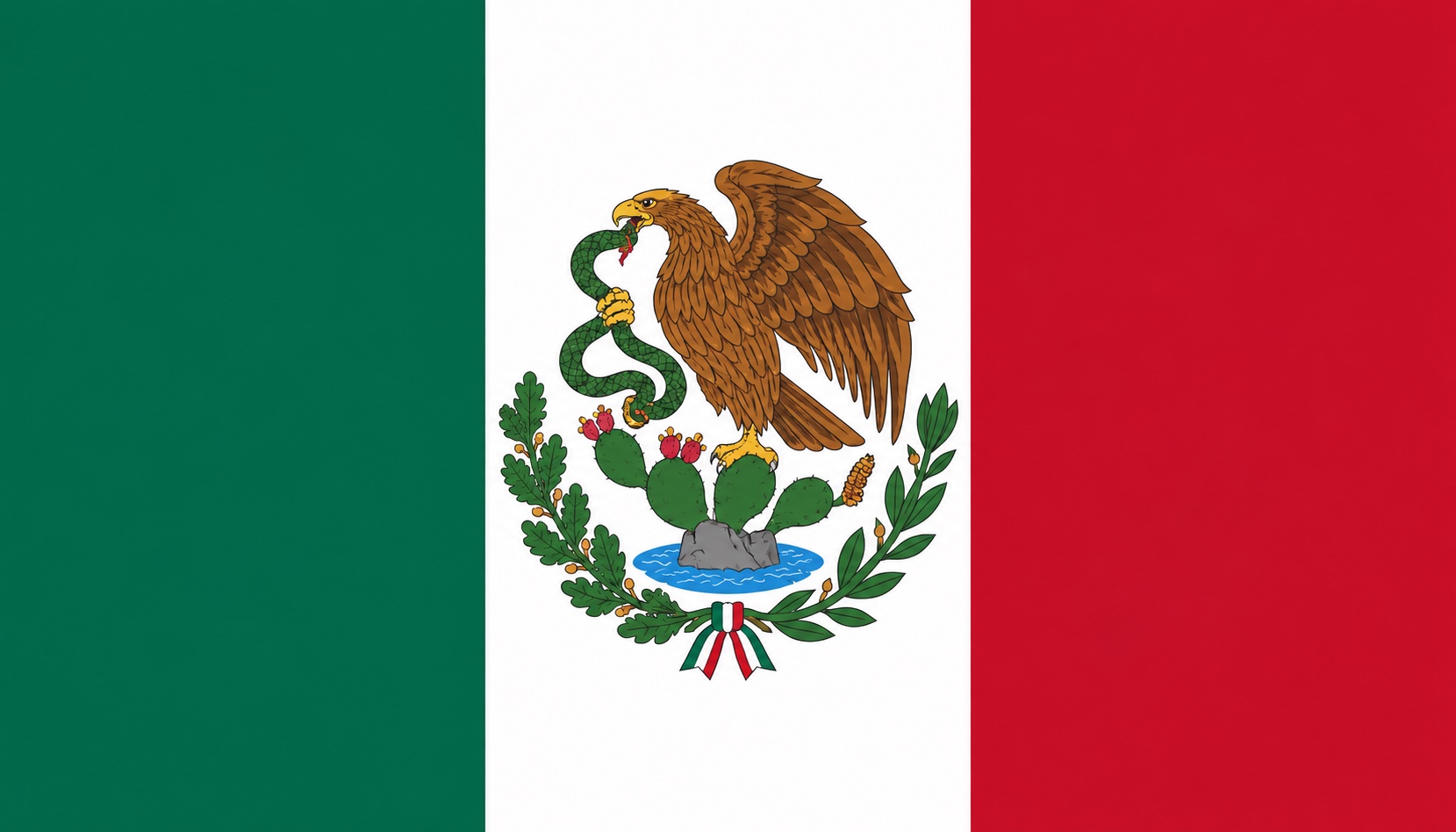
The national flag is a vertical tricolour of green, white and red, with the national emblem in the white stripe: a golden eagle standing on a prickly-pear cactus growing from a rock in a lake, holding a rattlesnake in its beak and talon, above a wreath of oak and laurel tied with a ribbon in the national colours. The emblem is the founding legend of Tenochtitlan, and the Confederation kept it through every constitutional change, including the one that renamed the state.
The flag was not altered when the Republic became the Confederation. The argument at the time was that the tricolour and the eagle belonged to the country rather than to a form of government, and that a state whose governing anxiety is the private capture of public power had better not begin by treating the national emblem as the property of a constitutional settlement. The one visible change was to the seal of the Confederal Council and the presidential band, neither of which is a flag.
✎ Editor's Note · Confederation, not Republic
The modern name is the Confederation of Mexico (La Confederación de México), not simply “Mexico” or the “Mexican Republic.” Key constitutional facts: the one-year directly elected presidency (the Confederation’s most distinctive feature); the Confederal Council as the executive continuity body; the unicameral Congress (Chamber of Deputies only, no Senate); Mexico City’s city-state status; the National Gendarmerie as the federal security force; and the doctrine of Public Sovereignty as the animating constitutional principle. The core danger is the dictatorship of the cartels, cartel sovereignty replacing public sovereignty.
Trivia
- In-Universe The Mexican presidency lasts one year. The Confederal Council provides the executive continuity the one-year term cannot, without it, a one-year presidency would produce permanent administrative chaos. Together they produce a system designed to maximise accountability while minimising entrenchment.
- In-Universe Mexico City holds city-state status within the Confederation, neither a full state nor merely a municipality. The arrangement is designed to prevent the capital from absorbing so much federal authority that provincial Mexico becomes irrelevant to national governance.
- In-Universe Mexico's primary interlocutor on many border questions is not the UKA federal government but the March of Arizona government directly. The March's extraordinary border powers mean that the daily realities of the frontier are managed at the March level, with federal UKA diplomacy reserved for larger questions.
- Design The Confederation's constitutional design is built defensively, every major institution is structured to resist a specific historical failure. The one-year presidency answers personalismo. The Confederal Council answers administrative collapse. The unicameral Congress answers blame diffusion. The doctrine of Public Sovereignty answers cartel capture. The design is not optimistic. It is experienced.
- Etymology "Confederation" rather than "Republic" is a deliberate naming choice. The arrangement of sovereign states in federal compact is emphasized over the unitary republic, a constitutional statement that power lives in the states as much as the centre.
- Real-World In our world, Mexico has a six-year presidential term (sexenio) with no immediate re-election permitted, a reform adopted after decades of one-party dominance. In this world, Mexico's answer to authoritarianism goes further still: one year, a continuity council, and a unicameral legislature with a single address for accountability.
- In-Universe Remittances from Mexican communities in the UKA are a structural part of Mexican household economies, particularly in rural western and central states. Every remittance is evidence that the territorial loss has a living economic consequence that no constitutional doctrine resolves.
- In-Universe The Virgin of Guadalupe appears on protest banners. The parish calendar determines the rhythm of market towns. Mexico's constitution is as formally secular as the French Empire's. In daily life, no one in either country would mistake one for the other.
- Design Oaxaca's food culture, mole, tlayudas, chapulines, the market system, is sold by the Confederation's tourist industry as a heritage product and continued by the communities themselves for reasons that have nothing to do with tourism. The gap between those two facts is the gap between how Mexico presents itself outward and how it actually works inward.
See also
- The Mexican-American War, the conflict that reshaped the northern frontier
- Territory of Loreto, the Baja peninsula sold to the UKA in 2027 under the Treaty of La Paz
- Republic of Cuba, the Confederation’s closest Caribbean partner
Mexico · Confederation · Federal Republic · North America · Foreign Nations