Federal Kingdom of Nigeria
The Federal Kingdom of Nigeria, ordinarily Nigeria, is a federal parliamentary monarchy in West Africa, on the Gulf of Guinea between Dahomey to the west, Niger to the north and the German associated state of Kamerun to the east. Its population of about two hundred and thirty million is the largest of any state in Africa, spread across thirty-six states and a small Lagos Federal Territory. Its capital is Lagos, which has never been moved and which, with about sixteen million people, is the second city of the continent after Cairo.
It became independent of Great Britain on 1 October 1960, by negotiation and without a war. It did not keep the British king and did not become a republic. The Lagos Convention of 1959 created a new national crown, so that the federation’s three regions, each dominated by one people and each afraid of the others, would have above them a head of state that none of them owned. The convention chose as the first king a man from the Ijaw, a minority people of the Niger Delta: Tonye Ebiye, a schoolmaster and federal senator from the town of Nembe, who reigned as Tonye I from 1960 to 1981. His family, the House of Nembe, has held the crown since by strict primogeniture open to women, and Queen Ibiere, a physician, has reigned since 2019, the first woman to do so. The old traditional thrones were kept as dignities without government, and their senior holders sit in a Council of Rulers outside Parliament.
The crown has used a reserve power once. In the coup of January 1966, in which young army officers killed the Prime Minister, Abubakar Tafawa Balewa, Tonye I refused to swear in the plotters. The army split, the coup failed, and parliamentary government was restored within months. Nigeria has never had a military government, and the refusal is the founding event in the crown’s account of itself.
It did not prevent the civil war. In 1966 mobs and mutinous soldiers in the north killed Igbo civilians and officers in their thousands, and the federal government did not stop them. The east left the federation in 1967 as the Republic of Biafra, under Chukwuemeka Odumegwu Ojukwu, and was defeated in a war that ended in January 1970. The civilian government of Obafemi Awolowo fought it, with Yakubu Gowon commanding the army, and its blockade of the east produced a famine in which between half a million and two million people died, most of them of hunger. Tonye I stayed in Lagos, refused to recognise Biafra, signed nothing and said nothing about the blockade, and lost the trust of much of the east for a generation.
Nigeria is a lower-income economy of very large size. Oil, found in the Delta in 1956, provides most of its exports and much of its public revenue, and the questions of who receives that revenue and who lives with the damage done in extracting it have governed its politics since independence. The government formed in 2027 is a coalition led by Hauwa Bello Gusau of the National Congress, the first woman Prime Minister, so that the first woman to reign and the first woman to govern hold office together.
Name
Nigeria takes its name from the river Niger. The name was proposed in 1897 in a London newspaper by the journalist Flora Shaw, who later married the territory’s first Governor-General, as a term for the British possessions on the lower river, and it was adopted when the northern and southern protectorates were joined in 1914. The origin of the river’s own name is uncertain.
The Lagos Convention debated the name and kept it. Proposals for a name drawn from the federation’s own languages were each rejected because they came from one of them, and the convention’s record draws the comparison between a name that belonged to nobody and a king who belonged to nobody. The draft constitution read “Kingdom of Nigeria”; the word Federal was added on the motion of the northern and minority delegates, who wished the state’s name to say that the regions had not been dissolved into the crown. The monarch is styled King or Queen of Nigeria. In Hausa the country is Najeriya, and the Yoruba and Igbo forms are close renderings of the English.
History
Precolonial states
The territory held some of the oldest and most elaborate states in West Africa, and they did not resemble one another. The Nok culture of the central plateau produced terracotta sculpture from the first millennium BC, and the bronzes of Igbo-Ukwu in the south-east were cast in the ninth or tenth century.
In the north, Kanem-Bornu around Lake Chad was Muslim from the eleventh century and lasted, under several dynasties, a thousand years. The Hausa city-states, Kano, Katsina, Zaria and Gobir among them, were walled commercial towns on the trans-Saharan trade. Between 1804 and 1812 the Fulani scholar Usman dan Fodio led a jihad against their rulers and founded the Sokoto Caliphate, the largest state in nineteenth-century West Africa, whose Sultan is still the senior Muslim authority in the country.
In the south-west, Ife was the sacred city of the Yoruba, whose bronze and terracotta heads of the twelfth to fifteenth centuries are among the great works of African art, and whose Ooni is held to stand at the origin of Yoruba kingship. Oyo was a cavalry empire that dominated the Yoruba states until it collapsed in civil war in the 1830s. The kingdom of Benin, under its Oba, was a centralised state with a guild of bronze-casters attached to the palace.
The Igbo of the south-east had no kingdom of comparable size. They governed themselves through village councils, title societies and age grades, with sacred authority held by the priest-kings of Nri and a wide commercial and religious network directed from the oracle at Arochukwu. In the Niger Delta, the trading city-states of Bonny, Kalabari, Okrika, Opobo and Nembe, most of them Ijaw, were ruled by kings and organised in trading houses that stood between the interior and the European ships.
The slave trade and the Bight of Benin
From the sixteenth century to the nineteenth, the coast was one of the principal sources of the Atlantic slave trade. The Bight of Benin, the lagoon coast west of Lagos, and the Bight of Biafra, the Delta and the Cross River estuary, together sent more than three million people across the Atlantic. Oyo’s wars fed captives to the coast, the Aro network supplied the Bight of Biafra, and the Delta houses bought from the interior and sold to ships that were British, Portuguese, French, Dutch and American.
Britain abolished the trade in 1807 and the Realm abolished it by its own Act at about the same time; American ships joined the suppression at sea, and many of the people freed from intercepted slavers were landed at Freetown or settled in Liberia. Palm oil, needed for soap and the lubrication of machinery, replaced people as the coast’s export, and the Delta was called the Oil Rivers long before petroleum was found there. Lagos was bombarded by a British squadron in 1851 and annexed in 1861, the first part of Nigeria under British rule.
The Royal Niger Company and the conquest
Britain’s claim to the Niger was recognised at the Berlin conference of 1884 and 1885 and made good at first by a company. The Royal Niger Company, chartered in 1886, held a monopoly of the river trade and the right to govern along it. In January 1895 the people of Nembe, shut out of the trade by the monopoly, attacked the company’s depot at Akassa; a naval expedition burned Nembe in reprisal. The charter was revoked in 1900.
The conquest of the interior was the state’s. Benin was taken in 1897 by a punitive expedition; the city was burned, the Oba deported, and several thousand bronzes and ivories taken to Britain. In the north, Frederick Lugard led the West African Frontier Force against the emirates and took Kano and Sokoto in 1903. Each campaign rested on machine guns and on African soldiers recruited elsewhere in the country.
Amalgamation, 1914
The Protectorate of Northern Nigeria and the Colony and Protectorate of Southern Nigeria were joined on 1 January 1914 under Lugard as Governor-General. The reason was financial: the south’s customs revenue paid its way, the north’s did not, and amalgamation made the south pay for the north. The two halves were joined administratively and governed separately. The north kept its own administration and largely excluded Christian missions from the emirates; the south received the missions and their schools, and a lead in Western education that the north did not close for generations.
Indirect rule
Lugard governed through existing rulers. In the north indirect rule left the emirs their courts and treasuries under a British Resident whose advice they had to take, and froze the emirates in the form the conquest found them. In the west some obas gained more power under British protection than their own constitutions allowed. In the east, where there were no kings, the administration appointed warrant chiefs, men answerable to nobody but the government, who became the instruments of tax and forced labour. In 1929 a rumour that women were to be taxed brought tens of thousands of Igbo and Ibibio women into protest across the south-east; troops and police fired on them and killed more than fifty. The administration reformed the warrant chief system afterwards and never acknowledged that it had invented it.
The Great Wars and the mandates
In 1914 Britain and Germany were allies and France the enemy. Nigerian soldiers and carriers fought in the conquest of the French colonies of Dahomey and Niger, alongside German colonial troops from Togo, in campaigns where disease killed more men than fighting and the dead carriers were not counted. Under the Treaty of Berlin of 1919 both passed to Britain as League mandates, administered separately from Nigeria. Kamerun remained German, and the boundary agreed between London and Berlin in 1913 was never contested. In the Second Great War, Nigerian divisions fought in Burma, and the soldiers came home to a colony governed much as it had been when they left.
The road to independence
The colonial constitutions of 1946 and 1951 created three regions, Northern, Western and Eastern, and each produced its own party. The National Congress, founded in 1949, was the party of the north and of the emirs’ administrations, led by Ahmadu Bello, the Sardauna of Sokoto, with Abubakar Tafawa Balewa as its leader in the federal legislature. The Action Party, founded in 1951, was the party of the Yoruba west, led by Obafemi Awolowo, whose regional government introduced free primary education in 1955. The People’s Alliance, founded in 1944, became the party of the Igbo east, led by Nnamdi Azikiwe.
The federal constitution of 1954 made Nigeria a federation of the three regions with a federal territory at Lagos. The north held more than half the population and therefore a majority in any legislature elected by population, and a fraction of the south’s schools and graduates. The south feared the north’s numbers and the north feared the south’s education. The minorities feared all three, and a commission sent by the British government in 1957 found that the Tiv, the Edo, the Ijaw, the Efik and the other smaller peoples had good reason to fear the majorities of their regions. It recommended safeguards and no new regions.
The Lagos Convention, 1959
The choice of a head of state was put to a convention at Lagos in the spring of 1959, composed of delegations from the regional and federal legislatures, the senior traditional rulers, and the minorities, whose seats were a concession won after the commission’s report. A British observer attended and took no part.
Britain offered the Crown, as it offered it to every colony. The People’s Alliance and the Action Party would not have a foreign head of state, and the National Congress would not keep the Crown alone, because a Crown kept by the north would have been read in the south as a northern alliance with the departing power. A republic was rejected because an elected president would belong to whichever region elected him: the north’s numbers made a presidency a northern office in the south’s eyes, and the north feared that a southern coalition would one day win it. Proposals for a rotating presidency and for a collective one of the three regional premiers failed on the same ground. No traditional throne would serve, since the Sultan of Sokoto could not be head of state of the Christian south nor the Ooni of Ife of the Muslim north.
The convention therefore created a new crown and gave it to a man from none of the three peoples. The minority delegates proposed it, the Action Party carried it, and the National Congress accepted it once the candidate was named. Tonye Ebiye, an Ijaw born at Nembe in 1895, had taught at mission schools in the Delta and at government colleges in Lagos and Zaria, and had sat as a federal senator since 1957. He was an Anglican, from a people whose fears the commission had just upheld, and was known in all three regions without belonging to any. The traditional rulers agreed on condition that their thrones be kept and given a place in the constitution, which produced the Council of Rulers. The convention also settled the federal form, the parliamentary executive and hereditary succession, so that the question it had answered would not be asked again. The minorities had asked for states of their own and were refused. They were given a crown instead.
Independence, 1960
The federal election of December 1959 returned the National Congress as the largest party, and Balewa, Prime Minister under British rule since 1957, formed a coalition with the People’s Alliance, with Awolowo leading the opposition. Nigeria became independent on 1 October 1960, and Tonye I was installed before Parliament in Lagos the same week. The constitution transferred the powers of the native authorities to elected local councils, in the north over a transition that ran to 1968, and left the rulers their titles and the Council. Nigeria entered the Commonwealth and the League. A Mid-West Region was carved from the west by referendum in 1963.
The first years were difficult. The census of 1962 was annulled amid charges of inflation in every region and its replacement was disputed in turn, because the count decided each region’s seats. The federal election of 1964 was boycotted in parts of the south and marred by fraud, and the Western Region’s election of 1965 was worse, leaving the west in a disorder that the federal government declined to address.
The coup of January 1966 and the refusal
In the early hours of 15 January 1966 a group of young army officers, most of them majors and most of them Igbo, attempted to overthrow the federal government. In Lagos they seized the Prime Minister, Abubakar Tafawa Balewa, whose body was found by a roadside days later. In Kaduna, Major Chukwuma Nzeogwu led the attack in which Ahmadu Bello, Premier of the Northern Region, was killed. The Premier of the Western Region was also killed, as were Festus Okotie-Eboh, the federal Minister of Finance, and a number of senior officers, most of them northern. The plotters said they had acted against corruption and the fraud of the recent elections. No leader from the east was among their victims.
They held Kaduna but failed to secure Lagos or the army’s headquarters. On the morning of 16 January an emissary of their council came to State House at the Marina and asked Tonye I to swear in a revolutionary council as the government and to dissolve Parliament.
The King refused. The constitution required him to act on the advice of the Prime Minister, and there was no Prime Minister; it required him to appoint a person able to command the House of Representatives, and the council could command only the men under its officers. He replied in a note of four lines, now displayed at State House, that he would swear in no government not formed under the constitution, and that evening he said the same on the radio in less than two minutes and asked soldiers to obey their lawful commanders.
The refusal split the army. Units that would have obeyed a government the King had sworn in would not obey one he had refused, and the senior command rallied the Lagos garrison to the crown. Nzeogwu held Kaduna for three days and surrendered on terms of safe conduct. For about three months the surviving ministers sat as a caretaker cabinet under emergency regulations, with the army keeping order. Parliament reconvened in April 1966. The National Congress had lost both its leaders in one night and could not agree on a successor, and it agreed to serve under Obafemi Awolowo, the senior surviving party leader, in a coalition of the Action Party and the National Congress that excluded the People’s Alliance, whose voters the north held responsible for the coup. Awolowo was commissioned as Prime Minister.
The killings of 1966
The coup had been carried out mostly by Igbo officers and its victims were mostly northern, and in the north it was read as an Igbo attempt to seize the federation. The plotters’ trial was delayed through the spring by argument over which court could try them, and the delay was read as protection.
In May 1966 mobs in northern cities killed several hundred Igbo traders, clerks and their families. In July northern soldiers mutinied in barracks at Abeokuta, Ikeja, Kaduna and elsewhere and killed perhaps two hundred Igbo officers and men. In September and October the killing became general: in Kano, Kaduna, Zaria, Jos and towns across the north, Igbo and other easterners were killed in their homes, at railway stations and at the airport, with soldiers and police taking part. Estimates of the dead run from several thousand to thirty thousand and more. More than a million easterners fled to the east.
The federal government did not stop the killings. Awolowo’s coalition depended on the National Congress, and the northern authorities, whose police stood by and in places organised the violence, were not instructed to stop it, not reinforced and not afterwards held to account. No one was convicted. The crown, which had acted alone in January because there was no government to advise it, did not act in September, because there was one.
The civil war, 1967 to 1970
The east withdrew its cooperation from Lagos through the autumn of 1966. Its authority passed to Lieutenant-Colonel Chukwuemeka Odumegwu Ojukwu, the senior officer in the region, who had refused orders from Lagos since the July killings and was given the region’s executive authority by its legislature and a consultative assembly of chiefs and elders. A meeting at Aburi in Ghana in January 1967 produced an agreement the two sides read in incompatible ways.
On 27 May 1967 Awolowo’s government replaced the four regions with twelve states, a reform the Action Party had long advocated and one that, by giving the east’s minorities states of their own, detached them from secession. The same day the eastern assembly mandated secession, and on 30 May 1967 Ojukwu proclaimed the Republic of Biafra. Fighting began on 6 July.
Biafra’s army crossed the Niger into the Mid-West in August 1967 and was driven back. Federal forces took Enugu in October 1967 and Port Harcourt in May 1968, and the enclave shrank to the Igbo heartland. The federal army grew from about ten thousand men to about a quarter of a million under Yakubu Gowon, a Christian from a minority people of the Middle Belt, whom Awolowo’s government had made its commander because he was acceptable to the north without being of it. At Asaba, in October 1967, federal soldiers killed several hundred men and boys after the town’s capture. Nembe, the King’s own town, lay inside the territory Biafra claimed, and the Delta’s minorities were reluctant Biafrans.
The blockade was the federal government’s principal weapon and its decision. The navy closed the eastern ports, the advance closed the land, and by the middle of 1968 the enclave was starving. Awolowo’s government defended the blockade as a lawful weapon of war, and some of its ministers said in terms that starvation was one. It allowed relief only on conditions Biafra’s government would not accept, and Biafra’s government refused conditions that might have let more food in. Between half a million and two million people died, most of them civilians and most of them of hunger and its diseases. The famine was the means by which the war was won.
Tonye I signed nothing and said nothing. The blockade required no royal instrument, and the King, who had acted alone once, did not act again. He stayed in Lagos, refused to recognise Biafra and made no public statement about the famine, and the crown’s standing in the east did not recover for a generation.
Britain armed the federal side, with small arms, ammunition and armoured vehicles, on the ground that it was the lawful government of a Commonwealth member, and the east has not forgotten it. The Realm sold arms to neither side. No state openly backed or recognised Biafra, though arms reached it through dealers by routes more than one government knew about. The relief came from the churches, whose aircraft flew food and medicine by night into Uli, a stretch of road serving as Biafra’s airstrip, from 1968 to the end of the war, and the airlift is the best-remembered act of the war abroad.
Ojukwu left the enclave by air on 11 January 1970 and went into exile. His deputy surrendered at Lagos on 15 January 1970, four years to the day after the coup. Gowon received the surrender and said that there was no victor and no vanquished, and the east remembers the phrase as a promise and as a measure of what followed.
Reconstruction under Awolowo
There were no mass reprisals, no trials for rebellion and no purge of the east, and easterners returned to federal employment and the universities. The east was not reconciled. Every easterner who had held money in a bank before the war received twenty pounds for it, whatever the size of the account. Igbo houses and businesses in Port Harcourt and other towns outside the Igbo states were declared abandoned property and passed to new owners, and most were never returned. The producing areas’ share of oil revenue by derivation, fifty per cent at independence, was cut during the war and again after it.
Gowon became Chief of the Defence Staff in 1970, retired in 1975 and went abroad to study. He refused every invitation to enter politics, and the army has kept out of it since; Nigerians give the credit to the refusal of 1966 and to Gowon in roughly equal parts.
Parliament’s life was extended during the war, and the general election due in 1969 was held in 1971 and returned Awolowo’s coalition. His government extended free primary education across the federation, built roads and universities, and created the naira in 1973. It also detained critics under emergency powers that outlasted the war, the playwright Wole Soyinka among them, and its police raided the Lagos commune of the musician Fela Kuti repeatedly. The National Congress left the coalition in 1974 and won the election of 1975. Awolowo died in 1987, the most admired and the most hated politician the federation has produced, by different regions.
The oil decades
Oil had been found at Oloibiri, a few miles from Nembe, in 1956, and production rose steeply after the war. The price rises of the 1970s made Nigeria rich very quickly, and oil became more than four-fifths of exports and most of federal revenue. The government of Garba Idris Kazaure, the first northern Prime Minister since Balewa, governed on that revenue from 1975 to 1983. It created seven new states in 1976, introduced universal primary education, signed the Treaty of Lagos of 1975 that founded the Economic Community of West African States, and ordered so much cement that in 1975 several hundred ships lay off Lagos waiting to unload. Agriculture declined, Nigeria began to import food it had once exported, and corruption grew with the revenue.
In February 1977 soldiers burned Fela Kuti’s commune in Lagos, and his mother, the campaigner Funmilayo Ransome-Kuti, was thrown from a window and died of her injuries. An inquiry blamed unknown soldiers and no one was tried. In 1982, on Kazaure’s advice, Boma I pardoned Ojukwu, who came home, the crown’s first gesture to the east since the war. In January 1983, as the oil price fell, the government expelled within weeks perhaps a million undocumented West African migrants, most of them Ghanaian, in conditions that killed some of them.
The 1980s and 1990s
The election of 1983 returned the People’s Alliance as the largest party, and Ikenna Udeagu, an Igbo lawyer from Onitsha, became the first Prime Minister from the east, in coalition with the Action Party. His accession was counted as a step in the reconciliation, and many easterners date the end of their exclusion from it. His government governed through a collapse: the oil price fell by more than half in 1986, and the structural adjustment that followed devalued the naira, cut subsidies and public employment, and produced riots in 1989. In 1990 it sent Nigerian troops at the head of a West African peacekeeping force into the civil war in Liberia.
The National Congress returned in 1991 under Abdulkadir Bunu, a Kanuri from Borno, and inherited an unrest in the Delta that had been building since the boom.
Saro-Wiwa and the fall of Bunu
The Ogoni, about half a million people on the eastern edge of the Delta, had produced oil since the 1950s and received pollution, gas flares and little else. In 1990 a movement led by the writer Ken Saro-Wiwa demanded autonomy, a share of the revenue and the cleaning of the land, and organised protests that led the largest foreign company in the Delta, a British-Dutch major, to withdraw from Ogoniland in 1993. The federal government sent an internal security force that killed several hundred people and burned villages in 1993 and 1994.
In May 1994 four Ogoni chiefs opposed to Saro-Wiwa were murdered by a crowd. Saro-Wiwa and others were tried for incitement before a special tribunal set up under federal emergency legislation, with no appeal to the ordinary courts, and two of the prosecution’s principal witnesses later swore that they had been paid. On 10 November 1995 Saro-Wiwa and eight others were hanged at Port Harcourt.
Boma I asked for clemency. He asked the Prime Minister in private, more than once, to advise commutation, and Bunu refused. The prerogative of mercy is exercised on the federal government’s advice, and the King did not use it against that advice; no Nigerian monarch ever has. His request became known after his death.
Britain recalled its high commissioner and the Realm suspended military cooperation. The Commonwealth’s standing committee declined to recommend suspension, on the ground that its conditions applied to coups and stolen elections and the government responsible was elected. At home Bunu’s coalition partners withdrew, and his government lost a vote of confidence in February 1996.
The Ladipo government
The election that followed returned the Action Party under Oyewole Ladipo, a Yoruba economist from Ibadan, who opened a public inquiry into the Ogoni tribunal and the security forces in the Delta. Its report of 1998 found that the trial had been unfair and that the security force had committed killings, rapes and the destruction of villages; on its findings the convictions were referred to the Court of Appeal, which quashed them in 2001. No member of the security force was convicted. The government raised the producing states’ share of oil revenue to thirteen per cent in 1999. It also sent the army to Odi, an Ijaw town in the Delta, in November 1999, after twelve policemen were killed by a gang based there; the soldiers destroyed the town and killed a number of its people that no inquiry has fixed and that the survivors put in the hundreds. It opened no inquiry into Odi.
The piracy crisis and the ATO, 1999
In 1998 piracy off the Delta turned from fishing boats to tankers. Gangs from the creeks attacked laden tankers, kidnapped crews and set two ships on fire, and in the first months of 1999 the insurers withdrew cover from the approaches to Bonny and Forcados. For several months the shipping lanes were effectively closed, and exports and federal revenue fell to a fraction of their level. At the government’s request, navies of the Atlantic Treaty Organization, among them Britain’s, the Realm’s and Germany’s squadron at Duala, patrolled the gulf with the Nigerian navy from the spring, escorted tankers and broke up the gangs’ bases. The lanes reopened in the summer, and Nigeria asked to join the alliance. The members consented and ratified within the year, and Nigeria acceded in the fourth enlargement.
The twenty-first century
In 2000 twelve northern states, beginning with Zamfara, extended their Islamic courts to criminal law, and riots in Kaduna over the change killed more than a thousand people.
The Delta’s grievances became an insurgency. Armed groups attacked pipelines, kidnapped oil workers and between 2006 and 2008 cut output by about a quarter. The People’s Alliance government of Ejiro Okpako, an Urhobo from the Delta and the first Prime Minister from the south-south, ended it by an amnesty in 2009: fighters who surrendered received a pardon, a monthly stipend and training, and some commanders received contracts to guard the pipelines they had attacked. The amnesty still pays former fighters.
In July 2009 an Islamist movement in Maiduguri, known as Boko Haram, rose against the police and was put down with several hundred dead; its founder, Mohammed Yusuf, was killed in police custody. It returned in 2010 as an insurgency, bombing Maiduguri, Kano and the towns of the north-east and by 2014 holding territory in Borno. The National Congress government of Nasiru Danbaba, a Hausa from Zaria, declared an emergency in Borno, Yobe and Adamawa in 2013. On the night of 14 April 2014 the insurgents took 276 schoolgirls from a government school at Chibok. Some escaped within days; others were freed by negotiation in 2016 and 2017 or escaped later; a number have never been accounted for. The army’s conduct fed the war: it detained thousands of men and boys in barracks where very many died, and killed prisoners and civilians in reprisal. The insurgency was driven from the towns by 2016 and survives in the forests of Borno and the islands of Lake Chad.
On 15 January 2010, the fortieth anniversary of the surrender, Ebiye I went to Enugu and apologised for the blockade and the famine. He said that the crown had been silent while the east starved, and he apologised on its behalf with the consent of Okpako’s government. The Action Party opposed the apology, holding, as Awolowo had, that the blockade was a lawful act of war. Many in the east accepted it and many said it came a generation late. No government has apologised on its own account.
The 2019 acclamation and the present coalition
The National Congress lost the election of 2015 to the Action Party under Gbenga Oduwole, who governed until 2019. Ebiye I died in 2019, childless, and the crown passed to his niece, Ibiere Ebiye-Dappa, director of the teaching hospital at Port Harcourt. She was acclaimed by the Council of Rulers and Parliament sitting together, installed as Queen Ibiere at fifty-seven, and became the first woman to reign. Her first act was to commission Chibuzo Okonta of the People’s Alliance, returned at the election a few weeks before, as Prime Minister.
No party has held a majority since. In October 2020 soldiers fired on unarmed protesters against a police unit notorious for extortion and killings at the Lekki toll gate in Lagos. Okonta’s government lost a vote of confidence in 2022, and the National Congress governed under Yusuf Abba Lafia until the election of 2024 brought the Action Party back under Olumide Oyekunle. His government lost a vote of confidence in 2027. The election that followed left the Action Party the largest party, short of a majority, and the National Congress and the People’s Alliance formed a coalition under Hauwa Bello Gusau, a lawyer from Gusau in Zamfara and a former federal Attorney-General, the first woman Prime Minister. It is an east-and-north bargain against the Action Party, the shape of Balewa’s coalition of 1960, and its agreement commits the government to review the derivation formula without committing it to a figure.
Geography
Nigeria covers about 880,000 square kilometres, from the mangrove coast of the Gulf of Guinea to the edge of the Sahara. The Niger enters from the north-west and the Benue from the east, and they meet at Lokoja to flow south together to the Niger Delta, one of the largest wetlands in the world, a maze of creeks and swamp forest that holds the Ijaw, a dozen other peoples and the oil. North of the Delta, rainforest gives way to the savanna of the Middle Belt and then to the dry Sahel of the far north.
Rainfall declines from more than three thousand millimetres a year on the coast to under five hundred on the northern border, and the drying of the Sahel is the environmental fact that most affects the north. Lake Chad, shared with Niger, Kamerun and the territories to the east, has shrunk by most of its area since the 1960s, and the collapse of the fishing, farming and herding that depended on it is one of the causes of the insurgency in the north-east. The same drying has driven herders south into the farmland of the Middle Belt.
The crown
Why a crown
The Nigerian crown was made for a purpose recorded by the convention that made it: to put above the north, the west and the east a head of state that none of them owns. It has no history before 1959 and claims no descent from the older thrones. The convention reasoned that an elected head of state would always be some region’s candidate, a rotating one the current region’s, and a British one acceptable to nobody in the south. A hereditary head of state chosen once, from outside the three majorities, would settle the question of whose crown it was at the start. The choice of an Ijaw was the substance of the arrangement, not a detail of it.
The arrangement has a cost its defenders acknowledge. A crown that belongs to no region has no constituency of its own when a region turns against it, as the east did during and after the war. It has survived because each of the three majorities has continued to prefer a crown belonging to none of them to a presidency that might belong to one of the others.
The House of Nembe
The royal house takes its name from Nembe, the Ijaw town in the eastern Delta where Tonye Ebiye was born. It is a family of the town’s trading class, educated in the Delta’s Anglican mission schools, and before 1959 it was neither noble nor royal. Nembe has its own traditional ruler, the Amanyanabo, whose throne is centuries older than the national crown; the house took the town’s name and not its throne.
The house is Anglican, as it has been since Tonye I, and the crown has no religious office. The monarch heads no church and swears no religious oath, and Muslim, Christian and traditional leaders attend the installation as guests.
Succession and acclamation
Succession is strictly hereditary by absolute primogeniture: the crown passes to the monarch’s eldest child of either sex and that child’s descendants, and failing descendants to the next line of the family by the same rule. The throne has been open to women since 1960. No woman stood first in line before 2019.
Each successor is acclaimed by the Council of Rulers and Parliament sitting together in Lagos, which hear the proclamation of the demise and the successor’s name and assent. They cannot refuse. The successor reigns from the predecessor’s death, and the acclamation recognises a succession rather than making one. It was the convention’s concession to the traditional rulers, whose own thrones are filled by kingmakers, and who wished the new crown to be seen to be received by the old ones although they did not choose it.
Every succession has followed the line. Tonye I was succeeded in 1981 by his son, Boma I, who was childless; Boma I in 2002 by his nephew, Ebiye I, also childless; and Ebiye I in 2019 by his niece, Ibiere. All three kings died on the throne. There has been no abdication, regency or disputed succession.
Installation, not coronation
No Nigerian monarch has been crowned. The convention held that a coronation was a religious rite and the new crown had no religion. The crown on the arms and the royal standard is heraldic, and no object corresponding to it exists. The monarch is instead installed before Parliament in Lagos, in the chamber of the House of Representatives with the Senate and the Council of Rulers present, takes an oath to uphold the constitution, and signs it before the Speaker and the President of the Senate. Members of the Council repeat the oath in Hausa, Yoruba and Igbo. The ceremony takes about forty minutes and has been performed four times, in 1960, 1981, 2002 and 2019, in the same form.
The one reserve power
The monarch acts on the advice of the Prime Minister in almost everything: appointing as Prime Minister the person able to command the House, dissolving Parliament, assenting to bills, appointing judges and officers, and exercising the prerogative of mercy. The constitution also reserves to the monarch a residual duty to refuse any act that would subvert the constitution itself, including the appointment of a government not formed under it.
That power has been used once. On 16 January 1966 Tonye I refused to swear in the plotters’ council, acting alone because there was nobody to advise him, and his refusal split an army that might otherwise have followed them. It is the founding legend of the crown, taught as such, and the reason most Nigerians give for the absence of military government.
Its critics make two replies: that the coup failed as much because the plotters bungled Lagos as because the King refused them, and that the crown which refused in January was silent in September and through the blockade, because by then it had a government to advise it, so that a power used once since 1960, against soldiers and never against a government, is a narrow foundation for a legend. The crown’s defenders accept the facts in both and dispute the conclusion.
The monarchs
| Monarch | Born | Reign | Relationship | Notes |
|---|---|---|---|---|
| Tonye I (Tonye Ebiye) | 1895, Nembe | 1960 to 1981 | Chosen by the Lagos Convention | Schoolmaster and federal senator. Refused to swear in the plotters of 1966 and to recognise Biafra. Died on the throne, aged eighty-six |
| Boma I | Nembe | 1981 to 2002 | Son of Tonye I | Economist. Pardoned Ojukwu in 1982. Asked privately for clemency for Ken Saro-Wiwa. Childless. Died on the throne |
| Ebiye I | Nembe | 2002 to 2019 | Nephew of Boma I | Lawyer and former ambassador to the League of Nations. Apologised at Enugu in 2010. Childless. Died on the throne |
| Ibiere (Ibiere Ebiye-Dappa) | 1962 | 2019 to the present | Niece of Ebiye I | Physician. The first woman to reign |
The present queen, her consort and the heir
Queen Ibiere was born in 1962 and trained as a physician at Ibadan and in London. She practised as a paediatrician in Port Harcourt and became director of the city’s university teaching hospital, which she ran through a decade of strikes, unpaid salaries and the emigration of much of its staff. She acceded in 2019 at fifty-seven. Her reign has been quiet by design: she has visited every state, made the health of mothers and children the subject of most of her speeches, and spoken on the north-east and the Delta only in terms her governments have approved.
Her husband, Prince Olawale Adewusi, is a Yoruba cardiothoracic surgeon from Ibadan, styled Prince by letters patent of 2019, with no constitutional role. Her marriage into one of the three majority peoples was remarked on at her accession and then left alone. The heir is their eldest child, Prince Tamuno, born in 1991, an engineer who worked on the Lagos lagoon crossings and in the Delta’s drainage authorities.
State House
The official residence is State House at the Marina in Lagos, the old Government House of the colonial governors, facing the harbour from Lagos Island. It has been the royal residence since 1960, and the State Opening of Parliament and the presentation of ambassadors’ credentials begin from it. The family keeps a private house at Nembe with no official function, and the three kings are buried in the churchyard of the town’s Anglican church.
Government and politics
The Constitution
The Constitution of 1960, adopted on the Lagos Convention’s resolutions and in force from independence, has been amended many times, most heavily when the regions were replaced by states in 1967, and has never been replaced. It establishes a federal parliamentary monarchy with a bill of rights enforced against both levels of government, the Council of Rulers, the formula for dividing federal revenue and the principle of derivation, and the states’ powers over local government, customary law and personal law. Amendment requires two-thirds of each House and of the state legislatures, and amendments touching the crown or the Council require the Council’s opinion, which is not binding and has never been overridden.
The Prime Minister
The Prime Minister is appointed by the monarch as the person best able to command the House of Representatives and chooses a cabinet that by convention includes ministers from every geopolitical zone. Hauwa Bello Gusau has held the office since 2027, the thirteenth holder and the first woman. The office is stronger than the convention intended, because the federal government controls the oil revenue and with it most of the states’ budgets, and weaker than its holders would like, because no party has governed without votes from more than one region and the House has brought down three governments by votes of confidence, in 1996, 2022 and 2027.
Prime Ministers
| No. | Prime Minister | Party | From | Term | Notes |
|---|---|---|---|---|---|
| 1 | Abubakar Tafawa Balewa | National Congress | North (Bauchi) | 1960 to 1966 | Prime Minister from 1957 under British rule. Killed in the coup of 15 January 1966 |
| 2 | Obafemi Awolowo | Action Party | West (Ogun) | 1966 to 1975 | The civil war and the reconstruction. The blockade was his government’s |
| 3 | Garba Idris Kazaure | National Congress | North (Kano) | 1975 to 1983 | The first northern Prime Minister since Balewa. The oil boom; the Ojukwu pardon |
| 4 | Ikenna Udeagu | People’s Alliance | East (Anambra) | 1983 to 1991 | The first Prime Minister from the east. Structural adjustment |
| 5 | Abdulkadir Bunu | National Congress | North (Borno) | 1991 to 1996 | Hanged Ken Saro-Wiwa in 1995; fell in 1996 |
| 6 | Oyewole Ladipo | Action Party | West (Oyo) | 1996 to 2003 | Opened the Ogoni inquiry. Thirteen per cent derivation. Joined the ATO. Odi |
| 7 | Ejiro Okpako | People’s Alliance | South-south (Delta) | 2003 to 2010 | The first Prime Minister from the south-south. The Delta amnesty |
| 8 | Nasiru Danbaba | National Congress | North (Kaduna) | 2010 to 2015 | The emergency in the north-east. Chibok |
| 9 | Gbenga Oduwole | Action Party | West (Lagos) | 2015 to 2019 | The insurgency driven from the towns |
| 10 | Chibuzo Okonta | People’s Alliance | East (Imo) | 2019 to 2022 | The first Prime Minister commissioned by Queen Ibiere. Lekki. Lost a vote of confidence |
| 11 | Yusuf Abba Lafia | National Congress | North (Nasarawa) | 2022 to 2024 | Formed a government in the same Parliament |
| 12 | Olumide Oyekunle | Action Party | West (Ekiti) | 2024 to 2027 | Lost a vote of confidence |
| 13 | Hauwa Bello Gusau | National Congress | North-west (Zamfara) | 2027 to the present | The first woman Prime Minister, in coalition with the People’s Alliance |
Parliament
The Parliament of Nigeria sits in Lagos and consists of the monarch, the House of Representatives and the Senate. The House of Representatives has 360 members elected from single-member constituencies for up to five years; it is the chamber of confidence and alone originates money bills. Its constituencies are drawn on the census, the most contested statistic in the federation, because the region that counts more people wins more seats.
The Senate has 108 members, three for each state; the Lagos Federal Territory is represented in the House only. The Senate revises legislation, must consent to constitutional amendments and the creation of states, and confirms Supreme Court judges and service chiefs, but cannot bring down a government. Its equal representation of the states makes it the chamber of the minorities, whose states outnumber those of the three majority peoples.
The Council of Rulers
The Council of Rulers is the constitutional body of the traditional thrones: about thirty senior rulers, among them the Sultan of Sokoto, the Ooni of Ife, the Oba of Benin, the Obi of Onitsha, the Shehu of Borno, the Emir of Kano, the Alaafin of Oyo, the Tor Tiv and the Obong of Calabar, with thrones from every state. It sits outside Parliament and takes no part in legislation. It acclaims each new monarch with Parliament and cannot refuse; it must be consulted on any bill touching custom, chieftaincy or religion, and its opinion is published and not binding; and it advises on matters referred to it, which in practice are the matters no elected body wishes to be seen to decide. It is presided over by the Sultan of Sokoto and the Ooni of Ife alternately, year by year, a rotation between the senior Muslim and the senior Yoruba throne settled in 1960 and never broken.
Its influence exceeds its powers. Its members are heard in their regions as no politician is, and its collective opinion has stopped several bills that Parliament had the votes to pass. Its critics say it gives the thrones a standing their subjects did not choose and speaks for the men who hold them rather than the people beneath them. It has no women members.
The states and the Lagos Federal Territory
The federation has thirty-six states, created by division of the regions in 1967 and of the states in 1976, 1987, 1991 and 1996, and the Lagos Federal Territory. Each state has an elected House of Assembly, a Premier answerable to it, and a Governor appointed by the crown on the state government’s advice whose functions are formal. The states run schools, health, local government, customary law and, in the north, the Islamic courts, and most depend on the monthly allocation from the federation account for their own salaries. They are grouped informally into six geopolitical zones, north-west, north-east, north-central, south-west, south-east and south-south, which have no constitutional standing and govern the distribution of cabinet posts, federal agencies and much else.
The Lagos Federal Territory, the island and the Marina, was carved from Lagos State at its creation in 1967 and is administered by the federal government. It holds State House, Parliament, the Supreme Court and the principal ministries, and Lagos State has disputed its boundaries, revenue and planning powers in the courts since 1967.
Parties and the branch law
Politics has been organised since before independence around three national parties, each rooted in one region: the National Congress in the north, the Action Party in the Yoruba west, and the People’s Alliance in the Igbo east and, since the Delta states were created, most of the south-south. The Political Parties Act of 1972, passed by Awolowo’s government, requires every party to keep branches and field candidates in every state. It has made the parties nationally organised without making them nationally supported: each has branches in all thirty-six states, and each wins most of its seats in one zone or two.
A seat test, requiring a party to win seats in a minimum number of states to remain registered or to lead a government, has been proposed by two electoral commissions and by members of all three parties. It has never passed. Its supporters say only a test of results will make the parties national; its opponents say it would deregister any party that lost badly and hand the shape of politics to whoever drafted it. Smaller parties, a labour party among them, win seats in the cities and have never held office.
Law and religion
The courts
The Supreme Court in Lagos heads a federal judiciary with a Court of Appeal sitting in divisions across the federation. The states have High Courts, customary courts and, in the north, Islamic courts, and the Supreme Court hears appeals from all of them on questions of constitutional right. Appeals to the Privy Council ended at independence, since it advises a Crown the federation does not share. The law mixes English law received in the colonial period, the customary law of each people for family, land and inheritance, and Islamic law in the north. The higher courts are independent in practice; the lower are slow, underfunded and in places corrupt, and most of the federation’s prisoners are awaiting trial.
Islamic law in the north
The federation is secular: the constitution forbids a state religion and guarantees freedom of religion, and it leaves personal law to the states, so that the northern states have run Islamic courts for marriage, divorce and inheritance since before independence. In 2000 twelve of them extended those courts to criminal law for Muslims, with the Islamic penalties of amputation and stoning. The federal government did not challenge the codes directly, and the Supreme Court has not ruled on them as a whole. A small number of amputations were carried out in the first years; the stoning sentences, most of them passed on women for adultery, were overturned on appeal. Most severe sentences are overturned and few are carried out, and the codes remain in force. Their defenders say the states have used a power the constitution gives them; their critics say a constitution of equal rights cannot permit such punishments in some states and not others, and that the codes fall hardest on women, the poor and the Christians of the north who live under their shadow.
Rights and their limits
The bill of rights is enforced in the cities and the higher courts, more weakly elsewhere, and is suspended in practice in the parts of the north-east under military operations. Same-sex relations are a crime under federal law, inherited from the colonial code; a federal statute of 2014 extended the prohibition to marriage and to supporting organisations, and the northern Islamic codes provide harsher penalties, including stoning. Prosecutions are uncommon; arrests, extortion and violence by police and crowds are not. The press is free and among the most combative in Africa, though journalists have been detained by the security services and killed in the Delta and the north-east.
Foreign relations
Britain and the King
Relations with the United Kingdom of Great Britain are close and unsentimental. Britain is the former colonial power, a principal destination of Nigerian students and emigrants, and the government that armed the federal side in the civil war, which the east has not forgotten. Nigeria has never asked Britain for an apology for colonial rule, holding that the question belongs to its people’s organisations and courts, and has never received one. It has asked at intervals for the return of the Benin bronzes and ivories in title; British museums have returned a number, most of them as long-term loans, and the Oba of Benin and the federal government both hold that a loan is not a return.
Ernest V made state visits in 1987 and 2012, as King of Great Britain and guest of the Nigerian crown. He did not reign in Nigeria and had no standing there beyond his headship of the Commonwealth. The two monarchies are cordial, and diplomats on both sides call them the Commonwealth’s two kinds of crown: one shared across fourteen realms and descended from the empire, the other made by a former colony for itself.
The Commonwealth
Nigeria has been a member of the Commonwealth of Nations since independence, as a monarchy of its own, under the London Declaration of 1949, which provides that a member adopting a republican constitution or a monarchy of its own remains a full member and accepts the King as Head of the Commonwealth. It has its own row in the association’s table of members and has never been suspended. Lagos hosted the summit in 1975 and 2008. Nigeria pressed hard for sanctions against apartheid in the 1970s and 1980s, and its votes were part of the majority that won that fight.
Its one crisis in the association followed the hanging of Ken Saro-Wiwa in 1995, when the standing committee declined to recommend suspension because the government responsible was elected. Ogoni organisations and the Nigerian opposition criticised the decision, and the association’s own historians have since called it the clearest case of its rules protecting a member they were not written to protect.
The Atlantic Treaty Organization
Nigeria acceded to the Atlantic Treaty Organization in 1999, the fourth enlargement, after the piracy crisis in which allied navies had patrolled the gulf with its own. It is the alliance’s only African member, and with it the alliance numbers seventeen states and thirteen parties to the treaty. The guarantee is automatic, so accession bound Nigeria to the defence of every member, those on the Russian frontier in northern Europe included, and bound them to a coastline none had guarded before: the protocol of accession widened the treaty area from European and North American ground to the territory of any Party, so that Nigerian soil is guaranteed as fully as any other member’s. Parliament debated in 1999 whether the federation understood the first half of that bargain; the government answered that a state living on tankers had no defence of its sea lanes without allies, and the vote was carried with the People’s Alliance divided. In May 2006, when the guarantee came closest to operating, Lagos waited with every other allied capital to learn whether it was at war. Nigeria’s contribution is principally naval.
The League of Nations
Nigeria joined the League of Nations at independence, has held one of the African elected seats on the Security Council several times, and has been among the largest African contributors to League peacekeeping since the 1960s. Ebiye I was the federation’s ambassador to the League before his accession. Olusegun Adeyemi, a Nigerian, was the League’s Secretary-General from 2021 until February 2024, when he was killed as his aircraft crashed on landing at Addis Ababa on his way to the Tigray talks, the first Secretary-General to die in office. On the proposed permanent African seat, Nigeria backs the rotating plan, under which the seat would belong to the region and be held in turn, rather than a seat named for one state. As the most populous African state it would be the obvious candidate for a named seat, and the position is criticised at home as giving away a claim. Its governments answer that a seat belonging to no single state is the only kind the region could agree on.
West Africa and the Economic Community
Nigeria is the largest economy and military power in West Africa. The Economic Community of West African States, founded by the Treaty of Lagos in 1975, has its secretariat at Lagos, a customs union and free movement in principle and largely in practice, and a court. Its peacekeepers, led and largely manned by Nigerians, served in the civil wars in Liberia from 1990 and Sierra Leone from 1997, ended both at a cost of several hundred Nigerian lives, and faced substantiated allegations of looting and abuse. The region regards the interventions with a mixture of gratitude and resentment, and remembers the expulsion of 1983 against Nigeria more often than anything else.
Kamerun and Germany
Kamerun, to the east, is an associated state of the German Empire, and relations are friendly and close. The border was fixed between London and Berlin in 1913 and has never been fought over, revised or disputed. The Bakassi peninsula at its southern end is Kamerun’s by the 1913 agreement, and no Nigerian government has claimed it. The old emirate of Adamawa straddles the line, its Lamido at Yola on the Nigerian side. Germany keeps its West African station at Duala, a few hours from the border, whose ships have exercised with the Nigerian navy since 1999, and German firms trade through Lagos in volume.
Dahomey and Niger
Dahomey and Niger were French colonies until 1919, British League mandates until 1960, and have been independent republics since 1960. The Lagos Convention considered inviting them into the federation and did not, because the mandates required each territory’s own self-determination and neither wished to be a Nigerian state. Both borders are porous: the Yoruba live on both sides of one and the Hausa on both sides of the other, Nigeria’s markets buy their produce and its cities employ their workers, and goods smuggled through Dahomey’s port of Cotonou to avoid Nigerian tariffs have led Lagos to close that border several times. Niger shares the drying of Lake Chad and the insurgency of the north-east.
Ghana, Sierra Leone and Liberia
Ghana became independent as a republic in 1957, the first of British Africa to leave, and relations are close and competitive. Sierra Leone became a republic in 1961. Liberia has been a republic since 1847, settled in part by people freed from slave ships the Realm’s navy intercepted, and Nigeria’s intervention in its civil war was the largest military operation the federation had undertaken since 1970.
The diaspora in the Realm
About a million people of Nigerian birth or descent live in the United Kingdom of America, concentrated in Chicago, in the Commonwealth of Illinois, Houston, in the Republic of Texas, and the New York area, with a high proportion of doctors, nurses, engineers and academics on whom the Realm’s hospitals and universities depend. Remittances from the diaspora in the Realm and Britain exceed every Nigerian export except oil.
Defence
The Nigerian Armed Forces, an army, navy and air force of something over two hundred thousand regulars, are the largest in West Africa. Commissions run in the monarch’s name; command is exercised by the Chief of the Defence Staff under the Minister of Defence and the Prime Minister. The army has never governed, and its tradition of subordination, shaped by January 1966 and by Gowon, is taught to its officers. It is not a tradition of restraint in the field: Asaba in 1967, Odi in 1999 and the north-east since 2009 are set out above. The navy, a coastal force until 1999, is the federation’s contribution to the alliance; the air force has flown in the north-east since 2013, and its strikes on villages and camps for the displaced, one of which killed more than a hundred civilians, have been the subject of inquiries.
Economy
Nigeria is a lower-income economy of very large size, with a gross domestic product of about A£380 billion, about A£1,650 a head, below Egypt, South Africa and the East African Federation. It is very unequal: Lagos and the oil towns have a wealthy class, the south a growing middle class, and the rural north some of the deepest poverty on the continent.
Oil
Oil is the economy’s base. Production began in the Delta in 1958, rose steeply after the civil war, and has since the 1970s provided most of the federation’s exports, usually more than four-fifths, and much of federal revenue. Gas, flared off at the wells for decades, is now also exported. The budget rises and falls with the price of crude, the currency with the budget, and politics with both. The booms of the 1970s and 2000s were spent largely on consumption, construction and imports; the busts of the 1980s and of 2014 and 2015 were met with borrowing, devaluation and cuts. Agriculture and manufacturing have never recovered the place they held before oil.
The damage in the Delta is great. Spills from corroded pipelines, sabotage and theft have contaminated the creeks, the farmland and the drinking water of hundreds of communities, and gas flares burned for decades beside villages. The League’s report of 2011 on Ogoniland found drinking water contaminated with benzene at many times the safe level and set a clean-up of decades that has barely begun.
The derivation formula
Federal revenue is paid into a federation account and divided by a constitutional formula between the federal government, the states and the local councils, after a share is paid to the producing states by derivation. At independence that share was fifty per cent. It was cut during and after the war and fell to a few per cent by the 1980s, on the principle that oil belonged to the whole federation, and was raised to thirteen per cent in 1999. The rest is pooled. The Delta wants fifty, arguing that the federation took its revenue and left it the pollution. The other regions answer that the oil lies under federal law, that the federation fought a war to keep the east and its oil, and that fifty per cent would make two or three states rich and the rest dependent on them.
The state corporation and the foreign companies
The industry runs on joint ventures between the federal national oil corporation, founded in 1971, and foreign companies supplying capital and operation. The largest partner for most of the industry’s history has been a British-Dutch major, which withdrew from Ogoniland in 1993, has been sued by Delta communities in the courts of several countries, and settled one claim arising from the Ogoni hangings in 2009 without admitting liability. Companies from the Realm, France and Italy hold most of the other ventures. The corporation is the federation’s largest enterprise and its least transparent: it sells the government’s crude, imports refined fuel because the federal refineries have rarely worked, and for decades administered a fuel subsidy that cost more than the federal health and education budgets together.
Corruption
Corruption in the oil revenue is the federation’s most damaging economic failing. The federation’s own Auditor-General has reported in successive years crude sold and not paid for, revenue not remitted, subsidies paid for fuel never imported and contracts let at many times their cost, in amounts running to billions in single years. A trade in stolen crude, protected by officials, takes a share of production estimated at a tenth or more. Anti-corruption agencies have recovered some of the money and prosecuted some of the guilty, have also been used against governments’ opponents, and have sent few senior figures to prison.
Agriculture
Agriculture employs about a third of the workforce. The south grows yams, cassava, maize and plantains, the north millet, sorghum, rice and groundnuts, and Nigeria is the world’s largest producer of yams and cassava. Cocoa from the west, groundnuts from the north and palm produce from the east paid for the colonial state and the first years of independence, until oil drew labour and investment away. The federation imports much of its rice and wheat, and northern farming is threatened by drought, insurgency and the conflict in the Middle Belt.
Lagos
Lagos, with about sixteen million people, is the capital, the principal port and the commercial centre, grown from a colonial port of under a million at independence without ever being planned to its present scale. Lagos Island holds the Marina, State House, Parliament and the ministries; Victoria Island and Ikoyi the banks, embassies and the wealthy; the mainland the port at Apapa, the markets, the industries and most of the people, in districts ranging from suburbs to settlements on stilts over the lagoon. Its traffic, flooding and housing are national questions, argued over between the federal government and Lagos State.
The capital has never moved. A commission recommended in 1976 a new capital in the centre of the country, on neutral ground between the regions. Kazaure’s government declined, and Parliament agreed, for two reasons recorded at the time: the cost, and that the crown, which sat in Lagos and belonged to no region, already made the capital neutral. Lagos’s congestion is the price of the second reason.
Society
Peoples and languages
Nigeria holds more than five hundred languages. The Hausa and Fulani of the north make up something under a third of the population, the Yoruba about a sixth and the Igbo about a sixth. The rest, more than a third, belong to peoples that are national minorities and often majorities in their own states: the Ijaw, Kanuri, Tiv, Ibibio, Efik, Edo, Nupe, Urhobo, Igala and hundreds more. English is the language of federal government, the courts, higher education and national business. Hausa, Yoruba and Igbo are official alongside it in the states where they are spoken, and Hausa is the lingua franca of the north. A Nigerian Pidgin based on English is the language of markets, motor parks, popular music and much broadcasting, the first language of millions in the Delta cities and the one most Nigerians share.
Religion
Nigerians are about half Muslim and half Christian, with traditional religion alongside both. The north is predominantly Sunni Muslim, with the Sultan of Sokoto as its senior religious authority; the south-east and south-south are predominantly Christian; the Yoruba south-west is divided, often within families; the Middle Belt is mixed. Christianity is Anglican, Catholic, Methodist and Baptist from the mission period and very largely Pentecostal now, and Nigerian priests staff parishes in Ireland, Italy and Germany that once sent missionaries to the Delta. Religious violence has recurred, in Kaduna in 2000, in Jos repeatedly from 2001 and in Boko Haram’s attacks on churches and on mosques that rejected it, and the crown’s neutrality between faiths is one of the things it is valued for.
Education and Ibadan
The University of Ibadan, founded in 1948 as a college of the University of London, is the oldest university, where Achebe and Soyinka studied and a generation of administrators and scholars was formed. There is now a federal university in every state, beside state and private ones. The system is very unequal: the south has had schools since the missions arrived, while the north, where the colonial government kept the missions out of the emirates, began independence far behind and has not caught up, and very many northern children, most of them girls, are out of school. The federal universities are crowded, underfunded and closed for months by strikes, and many of the best students leave for Britain and the Realm.
Culture
Nollywood
Nollywood began with the video-film boom of the early 1990s in Lagos, when producers with consumer video cameras made features in weeks for markets that sold cassettes, and found that the audience would buy as many as they could make. It is now among the largest film industries in the world by output, producing well over a thousand features a year in English, Yoruba, Hausa, Igbo and Pidgin, distributed across Africa and the diaspora. Its critics complain of haste and melodrama; its defenders reply that it built an audience of hundreds of millions without subsidy, studio or foreign distributor. Kano has a Hausa-language industry regulated closely by the northern censorship boards.
Literature
Chinua Achebe, an Igbo novelist educated at Ibadan, published Things Fall Apart in 1958, an account of the British arrival in an Igbo village told from inside it, which became the most widely read African novel. He served Biafra during the war, and his last book, in 2012, laid the famine at the door of Awolowo’s government and renewed the national argument for a year. He died in 2013. Wole Soyinka, a Yoruba playwright and poet, was detained without trial by Awolowo’s government for most of the war after travelling east to try to broker peace. He received the Nobel Prize in Literature in 1986 and has been the federation’s most persistent critic of every government since. Others include the poet Christopher Okigbo, killed fighting for Biafra in 1967, the novelists Cyprian Ekwensi, Flora Nwapa and Buchi Emecheta, and Ken Saro-Wiwa, whose novel of the war was written in a Pidgin of his own making.
Music
Highlife came from Ghana in the 1950s and jùjú grew among the Yoruba, but the federation’s most famous music is Afrobeat, created in the late 1960s by Fela Kuti from highlife, jazz, funk and Yoruba rhythm. Fela’s songs, in Pidgin that everybody understood, were aimed at the state, and his quarrel was with Awolowo’s government and those that followed it, with the police, the soldiers and the elite of the oil boom. He declared his commune, the Kalakuta Republic, independent; it was raided repeatedly and burned in 1977, and he was imprisoned from 1984 to 1986 on currency charges, and the judge who convicted him later said that he had been pressed to do so. He died in 1997, and more than a million people came to his funeral. The Lagos pop of the twenty-first century, called Afrobeats after his music, is the federation’s largest cultural export after Nollywood.
Sport
Football is the national game, and the national team, the Super Eagles, is the most followed institution in the federation after the crown. It has played in several World Cups since the 1990s and won the African Cup of Nations three times, and its greatest success was the Olympic football title of 1996, won after beating Brazil and Argentina, which was celebrated in every city for days. The women’s team, the Super Falcons, has been the strongest in Africa for most of its history.
Symbols
Flag
The flag, a vertical triband of green, white and green, was adopted at independence in 1960 from a design by a student, Taiwo Akinkunmi, whose entry won a competition of 1958 and 1959; the green is the land and the white peace. It carries no crown: the convention decided that the flag should be the people’s, and put the crown on the arms and the royal standard instead.
Arms
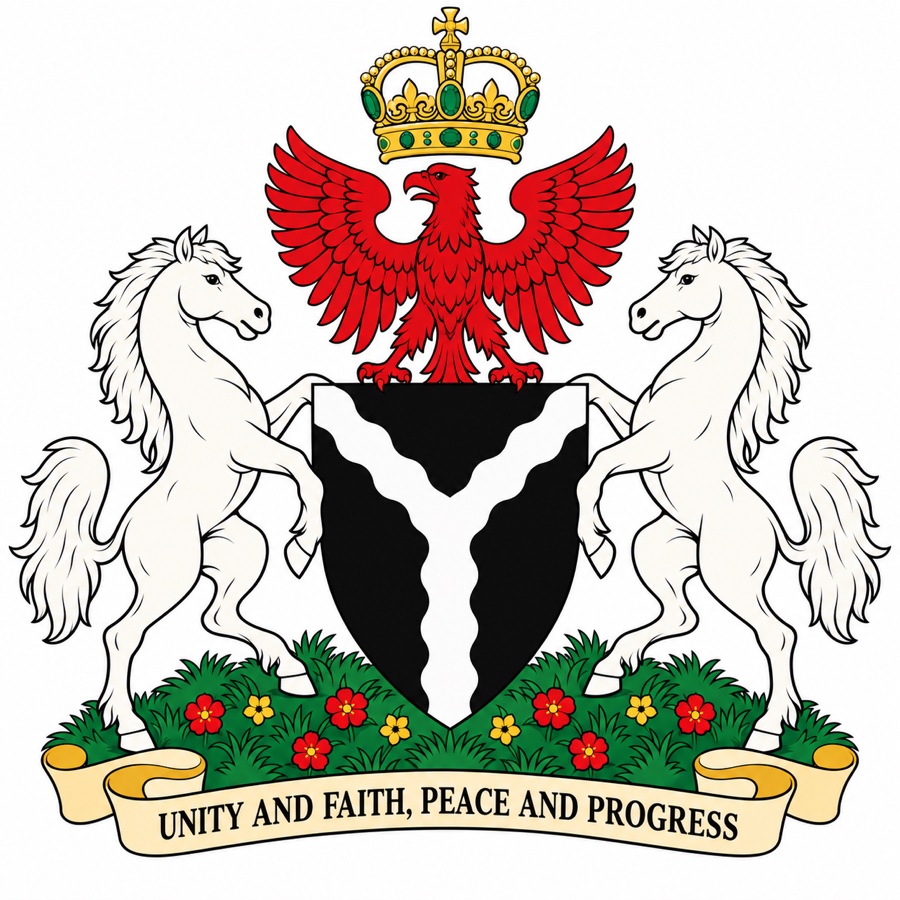
The arms show a black shield bearing a wavy white Y, for the meeting of the Niger and the Benue, supported by two white horses, with a red eagle standing on the shield and a crown above the eagle. The black is the soil, the horses dignity and the eagle strength, and the compartment beneath is strewn with the flowers of wild plants found across the federation. The crown was added at the convention’s direction.
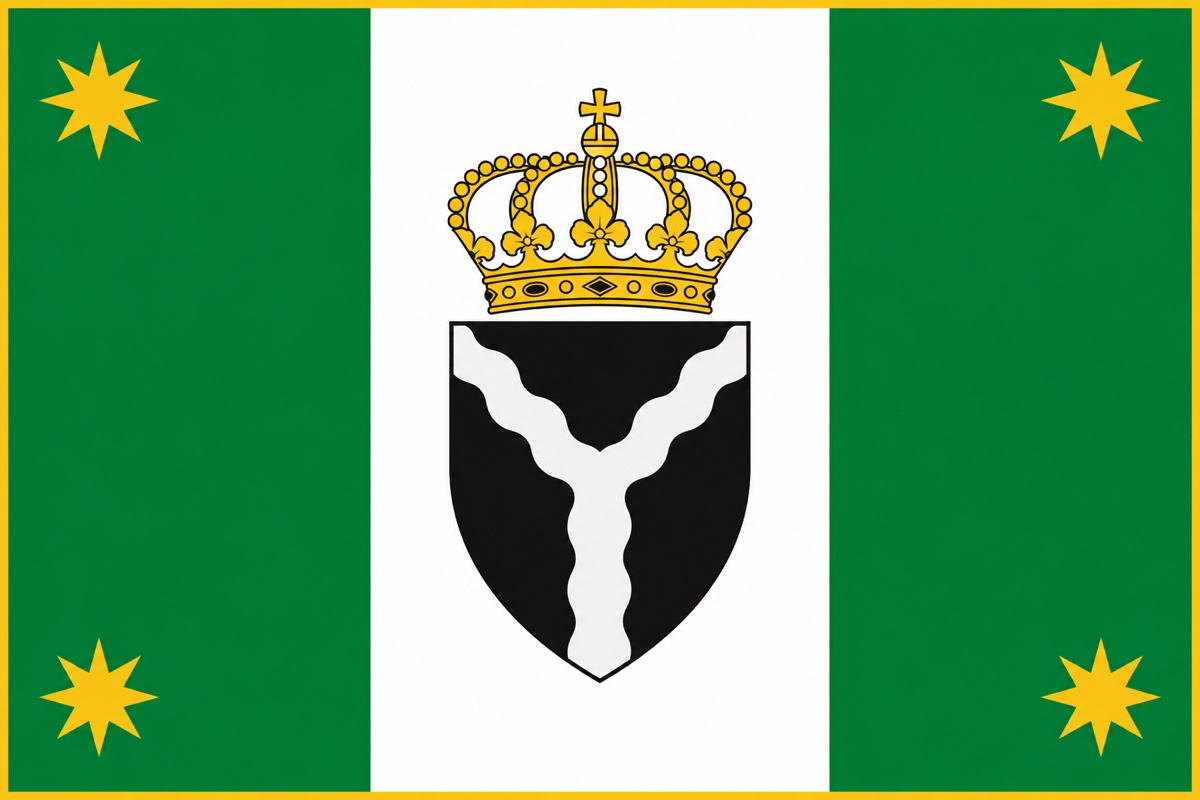
The royal standard carries the national colours, green, white and green, within a gold border, with the shield of the arms beneath the crown in the white band and a gold eight-pointed star in each corner. It flies over State House when the monarch is in residence and from the monarch’s car, and it is the only flag on which the crown appears.
Anthem and motto
The anthem, Nigeria, We Hail Thee, was adopted at independence and has never been replaced. Proposals for an anthem written by a Nigerian or in a Nigerian language have been made at intervals and have never passed, partly because no replacement could be agreed and partly because the anthem has acquired, through the football team and the funerals of three kings, the standing that age gives. The motto is Unity and Faith, Peace and Progress. Independence Day, 1 October, is the national holiday, and the monarch’s address from State House that day is the one speech each year most Nigerians hear.
Failings
The killings of 1966. In May, July, September and October 1966, mobs, police and mutinous soldiers in the north killed Igbo and other easterners in their thousands, perhaps their tens of thousands, and drove more than a million from their homes. Awolowo’s federal government, which depended on northern votes, did not stop the killings and prosecuted nobody afterwards. They drove the east out of the federation and caused the war.
The blockade and the famine. The federal blockade of Biafra from 1967 to 1970 starved the enclave, and between half a million and two million people died, most of them civilians and very many of them children. Awolowo’s government chose the blockade, defended starvation as a weapon of war and won the war by it. The crown signed nothing and said nothing, and apologised in 2010. No government has.
The hanging of Ken Saro-Wiwa. In 1995 Bunu’s government hanged Saro-Wiwa and eight other Ogoni men after a trial by a special tribunal with no appeal, on evidence two of its witnesses later said had been bought. A federal court quashed the convictions in 2001. Bunu refused the King’s private plea for clemency, and nobody responsible for the tribunal or for the security force’s killings in Ogoniland has been convicted.
The Delta’s pollution. Oil production since 1958 has contaminated the creeks, farmland and water of the Niger Delta through spills, sabotage, theft and gas flaring, under federal regulation that was weak and weakly enforced, by a state corporation and foreign companies that knew what they were doing. The clean-up of Ogoniland set in 2011 has barely begun, and the rest of the Delta has not been surveyed to the same standard.
Corruption in the oil revenue. The federation’s own Auditor-General has reported, year after year, the loss of oil revenue in billions, and theft of crude protected by officials takes a tenth or more of production. Few senior figures have been convicted.
The army’s abuses in the north-east. Since 2009 the army has detained thousands of men and boys in barracks where very many died, killed prisoners and civilians in reprisal, and bombed villages and camps for the displaced. The federation’s own inquiries have documented these acts, and very few soldiers have been tried.
Chibok and the abductions. In April 2014 Boko Haram took 276 schoolgirls from Chibok. The federal government was slow to acknowledge it and unable to recover most of them for years, and some have never been accounted for. Abductions of schoolchildren in the north have continued.
The Middle Belt killings. The conflict between farmers and herders in the Middle Belt, driven by the Sahel’s drying, has killed many thousands of people since the 2000s in raids on villages and reprisals against herders’ camps. Governments have announced plans, grazing laws and operations, and the killing has continued.
Same-sex relations criminalised. Same-sex relations are a crime under federal law, extended in 2014 to marriage and to supporting organisations, with harsher penalties in the northern Islamic codes. No government has proposed to change the law.
Open disputes
The derivation share. The producing states receive thirteen per cent of oil revenue by derivation, and the Delta wants fifty, its share at independence. The present coalition is committed to a review without a figure, and every previous review has ended where it began.
Islamic criminal law in the north. Whether a federal constitution of equal rights permits the northern states’ Islamic criminal codes has never been decided by the Supreme Court as a whole, and the federal courts overturn the severe sentences case by case. Defenders and critics both regard the position as unstable, for opposite reasons.
The League’s African seat. Whether the continent’s most populous state should claim a named seat, or whether backing the rotating plan gives one away, is argued in Parliament whenever the reform comes before the League.
Whether the crown should go on. A small republican movement, with members in all three parties, argues that a crown chosen in 1959 to solve a problem of 1959 has outlived it, and that the refusal of 1966 is a legend that excuses the silence of 1967 to 1970. The crown polls well, consistently and across the regions, because it belongs to none of them, and the movement has never proposed a replacement the regions could agree on.
The Ogoniland clean-up. A federal agency was created for it in 2016; the work has barely begun; and the companies, the corporation, the federal government and Rivers State dispute who should pay and who has failed.
The cross-regional party law. Whether the parties should be made national in their results, by a seat test, as well as in their branches is the oldest unresolved question in the federation’s politics after derivation.
Assessment
Nigeria has held together through a coup, a pogrom, a secession and a war that killed up to two million people. It has never had a military government, has transferred power between parties and regions repeatedly by election, has a free press and higher courts that are independent, and has a literature, music and cinema heard across the world. It is also poor for its size, very unequal, dependent on oil to a degree that has damaged both its economy and its land, corrupt on a scale its own auditors document, and unable to secure large parts of its north.
The crown’s part in this depends on the period examined. The refusal of January 1966 is the strongest argument for the convention’s design: a head of state who belonged to no region and owed nothing to the army refused a coup, and the army divided rather than follow it. The silence of 1966 to 1970 is the strongest argument against: the same crown, once it had a government to advise it, did nothing while the north killed easterners and the federal government starved the east, and the apology came forty years later from a king who had not been on the throne. Both follow from the same principle, that the crown acts on advice except where there is no one to give it.
The design’s more lasting effect has been to remove the head of state from the competition between the regions, so that no election in the federation’s history has been fought for its highest office. The governments that have ruled Nigeria have been coalitions between regions because no region could win alone. Whether that has made the federation more stable than a presidency would have, or has only moved its instability into Parliament, the census and the derivation formula, is a matter on which Nigerian historians disagree.
The failings above were mostly the acts of elected governments. The killings of 1966, the blockade, the hanging of Saro-Wiwa, Odi and the army’s conduct in the north-east were carried out or permitted by governments answerable to Parliament, in a federation with no junta to blame. Nigeria’s defenders count that as a mark of its constitutional seriousness, and its critics as proof that constitutional government prevented none of it.
Chronology
| Year | Event |
|---|---|
| c. 500 BC | The Nok culture produces terracotta sculpture on the central plateau |
| 12th to 15th century | The bronze and terracotta heads of Ife |
| 16th to 19th century | The Bights of Benin and Biafra send more than three million people into the Atlantic slave trade |
| 1804 to 1812 | Usman dan Fodio’s jihad founds the Sokoto Caliphate |
| 1807 | Britain abolishes the slave trade; the Realm does likewise and joins the suppression at sea |
| 1861 | Britain annexes Lagos |
| 1895 | Nembe attacks the Royal Niger Company’s depot at Akassa and is burned in reprisal |
| 1897 | Benin is taken and burned; its bronzes and ivories are removed to Britain |
| 1903 | Kano and Sokoto are taken |
| 1 January 1914 | Amalgamation under Lugard |
| 1919 | Treaty of Berlin: Dahomey and Niger become British League mandates |
| 1929 | Troops and police kill more than fifty protesting women in the south-east |
| 1948 | University College, Ibadan, is founded |
| 1954 | A federal constitution: three regions and a federal territory at Lagos |
| 1956 | Oil is found at Oloibiri, near Nembe |
| 1959 | The Lagos Convention creates a national crown and chooses Tonye Ebiye |
| 1 October 1960 | Independence. Tonye I is installed before Parliament. Nigeria joins the Commonwealth |
| 15 January 1966 | Young officers kill the Prime Minister, Abubakar Tafawa Balewa, and others |
| 16 January 1966 | Tonye I refuses to swear in the plotters; the army splits and the coup fails |
| April 1966 | Obafemi Awolowo becomes Prime Minister |
| May to October 1966 | Igbo and other easterners are killed in the north; the federal government does not stop it |
| 30 May 1967 | Ojukwu proclaims the Republic of Biafra; the civil war begins in July |
| October 1967 | Federal soldiers kill several hundred men and boys at Asaba |
| 1968 to 1970 | Famine in Biafra under the federal blockade; the churches’ airlift into Uli |
| 15 January 1970 | Biafra surrenders. Gowon declares there is no victor and no vanquished |
| 1972 | The Political Parties Act requires branches and candidates in every state |
| 1973 | The naira replaces the Nigerian pound |
| 1975 | Garba Idris Kazaure becomes Prime Minister. The Treaty of Lagos. The Commonwealth summit meets at Lagos |
| 1976 | A commission recommends moving the capital; the government declines |
| 1977 | Soldiers burn Fela Kuti’s commune in Lagos |
| 1981 | Tonye I dies; Boma I is acclaimed |
| 1982 | Boma I pardons Ojukwu |
| 1983 | Undocumented West African migrants are expelled. Ikenna Udeagu becomes the first Prime Minister from the east |
| 1986 | The oil price collapses. Wole Soyinka receives the Nobel Prize in Literature |
| 1987 | Ernest V makes a state visit |
| 1990 | West African peacekeepers under Nigerian command enter Liberia |
| 1991 | Abdulkadir Bunu becomes Prime Minister |
| 10 November 1995 | Ken Saro-Wiwa and eight others are hanged at Port Harcourt |
| 1996 | The Bunu government falls; Oyewole Ladipo opens the Ogoni inquiry; thirty-six states. The Super Eagles win the Olympic football title |
| 1999 | The Gulf of Guinea piracy crisis; Nigeria joins the Atlantic Treaty Organization. Derivation rises to thirteen per cent. Soldiers destroy Odi |
| 2000 | Northern states extend Islamic law to criminal cases |
| 2001 | A federal court quashes the Ogoni convictions |
| 2002 | Boma I dies; Ebiye I is acclaimed |
| 2008 | The Commonwealth summit meets at Lagos for the second time |
| 2009 | The Delta amnesty. The Boko Haram rising in Maiduguri |
| 15 January 2010 | Ebiye I apologises at Enugu for the blockade |
| 2011 | The League’s report on Ogoniland |
| 2012 | Ernest V makes a second state visit |
| 14 April 2014 | 276 schoolgirls are abducted from Chibok |
| 2019 | Ebiye I dies; Queen Ibiere is acclaimed, the first woman to reign |
| October 2020 | Soldiers fire on protesters at the Lekki toll gate |
| 2021 | Olusegun Adeyemi becomes Secretary-General of the League |
| February 2024 | Adeyemi is killed at Addis Ababa |
| 2027 | Hauwa Bello Gusau becomes the first woman Prime Minister |
✎ Editor's Note · What is ruled, what is invented, and why the crown is Ijaw
The article answers one ruling: Nigeria is a kingdom. It cannot be one of Ernest V’s capacities, because that union closed in 1958, so the crown had to be Nigeria’s own, which the Commonwealth’s London Declaration already allows. The design problem is the one Nigeria has always had: three regions each dominated by one people, and a head of state who would inevitably belong to one of them. The ruled answer is a new crown, chosen once by a convention from a minority people and hereditary afterwards. The Ijaw are a Delta minority, and the Delta is where the oil is, which ties the crown’s home to the federation’s hardest question without giving it any power over it.
The divergence costs something. The coup of January 1966, the northern pogroms, the civil war, the blockade and the famine, the hanging of Saro-Wiwa, the Delta’s pollution, Boko Haram and Chibok all happened in Nigeria and all happen here. The crown’s one success prevents the military government and nothing else; the killings and the war come anyway, under a civilian government, and the crown is silent through both. That gives the crown its founding legend and its founding failure in the same year, and moves responsibility for the war’s worst acts from a junta to an elected government, which is harder to explain away.
Ruled in the elicitation: the crown and its basis; the Lagos Convention; Tonye Ebiye and the House of Nembe; primogeniture and the acclamation that cannot refuse; installation, not coronation; the four monarchs, their reigns, professions and relationships; the Queen’s Yoruba husband and Prince Tamuno; State House; the single reserve power; Nzeogwu and the killing of Balewa; the 1966 killings; Ojukwu, Awolowo as Prime Minister from 1966 to 1975, Gowon as commander, the blockade and the famine figures, British arms, Uli, the pardon of 1982 and the apology of 2010; the states, the Federal Territory, the Council of Rulers and its rotating presidency; the three parties and the branch law; the count of thirteen Prime Ministers, with Balewa, Awolowo, Abdulkadir Bunu and Hauwa Bello Gusau named; the numbers, oil, derivation, the amnesty, the Saro-Wiwa hanging and Boma I’s plea, the Ogoniland report; Islamic law; Boko Haram, Chibok and the Middle Belt; the neighbours, the ATO and the League; the culture, the symbols, the nine failings and the six disputes.
Invented in the writing, for veto: the names of nine Prime Ministers, Garba Idris Kazaure, Ikenna Udeagu, Oyewole Ladipo, Ejiro Okpako, Nasiru Danbaba, Gbenga Oduwole, Chibuzo Okonta, Yusuf Abba Lafia and Olumide Oyekunle, with the terms and party sequence; the consort’s name, Prince Olawale Adewusi; the convention’s composition and reasoning; the coalition that brought Awolowo to office in April 1966; the King’s note and broadcast; the Commonwealth’s decision of 1995; the confidence votes of 1996, 2022 and 2027; the Ogoni inquiry and the quashing of 2001; the date of the Enugu apology; the capital commission of 1976; the Political Parties Act of 1972; the state Premiers and Governors; the Senate’s exclusion of the Federal Territory; the absence of a physical crown; the occasions on which the royal standard flies.
Some events the rulings did not mention are kept because they happened and would have happened here: Asaba, the twenty-pound settlement, Odi, the expulsion of 1983, the burning of Kalakuta and the shooting at the Lekki toll gate. They are attributed to the civilian governments this history supplies in place of the military ones that carried most of them out.
Trivia
- In-Universe The first King of Nigeria was chosen because he belonged to no region. The Lagos Convention of 1959 gave the new crown to Tonye Ebiye, an Ijaw schoolmaster from Nembe in the Niger Delta, so that none of the three majority peoples, Hausa-Fulani, Yoruba or Igbo, would own the head of state.
- In-Universe The crown has used a reserve power once. On 16 January 1966, with the Prime Minister dead and the plotters' emissary at State House, Tonye I refused to swear in their council. The army split, the coup failed, and Nigeria has never had a military government.
- In-Universe No Nigerian monarch has ever been crowned, and no physical crown exists. Each is installed before Parliament in Lagos, takes an oath to the constitution and signs it, in a ceremony of about forty minutes performed four times in the same form.
- In-Universe The leader of Biafra was pardoned by the King. Chukwuemeka Odumegwu Ojukwu went into exile when the secession collapsed in January 1970, and Boma I pardoned him in 1982 on the advice of a northern Prime Minister. He came home.
- In-Universe The first woman to reign and the first woman to be Prime Minister serve together. Queen Ibiere was acclaimed in 2019, and Hauwa Bello Gusau formed her coalition in 2027.
- In-Universe Lagos has never been replaced as capital. A commission recommended a new capital in the centre of the country in 1976, and the government declined, partly because the crown, which sat in Lagos and belonged to no region, already made the capital neutral ground.
- Real-World Nigeria became a republic in 1963, three years after independence, with Nnamdi Azikiwe as its first President. Here it never does.
- Real-World The capital moved from Lagos to Abuja, a new city built in the centre of the country, in 1991. Here no Abuja is built, and Lagos keeps the federal government, its congestion and a small federal territory carved out of Lagos State.
- Real-World The civil war of 1967 to 1970 was fought under a military government, with Yakubu Gowon as head of state and Obafemi Awolowo as its Commissioner for Finance. Here Awolowo is the civilian Prime Minister who fights it, and Gowon commands the army and never governs.
- Real-World Nigeria replaced its first anthem, Nigeria, We Hail Thee, with Arise, O Compatriots in 1978, and restored the original in 2024. Here it has never been replaced.
See also
- East African Federation, the other place where African crowns outlived decolonisation
- Union of South Africa, the continent’s Crown realm
- Republic of Egypt and the Sudan, whose capital is the one African city larger than Lagos
- German Empire, of which Kamerun is an associated state
- United Kingdom of Great Britain, the former colonial power
- The British Empire, for the conquest, indirect rule and the exit
- Commonwealth of Nations, of which Nigeria has been a member since 1960
- League of Nations, whose report of 2011 set the Ogoniland clean-up
- Atlantic Treaty Organization, which Nigeria joined in 1999
- Federation of Malaya, another federation that answered the question of a head of state with a king of its own
- France, which lost Dahomey and Niger in 1919
Categories
- Nations of the World
- Africa and the Middle East
- Monarchies
- Federations