Byzantine Federation
The Byzantine Federation is a dual-headed federal constitutional state in the eastern Mediterranean, joining the Kingdom of Greece and the Ottoman Sultanate under a single federal constitutional order. It is not a restored Byzantine Empire and it is not a revived Ottoman Empire. It is a federal settlement between two historical inheritances that could not safely defeat one another and could not honestly pretend one another away.
The Federation covers approximately 1,030,000 square kilometres across the southern Balkans, the Aegean and Anatolia, holds a population of approximately 110 million, and controls the Bosporus and the Dardanelles. At its centre stands Constantinople / Konstantiniyye, the federal capital, which can belong to everyone only because it belongs exclusively to no one.
Each constituent realm retains its own crown, government, parliament, courts and constitutional identity. Two heads of state act jointly for the Federation; two languages carry equal legal force in federal law; and the northern territory of Bulgaria is held within the Greek realm as a permanent constitutional question of its own.
Etymology
The Federation’s name exists in two official forms that say slightly different things to their respective audiences, and neither is a translation of the other. In Greek the state is the Βυζαντινή Ομοσπονδία (Vyzantiní Omospondía), literally “Byzantine Federation”, using Ομοσπονδία, the standard modern Greek term for a federal union of constituent states. The Greek name leans on Byzantium as inherited civilisational memory: Orthodox, Hellenic, Roman in legal pedigree, and unmistakably continuous with the empire that once ruled from the same city.
In Ottoman Turkish the state is the بيزانس اتحادى (Bizans İttihâdı), “Byzantine Union” or “Byzantine Confederation”, built from İttihâd, the Ottoman administrative term for “union” rather than the French-derived federasyon. The choice of İttihâd over a borrowed European word is deliberate: it roots the Federation’s Ottoman half in the Sultanate’s own constitutional vocabulary rather than importing a foreign political form. Crucially, the Ottoman name does not use Bizans İmparatorluğu, “Byzantine Empire”. Ottoman constitutional drafters insisted on İttihâd precisely to avoid any suggestion that the Sultanate had been absorbed into a revived Greek empire rather than entering a genuine union of equals. Both names translate to roughly the same English sense, and the asymmetry between them is treated as a feature rather than an oversight. The federal constitution requires both texts to carry equal legal force; no Greek-language statute or Ottoman-language statute is the original of which the other is a copy.
The adjective itself is a borrowed one, and this is the most important fact about it. The empire that ruled from the City for eleven centuries never called itself Byzantine. It called itself Roman: its formal style was the Basileia ton Rhomaion, the realm of the Romans, its subjects were Rhomaioi, Romans, and its people continued to use that word of themselves long after the last emperor had fallen. Byzantine is a scholar’s coinage of the sixteenth century, made in the western academies and derived from Byzantion, the Megarian colony on the Bosporus, traditionally founded by one Byzas, which the Emperor Constantine I refounded as his capital and which took his name instead. The word names the city that Constantinople replaced. It was applied backwards to the empire by historians who wanted a label for a state whose own name they were unwilling to concede.
The founders of the Federation adopted the exonym for exactly that reason. The Roman name was not neutral ground: it was claimed twice. Greek national tradition inherited Rhomaioi and the whole vocabulary of Romiosyne; and the Ottoman Sultan bore among his titles Kayser-i Rûm, Caesar of Rome, while Ottoman administration called the Balkan provinces Rumelia, the land of the Romans, for four hundred years. A federation named for Rome would have decided, in its own title, the one question the federation exists in order not to decide. “Byzantine” belonged to neither claimant, having been invented by foreigners who were not party to the quarrel, and it is used today with the full knowledge that it is an outsider’s word. In law the Federation’s citizens are Byzantines. In ordinary speech they say “the Federation”, Ομοσπονδία or İttihâd, and name their own realm first when asked what they are. Federal officials are also aware of the adjective’s second and less flattering sense in the languages of the west, and have been known to use it of their own procedures.
History
The Eastern Question and the altered settlement
The Byzantine Federation emerges from an altered resolution to the Eastern Question, the nineteenth-century competition among great powers, local peoples and successor states over what would replace Ottoman power in the eastern Mediterranean. The expected resolutions were all violent: the partition of the Sultanate among its neighbours, a general Balkan war of succession, or the collapse of Ottoman authority into whatever the great powers agreed to put in its place.
None of those came about in the form contemporaries predicted. The Greek War of Independence produced a settlement that preserved the Ottoman Sultanate rather than destroying it, and the century that followed was spent, slowly and without any single decisive moment, constructing a framework within which both the Greek and the Ottoman constitutional imaginations could survive. The Eastern Question became a constitutional question before it became a catastrophic collapse, which is the single sentence that most economically describes what happened in the eastern Mediterranean.
The two realms and their need of one another
The Ottoman Sultanate needed the Federation because the Federation preserved Ottoman dynastic dignity, Islamic public life, Anatolian continuity and constitutional survival. Without the federal framework the Ottoman position would have collapsed under Greek, Russian, British, French and regional pressure.
The Kingdom of Greece needed the Federation because the Federation provided access to Constantinople, maritime influence and a larger geopolitical role. A small Greek state without the federal connection could not have held Constantinople or the Straits.
The First Great War and the Federation’s origins
The Byzantine Federation did not exist during the First Great War. It was founded in 1922, out of the war’s settlement. In the war itself the two realms that would become the Federation fought on opposite sides. The Kingdom of Greece stood with the victorious Central Powers, Germany, Britain, the UKA and their allies. The Ottoman Empire fought for the defeated Entente alongside France and Russia, and its control of the Straits, the Bosporus and the Dardanelles, made it the chokepoint that kept Russia sealed from its allies; a bloody British-led assault in 1915 to force the passage foundered against the Ottoman defence before the Empire was ground down with the rest of the Entente. Its Arab provinces, meanwhile, rose in the British-backed Arab Revolt and broke away into an independent Arab Kingdom.
Out of that defeat came the 1922 union. Rather than see the shattered Ottoman realm collapse entirely, or leave two exhausted historic enemies to bleed each other white in the postwar Aegean, victorious Greece and the humbled Ottoman Sultanate chose federation, fusing former enemies under one federal roof. The Federation is thus a creature of the war’s aftermath, not a belligerent in it, a settlement that turned the Eastern Question into a constitutional question before it could become a second catastrophe.
The Second Great War
The Federation fought alongside Germany, Britain and the UKA against fascist France in the Second Great War. Its maritime position, control of the Straits and Black Sea access made it strategically essential to the allied effort in the eastern Mediterranean theatre. The postwar settlement confirmed and stabilised the Federation’s position in the reorganised European order.
The cold war and the Havana Accord
The Federation’s territory carried one quiet cost of the wider cold war. UKA missiles stationed on Byzantine soil were withdrawn under the tripartite Havana Accord that ended the Caribbean Missile Crisis of 1962, the settlement that also removed Russian missiles from Cuba. The withdrawal was deliberately undramatic and was not announced as a concession, and the Federation did not control the bargaining that produced it. It is remembered in Byzantine politics chiefly as a demonstration that a state can be a theatre of other powers’ arrangements without having been consulted about them.
The Federation in the modern period
At present, the Byzantine Federation is an established eastern Mediterranean state, constitutionalist, bilingual, dual-headed, and permanently managing the tensions that its founding settlement produced without resolving. Its strengths are its strategic position, its constitutional creativity and its capacity to make Greek-Ottoman coexistence work in practice over generations. Its weaknesses are the structural costs of dual headship, bilingual administration, and the permanent need to satisfy three constituencies, Greek, Ottoman and Bulgarian, each of which has reasons to demand more than the federal settlement can comfortably provide.
The Federation is a member of the European Concert, founded at Straßburg in 2027, and the keenest of its large members. It sees the Concert as proof that it belongs to Europe, which a state with its capital on the Bosporus and most of its territory in Asia has never been able to take for granted, and it presses harder than any other member for the completion of free movement and for cohesion money for the Anatolian interior. With some 110 million people it holds, with the German Empire, the largest delegation in the Concert’s Parliament, and its enthusiasm is the clearest answer the Concert has to the charge that it is a Christian union by another name.
Geography
Relief and drainage
The Federation spans two continents and three distinct highland systems. In Europe it holds the southern Balkans: the Balkan range and the Rhodope and Rila massifs across Bulgaria, the highest ground in the peninsula, and the long limestone spine of the Pindus running down the Greek mainland to the mountains of the Peloponnese. Between them lie the two great lowlands of the European realm, the Danubian plain along Bulgaria’s northern edge and the Thracian plain of the middle Maritsa.
In Asia the dominant feature is the Anatolian plateau, a high, dry, tilted interior enclosed on the north by the Pontic mountains along the Black Sea and on the south by the Taurus above the Mediterranean, the two ranges converging in the eastern highlands where the land rises to volcanic peaks and to the closed basin of Lake Van. West of the plateau, a series of broad river valleys run down to the Aegean between long ridges, which is why the Aegean face of Anatolia has always been the most accessible and most densely settled part of it.
Drainage runs in every direction from that plateau. The Kızılırmak and Sakarya turn north to the Black Sea; the headwaters of the Euphrates and Tigris rise in the eastern highlands and leave the Federation southward; the western valleys carry short rivers to the Aegean. In Europe the Maritsa drains the Thracian plain to the Aegean, the Struma and the Vardar cut south through the mountains to the same sea, and the Danube forms the northern boundary of the Bulgarian lands. Greek rivers are short, steep and seasonal. The interior of the plateau does not drain to the sea at all in places, ending instead in salt flats and closed lakes.
The straits, the coasts and the islands
The Federation’s coastline is among the longest in Europe and the most broken. The Aegean is an archipelago rather than a sea: the Cyclades, the Dodecanese, the Sporades and the north Aegean islands lie scattered between the Greek and Anatolian shores, with Crete closing it to the south, and no point in the Aegean basin is far from land. West of the mainland the Ionian islands face Italy; south and east the Mediterranean coast of Anatolia runs beneath the Taurus; north of the plateau the Black Sea coast is straight, wet and green.
Between the Aegean and the Black Sea lie the waters that define the state. The Dardanelles run some sixty kilometres from the Aegean into the Sea of Marmara, and the Bosporus carries the passage on for a further thirty kilometres past Constantinople into the Black Sea. At its narrowest the Bosporus is well under a kilometre across. Everything moving between the Black Sea and the Mediterranean must pass through both, in sight of both shores, and the whole federal constitution can be read as an elaborate answer to the question of who is entitled to stand on those shores.
Climate and vegetation
The coasts are Mediterranean: hot dry summers, mild wet winters, and a vegetation of olive, vine, fig, pine and low evergreen scrub that has been shaped by grazing and cultivation for several thousand years. The Anatolian interior is continental and semi-arid, with cold snowy winters, hot summers and steppe grassland thinning towards the salt basins. The Black Sea coast is the wettest region in the Federation, humid throughout the year and forested with deciduous and coniferous woodland on the Pontic slopes, and it supports tea, hazelnut and maize where the rest of Anatolia supports wheat and pasture. Bulgaria is continental behind the Balkan range and milder in the Thracian plain to the south of it. The eastern highlands are cold, high and thinly settled, and snow closes their passes for months.
The realms, and urbanisation
The two constituent realms are unequal in area and comparable in weight. The Ottoman Sultanate holds Anatolia, by far the larger territory, with its domestic capital at Bursa. The Kingdom of Greece holds the Greek mainland, the islands, Thrace and the Bulgarian lands to the north, with its domestic capital at Athens. Constantinople, standing on both sides of the Bosporus, belongs to neither and is administered under its own federal constitutional position.
Settlement is coastal, riverine and heavily concentrated. Roughly seven in ten Byzantines live in towns and cities, and the urban population is dominated by Constantinople to a degree that no other institution in the Federation is permitted to match. Beyond it, Athens, Smyrna, Thessaloniki, Bursa, Sofia and the Black Sea ports form the second rank. The Anatolian interior, the Bulgarian countryside and the smaller islands have been losing people to those cities for a century, and the federal government’s regional and infrastructure programmes exist largely to slow that movement.
Principal cities
Constantinople / Konstantiniyye is the Federation’s living argument made into a city. Street signs, court documents and shopfronts appear in both Greek and Ottoman Turkish. The call to prayer from the city’s mosques and the bells of its Orthodox churches are both part of the city’s daily soundscape, and both communities have learned, with varying degrees of comfort, to treat the other’s presence as permanent rather than provisional. Neighbourhoods carry distinct Greek, Ottoman, Jewish, Armenian and Levantine character, often street by street rather than district by district, a layered urban geography that predates the Federation and that the Federation’s constitutional settlement was built to accommodate rather than erase.
Athens is the Greek realm’s domestic capital and cultural anchor, parliamentary, mercantile and self-consciously classical, a city that governs Greek domestic life while watching Constantinople handle the Federation’s business. Athenian political culture supplies much of the Federation’s federalist and social-democratic leadership.
Bursa, the Ottoman Sultanate’s domestic capital, is older, quieter and more dynastically minded than Constantinople, a city of mosques, markets and palace memory, where Ottoman court tradition continues in forms that Constantinople’s federal bustle has no room for.
Thessaloniki and Smyrna/İzmir are the Federation’s secondary ports, Thessaloniki Greek-administered and historically a meeting point of Greek, Jewish and Ottoman commercial life; Smyrna Ottoman-administered and the Sultanate’s principal Aegean window onto Mediterranean trade. Sofia, though not a constituent capital, functions as Bulgaria’s regional administrative centre within the Greek realm and the seat of Bulgarian regionalist politics.
Government and politics
The two constituent realms
The Byzantine Federation joins the Kingdom of Greece and the Ottoman Sultanate under one federal constitutional order. Each realm retains its own crown, government, parliament, courts and constitutional identity. The Kingdom of Greece has its domestic capital at Athens. The Ottoman Sultanate has its domestic capital at Bursa. Neither realm’s capital becomes the federal capital.
The dual heads of state
The King of the Greeks and the Ottoman Sultan serve together as joint federal heads of state. This is the Federation’s most fundamental, and most awkward, constitutional fact. The dual headship is awkward because the Federation is honest: it cannot pretend that one historical inheritance supersedes the other.
The dual headship operates through joint assent for federal acts, joint proclamations for state occasions, and a constitutional theory of equal symbolic legitimacy, joint federal personality and mutual restraint. When the King and Sultan disagree, the Federation has procedures for resolution. When those procedures fail, the Federation has a crisis.
Neither head of state can act for the Federation alone. Both must sign. Both must appear. Both must maintain the position, which is also the truth, that neither represents the whole.
The Federal Consul
The Federal Consul, also styled First Minister, is the head of federal government, appointed by joint assent of the dual heads of state and commanding the confidence of the Federal Assembly. The Federal Consul manages the day-to-day business of federal governance, negotiates between the two constituent realms, and serves as the political face of the Federation in international settings where the dual headship protocol would be too complicated for routine diplomacy.
The Federal Assembly
The Federal Assembly is the federal legislature, bicameral, operating in both Greek and Ottoman Turkish, and required to reach outcomes that both constituent realms can live with. Federal law must be issued in both languages. Courts must be seen as legitimate by Greeks, Ottomans, Bulgarians, minorities, secular citizens and religious communities simultaneously.
The great danger of the Assembly is political polarisation into Greek versus Ottoman blocs. When the Assembly becomes only a Greek-versus-Ottoman contest, the Federation becomes a machine for producing deadlock rather than a machine for preventing domination.
Constantinople as federal capital
Constantinople / Konstantiniyye is the federal capital. It belongs to neither founding realm alone. Its status under the federal constitution is specifically constructed to prevent exclusive ownership: the City is federal, not Greek or Ottoman. To maintain this, Constantinople has its own constitutional position within the federal order, separate from both constituent realms.
This is the settlement’s most delicate achievement. The City was too important to cede to either side. The federal arrangement is the only solution that both sides could accept without conceding the prize entirely. The City’s federal character has also given it a role beyond the Federation’s own borders: the Council of the League of Nations, the organ charged with mediation between states, sits at Constantinople for reasons that are an argument about the Federation’s own history as much as about geography.
Bulgaria within the Greek realm
Bulgaria is held within the Greek realm, not as a silent map-piece, but as a permanent northern question with its own dignity, language, economy and political gravity. Bulgarian citizens need to feel that they are not simply owned territory. The Federation must give Bulgaria federal scale, infrastructure and economic opportunity while allowing Bulgarian identity and regional politics to remain real. Bulgarian representation runs through Athens rather than through a crown of its own, and Bulgarian regionalist politics is organised around the difference between those two things.
Parties and political life
The Federation’s party system includes federalists, social democrats, liberals, conservatives, religious parties, Bulgarian regionalists, island parties, Greens, nationalists, republicans and local movements. The more party politics collapses into only Greek versus Ottoman blocs, the more the Federation fails at its central purpose, and the federal parties that organise across both realms regard the maintenance of cross-communal party structures as a constitutional service rather than an electoral tactic.
Defence and the Joint Straits Command
Defence is the one federal institution where the dual settlement cannot afford ambiguity, because the Straits are the Federation’s entire strategic reason for existing.
The Joint Straits Command is the federal military institution responsible for the Bosporus and the Dardanelles: fortifications, naval patrol, mine-laying authority in wartime, and the legal power to close or open the Straits to foreign shipping under federal law. Command rotates between a Greek admiral and an Ottoman admiral on a fixed schedule, with operational decisions during any crisis requiring joint sign-off from both, the same dual-assent logic that governs the Crown itself, applied to the one institution that cannot be allowed to fail through deadlock. In practice, the Joint Straits Command has developed its own institutional culture, somewhat insulated from the Federal Assembly’s more openly partisan Greek-versus-Ottoman politics, because officers on both sides understand that a divided Command is a Command that cannot defend the Straits at all.
Beyond the Straits Command, ground forces remain organised along realm lines, a Greek army recruited and garrisoned within the Kingdom of Greece, an Ottoman army recruited and garrisoned within the Sultanate, each under its own officer corps and military law, but coordinated through a Federal Defence Council for matters of joint strategy, mobilisation planning and alliance commitments. Bulgaria contributes regiments through the Greek realm’s army structure, a fact that Bulgarian regionalist politicians periodically raise as evidence that Bulgarian sons are dying for a flag that is not fully theirs.
The Straits’ fortifications are the most visible material expression of the Federation’s founding logic: gun batteries on both the European and Asian shores, crewed by mixed Greek-Ottoman garrisons in the Joint Straits Command’s own units, a level of integration the rest of the Federation’s institutions have never attempted to match. Naval officers describe Straits Command service as the closest thing the Federation has to a truly shared national identity, forged less by constitutional theory than by the practical fact that an enemy fleet does not stop to ask whether the gun crew is Greek or Ottoman.
Economy
The Straits and federal revenue
The Federation’s economy is built on a single geographic fact: it owns the Straits. Every ship moving between the Black Sea and the Mediterranean, Russian grain, the grain and refined products of the United Principalities of Romania and Bulgarian exports, oil tankers, naval transits, ordinary commercial freight, passes through waters the Federation controls. Strait tolls and transit fees are a permanent, reliable and politically sensitive source of federal revenue. Every great power with Black Sea interests has an opinion about how the Federation manages that chokepoint, and the Federation has spent a century learning to monetise the chokepoint without provoking the powers who depend on it.
Commerce and finance
Constantinople / Konstantiniyye is the commercial as well as the political capital, a port city of enormous scale, where Greek shipping houses, Ottoman merchant families, Bulgarian grain exporters and foreign trading concerns all maintain offices within walking distance of each other. Federal banking and maritime insurance are concentrated here, alongside the federal customs administration that taxes the Straits traffic. Greek shipping is the Federation’s largest single commercial interest abroad and one of the largest merchant fleets in the world.
Agriculture and industry
Bulgaria contributes the Federation’s grain belt, wheat, sunflower and tobacco cultivation across the Thracian and northern plains, exported through Federation ports under Greek-realm administration. Tobacco in particular is a significant Bulgarian and Anatolian export, historically tied to Ottoman trading networks that predate the Federation by centuries.
Anatolia, under Ottoman administration, supplies cotton, dried fruit, carpets and, increasingly in the modern period, early industrial manufacturing around Bursa and the Anatolian rail corridors. The Sultanate has pursued a cautious industrialisation policy, wary of creating an urban working class large enough to destabilise the dual settlement, but unwilling to leave Anatolia permanently agrarian while Greek shipping wealth accumulates in Constantinople.
Tourism
Tourism, the islands, the ruins, the Bosporus itself, is a growing federal industry, complicated by the fact that the most visited sites carry layered Greek, Roman, Byzantine and Ottoman meaning simultaneously, and the federal tourism board has learned to present all of it rather than privileging one inheritance over another.
Output and inequality
The Federation is worth more at home than it is abroad. Nominal output of approximately A£3.0 trillion rises to approximately A£5.1 trillion measured at purchasing power, and an income per person of approximately A£27,000 is about a third of the American figure. Human development stands at 0.845, high for that income, and the Gini coefficient at 0.40. The unevenness is regional before it is anything else: the shipping and banking wealth of Constantinople and the Aegean sits in the same set of federal accounts as the Anatolian and Thracian countryside, and the average belongs to neither.
Demographics and society
Population
The Federation holds approximately 110 million people, which makes it one of the most populous states in Europe and by a wide margin the most populous in the eastern Mediterranean. No single community forms an overwhelming majority of the whole. Turks are the largest population of the Sultanate, Greeks the largest of the Kingdom, and Bulgarians the largest single community within the Greek realm’s northern territories; beyond those three, Kurdish, Armenian, Laz, Circassian, Vlach, Roma, Jewish and Levantine communities are long established, several of them older in their present homes than either founding realm’s modern constitution.
Population growth is slow but still positive, faster in Anatolia than in Greece or Bulgaria, and the median age of the Federation as a whole is lower than that of the western European states. Life expectancy sits in the high seventies, an outcome noticeably better than the income per head would suggest and the principal reason the human development figure of 0.845 stands where it does. Internal migration runs from the Anatolian interior, the Bulgarian countryside and the smaller islands towards Constantinople, Smyrna, Thessaloniki and Athens. Emigration abroad, particularly of Greek and Anatolian labour, built substantial communities in the industrial states of the west during the postwar decades, and the remittances and return migration that followed remain economically significant in the poorer districts.
Languages
Greek and Ottoman Turkish hold equal federal status, and every federal statute, judgment, form and public notice exists in both. Beneath that parity the Federation is more various still: Bulgarian is the everyday language of the northern territories within the Greek realm, Kurdish is widely spoken in the eastern Sultanate, Armenian and Ladino survive in the old urban communities of Constantinople, Smyrna and Thessaloniki, and the island and mountain dialects of both realms are numerous.
Daily life in the Federation runs on practical bilingualism rather than enforced integration. Most citizens of Constantinople function comfortably in whichever language a given transaction requires; few outside the federal civil service are genuinely fluent in both. Full working command of both federal languages is the ordinary condition of entry to federal service, which has made the federal administration the most reliably bilingual institution in the state and one of the few places where the two literary traditions are read side by side as a matter of routine.
Religion and the Ecumenical question
The Federation’s religious geography is as carefully balanced as its politics. The Ecumenical Patriarchate, seated in Constantinople, remains the spiritual centre of Orthodox Christianity worldwide, a status the Federation protects as a matter of both faith and federal prestige, since a diminished Patriarchate would read as a diminished Greek position within the federal settlement. Sunni Islam holds comparable symbolic weight through the Ottoman Sultan’s traditional religious authority, exercised within the Sultanate’s own institutions and respected, rather than shared, at the federal level.
The status of Constantinople’s great religious monuments, foremost among them the city’s former cathedral turned mosque turned federal monument, Hagia Sophia, is governed by a specific federal compromise: the building functions as a protected federal heritage site, accessible for both Christian and Muslim observance under a rotating and carefully negotiated schedule, administered by neither the Greek nor the Ottoman religious authority alone. The arrangement satisfies no one completely and is treated by both communities as preferable to the alternatives.
Bulgarian Orthodoxy, autocephalous and historically distinct from the Greek-dominated Ecumenical Patriarchate, adds a third religious thread within the Greek realm, and Bulgarian parishes operate under their own church administration even as Bulgaria’s political representation runs through Athens. The Armenian Apostolic Church and the Jewish communities of the great ports hold their own recognised standing alongside them.
Secular and irreligious citizens are most visible in Constantinople’s professional and university classes, where federal civil servants, lawyers and academics increasingly describe the Federation’s religious balancing act in constitutional rather than devotional terms, a development that older Greek and Ottoman religious authorities view with some unease, since the Federation’s legitimacy was built partly on the assumption that both faiths would always care enough to keep negotiating.
Education
Schooling belongs to the constituent realms and follows their languages, so that a child in Anatolia is educated in Ottoman Turkish, a child in the Peloponnese in Greek and a child in the northern territories in Bulgarian, with the other federal language taught as a subject. The universities of Constantinople draw students from both realms and teach in both languages; those of Athens, Bursa, Thessaloniki, Smyrna and Sofia serve their own regions in their own tongues. The federal civil service examination, sat in both languages, is the principal channel by which the Federation’s educated young pass from a realm’s institutions into the federation’s own.
Culture
Daily life
Daily life in the Federation is conducted in overlapping registers rather than in a single national style. The coffee house, under either of its names, is the common institution of both realms, and the argument over which of them invented it is one of the safer quarrels available. Food culture across the Federation shares a common Eastern Mediterranean vocabulary: Greek, Ottoman and Bulgarian kitchens draw on the same olive oil, lamb, yoghurt and pastry traditions, argued over by every community as uniquely theirs and recognisably shared by everyone else. The rhythm of the year runs on two religious calendars and one federal one, and in mixed cities the practical result is a great many public holidays.
Press and letters
The press is organised by language rather than federally, with Greek papers in Athens and Thessaloniki, Ottoman papers in Bursa and Smyrna, Bulgarian papers in Sofia, and rival titles in both federal languages in Constantinople itself. The federal gazette publishes in both. Literary culture is similarly doubled, and the translation of contemporary writing between the two federal languages is treated as a matter of public interest and supported as such, on the reasoning that a federation whose readers never read one another’s books will not stay a federation.
Music, sport and public memory
Music, like food, is a shared inheritance disputed at the edges, with the modal traditions of the eastern Mediterranean common to Greek, Ottoman and Bulgarian practice and each community’s popular forms drawing on the same instruments. Association football is the mass spectator sport, and the great clubs of Constantinople, several founded by Greek and Ottoman communities in the same decades, carry more communal history than the Federal Assembly finds comfortable; wrestling holds an older and more ceremonial place in Anatolia, and sailing and swimming follow the Aegean.
Public memory is the Federation’s most carefully managed cultural terrain. The two founding realms fought on opposite sides of the First Great War, and both facts are taught. The federal account emphasises the 1922 union rather than the war that preceded it, the Straits rather than the campaigns fought over them, and the survival of two inheritances rather than the victory of either. The withdrawal of foreign missiles in 1962 occupies a smaller but persistent place in the same account, as the standing example of what happens to a state that other powers regard as a location.
Symbols and national days
The federal flag combines a Greek-blue field with an Ottoman crescent rendered in a stylised form distinct from the Sultanate’s own naval ensign, set against a central device recalling the double-headed eagle of the old Eastern Roman court, claimed by neither founding realm exclusively, since both the Palaiologan eagle and Ottoman heraldic tradition draw on overlapping Byzantine and Anatolian visual inheritance.
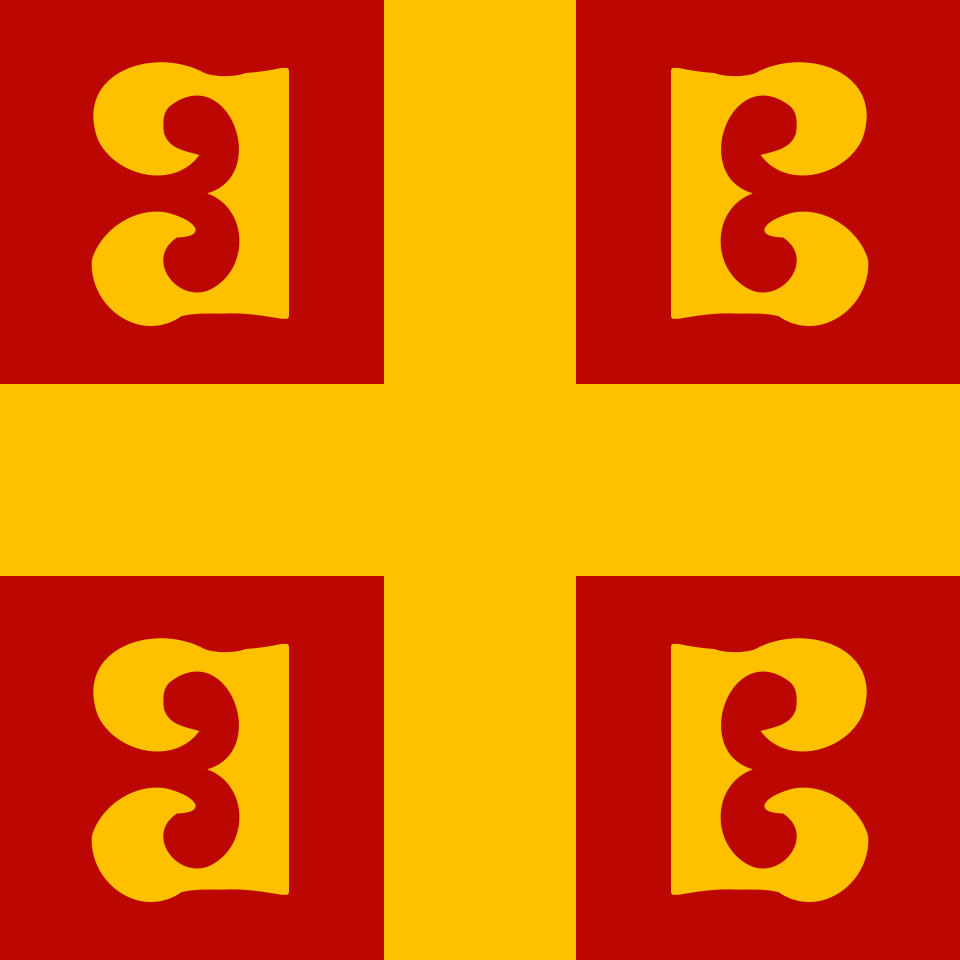
The Federation deliberately has no single national anthem. State occasions play the Greek royal anthem and an Ottoman court anthem in sequence, never blended, a musical expression of the same principle that governs the dual headship: coexistence through alternation, not fusion.
National days follow the same logic of careful multiplicity. The Federation observes no single founding-day celebration, since any one date would read as privileging either the Greek constitutional settlement or the Ottoman survival it preserved. Instead, Straits Day, commemorating the federal compact’s ratification, is marked federally each year, while Greek and Ottoman national and religious calendars continue to operate separately within their own realms, observed locally rather than imposed federally.
✎ Editor's Note · The Two-Crown Federation
The Byzantine Federation is not a vague post-Ottoman constitutional entity, it is a precisely designed dual-headed federal state. The Kingdom of Greece and the Ottoman Sultanate are the two constituent realms, with Athens and Bursa as their respective domestic capitals; the Federal Consul is the head of government; the Federal Assembly is bicameral; Bulgaria is held within the Greek realm; the Federation was founded in 1922 from the First Great War’s settlement (in that war Greece fought for the victorious Central Powers and the Ottomans for the defeated Entente, they federated only afterward), and it fought with Germany, Britain, and the UKA in the Second Great War. The dual headship, the King of the Greeks and the Ottoman Sultan jointly, is the Federation’s most fundamental design feature.
Trivia
- In-Universe The King of the Greeks and the Ottoman Sultan must both sign every federal act. Neither can act for the Federation alone. When they disagree, the Federation has procedures for resolution. When those procedures fail, the Federation has a crisis.
- In-Universe Constantinople / Konstantiniyye belongs to neither founding realm. The City's federal status is specifically constructed to prevent exclusive ownership, it is constitutionally federal, held outside both Greek and Ottoman jurisdiction.
- In-Universe Bulgaria is held within the Kingdom of Greece as a northern constitutional fact. Bulgarian citizens are part of the Greek realm within the federal order, their identity and regional politics are constitutionally present, but Bulgaria is not a separate constituent realm with its own Crown.
- Design The Federation's name is a deliberate act of historical reappropriation. "Byzantine" invokes both the Eastern Roman Empire and the reputation for labyrinthine complexity. The Federation is neither empire restored nor Ottoman survival project, it chose to name itself after a shared memory rather than either founding realm's victory.
- Etymology "Byzantine" derives from Byzantium, the ancient Greek colonial city on the Bosporus that became Constantinople under the Roman Emperor Constantine I. In this world, Constantinople / Konstantiniyye remains the federal capital, belonging to the Federation rather than to the city's Greek or Ottoman namesake histories.
- Real-World In our world, the Greek-Turkish relationship was shaped by the Greco-Turkish War of 1919 to 1922, population exchanges, and decades of enmity over Cyprus and the Aegean. In this world, the Eastern Question became a constitutional settlement before it became a catastrophe, producing a federal state where both Greek and Ottoman imaginations survive under shared law.
- In-Universe Hagia Sophia operates under a rotating, carefully negotiated schedule of Christian and Muslim observance, administered by neither the Greek nor the Ottoman religious authority alone. The compromise satisfies no one completely and is treated by both communities as preferable to every alternative anyone has proposed.
- In-Universe Every ship moving between the Black Sea and the Mediterranean pays a toll to cross the Federation's Straits. It is the most reliable source of federal revenue and the single fact about the Federation that every great power with Black Sea interests has an opinion about.
- Design The Federation's daily life is built on practical rather than enforced bilingualism, most Constantinopolitans manage whichever language a transaction requires without being fluent in both. This mirrors the Federation's constitutional logic: coexistence by working arrangement, not by ideological fusion.
- In-Universe The Federation has no single national anthem. State occasions play the Greek royal anthem and an Ottoman court anthem in sequence, never blended, a musical expression of the same principle that governs the dual headship: coexistence through alternation, not fusion.
- Design The Ottoman official name uses İttihâd ("union"), the Sultanate's own administrative vocabulary, rather than the French-derived federasyon, and pointedly avoids İmparatorluğu ("empire"), so the Ottoman text cannot be read as describing absorption into a revived Greek empire.
- In-Universe Naval officers describe Joint Straits Command service as the closest thing the Federation has to a truly shared national identity, forged less by constitutional theory than by the fact that an enemy fleet does not stop to ask whether the gun crew is Greek or Ottoman.
See also
- The First Great War, in which Greece and the Ottoman Empire fought on opposite sides
- The Second Great War, fought by the Federation alongside Germany, Britain and the UKA
- Republic of Cuba, the other territory covered by the Havana Accord of 1962
- Austria-Hungary, the Habsburg monarchy on the Federation’s northwestern border
- League of Nations, whose Council sits at Constantinople
- European Concert, of which the Federation is the keenest large member
Byzantine Federation · Greece · Ottoman Sultanate · Federation · Dual Headship · Eastern Mediterranean · Foreign Nations