Austria-Hungary
Austria-Hungary, formally the Dual Monarchy of Austria-Hungary, is a sovereign composite monarchy in central Europe, the largest state on the continent west of the Russian Republic by population, and the last multinational monarchy in the world. It is a member of the European Concert and was a Central Power in both Great Wars, on the winning side of each.
It is not a dual monarchy and has not been since 1920. The Compromise of 1867 made two crowns of one; the Imperial Reforms of 1920 made four. Austria, Hungary, Bohemia and Illyria are co-equal kingdoms with their own parliaments, governments, laws and courts, holding in common a sovereign, a foreign policy, an army and the money to pay for both. Everything else is theirs.
The Emperor-King is crowned once. He is crowned Emperor at Vienna, and each of the four kingdoms then acknowledges him by its own rite, which is a distinction the kingdoms insisted on in 1920 and which means that no crown may claim to have made him and none may claim to have withheld itself. Emperor-King Karl III acceded in 2026 at thirty-two, on the abdication of his father, and is thirty-four. The monarchy is watching him with the particular attention it reserves for a young sovereign it does not yet know, in a year in which it has finally been asked a question it cannot defer.
The question the monarchy exists to answer is whether a state can be made of many peoples without becoming a nation, and its answer is yes, so far. Every other multinational empire in Europe broke, and the states that replaced them were built on the proposition that a people and a state should be the same thing. Austria-Hungary is the standing argument against that proposition. It is not a museum piece, it is not obviously dying, and it is the largest economy in central Europe after Germany’s.
It is also the one European great power that has never had to examine its own record, because nothing ever obliged it to. There was no defeat, no dissolution, no occupation and no successor state to write the indictment. The Habsburgs never paid for anything, and a monarchy that has never been made to account for itself has not, on the whole, volunteered.
Etymology
The official name of the state is the Dual Monarchy of Austria-Hungary, and it has been inaccurate since 1920.
The style was adopted for the arrangement of 1867, when the monarchy genuinely was dual, and it was not altered by the Imperial Reforms that made four crowns of two. The Dual Monarchy has had four crowns for a century, and the failure to rename it is the single most quoted example of the monarchy’s habit of leaving a settled thing alone.
The reason it was never changed is that nobody could agree what to change it to. Danubia was proposed in 1920 and rejected because two of the four kingdoms do not sit on the Danube. The Habsburg Union was rejected because it named the dynasty rather than the peoples. Central Europe was rejected by the Germans of Austria on the ground that it included Germany, and by everyone else on the ground that it did not. The Quadruple Monarchy was the obvious answer and was rejected by Hungary, on the ground that it implied a fourfold equality Hungary had voted against.
So the name stayed, and the Czechs and the South Slavs have been formally governed by a description of somebody else ever since. The Bohemian Diet has twice voted to request a change of style. Both requests were received, considered by a joint committee, and are still before it.
In ordinary use the state is the Monarchy, die Monarchie, which is what instruments of the joint ministries say and what its inhabitants call it. The full formal style is a list: the sovereign is Emperor of Austria, Apostolic King of Hungary, King of Bohemia and King of Illyria, and the Dual Monarchy of Austria-Hungary is whatever those four hold in common.
History
The Habsburg monarchy before 1867
The lands were accumulated by marriage, inheritance and election over five centuries and were never a country. They were a set of separate relationships with one family, each with its own law, estates and privileges, and the Habsburgs ruled them as a bundle of distinct titles rather than as a state. The Emperor was Archduke in Austria, King in Hungary and King in Bohemia by different rights, and the difference mattered.
The bundle was tied together twice before it was ever governed as one. The Pragmatic Sanction of 1713 was the first attempt: an instrument declaring the Habsburg lands indivisible and inheritable by a daughter, accepted separately by each set of estates, and therefore itself a treaty among the lands rather than a constitution over them. Maria Theresa spent forty years turning that paper unity into an administration, and her son Joseph II spent ten trying to turn the administration into a nation, in German, by decree. He failed comprehensively, and the failure is the monarchy’s founding lesson: the Hungarian county assemblies simply refused to execute his ordinances, and on his deathbed he revoked nearly all of them.
The monarchy has never since attempted to make one people of its peoples, and it dates that decision to 1790 rather than to 1920. The Josephine experiment is taught in Austrian schools as an idealist’s error and in Hungarian schools as a warning, which is one of the very few episodes on which the two curricula substantially agree.
The long Metternich period that followed was the opposite method: no unification, no reform, and a police apparatus to keep the lid down. It produced forty years of quiet, an immense censorship, a secret service whose habits outlived it, and the accumulated pressure that came out in 1848.
The revolutions of 1848
Every capital in the monarchy rose in 1848 and the monarchy put them all down itself.
Vienna rose in March and again in October, Prague in June, Milan and Venice through the spring, and Hungary declared first a separate government and then, in April 1849, a deposition of the dynasty. The Italian risings were beaten in the field. Prague was shelled into surrender in a week. Vienna was retaken in October at a cost the city has never quite forgiven.
Hungary was the long war and it was won without help. The Hungarian armies were good, the campaign ran for thirteen months, and the outcome turned on a winter reorganisation of the imperial command and on the Croatian and Romanian levies of the Hungarian kingdom itself, who had been offered nothing by Budapest and were offered something by Vienna. The monarchy did not ask Russia to intervene. The Tsar offered, twice, and was declined on the advice of the young Emperor’s ministers, who calculated that a dynasty restored by Russian bayonets would hold Hungary on Russian sufferance and would be asked for the favour back within the decade.
That refusal is the most consequential thing the monarchy ever did and almost nobody outside it has heard of it. It cost an additional year of fighting and perhaps forty thousand dead. What it bought was that the monarchy owed Russia nothing, entered the second half of the century as a free agent in the east rather than as a grateful client, and never acquired the particular shame of a Habsburg throne held up by a Romanov army.
It also changed what Hungary could say afterwards. A Hungary defeated by Austria alone was defeated by its own sovereign, which is a constitutional fact and admits of a constitutional remedy. A Hungary defeated by Russia would have been defeated by a foreign power, which is a national fact and admits only of revenge. The Compromise of 1867 was possible because 1849 had been a family quarrel. Hungarian public memory does not put it that way, and Hungarian historians, on the whole, do.
The settlement that followed the revolutions was reactionary, centralising and German, and it lasted eleven years before it was abandoned as unworkable. But the estates had been broken as a form of government, serfdom had been abolished and was not restored, and the nationalities had learned that they existed. 1848 did not win, and it made everything after it inevitable.
Königgrätz and the exclusion from Germany
In 1866 the war with Prussia was lost at Königgrätz in seven weeks. Austria was excluded from Germany, and the Holy Roman Empire, restored at Vienna in 1815 and worn by the Habsburgs at every election since, was dissolved a second time by Prussian arms.
The exclusion is the hinge of everything after it. A dynasty that had been the first house of Germany for four hundred years found itself, in a summer, a central European power with a German-speaking minority and a great many other people. The monarchy that resulted had to be something other than German, because German was no longer available.
Austrian historians describe 1866 as the year the monarchy was given its subject. Everything the state has done since, including the settlements of 1867 and 1920 and the argument now running over Galicia, is an attempt to answer a question that Prussia asked and did not stay to hear answered.
The Compromise of 1867
The Ausgleich of 1867 answered the immediate problem by satisfying the Magyars. Hungary received its own parliament, government and law, an equal standing with the Austrian lands, and a guarantee that nothing legislated at Vienna would apply to it. What was held in common was reduced to three things: the sovereign, foreign policy, and the army, with a joint finance ministry to pay for the last two.
It worked for the Hungarians and for nobody else. The Czechs of Bohemia, who had a historic crown, a Diet and a legal claim considerably older than Hungary’s, asked for the same terms and were refused, because the Magyars would not permit a third partner and the Germans of Austria would not permit the loss of Bohemian industry. The Croats obtained a sub-compromise with Hungary in 1868 that gave them autonomy on paper and a Ban appointed from Budapest, and the Serbs, Slovaks, Romanians and Ruthenes obtained nothing at all.
The Compromise also fixed the monarchy’s characteristic vice, which is that it renegotiates with whoever is currently dangerous and settles nothing generally. Hungary was dangerous in 1867 and was bought. Bohemia was not dangerous enough and was not. For fifty years the monarchy therefore ran on an arrangement that had bought off the second most dangerous nationality and left the rest to accumulate.
The First Great War
The war began in the summer of 1914 with the assassination of the Duke of Saxe-Coburg and Gotha by a French national, and Austria-Hungary entered it beside Germany, Great Britain, Italy, Greece and later the United Kingdom of America, against republican France and Tsarist Russia.
The eastern front was substantially the monarchy’s war. The Russian armies came into Galicia in the first months and were held, then pushed back over three years of fighting across the Carpathians and the Polish plain that cost the monarchy more dead than any war in its history. The Russian Republic article records the collapse from the other side: an empire that fractured under the strain and lost its western lands for good.
The strain on Austria-Hungary was very nearly as severe and the monarchy has never been entirely honest about how close it came. The common army fought in eleven languages and was held together by an officer corps that spoke German and a system of regimental languages that broke down under casualties. Food ran short in the Austrian cities while Hungary held its grain. Czech units were suspected, in some cases justly, of unwillingness. The monarchy came out of the war on the winning side and knew that it had been closer to disintegration than to victory, and the reforms of 1920 were the response of a governing class that had been frightened.
The Imperial Reforms of 1920
The Treaty of Berlin settled the continent in the victors’ favour and left Austria-Hungary intact, larger in influence and unreformed. The reforms that followed two years later were entirely internal and were not required by anybody.
They created two more crowns. Bohemia was raised to a kingdom co-equal with Austria and Hungary, its historic crown restored in fact as well as in style, with the Czech lands under a Diet at Prague. Illyria was created out of Croatia, Slavonia, Dalmatia, Carniola, Bosnia and the South Slav districts, a kingdom that had never existed before, with its capital at Zagreb.
And they did something the crowns get less credit for. The peoples not strong enough to demand a crown were given, by imperial statute rather than by compromise, a guaranteed body of rights that did not depend on the goodwill of the kingdom they lived in: schooling in their own language to university entrance, their own language in the courts and the local administration where they were numerous, a national council with a right to be consulted on any measure affecting them, and a right of petition to the Emperor-King directly over the head of their kingdom’s government. The Slovaks, the Romanians of Transylvania, the Ruthenes of Galicia, the Slovenes, the Italians of the Littoral, the Poles and the Serbs of the Banat all hold their position under that statute.
The same year gave every adult in the monarchy the vote, in one instrument, without distinction of sex. It was decades ahead of Great Britain and a generation ahead of France, it was carried without a suffrage campaign of any size, and the reason is not creditable: the franchise was cheap. The governing class calculated that a universal electorate voting inside four separate kingdoms could not threaten the joint affairs, which no voter reached then and no voter reaches now, and that enfranchising the smaller peoples would bind them to the kingdoms rather than to their nations.
The calculation was half right. The smaller peoples did use the vote and did stay. But they voted by nation almost exactly as they had organised by nation, the national parties arrived in the four parliaments within a decade, and the monarchy discovered that it had enfranchised the nationalities question rather than dissolved it.
Disestablishment came with the same package, the Catholic Church losing its established position in all four kingdoms as a condition of the Illyrian crown, since a kingdom of Catholics, Orthodox and Muslims could not be founded under an established church without founding a grievance with it.
The reforms were passed against Hungarian resistance and they are the reason the monarchy survived. They answered the nationalities question not by making four nations happy but by making it unnecessary for the other ten to leave.
Hungary complied on paper and obstructed in practice for another generation. Slovak schooling was provided for in Hungarian law within a year of the statute and was not adequately provided in fact until the 1950s; Romanian-language courts in Transylvania were established, then starved of judges who spoke Romanian; and the national councils’ first two decades of submissions are a continuous record of rights granted at Vienna and withheld at the county level. The statute was a promise the monarchy kept slowly and unevenly, and the people it was written for spent thirty years suing to obtain what they had already been given.
The Second Great War
Austria-Hungary was allied throughout the second war as it had been through the first, and this time its war was in the west.
Fascist France was the aggressor and the monarchy fought it beside Germany, Great Britain and the United Kingdom of America. Austro-Hungarian armies fought in France, on the Rhine and in the Alpine passes, and the monarchy’s casualties were heavy: proportionally the worst of any of the western allies, because the common army was large, was committed early, and was used where the line was thickest.
It is the war the monarchy is proudest of and the one it discusses least comfortably, because the dead were disproportionately drawn from the poorer lands. The Slovak counties, the Bosnian districts and Ruthene Galicia sent men in numbers well above their share of the population and got them back in numbers well below it, and the memorials in those places carry more names per village than anywhere in Austria. The recruiting was not rigged. The economics did it, and the monarchy has never entirely answered the charge that a state which lets its east stay poor will always find its east easiest to recruit from.
The reformed army fought better than the old one and the reason is generally agreed. The men of the smaller nationalities had by then been educated in their own languages, judged in their own courts and consulted through their own councils for twenty years, and the monarchy discovered that people who have been treated as citizens will fight for the thing that treated them so. The Czech and Slovak formations of the second war are the standing evidence for the 1920 settlement, and are produced in argument whenever anyone in Vienna suggests the reforms went too far.
The monarchy’s own territory was never invaded and never occupied. It is the only continental great power of which that is true across both wars.
The monarchy as refuge
The most consequential thing Austria-Hungary did in the twentieth century, it did by standing still.
Fascism in this century was French, and the German Empire was an ally throughout. There was therefore no German racial state, no annexation of Austria, no racial legislation across central Europe and no machinery of deportation anywhere the monarchy’s writ ran. The largest Jewish population in Europe lived through the century that came nearest to destroying European Jewry inside a state that was never in an enemy’s reach.
And people came to it. The monarchy received Jewish refugees from fascist France and from the territories France held, in numbers that ran to the hundreds of thousands across the war years, and it took them because Vienna, Budapest, Prague and Lemberg already had the communities, the institutions and the languages to receive them. The receiving is the story, and the monarchy tells it well.
It tells the other part less well. Reception was slow, it was administered by a service that required documents from people who had left without them, and the professional quotas of the 1920s were still on the statute book in three of the four kingdoms while the refugees were arriving. Hungary admitted the fewest and released the numbers last. The monarchy did not turn the refugees away, and it did not hurry, and both of those sentences are true.
Since the war
The eighty years since have been the most placid in the monarchy’s history and, by the standards of its own past, almost dull. Reconstruction in the east, industrial expansion, a long social-democratic ascendancy in the Austrian and Bohemian lands, the founding of the Concert, and a steady constitutional argument about a fifth crown that has been running since 1948.
The cold war put the monarchy on the line and kept it there. The Russian Republic came out of the second war a great power and an authoritarian one, and the monarchy’s Galician frontier became the longest land border any western state held with it. That fact organised eighty years of Austro-Hungarian defence policy, paid for the common army through decades in which nobody wanted to pay for anything, and gave Vienna a standing in western councils considerably larger than its economy would have bought.
The end of that confrontation has been harder on the monarchy than the confrontation was. A state whose external justification was the Russian frontier and whose internal justification was the settlement of 1920 has, since the cold war faded, been left with only the internal one. The fifth-crown argument became serious at almost exactly the moment the Russian argument stopped being frightening, and the monarchy’s constitutionalists do not think that is a coincidence.
The domestic decades were quieter than the century that preceded them and are harder to summarise for exactly that reason. The east was rebuilt, the industrial base doubled and doubled again, the social insurance systems were extended to agricultural labour in the 1950s and made portable across the four kingdoms in 1957, and a long social-democratic ascendancy in Austria and Bohemia coexisted with Christian Social governments in Hungary and a confessional politics in Illyria without any of the four ever being able to impose its programme on the joint affairs. Nothing was decided at the level of the monarchy because the monarchy is not a level at which things are decided.
Two external events reshaped it. The founding of the European Concert at Straßburg in 2027 placed the monarchy inside a supranational union with a directly elected parliament, and seated that union’s Court at Vienna, which was a considerable diplomatic success and an awkward constitutional example. And the long fading of the Russian confrontation removed the argument that had held the joint affairs together since 1945.
Geography
The monarchy runs from the Bohemian forest to the Carpathians and from the Sudeten mountains to the Adriatic, and it is held together by a river and divided by two mountain systems.
The Danube is the spine. It enters from Germany, passes Vienna and Budapest, and leaves through the Iron Gates, and it is the reason the monarchy’s two largest cities are where they are. The whole of the Hungarian plain drains to it, most of Bohemia does not, and Illyria faces the sea instead.
The Alps close the west, giving the Austrian lands their character and their tourism, and the Carpathians close the north and east in a long arc through Slovakia, Galicia and Transylvania, forming the frontier the monarchy has defended against Russia twice.
Between them lies the Hungarian plain, the puszta, flat, dry, agricultural and hot in summer, which is the monarchy’s granary and the geographical fact behind Hungarian political weight.
Bohemia is a basin ringed by mountains, which is why it was a kingdom before it was a province and why its industry developed early and separately.
Illyria is the coast, the Dalmatian shore with its islands and its walled towns, the Dinaric mountains immediately behind it, and Bosnia beyond those.
The geography explains the constitution better than the constitution does. Four of the monarchy’s regions are separated from one another by mountains and joined to the outside world by rivers and coasts, and a state assembled from such a map was never going to be governed from one place. The Delegations rotate between four capitals because the country has four centres of gravity, and no amount of administrative will has ever produced a fifth in the middle.
The railways
The railway network is the thing that physically holds the monarchy together, and the monarchy knows it, funds it accordingly, and puts it on the coinage.
The system was built outward from Vienna in the nineteenth century and rebuilt as a grid in the twentieth, on the explicit principle that no kingdom’s traffic should have to pass through another kingdom’s capital. Prague reaches Trieste without touching Vienna; Budapest reaches Kraków without touching Prague; Zagreb reaches the Danube without touching Budapest. Each of those routes was more expensive than the alternative and each was built anyway, because the Delegations understood that a rail map is a political document.
The night trains are a national institution, running between all four capitals and out to Lemberg, Sarajevo and Trieste, and the timetable is published in fourteen languages in a volume that has come out annually since 1873. It is the only document of the monarchy that has never been the subject of a constitutional dispute.
Trieste and the sea
Trieste is the monarchy’s port and the reason it is a naval power at all. It handles the trade of eighty million people, it is the terminus of the rail routes from Vienna, Prague and Budapest, and it is the only reason the Adriatic matters to a state whose centre is six hundred kilometres inland.
The city is Italian-speaking in its old quarter, Slovene in its hinterland and German in its administration, which was a quarrel for a century and is now, since the 1920 statute, a working trilingual arrangement that the monarchy exhibits to visitors rather more often than the visitors would like.
Trieste belongs to none of the four kingdoms in the way the four capitals belong to theirs. It sits legally in the Austrian half and behaves like a free city that has agreed to be governed, its commercial class is Italian and Greek and Jewish and Armenian by descent and Triestine by preference, and it is the one place in the monarchy where the question of which nation a person belongs to is regarded as slightly vulgar. It is the monarchy’s window on the world and it does not much resemble the monarchy.
The cities
Vienna is the third largest city in Europe, after Berlin and London, and it is the only one of the three that is the capital of a state with no majority nationality.
It holds something over four million people in the city and nearly seven in its region, and it is the seat of the court, the joint ministries, the Joint Supreme Court, the imperial service, the central bank, the Austrian parliament, the Court of the European Concert and the League’s atomic energy agency. It is the seat of nothing else of the monarchy’s, the three other kingdoms having their own capitals and having taken care that Vienna should not become the capital of the monarchy in any sense beyond the ceremonial. The distinction is a fiction that everybody maintains and nobody believes: Vienna is the imperial capital, is universally so described, and is careful never to be so described in an instrument.
Budapest is the second city, some three million people on both banks of the Danube, and it behaves like a rival capital rather than a provincial one. It has its own opera, its own academy, its own stock exchange, its own foreign press corps and its own view of central European history, and none of them is derivative of Vienna’s. The Hungarian parliament sits in the largest legislative building in Europe, which was built at a moment when Hungary wished to make a point and has been making it ever since. A Hungarian minister travelling to Vienna for the Delegations describes himself as going abroad, and means it as a joke about a fact.
Prague is the third city and the richest per head. It is the capital of Bohemia, the industrial and scientific centre of the monarchy, and its money is the reason Bohemia’s complaints get heard. Prague pays a larger share of the joint budget than any other city in the monarchy and has never allowed anybody to forget it; the Bohemian Diet’s practice of publishing its net contribution annually, in a single-page pamphlet, is a hundred and four years old and is regarded at Vienna as an act of controlled aggression.
Zagreb is the newest and the smallest of the four, capital of a kingdom that did not exist before 1920, and it is visibly building itself a past it did not have. The ministries occupy buildings put up in the 1920s in a deliberately antique manner; the national museum’s medieval collection was assembled by purchase from three countries; the Illyrian Academy dates its foundation from a learned society of 1866 that had no connection with it. The self-consciousness is the point rather than an embarrassment. A kingdom invented within living memory has to be furnished, and Zagreb has spent a century furnishing it, in the reasonable belief that in another century nobody will be able to tell.
Kraków and Lemberg are where the fifth-crown argument is actually had. Kraków is the historic royal capital of Poland, holds the tombs of Polish kings, and is the seat of a university older than any in the monarchy except Prague’s. Lemberg is the administrative capital of Galicia, is a third Polish, a third Ruthene and a third Jewish by long tradition, and is where the argument turns from a matter of Polish right into a matter of Ruthene fear. The Polish case is made in Kraków, where it sounds obvious, and answered in Lemberg, where it does not.
Brno, Sarajevo, Bratislava, Rijeka and Czernowitz are the cities of the next rank, and every one of them is a place where two or three languages are ordinary. Czernowitz in the Bukovina, where German, Romanian, Ruthene, Polish and Yiddish have shared a university and a municipal council for a century and a half, is the monarchy’s favourite example of itself and appears in more official publications than any city of ninety thousand people has any right to.
Government and politics
The four crowns and what they hold
Each kingdom holds everything except the three joint affairs. Law, courts, education, religion, police, local government, health, transport within its own territory, agriculture, industrial regulation and taxation are the kingdom’s. Each has its own parliament, its own ministry responsible to that parliament, and its own budget.
The joint affairs are foreign policy, the common army, and the finance of both, and nothing else has ever been added, three attempts to add a joint economic competence having failed in 1931, 1958 and 1994.
The list has not grown in a hundred and sixty years and its shortness is the monarchy’s central constitutional fact. Everything a modern state does that was not being done in 1867 belongs, by default, to the kingdoms: broadcasting, aviation, social insurance, environmental regulation, universities, energy. Where those things need coordinating, they are coordinated by treaty between the four kingdoms rather than by imperial law, and the monarchy therefore maintains an internal diplomatic practice of some complexity between governments that share a sovereign.
The Delegations
The joint affairs are settled by the Delegations, and the institution is the monarchy’s most characteristic invention.
Each of the four parliaments elects a delegation of equal size. The four delegations sit at the same time in the same city but deliberate separately and in their own languages, communicating by written message. They do not debate together. If after three exchanges of messages they cannot agree, they meet in a single body and vote without debate, which is the only occasion on which the four sit as one.
They meet alternately at Vienna, Budapest, Prague and Zagreb, a year in each, and the rotation is observed to the letter.
The arrangement is deliberately awkward and the awkwardness is the point. A joint parliament would require a joint language and a majority, and a majority in a state of four unequal kingdoms is a Hungarian veto or an Austro-Bohemian bloc depending on the arithmetic. Separate deliberation makes agreement slow and makes coercion impossible, and the monarchy would rather be slow.
The written messages are published, which is the feature that makes the system tolerable to the peoples who have no delegation of their own. The exchanges appear in all four languages within a week, the national councils cite them, and the Joint Supreme Court has twice used a delegation’s own message against the kingdom that sent it.
The common parliament that does not exist
The great unresolved demand of the monarchy’s politics is for a parliament of the whole, elected directly, sitting as one body, with the joint affairs before it. It has been proposed formally in 1919, 1931, 1948, 1968, 1991 and 2019. It has never once come to a vote of the Delegations, because Hungary has blocked its introduction every time.
The case for it is short and is not seriously contested on the merits. The joint affairs are the only part of the monarchy that no voter can reach. A citizen elects a kingdom’s parliament, which elects a delegation, which negotiates with three other delegations by letter; the foreign policy, the army and the money that pays for both emerge from that process without any elector having had a proposition put to them. The monarchy is a democracy at every level except the one at which it is a state.
The case against it is made by Hungary and is not really a case about parliaments. A common assembly elected by population would put Hungary permanently in a minority, in an institution whose whole purpose since 1867 has been to guarantee that Hungary is never in a minority. Every Hungarian government of the past century, of whatever politics, has understood a common parliament as the undoing of the Compromise, and has said so with a consistency that its opponents concede is at least honest.
The Bohemian and Illyrian parliaments have both resolved in favour of one. The Austrian Reichsrat has never resolved either way, which is Austria’s characteristic position on any reform that would cost it primacy. And the national councils of the protected peoples support it almost unanimously, for the plain reason that a common parliament elected by population is the only arrangement anybody has ever proposed under which a Slovak vote would count in the joint affairs of the monarchy at all.
Parties and elections
There is no monarchy-wide party system, and there are monarchy-wide parties. Both halves of that sentence are true and the tension between them is most of Austro-Hungarian politics.
Each kingdom has its own party system, formed by its own history and fought on its own questions, and the four are not commensurable. Austrian politics runs between Social Democrats and Christian Socials on a division a century and a half old. Bohemian politics is Czech-national against Czech-liberal, with a German-Bohemian bloc holding the balance more often than its size suggests. Hungarian politics is organised around the Compromise itself, with the parties distinguished chiefly by how much of it they would defend. Illyrian politics is confessional and regional and does not resolve into a left and a right at all.
Three organisations run everywhere. The Social Democrats are a genuine monarchy-wide party, federated into four national sections but holding a common congress, a common programme and a common position on the joint affairs, which is that there should be a parliament for them. They are the largest single political force in the monarchy taken as a whole and have never held power in more than three kingdoms at once. The Christian Socials are organised across Austria, Hungary and Illyria and not in Bohemia, where the Czech parties absorbed the Catholic vote in the 1920s. And the imperial-constitutional tendency, which is not quite a party and does not always contest elections under one name, runs candidates in all four kingdoms on the single proposition that the monarchy should be reformed into a federation and stop pretending it is four states.
Elections in the four kingdoms are not held on the same day and this is not an oversight. A common election date was proposed in 1968 and rejected, on the Hungarian ground that simultaneous elections would produce a monarchy-wide campaign, which would produce monarchy-wide parties, which would produce a common parliament. The objection was correct and the proposal was defeated by it.
The franchise
Every adult in the monarchy has voted since 1920, without distinction of sex, and the monarchy mentions this more often than the circumstances entirely justify.
The instrument was carried in one piece and applied to all four kingdoms at once, which no other reform in the monarchy’s history has managed. It preceded the equivalent British measure by eight years and the French by a generation. It was not won by a suffrage movement, because the monarchy did not have one of any size, and this is the part that the official histories handle briskly.
It was granted because it was safe. A universal electorate inside four separate kingdoms could not reach the joint affairs and cannot reach them now. The vote was extended precisely as far as it could go without touching anything, and the governing class of 1920 said so to one another in terms that the state archives have made available since 1990 and that nobody has enjoyed reading.
What it did achieve was real for all that. The smaller peoples entered the four parliaments in force within a decade, the national parties became permanent fixtures rather than pressure groups, and the statute of 1920 acquired a constituency that could defend it at the ballot rather than only in court. A cynical reform can still be a good one, and the monarchy’s historians have spent a century arguing about whether that sentence is a defence or an indictment.
The Emperor-King
The sovereign is crowned once, as Emperor, at Vienna. Each kingdom then acknowledges him by its own rite: Hungary by the Holy Crown, Bohemia by the crown of Saint Wenceslas, Illyria by an oath at Zagreb devised in 1921 because it had no historic rite to revive.
The distinction was Bohemia’s demand in 1920 and it matters. Four coronations would let a kingdom threaten to withhold one. One crowning acknowledged four times means the sovereignty is single and the recognitions are courtesies, which is precisely backwards from how the kingdoms describe their own position and is the compromise everyone agreed to stop discussing.
The Emperor-King’s powers are real but bounded. He appoints the joint ministers, commands the common army, and holds the right to summon and dissolve the Delegations. He does not legislate, does not choose the kingdoms’ governments and does not intervene in their domestic affairs, and the last sovereign who tried was told by three parliaments simultaneously that he could not.
He also holds the reserve powers, which are undefined, unused within living memory, and generally understood to exist for the case in which the Delegations cannot produce a government for the joint affairs at all. The monarchy’s constitutional lawyers describe them as a fire axe behind glass: the value is in the glass.
Karl III
Karl III acceded in 2026 at thirty-two, the youngest sovereign in two centuries, on the abdication of his father.
The abdication is the unusual part. Emperors of this house die in office; the last voluntary resignation of the Habsburg dignity was in 1556. Karl’s father was found, after two years of increasing difficulty, to be suffering from a degenerative illness whose course was known, and he abdicated in the eighteenth month of it, in an instrument that gave the reason in one sentence and did not elaborate.
The reasoning was constitutional and was made public at the time. The reserve powers are undefined and exist for an emergency; an emergency is precisely the circumstance in which a sovereign’s capacity to judge cannot be tested in advance; and a monarchy that would not permit an incapable man to sign a cheque was proposing to leave one holding a power nobody could describe. He went before the question could arise, and the instrument said so.
The monarchy has decided to be proud of this and is still slightly unsettled by it. The act is universally praised and it established, without anybody voting on it, that the Habsburg crown can be laid down. Austrian constitutionalists have pointed out since that a crown which can be resigned is a crown which can be asked to resign, and that no instrument anywhere in the monarchy says who might do the asking. Nobody has taken the point further, and everybody has noticed it.
Karl himself has said very little, appointed nobody unexpected, and attended the Delegations in all four cities in his first year, which was noticed. He is thirty-four in 2028 and the monarchy is watching him with the particular attention it reserves for a young sovereign it does not yet know, in a year in which the Galician question is live and the reserve powers have begun, for the first time in a century, to be discussed in the newspapers.
The joint ministries
There are three joint ministries and there have been three since 1867. The joint foreign ministry, the joint war ministry and the joint finance ministry exist to administer the three joint affairs and nothing else, and each is answerable to the Delegations rather than to any parliament.
The joint ministers are appointed by the Emperor-King and are conventionally drawn one from each of three kingdoms, with the fourth kingdom holding the presidency of the Delegations in compensation. The convention is not written anywhere. It has been observed without exception since 1924, and the one occasion on which a sovereign proposed to depart from it, in 1961, produced a joint remonstrance from all four parliaments within a fortnight and was not pursued.
A joint minister is in an unusual constitutional position and the monarchy has never resolved it. He is appointed by the sovereign, may be dismissed by the sovereign, is scrutinised by four delegations that cannot dismiss him, and administers a budget four parliaments must fund and none may direct. He is responsible to everybody in a manner that means nobody can remove him, and the joint foreign ministry in particular has developed a continuity of policy across changes of government in all four kingdoms that its admirers call statesmanship and its critics call an absence of democratic control.
The joint finance ministry is the one that is genuinely feared. It sets the quota, which is the share each kingdom pays of the joint expenditure, and the quota is renegotiated every ten years in a process that occupies the Delegations for the better part of two. The quota negotiation is the closest thing the monarchy has to a general election on the state itself, and it is conducted between four delegations by written message, in four languages, without any voter having been consulted at any point.
The imperial service
The monarchy is held together by its civil service, and this is the least romantic and most important sentence in the article.
The imperial and royal service recruits across all four kingdoms and every protected people, by examination, and its defining requirement is linguistic. An official is expected to work in three languages and is paid a supplement for each beyond that, the supplements being large enough that a fluent Slovak-Hungarian-German-Romanian speaker in Transylvania earns more than his superior.
It is genuinely multilingual and not merely officially so. A file moving from a district office in Slovakia to a ministry in Vienna is read in Slovak by three people before anyone translates it, and the translation is done because the ministry works in German rather than because the file was unintelligible. The service maintains its own language schools, its own terminology commissions in fourteen languages, and a corps of translators that is the largest civilian body of its kind in the world.
The achievement is real and the monarchy underrates it. Officials are posted across kingdoms as a matter of course, so that a Bohemian may spend a career in Bosnia and a Croat in Galicia, and the effect is a governing class whose loyalty is to the service rather than to a nation. When Austro-Hungarian ministers are asked what holds the monarchy together, they say the Crown, and when Austro-Hungarian officials are asked, they say the pension.
The service’s weakness is the obvious one. It is enormous, it is slow, it is the largest employer in the monarchy, and a state that governs by finding a form of words in four languages does not govern quickly.
It is also, and this is the part the monarchy least likes stated, unelected and unreachable. The joint ministries are staffed by the service, directed by ministers the Emperor-King appoints, and financed by delegations that meet by letter. A citizen who objects to the monarchy’s foreign policy has no one to vote against, and the service’s own culture, which is genuinely honourable, genuinely incorruptible and genuinely indifferent to politics, is a poor substitute for that and knows it.
Hungary and the politics of obstruction
Budapest resisted every reform, conceded least, and is where the monarchy’s minority problem still lives. The Register says this plainly because the monarchy’s own institutions say it, in the Joint Supreme Court’s reports and in the national councils’ annual submissions.
The Hungarian position has been consistent for a hundred and sixty years. The Compromise of 1867 gave Hungary equality with Austria and Hungary has understood every subsequent reform as a subtraction from it. It resisted the Bohemian crown in 1920 and was overruled. It resisted the statute of 1920 harder and was overruled again. It has since complied with both in the letter and has been found, repeatedly, to have fallen short of them in the administration of schools, of the courts and of local government in the Slovak north and in Transylvania.
The Magyarisation of the nineteenth century was real and was abandoned rather than repudiated. Hungarian public memory treats the period as a normal exercise of state-building; Slovak and Romanian memory treats it as an attempt to end them as peoples; and no Hungarian government has ever said which it was.
The deeper problem is that obstruction has never cost Hungary anything. It voted against the Bohemian crown and kept its own. It obstructed the statute for thirty years and was found against by a court that can order a remedy and cannot impose a penalty. It has blocked a common parliament six times and has never had to defend the blocking to any electorate but its own. A constitution that makes coercion impossible makes obstruction free, and the monarchy built one deliberately, and Hungary has spent a century demonstrating what such a constitution costs.
The Transylvanian settlement nonetheless worked, which is the awkward fact for everybody. The Romanians of Transylvania hold their schools, their courts, their church and their national council under the imperial statute, and Romanian irredentism, which was the great danger of the 1920s, faded across two generations and is now a marginal politics in Bucharest, where the United Principalities have reorganised their national idea around their own two kingdoms and treat the Transylvanians as cousins abroad. They stopped looking east because the thing they would have been looking for arrived. Hungarian administration made it as slow and grudging as it could, and it arrived.
The fifth crown
The live constitutional question is whether Galicia should become a fifth kingdom, and it is no longer academic.
The Polish case is straightforward. Galicia is populous, it has a historic capital at Kraków and an administrative one at Lemberg, its political class has run its own affairs since 1867, and its universities are among the best in the monarchy. The Poles ask what Bohemia had that they do not, and no one has produced an answer that survives being written down.
The answers given are all uncomfortable. That a fifth crown would unbalance the Delegations, which is arithmetic and is conceded to be arithmetic. That Galicia contains a very large Ruthene population who would then be a minority in a Polish kingdom rather than a protected people in an Austrian crownland, which is true, and is the objection the Ruthenes themselves make, and is the only one of the three that anybody defends in public. And that a Polish kingdom inside the monarchy would have a relationship with the Polish-Lithuanian Commonwealth across the frontier that nobody in Vienna has thought through, which is the real reason and is never said aloud.
The Russian dimension is the reason the third answer is never said aloud. Galicia is the monarchy’s frontier with the Russian Republic. A Polish crown standing on that frontier, in a monarchy allied to Germany, adjacent to a Polish-Lithuanian state that Russia regards as its own lost ground, is a proposition with consequences no Austro-Hungarian foreign minister has been willing to put in a memorandum. The monarchy’s most purely domestic constitutional question is also a question about Russia, and the two cannot be separated, and the fact that they cannot is itself the reason for eighty years of deferral.
For most of those eighty years the question was managed by the monarchy’s standard method. It was raised in the Delegations about every fifth year, referred to a joint committee, and the committee reported that further study was required. Nine committees have reported since 1948. Every one of them recommended further study.
What changed is that the Poles stopped accepting it. The Galician Diet resolved for a crown in 2026 by a majority large enough to include parties that had previously opposed it. The resolution was transmitted to the Delegations, which referred it to a joint committee, which was the ninth. The Diet then declined to send its members to the committee, on the stated ground that it had been studied for eighty years and that a tenth study would be an answer rather than a delay.
The monarchy is therefore in the position it has spent a century avoiding: a question it must answer. The committee cannot report without the Poles. The Delegations cannot take a vote the committee has not prepared. The Ruthene national council has petitioned the Emperor-King directly, under the statute of 1920, against any crown that would place it inside a Polish kingdom without a guarantee it regards as adequate, and no such guarantee has been drafted. And a young sovereign holds reserve powers that nobody can describe, in the first year in which anyone has needed to ask what they are for.
Nothing is settled. The Diet has not withdrawn. The committee has not reported. The Ruthene petition has not been answered. Vienna has not said what it will do, Budapest has said it will refuse, and the monarchy’s method of deferring everything has finally met a question that will not be deferred.
The four crowns
Austria
The Austrian half is formally the Imperial and Royal Kingdoms and Lands represented in the Reichsrat, and is the eldest, the German-speaking heartland and the seat of the court. It comprises the Alpine provinces, Lower and Upper Austria, Styria, Carinthia, the Tyrol and Vorarlberg, together with Galicia, Bukovina, the Littoral and Trieste.
The Reichsrat at Vienna is Austria’s parliament and not the monarchy’s, a distinction the other three crowns insist on and Austrians periodically forget. Austrian political culture carries the imperial weight: the Hofburg, the court, the Catholic establishment, and a party system in which the Social Democrats have been the largest party for most of a century.
The Austrian Germans have the most to lose from every reform and have said so at each of them. They lost primacy in 1867, lost it again in 1920 when Bohemia was raised, and would lose it a third time if Galicia became a crown. Their objection has always been made with the dignified resentment of people who built something and are watching others be invited to share it, and they have never once been able to stop anything.
Galicia is the anomaly inside the anomaly. It is a Polish crownland in the Austrian half, larger in population than Illyria, with a Polish administration, Polish courts, a Polish diet and two universities, and it is the subject of the fifth-crown question. Kraków is the historic Polish royal capital and Lemberg the crownland’s administrative seat, and its Ruthene east is the reason the question is harder than the Poles admit.
Hungary
The Lands of the Holy Crown of Saint Stephen are the second crown and the most self-contained. Hungary has its own parliament at Budapest in the largest legislative building in Europe, its own government, its own law descending from custom rather than from a code, and a national self-conception formed in 1848 and hardened by 1867.
Hungary is the crown that concedes and does not agree. It complied with the Bohemian elevation and voted against it. It complied with the statute of 1920 and litigates its application to this day. Its administration of Slovak and Romanian schooling, courts and local government has been found short of the statute by the Joint Supreme Court more often than the other three crowns combined.
It is also, on the ordinary measures, well governed. Hungarian public administration is efficient, Hungarian agriculture is the monarchy’s most productive, and Budapest is a great capital. The monarchy’s difficulty with Hungary is not competence and never was.
Bohemia
The Lands of the Crown of Saint Wenceslas were raised in 1920 to the equality refused in 1867, and Bohemia has spent the century since demonstrating that the refusal had been the mistake.
It comprises Bohemia, Moravia and Austrian Silesia, it holds the monarchy’s industrial core, and its income per head is the highest of the four. The Diet at Prague legislates in Czech and in German, the German-speaking minority of the border districts holding its position under the same statute of 1920 that protects the Slovaks in Hungary, which is a symmetry the drafters intended and which is quoted whenever Bohemia complains about anything.
Czech opinion of the monarchy is the most instrumental of the four. It is warm about the settlement, cool about the dynasty, and entirely clear that Bohemia would be viable alone and has decided not to be. Czech politicians say this in public. It is the closest thing to a separatist argument anywhere in the monarchy and it is made as a compliment.
Illyria
The Lands of the Crown of Illyria, under Saint Jerome, Saint Sava, Ajvaz Dedo and Saint Hermagoras are the newest of the four and the only one that had to be invented. The kingdom was assembled in 1920 from Croatia, Slavonia, Dalmatia, Carniola, Bosnia and the South Slav districts of the Hungarian south, with its capital at Zagreb and a coronation oath devised because there was no historic rite to revive.
The style is the settlement in miniature and it took eleven months to draft. Austria is the Imperial and Royal Kingdoms and Lands represented in the Reichsrat, Hungary the Lands of the Holy Crown of Saint Stephen, Bohemia the Lands of the Crown of Saint Wenceslas: each has one patron and none had to argue about it. Illyria had three confessions and no figure who would serve for all of them.
The drafters therefore named them all. Saint Jerome, the Dalmatian translator, for the Croats. Saint Sava, who founded the Serbian church, for the Orthodox. And Ajvaz Dedo, the wali of Prusac whose pilgrimage is the largest Muslim gathering in Europe, for the Muslims of Bosnia. The Muslim delegation argued for a fortnight against standing a wali in a list of saints, and accepted the wording on the express record that the style names him and does not describe him, a distinction the Islamic Community of Illyria still prints beside the arms.
Saint Hermagoras came later and came last. The Slovenes were told in the first draft that Jerome was Illyrian rather than Croatian and therefore theirs, which was thin, and they pressed it until the second draft added Hermagoras of Aquileia. He was appended rather than placed, because reopening the order would have meant reopening the list, and the Slovenes have made the point at every constitutional anniversary since.
The arithmetic that resulted is the part nobody planned. Four figures for three confessions, of whom two are Catholic, and the Serbs and the Bosnians said so at the time. The answer given was that Jerome is Dalmatian and Hermagoras Aquileian, so the pair are territorial rather than confessional, which nobody believed and everybody accepted. A formula devised to give every confession a place gave the Catholics half of them, and it has stood unamended since 1921 because reopening it would mean holding the argument again.
In practice the kingdom is called Illyria, and the full style appears on instruments, on coinage and at coronations, where it is read aloud in four languages and takes some time.
Its difficulty is that it is a crown for a people that did not exist when it was made. Croats, Serbs, Slovenes, Bosnian Muslims and Dalmatians were given one kingdom on the theory that they were one nation, and to a considerable degree they still do not think so. The Illyrian parliament works in three languages and two alphabets. Its Serbs look, without much urgency, toward Belgrade. Its Bosnian Muslims hold their own religious hierarchy and courts and are the most content of its peoples with the arrangement, having been a minority in every previous version of it.
Illyria is the reform’s boldest stroke and its least finished business. It took the South Slav question, which was the thing that was expected to destroy the monarchy, and answered it by making a kingdom, and the answer has held for a century without ever quite becoming a nation.
Law and judiciary
There are four legal systems and there is no imperial code.
Austrian law descends from the civil code of 1811, one of the great codifications of Europe and still in force in amended form. Hungarian law was customary until the nineteenth century and remains the most distinct of the four. Bohemian law began as Austrian and has diverged steadily since 1920. Illyrian law is the newest, assembled after 1920 from Croatian, Dalmatian and Ottoman-successor material, and is the only one of the four that was drafted rather than inherited.
A citizen of the monarchy therefore lives under one of four private laws, and which one is a question of where rather than of who. Marriage, inheritance, contract, tenancy and the age of majority differ across the four, sometimes materially. A Slovak family moving from Bratislava to Brno changes legal systems without changing country, language or sovereign, and the monarchy’s conveyancers and notaries constitute a profession of a size and prestige that surprises foreigners.
The Joint Supreme Court
The Joint Supreme Court at Vienna resolves conflicts between the four systems. It does not sit above them: it has no appellate jurisdiction over a kingdom’s own law, and it may not tell a Hungarian court what Hungarian law is. What it decides is which of four laws applies, and its jurisprudence on that question is studied wherever legal systems meet, which since the founding of the Concert has meant most of Europe.
It also enforces the statute of 1920, and this is the exception to everything above. A protected people’s rights under the statute are imperial rather than royal, and the Joint Supreme Court hears those cases directly, over the head of the kingdom concerned. It has ruled against Hungary more often than against the other three combined, which the Hungarians point out at intervals and which nobody disputes.
And it says nothing whatever about the constitution. The Court has never ruled on the powers of the Delegations, the scope of the joint affairs, the reserve powers of the Emperor-King, or whether a fifth crown may be created and by what instrument. It has been invited to and has declined, consistently, for a hundred and eight years, on the doctrine that the arrangements of 1867 and 1920 are compacts between the kingdoms rather than law administered by a court.
The doctrine is coherent and its consequence is that the monarchy has no constitutional umpire. Every other question in the state can be taken somewhere. The questions about the state itself can be taken only to the Delegations, which is to say to the parties to the dispute. The Galician case is the first in a century that has made this look less like modesty and more like a hole.
Rights
The death penalty was abolished in all four kingdoms in the 1860s and 1870s and the monarchy regards it as one of its two or three genuine claims on the moral attention of Europe. It has never been restored, it was not restored in either war, and the restoration of it is not a live proposition in any of the four parliaments.
The right of petition to the Emperor-King is real, is used, and is older than any of the parliaments. It descends from the personal petition to the sovereign of the pre-constitutional monarchy and was preserved, deliberately, in 1920. Several hundred petitions are lodged annually, most are refused, and the ones that succeed have twice produced imperial instruments overriding a kingdom’s administration, both times against Hungary. It is the only route in the constitution by which a subject may go over the head of an entire government, and its survival into a parliamentary age was an anachronism in 1920 that has since been reclassified as a safeguard.
Language rights are justiciable, and this is the monarchy’s most distinctive contribution to law. A litigant may sue over the language in which his court sits, the language in which his child is taught, the language in which a municipal notice is posted and the threshold at which a language becomes usable in a district. The case law runs to a hundred and eight years and several thousand decisions, it is the material the Concert consults, and it turns on questions that most legal systems have never had to consider: what counts as a speaker, at what date, on whose census, and whether a right once acquired by a district is lost when its numbers fall.
Against all of which stands the police. The monarchy’s police powers are wide, its surveillance tradition runs continuously from Metternich, and it never had the rupture that would have obliged it to dismantle the apparatus and start again. Registration of residence is universal and compulsory. The political sections of the four kingdoms’ police forces maintain files whose existence is admitted and whose scope is not. The monarchy that abolished the scaffold before most of Europe has never abolished the file, and its civil libertarians make that comparison constantly.
Foreign relations
The Concert
Austria-Hungary is one of the seventeen seats of the European Concert, it hosts the Concert’s Court at Vienna, and its role there is specialised.
It is the Concert’s authority on minorities. Every European state with a stranded people, a bilingual province or a language quarrel consults the monarchy’s experience, its officials sit on commissions, and the statute of 1920 is cited in negotiations from Ireland to the Byzantine lands.
Nobody copies it. The monarchy’s arrangements assume a state with no majority nationality, an imperial service, four legal systems and a sovereign standing above all of them, and a nation state that tries to import the parts finds that the parts do not work alone. Austria-Hungary is consulted constantly and imitated never, which its diplomats find flattering and its constitutionalists find ominous.
The Concert is also, quietly, a problem for the monarchy. A supranational union with a directly elected parliament, a strong court and a competence to override national law is an argument, standing in Straßburg, that peoples can be governed in common by an assembly they elect. The Austro-Hungarian citizen who votes for the European Parliament is voting directly for a body above his kingdom, which is precisely the thing he may not do for the joint affairs of his own monarchy. The comparison is made in every debate on a common parliament and has never been answered.
Germany
The relationship with the German Empire is the closest and the most complicated. They were allies in both wars, they are the two great powers of central Europe, and between them they set the Concert’s agenda more often than the other fifteen seats combined.
The complication is 1866 and it has not gone away. Germany excluded Austria from Germany by force, dissolved the Empire the Habsburgs had worn for four centuries, and became the German state. The monarchy’s German-speakers are a fifth of its population and are the only large German-speaking community in Europe outside the Empire that has never been part of it. The two states are close, the two peoples are closer, and neither government has ever found the arrangement entirely comfortable.
Russia
Russia is the frontier and everything else about the monarchy’s foreign policy proceeds from it.
The Galician border is the longest land frontier between the Russian Republic and any western state. It has been fought over twice, it was the cold war’s central European line for forty years, and it is the reason the common army exists in the size it does. The monarchy does not have a Russia policy in the way other states do. It has a Russia condition.
The relationship is cold, correct and continuous. There is trade, there are rail links, there is a consular network in Kiev and Odessa larger than the monarchy maintains in most friendly countries, and there is a permanent and unresolved argument about the Ruthenes, whom Russian publicists periodically describe as a branch of the Russian people awaiting reunion, and whom the monarchy’s own statute protects as a people in their own right. The Ruthene national council has consistently and publicly rejected the Russian claim, which is the single most useful thing the statute of 1920 has ever done for Austro-Hungarian foreign policy and which no Austro-Hungarian government has ever thanked it for in as many words.
And Russia is why the fifth crown is dangerous, which is dealt with above and which every Austro-Hungarian foreign minister since 1948 has understood and none has put in writing.
The United Kingdom of America
Allies twice over, and closer than the map suggests. The United Kingdom of America and the monarchy fought on the same side in both Great Wars, and the human link is older than either: the emigration of the decades before 1920 carried Czechs, Slovaks, Croats, Slovenes, Poles, Hungarians and Galician Jews to the American polities in numbers that founded communities still identifiable there.
The emigration stopped and the connection did not. Austro-Hungarian ministers visiting the UKA are received in cities where their languages are still spoken by the fourth generation, and the monarchy maintains consulates in places whose commercial importance to it is negligible and whose sentimental importance is not.
The two states are also, without either quite saying so, the world’s two great experiments in the same problem. A federation of unequal polities under one crown, holding together peoples who did not choose one another, is what both of them are. American constitutional lawyers cite the statute of 1920 and the Joint Supreme Court’s language jurisprudence; Austro-Hungarian constitutionalists cite the American Charter and the Rights Act. Each privately believes its own solution is the better one, and each is privately unsure.
Serbia and Romania
Serbia is the monarchy’s most difficult neighbour and the Concert is where it is managed. The South Slavs of Illyria are a crown rather than a grievance, which took the force out of the pre-war quarrel, and what remains is a long argument about the Serbs of the Banat and the Bosnian districts that both states pursue through Concert machinery and neither will let become anything else.
Romania is settled, and the settlement is the 1920 statute rather than any treaty. The Transylvanian Romanians got institutions and stopped looking east, and Romanian irredentism is now a small politics.
Poland-Lithuania
Warm and inconsequential, which is the Commonwealth’s own description. Galicia was the freest of the three partitions, Polish memory of Vienna is correspondingly positive to a degree Austrians find gratifying and slightly excessive, and the practical content is students, degrees, the Vistula and unrestricted movement.
The fifth crown would make it consequential overnight, and both governments know it and neither raises it. A Polish kingdom inside Austria-Hungary and a Polish-Lithuanian Commonwealth outside it would be two Polish states in a line along the Russian frontier, and the Commonwealth’s position on that prospect is that it has no position and would prefer not to be asked.
Italy
Settled, and the settlement was Italy’s to make. The Socialist Kingdom of Italy renounced its Adriatic claims and looked west instead, taking Nice and later Savoy from France across two wars. The South Tyrol, Trentino and Trieste remained with the monarchy, the Italians of the Littoral hold their position under the statute of 1920 like any other protected people, and the two states have had nothing serious to quarrel about for a century.
Defence
The army is where the monarchy’s method stops working, and it has stopped working in the same place since 1867.
The common army
There is one common army, raised across all four kingdoms, paid for by the Delegations, and commanded by the Emperor-King. Its command language is German and has been since Maria Theresa.
This is the oldest quarrel in the state and it has never been settled. The Hungarians demanded a Hungarian command language in 1867, in 1889, in 1903 and in 1920 and were refused each time. The Czechs demanded parity in 1920 on the ground that a co-equal kingdom whose language is not a command language is not co-equal, and were refused. The Illyrians did not ask, having no single language to ask for.
The compromise is the regimental language. A regiment recruited in Bohemia works in Czech; its officers must learn Czech within three years; and everything above regimental level is in German, together with about eighty words of command that every soldier in the monarchy learns whatever he speaks. It functioned in the First Great War until casualties broke the officer corps and then it did not.
The four militias
Each kingdom maintains its own militia under its own war minister, in its own language, for home defence, and the militias are as large in aggregate as the common army.
This is a bad way to run an army and everyone involved knows it. The militias duplicate the common army’s training and equipment, they are politically untouchable because each is a kingdom’s guarantee against the others, and a mobilisation requires the agreement of five war ministries. The monarchy has spent a century producing plans to merge them and has produced no merger.
A common force that cannot decide what language it speaks is a real weakness on the Russian frontier, and the Register states it as such rather than as a curiosity. The monarchy’s soldiers are well trained, its equipment is good and its staff work is excellent. Its command structure is a constitutional settlement wearing a uniform, and the settlement was designed to prevent any kingdom dominating the others rather than to win a war.
The Adriatic fleet
The monarchy keeps a navy, based at Pola and Trieste, and it is smaller than its coastline suggests and larger than its strategic position requires.
Its purpose is the Adriatic, its ships are modern, and its establishment is a standing argument in the Delegations, because the fleet is the one joint expenditure whose benefit is visibly concentrated in a single kingdom. Bohemia has asked, at intervals since 1925, why a landlocked industrial kingdom six hundred kilometres from the sea should pay a quarter of the cost of a navy that protects Illyria’s coast and Illyria’s tourism.
The answer given, and it is a good one, is Trieste. The port handles the trade of all four kingdoms, three of which are landlocked, and a monarchy whose only outlet to the world can be closed by somebody else’s navy is not a great power. Bohemia accepts this and continues to ask.
For Illyria the fleet is something else again. It is the one joint institution that is visibly, physically Illyrian: based in Illyrian ports, recruited heavily from the Dalmatian coast, and officered in a service where a Croat seaman’s career does not depend on the Hungarian county administration. The newest crown’s attachment to the common navy is the strongest of the four, and the reason is that the navy was the first joint body in which Illyrians were not a minority of anything.
The nuclear question
The monarchy does not have nuclear weapons and the refusal is deliberate, contested, and reviewed about once a decade.
There are six recognised nuclear powers in the world: the United Kingdom of America, Great Britain, China, Russia, the Raj and the German Empire. Austria-Hungary is not among them and could have been. Its physics was never interrupted, its universities were never emptied, the theoretical work was substantially done at Vienna and Prague, and the industrial base at Pilsen and Brno is entirely capable of the engineering. The monarchy is the clearest case in the world of a state that possesses every capacity for a weapon and does not have one.
The decision was taken in 1954 and has been retaken five times. The reason given publicly is the frontier: a state whose border with Russia runs for a thousand kilometres through the country of a protected people gains less from a deterrent than it loses from becoming a first target, and the monarchy prefers to be a place Russia has no particular reason to strike first.
The reason given privately is the constitution, and it is the more interesting one. A nuclear weapon requires a single authority to release it, immediately, without deliberation. The monarchy has no such authority and has spent a hundred and sixty years making sure it has none. The joint affairs are settled by four delegations exchanging written messages. The common army is commanded by a sovereign whose powers are bounded, in a language two kingdoms object to, through a structure requiring the agreement of five war ministries to mobilise. A state built so that nobody can act alone cannot hold a weapon that only one person can use, and the Delegations have concluded five times that acquiring one would mean either creating an authority the monarchy has always refused to create, or building a weapon nobody could lawfully fire.
That its closest ally has an independent deterrent and it does not is a fact the monarchy notices constantly. Germany’s arsenal covers central Europe whether Vienna asks it to or not, which is a security the monarchy accepts, does not acknowledge in any instrument, and cannot discuss without conceding that the refusal it is proud of is affordable because somebody else refused nothing.
Economy
The monarchy is the third economy of Europe and is four economies in a customs union. Income per head is roughly level with the French Empire and a little behind the German Empire, which is a comparison Austro-Hungarian ministers make often and Austro-Hungarian economists make carefully, because the average conceals more here than it does in any comparable state.
Bohemia is the industrial core, and has been since the nineteenth century: engineering, vehicles, glass, chemicals, armaments and precision manufacturing, with an output per head above the Austrian lands and well above the Hungarian.
Austria is finance, machinery and services, with Vienna as the financial capital of central Europe and the clearing house for a great deal of business that never touches the monarchy at all.
Hungary is agriculture and food processing, the plain being among the most productive arable land in Europe, together with a substantial pharmaceutical industry around Budapest.
Illyria is shipping, shipbuilding, tourism and, latterly, energy, with the Adriatic coast the monarchy’s holiday shore and Trieste and Rijeka its ports.
What it sells
Machine tools and precision engineering are the monarchy’s signature, made in Bohemia, exported everywhere, and holding a position in the world’s workshops out of all proportion to the monarchy’s size. A disproportionate share of the machines that make other countries’ machines is made within two hundred kilometres of Brno.
It is one of Europe’s serious arms exporters, which sits oddly beside the nuclear refusal and which the monarchy handles by not discussing the two in the same sentence. The industry descends from the imperial arsenals, survived both wars as a going concern, and sells artillery, small arms, armour and munitions across the Concert and well beyond it. A state that will not build a weapon it could not lawfully fire has no difficulty at all selling weapons to people who can. Its critics make this point regularly. Its governments have never answered it.
Vehicles and locomotives follow from the same industrial base, the monarchy’s railway builders having had eighty million people and fourteen gauge and signalling arguments to practise on. Pharmaceuticals and chemicals run out of Budapest, Basle’s only real competitor east of the Rhine. Grain and processed food go west from the Hungarian plain in quantities that make the monarchy one of the few net food exporters in industrial Europe.
Vienna sells banking and insurance, and has since the nineteenth century, on the strength of being the one financial centre that never had a revolution, a currency collapse, an occupation or a nationalisation. Austrian insurers write risk across central Europe and into the Levant, and the archives of the Vienna houses are the single best commercial record of the region’s last two hundred years.
And it sells itself. Tourism is a major industry and is the one export in which all four kingdoms compete directly with one another: the Alps, the Adriatic, the Danube, the four capitals, and a cultural infrastructure built for an empire and maintained for visitors. The monarchy’s largest single earner from abroad is people coming to look at it.
The crown and the bank
The crown is common to all four kingdoms, and the monetary union is the least disputed of the joint arrangements, having survived two wars, the founding of the Concert and every constitutional quarrel of the past century without anyone proposing to leave it.
The central bank is another matter. Its board is composed by kingdom, its governorship rotates among the four, and the rotation was agreed in 1922 after the only serious monetary quarrel in the monarchy’s modern history. The governorship is fought over every time it falls due, in a contest conducted entirely through the Delegations and entirely in public, on the reasonable ground that a bank setting one interest rate for an industrial Bohemia and an agricultural Hungary is making a political choice whatever it does.
The monarchy has kept its own currency inside the Concert and the argument about whether to join a common European one has begun. Bohemia is for it, Hungary is against it, Austria has not said, and Illyria would like to know who would pay. The positions are precisely those of every other constitutional question in the monarchy, which the monarchy’s economists find depressing and its constitutionalists find clarifying.
The disparities
The internal gap is the standing political problem and the monarchy chose it.
Bohemian income per head is roughly twice that of the Bosnian districts of Illyria and of the Ruthene counties of Galicia. Transfers between the kingdoms are settled in the Delegations, are resented in Prague, and have never been large enough to close the gap in any decade of the past century. Every serious argument about the joint budget is in the end an argument about this.
It is not an accident and it is not a legacy. The monarchy has had eighty peaceful years, a common currency, a customs union, free internal movement and a civil service capable of administering anything, and the east and south are still poor. The reason is that development is a kingdom competence and the poor regions are inside kingdoms that are themselves not rich, and no joint competence to do anything about it has ever been created, three attempts having failed in 1931, 1958 and 1994. The monarchy could have built a joint economic competence at any point in a century and declined at each opportunity, and the villages that sent their sons to France in 1940 are the villages that are still poorest now.
Demographics and society
The peoples
The monarchy holds about eighty-one million people and has no majority nationality. Germans are about a fifth, Magyars about a sixth, Czechs and Slovaks together about a seventh, and the South Slavs, Poles, Romanians, Ruthenes, Slovenes and Italians make up the rest.
Fourteen languages are recognised and usable in administration and the courts where their speakers live. German is the imperial language, meaning the language of the court, the common army above regimental level and the joint ministries, and it is not the national language because there is no nation.
Bilingualism is ordinary and trilingualism is unremarkable. A Slovak with German and Hungarian, a Croat with German and Italian, a Ruthene with Polish and German: these are not accomplishments in the monarchy, they are what living there involves.
Language and schooling
Instruction in the mother tongue is a right, and German is taught everywhere as the common second language. Those two rules together are the whole of the monarchy’s education policy and they were settled in 1920.
The first rule means that no kingdom may school a child in a language the child does not speak, and it is enforceable in court against the kingdom by the child’s national council. The second means that every child in the monarchy, whatever else they learn, leaves school able to work in German. The monarchy is candid that the second rule is what makes the first affordable: a state can support fourteen languages of instruction only if it is confident that its administration, its army and its universities can still be run in one.
Whether that is generosity or a long game is the argument. The national councils accept the arrangement and say so. Slovak and Ruthene educationalists point out that a common second language always belongs to somebody, that German-speaking children learn one language while everyone else learns two, and that this is not a neutral arrangement however neutrally it is administered. The monarchy’s reply is that the alternative was Magyarisation, which is true, and is not an answer to the point.
The universities are the monarchy’s pride and its most effective integrating institution. Vienna, Prague, Budapest, Kraków, Lemberg, Zagreb, Graz and Brno admit across the monarchy, teach in several languages, and produce a professional class that has studied in at least two kingdoms. The Polish-Lithuanian Commonwealth’s students attend Kraków and Lemberg under a standing agreement, degrees being mutually recognised, so that a substantial part of the Polish academic profession abroad has been trained in what it regards as a Polish city.
The protected peoples
The statute of 1920 is the monarchy’s real constitution and it governs the position of every people without a crown.
It guarantees schooling in the mother tongue to university entrance; the use of the language in the courts and the local administration wherever a people exceeds a threshold; a national council for each people, elected, with a right to be consulted on any measure affecting it and a right to be heard by the Joint Supreme Court; and a right of petition to the Emperor-King directly, over the head of the kingdom’s government.
And it is still not a crown. The four kingdoms sit in the Delegations and settle the foreign policy, the army and the money. The national councils do not. A protected people may be consulted about a measure and may not vote on the budget that pays for it, and the Slovaks, who are more numerous than the Slovenes and about as numerous as some European states, are represented in the joint affairs of the monarchy by the delegation of a kingdom whose government they have spent a century litigating against.
The monarchy’s answer is that the statute gives them everything a crown would except the votes. The Slovak answer is that the votes are what a crown is.
The Slovak answer is the better one and the monarchy has never really engaged with it. A people whose schools, courts and councils are guaranteed and whose foreign policy, army and taxes are settled by somebody else is a people held in a very comfortable second class. The statute is generous, it is enforced, it is genuinely admired across Europe, and it draws a line between the peoples who vote on the monarchy and the peoples who are merely well treated by it. Everyone on the wrong side of that line knows exactly where it is.
Religion
There is no established church and has not been since 1920. The monarchy is Catholic in its majority and in its dynasty, and it contains the largest Orthodox and Jewish populations in western and central Europe and a substantial Muslim population in Bosnia, which has been a recognised religious community with its own hierarchy and its own religious courts in personal matters since the 1900s.
The disestablishment of 1920 was a condition of the Illyrian crown and was resisted by the Austrian and Hungarian bishops. It is now regarded as the least controversial of the reforms.
Catholicism is nonetheless everywhere in the culture and nowhere in the law, which is a distinction the monarchy manages more comfortably than most. The holidays are Catholic, the architecture is Catholic, the vocabulary of public life is Catholic, and none of it has any legal content whatever. The four kingdoms fund the upkeep of historic churches as monuments, fund the schools of every recognised confession on the same terms, and have not had a serious church-and-state quarrel since the 1930s.
The Jewish population
The monarchy holds the largest Jewish population in Europe, some two and a half million people, concentrated in Vienna, Budapest, Prague, Lemberg and the Galician towns, and Vienna’s community is the largest and oldest-established in the world outside America.
It is there because nothing happened to it, which is a sentence with a great deal behind it. There was no annexation of Austria to a German racial state, because there was no German racial state. There was no racial legislation, no expropriation, no deportation and no camp anywhere the monarchy’s writ ran. The community of 1910 continued into 2028 without a rupture, in the same cities, in the same institutions, and with its records intact.
The monarchy also received. Refugees came from fascist France and the territories France held, in numbers running to the hundreds of thousands, and were taken in by a state that already had the communities and the languages to receive them.
And the monarchy’s antisemitism was real and was never confronted. It was strong enough to elect a mayor of Vienna on it before 1900. The professional quotas of the 1920s were real and remained on the statute book in three kingdoms into the 1950s. What the monarchy has instead of a reckoning is a general sense that things were handled better here, which is true, and which is not the same as having behaved well.
The community’s own account is more complicated than the city’s. It says that survival is not the same as welcome, that the reception of the refugees was slow and grudging and administered by clerks demanding papers from people who had fled without them, and that the largest Jewish population in Europe lives in the one European country that has never had to explain itself. The Register records that account because the community makes it publicly and because nothing in the monarchy’s own record contradicts it.
Welfare and the ordinary state
Social insurance is a kingdom competence, so there are four of them, and the ordinary business of being ill, old or out of work in Austria-Hungary is administered by whichever kingdom the citizen happens to live in.
The schemes are old. Sickness and accident insurance date from the 1880s in the Austrian lands and were extended across the monarchy by imitation rather than by imperial law, each kingdom legislating its own version, in its own way, on its own timetable. The result is four systems that resemble one another closely enough to be confusing and differ enough to matter. Contribution rates, pensionable ages, the treatment of agricultural labour and the coverage of the self-employed are all different, and a career spent in three kingdoms produces three partial entitlements that a specialised profession exists to reconcile.
A treaty of 1957 between the four governments makes the entitlements portable, which is the standard Austro-Hungarian answer to a problem that in a unitary state would be solved by a statute: not a common law, but an agreement between governments that share a sovereign. It works. It took nine years to negotiate. The monarchy regards this as an ordinary length of time for a negotiation between four of its own kingdoms, which is the most revealing thing about the arrangement.
Health provision is the same story with better outcomes. All four systems are universal, all four are good, the Bohemian is the best resourced and the Bosnian districts of Illyria the worst, and the gap between them tracks the income gap almost exactly. There is no joint competence to close it and no proposal to create one, and a monarchy that will fund a navy for a coast three of its kingdoms do not touch has never funded a hospital across a border.
Emigration
The monarchy lost people to the United Kingdom of America in millions before 1920 and lost almost nobody after it, and the two halves of that sentence are the monarchy’s whole case for itself.
The emigration of 1880 to 1914 was among the largest in Europe: Slovaks, Croats, Slovenes, Poles, Ruthenes, Hungarians and Galician Jews leaving a state that offered them poverty, conscription in a language they did not speak, and administration by people who regarded them as a problem. They founded communities in the American polities that are identifiable to this day.
It stopped, and the monarchy attributes the stopping to the reforms. The statute of 1920 gave the peoples who had been leaving schools, courts, councils and a right of petition, and the outward flow fell within a decade to a fraction of its old level and has never recovered it. This is the single strongest empirical claim the monarchy makes about itself, and it is a fair one: the people best placed to judge the settlement of 1920 were the people who had been voting against its predecessor with their feet, and they stopped.
The qualification is that they stopped leaving before they stopped being poor. The Slovak and Ruthene counties are still the poorest ground in the monarchy. What changed was not their prosperity but their standing, and the monarchy is entitled to the credit for that and not to more of it than that.
Culture and daily life
The monarchy’s culture is not one culture and its institutions have stopped pretending otherwise.
The unbroken city
Vienna’s intellectual life was never interrupted, and the consequences are the most far-reaching thing about this monarchy.
The city that produced psychoanalysis, logical positivism, the twelve-tone method, Austrian economics, modern architecture and a substantial part of twentieth-century philosophy came within a decade of being destroyed as an intellectual centre within a decade, its people killed or driven out, and its traditions continued elsewhere in exile or not at all.
Here nothing happened to it. The university, the medical school, the musical establishment, the coffee houses and the publishing houses ran without a break through a century in which every comparable centre in Europe was interrupted.
The consequence is that the twentieth century’s intellectual centre of gravity never crossed the Atlantic. The disciplines founded here stayed here. Psychoanalysis remained a Viennese profession with a Viennese literature rather than becoming an American one. The physicists stayed in Vienna, Prague and Budapest. The philosophers stayed. The great American universities did not rise on refugee scholarship, because there were no refugee scholars, and they became what they are by other routes entirely.
The monarchy is aware of this and is careful about how it says it, because the obvious formulation is a boast about a catastrophe that did not happen to it, and the less obvious one is an admission that its pre-eminence is an accident of geography and alliance rather than of merit. Vienna is the intellectual capital of Europe and it is so by default as much as by desert, having been the one that nothing was done to.
Music
Music is the oldest claim and the strongest. The Viennese tradition runs unbroken from the eighteenth century to the present, the twelve-tone method was developed here and stayed here, and the monarchy’s opera houses, orchestras and conservatories are the densest concentration in the world.
It is also state-supported to a degree that startles foreigners. Each of the four kingdoms funds its own establishment, the four compete, and the competition has produced four full operatic traditions in a state of eighty-one million people. The monarchy spends more public money per head on music than any state in the world and has never had a serious debate about whether it should.
Literature and the press
Literature is written in fourteen languages and the monarchy has never had a national literature, which its critics regard as a defect and its writers regard as the subject. The characteristic Austro-Hungarian novel is about administration, ambiguity, and people who belong to a place rather than a nation, and the tradition has produced a body of work that reads, to a foreigner, as though a whole literature had decided to write about the same problem.
The press is free, plural and printed in every one of the languages. Each kingdom regulates its own, none of the four has a licensing regime, and the monarchy’s newspaper market is accordingly one of the most fragmented in Europe: a Viennese daily, a Prague daily and a Budapest daily report the same session of the Delegations to three audiences that will not read one another. There is no newspaper of the monarchy, and the two attempts to found one, in 1908 and 1953, both failed for want of a language to fail in.
What the monarchy has instead is the official gazette, published in fourteen languages, containing the Delegations’ exchanged messages, and read by a professional class across all four kingdoms. The most widely read common text in the monarchy is a government document, and this is generally agreed to explain a good deal about the place.
The coffee house
The coffee house survives as an institution rather than a nostalgia, with newspapers on rods, a table one may occupy for a day on the price of one cup, and a role in the intellectual life of the cities that has not been displaced by anything.
It is not preserved and it is not a heritage exhibit. There are several thousand of them, they are ordinary, they are where a great deal of the monarchy’s professional and political business is actually transacted, and the practice of the Stammtisch means that a substantial number of the monarchy’s arguments are conducted weekly at the same table by the same people. A foreign correspondent posted to Vienna is advised to find a coffee house before finding a flat.
Food
Food is regional to the point of being political, and everyone claims everything. The Bohemian, Hungarian, Austrian and Illyrian kitchens have borrowed from one another continuously for four centuries and each maintains that the borrowing ran the other way.
The disputes are real, are pursued in cookbooks with footnotes, and have twice reached the Joint Supreme Court over the labelling of protected regional names. The Court declined jurisdiction on both occasions, holding that the origin of a pastry is not a conflict of laws, in a judgment whose closing paragraph is the only joke anybody has found in a hundred and eight years of its reports.
Sport
Sport is football and it is where the nationalities question is conducted safely. The four kingdoms field separate national sides and there is no monarchy-wide team, an arrangement adopted in 1930 after the joint side of the 1920s proved impossible to select without a political crisis.
The Bohemia-Hungary fixture is the largest sporting event in central Europe and is policed accordingly. The club game is fiercer still, and the great rivalries run along exactly the lines the constitution was designed to keep out of politics: Vienna against Budapest, Prague against Vienna, the Zagreb clubs against one another on confessional lines that nobody names and everybody understands. The monarchy regards this as a success, on the view that a quarrel conducted every fortnight in a stadium is a quarrel not being conducted anywhere else.
The bureaucracy as a way of life
The imperial service is not only an institution here, it is a culture, with its own manners, its own vocabulary, its own humour and its own literature.
The forms, the stamps, the ranks, the honorifics and the extraordinary elaboration of official courtesy are the subject of a comic tradition running back a century and a half, produced by the people who work inside it and enjoyed most by them. The monarchy’s characteristic joke is about a file, and the monarchy’s characteristic novel is about the man carrying it. Foreigners take this as evidence of a state exhausted by its own machinery. Austro-Hungarians take it as evidence that the machinery is theirs, on the reasonable ground that people do not make jokes about institutions they are frightened of.
Symbols and national days
The monarchy has no flag its citizens fly. The four kingdoms fly their own, and those are the flags on the streets: Austria’s red-white-red, Hungary’s red-white-green with the Holy Crown, Bohemia’s white-and-red bicolour with the lion, and Illyria’s blue-white-red devised in 1920. The imperial standard, the black double-headed eagle on gold, is the sovereign’s and is flown where he is.
In practice a public building flies its kingdom’s flag and the imperial standard together, and the order in which they are flown was settled by an instrument of 1923 that runs to eleven pages.
The flag of the joint institutions
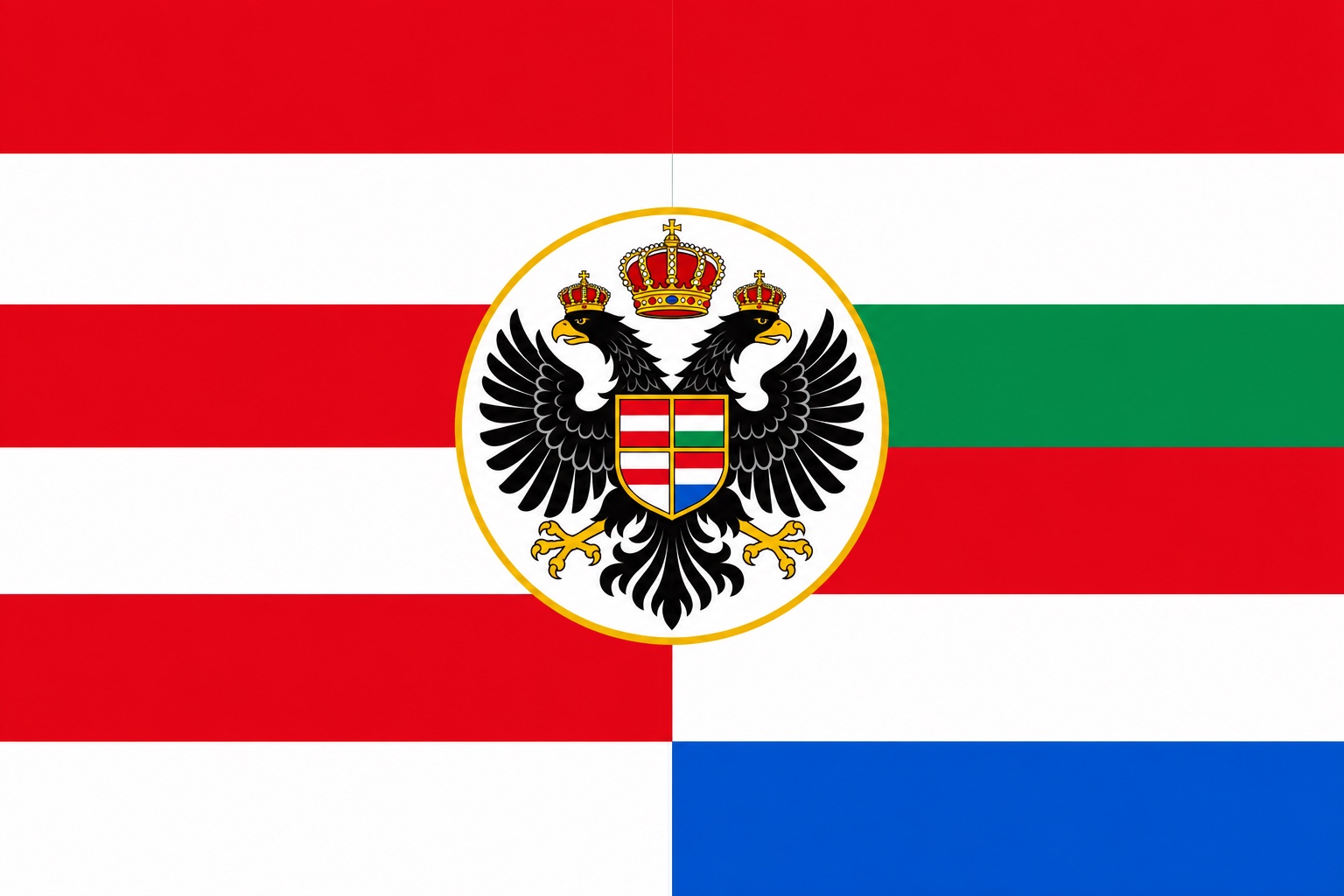
There is one flag of the whole monarchy and its use is narrow. It is flown at the joint ministries, at the Delegations wherever they sit, by the common army and by the Adriatic fleet at Pola, and nowhere else. It does not fly over town halls, schools or private houses, is not sold in shops, and is not carried at football matches, and Austro-Hungarians asked to describe their flag will generally describe their kingdom’s.
The design is the settlement of 1920 in cloth. The field is quartered for the four crowns, Austria at the upper hoist, Hungary at the upper fly, Bohemia below Austria and Illyria below Hungary, each quarter carrying its kingdom’s colours in three horizontal bands; Bohemia’s appear as white, red and white rather than as the kingdom’s plain bicolour, a simplification the heralds permitted so that all four quarters would be built the same way and which Prague has complained about since. At the centre, on a white disc, is the black double-headed eagle with a shield on its breast quartering the same four colour schemes in miniature.
Above the eagle’s two heads is a single crown, and that is the whole argument of 1920 rendered in gold: the sovereign is crowned once, at Vienna, and acknowledged four times. The two smaller crowns the eagle wears on its heads are ornament inherited from the old imperial eagle, they mean nothing under the present constitution, and the College of Heralds has twice proposed removing them and twice been told not to bother.
There is no national anthem. The imperial hymn is played for the sovereign; each kingdom has its own for everything else; and at joint occasions the imperial hymn is played and nobody sings, because the words are in German.
There is no national day. Each kingdom keeps its own, the sovereign’s accession is marked across the monarchy, and the twelfth of October, the anniversary of the Imperial Reforms of 1920, is a public holiday in Bohemia and Illyria, an ordinary working day in Austria, and is not marked in Hungary at all, which is the most compact available summary of the monarchy’s internal politics.
Assessment
Austria-Hungary is the last multinational monarchy in the world, and it is still making its argument.
The argument is that a state need not be a nation. Every other multinational empire in Europe broke, and the states that replaced them were built on the proposition that a people and a state should be the same thing, a proposition that required moving or removing everybody who was in the wrong place. The monarchy is the standing counter-example, and it is not a ruin, a museum or a special case: it is eighty-one million people, the third economy in Europe, and a going concern.
It solved the problem it was given, and the solution was not the crowns. The crowns satisfied the four peoples strong enough to demand something. The statute of 1920 satisfied the other ten by giving them, without a crown, almost everything a crown would have brought, and the reason there is no Slovak or Transylvanian or Ruthene secession movement of any consequence is that the thing such a movement would demand already arrived.
Nobody serious expects it to break up. The arguments inside it are about terms and not about existence, which is more than could be said of any comparable state in 1914, and which is the monarchy’s fair claim on the century.
Two faults stand against it, and they are the same fault seen from two directions.
The first is that it buys peace by deferring everything. No question in this state is ever settled; each is postponed on terms that let it be postponed again. The command language has been deferred since 1867. The common parliament has been proposed six times and voted on never. The fifth crown has been before a committee since 1948, and nine committees have reported that further study is required. Each generation inherits the whole accumulated stock of unfinished business and hands it on slightly larger, and the monarchy calls this stability because nothing has yet fallen over. A constitution designed to make coercion impossible made obstruction free, and Hungary has spent a century demonstrating that a state which cannot compel anybody will, in the end, do whatever the most obstinate of its parts permits.
The second is that a people without a crown is a second-class people, whatever the statute says. The four kingdoms settle the foreign policy, the army and the money. The national councils are consulted about them. The Slovaks are more numerous than several European states and vote on none of it. The statute is generous, it is enforced, it is admired across Europe, and it draws a line between the peoples who govern the monarchy and the peoples who are governed well by it. Everyone on the wrong side of that line knows precisely where it is, and the monarchy’s answer, that the statute gives them everything a crown would except the votes, concedes the case in the act of making it.
Three lesser things follow from those two. The army cannot decide what language it speaks, and has not been able to since 1867, on a frontier that has been fought over twice. The east and south have stayed poor for a century inside a state with the administrative capacity to have done something about it and no joint competence to try. And the Habsburgs never paid for anything: there was no defeat, no dissolution, no occupation, no successor state and no tribunal, and so there was never the moment at which a European power is made to write down what it did. The record on Magyarisation, on Bosnia, on the Ruthene countryside and on the antisemitism of its own capital has never been examined by anybody with standing to compel an answer, and what stands in place of a reckoning is a comfortable sense that things were handled better here.
Often they were. That is what makes the absence of the reckoning a fault rather than a technicality: a state with a genuinely good record on the nationalities question has less excuse than most for never having looked at the parts of it that were not.
The monarchy’s own constitutionalists put the risk simply. The settlement of 1920 was made by a governing class that had been frightened by a war, and nothing has frightened the monarchy since. A state that reforms only when alarmed, and has not been alarmed in a century, has stopped being able to tell the difference between stability and delay.
At present that proposition is being tested for the first time. The Galician Diet has refused the tenth committee. The Ruthene national council has petitioned the Emperor-King against a Polish crown. Hungary has said it will refuse a vote. And a sovereign of thirty-four, two years on the throne by his father’s abdication, holds reserve powers that no instrument describes, in the first year in which anybody has needed to ask what they are for.
Chronology
| Year | Event |
|---|---|
| 1526 | The Habsburgs acquire the crowns of Bohemia and Hungary, and hold them by separate right |
| 1713 | The Pragmatic Sanction declares the lands indivisible, accepted separately by each set of estates |
| 1780 | Joseph II begins ten years of centralising reform, in German, by decree |
| 1790 | Joseph revokes almost all of it on his deathbed; the monarchy never again tries to make one people of its peoples |
| 1804 | The Austrian Empire is proclaimed, the Holy Roman title being no longer secure |
| 1848 | Revolution across the monarchy: Vienna twice, Prague, the Italian lands, and a Hungarian government that declares the dynasty deposed |
| 1849 | Hungary is defeated after thirteen months. The Tsar’s offer of intervention is declined twice, and the monarchy enters the second half of the century owing Russia nothing |
| 1866 | Königgrätz. Austria is excluded from Germany and the Holy Roman Empire is dissolved a second time |
| 1867 | The Compromise: Hungary receives equality, and the Czechs, who ask for the same, are refused |
| 1868 | The Croatian sub-compromise gives autonomy on paper and a Ban appointed from Budapest |
| 1870 | The death penalty is abolished across the monarchy and is never restored |
| 1873 | The joint railway timetable is first published in fourteen languages, and has appeared annually since |
| 1908 | Bosnia is annexed; the Muslim community is recognised with its own hierarchy and religious courts |
| 1914 | A French national assassinates the Duke of Saxe-Coburg and Gotha; the monarchy enters the war beside Germany and Britain |
| 1914 to 1918 | The eastern front is substantially the monarchy’s war; the army fights in eleven languages and very nearly comes apart |
| 1918 | The Treaty of Berlin leaves Austria-Hungary intact, larger in influence and unreformed |
| 1919 | A parliament of the whole is proposed for the first time, and is blocked by Hungary |
| 1920 | The Imperial Reforms: Bohemia and Illyria are raised to crowns, and the statute gives the peoples without a crown schooling, courts, councils and a right of petition |
| 1920 | Universal suffrage without distinction of sex, in one instrument, decades ahead of Britain and France, and granted because it could not reach the joint affairs |
| 1920 | Disestablishment of the church, as a condition of the Illyrian crown |
| 1921 | Illyria, having no historic rite, devises an oath of acknowledgement at Zagreb, and its style is settled with four figures for three confessions |
| 1922 | The joint central bank is settled after the monarchy’s only serious monetary quarrel |
| 1923 | An instrument of eleven pages settles the order in which flags are flown |
| 1930 | The joint football side is abandoned; the four kingdoms play separately |
| 1931 | The first of three failed attempts to add a joint economic competence; a common parliament is proposed a second time |
| 1939 to 1945 | The Second Great War. The monarchy’s war is in the west, against fascist France beside Germany, Britain and the UKA, and its casualties are the heaviest of the western allies in proportion, drawn disproportionately from its poorest lands |
| 1939 to 1945 | The monarchy receives Jewish refugees from France and the territories France holds, slowly and in hundreds of thousands, having itself never been in an enemy’s reach |
| 1948 | The question of a fifth crown for Galicia is raised, and referred to a joint committee |
| 1954 | The Delegations decline to acquire nuclear weapons, for the first of six times |
| 1958 | The second failed attempt at a joint economic competence |
| 1968 | A common election date is proposed and rejected, on the ground that it would produce monarchy-wide parties |
| 1994 | The third failed attempt at a joint economic competence |
| 2019 | A parliament of the whole is proposed for the sixth time, and blocked for the sixth time |
| 2026 | Karl III accedes at thirty-two on his father’s abdication, the first Habsburg to lay down the dignity since 1556 and the youngest sovereign in two centuries |
| 2026 | The Galician Diet resolves for a crown by a large majority; the Delegations refer it to a ninth committee |
| 2027 | The European Concert is founded at Straßburg; its Court is seated at Vienna |
| 2028 | The Galician Diet declines to send members to the committee. The Ruthene national council petitions the Emperor-King. Hungary says it will refuse a vote. Nothing is settled |
Trivia
- In-Universe The Emperor-King is crowned once and acknowledged four times. Bohemia demanded the arrangement in 1920, because four coronations would let a kingdom threaten to withhold one, and the effect is that the sovereignty is single and the recognitions are courtesies, which is exactly backwards from how the kingdoms describe their own position.
- In-Universe The four Delegations sit in the same city at the same time and do not speak to each other. They deliberate separately in their own languages and communicate by written message, and only if three exchanges fail do they meet as one body and vote without debate. The awkwardness is the point: it makes agreement slow and coercion impossible.
- In-Universe In 1849 the Tsar twice offered to help put down the Hungarian revolution and was twice declined, on the calculation that a dynasty restored by Russian bayonets would hold Hungary on Russian sufferance. The refusal cost an extra year of fighting and perhaps forty thousand dead. It bought a monarchy that owed Russia nothing, and a Hungary that had been defeated by its own sovereign rather than by a foreign power, which is a constitutional fact and admits of a constitutional remedy. The Compromise of 1867 was possible because 1849 had been a family quarrel.
- In-Universe Karl III is the first Habsburg to lay down the dignity since 1556. His father abdicated in 2026 on being diagnosed with a degenerative illness, reasoning publicly that the reserve powers are undefined, that an emergency is exactly the circumstance in which a sovereign's judgment cannot be tested in advance, and that a monarchy which would not let an incapable man sign a cheque was proposing to leave one holding a power nobody could describe. The act is universally praised, and Austrian constitutionalists have since observed that a crown which can be resigned is a crown which can be asked to resign, and that no instrument says who might do the asking.
- In-Universe The Dual Monarchy of Austria-Hungary has had four crowns since 1920 and has never been renamed. Danubia was rejected because two of the four do not sit on the Danube, the Habsburg Union because it named the dynasty rather than the peoples, and the Quadruple Monarchy because Hungary said it implied a fourfold equality it had voted against. The Bohemian Diet has twice requested a change of style and both requests are still before a joint committee.
- In-Universe Illyria has four patrons for three confessions. Saint Jerome stands for the Croats, Saint Sava for the Orthodox, and Ajvaz Dedo, the wali of Prusac, for the Muslims of Bosnia, whose delegation accepted the wording only on the record that the style names him and does not describe him. Saint Hermagoras was appended at Slovene insistence, which left the Catholics holding two of the four. A formula devised to give every confession a place gave one of them half, and it has stood unamended since 1921 because reopening it would mean holding the argument again.
- In-Universe Every adult in the monarchy has voted since 1920 without distinction of sex, decades ahead of Britain and a generation ahead of France, and it was granted because it was safe. A universal electorate inside four separate kingdoms could not reach the joint affairs then and cannot reach them now. The vote was extended precisely as far as it could go without touching anything, and the governing class said so to one another in papers the archives released in 1990.
- In-Universe The monarchy could have built nuclear weapons and has declined six times since 1954. The public reason is the Russian frontier. The private reason is the constitution: a weapon requires one authority to release it immediately and without deliberation, and a state whose joint affairs are settled by four delegations exchanging written messages has spent a hundred and sixty years making sure it has no such authority. Its closest ally has an independent deterrent, which covers central Europe whether Vienna asks or not, and which the monarchy cannot discuss without conceding that its refusal is affordable because somebody else refused nothing.
- In-Universe Officials of the imperial service are paid a supplement for each language beyond three, and the supplements are large enough that a fluent Slovak-Hungarian-German-Romanian speaker in Transylvania earns more than his superior. Asked what holds the monarchy together, ministers say the Crown and officials say the pension.
- In-Universe The joint railway timetable has been published annually in fourteen languages since 1873 and is the only document of the monarchy that has never been the subject of a constitutional dispute. The network was deliberately built so that no kingdom's traffic need pass through another kingdom's capital: Prague reaches Trieste without touching Vienna, and Budapest reaches Krakow without touching Prague. Every one of those routes cost more than the alternative and was built anyway, because a rail map is a political document.
- In-Universe The most widely read common text in the monarchy is a government document. There is no newspaper of the monarchy, two attempts to found one having failed in 1908 and 1953 for want of a language to fail in, and what circulates across all four kingdoms instead is the official gazette carrying the Delegations' exchanged messages in fourteen languages.
- In-Universe The Joint Supreme Court has twice been asked to rule on the labelling of protected regional pastry names and twice declined jurisdiction, holding that the origin of a pastry is not a conflict of laws. The closing paragraph of the second judgment is the only joke anybody has found in a hundred and eight years of its reports.
- In-Universe The anniversary of the Imperial Reforms of 1920 is a public holiday in Bohemia and Illyria, an ordinary working day in Austria, and is not marked in Hungary at all. It is the most compact available summary of the monarchy's internal politics.
- In-Universe There is no monarchy-wide football team. The joint side of the 1920s proved impossible to select without a political crisis and was abandoned in 1930, and the four kingdoms have played separately ever since. Bohemia against Hungary is the largest sporting event in central Europe and is policed accordingly.
- In-Universe The fifth crown for the Poles of Galicia has been before a joint committee since 1948, and nine committees have reported that further study is required. In 2026 the Galician Diet resolved for a crown and then declined to send members to the ninth committee, on the ground that a tenth study would be an answer rather than a delay. The Delegations cannot vote on a report the committee cannot write, the Ruthene national council has petitioned the Emperor-King against a Polish crown, Hungary says it will refuse, and nothing is settled.
- In-Universe Vienna is the third largest city in Europe after Berlin and London, and the only one of the three that is the capital of a state with no majority nationality. It holds the largest and oldest-established Jewish community in the world outside America, and since 2027 the Court of the European Concert.
- Real-World The Compromise of 1867, the refusal of the Czech claim, the Croatian sub-compromise, the quarrel over the army's command language, Magyarisation, the annexation of Bosnia and the recognition of its Muslim community are all real history, as is the Russian intervention of 1849 that here was declined. The divergences are that the monarchy won the First Great War, reformed itself in 1920 rather than dissolving, and therefore still exists.
- Real-World Vienna's intellectual life was never interrupted here, because there was no German racial state and Austria was not available to be annexed to one. Psychoanalysis, logical positivism, the twelve-tone method and the physics all stayed. The consequence is that the twentieth century's intellectual centre of gravity never crossed the Atlantic, and the great American universities of this world rose by other routes entirely.
- Design Jake ruled the monarchy a success, which is the harder version to write, because a divergence that only improves things is a weak one. The cost is placed in two faults that are the same fault from two directions: a state that buys peace by deferring every question, so that nothing is settled and each generation inherits the whole accumulated stock, and an autonomy that is still not a crown, so that the Slovaks are more numerous than several European states and vote on none of the joint affairs. The lesser costs follow: an army that cannot decide what language it speaks, an east left poor for a century, and a great power never defeated and therefore never made to examine its own record.
See also
- European Concert, where the monarchy holds a seat and is consulted about minorities by everyone who does not copy it
- German Empire, which excluded Austria from Germany in 1866 and has been its closest ally since
- The First Great War, which began with the Coburg assassination and which the monarchy very nearly did not survive
- Poland-Lithuania, whose students attend Kraków and Lwów and with which there is no security relationship at all
- Socialist Kingdom of Italy, which renounced South Tyrol, Trentino, Trieste, Istria and Dalmatia
- Kingdom of Prussia, whose victory at Königgrätz made the monarchy what it is
- Russian Republic, the frontier across Galicia, and the reason the fifth crown is dangerous
- United Kingdom of America, allied twice over, and the other great federation of peoples who did not choose one another
Categories
Foreign Nations · Europe · Monarchies · European Concert